low VOLKSWAGEN TRANSPORTER 2014 Owner's Guide
[x] Cancel search | Manufacturer: VOLKSWAGEN, Model Year: 2014, Model line: TRANSPORTER, Model: VOLKSWAGEN TRANSPORTER 2014Pages: 486, PDF Size: 69.28 MB
Page 62 of 486
A WARNING (Continued)
• Only adjust the height and tilt of the seat or move lt forwards and backwards when the area around the seat is clear.
• There should be no objects in the adjust-ment area of the front seats.
• Make sure that there is no dirt in the areas within which the front seats can be adjusted (and locked In place).
A WARNING
Cigarette lighters in the vehicle could be damaged or accidentally lit. This could lead to serious burns and other Injuries.
• Before adjusting the seats always make sure that there is no lighter on or near the moveable parts of the seat.
• Before closing stowage areas or compart-ments always ensure that there Is no lighter in the way.
• Never stow lighters in stowage areas or compartments or on other surfaces In the ve-hicle. Cigarette lighters may self-Ignite on high-temperature surfaces, especially In sum-
The dangers of assuming an incorrect sitting position
.....-m First read and observe the Introductory L-.bU information and safety warnings & on page 61.
If the seat belts are not worn or are worn incorrect-ly, the risk of severe or fatal injuries increases. Seat belts can only provide optimal protection if the seat belt routing is correct. Assuming an incorrect sitting position considerably impairs the level of protection provided by a seat belt. This could lead to severe or even fatal injuries. The risk of severe or fatal injuries is especially increased when a de-ploying airbag strikes a vehicle occupant who has assumed an incorrect sitting position. The driver is responsible for all occupants transported in the ve-hicle, especially children.
The following list contains examples of sitting posi-tions that can be dangerous for all vehicle occu-pants.
Whenever the vehicle is in motion:
• Never stand in the vehicle.
• Never stand on the seats.
• Never kneel on the seats.
• Never tilt the backrest too far to the rear.
• Never lean against the dash panel.
• Never lie on the seats in the passenger com-partment.
• Never sit on the front edge of a seat.
• Never sit sideways.
Before the journey
• Never lean out of a window .
• Never put your feet out of a window.
• Never put your feet on the dash panel.
• Never place your feet on the seat cushion or seat backrest.
• Never travel in a footwell.
• Never sit on the armrest.
• Never travel on a seat without wearing the seat belt.
• Never use the bed.
• Never travel in the luggage compartment or on the load surface.
A WARNING
Every Incorrect sitting position In the vehicle Increases the risk of severe or fatal Injuries In the event of an accident or sudden driving or braking manoeuvre.
• All vehicle occupants must maintain a cor-rect sitting position and wear their seat belt properly while the vehicle Is In motion.
• Sitting In an incorrect position, not fasten-ing the seat belt, or too short a distance to the alrbag exposes the occupants to critical or fatal injuries, especially if the alrbags de-ploy and strike an occupant who has as-sumed an Incorrect sitting position.
Page 63 of 486
Correct sitting position
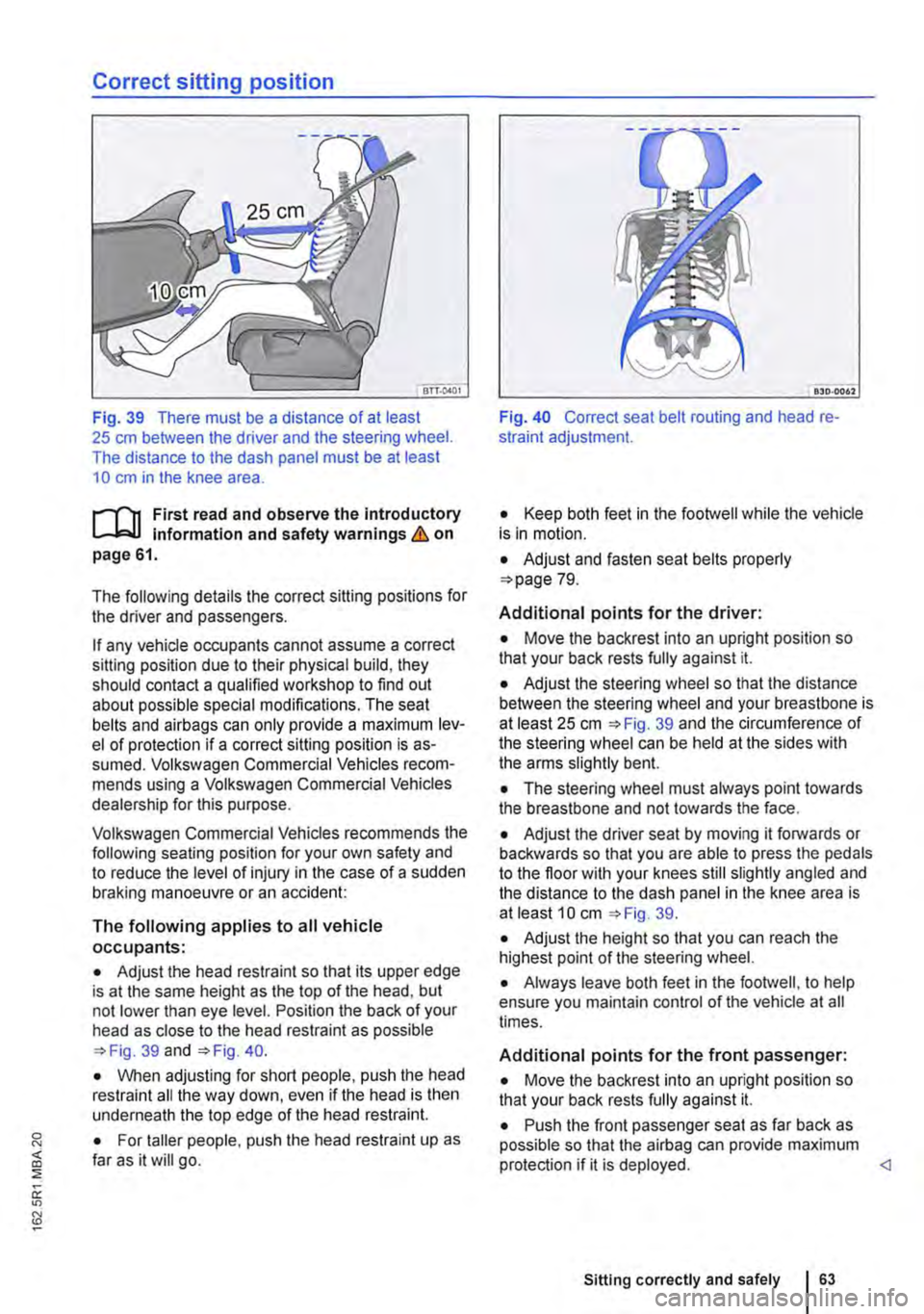
Fig. 39 There must be a distance of at least 25 cm between the driver and the steering wheel. The distance to the dash panel must be at least 10 cm in the knee area.
f"'"""('n First read and observe the introductory L-Jc..l.l Information and safety warnings & on page 61.
The following details the correct sitting positions for the driver and passengers.
If any vehicle occupants cannot assume a correct sitting position due to their physical build, they should contact a qualified workshop to find out about possible special modifications. The seat belts and airbags can only provide a maximum lev-el of protection if a correct sitting position is as-sumed. Volkswagen Commercial Vehicles recom-mends using a Volkswagen Commercial Vehicles dealership for this purpose.
Volkswagen Commercial Vehicles recommends the following seating position for your own safety and to reduce the level of injury in the case of a sudden braking manoeuvre or an accident:
The following applies to all vehicle occupants:
• Adjust the head restraint so that its upper edge is at the same height as the top of the head, but not lower than eye level. Position the back of your head as close to the head restraint as possible 39 and 40.
• When adjusting for short people, push the head restraint all the way down, even if the head is then underneath the top edge of the head restraint.
• For taller people, push the head restraint up as far as it will go.
Fig. 40 Correct seat belt routing and head re-straint adjustment.
• Keep both feet in the footwell while the vehicle is in motion.
• Adjust and fasten seat belts properly 79.
Additional points for the driver:
• Move the backrest into an upright position so that your back rests fully against it.
• Adjust the steering wheel so that the distance between the steering wheel and your breastbone is at least 25 cm 39 and the circumference of the steering wheel can be held at the sides with the arms slightly bent.
• The steering wheel must always point towards the breastbone and not towards the face.
• Adjust the driver seat by moving it forwards or backwards so that you are able to press the pedals to the floor with your knees still slightly angled and the distance to the dash panel in the knee area is at least 10 cm 39.
• Adjust the height so that you can reach the highest point of the steering wheel.
• Always leave both feet in the footwell, to help ensure you maintain control of the vehicle at all times.
Additional points for the front passenger:
• Move the backrest into an upright position so that your back rests fully against it.
• Push the front passenger seat as far back as possible so that the airbag can provide maximum protection if it is deployed.
Page 65 of 486
Additional information and warnings:
• Sitting correctly and safely 61
• Child seats (accessories) 96
A WARNING
Assuming an Incorrect sitting position In the vehicle can Increase the risk of severe or fa-tal injuries during a sudden driving or brak-Ing manoeuvre, In the event of a collision or accident, or If the alrbags are triggered.
• The number of vehicle occupants must never exceed the number of seats with seat belts In the vehicle.
• All vehicle occupants must assume a cor-rect sitting position before setting off and maintain this position throughout the trip. This also applies to the fastening of seat belts.
• Always secure children in the vehicle in an authorised restraint system which is suita-ble for their height and page 61.
• Always keep your feet in the footwell while the vehicle is in motion. Never place your feet on the seat or dash panel, for example, and never ride with your feet out the window. When you are sat like this, the airbag and
Mechanical controls on the front seats
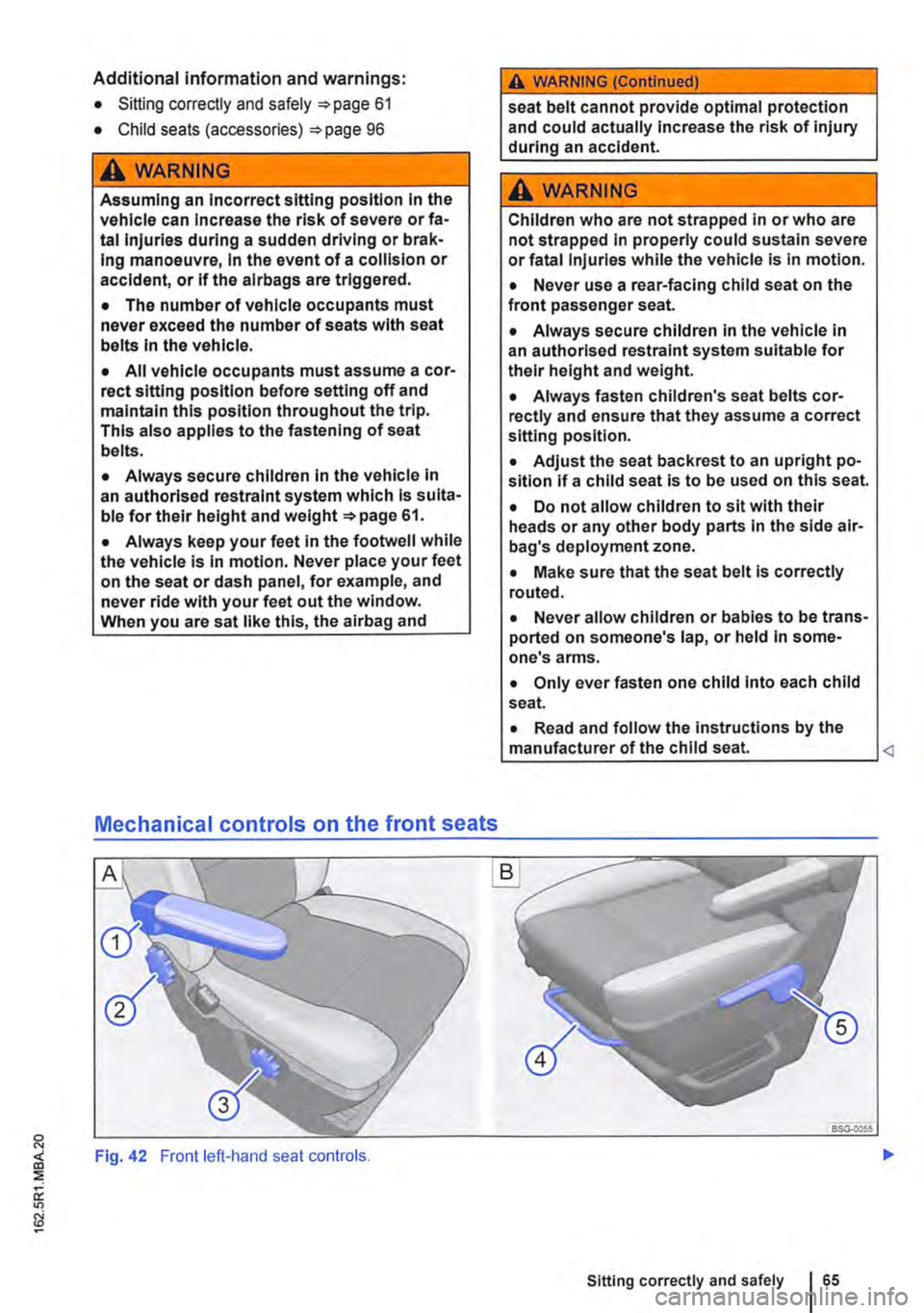
Fig. 42 Front left-hand seat controls.
A WARNING (Continued)
seat belt cannot provide optimal protection and could actually increase the risk of injury during an accident.
A WARNING
Children who are not strapped in or who are not strapped in properly could sustain severe or fatal Injuries while the vehicle Is In motion.
• Never use a rear-facing child seat on the front passenger seat.
• Always secure children in the vehicle in an authorised restraint system suitable for their height and weight.
• Always fasten children's seat belts cor-rectly and ensure that they assume a correct sitting position.
• Adjust the seat backrest to an upright po-sition If a child seat is to be used on this seat.
• Do not allow children to sit with their heads or any other body parts in the side air-bag's deployment zone.
• Make sure that the seat belt is correctly routed.
• Never allow children or babies to be trans-ported on someone's lap, or held in some-one's arms.
• Only ever fasten one child Into each child seat.
• Read and follow the instructions by the manufacturer of the child seat.
Page 66 of 486
r-f'n First read and observe the introductory Information and safety warnings & on page 61.
The layout of the controls on the front right-hand seat is a mirror image of the layout of the controls on the front left-hand seat.
Fig. 42 Function
G) Adjusting the armrest
® Adjusting the backrest.
@) Adjusting the lumbar support.
0 Pushing the front seat forwards or backwards.
® Adjusting the seat height.
The seat may have a combination of mechanical and electrical controls.
Action
Turn the thumb wheel underneath the armrest.
Turn handwheel.
Turn handwheel.
Lift the lever and move the front seat. The front seat must engage after the lever has been released.
Move the lever up or down. several times if necessary.
m The height of the rotating front seats cannot L!J be adjusted.
BTT.0168
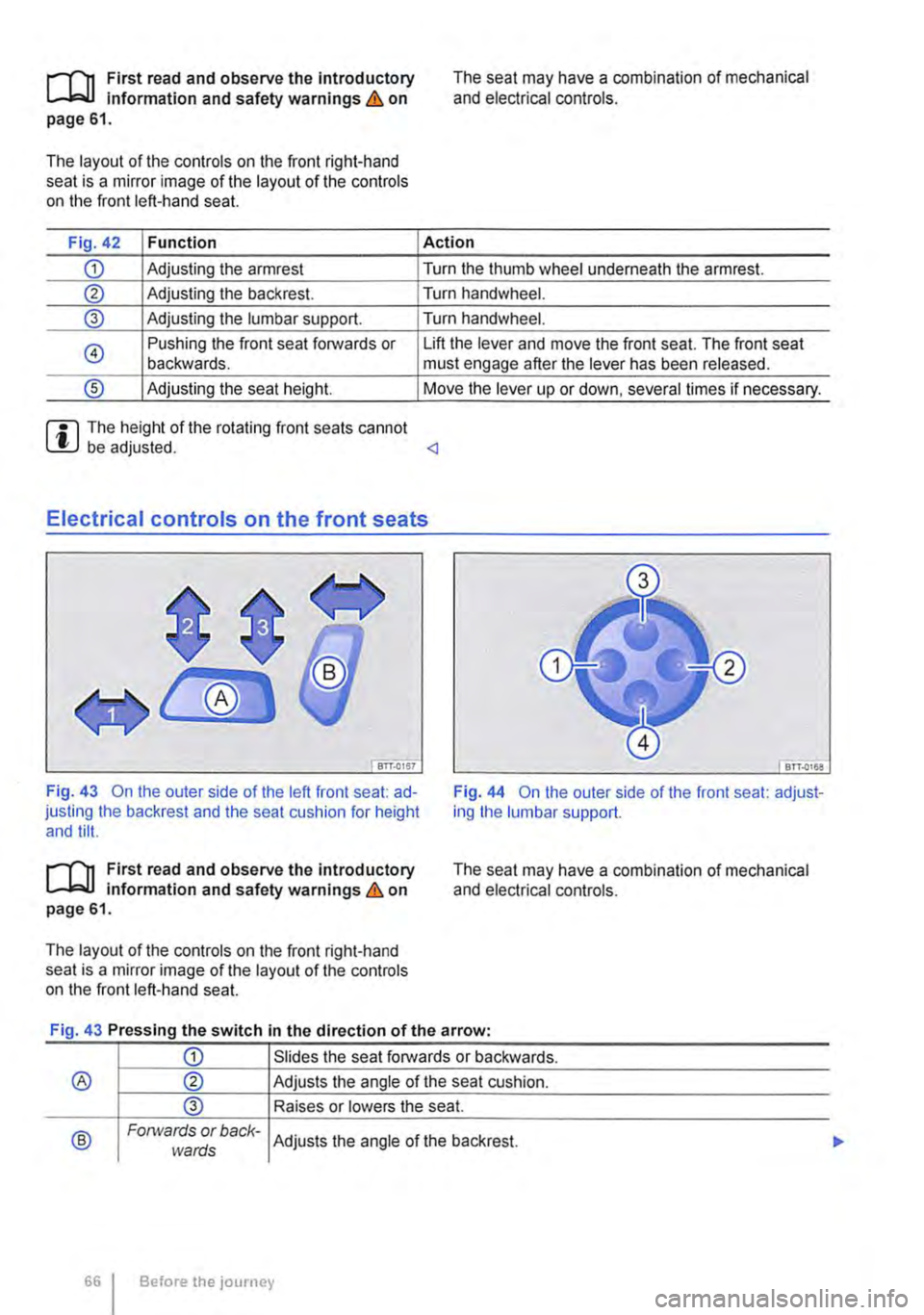
Fig. 43 On the outer side of the left front seat: ad-justing the backrest and the seat cushion for height and tilt.
Fig. 44 On the outer side of the front seat: adjust-ing the lumbar support.
r-f'n First read and observe the introductory information and safety warnings & on page 61.
The layout of the controls on the front right-hand seat is a mirror image of the layout of the controls on the front left-hand seat.
The seat may have a combination of mechanical and electrical controls.
Fig 43 Pressing the switch in the direction of the arrow·
G) Slides the seat forwards or backwards.
® ® Adjusts the angle of the seat cushion.
@) Raises or lowers the seat.
® Forwards or back-Adjusts the angle of the backrest. wards
Before the journey
Page 67 of 486
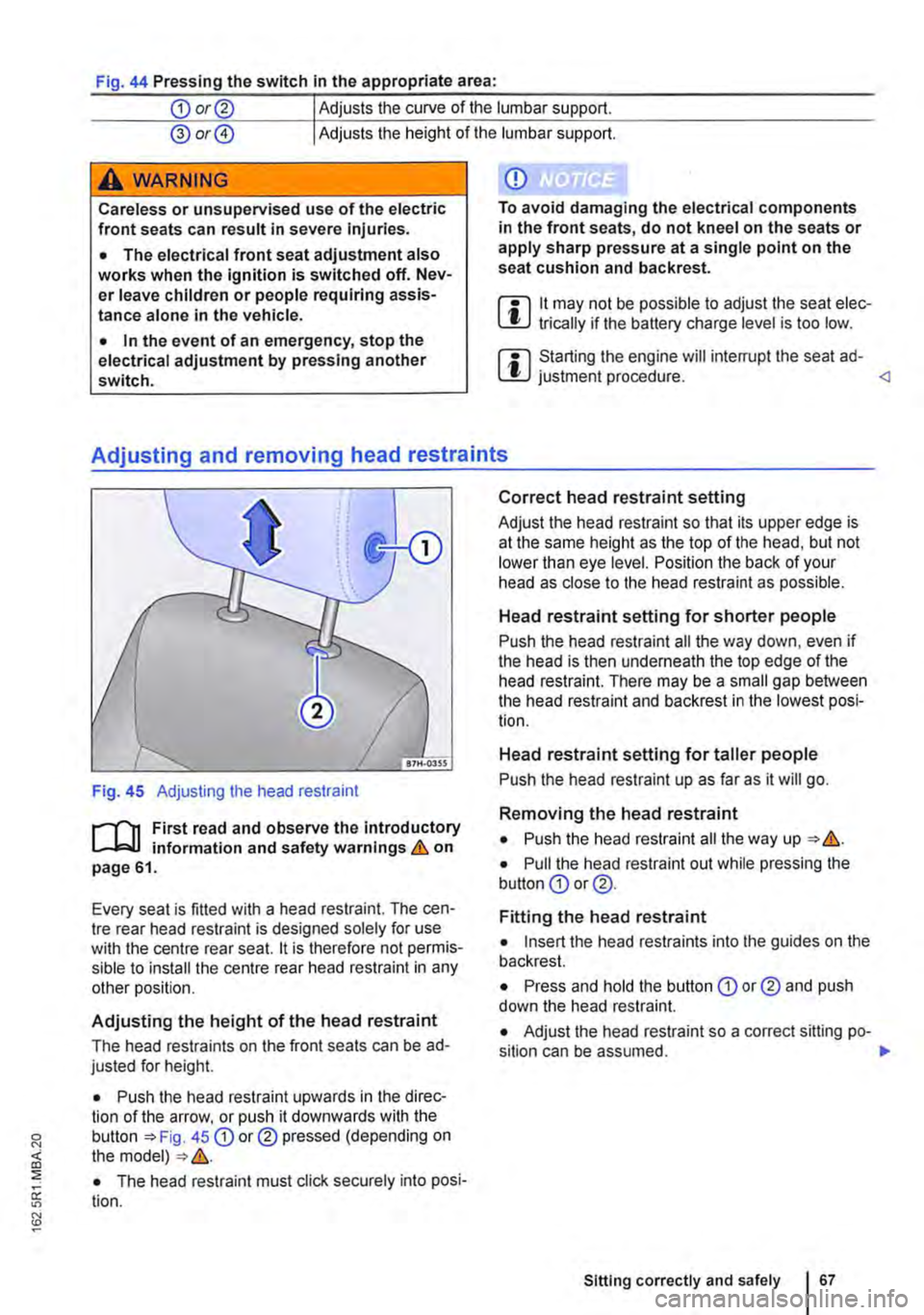
Fig. 44 Pressing the switch In the appropriate area:
CD or@ Adjusts the curve of the lumbar support.
@ or@ Adjusts the height of the lumbar support.
A wARNING
Careless or unsupervised use of the electric front seats can result in severe Injuries.
• The electrical front seat adjustment also works when the ignition is switched off. Nev-er leave children or people requiring assis-tance alone in the vehicle.
• In the event of an emergency, stop the electrical adjustment by pressing another switch.
CD
To avoid damaging the electrical components in the front seats, do not kneel on the seats or apply sharp pressure at a single point on the seat cushion and backrest.
m 11 may not be possible to adjust the seat elec-l!J trically if the battery charge level is too low.
m Starting the engine will interrupt the seat ad-l!J justment procedure.
Fig. 45 Adjusting the head restraint
r--("'n First read and observe the introductory L--J,::.U information and safety warnings & on page 61.
Every seat is fitted with a head restraint. The cen-tre rear head restraint is designed solely for use with the centre rear seat. 11 is therefore not permis-sible to install the centre rear head restraint in any other position.
Adjusting the height of the head restraint
The head restraints on the front seats can be ad-justed for height.
• Push the head restraint upwards in the direc-tion of the arrow, or push it downwards with the button 45 CD or® pressed (depending on the model) &.
• The head restraint must click securely into posi-tion.
Correct head restraint setting
Adjust the head restraint so that its upper edge is at the same height as the top of the head, but not lower than eye level. Position the back of your head as close to the head restraint as possible.
Head restraint setting for shorter people
Push the head restraint all the way down, even if the head is then underneath the top edge of the head restraint. There may be a small gap between the head restraint and backrest in the lowest posi-tion.
Head restraint setting for taller people
Push the head restraint up as far as it will go.
Removing the head restraint
• Push the head restraint all the way up &.
• Pull the head restraint out while pressing the button CD or @.
Fitting the head restraint
• Insert the head restraints into the guides on the backrest.
• Press and hold the button CD or® and push down the head restraint.
• Adjust the head restraint so a correct sitting po-sition can be assumed. .,.
Sitting correctly and safely 167
Page 68 of 486
A WARNING
Driving without head restraints or with Incor-rectly adjusted head restraints Increases the risk of severe or fatal injuries In the event of an accident or sudden' driving or braking ma-noeuvre.
• If a seat is occupied, the head restraint for that seat must be fitted and adjusted correct-ly.
• Each vehicle occupant must adjust the head restraint to suit their body size, to help reduce the risk of neck injuries in an acci-dent. As far as possible, the upper edge of
Adjusting the steering wheel position
an-0211
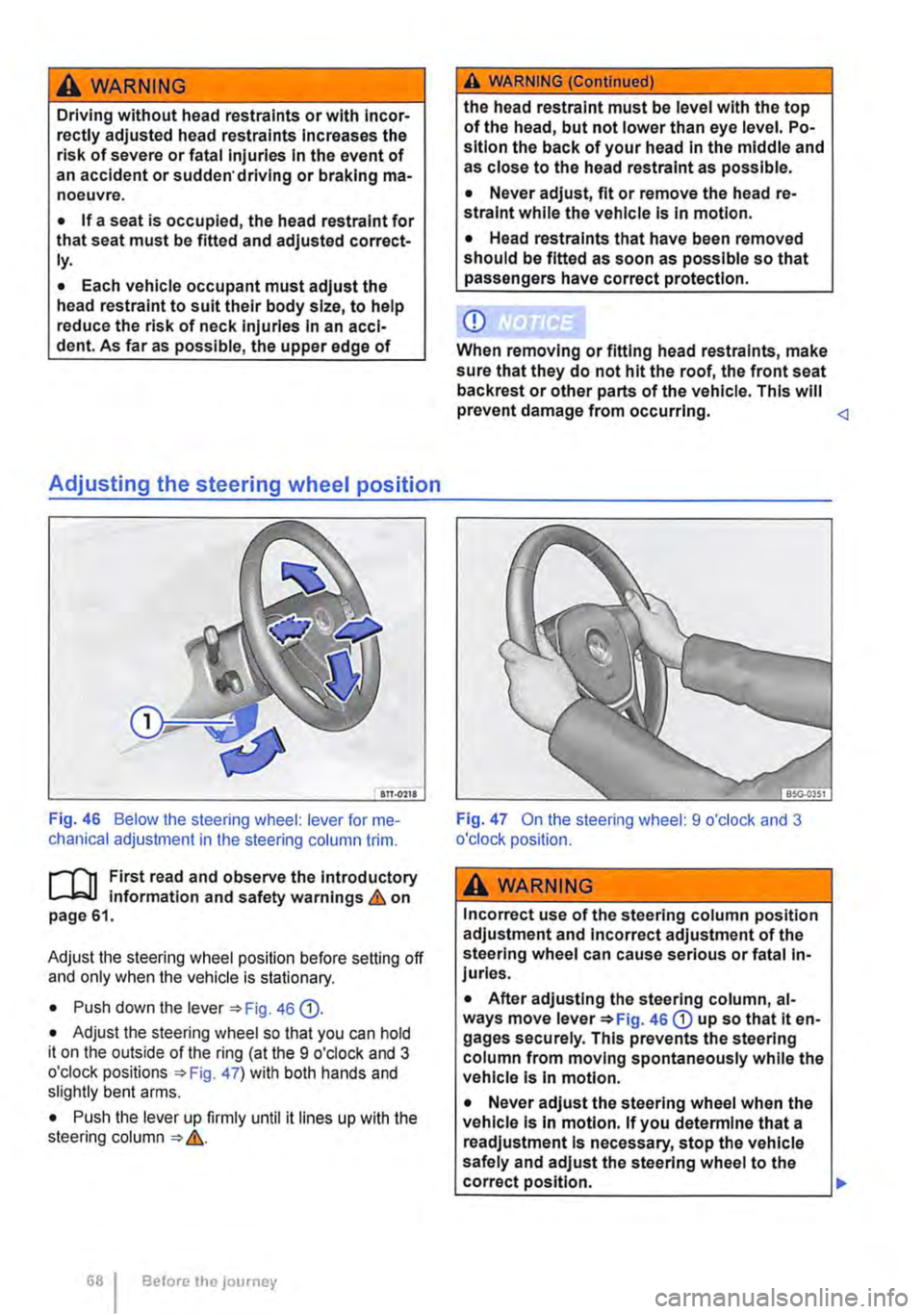
Fig. 46 Below the steering wheel: lever for me-chanical adjustment in the steering column trim.
r--f'n First read and observe the introductory L-W.I information and safety warnings & on page 61.
Adjust the steering wheel position before setting off and only when the vehicle is stationary.
• Push down the lever 46 Q).
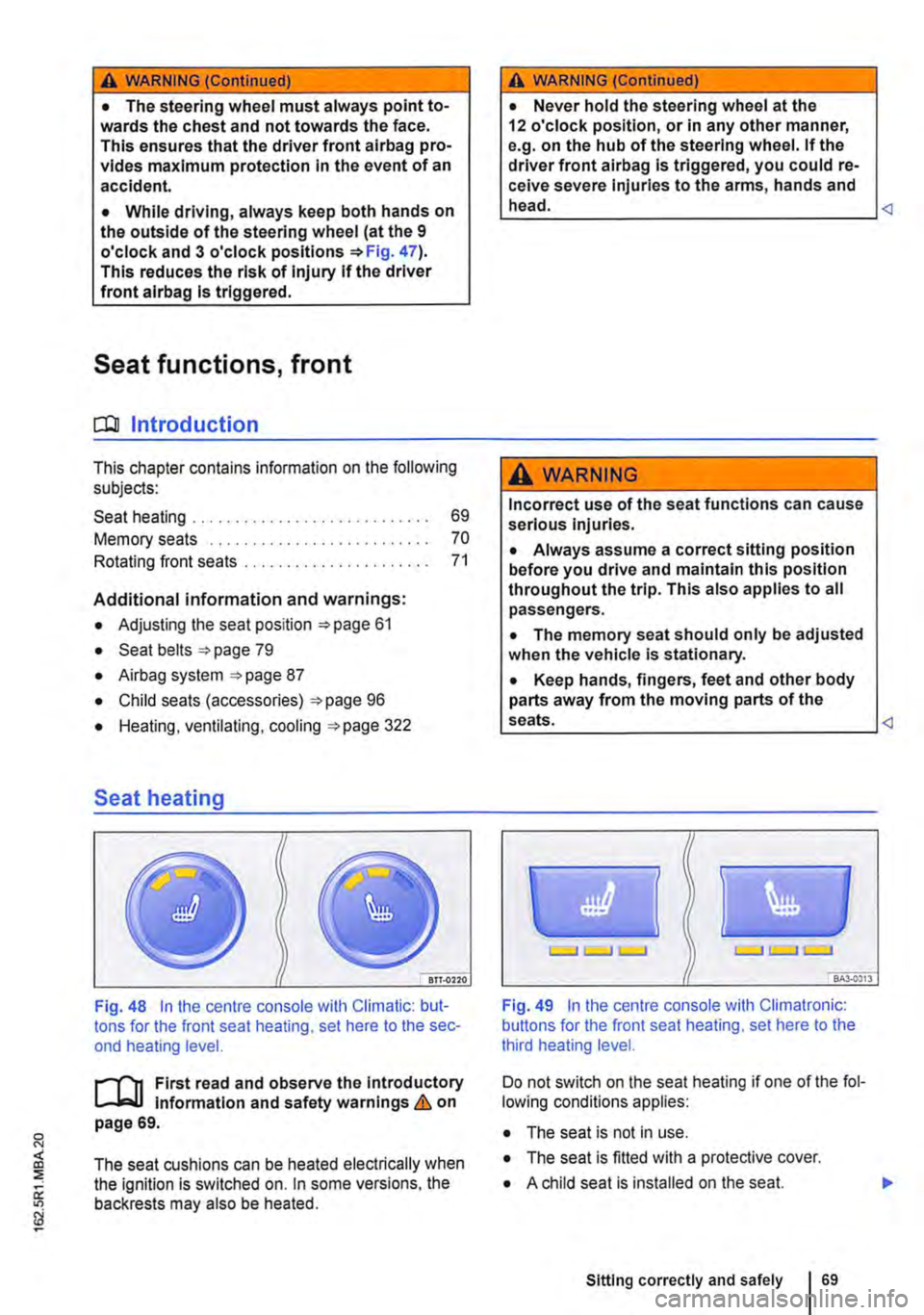
• Adjust the steering wheel so that you can hold it on the outside of the ring (at the 9 o'clock and 3 o'clock positions =:o Fig. 47) with both hands and slightly bent arms.
• Push the lever up firmly until it lines up with the steering column =:o &.
Before the journey
A WARNING (Continued)
the head restraint must be level with the top of the head, but not lower than eye level. Po-sition the back of your head in the middle and as close to the head restraint as possible.
• Never adjust, fit or remove the head re-straint while the vehicle is in motion.
• Head restraints that have been removed should be fitted as soon as possible so that passengers have correct protection.
CD
When removing or fitting head restraints, make sure that they do not hit the roof, the front seat back rest or other parts of the vehicle. This will prevent damage from occurring.
A WARNING
Incorrect use of the steering column position adjustment and Incorrect adjustment of the steering wheel can cause serious or fatal In-juries.
• After adjusting the steering column, al-ways move lever =:oFig. 46 CD up so that it en-gages securely. This prevents the steering column from moving spontaneously while the vehicle Is In motion.
• Never adjust the steering wheel when the vehicle Is In motion. If you determine that a readjustment Is necessary, stop the vehicle safely and adjust the steering wheel to the correct position. .,.
Page 69 of 486
A WARNING (Continued)
• The steering wheel must always point to-wards the chest and not towards the face. This ensures that the driver front airbag pro-vides maximum protection in the event of an accident.
• While driving, always keep both hands on the outside of the steering wheel (at the 9 o'clock and 3 o'clock positions =>Fig. 47). This reduces the risk of injury if the driver front alrbag Is triggered.
Seat functions, front
a:n Introduction
This chapter contains information on the following subjects:
Seat heating . . . . . . . . . . . . . . . . . . . • • • . . . . . . 69
Memory seats . . . . . . . . . . . . . . . . . . . 70
Rotating front seats . . . . . . . . . . . . . . . . . . . . . . 71
Additional information and warnings:
• Adjusting the seat position =>page 61
• Seat bells =>page 79
• Airbag system =>page 87
• Child seats (accessories) 96
• Heating, ventilating, cooling 322
Seat heating
Fig. 48 In the centre console with Climatic: but-tons for the front seat heating, set here to the sec-ond heating level.
First read and observe the Introductory l-J,:.,U Information and safety warnings & on page 69.
The seat cushions can be heated electrically when the ignition is switched on. In some versions, the backrests may also be heated.
A WARNING (Continued)
• Never hold the steering wheel at the 12 o'clock position, or in any other manner, e.g. on the hub of the steering wheel. If the driver front airbag is triggered, you could re-ceive severe Injuries to the arms, hands and head.
A WARNING
Incorrect use of the seat functions can cause serious injuries.
• Always assume a correct sitting position before you drive and maintain this position throughout the trip. This also applies to all passengers.
• The memory seat should only be adjusted when the vehicle Is stationary.
• Keep hands, fingers, feet and other body parts away from the moving parts of the seats.
Fig. 49 In the centre console with Climatronic: buttons for the front seat heating, set here to the third heating level.
Do not switch on the seat heating if one of the fol-lowing conditions applies:
• The seat is not in use.
• The seat is fitted with a protective cover.
• A child seat is installed on the seat.
Sitting correctly and safely 69
Page 72 of 486
Seat functions, rear
Cl:lJ Introduction
This chapter contains information on the following subjects:
Single seats .
3-seat bench
Drawers in the 3-seat bench ......•.....
Bed extension (multi-flex board) ... Centre armrest ......................... .
Additional information and warnings:
• Adjusting the seat position 61
• Seat belts ""page 79
• Airbag system 87
• Child seats (accessories) :;.page 96
• Luggage compartment :;. page 130
• Guide rail system in rear vehicle floor :;.page 133
• Stowage ""page 150
• Vehicle tool kit ""page 416
A WARNING
73
74
76
77 78
Incorrect use of the seat functions can cause serious injuries.
• Always assume a correct sitting position before you drive and maintain this position throughout the trip. This also applies to all passengers.
721 Before the journey
A WARNING (Continued)
• Keep hands, fingers, feet and other body parts away from the moving parts of the seats.
A WARNING
Incorrect adjustment or removing and fitting single seats and/or the bench seats can cause accidents and severe Injuries.
• All adjustments as well as removing/fitting should be carried out only when the vehicle is stationary; otherwise the single seats and/ or the bench seats could move suddenly when the vehicle Is In motion. Furthermore, an Incorrect seating position Is adopted while adjusting the seat.
• All single seats and the bench seats must always be fitted In their retainers and must be securely engaged.
• Never use the table while the vehicle is In motion. All backrests must be In the upright position and securely engaged in this posi-tion while the vehicle Is In motion.
• Never fit single seats behind the 3-seat bench.
• Never fit two 3-seat benches In the vehi-cle.
• While fitting and removing the single seats and/or the bench seat, make sure that the seat feet are not soiled or damaged.
• Never use child seats In the groups 0 or 0+ on single seats that face the rear of the vehicle. <
Page 74 of 486
Turning the single seat
• To ensure enough room for turning: place the backrest in an upright position. move the central table and return it to its basic position. Secure the vehicle against rolling away and set the handbrake lever to the lowest position.
• Pull the lever(D to the side and turn the seat slightly in the required direction.
• Release lever and turn the seat further. The single seat must engage in a position.
Removing a single seat
• Push the central table forwards I fold the folding table into the side panel.
• If necessary slide the front seats forwards.
• If necessary, move the backrest of the front seats to the upright position.
• Remove the protective covers from the seat rails 133.
• Removing the head restraint
• Fold out the table.
• For rotating single seat: turn the single seat through go• so that the backrest points in the direc-tion of the open sliding door.
• Push the single seat forwards in the seat rails to the point where the seat feet can be lifted out of the slots.
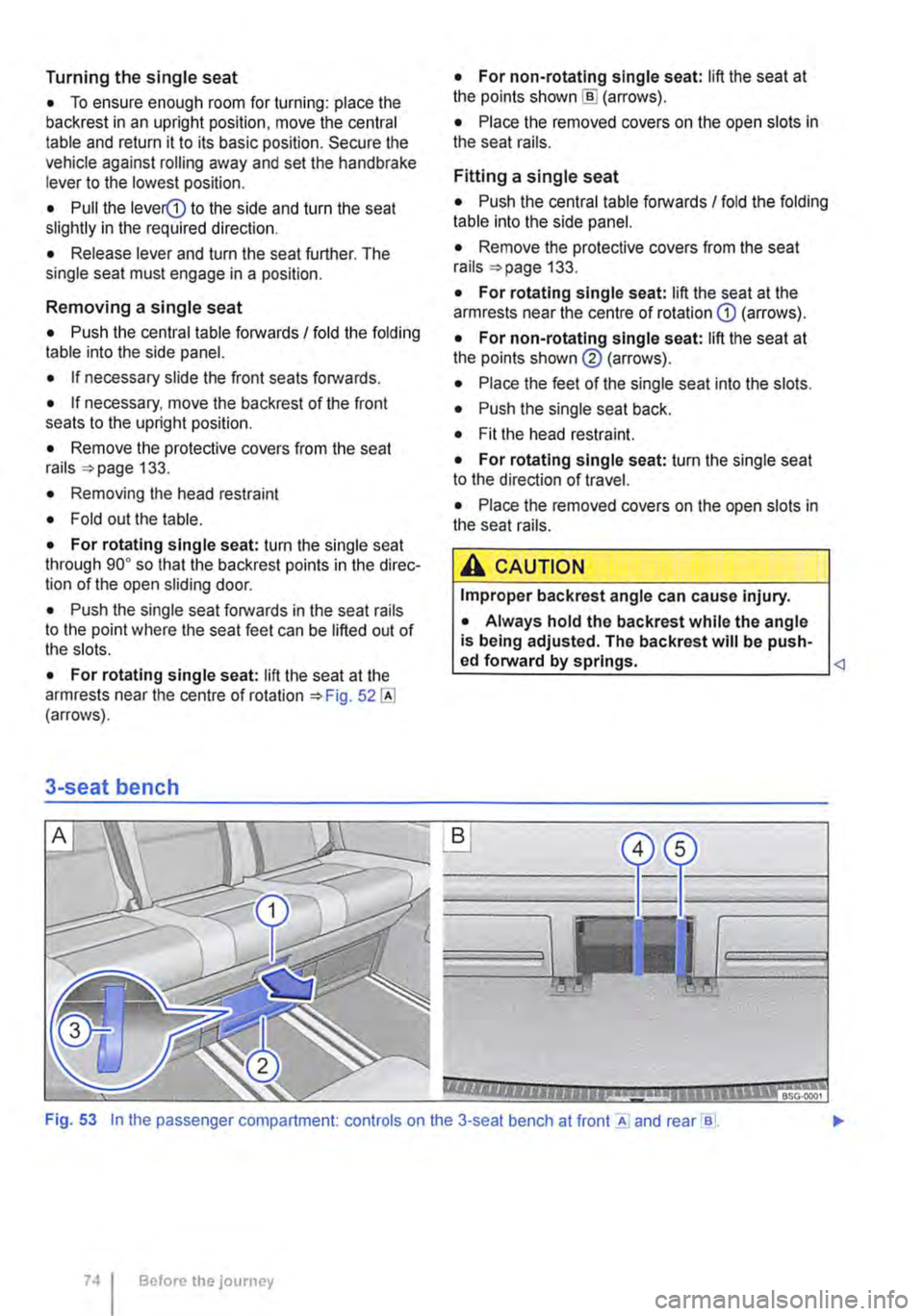
• For rotating single seat: lift the seat at the armrests near the centre of rotation (arrows).
3-seat bench
• For non-rotating single seat: lift the seat at the points shown [ID (arrows).
• Place the removed covers on the open slots in the seat rails.
Fitting a single seat
• Push the central table forwards I fold the folding table into the side panel.
• Remove the protective covers from the seat rails 133.
• For rotating single seat: lift the seat at the armrests near the centre of rotation G) (arrows).
• For non-rotating single seat: lift the seat at the points shown@ (arrows).
• Place the feet of the single seat into the slots.
• Push the single seat back.
• Fit the head restraint.
• For rotating single seat: turn the single seat to the direction of travel.
• Place the removed covers on the open slots in the seat rails.
A CAUTION
Improper backrest angle can cause injury.
• Always hold the backrest while the angle is being adjusted. The backrest will be push-ed forward by springs.
Before the journey
Page 75 of 486
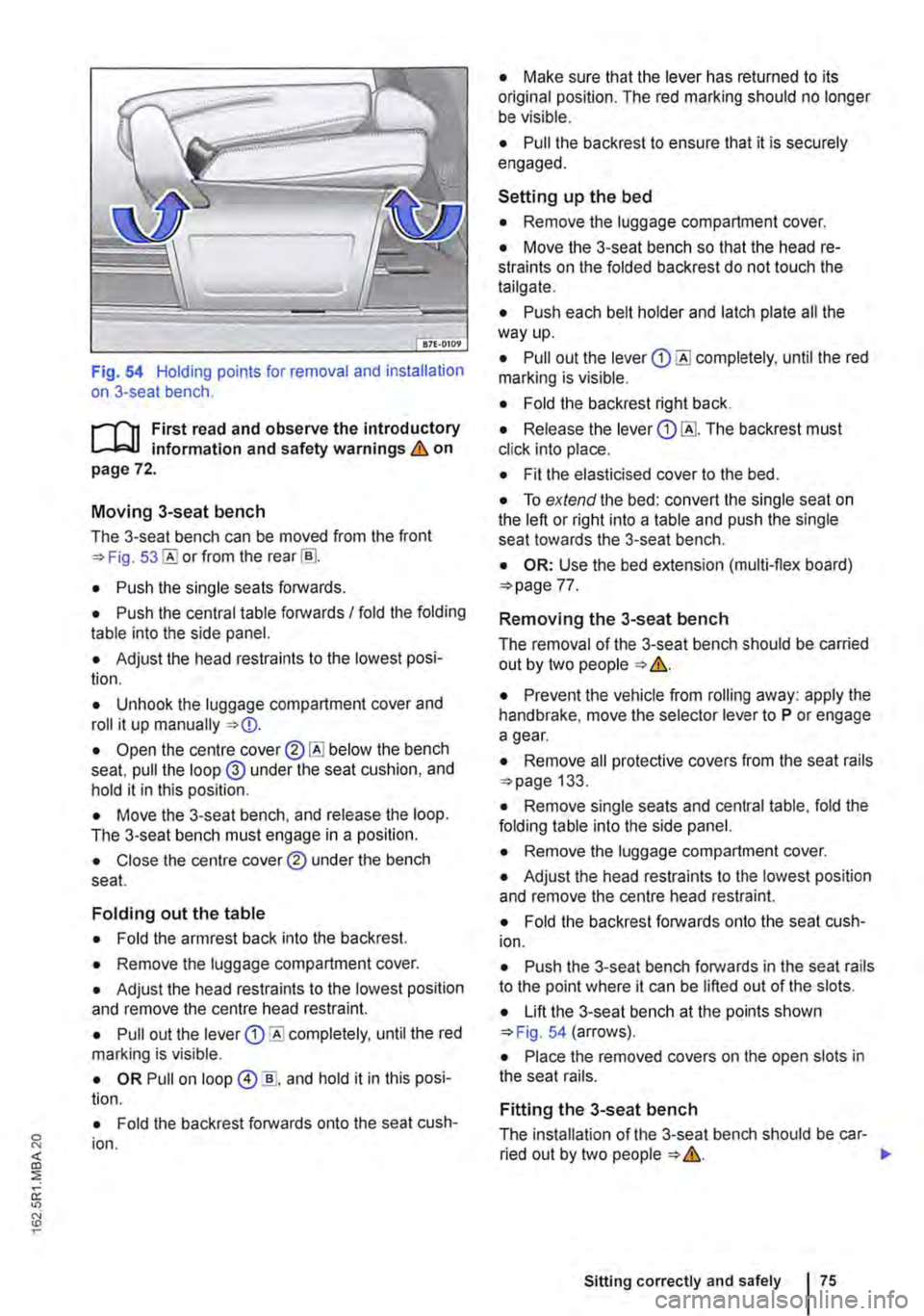
Fig. 54 Holding points for removal and installation on 3-seat bench.
,....-m First read and observe the introductory L-W.I information and safety warnings & on page 72.
Moving 3-seat bench
The 3-seat bench can be moved from the front =>Fig. or from the rear [ru.
• Push the single seats forwards.
• Push the central table forwards I fold the folding table into the side panel.
• Adjust the head restraints to the lowest posi-tion.
• Unhook the luggage compartment cover and roll it up manually =>
• Move the 3-seat bench, and release the loop. The 3-seat bench must engage in a position.
• Close the centre cover® under the bench seat.
Folding out the table
• Fold the armrest back into the backrest.
• Remove the luggage compartment cover.
• Adjust the head restraints to the lowest position and remove the centre head restraint.
• Pull out the lever Q) completely, until the red marking is visible.
• OR Pull on loop @ ]], and hold it in this posi· lion.
• Fold the backrest forwards onto the seat cush· ion.
• Make sure that the lever has returned to its original position. The red marking should no longer be visible.
• Pull the backrest to ensure that it is securely engaged.
Setting up the bed
• Remove the luggage compartment cover.
• Move the 3-seat bench so that the head re· straints on the folded backrest do not touch the tailgate.
• Push each belt holder and latch plate all the way up.
• Pull out the lever Q) until the red marking is visible.
• Fold the backrest right back.
• Release the lever Q) The backrest must click into place.
• Fit the elasticised cover to the bed.
• To extend the bed: convert the single seat on the left or right into a table and push the single seat towards the 3-seat bench.
• OR: Use the bed extension (multi-flex board) =>page 77.
Removing the 3-seat bench
The removal of the 3-seat bench should be carried out by two people => &.
• Prevent the vehicle from rolling away: apply the handbrake, move the selector lever to P or engage a gear.
• Remove all protective covers from the seat rails =>page 133.
• Remove single seats and central table, fold the folding table into the side panel.
• Remove the luggage compartment cover.
• Adjust the head restraints to the lowest position and remove the centre head restraint.
• Fold the backrest forwards onto the seat cush-ion.
• Push the 3-seat bench forwards in the seat rails to the point where it can be lifted out of the slots.
• Lift the 3-seat bench at the points shown =>Fig. 54 (arrows).
• Place the removed covers on the open slots in the seat rails.
Fitting the 3-seat bench
The installation of the 3-seat bench should be car-ried out by two people => &. .,.
Sitting correctly and safely