length VOLKSWAGEN TRANSPORTER 2015 Owner´s Manual
[x] Cancel search | Manufacturer: VOLKSWAGEN, Model Year: 2015, Model line: TRANSPORTER, Model: VOLKSWAGEN TRANSPORTER 2015Pages: 486, PDF Size: 72.17 MB
Page 200 of 486
,...-m First read and observe the Introductory L--W.I Information and safety warnings & on page 193.
The medium-length bed is around 1.80 metres long. The bed can only be set up In vehicles with a 3-seat bench and with the single seats removed.
Setting up the medium-length bed
• Push the multi-flex board backwards to the stop.
• Fold up the front area 162 @!ID of the multi-flex board.
• Remove single seats 72.
• Pull out the lever completely, until the red marking is visible.
• Fold the backrest of the 3-seat bench com-pletely forwards onto the seat cushion.
• Open the centre below the bench seat, pull the loop @ under the seat cushion, and hold it in this position.
• Move the 3-seat bench, and release the loop. The front edge of the base of the 3-seat bench must be around 15 cm away from the rear end of the door aperture, and it must engage firmly.
• Close the centre cover® under the bench seat.
200 Before tho JOurney
• Pull out the lever completely, until the red marking is visible.
• Fold the backrest of the 3-seat bench com-pletely backwards.
• Make sure that the lever has returned to its original position. The red marking should no longer be visible.
• Move the bench seaUbed and release the lever. The bench seaUbed must be engaged in position.
Fitting the mattress
• Fasten parts 160 CD and® of the mat-tress to each other with the help of the zip.
• Fold part® together and fasten it to part@ with the help of the zip.
• Place the mattress on the multi-flex board and the 3-seat bench 163.
Removing the bed
• Remove the mattress and stow it securely in the vehicle 203.
• Fit the single seats.
• Move the single seats and the 3-seat bench in-to position for driving 72.
Page 227 of 486
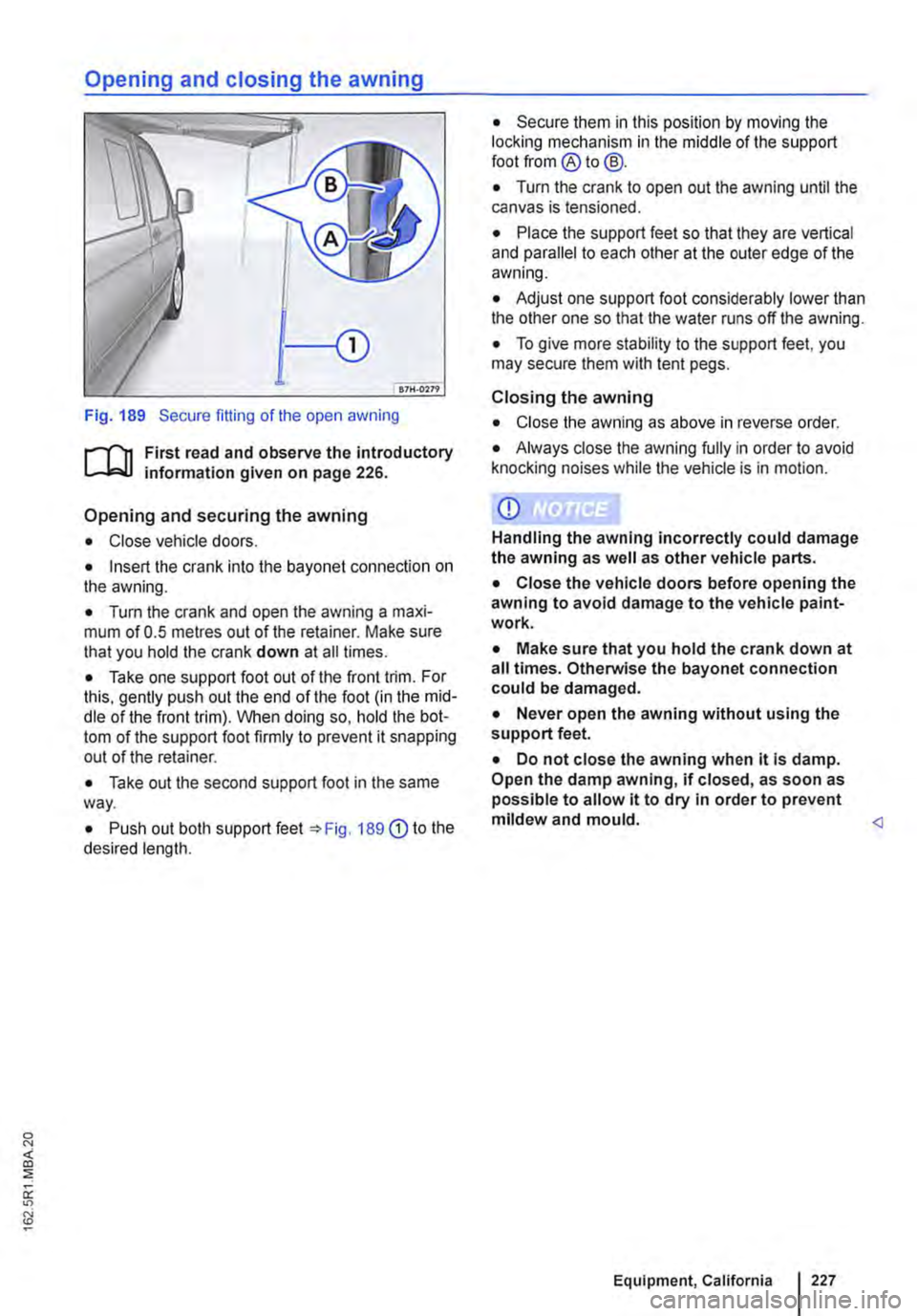
Fig. 189 Secure fitting of the open awning
r-1l1 First read and observe the introductory information given on page 226.
Opening and securing the awning
• Close vehicle doors.
• Insert the crank into the bayonet connection on the awning.
• Turn the crank and open the awning a maxi-mum of 0.5 metres out of the retainer. Make sure that you hold the crank down at all times.
• Take one support foot out of the front trim. For this, gently push out the end of the foot (in the mid-dle of the front trim). When doing so, hold the bot-tom of the support foot firmly to prevent it snapping out of the retainer.
• Take out the second support foot in the same way.
• Push out both support feet =>Fig. 189 G) to the desired length.
• Secure them in this position by moving the locking mechanism in the middle of the support foot from ®to@.
• Turn the crank to open out the awning until the canvas is tensioned.
• Place the support feet so that they are vertical and parallel to each other at the outer edge of the awning.
• Adjust one support foot considerably lower than the other one so that the water runs off the awning.
• To give more stability to the support feet, you may secure them with tent pegs.
Closing the awning
• Close the awning as above in reverse order.
• Always close the awning fully in order to avoid knocking noises while the vehicle is in motion.
CD
Handling the awning incorrectly could damage the awning as well as other vehicle parts.
• Close the vehicle doors before opening the awning to avoid damage to the vehicle paint-work.
• Make sure that you hold the crank down at all times. Otherwise the bayonet connection could be damaged.
• Never open the awning without using the support feet.
• Do not close the awning when it Is damp. Open the damp awning, if closed, as soon as possible to allow it to dry in order to prevent mildew and mould.
Page 229 of 486
Tables and camping chairs, California
CllJ Introduction
This chapter contains information on the following subjects:
Folding table in the sliding door . . . . . . . . . . . . 229
Folding the work table out and in . . . . . . . . . . 230
Moving the work table . . . . . . . . . . . . . . . . . • . 231
Camping chairs . . . . . . . . . . . . . . . . . . . . . . . . 232 Flyscreen element for the sliding window . . . . 232
Additional Information and warnings:
• Seat functions, front 69
• Seat functions, rear =>page 72
• Stowage 150
• Stowage areas, California 210
• Drink holder 153
• Tailgate 36
• Awning 226
Folding table in the sliding door
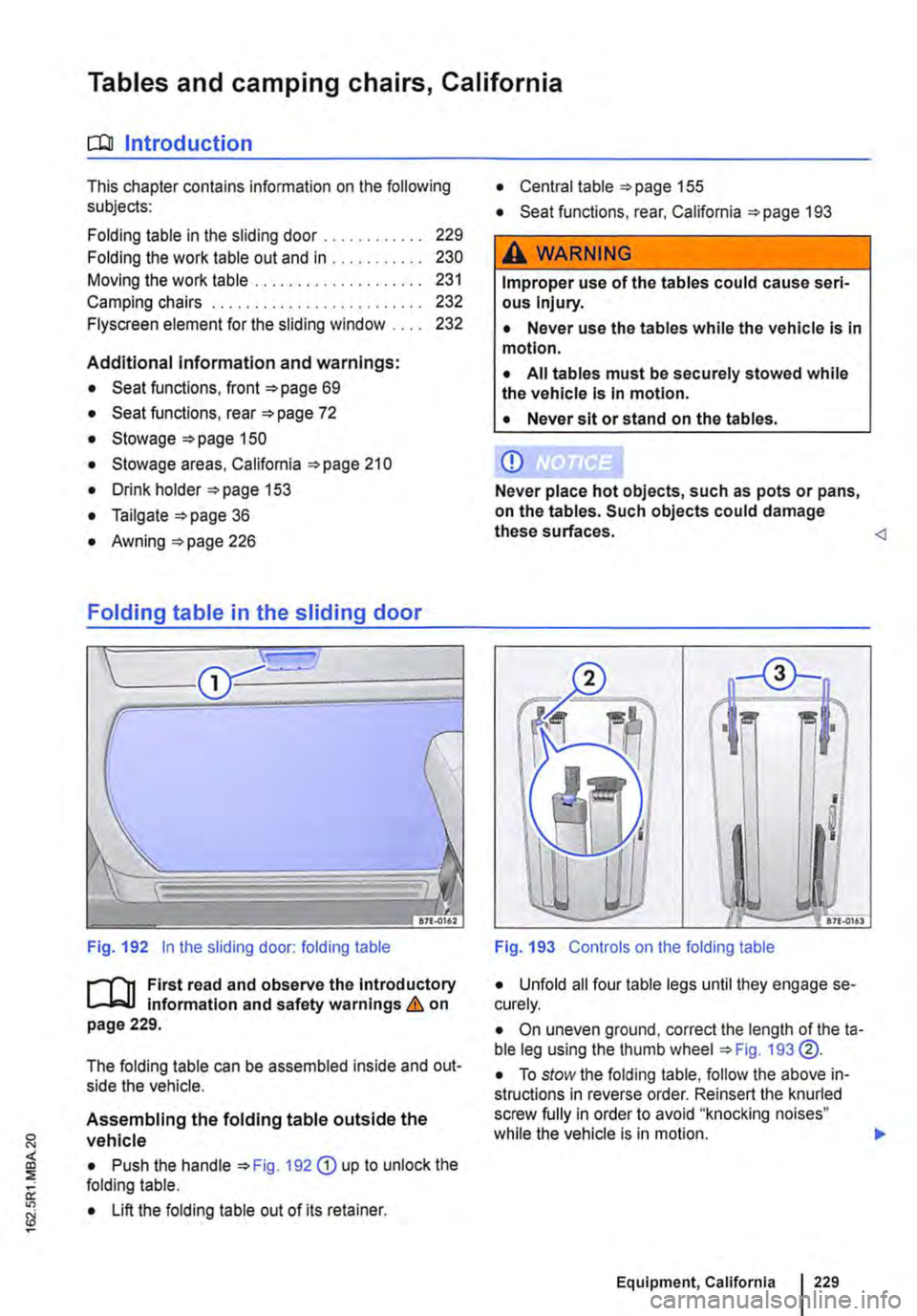
Fig. 192 in the sliding door: folding table
J"'"'"('n First read and observe the introductory L-Jo:.LI information and safety warnings & on page 229.
The folding table can be assembled inside and out-side the vehicle.
Assembling the folding table outside the vehicle
• Push the handle 192 G) up to unlock the folding table.
• Lift the folding table out of its retainer.
• Central table 155
• Seat functions, rear, California 193
,A WARNING
Improper use of the tables could cause seri-ous Injury.
• Never use the tables while the vehicle is in motion.
• All tables must be securely stowed while the vehicle is in motion.
• Never sit or stand on the tables.
CD
Never place hot objects, such as pots or pans, on the tables. Such objects could damage these surfaces.
I !! I
I
I
.. -17£.0161
Fig. 193 Controls on the folding table
• Unfold all four table legs until they engage se-curely.
• On uneven ground, correct the length of theta-ble leg using the thumb wheel 193 @.
• To stow the folding table, follow the above in-structions in reverse order. Reinsert the knurled screw fully in order to avoid "knocking noises" while the vehicle is in motion. .,.
Equipment, California 229
Page 295 of 486
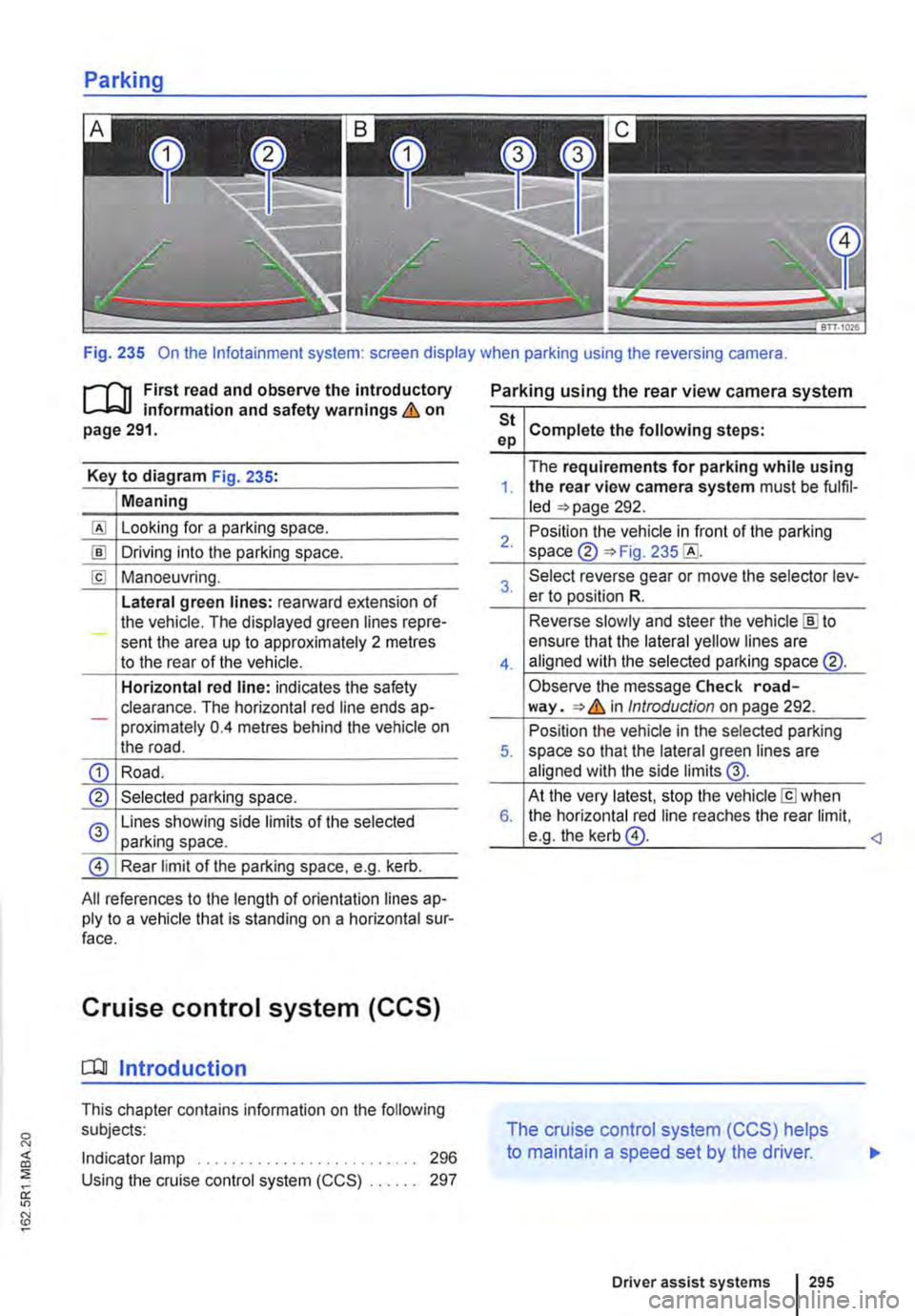
Fig. 235 On the lnfotainment system: screen display when parking using the reversing camera.
r-111 First read and observe the introductory L-L::.I.I information and safety warnings & on page 291.
Key to diagram Fig. 235:
Meaning
Looking for a parking space.
!ID Driving into the parking space.
[£! Manoeuvring.
Lateral green lines: rearward extension of the vehicle. The displayed green lines repre-sent the area up to approximately 2 metres to the rear of the vehicle.
Horizontal red line: indicates the safety clearance. The horizontal red line ends ap--proximately 0.4 metres behind the vehicle on the road.
CD Road.
® Selected parking space.
0 Lines showing side limits of the selected parking space.
@ Rear limit of the parking space, e.g. kerb.
All references to the length of orientation lines ap-ply to a vehicle that is standing on a horizontal sur-face.
Cruise control system (CCS)
[QJ Introduction
This chapter contains information on the following subjects:
Indicator lamp . . . . . . . . . . . . . . . . . . 296 Using the cruise control system (CCS) . . 297
Parking using the rear view camera system
St Complete the following steps: ep
The requirements for parking while using 1. the rear view camera system must be fulfil-led =>page 292.
2. Position the vehicle in front of the parking space ® =>Fig. 235
3. Select reverse gear or move the selector lev-er to position R.
Reverse slowly and steer the vehicle [ID to
4.
ensure that the lateral yellow lines are aligned with the selected parking space @.
Observe the message Check road-way. => & in Introduction on page 292.
Position the vehicle in the selected parking 5. space so that the lateral green lines are aligned with the side limits @.
At the very latest, stop the vehicle[£] when 6. the horizontal red line reaches the rear limit, e.g. the kerb@.
The cruise control system (CCS) helps
to maintain a speed set by the driver.
Driver assist systems 295
Page 339 of 486
Switching the childproof lock on and off
B7f·0201
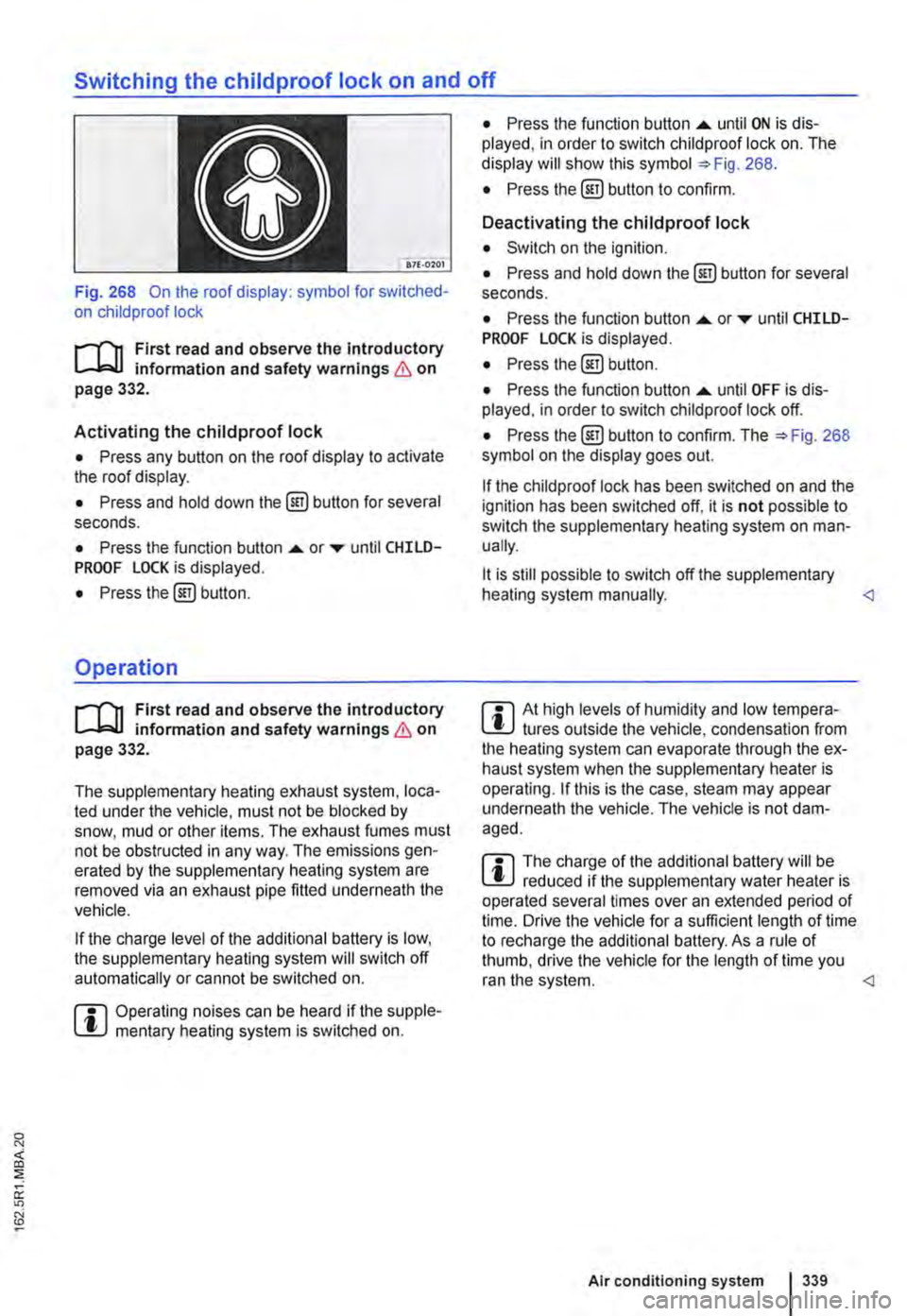
Fig. 268 On the roof display: symbol for switched-on child proof lock
r-T'n First read and observe the introductory L-.bU information and safety warnings & on page 332.
Activating the childproof lock
• Press any button on the roof display to activate the roof display.
• Press and hold down the @) button for several seconds.
• Press the function button .... or ..-until CHILD-PROOF LOCK is displayed.
• Press the@) button.
Operation
r-T'n First read and observe the introductory L-.bU information and safety warnings & on page 332.
The supplementary heating exhaust system, loca-ted under the vehicle, must not be blocked by snow, mud or other items. The exhaust fumes must not be obstructed in any way. The emissions gen-erated by the supplementary heating system are removed via an exhaust pipe fitted underneath the vehicle.
If the charge level of the additional battery is low, the supplementary heating system will switch off automatically or cannot be switched on.
m Operating noises can be heard if the supple-l!J mentary heating system is switched on.
• Press the function button .... until ON is dis-played, in order to switch child proof lock on. The display will show this symbol =>Fig. 268.
• Press the @] button to confirm.
Deactivating the childproof lock
• Switch on the ignition.
• Press and hold down the@] button for several seconds.
• Press the function button....._ or..-until CHILD-PROOF LOCK is displayed.
• Press the@) button.
• Press the function button .... until OFF is dis-played. in order to switch child proof lock off.
• Press the@) button to confirm. The =>Fig. 268 symbol on the display goes out.
If the child proof lock has been switched on and the ignition has been switched off, it is not possible to switch the supplementary heating system on man-ually.
lt is still possible to switch off the supplementary heating system manually.
r::l The charge of the additional battery will be W reduced if the supplementary water heater is operated several times over an extended period of time. Drive the vehicle for a sufficient length of time to recharge the additional battery. As a rule of thumb, drive the vehicle for the length of time you ran the system.
Page 369 of 486
Storing tyres
Mark tyres before you remove them to indicate the direction of rotation. This ensures you will be able to mount them correctly when you replace them (left, right, front, rear). When removed, the wheels or tyres should be stored in a cool, dry and pref-erably dark place. Do not store tyres mounted on the rim vertically.
Any tyres not fitted on rims should be kept in suita-ble sleeves to protect against dirt and should be stored vertically (standing on the tread).
All-terrain tyres
Some vehicles can be fitted at the factory with "all-terrain tyres". These tyres have a deep-tread pro-file that alters the vehicle's driving properties (such as comfort, consumption, braking distance, corner-Ing behaviour, rolling noise)=>&.
A WARNING
Corrosive liquids and other substances can cause visible and Invisible damage to the tyres, which can cause the tyre to burst.
• Always keep chemicals, oils, lubricants, fuel, brake fluid and other corrosive substan-ces away from the tyres.
A WARNING
Old tyres (even if never used) can suddenly lose pressure or burst, especially at high speeds. This can cause accidents and seri-ous injuries.
• Avoid using tyres that are more than six years old. If you have no alternative, drive slowly and with extra care at all times.
Rims
,....-('n First read and observe the Introductory L-J.:.ll information and safety warnings & on page 367.
The design of the wheel bolts is matched to the rims. If different rims are fitted, the correct wheel bolts with the right length and correctly shaped bolt heads must be used. This ensures that wheels are fitted securely and that the brake system works properly =>page 420.
For technical reasons, it is not generally possible to use the wheels from other vehicles. This can al-so apply to wheels of the same vehicle type.
A WARNING
The deep-tread profile of all-terrain tyres can considerably increase the braking distance or cornering behaviour and thus cause acci-dents and serious injuries.
• Always bear the modified vehicle handling in mind, and drive carefully.
CD
Avoid heavy impacts and drive round obstacles whenever possible. Tyres, particularly low-pro-file tyres, can be considerably compressed and deformed by potholes and curb edges especial-ly. This can cause the tyre's webbing reinforce-ment to brake, and cause dents or rips on the side walls or deformations or cracks on the rims.
Old tyres should be disposed of as required !!IS by legislation.
Wheel bolts
Wheel boils must always be tightened with the cor-rect tightening torque =>page 420.
Rims with bolted-on rings
Rims with bolted-on rings consist of several com-ponents. These components are fastened using special bolts and special fastening technology. This ensures that the wheel functions proper1y, does not leak, remains safe and runs true. For this reason, damaged rims should be replaced. They may only .,..
Wheels and tyres I 369
Page 384 of 486

Check the condition of the wiper blades on a regu-lar basis. Rubbing wiper blades should be changed if damaged or cleaned if dirty
Damaged wiper blades should be replaced imme-diately. Wiper blades can be bought from a quali-fied workshop.
Cleaning wiper blades
Note for the front wipers: move the wiper arms to the service position before lifting them 116.
• When lifting the wiper arm hold it only by the wiper blade mounting.
• Clean the wiper blade carefully using a damp cloth
• Place the wiper arm back onto the windscreen.
Changing the wiper blades
• Move the wiper arms to the service position be-fore lifting 116.
• When lifting the wiper arm hold it only by the wiper blade mounting.
• Press and hold the release button 285 G) and simultaneously pull off the wiper blade in the direction of the arrow.
• Insert a new wiper blade with the same length and design onto the wiper arm. Push it on until it engages.
• Place the wiper arm back onto the windscreen.
Changing the wiper blade for the rear window
• When lifting the wiper arm hold it only by the wiper blade mounting.
• Lift and fold back the wiper arm.
Waxing and polishing the vehicle
r--f"n First read and observe the Introductory L-J,::,JJ Information and safety warnings & on page 380.
Waxing
waxing protects the paintwork. You will need to re-wax the vehicle with a good hard wax if water no longer clearly forms small drops and runs off the paintwork when it is clean.
Even if a wax solution is used regularly in the car wash, Volkswagen Commercial Vehicles recom-mends protecting the paint with a coat of hard wax at least twice a year.
384 I Cleaning and maintenance
• Release the wiper blade in the direction of the arrow 286 G).
• Pull off the wiper blade in the direction of the ar-row®.
• Insert a new wiper blade with the same length and design on to the wiper arm against the direc-tion of the arrow. Push it on until it engages®.
• Push the release against the direction of the ar-row G) in order to lock the wiper blade.
• Place the wiper arm back onto the rear window.
A WARNING
Worn or dirty wiper blades reduce visibility and Increase the risk of accidents and severe Injuries.
• Therefore, always change wiper blades If they are damaged and worn and or longer clean the windscreen properly.
CD
• Damaged or dirty wipers could scratch the windscreen.
• Detergents containing solvents, hard sponges and other sharp objects can damage the graphite coating.
• Do not use fuel, nail varnish remover, paint thinner or similar products to clean the win-dows.
Polishing Is only necessary If the paint has lost its shine, and the gloss cannot be brought back by applying wax.
The car must be waxed after polishing if the polish used does not contain wax compounds to seal the paint.
CD
• In order to avoid damage, painted parts with a matt finish, plastic parts, headlight lenses and the tail lights should not be treated with polish or hard wax.
• Do not polish your vehicle in a sandy or dusty environment or when the vehicle is dirty.
Page 421 of 486
Checklist (Continued)
8. VI/hen towing a trailer, unhitch the trailer from the vehicle and park it properly.
9. Remove any items of luggage from the lug-gage compartment.
10. Remove the spare wheel and vehicle tools from the vehicle.
11. Remove the hubcaps =>page 417.
Wheel bolts
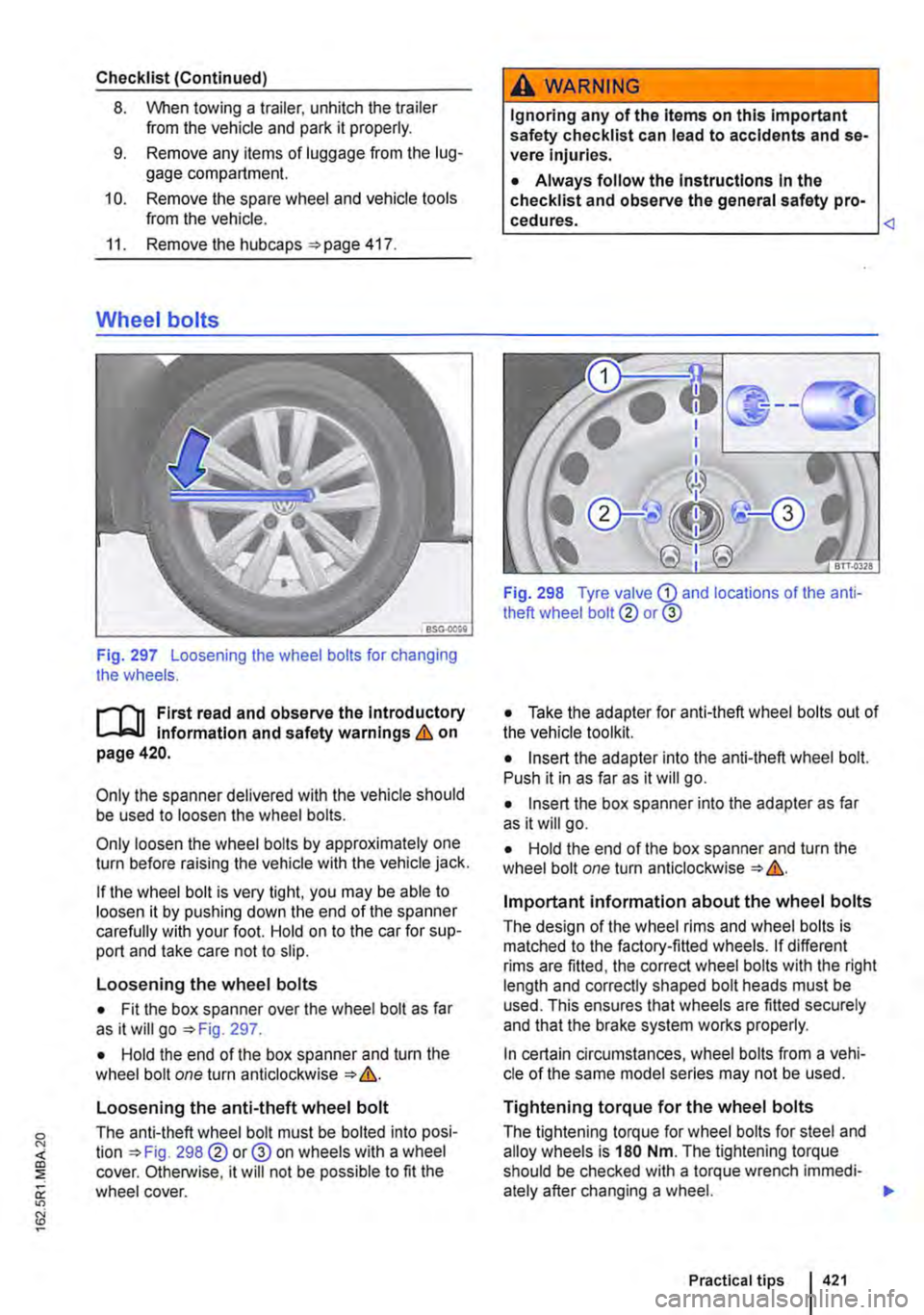
Fig. 297 Loosening the wheel bolts for changing the wheels.
r-"f"'n First read and observe the Introductory l.-J,:..LJ Information and safety warnings & on page420.
Only the spanner delivered with the vehicle should be used to loosen the wheel bolts.
Only loosen the wheel bolts by approximately one turn before raising the vehicle with the vehicle jack.
If the wheel bolt is very tight, you may be able to loosen it by pushing down the end of the spanner carefully with your foot. Hold on to the car for sup-port and take care not to slip.
Loosening the wheel bolts
• Fit the box spanner over the wheel bolt as far as it will go =>Fig. 297.
• Hold the end of the box spanner and turn the wheel bolt one turn anticlockwise => &.
Loosening the anti-theft wheel bolt
The anti-theft wheel bolt must be bolted into posi-tion =>Fig. 298@ or@ on wheels with a wheel cover. Otherwise, it will not be possible to fit the wheel cover.
A WARNING
Ignoring any of the Items on this Important safety checklist can lead to accidents and se-vere Injuries.
• Always follow the Instructions In the checklist and observe the general safety pro-
Fig. 298 Tyre valve G) and locations of the anti-theft wheel bolt@ or@
• Take the adapter for anti-theft wheel bolts out of the vehicle toolkit.
• Insert the adapter into the anti-theft wheel bolt. Push it in as far as it will go.
• Insert the box spanner into the adapter as far as it will go.
• Hold the end of the box spanner and turn the wheel bolt one turn anticlockwise => &.
Important information about the wheel bolts
The design of the wheel rims and wheel bolts is matched to the factory-fitted wheels. If different rims are fitted, the correct wheel bolts with the right length and correctly shaped bolt heads must be used. This ensures that wheels are fitted securely and that the brake system works properly.
In certain circumstances, wheel bolts from a vehi-cle of the same model series may not be used.
Tightening torque for the wheel bolts
The tightening torque for wheel bolts for steel and alloy wheels is 180 Nm. The tightening torque should be checked with a torque wrench immedi-ately after changing a wheel. .,.
Practical tips 421
Page 452 of 486
Dimensions
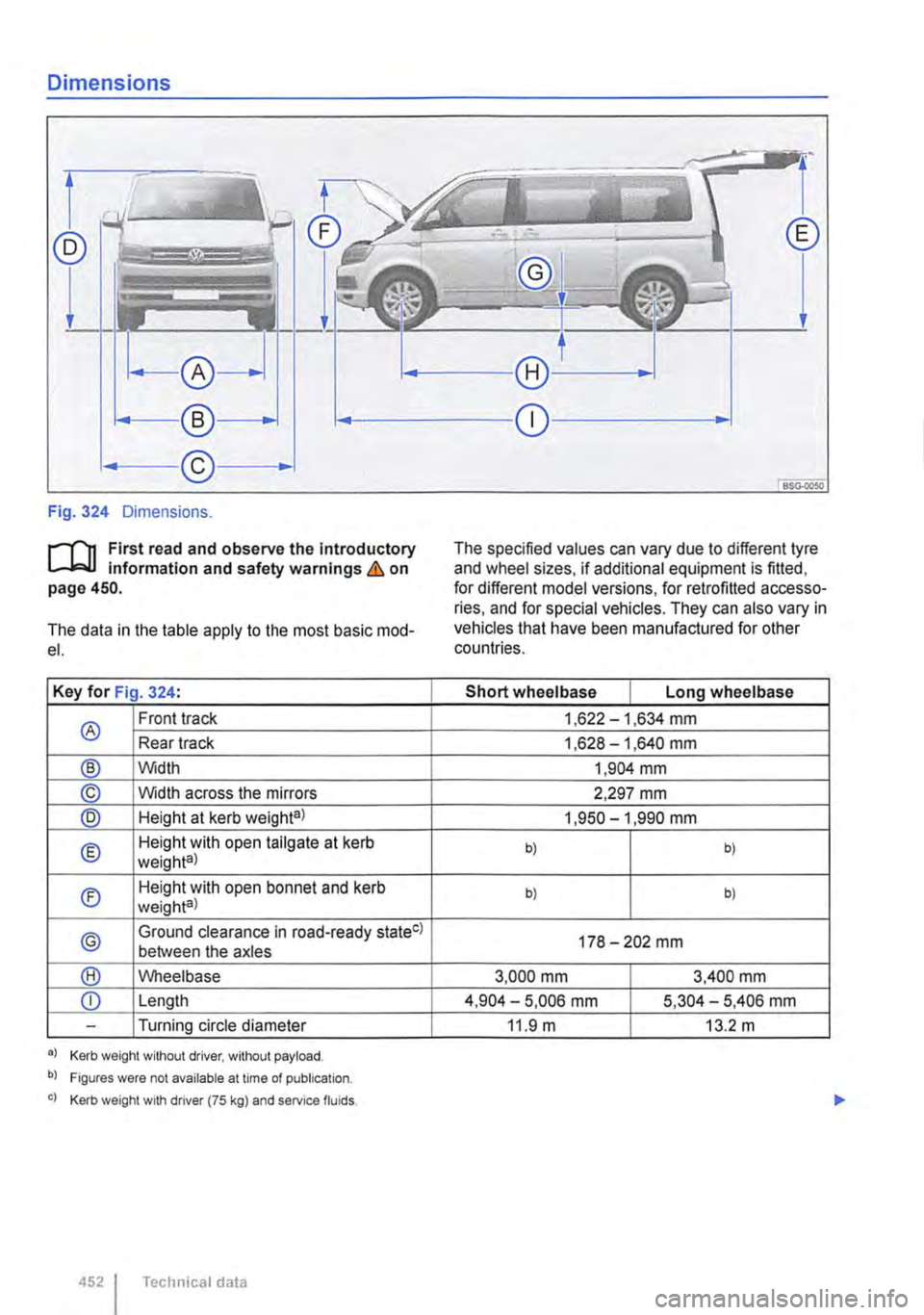
Fig. 324 Dimensions.
l""""'('n First read and observe the introductory L-J,.:.U information and safety warnings & on page 450.
The data in the table apply to the most basic mod-el.
Key for Fig. 324:
® Front track
Rear track
® Width
© Width across the mirrors
@ Height at kerb weight8l
® Height with open tailgate at kerb weight8l
® Height with open bonnet and kerb weight8l
@ Ground clearance in road-ready statecl between the axles
® Wheelbase
CD Length
-Turning circle diameter
•l Kerb weight without driver, without payload.
b) Figures were not available at time of publication.
c) Kerb weight with driver (75 kg) and service fluids.
452 I Technical data
The specified values can vary due to different tyre and wheel sizes, if additional equipment is fitted, for different model versions, for retrofitted accesso-ries, and for special vehicles. They can also vary in vehicles that have been manufactured for other countries.
Short wheelbase Long wheelbase
1,622 -1,634 mm
1,628 -1,640 mm
1,904 mm
2,297 mm
1,950-1 ,990 mm
b) b)
b) b)
178-202 mm
3,000 mm 3,400 mm
4,904-5,006 mm 5,304 -5,406 mm
11.9 m 13.2 m
Page 475 of 486
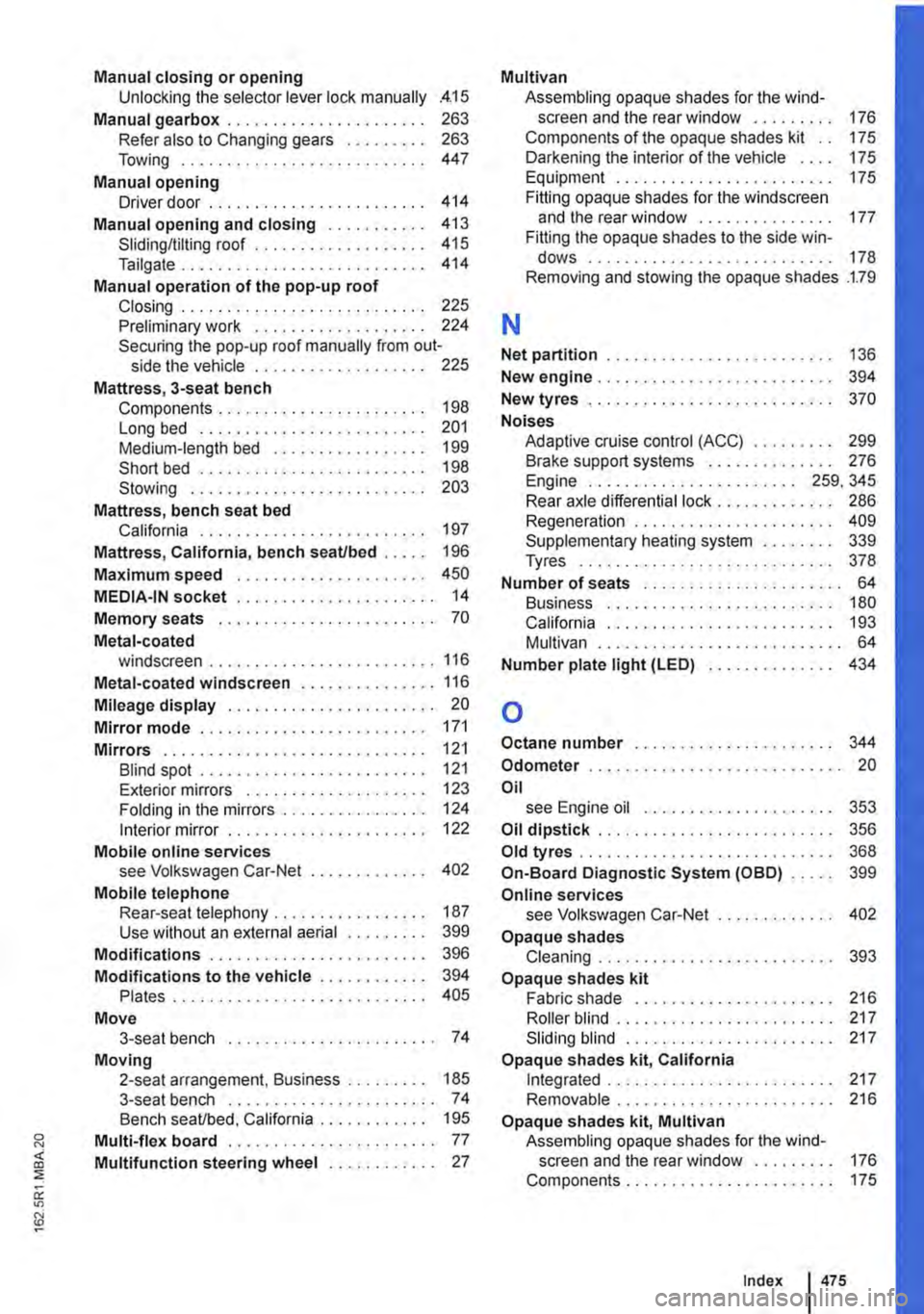
Manual closing or opening Unlocking the selector lever lock manually
Manual gearbox ..................... . Refer also to Changing gears ........ . Towing .......................... .
Manual opening Driver door ...................... .
.4.15
263 263 447
414
Manual opening and closing . . . . . . . . . . 413 Sliding/tilting roof . . . . . . . . . . . . . . . . . . 415 Tailgate . . . . . . . . . . . . . . . . . . . . . . . . . . . 414
Manual operation of the pop-up roof Closing . . . . . . . . . . . . . . . . . . . . . . . . . . . 225 Preliminary work . . . . . . . . . . . . . . . . . . . 224 Securing the pop-up roof manually from out-side the vehicle . . . . . . . . . . . . . . . . . . . 225
Mattress, 3-seat bench Components . . . . . . . . . . . . . . . . . . . . . . . 198 Long bed . . . . . . . . . . . . . . . . . . . . . . . . . 201 Medium-length bed . . . . . . . . . . . . . . . . . 199 Short bed . . . . . . . . . . . . . . . . . . . . . . . . . 198 Stowing . . . . . . . . . . . . . . . 203
Mattress, bench seat bed California . . . . . . . . . . . . . . 197 Mattress, California, bench seatlbed . . 196
Maximum speed . . . . . . . . . . . . . . . . . . . . . 450
MEDIA-IN socket . . . . . . . . . . . . . . . . . . . . . . 14
Memory seats . . . . . . . . . . . . . . . . . . . . . . . . 70
Metal-coated windscreen . . . . . . . . . . . . . . . . . . . . . . . . . 116
Metal-coated windscreen .....•......... 116
Mileage display . . . . . . . . . . . . . . . . . . . . . . . 20
Mirror mode . . . . . . . • . . . . . . . . • . . . . . . . . 171
Mirrors . . . . . . . . . . . . . . . . . . . . . . . . . . 121 Blind spot . . . . . . . . . . . . . . . . . . . . . • . . . 121 Exterior mirrors . . . . . . . . . . . . . . . . . . . . 123 Folding in the mirrors . . . . . . . . . . . . . . . . 124 Interior mirror . . . . . . . . . . . . . • . . . . • • . . 122 Mobile online services see Volkswagen Car-Net . . . . . . . . . . . . . 402
Mobile telephone Rear-seat telephony................. 187 Use without an external aerial . . . . . . . . . 399
Modifications . . . . . . . . . . . . . . . . . . . . . . . . 396 Modifications to the vehicle . . . . . . . . • . . . 394 Plates . . . . . . . . . . . . . . . . . . . . . . . . . . . 405
Move 3-seat bench ..... . ............. 74
Moving 2-seat arrangement, Business . . . . . . . . . 185 3-seat bench . . . . . . . . . . . . . . . . . . . . . . . 74 Bench seatlbed, California . . . . . . . . . . . . 195
Multi-flex board . . . . . . . . . . . . . . . . . . . . . . . 77
Multifunction steering wheel 27
Multivan
N
Assembling opaque shades for the wind-screen and the rear window . . . . . . . . . 176 Components of the opaque shades kit . . 175 Darkening the interior of the vehicle . . . . 175 Equipment . . . . . . . . . . . . . . . . . . . . . . . . 175 Fitting opaque shades for the windscreen and the rear window . . . . . . . . . . . . . . . 177 Fitting the opaque shades to the side win-dows . . . . . . . . . . . . . . . . . . . . . . . . . . . 178 Removing and stowing the opaque shades .1.79
Net partition . . . . . . . . . . . . . . . . . . . . . . . . 136
New engine . . . . . . . . . . . . . . . • . . . . . . . . . 394
New tyres . . . . . . . . . . . . . . . . . . . . . . . . . . 370
Noises Adaptive cruise control (ACC) . . . . . . . . . 299 Brake support systems . . . . . . . . . . . . . . 276 Engine . . . . . . . . . . . . . . . . . . . . . . . 259, 345 Rear axle differential lock . . . . . . . . . . . . . 286 Regeneration . . . . . . . . . . . . . . . . . . . . . . 409 Supplementary heating system . . . • . . . . 339 Tyres . . . . . . . . . . . . . . . . . . . . . . . . . . . . 378
Number of seats . . . . • . . . . . . . . . . . . . . . . . 64 Business . . . . . . . . • . . . . . . . . . . . . . . . . 180 California ..... , . . . . . . . . . . . . . . . . . . . 193 Multivan ........................... 64
Number plate light (LED) . . . . . . • . . . . . . . 434
0
Octane number . . . . . . . . . . . . . . . . . . . . . . 344
Odometer . . . . . . . . . . . . . . . • . . . . . . . . . . . . 20
Oil see Engine oil . . . . . . . . . . . . . . . . . . . . . 353
Oil dipstick . . . . . . . . . . . . . . . . . . . . . . . . . . 356 Old tyres . . . . . . . . . . . . . . . . . . . . . . . . . . . . 368 On-Board Diagnostic System (OBD) . . . . . 399
On line services see Volkswagen Car-Net . . . . . . . . . . . . . 402
Opaque shades Cleaning . . . . . . . . . . . • . . . . . . . . • . . . . . 393
Opaque shades kit Fabric shade . . . . . . . . . . . . . . . . . . . . . . 216 Roller blind . . . . . . . . . . . . . . . . . . . . . . . . 217 Sliding blind . . . . . . . . . . . . . . . . . • . . . . . 217
Opaque shades kit, California Integrated . . . . . . . . . . . . . . . . . . . • . . . . . 217 Removable . . . . . . . . . . . . . . . . . . . . . . . . 216
Opaque shades kit, Multivan Assembling opaque shades for the wind-screen and the rear window . . . . . . . . . 176 Components . . . . . . . . . . . . . . . . . . . . . . . 175
Index I 475