service schedule VOLKSWAGEN TRANSPORTER 2015 Owner´s Manual
[x] Cancel search | Manufacturer: VOLKSWAGEN, Model Year: 2015, Model line: TRANSPORTER, Model: VOLKSWAGEN TRANSPORTER 2015Pages: 486, PDF Size: 72.17 MB
Page 343 of 486
Capacities
r--('n First read and observe the introductory L-W.I information and safety warnings & on page 340.
Checks when filling the tank
r--r'n First read and observe the introductory L-W.I information and safety warnings & on page 340.
Checklist
Never carry out any work on the engine or in the engine compartment if you are not familiar with the necessary procedures and the general safety re-quirements or if the correct operating equipment, fluids and unsuitable tools are not available 350, Preparation for working in the engine compartment! The work should be carried out by a qualified workshop if you are uncertain. Please en-sure that the following are checked regular1y, pref-erably every time you fill the tank:
..( Windscreen washer fluid level 116
..( Engine oil level 353
Fuel
c:QJ Introduction
This chapter contains information on the following subjects:
Petrol
Diesel ...
344 345
Different engines require different fuels. The facto-ry-fitted sticker on the inside of the tank flap indi-cates the fuel type that is required for your particu-lar vehicle.
Volkswagen Commercial Vehicles recommends us-ing fuels with a low sulphur content or which are sulphur-free in order to reduce fuel consumption and prevent damage to the engine.
If the engine is not running smoothly or begins to judder, this can indicate poor or inadequate fuel quality, e.g. water in the fuel. If these symptoms appear, reduce the vehicle speed immediately and drive to the nearest qualified workshop at medium engine speeds, avoiding high engine loading. If these symptoms occur immediately after the vehi-
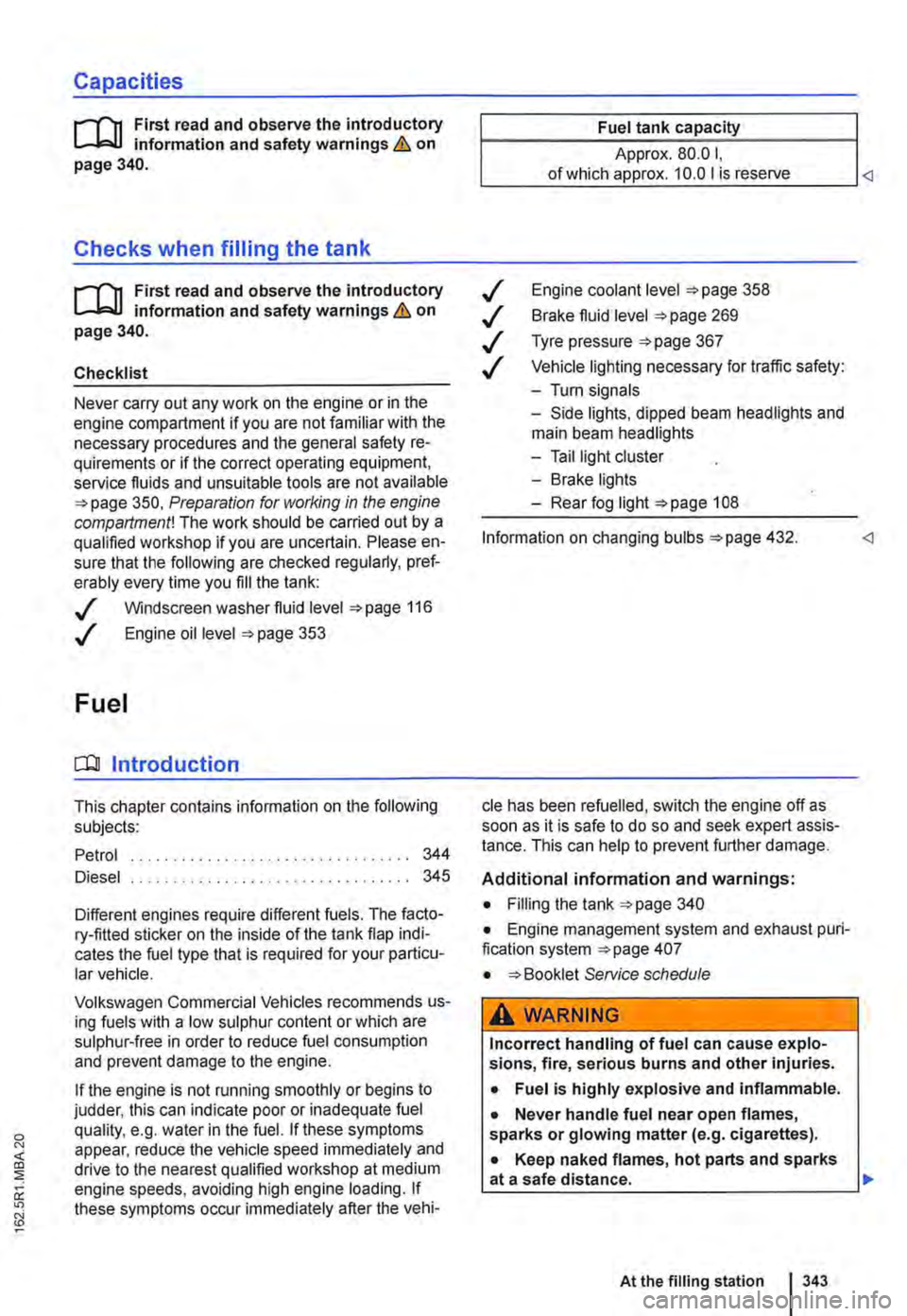
Fuel tank capacity
Approx. 80.0 I,
..( Engine coolant level 358
..( Brake fluid level 269
..( Tyre pressure 367
..( Vehicle lighting necessary for traffic safety:
-Turn signals
-Side lights, dipped beam headlights and main beam headlights
-Tail light cluster
-Brake lights
-Rear fog light 1 08
Information on changing bulbs 432.
cle has been refuelled, switch the engine off as soon as it is safe to do so and seek expert assis-tance. This can help to prevent further damage.
Additional information and warnings:
• Filling the tank 340
• Engine management system and exhaust puri-fication system 407
• Service schedule
A WARNING
Incorrect handling of fuel can cause explo-sions, fire, serious burns and other injuries.
• Fuel is highly explosive and inflammable.
• Never handle fuel near open flames, sparks or glowing matter (e.g. cigarettes).
• Keep naked flames, hot parts and sparks at a safe distance.
At the filling station 1343
Page 345 of 486
CD
• Fuels that are identified at the fuel pump as containing metallic additives may not be used. LRP fuel (lead replacement petrol) also con-tains high concentrations of metallic additives. Risk of engine damage I
Diesel
r'""'('n First read and observe the Introductory L-J,:.U Information and safety warnings & on page 343.
Diesel
Diesel fuel must comply with the European stand-ard EN 590 (in Germany DIN EN 590).
The service intervals are shorter if you use diesel with a high sulphur content =>Booklet Service schedule =>CD. A Volkswagen Commercial Vehicles dealership will be able to tell you which countries have diesel with a high sulphur content.
Where diesel fuel complying with the EN 590 standard is not available, Volkswagen Commercial Vehicles dealerships and filling stations will have information on which fuels do comply with the EN 590 standard.
Do not mix fuel additives (thinners. or similar addi-tives) with diesel.
Winter diesel
When using summer-grade diesel. difficulties may be experienced at temperatures below o•c (+32.F)
because the fuel thickens due to paraffin separa-tion. For this reason winter-grade diesel which can be used at temperatures below -2o•c (·4°F) is available in countries such as Germany during the cold months.
In countries with different climatic conditions the diesel sold generally has different temperature characteristics. Check with a Volkswagen Com-mercial Vehicles dealer or filling stations in the country concerned regarding the type of diesel fuels available.
it is not unusual for a cold diesel engine to be loud-er in cold temperatures that in warm weather. In addition, exhaust emissions may be tinged with blue while the engine starts and reaches operating temperature. The amount of exhaust fumes de-pends on the outside temperature.
CD
• Just one tankful of leaded fuel, or fuel con-taining other metallic additives, can seriously Impair the efficiency of the catalytic converter and can also cause considerable damage to the catalytic converter and engine.
Diesel vehicles are equipped with a filter pre-heat-er system. This ensures that the fuel system re-mains operational even down to approximately -24•c (-11.F) provided that winter-grade diesel which is safe down to -15•c (+5.F) is used.
However, if the fuel has thickened to such an ex-tent that the engine will not start at temperatures below -24•c (-11.F) simply place the vehicle in a warm garage or workshop for a while.
Supplementary heater
Vehicles fitted with a diesel engine may also be equipped with a fuel-driven supplementary heater. This heater is powered with fuel from the vehicle tank. In this case, odour and water vapour may es-cape from the vehicle, and there may be a greater quantity of smoke. This is quite normal when the system is in use, and does not indicate damage or a fault in the system.
The supplementary heater will be switched off au-tomatically if the level in the fuel tank is low (re-serve level).
A WARNING
Never use a start booster. Start boosters may explode or cause the engine to suddenly run at high revs, which can cause serious Injuries and engine damage.
CD
• Before filling up with diesel, check whether the fuel corresponds to the vehicle's require-ments according to the fuel standard Informa-tion at the pump.
• Only use fuel that complies with the EN 590 standard and has the correct cetane number. Otherwise, the engine and the fuel system can suffer considerable damage. The engine can al-so lose power or fall. ..,.
At the filling station 1345
Page 346 of 486
CD
• Your vehicle is not suitable for use with bio-diesel and must not be filled up or driven with biodiesel. Failure to observe this point can re-sult in damage to the fuel system and engine.
• Some diesel manufacturers blend biodiesel with diesel fuel in compliance with European Standard 590 or an equivalent standard (in Ger-many). Use of this diesel is allowed and will not damage the engine or fuel system.
• The diesel engine has been developed for use with diesel only. For this reason, petrol, heating oil or other unsuitable fuels may not be used. These fuels can cause serious damage to the fuel system and engine.
CD
• The service life of the diesel particulate filter can be reduced considerably if diesels with a high sulphur content are used. A Voikswagen Commercial Vehicles dealership will be able to tell you which countries have diesel with a high sulphur content.
o:::n Introduction
This chapter contains information on the following subjects:
Warning and indicator lamps Refilling Ad Blue® ... 347
348
SCR catalysts can be used to reduce emissions from diesel engines (SCR = Selective Catalytic Re-duction). The SCR catalyst uses Ad Blue® urea sol-ution to convert nitrogen oxides into nitrogen and water.
If the vehicle is equipped with this kind of emission control system for diesel vehicles, the filler neck for the Ad Blue® tank is located below the filler cap for the fuel tank.
The Ad Blue® level should be checked within the scope of the service work Service schedule.
Information on AdBiue®
The Ad Blue® consumption figures depend on the individual driving style, the system's operating tem-perature and the ambient temperature that the ve-hicle is operated in.
The vehicle is fitted with a separate tank for Ad Bl-ue®. The Ad Blue® tank holds approximately 13 li-tres. For technical reasons, the capacity may be slightly larger when refilling using refill bottles.
The Ad Blue® tank must never run empty. As of a remaining distance of approximately 2,400 km. the instrument cluster display will indicate that the
346 While drivmg
Ad Blue® must be refilled 348. If the re-maining range is 0 km, the engine cannot be star-ted anymore 347.
The Ad Blue® trademark is held by the German As-sociation of the Automobile Industry (VDA) in the USA, Germany, the European Union and other countries.
Additional information and warnings:
• Fuel 343
• Accessories, modifications, repairs and renewal of parts 394
A WARNING
If the AdBiue® level is too low, the vehicle cannot be restarted after the Ignition has been switched off. Starting with jump leads is also not possible.
• Refill AdBiue® at the latest when the re-maining distance reaches approximately 1,000 km.
• Never allow the Ad Blue® tank to run emp-ty.
A WARNING
Ad Blue® is an Irritant and corrosive fluid that can damage the skin, eyes and breathing passages upon contact.
Page 357 of 486
A WARNING (Continued)
• If engine oil is spilt on cold engine parts it can heat up and Ignite when the engine Is running.
• Always ensure that the engine oil filler cap Is securely tightened after refilling, and that the dipstick Is properly Inserted back Into the guide tube. This will prevent the engine oil from draining out on to hot engine compo-nents when the engine Is running.
CD
• Do not start the engine if the engine oil level Is above area@. Seek expert assistance. The catalytic converter and the engine could other-wise be damaged.
• When refilling or changing service fluids, please ensure that the correct fluids are added through the correct openings. Incorrect service fluids can cause serious functional problems and engine damage.
Engine oil consumption
n"'n First read and observe the introductory l.-J,:.ll information and safety warnings & on page 353.
Engine oil consumption can vary from engine to engine and can change during the working life of an engine.
The vehicle may consume up to 1.0 litre of engine oil per 2,000 km, depending on how you drive and the conditions in which the car is used. In new ve-
Changing engine oil
n"'n First read and observe the Introductory l.-J,:.ll Information and safety warnings & on page 353.
The engine oil must be changed regularly in ac-cordance with the data given in the service sched-ule.
The engine oil and filter change should be carried out by a qualified workshop due to the special tools and knowledge required, this also applies to the disposal of used oil. Volkswagen Commercial Vehi-cles recommends using a Volkswagen Commercial Vehicles dealership for this purpose.
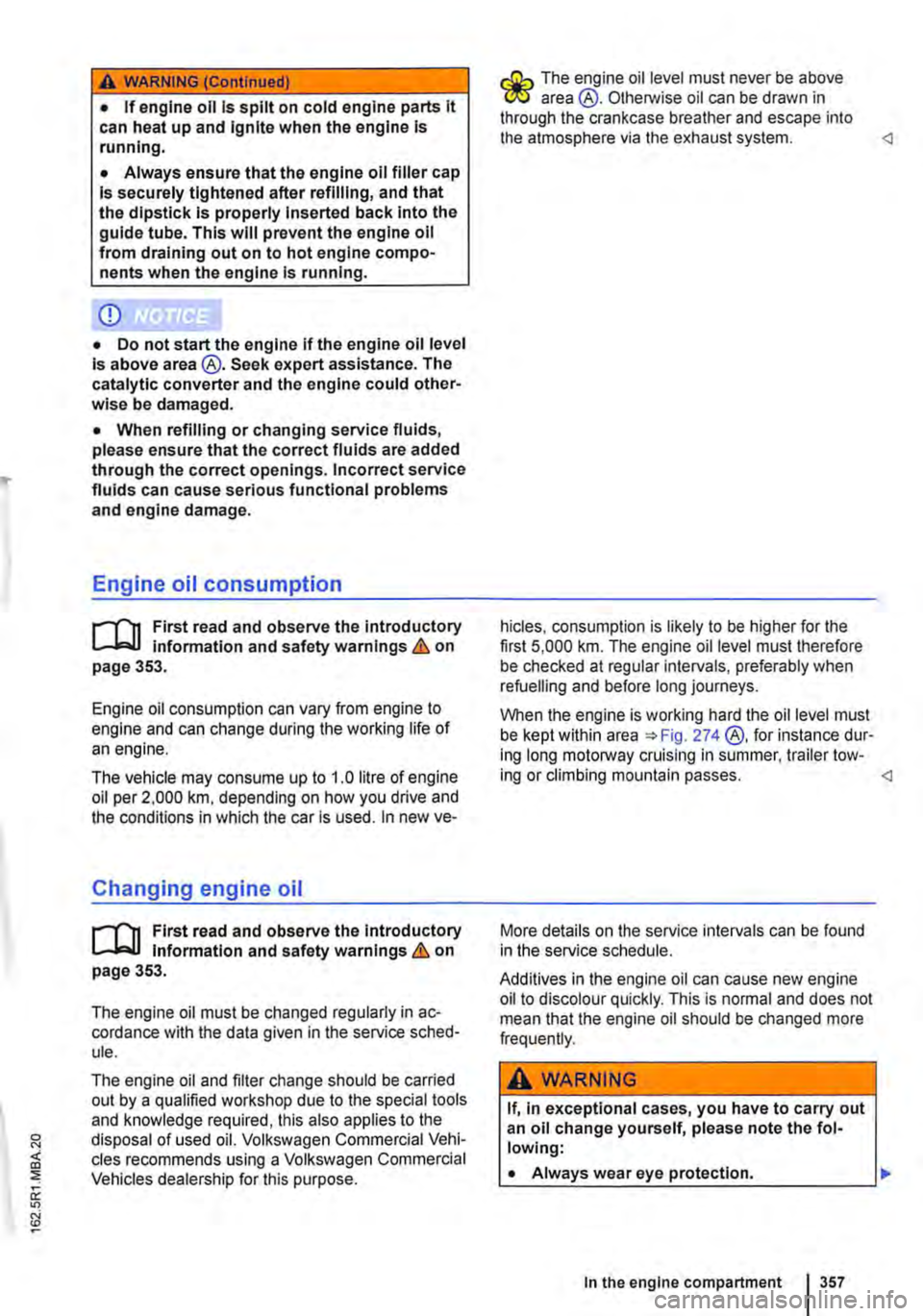
The engine oil level must never be above I!!S area @. Otherwise oil can be drawn in through the crankcase breather and escape into the atmosphere via the exhaust system. <1
hicles. consumption is likely to be higher for the first 5,000 km. The engine oil level must therefore be checked at regular intervals, preferably when refuelling and before long journeys.
When the engine is working hard the oil level must be kept within area =>Fig. 274 @,for instance dur-ing long motorway cruising in summer, trailer tow-ing or climbing mountain passes. <1
More details on the service intervals can be found in the service schedule.
Additives in the engine oil can cause new engine oil to discolour quickly. This is normal and does not mean that the engine oil should be changed more frequently.
A WARNING
If, In exceptional cases, you have to carry out an oil change yourself, please note the fol-lowing:
• Always wear eye protection. .,.
In the engine compartment 357
Page 363 of 486
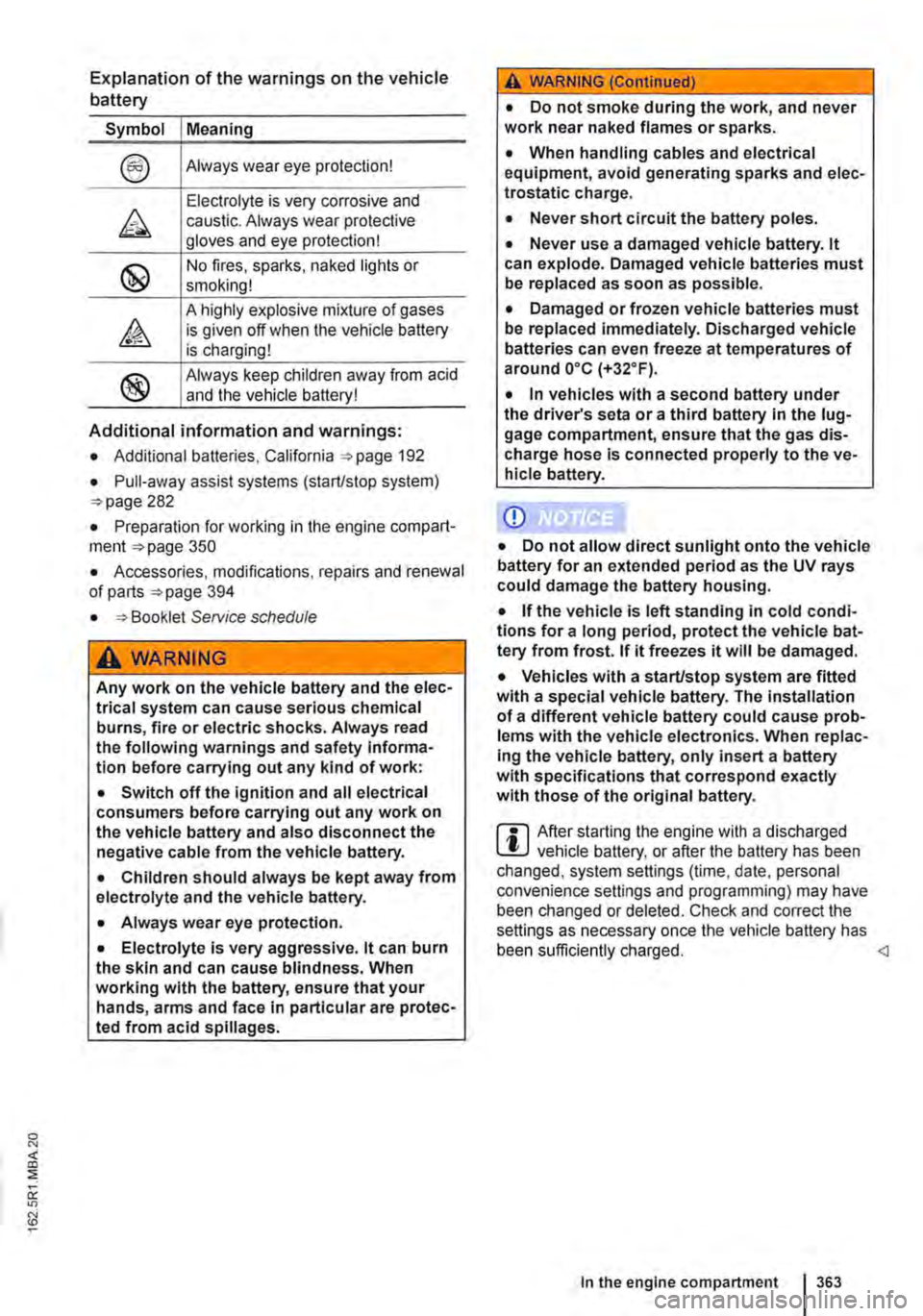
Explanation of the warnings on the vehicle battery
Symbol Meaning
Always wear eye protection!
Electrolyte is very corrosive and caustic. Always wear protective gloves and eye protection!
No fires, sparks, naked lights or smoking!
A highly explosive mixture of gases is given off when the vehicle battery is charging!
Always keep children away from acid and the vehicle battery!
Additional information and warnings:
• Additional batteries, California 192
• Pull-away assist systems (starUstop system) 282
• Preparation for working in the engine compart-ment 350
• Accessories, modifications, repairs and renewal of parts 394
• Service schedule
A WARNING
Any work on the vehicle battery and the elec-trical system can cause serious chemical burns, fire or electric shocks. Always read the following warnings and safety informa-tion before carrying out any kind of work:
• Switch off the ignition and all electrical consumers before carrying out any work on the vehicle battery and also disconnect the negative cable from the vehicle battery.
• Children should always be kept away from electrolyte and the vehicle battery.
• Always wear eye protection.
• Electrolyte Is very aggressive. lt can burn the skin and can cause blindness. When working with the battery, ensure that your hands, arms and face in particular are protec-ted from acid spillages.
A WARNING (Continued)
• Do not smoke during the work, and never work near naked flames or sparks.
• When handling cables and electrical equipment, avoid generating sparks and elec-trostatic charge.
• Never short circuit the battery poles.
• Never use a damaged vehicle battery. it can explode. Damaged vehicle batteries must be replaced as soon as possible.
• Damaged or frozen vehicle batteries must be replaced immediately. Discharged vehicle batteries can even freeze at temperatures of around ooc (+32°F).
• In vehicles with a second battery under the driver's seta or a third battery in the lug-gage compartment, ensure that the gas dis-charge hose is connected properly to the ve-hicle battery.
• If the vehicle is left standing in cold condi-tions for a long period, protect the vehicle bat-tery from frost. If it freezes it wilt be damaged.
• Vehicles with a starUstop system are fitted with a special vehicle battery. The installation of a different vehicle battery could cause prob-lems with the vehicle electronics. When replac-ing the vehicle battery, only insert a battery with specifications that correspond exactly with those of the original battery.
W After starting the engine with a discharged L!J vehicle battery, or after the battery has been changed, system settings (time, date, personal convenience settings and programming) may have been changed or deleted. Check and correct the settings as necessary once the vehicle battery has been sufficiently charged.
Page 365 of 486
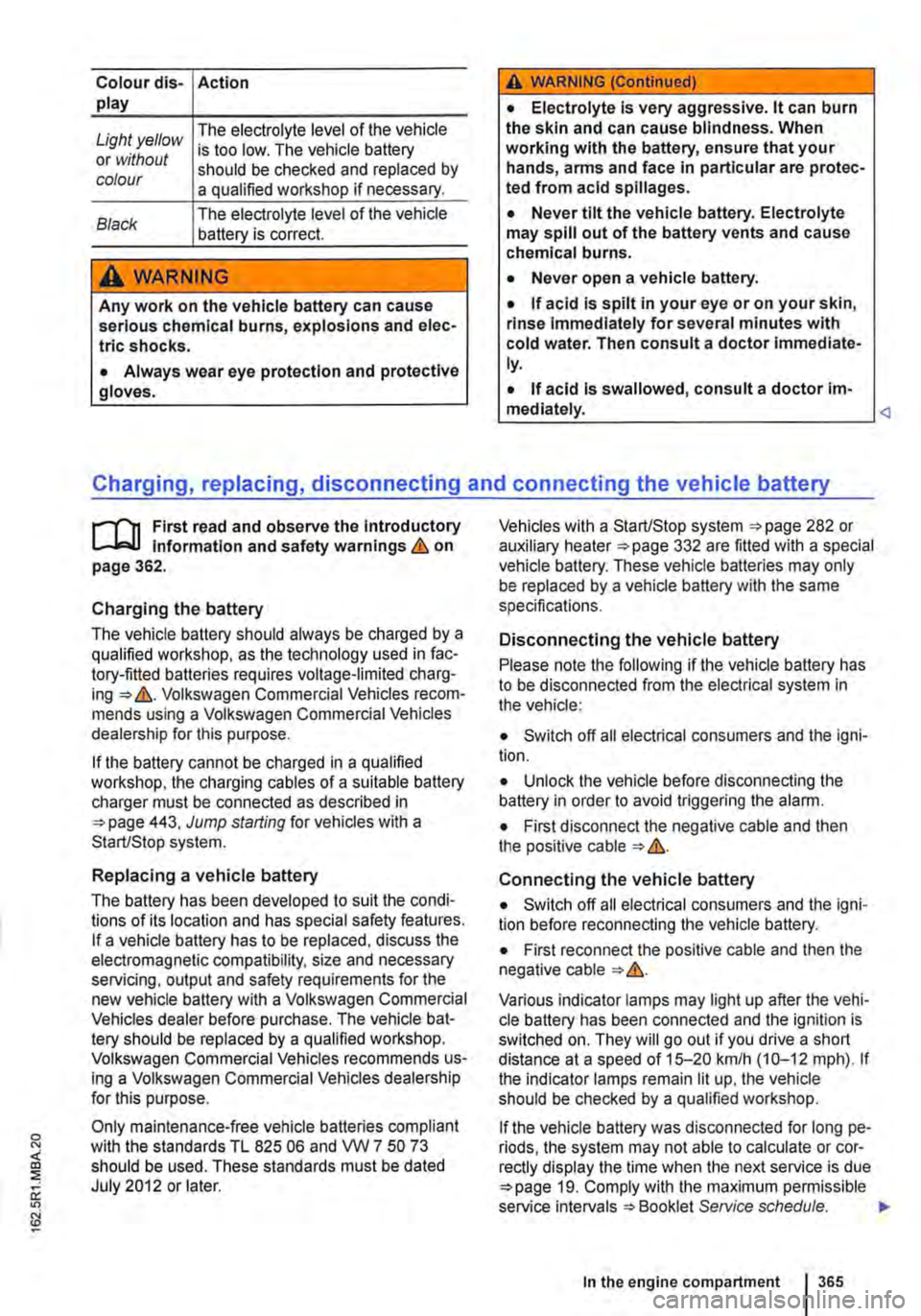
Colour dis-Action play
Light yellow The electrolyte level of the vehicle
or without is too low. The vehicle battery
colour should be checked and replaced by a qualified workshop if necessary.
Black The electrolyte level of the vehicle battery is correct.
A WARNING
Any work on the vehicle battery can cause serious chemical burns, explosions and elec-trlc shocks.
• Always wear eye protection and protective gloves.
A WARNING (Continued)
• Electrolyte is very aggressive. lt can burn the skin and can cause blindness. When working with the battery, ensure that your hands, arms and face in particular are protec-ted from acid spillages.
• Never tilt the vehicle battery. Electrolyte may spill out of the battery vents and cause chemical burns.
• Never open a vehicle battery.
• if acid is spilt in your eye or on your skin, rinse immediately for several minutes with cold water. Then consult a doctor immediate-ly.
• If acid is swallowed, consult a doctor im-mediately.
r-"f'n First read and observe the introductory L-Jo:.l.l information and safety warnings & on page 362.
Charging the battery
The vehicle battery should always be charged by a qualified workshop, as the technology used in fac-tory-fitted batteries requires voltage-limited charg-ing => &. Volkswagen Commercial Vehicles recom-mends using a Volkswagen Commercial Vehicles dealership for this purpose.
If the battery cannot be charged in a qualified workshop, the charging cables of a suitable battery charger must be connected as described in =>page 443, Jump starting for vehicles with a Start/Stop system.
Replacing a vehicle battery
The battery has been developed to suit the condi-tions of its location and has special safety features. If a vehicle battery has to be replaced, discuss the electromagnetic compatibility, size and necessary servicing, output and safety requirements for the new vehicle battery with a Volkswagen Commercial Vehicles dealer before purchase. The vehicle bat-tery should be replaced by a qualified workshop. Volkswagen Commercial Vehicles recommends us-ing a Volkswagen Commercial Vehicles dealership for this purpose.
Only maintenance-free vehicle batteries compliant with the standards TL 825 06 and VVV 7 50 73 should be used. These standards must be dated July 2012 or later.
Vehicles with a Start/Stop system =>page 282 or auxiliary heater =>page 332 are fitted with a special vehicle battery. These vehicle batteries may only be replaced by a vehicle battery with the same specifications.
Disconnecting the vehicle battery
Please note the following if the vehicle battery has to be disconnected from the electrical system in the vehicle:
• Switch off all electrical consumers and the igni-tion.
• Unlock the vehicle before disconnecting the battery in order to avoid triggering the alarm.
• First disconnect the negative cable and then the positive cable => &.
Connecting the vehicle battery
• Switch off all electrical consumers and the igni-tion before reconnecting the vehicle battery.
• First reconnect the positive cable and then the negative cable=>&.
Various indicator lamps may light up after the vehi-cle battery has been connected and the ignition is switched on. They will go out if you drive a short distance at a speed of 15-20 kmlh (10-12 mph). If the indicator lamps remain lit up, the vehicle should be checked by a qualified workshop.
if the vehicle battery was disconnected for long pe-riods, the system may not able to calculate or cor-rectly display the time when the next service is due =>page 19. Comply with the maximum permissible service intervals =>Booklet Service schedule. ""
In the engine compartment 365
Page 399 of 486
Additional functions that are contractually agreed with the customer, e.g. vehicle positioning in an emergency, allow certain vehicle data to be trans-mitted from the vehicle.
Event data recorder
The vehicle is not fitted with an event data record-er.
Event data recorders temporarily store vehicle in-formation. This provides precise information in the event of an accident. In vehicles with an airbag system, data that might be relevant in the event of an accident can be stored, e.g. impact speed, belt buckle status, seat positions and trigger speed. The scope of the data is manufacturer-specific.
An event data recorder may only be fitted if the owner has approved the procedure. This is cov-ered by legislation in some countries.
Reprogramming control units
All data for the control of components are stored in the control units. Some convenience functions, such as lane change flash, single door unlocking and displays, can be reprogrammed using special workshop equipment. If this is the case, the de-scriptions in your vehicle wallet will no longer cor-respond with the original functions. Volkswagen Commercial Vehicles recommends that any re-programming should be confirmed in the service schedule under "Workshop comments".
Information about possible reprogramming can be obtained from the Volkswagen dealership.
Reading the vehicle's event memory
There is a diagnostic interface for reading the event memories in the vehicle interior &. Data relating to the function and status of the electronic control units are stored in the event memory. Addi-tional information on the stored data is available from qualified workshops.
The diagnosis interface is located in the footwell on the driver side behind a cover next to the lever for opening the bonnet.
The event memory should only be read and reset by a qualified workshop.
After a fault has been rectified, the information in the memory pertaining to the fault is deleted. Other memory content is overwritten on an on-going ba-sis.
A WARNING
Incorrect use of the diagnostic Interface can cause faults, which can result in accidents and serious injuries.
• Never read the event memory using the di-agnostic Interface yourself.
• The diagnostic Interface should only be read by a qualified workshop.
external aerial
,...--.m First read and observe the introductory L--I=>U information and safety warnings & on page 394.
Both during telephone calls and in standby mode, mobile telephones transmit and receive radio waves, which may also be termed "high-frequency energy". Current scientific literature warns us that radio waves can be harmful to human beings if they exceed certain limits. Government bodies and international committees have introduced threshold values and guidelines to ensure that electromag-netic radiation produced by mobile telephones does not pose a hazard to health. However, there is no proven scientific evidence that demonstrates that cordless telephones are absolutely safe.
For this reason, some experts are calling for more precautions to be taken in the use of mobile tele-phones, by taking steps to reduce the level of per-sonal exposure to electromagnetic radiation.
If a mobile telephone that is not connected to the vehicle's external aerial is used inside the vehicle, the level of electromagnetic radiation could be higher than when the mobile telephone is connec-ted to an integrated aerial or any other external aerial.
If the vehicle is fitted with a suitable hands-free unit which enables the use of innumerable additional functions of Bluetooth® compatible mobile tele-phones, this will satisfy the legal requirements in many countries which permit the use of a mobile telephone in a vehicle only if a hands-free unit is used.
The factory-fitted hands-free system in your vehicle has been developed for use with mobile tele-phones that are compatible with Bluetooth®_ Mo-bile telephones must be carried in a suitable tele-phone holder or be stored securely in the vehicle. If a telephone holder is used it must be securely at-tached to the base plate. This is the only way to .,.
Vehicle care and maintenance 399
Page 404 of 486
In the interest of data protection. Depending on which services are activated, any relevant In-formation must also be given to the driver.
m Volkswagen collects, processes, transmits W and uses personal data entered by the user within the framework of legal regulations for the purpose of smooth functioning of individual Volks-wagen Car-Net services and their provision. Data
Applications (apps)
r""('n First read and observe the Introductory 1....-J,:.lJ Information and safety warnings & on page 402.
Many mobile devices have the option to download applications (apps). Apps can display additional in-formation regarding factory-fitted radio and naviga-tion systems or can allow you to activate, manage or deactivate certain functions in the vehicle.
Applications, use of applications and the required mobile network may be subject to fees.
The range of applications available can be wide or they can be vehicle-specific and country-specific =>CD. Content, range and provider of applications can vary. Some applications also depend on avail-ability of services offered by third parties. A mobile network with sufficient signal strength for exchange of data must be available for the use of applica-tions.
The provider of an application may provide a de-scription of it.
Due to the high number of mobile devices and the fast pace of software development, the applica-tions on offer cannot be operated on all mobile de-
Consumer information
CQJ Introduction
This chapter contains information on the following subjects:
Information stickers and plates . . . . . . . . . . . . 405 Using the vehicle in other countries and continents . . . . . . . . . . . . . . . . . . . . . . . . . . 405 Radio reception and aerials . . . . . . . . 406 Volkswagen Commercial Vehicles repair information . . . . . . . . . . . . . . . . . . . . 406
Declaration of conformity 406 Recycling and scrapping end-of-life vehicles . 407
404 Cleaning and maintenance
is not forwarded to third parties. Current terms of use can be found at www.volkswagen-commercial-vehicles-carnet.com.
m Volkswagen Car-Net services is a system W based on a mobile network. If a fault arises despite the fact that all requirements have been fulfilled, please try using the services again at a lat-er stage.
Applications can be changed, set, deactivated, re-activated and expanded without prior notice.
The network or cable connection between the fac-tory-fitted radio or navigation system and mobile device must be adequate and free of interruptions to allow for the use of applications.
Q)
Volkswagen Is not responsible for damage to the vehicle caused by poor quality or faulty ap-plications, Insufficient programming of applica-tions, Insufficient network strength or loss of data during transmission or by misuse of the mobile equipment.
• Exterior views =>page 5
• Pull-away assist systems =>page 282
• Accessories, modifications, repairs and renewal of parts =>page 394
• =>Booklet Service schedule .,.
Page 405 of 486
A WARNING
Handling the vehicle Incorrectly will Increase the risk of accident and Injuries.
• Comply with legal regulations.
• Observe the owner's manual.
Information stickers and plates
r--('n First read and observe the introductory L-1=.1.1 information and safety warnings & on page 404.
Safety certificates, stickers and plates showing im-portant vehicle operation information are factory-fit-ted in the engine compartment and on certain parts such as the tank flap, front passenger sun visor, the driver door pillar or in the luggage compart-ment floor.
• Never remove or damage the safety certifi-cates, stickers and plates. They must remain legi-ble at all times.
• If vehicle parts bearing safety certificates, stick-ers or plates are removed from the vehicle, re-placement safety certificates, stickers or plates with the same information must be applied properly to the new parts by the qualified workshop.
CD
Handling the vehicle incorrectly could lead to the vehicle becoming damaged.
• Comply with legal regulations.
• Carry out service jobs in accordance with the service schedule.
• Observe the owner's manual.
Safety certificate
A safety certificate on the door pillar of the driver door provides the information that all necessary safety standards and specifications of the transport safety authorities of the individual country have been met at the time of production. The month and year of production and the chassis number may al-so be listed.
High voltage warning sticker
There is a sticker near the bonnet lock showing a warning about the high voltage in the vehicle's electrical system. The vehicle's ignition system ful-fils the requirements of standards that include
r--('n First read and observe the lntrod uctory L-Jo-ll Information and safety warnings & on page 404.
The vehicle has been manufactured specifically for a particular country and complies with the registra-tion regulations that applied in that country at the time of vehicle production.
If you want to use the vehicle abroad for a short period, all relevant information and Instructions should be followed 34, Driving abroad.
If the vehicle is going to be sold in another country or used in another country for an extended period, the legal requirements applicable in that country must be observed.
In some cases, certain equipment will have to be fitted or removed and functions deactivated. The service scope and service types could also be af-
fected. This is particularly important if the vehicle is driven in another climate region for a long period of time.
Because different frequency bands are used in dif-ferent countries, the factory-fitted radio or naviga-tion system may not work in other countries.
Rail transport
Due to differing tunnel heights and loading stand-ards in some countries, there may be restrictions on transporting your vehicle by rail or special measures may be required. Volkswagen Commer-cial Vehicles Service will provide information on
Vehicle care and maintenance 405