mirror VOLKSWAGEN TRANSPORTER 2015 Owner´s Manual
[x] Cancel search | Manufacturer: VOLKSWAGEN, Model Year: 2015, Model line: TRANSPORTER, Model: VOLKSWAGEN TRANSPORTER 2015Pages: 486, PDF Size: 72.17 MB
Page 313 of 486
A WARNING (Continued)
• Never use the lane change assist system on unsurfaced roads. The lane change assist system has been designed exclusively for use on surfaced roads.
• Always pay close attention to what Is hap-pening around the vehicle.
• Never use the lane change assist system, If the radar sensors are dirty, covered or dam-aged. These circumstances can Impair the proper functioning of the system.
• lt may be hard to see the display In the ex-terior mirror In direct sunlight.
Indicator lamp
.---T'n First read and observe the introductory L-J,:..IJ Information and safety warnings & on page 312.
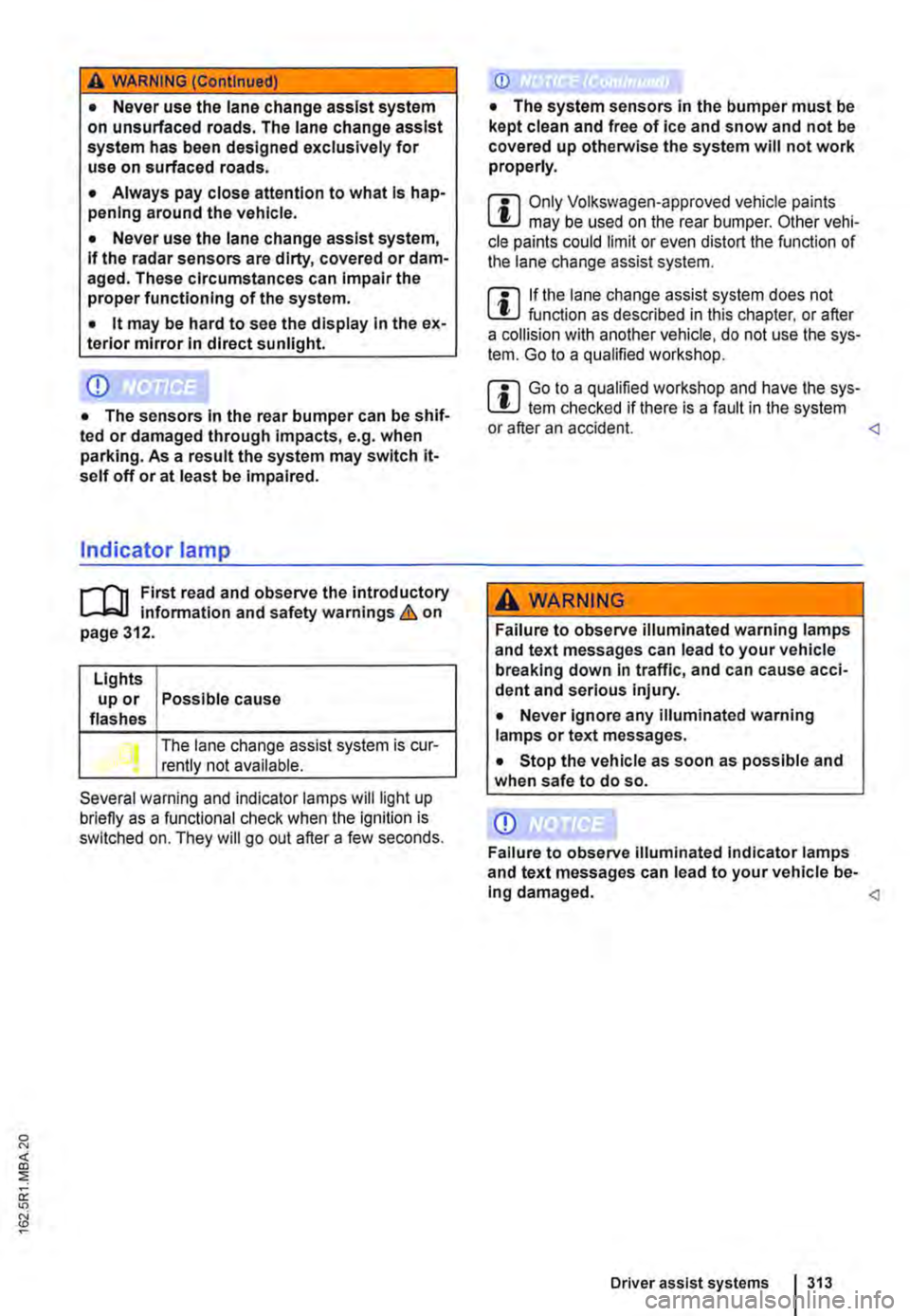
Lights up or Possible cause flashes
The lane change assist system is cur-rently not available.
Several warning and indicator lamps will light up briefly as a functional check when the ignition is switched on. They will go out after a few seconds.
m Only Volkswagen-approved vehicle paints L!..J may be used on the rear bumper. Other vehi-cle paints could limit or even distort the function of the lane change assist system.
m If the lane change assist system does not L!..J function as described in this chapter, or after a collision with another vehicle, do not use the sys-tem. Go to a qualified workshop.
m Go to a qualified workshop and have the sys-L!..J tern checked ifthere is a fault in the system or after an accident.
Failure to observe illuminated warning lamps and text messages can lead to your vehicle breaking down in traffic, and can cause acci-dent and serious Injury.
• Never ignore any illuminated warning lamps or text messages.
• Stop the vehicle as soon as possible and when safe to do so.
Page 314 of 486
Operation
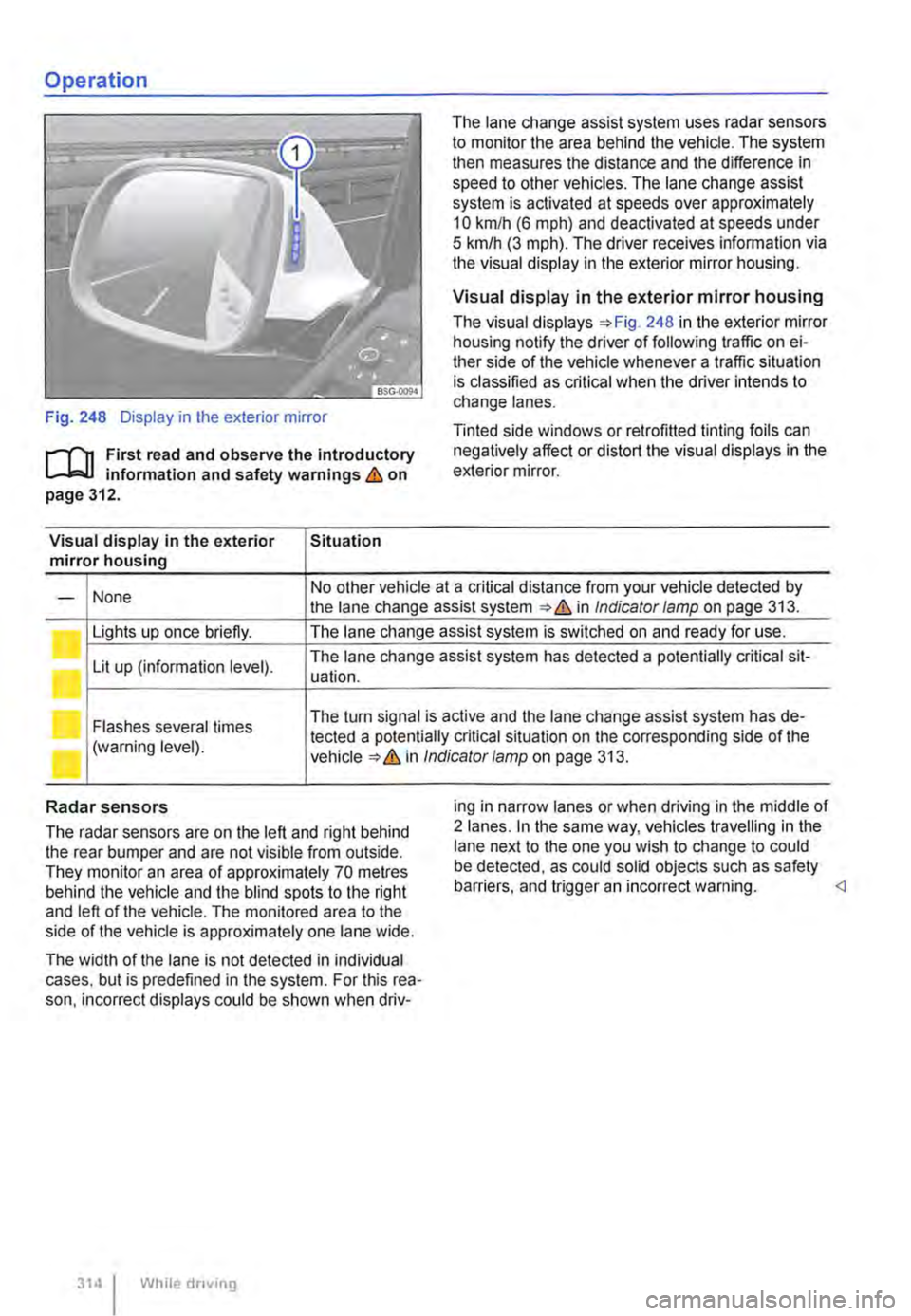
Fig. 248 Display in the exterior mirror
r-f"n First read and observe the introductory L-W! information and safety warnings & on page 312.
Visual display in the exterior Situation mirror housing
The lane change assist system uses radar sensors to monitor the area behind the vehicle. The system then measures the distance and the difference in speed to other vehicles. The lane change assist system is activated at speeds over approximately 10 km/h (6 m ph) and deactivated at speeds under 5 km/h (3 mph). The driver receives infonmation via the visual display in the exterior mirror housing.
Visual display in the exterior mirror housing
The visual displays 248 in the exterior mirror housing notify the driver of following traffic on ei-ther side of the vehicle whenever a traffic situation is classified as critical when the driver intends to change lanes.
Tinted side windows or retrofitted tinting foils can negatively affect or distort the visual displays in the exterior mirror.
None No other vehicle at a critical distance from your vehicle detected by -the lane change assist system & in Indicator lamp on page 313.
Lights up once briefly. The lane change assist system is switched on and ready for use.
Lit up (information level). The lane change assist system has detected a potentially critical sit-uation.
Flashes several times The turn signal is active and the lane change assist system has de-
(warning level). tected a potentially critical situation on the corresponding side of the in Indicator/amp on page 313.
Radar sensors
The radar sensors are on the left and right behind the rear bumper and are not visible from outside. They monitor an area of approximately 70 metres behind the vehicle and the blind spots to the right and left of the vehicle. The monitored area to the side of the vehicle is approximately one lane wide.
The width of the lane is not detected in individual cases. but is predefined in the system. For this rea-son. incorrect displays could be shown when driv-
314 I While driving
ing in narrow lanes or when driving in the middle of 2 lanes. In the same way, vehicles travelling in the lane next to the one you wish to change to could be detected, as could solid objects such as safety barriers. and trigger an incorrect warning.
Page 315 of 486
![VOLKSWAGEN TRANSPORTER 2015 Owner´s Manual Driving situations
A
(I
Fig. 249 [A] Driving situation when overtaking with traffic behind the vehicle [81 Visual display in the left-hand exterior mirror.
A
Fig. 250 situation when overtaking an](/img/18/40253/w960_40253-314.png "VOLKSWAGEN TRANSPORTER 2015 Owner´s Manual Driving situations
A
(I
Fig. 249 [A] Driving situation when overtaking with traffic behind the vehicle [81 Visual display in the left-hand exterior mirror.
A
Fig. 250 situation when overtaking an")
Driving situations
A
(I
Fig. 249 [A] Driving situation when overtaking with traffic behind the vehicle [81 Visual display in the left-hand exterior mirror.
A
Fig. 250 situation when overtaking and pulling in. [B' Visual display in the right-hand exterior mirror.
rll1 First read and observe the introductory L-W.I Information and safety warnings & on page 312.
The following driving situations trigger a light in the exterior mirror 249 [ID (arrow) or 250 [ID (arrow):
• When another vehicle is overtaking your vehi-cle 249
• When overtaking another vehicle 250 with a speed difference of up to approximately 15 km/h (9 m ph). No display will be shown if the take-over manoeuvre is much faster.
The display in the exterior mirror will be shown ear-lier the faster you are nearing another vehicle as the lane change assist system calculates the
speed difference to other vehicles. For this reason, the display could be activated at different times de-spite your vehicle being at the same distance from other vehicles.
Physical and system-specific limits
The lane change assist system might, for example, interpret the traffic situation incorrectly in certain driving situations. In the following situations, for ex-ample:
• In tight bends.
• When road lanes are of varying width.
• At the brow of a hill.
• In poor weather conditions.
• Where there are special roadside structures, e.g. high or offset crash barriers. <1
Driver Alert System (recommendation for rest breaks)
o::n Introduction
This chapter contains information on the following subjects:
Function and operation by the user.. . . . 316
The Driver Alert System informs the driv-
er if their driving shows signs of tired-
ness.
Driver assist systems 315
Page 380 of 486
Vehicle care and maintenance
Caring for and cleaning the vehicle exterior
o:n Introduction
This chapter contains information on the following subjects:
Washing the vehicle . . . . . . . . . . . . . . . 381
Washing the vehicle with a high-pressure cleaner . . . . . . . . . . . . . . . . . . . . . . . . . . . 382 Cleaning windows and exterior mirrors . . . . . . 382
Cleaning and changing wiper blades 383
Waxing and polishing the vehicle 384
Cleaning and caring for chrome and aluminium trim parts . . . . . . . . . . . . . . 385
Cleaning and caring for the decorative film . . 385
Cleaning wheels . . . . . . . . . . . . . . . . . . . . . 386
Care of rubber seals . . . . . . . . . . . . . . . . . . . . . 386
De-icing door lock cylinders . . . . . . • . . . . . . . . 387
Undersea! . . . . . . . . . . . . . . . . . . . . . . . . . . . . . . 387
Cleaning the engine compartment . 387
Regular and expert care helps to maintain the val-ue of the vehicle. Proper maintenance may also be one of the requirements for the approval of warran-ty claims in the event of corrosion or paint defects.
Suitable care products are available from Volkswa-gen Commercial Vehicles dealers.
Additional information and warnings:
• Preparation for working in the engine compart-ment ::-page 350
• Cleaning and caring for the interior ::-page 388
• Accessories, modifications, repairs and renewal of parts ::-page 394
A WARNING
Car care products can be toxic and hazard-ous. Unsuitable care products and Incorrect application of care products can cause acci-dents, serious Injuries, burns or poisoning.
• The care product must be kept In Its origi-nal sealed container.
380 Cleaning and maintenance
A WARNING (Continued)
• Read the manufacturer's Instructions .
• Never store car care products in empty food containers, bottles or any other non-original containers as people finding these containers may not know that they contain care products.
• Keep children away from care products .
• The products can give off harmful fumes during use. They should therefore only be used outside or In well-ventilated spaces.
• Never use fuel, turpentine, engine oil, nail varnish remover or other volatile fluids to wash, clean or care for your vehicle. These substances are toxic and highly Inflammable.
A WARNING
Incorrect care and cleaning of vehicle parts can Impair the safety features of the vehicle and thus cause serious Injury.
• Vehicle parts must be cleaned according to the manufacturer's Instructions.
• Only use approved or recommended cleaning products.
CD
Cleaning agents that contain solvents attack the material and can cause damage.
r:Q:... In the interests of environmental protection, "C!S the vehicle should only be washed in special-ly provided wash bays. This prevents waste water contaminated with oil, grease or fuel from entering the sewerage system. In some countries, washing vehicles anywhere else may be prohibited.
r:Q:... Environmentally-friendly care products "C!S should be used.
r:Q:... Leftover car care products should not be dis-"C!S posed of with ordinary household waste. Read the manufacturer's instructions.
Page 381 of 486
Washing the vehicle
r-f'n First read and observe the introductory Information and safety warnings & on page 380.
The longer substances such as insects, bird drop-pings, resinous tree sap, road dirt, industrial de-posits, tar, soot or road salt and other corrosive materials remain on the vehicle, the more damage they do to the paintwork. High temperatures (for in-stance in strong sunlight) accelerate the corrosion process. The underside of the vehicle should also be cleaned thoroughly and regularly.
Car washes
Please observe the signs on the automatic car wash. Before using an automatic car wash take the usual precautions, such as closing all windows and folding in the exterior mirrors, in order to avoid damage to the vehicle. You must consult the car wash operator if there are special parts on your ve-hicle such as spoilers, roof luggage carrier systems or radio aerials ::.CD.
The paint is so hard-wearing that the car can nor-mally be washed without problems in an automatic car wash. However, the effect on the paint de-pends to a large extent on the design of the car wash. Volkswagen Commercial Vehicles recom-mends the use of car washes without brushes.
To remove any wax residue from the windows and to stop wipers rubbing, please note the following points ::.page 382, Cleaning windows and exterior mirrors.
Washing the car by hand
When washing by hand, first soften the dirt with plenty of water and rinse off as well as possible.
Then clean the vehicle with a soft sponge, a glove or a brush using only light pressure. Start with the roof and work from the top to the bottom. Use a shampoo for very stubborn dirt only.
The sponge or glove should be wrung out thor-oughly at regular intervals.
Clean the wheels, sill panels etc. last. Use a differ-ent sponge for this purpose.
A WARNING
Parts of the vehicle with sharp edges can cause Injury.
• Protect your hands and arms from cuts on sharp parts, for example when cleaning the underbody or the inside of the wheel hous-lngs.
A WARNING
After the car has been washed, the braking effect could set in later than normal and ex-tend the braking distance as the brake discs and brake pads will be wet, or iced up In win-ter.
• You can "dry and de-ice" the brakes by performing careful braking manoeuvres. Make sure that you do not endanger any oth-er road users or violate any legal regulations when doing so.
CD
• The water should be no warmer than +so•c (+140.FJ.
• Do not wash the vehicle in direct sunlight in order to avoid damage to the vehicle palntwork.
• Never clean with insect sponges, rough kitchen sponges or similar products as these can damage the surface.
• Never clean the headlights with a dry cloth or sponge. Always use a wet cloth or sponge. lt is best to use soapy water.
• Washing the vehicle In cold weather: if the vehicle is rinsed with a hose, do not direct the water at the lock cylinders or the gaps around the doors, boot, or bonnet. The locks and seals could freeze.
CD
Observe the following guidelines before driving the vehicle into an automatic car wash in order to avoid damage to the vehicle:
• Ensure that the gap between the guide rails In the car wash is sufficient for the vehicle track. If the track is too narrow your wheels and tyres will be damaged.
• Switch off the rain sensor before driving the vehicle Into an automatic car wash.
• Check that the car wash is tall and wide enough for your vehicle.
• Fold In the exterior mirrors. Electrically fold-Ing exterior mirrors must be moved electrically. Do not fold them in and out by hand.
• In order to prevent damage to the palntwork on the bonnet, fold the wipers back onto the windscreen after drying the wiper blades. Do not drop the wipers onto the glass.
• Lock the tailgate to prevent it from opening accidentally In the car wash.
Page 382 of 486

Washing the vehicle with a high-pressure cleaner
I""""'T'n First read and observe the Introductory L.-lo:oJ.I information and safety warnings & on page 380.
Follow the instructions provided by the manufactur-er when cleaning your vehicle using a high-pres-sure cleaner. This applies in particular to the pres-sure and the spraying distance=>&.
Maintain sufficient distance to soft materials such as rubber hoses, insulation, and the ParkPilot sen-sors. The ParkPilot sensors are located in the front bumper, and in some cases also in the rear bump-er =>
A WARNING
The incorrect use of a high-pressure cleaner can cause visible and invisible long-term damage to tyres and other materials. This can cause accidents and serious injuries.
• Maintain sufficient distance between the washer jet and the tyres.
• Never clean the tyres with concentrated jet nozzles (dirt blasters). The tyres may incur visible and invisible damage even if cleaned briefly with the spray at a distance.
A WARNING
After the car has been washed, the braking effect could set in later than normal and ex-tend the braking distance as the brake discs and brake pads will be wet, or iced up in win-ter.
• You can "dry and de-ice" the brakes by performing careful braking manoeuvres. Make sure that you do not endanger any oth-er road users or violate any legal regulations when doing so.
CD
• The water may be no warmer than +so·c (+140.FJ.
• Do not wash the vehicle In direct sunlight In order to avoid damage to the vehicle palntwork.
• The ParkPilot sensors In the bumpers must be kept clean and free of Ice. When cleaning with pressure hoses or steam cleaners, the sensors should only be sprayed briefly and the steam/hose nozzle must be kept more than 10 cm away.
• Do not clean windows that are iced over or covered In snow with a high-pressure cleaner.
• Washing the vehicle in cold weather: If the vehicle is rinsed with a hose, do not direct the water Into the lock cylinders or the gaps round the doors, boot, or bonnet. The locks and seals could freeze.
I""""'T'n First read and observe the introductory L.-lo:oJ.I information and safety warnings & on page 380.
Cleaning windows and exterior mirrors
Moisten the windows and exterior mirrors with commercially available, alcohol-based glass clean-er.
382 Cleaning and maintenance
Dry the glass surfaces with a clean chamois leath-er or a lint-free cloth. Chamois leathers that have been used on painted surfaces are not suitable for use on glass surfaces. They will be soiled with wax deposits which could smear the surfaces.
Use window cleaner or a silicone remover to clean off rubber, oil, grease and silicone deposits =>
Page 383 of 486
Removing wax
Car washes and care products could leave wax deposits on the glass surfaces. Wax residue can only be removed using a special cleaning product or cleaning cloths. Wax deposits on the wind-screen can cause the wiper blades to rub. Volks-wagen Commercial Vehicles recommends that a glass cleaning cloth G 052 522 A1 be used to re-move wax deposits from the windows and exterior mirrors each time the vehicle is washed.
A window cleaning agent specifically for removing wax will stop the blades rubbing if added to the windscreen wash water. Dilute the cleaner as in-structed. Grease-removing cleaners will not re-move wax deposits =-CD.
Special cleaners, glass cleaners and glass clean-ing cloths are available from Volkswagen Commer-cial Vehicles dealerships.
Removing snow
Use a small brush to remove snow from the win-dows and exterior mirrors.
Removing ice
The best method for removing ice is to use a de-icer spray. If you use an ice scraper, do not move it to and fro, but push it in one direction only. Mov-ing the ice scraper backwards can cause dirt to scratch the window.
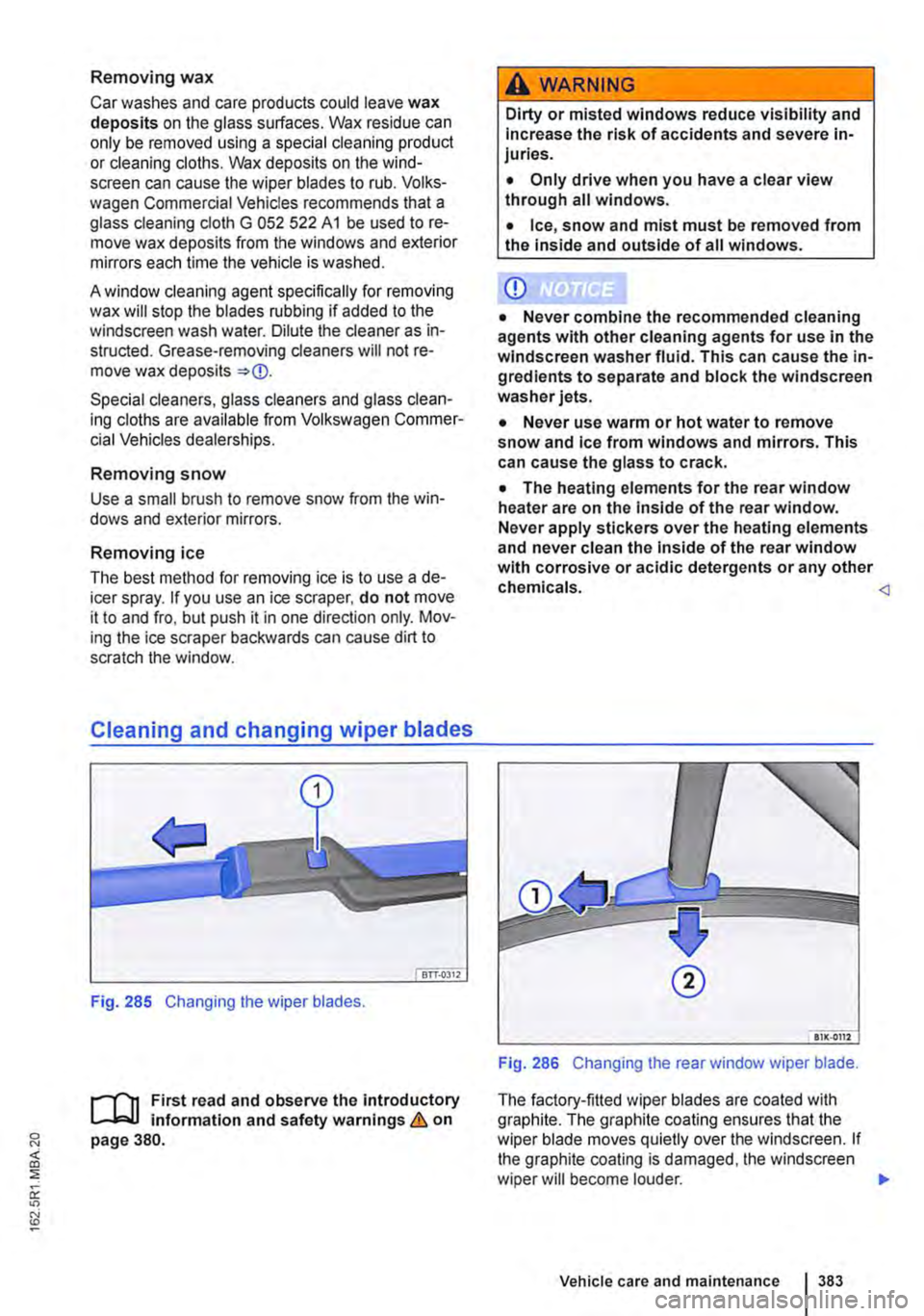
Cleaning and changing wiper blades
Fig. 285 Changing the wiper blades.
1"'111 First read and observe the introductory l..-J,:.U information and safety warnings & on page 380.
A WARNING
Dirty or misted windows reduce visibility and Increase the risk of accidents and severe in-juries.
• Only drive when you have a clear view through all windows.
• Ice, snow and mist must be removed from the inside and outside of all windows.
CD
• Never combine the recommended cleaning agents with other cleaning agents for use in the windscreen washer fluid. This can cause the in-gredients to separate and block the windscreen washer jets.
• Never use warm or hot water to remove snow and Ice from windows and mirrors. This can cause the glass to crack.
• The heating elements for the rear window heater are on the Inside of the rear window. Never apply stickers over the heating elements and never clean the inside of the rear window with corrosive or acidic detergents or any other chemicals.
The factory-fitted wiper blades are coated with graphite. The graphite coating ensures that the wiper blade moves quietly over the windscreen. If the graphite coating is damaged, the windscreen wiper will become louder. .,..
Vehicle care and maintenance 383
Page 396 of 486
should be replaced at a qualified workshop. Volks-wagen Commercial Vehicles dealers are kept up to date with regard to any changes.
A WARNING
Unsuitable service fluids and consumables, and the Incorrect use of these fluids and con-sumables, can cause accidents, serious inju-ries, burns or poisoning.
• Service fluids must be kept In their origi-nal sealed container.
• Never store service fluids In empty food containers, bottles or any other non-original containers as people finding these containers could drink them.
• Keep children away from all service fluids and consumables.
• Always read and follow the Information and warnings on the service fluid packaging.
Repairs and technical modifications
.....-T'n First read and observe the Introductory l-J,::JJ Information and safety warnings & on page 394.
Repairs and modifications must always be car-ried out according to Volkswagen Commercial Vehicles specifications =:ob:,!
Unauthorised modifications to the electronic com-ponents or software in the vehicle may cause faults. As the electronic components are linked to-gether in networks. other systems may be affected by the faults. This can seriously impair safety, lead to excessive wear of components, and also invalid-ate the type approval for the vehicle.
The Volkswagen Commercial Vehicles dealer can-not be held liable for any damage caused by tech-nical modifications and/or work performed incor-rectly.
The Volkswagen Commercial Vehicles dealer can-not be held liable for any damage caused by tech-nical modifications and/or work performed incor-rectly. This is also not covered by the Volkswagen guarantee.
3961 Clt!aning and maintenance
A WARNING (Continued)
• When using products that give off harmful fumes, always work outdoors or In a well-ventilated area.
• Never use fuel, turpentine, engine oil, nail varnish remover or other volatile fluids for vehicle care. They are toxic and highly flam-mable. They could cause fires and explo-sions.
CD
• Only use suitable service fluids for refilling. Never use the wrong service fluid. Failure to observe this warning can result In serious mal-functions and engine damage.
• Optional equipment and other accessories In front of the air Inlet reduce the cooling effect of the coolant. The engine may overheat at high ambient temperatures and high engine loads.
Leaking service fluids can pollute the envi-C!IS ronment. Spilt service fluids must be collec-ted in suitable containers and disposed of properly and with respect for the environment.
Vehicles with special auxiliary equipment or body parts
The manufacturer of these components must en-sure that these parts (fittings) adhere to the stipula-ted environmental laws and regulations, particular-ly the EU directive 2000/53/EC concerning end-of-life vehicles and EU directive 2003/11/EC concern-ing the restriction on the marketing and use of cer-tain dangerous substances and preparations.
The vehicle owner should keep all assembly docu-mentation for these auxiliary fittings, and pass it on to any scrapping company later engaged. This is to facilitate environmentally responsible disposal for all vehicles, Including refitted vehicles.
Windscreen repairs
To function properly, some items of equipment re-quire a camera or sensor, which Is located on the inside of the windscreen near the interior mirror. If the windscreen in the viewing field of the camera ,..
Page 406 of 486
CD
• Volkswagen Commercial Vehicles Is not re-sponsible for any vehicle damage which Is caused by low-quality fuel, inadequate servic-ing work or lack of availability of Genuine Parts.
Radio reception and aerials
i"""(")1 First read and observe the Introductory l-J.::.U information and safety warnings & on page 404.
The vehicle aerials are located in the exterior mir-rors. If any metallic chrome plates, such as chrome mirror caps, are retrofitted to the exterior mirrors you may experience problems with the radio,
CD
• Volkswagen Commercial Vehicles cannot be held responsible If the vehicle does not comply with or only partly complies with the relevant legal requirements In other countries and conti-nents.
m Interference with AM radio reception could W occur if electrical devices are used in the vi-cinity of the aerial.
i"""(")1 and observe the introductory l-J.::.U mformat1on and safety warnings & on page 404.
Volkswagen Commercial Vehicles Service infonna-tion and official Volkswagen Commercial Vehicles repair infonnation can be purchased from the fol-lowing addresses:
Please contact a Volkswagen Commercial Vehicles dealership or a qualified workshop or order the lit-erature you require from www.erwin.volkswagen.de.
Declaration of conformity
i"""(")1 First read and observe the introductory l-J.::.U information and safety warnings & on page 404.
The individual manufacturer declares herewith that the following products conform, at the time of vehi-cle production, with the basic requirements and other relevant laws and regulations, including FCC Part 15.19, FCC Part 15.21 and RSS-Gen Issue 1:
4061 Clean1ng and mamtenance
A WARNING
Incorrect repairs and modifications can cause functional problems and damage to the vehicle and impair the effectiveness of the driver assist systems and the alrbag sys-tems. This can result In accidents and severe Injuries.
• Repairs and modifications to your vehicle should only be carried out by a qualified workshop.
• Electronic immobilizer.
• Remote control key for the vehicle.
• Remote control for the supplementary heating system (auxiliary heater).
Electrical equipment
• 12-volt socket.
Page 410 of 486
If and when
Practical tips
Frequently asked questions
If you suspect that a vehicle fault has arisen or your vehicle has been damaged, read and observe the following information before contacting a Volkswagen Commercial Vehicles dealership or
qualified workshop. You may also find useful infor-mation in the index under the headings "Things to note" or "Checklist".
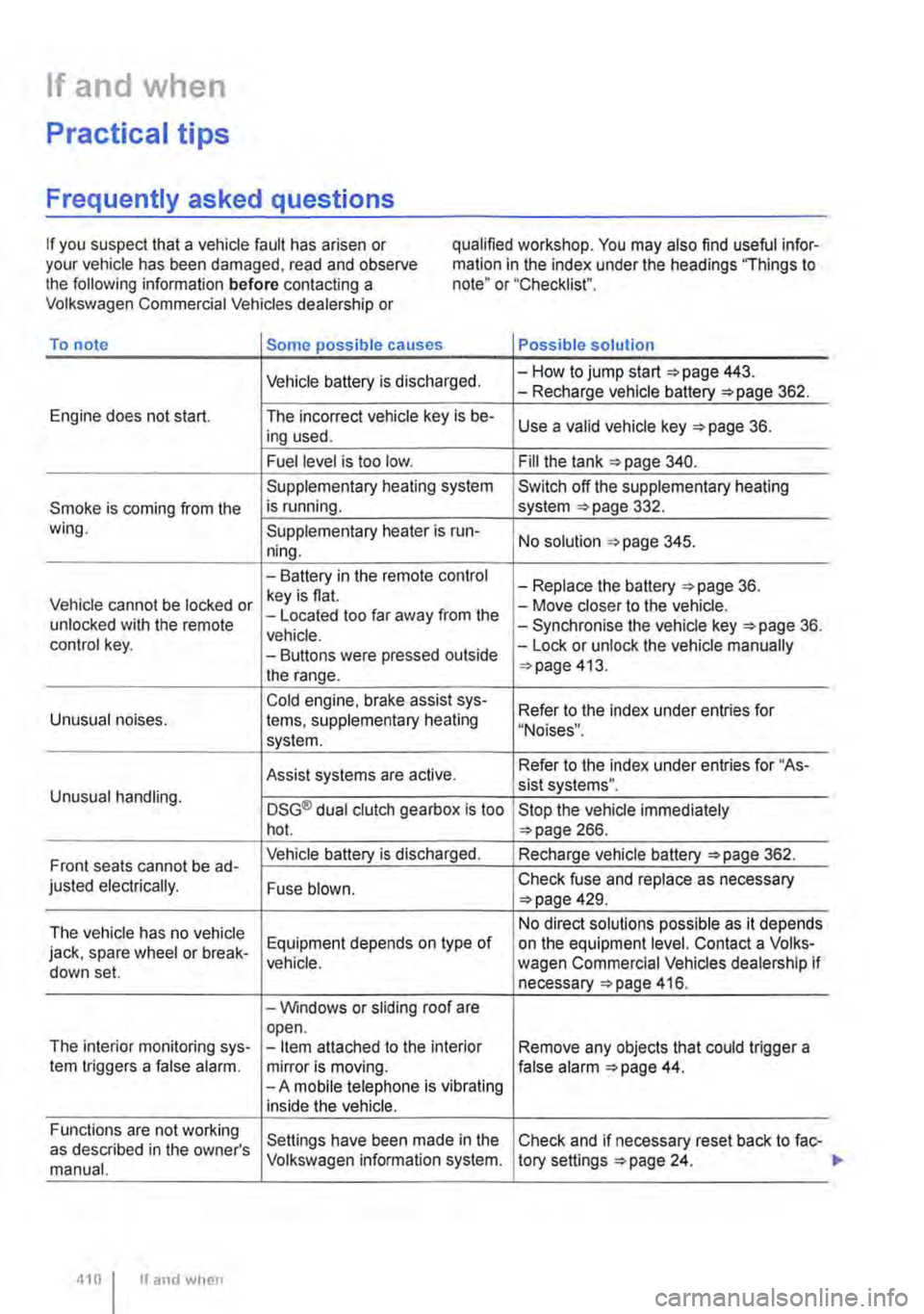
To note Some possible causes Possible solution
Vehicle battery is discharged. -How to jump start =>page 443. -Recharge vehicle battery 362.
Engine does not start. The incorrect vehicle key is be-Use a valid vehicle key 36. ing used.
Fuel level is too low. Fill the tank 340.
Supplementary heating system Switch off the supplementary heating
Smoke is coming from the is running. system 332. wing. Supplementary heater is run-No solution 345. ning.
-Battery in the remote control -Replace the battery 36. Vehicle cannot be locked or key is flat. -Move closer to the vehicle. unlocked with the remote -Located too far away from the -Synchronise the vehicle key =>page 36. vehicle. control key. -Buttons were pressed outside -Lock or unlock the vehicle manually
the range. 413.
Cold engine. brake assist sys-Refer to the index under entries for Unusual noises. tems, supplementary heating "Noises". system.
Assist systems are active. Refer to the index under entries for "As-sist systems". Unusual handling. DSG® dual clutch gearbox is too Stop the vehicle immediately hot. 266.
Front seats cannot be ad-Vehicle battery is discharged. Recharge vehicle battery 362.
justed electrically. Fuse blown. Check fuse and replace as necessary 429.
The vehicle has no vehicle No direct solutions possible as it depends
jack, spare wheel or break-Equipment depends on type of on the equipment level. Contact a Volks-vehicle. wagen Commercial Vehicles dealership if down set. necessary 416.
-Windows or sliding roof are open. The interior monitoring sys--Item attached to the interior Remove any objects that could trigger a tem triggers a false alarm. mirror is moving. false alarm 44. -A mobile telephone is vibrating inside the vehicle.
Functions are not working Settings have been made in the Check and if necessary reset back to fac-as described in the owner's manual. Volkswagen information system. tory settings 24.
410 I If and when