remove seats VOLKSWAGEN TRANSPORTER 2015 Owner´s Manual
[x] Cancel search | Manufacturer: VOLKSWAGEN, Model Year: 2015, Model line: TRANSPORTER, Model: VOLKSWAGEN TRANSPORTER 2015Pages: 486, PDF Size: 72.17 MB
Page 271 of 486
A WARNING (Continued)
• If the brake warning lamp ID does not go out, or if it lights up when driving, the brake fluid level in the reservoir is too low or there is a fault in the brake system. Stop the vehi-cle Immediately and seek expert assistance 277, Brake fluid.
• If the brake warning lamp@ lights up to-gether with the ABS indicator lamp S, the control function of the ABS may have failed. This can cause the rear wheels to lock quick-ly when you brake. Locked rear wheels can lead to a loss of control of the vehicle. If pos-sible, reduce your speed and drive carefully at low speed to the nearest qualified work-shop in order to have the brake system tes-ted. Avoid sudden braking and driving ma-noeuvres on the way.
• The ABS Is not functioning correctly if the ABS indicator lampS does not go out or comes on while the vehicle is in motion. The
Handbrake
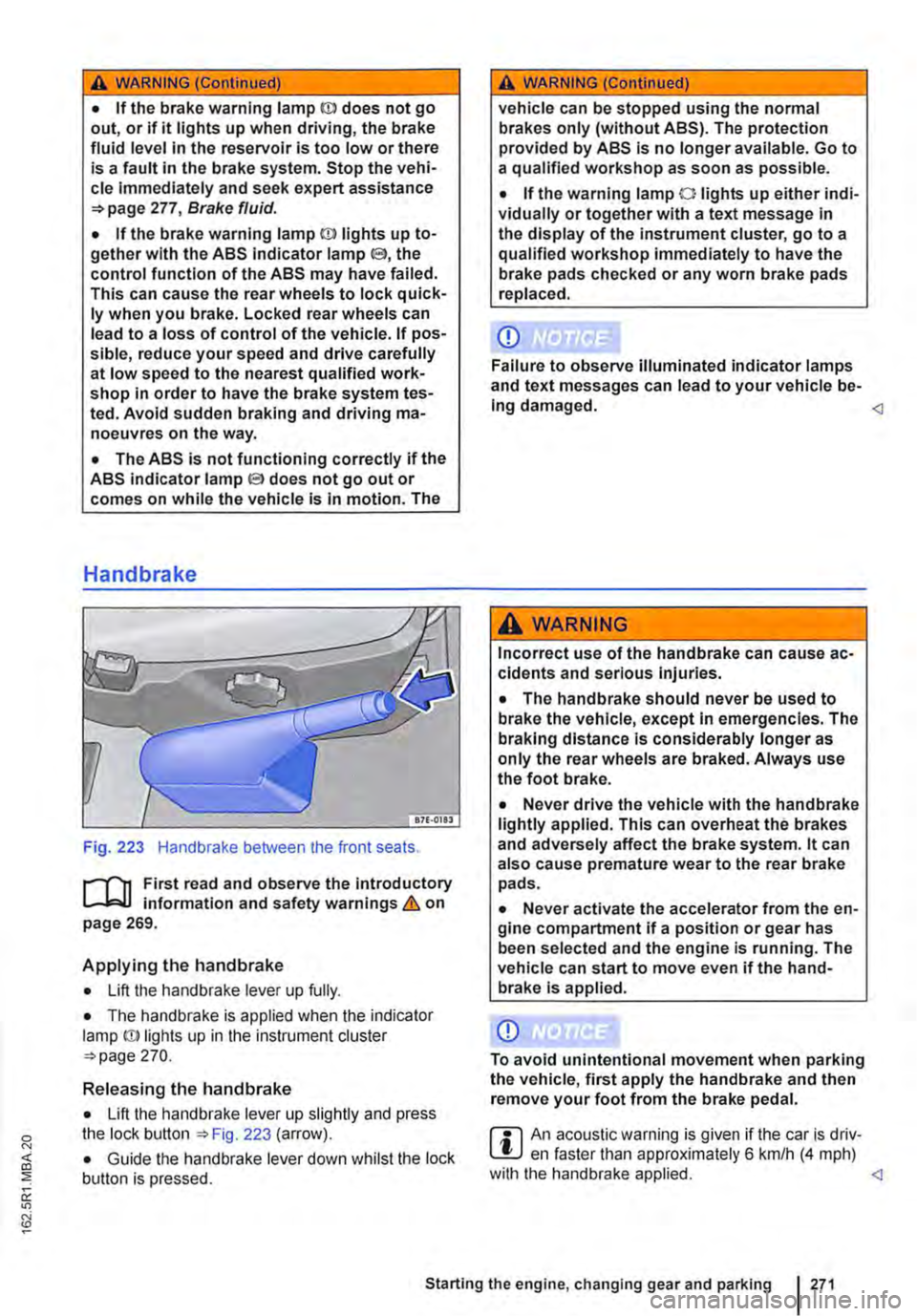
Fig. 223 Handbrake between the front seats.
r--fl1 First read and observe the introductory L-J,::.IJ information and safety warnings & on page 269.
Applying the handbrake
• Lift the handbrake lever up fully.
• The handbrake is applied when the indicator lamp ID lights up in the instrument cluster =-page 270.
Releasing the handbrake
• Lift the handbrake lever up slightly and press the lock button ::.Fig. 223 (arrow).
• Guide the handbrake lever down whilst the lock button is pressed.
A WARNING (Continued)
vehicle can be stopped using the normal brakes only (without ABS). The protection provided by ABS is no longer available. Go to a qualified workshop as soon as possible.
• If the warning lamp 0 lights up either indi-vidually or together with a text message in the display of the instrument cluster, go to a qualified workshop immediately to have the brake pads checked or any worn brake pads replaced.
CD
Failure to observe illuminated indicator lamps and text messages can lead to your vehicle be-Ing damaged.
Incorrect use of the handbrake can cause ac-cidents and serious Injuries.
• The handbrake should never be used to brake the vehicle, except in emergencies. The braking distance is considerably longer as only the rear wheels are braked. Always use the foot brake.
• Never drive the vehicle with the handbrake lightly applied. This can overheat the brakes and adversely affect the brake system. lt can also cause premature wear to the rear brake pads.
• Never activate the accelerator from the en-gine compartment if a position or gear has been selected and the engine is running. The vehicle can start to move even if the hand-brake Is applied.
CD
To avoid unintentional movement when parking the vehicle, first apply the handbrake and then remove your foot from the brake pedal.
r::l An acoustic warning is given if the car is driv-L.!:.J en faster than approximately 6 km/h (4 mph) with the handbrake applied.
Page 389 of 486

m Suitable care products are available from a W Volkswagen Commercial Vehicles dealership.
r--f'n First read and observe the introductory L-J,::.U Information and safety warnings & on page 388.
Checklist
Please note the following for the cleaning and maintenance of the seat covers =>Q):
v' Before getting into the vehicle, close all Vel-era fasteners that could touch the cloth seat covers and fabric trims. Open Velcro fasten-ers can cause damage to cloth seat covers and fabric trims.
v' Avoid the direct contact of sharp-edged items and accessories to the upholstery and fabric trims in order to prevent damage. Ac-cessories include zips, studs, rhinestones on clothing or belts.
v' Dust and grit in upholstery pores, folds and seams should be removed regularly so that no lasting damage is caused to the surface of the seats by scratching.
v' Always check whether garments are colour-fast to prevent damage to the upholstery. This is especially important for light-col-oured upholstery.
CD
Ignoring any ofthe items on this important checklist for maintaining the seat covers can lead to damage or discolouration of the seat covers and fabric trims.
• Follow the Instructions on the checklist.
m Volkswagen Commercial Vehicles recom-l!.J mends that stained upholstery is cleaned by a specialist company.
r--f'n First read and observe the introductory L-J,::.IJ information and safety warnings & on page 388.
Cleaning upholstery on seat cushions with seat heating, electrically adjustable seats, or seats containing airbag components
Airbag-related components and electrical connec-tors may be installed in the driver seat, passenger seat and sometimes also in the rear outer seats. Seat cushions or backrests that are damaged, in-correctly cleaned or treated, or that become wet, may cause damage to the vehicle electrics or trig-ger a fault in the airbag system => &.
Electrical components and connectors are installed in electrically adjustable seats and seat cushions with seat heating. These can be damaged if cleaned or treated incorrectly =>Q). This can also result in damage to other parts of the vehicle elec-trics.
To avoid this please follow these cleaning guide-lines:
• Do not use high-pressure cleaners, steam cleaners or coolant spray.
• Do not use washing paste or fine detergent sol-utions.
• Avoid getting the seat wet.
• Only use detergents that have been approved by Volkswagen.
• If in doubt, consult a specialist cleaning compa-ny.
Cleaning upholstery on seat cushions without seat heating, seats that are not electrically adjustable, and seats that do not contain airbag components
• Please read and follow the instructions, notes and warnings on the package before using clean-ing products.
• Upholstery, fabric trims, Alcantara® seat covers and carpeting should be cleaned regularly with a vacuum cleaner (brush).
• Do not use high-pressure cleaners, steam cleaners or coolant spray.
Vehicle care and maintenance 389
Page 390 of 486
• We recommend that you use a soft sponge or commercially available lint-free microfibre cloth for cleaning jobs
• Clean Alcantara® surfaces with a slightly damp cotton or woollen cloth or a commercially available lint-free microfibre cloth
General surface soiling of the upholstery and fabric trim can be cleaned with a commercially available foam cleaner.
If the upholstery and fabric trims are generally heavily soiled, consult a Volkswagen dealership for information on suitable cleaning methods before attempting any cleaning. If required, take the vehi-cle to a specialist cleaning company.
Treating stains
When treating stains, it may be necessary to clean the entire surface and not just the stain itself. This particularly applies if the surface shows general signs of wear. The cleaned area could otherwise be lighter than the surrounding area. If in doubt, consult a specialist cleaning company.
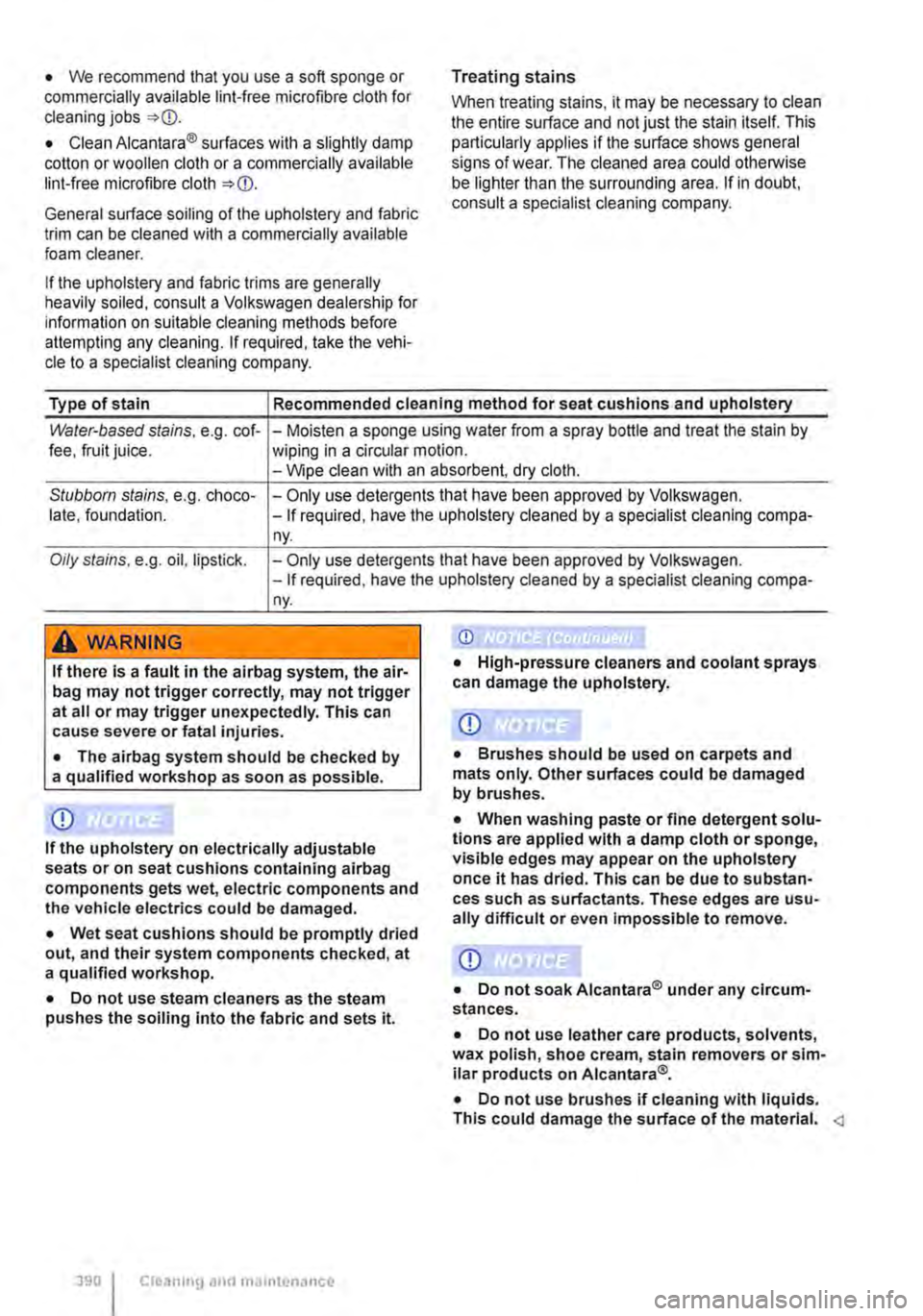
Type of stain Recommended cleaning method for seat cushions and upholstery
Water-based stains, e.g. cof-fee, fruit juice. -Moisten a sponge using water from a spray bottle and treat the stain by wiping in a circular motion. -Wipe clean with an absorbent, dry cloth.
Stubborn stains, e.g. choco--Only use detergents that have been approved by Volkswagen. late, foundation. -If required, have the upholstery cleaned by a specialist cleaning compa-ny.
Oily stains, e.g. oil, lipstick. -Only use detergents that have been approved by Volkswagen. -If required, have the upholstery cleaned by a specialist cleaning compa-ny.
A WARNING CD
If there is a fault in the airbag system, the air-bag may not trigger correctly, may not trigger at all or may trigger unexpectedly. This can cause severe or fatal injuries.
• The airbag system should be checked by a qualified workshop as soon as possible.
Q)
If the upholstery on electrically adjustable seats or on seat cushions containing airbag components gets wet, electric components and the vehicle electrics could be damaged.
• Wet seat cushions should be promptly dried out, and their system components checked, at a qualified workshop.
• Do not use steam cleaners as the steam pushes the soiling into the fabric and sets it.
390 Cleaning and maintenance
• High-pressure cleaners and coolant sprays can damage the upholstery.
Q)
• Brushes should be used on carpets and mats only. Other surfaces could be damaged by brushes.
• When washing paste or fine detergent solu-tions are applied with a damp cloth or sponge, visible edges may appear on the upholstery once it has dried. This can be due to substan-ces such as surfactants. These edges are usu-ally difficult or even Impossible to remove.
Q)
• Do not soak Alcantara® under any circum-stances.
• Do not use leather care products, solvents, wax polish, shoe cream, stain removers or sim-ilar products on Alcantara®.
• Do not use brushes if cleaning with liquids. This could damage the surface of the material.
Page 393 of 486
A wARNING
Check the condition of all seat belts regularly. If the belt webbing or any other part of the seat belt becomes damaged have it removed and replaced immediately by a qualified workshop. Damaged seat belts are very dan-gerous and can cause severe or fatal injuries.
• Never use chemical cleaning agents on the seat belts or their components. Further-more the seat belts may not come Into con-tact with corrosive fluids, solvents or sharp objects. These could considerably weaken the webbing.
• After cleaning, allow seat belts to dry completely before rolling them up. Otherwise the automatic belt retractors could become damaged and thus Impair their function.
Cleaning cool box
)""""'('n First read and observe the Introductory L.-J,:,JJ Information and safety warnings & on page 388.
Cleaning seat rails
)""""'('n First read and observe the introductory information and safety warnings & on page 388.
Clean the surface of the seat rails on a regular ba-sis
• Use a narrow nozzle on a vacuum cleaner to remove sand, dirt etc. from the seat rails.
Cleaning opaque shades
)""""'('n First read and observe the introductory information and safety warnings & on page 388.
For the best cleaning results have the opaque shades dry cleaned.
A WARNING (ConUnued)
• Avoid allowing foreign bodies or liquids to enter the slot for the seat belt buckle. This could prevent the belt buckle and seat belt from working properly.
• Never try to repair, modify or remove the seat belts yourself.
• Damaged seat belts must be replaced im-mediately with new seat belts approved by Volkswagen Commercial Vehicles for your ve-hicle type. Seat belts subjected to stress and stretched during an accident must be re-placed by a qualified workshop. Renewal may be necessary even if there is no apparent damage. The belt anchorage should also be checked.
• Clean the cool box with a household detergent before using it for the first time and whenever it needs cleaning.
• To prevent mould and mildew from forming in the cool box when it is not being used for long peri-ods, place a folded dry towel between the box and its lid.
CD
If seats are moved when the seat rails are soiled, the seat rails and the seat feet could be damaged.
Please refer to the information on the labels sewn into the opaque shades before cleaning in a wash-ing machine.
Vehicle care and maintenance 393
Page 397 of 486
or sensors has been damaged, e.g. by stone im-pact, the windscreen must be replaced. Repairing the crack can lead to malfunction or functional faults in the equipment.
After changing the windscreen, the camera and sensors must be set up and calibrated by a quali-fied workshop.
A WARNING
Incorrect repairs and modifications can cause functional problems and damage to the vehicle and impair the effectiveness of the driver assist systems. This can result In acci-dents and severe Injuries.
• Repairs and modifications to your vehicle should only be carried out by a qualified workshop.
Repairs and faults in the airbag system
,....,..,. First read and observe the introductory l.-Jo:-11 Information and safety warnings&. on page 394.
Repairs and modifications must always be car-ried out according to Volkswagen Commercial Vehicles specifications"*&.!
Modifications and repairs to the front bumper, the doors, the front seats, the headliner, or the body-work should be carried out by a qualified work-shop. System components and airbag system sen-sors might be fitted on these vehicle components.
If you work on the airbag system or remove and in-stall parts of the system when performing other re-pair work, parts of the airbag system may be dam-aged. The consequence may be that, in the event of an accident, the airbag inflates incorrectly or does not inflate at all.
Regulations must be observed to ensure that the effectiveness of the airbags is not reduced and that removed parts do not cause any injuries or envi-ronmental pollution. Qualified workshops are famili-ar with these requirements.
Any modifications to the vehicle's suspension could prevent the airbag system from working properly during a collision. For example, using tyre/ rim combinations which have not been approved by Volkswagen Commercial Vehicles, lowering the vehicle, making modifications to the suspension rate including work on the springs, struts and shock absorbers could cause the forces which are measured by the airbag sensors and sent to the electronic control unit to change. Some changes to the suspension could cause the forces measured by the sensors to increase. This can lead to the airbag system being triggered in collision scenarios
where it normally would not be triggered if modifi-cations to the suspension had not been made. Other modifications can cause the forces meas-ured by the sensors to decrease. therefore pre-venting the airbag system from being triggered when it should have been.
A WARNING
Incorrect repairs and modifications can cause function problems and damage to the vehicle and Impair the effectiveness of the alrbag system. This can result In accidents and serious or even fatal injuries.
• Repairs and modifications to your vehicle should only be carried out by a qualified workshop.
• Alrbag modules cannot be repaired. They must be replaced.
• Never use recycled airbag components or components that have been taken from end-of-life vehicles In your vehicle.
A WARNING
Modifications to the vehicle's suspension, in-cluding the use of unsuitable tyre/rim combi-nations, can cause the alrbag system to work differently and increase the risk of serious or fatal injuries In the event of an accident.
• Never install any components in the sus-pension system that do not have the same characteristics as the original factory-fitted components.
• Never use tyre/rim combinations that have not been approved by Volkswagen Commer-cial Vehicles.
Vehicle care and maintenance 397
Page 410 of 486
If and when
Practical tips
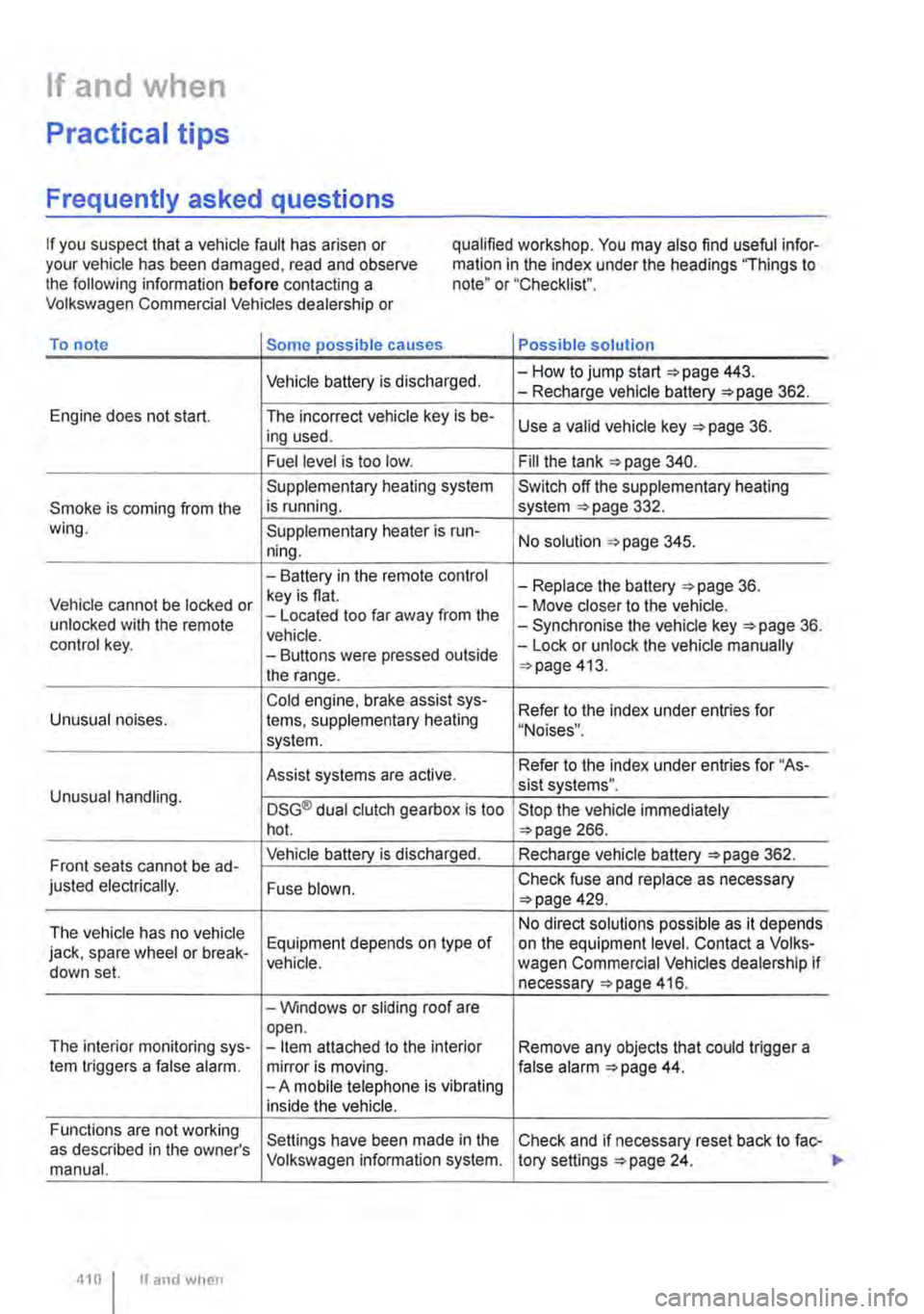
Frequently asked questions
If you suspect that a vehicle fault has arisen or your vehicle has been damaged, read and observe the following information before contacting a Volkswagen Commercial Vehicles dealership or
qualified workshop. You may also find useful infor-mation in the index under the headings "Things to note" or "Checklist".
To note Some possible causes Possible solution
Vehicle battery is discharged. -How to jump start =>page 443. -Recharge vehicle battery 362.
Engine does not start. The incorrect vehicle key is be-Use a valid vehicle key 36. ing used.
Fuel level is too low. Fill the tank 340.
Supplementary heating system Switch off the supplementary heating
Smoke is coming from the is running. system 332. wing. Supplementary heater is run-No solution 345. ning.
-Battery in the remote control -Replace the battery 36. Vehicle cannot be locked or key is flat. -Move closer to the vehicle. unlocked with the remote -Located too far away from the -Synchronise the vehicle key =>page 36. vehicle. control key. -Buttons were pressed outside -Lock or unlock the vehicle manually
the range. 413.
Cold engine. brake assist sys-Refer to the index under entries for Unusual noises. tems, supplementary heating "Noises". system.
Assist systems are active. Refer to the index under entries for "As-sist systems". Unusual handling. DSG® dual clutch gearbox is too Stop the vehicle immediately hot. 266.
Front seats cannot be ad-Vehicle battery is discharged. Recharge vehicle battery 362.
justed electrically. Fuse blown. Check fuse and replace as necessary 429.
The vehicle has no vehicle No direct solutions possible as it depends
jack, spare wheel or break-Equipment depends on type of on the equipment level. Contact a Volks-vehicle. wagen Commercial Vehicles dealership if down set. necessary 416.
-Windows or sliding roof are open. The interior monitoring sys--Item attached to the interior Remove any objects that could trigger a tem triggers a false alarm. mirror is moving. false alarm 44. -A mobile telephone is vibrating inside the vehicle.
Functions are not working Settings have been made in the Check and if necessary reset back to fac-as described in the owner's manual. Volkswagen information system. tory settings 24.
410 I If and when
Page 416 of 486
Vehicle toolkit
CCll Introduction
This chapter contains information on the following subjects:
Stowage Contents 416 417
Observe any country-specific legislation when se-curing your vehicle in the event of a breakdown.
Additional information and warnings:
• Seat functions, passenger compartment 72
• Stowage =>page 150
• Preparation for working in the engine compart-ment page 350
• In an emergency =>page 411
• Changing a wheel 420
• Breakdown set =>page 425
Stowage
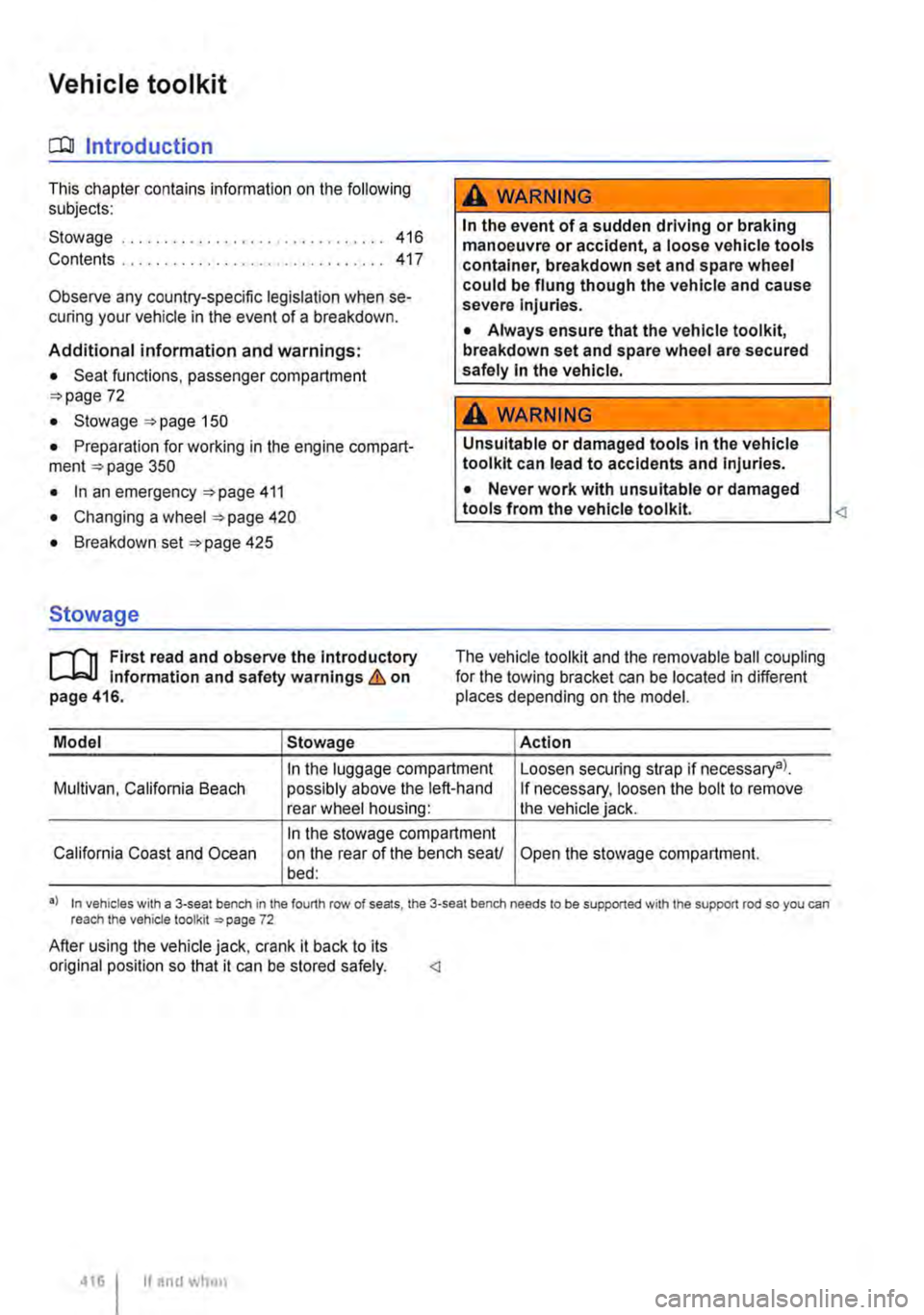
r-111 First read and observe the introductory L-J,::.U information and safety warnings & on page 416.
Model Stowage
A WARNING
In the event of a sudden driving or braking manoeuvre or accident, a loose vehicle tools container, breakdown set and spare wheel could be flung though the vehicle and cause severe injuries.
• Always ensure that the vehicle toolkit, breakdown set and spare wheel are secured safely in the vehicle.
A WARNING
Unsuitable or damaged tools in the vehicle tool kit can lead to accidents and injuries.
• Never work with unsuitable or damaged tools from the vehicle toolklt.
Action
In the luggage compartment Loosen securing strap if necessarya)_ Multivan, California Beach possibly above the left-hand If necessary, loosen the bolt to remove rear wheel housing: the vehicle jack.
In the stowage compartment California Coast and Ocean on the rear of the bench sea V Open the stowage compartment. bed:
•I In vehicles with a 3-seat bench in the fourth row of seats, the 3-seat bench needs to be supported with the support rod so you can reach the vehicle toolkit , page 72
After using the vehicle jack, crank it back to its original position so that it can be stored safely.
Page 477 of 486
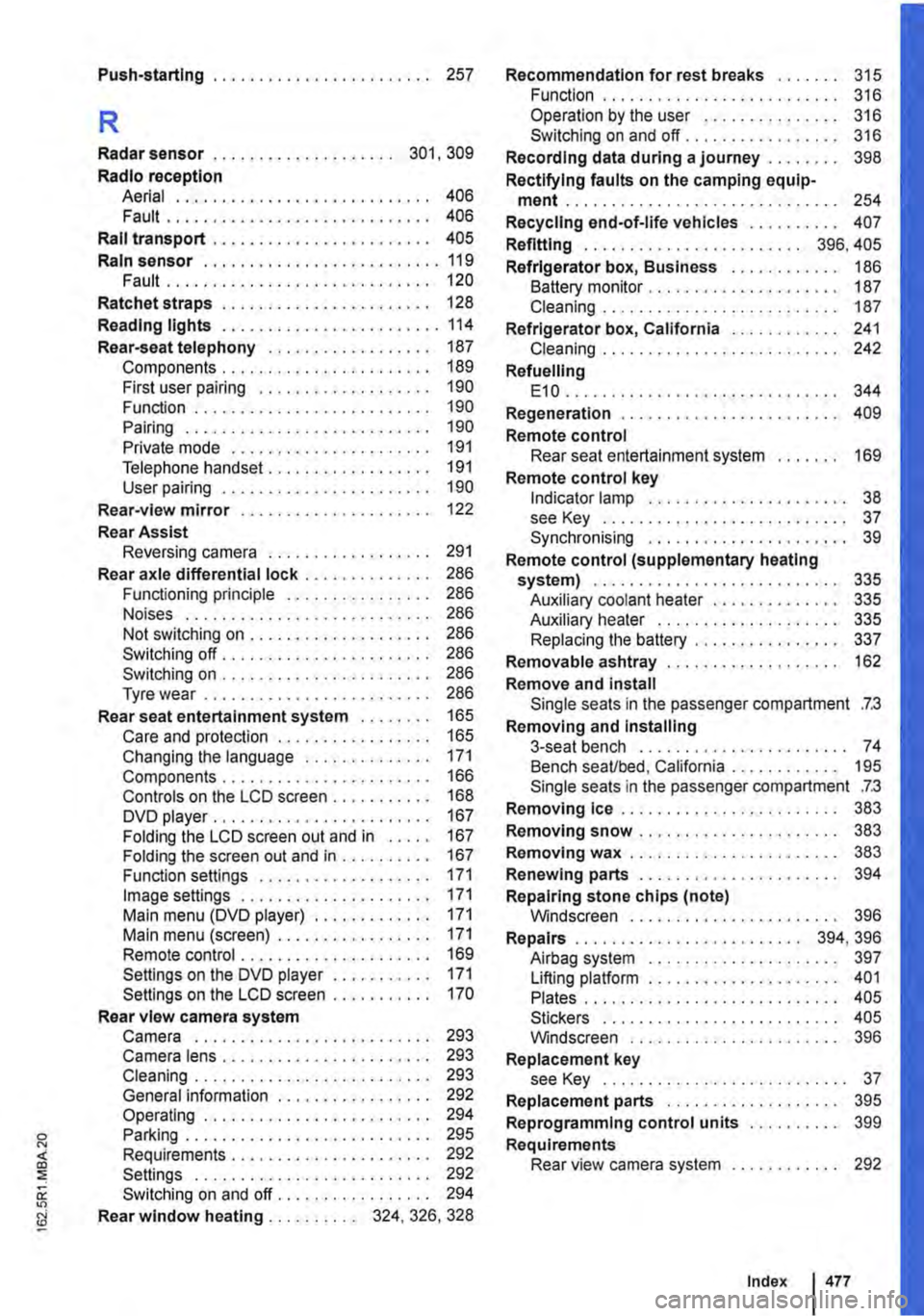
Push-starting . . . . . . . . . . . . . . . . . . . . . . . . 257
R
Radar sensor . . . . . . . . • . . . . . . . . . . . 301, 309
Radio reception Aerial . . . . . . . . . . . . . . . . . . . . . . . . . . . . 406 Fault .........•...........•....... 406
Rail transport . . . . . . . . . . . . . . . . . . . . . . . . 405
Rain sensor . . . . . . . . . . . . . . . . . . . . . . . . . . 119 Fault . . . . . . . . . . . . . . . . . . . . . . . . . . . . . 120
Ratchet straps . . . . . . . . . . . . . . . . . . . . . . . 128
Reading lights ...............•........ 114
Rear-seat telephony . . . . . . . . . . . . . . . . . . 187 Components . . . . . . . . . . . . . . . . . . . . . . . 189 First user pairing . . . . . . . . . . . • . . . . . . . 190 Function . . . . . . . . . . . . . . . . . . . . . . . . . . 190 Pairing . . . . . . . . . . . . . . . . . . . • . . . . . . . 190 Private mode . . . . . . . . . . . . . . . . . . . . . . 191 Telephone handset . . . . . . . . . . • . . . . . . . 191 User pairing . . . . . . . . . . . . . . . . . . . . . . . 190
Rear-view mirror . . . . . . . • . . . . . . . . . . . . . 122
Rear Assist Reversing camera . . . . . . . . . . . . . . . . . . 291
Rear axle differential lock . . . • . . . . . . . . . . 286 Functioning principle . . . . . . . . . . . . . . . . 286 Noises ........................... 286 Not switching on . . . . . . . . . . . . . . . . . . . . 286 Switching off . . . . . . . . . . . . . . . . . . . . . . . 286 Switching on . . . . . . . . . . . . . . . . . . . . . . . 286 Tyre wear . . . . . . . . . . . . . . . . . . . . . . . . . 286
Rear seat entertainment system . . . . . . . . 165 Care and protection . . . . . . . . . . . . . . . . . 165 Changing the language . . . . . . • . . 171 Components . . . . . . . . . . . . . . . . . . . . . . . 166 Controls on the LCD screen . . . . . . . . . . . 168 DVD player. . . . . . . . . . . . . . . . . . . . . . . . 167 Folding the LCD screen out and in . . . . . 167 Folding the screen out and in . . . . . . . . . . 167 Function settings . . . . . . . . . . . . . . . . . . . 171 Image settings . . . . . . . . . . .. . . . . . . . . . . 171 Main menu (DVD player) . . . . . • . . . . . . . 171 Main menu (screen) . . . . . . . . . . . . . . . . . 171 Remote control . . . . . . . . . . . . . . . . . . . . . 169 Settings on the DVD player . . . . . . . . . . . 171 Settings on the LCD screen . . . . . . . . . . . 170
Rear view camera system Camera .......................... 293 Camera lens . . . . . . . . . • . . . . . . . . . . . . . 293 Cleaning . . . . . . . . . . . . . . . . . . . . . . . . . . 293 General information . . . • . . . . . . . . . . . . . 292 Operating . . . . . . . . . . . . . . . . . . . . . . . . . 294 Parking . . . . . . . . . . . . . . . . . . . . . . . . . . . 295 Requirements . . . . . . . . • . . . . . . . . . . . . . 292 Settings . . . . . . . . . . . . . . . . . . . . . . . . . . 292 Switching on and off . . . . . . . . . . . . . . . . . 294 Rear window heating . . . . . . . . . . 324, 326, 328
Recommendation for rest breaks . . . . . . . 315 Function . . . . . . . . . . . . . . . . . . . . . • . . . . 316 Operation by the user . . . . . . . . . . . . . . . 316 Switching on and off................. 316
Recording data during a journey . . . . . . . . 398
Rectifying faults on the camping equip-ment .............................. 254
Recycling end-of-life vehicles . . . . . . . . . . 407 Refitting . . . . . . . . . . . . . . . . . . . . . . . . 396, 405
Refrigerator box, Business . . . . . . . . . . . . 186 Battery monitor . . . . . . . . . . . . . . . . . . . . . 187 Cleaning . . . . . . . . . . . . . . . . . . . . . . . . . . 187 Refrigerator box, California . . . . . . . . . . . . 241 Cleaning . . . . . . . . . . . . . . . . . . . . . . . . . . 242
Refuelling E10 . . . . . . . . . . . • . . . . . . . . • . . . . . . . . . 344
Regeneration . . . . . . . . . . . . . . . . . . . . . . . . 409
Remote control Rear seat entertainment system . . . . . . . 169
Remote control key Indicator lamp . . . . . . . . . . . • . . . . . . . . . . 38 see Key . . . . . . . . . . . . . . . . . . . . . . . . . . . 37 Synchronising . . . . . . . . . . . . . . . . . . . . . . 39
Remote control (supplementary heating system) . . . . . . . . . . . . . . . . . . . . . . . . . . . 335 Auxiliary coolant heater . . . . . . . . . . . . . . 335 Auxiliary heater . . . . . . . . . . . . . . . . . . . . 335 Replacing the battery . . . . . . . . . . . . . . . . 337
Removable ashtray . . . . . . . . . . . . . . . . . . . 162
Remove and Install Single seats in the passenger compartment .7.3
Removing and Installing 3-seat bench . . . . . . . . . . . . . . . . . . . . . . . 74 Bench seaUbed, California . . . . . . . . . . . . 195 Single seats in the passenger compartment .7.3
Removing Ice . . . . . . . . . . . . . . . . . . . . . . . . 383
Removing snow . . . . . . . . . . . . . . . . . . . . . . 383 Removing wax . . . . . . . . . . . . . . . . . . . . . . . 383 Renewing parts . . . . . . . . . . . . . . . . . . . . . . 394
Repairing stone chips (note) Windscreen . . . . . . . . . . . . . . . . . . . . . . . 396
Repairs . . . . . . . . . . • . . . . . . . . . . . . . . 394, 396 Airbag system . . . . . . . . . . . . . . . . . . . . . 397 Lifting platform . . . . . . . • . . . . . . . . . . 401 Plates . . . . . . . . . . . . . . • . . . . . . . . . . . . . 405 Stickers . . . . . . . . . . . . . . . . . . . . . . . . . 405 Windscreen . . . . . . . . . . . . . . . . . . . . . . . 396 Replacement key see Key . . . . . . . . . . . . . . . . . . . . . . . . . . . 37 Replacement parts . . . . . . . . . . . . . . . . . . . 395
Reprogramming control units . . . . . . . . . . 399
Requirements Rear view camera system . . . . . • . . . . . . 292
Index 477