door lock VOLKSWAGEN TRANSPORTER 2015 Owner´s Manual
[x] Cancel search | Manufacturer: VOLKSWAGEN, Model Year: 2015, Model line: TRANSPORTER, Model: VOLKSWAGEN TRANSPORTER 2015Pages: 486, PDF Size: 72.17 MB
Page 238 of 486
Fresh water system
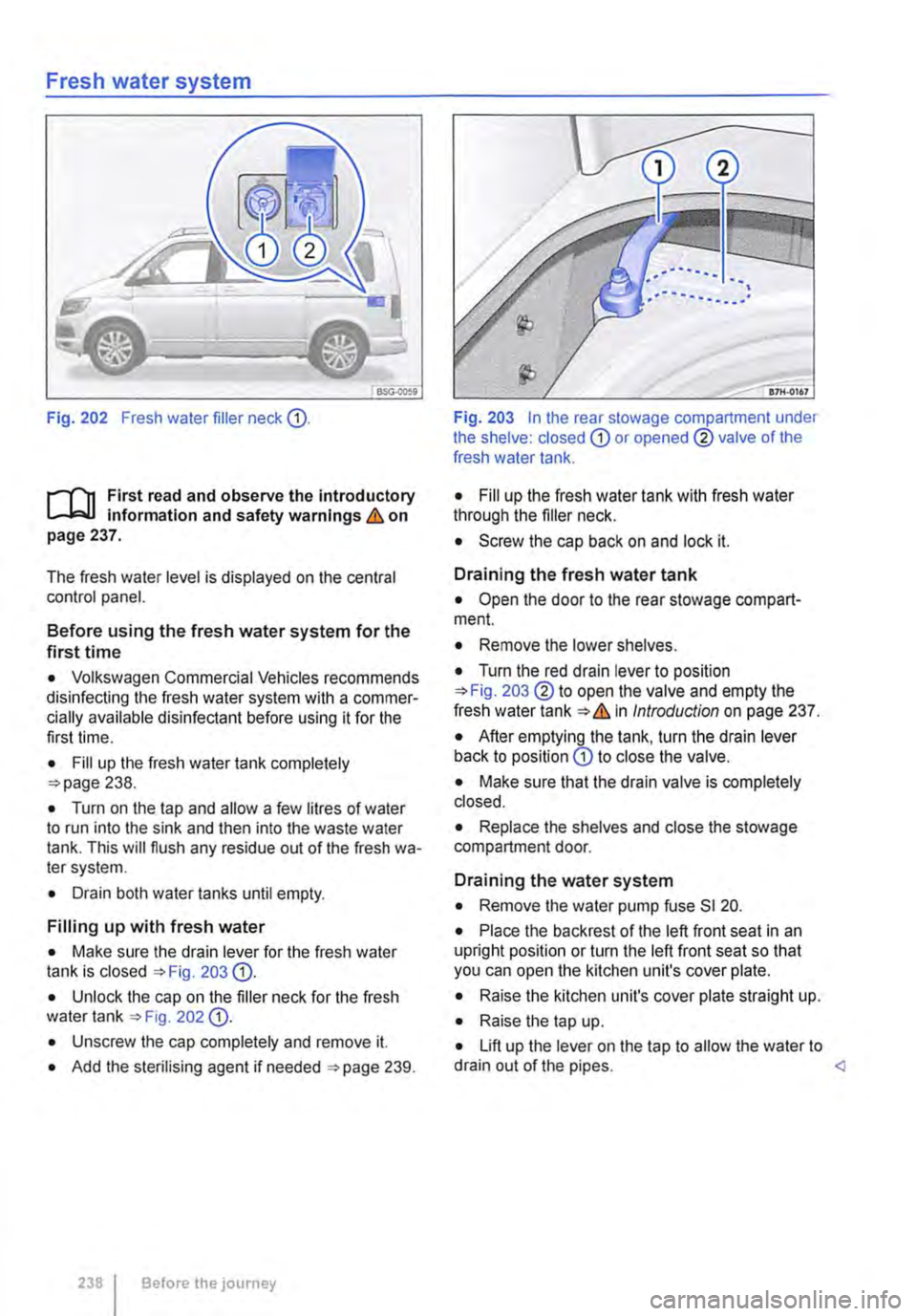
Fig. 202 Fresh water filler neck CD.
l"'""'('n First read and observe the introductory L-J.:.I.I Information and safety warnings & on page 237.
The fresh water level is displayed on the central control panel.
Before using the fresh water system for the first time
• Volkswagen Commercial Vehicles recommends disinfecting the fresh water system with a commer-cially available disinfectant before using it for the first time.
• Fill up the fresh water tank completely =>page 238.
• Turn on the tap and allow a few litres of water to run into the sink and then into the waste water tank. This will flush any residue out of the fresh wa-ter system.
• Drain both water tanks until empty.
Filling up with fresh water
• Make sure the drain lever for the fresh water tank is closed =>Fig. 203 CD.
• Unlock the cap on the filler neck for the fresh water tank =>Fig 202 CD.
• Unscrew the cap completely and remove it.
• Add the sterilising agent if needed =>page 239.
238 I Before the journey
Fig. 203 In the rear stowage compartment under the shelve: closed CD or opened ® valve of the fresh water tank.
• Fill up the fresh water tank with fresh water through the filler neck.
• Screw the cap back on and lock it.
Draining the fresh water tank
• Open the door to the rear stowage compart-ment.
• Remove the lower shelves.
• Turn the red drain lever to position =>Fig. 203 ®to open the valve and empty the fresh water tank=>& In Introduction on page 237.
• After emptying the tank, turn the drain lever back to position CD to close the valve.
• Make sure that the drain valve is completely closed.
• Replace the shelves and close the stowage compartment door.
Draining the water system
• Remove the water pump fuse SI 20.
• Place the back rest of the left front seat in an upright position or turn the left front seat so that you can open the kitchen unit's cover plate.
• Raise the kitchen unit's cover plate straight up.
• Raise the tap up.
• Lift up the lever on the tap to allow the water to drain out of the pipes. <
Page 239 of 486
Sterilising agent
f"""('n First read and observe the Introductory L-J,:,U information and safety warnings & on page 237.
Volkswagen Commercial Vehicles recommends adding a sterilising agent to the fresh water through the fresh water filler neck =>&.After add-ing sterilising agent, turn on the tap and allow ap-proximately one litre of water to run out and down the drain. This will distribute the sterilising agent through the fresh water system.
You may also pour sterilising agent down the sink, followed by a little water, to sterilize the waste wa-ter tank.
Cleaning the fresh water tank
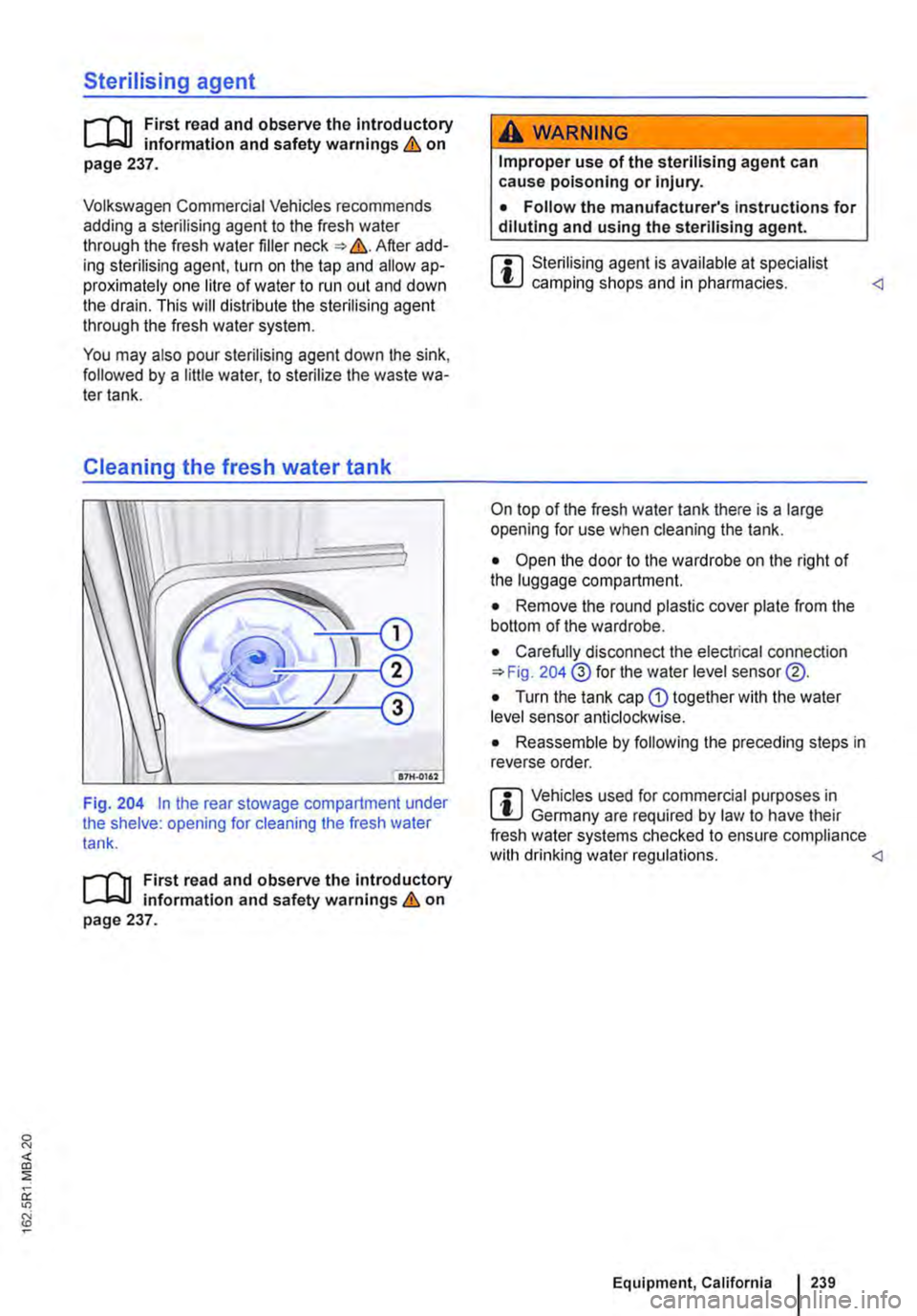
Fig. 204 In the rear stowage compartment under the shelve: opening for cleaning the fresh water tank.
f"""('n First read and observe the introductory l-J,:,,J information and safety warnings & on page 237.
A WARNING
Improper use of the sterilising agent can cause poisoning or Injury.
• Follow the manufacturer's instructions for diluting and using the sterilising agent.
m Sterilising agent is available at specialist L!J camping shops and in pharmacies.
• Open the door to the wardrobe on the right of the luggage compartment.
• Remove the round plastic cover plate from the bottom of the wardrobe.
• Carefully disconnect the electrical connection =>Fig. 204@ for the water level sensor@.
• Turn the tank cap Q) together with the water level sensor anticlockwise.
• Reassemble by following the preceding steps in reverse order.
m Vehicles used for commercial purposes in L!J Germany are required by law to have their fresh water systems checked to ensure compliance with drinking water regulations.
Page 241 of 486
Cleaning the drain
r-f'n First read and observe the introductory l.-.lo=-U information and safety warnings & on page 237.
• Make sure that there is no food debris or water in the sink.
• You will need a suitable container to catch any water that is drained out.
• Open the cupboard door under the sink.
• Pull out the drawer.
• Loosen the clamp on the drain hose on top of the waste water tank and carefully pull the drain hose from its waste water tank connection.
• Drain the water out of the drain hose into the container.
Refrigerator box, California
CClJ Introduction
This chapter contains information on the following subjects:
Using the refrigerator box . . . . . . . . . . . . . . . . . 242
Cleaning the refrigerator box . . . . . . . . . . 242
Additional information:
• Central control panel 204.
• Rectifying faults on the camping equipment 254
• Fuses for the camping equipment 249.
A WARNING
Objects that are not secured, or are secured Incorrectly, can cause serious injuries in the event of a sudden driving or braking manoeu-vre or accident.
• The refrigerator box lid must always be kept closed and locked when the vehicle is in motion.
• Never use the refrigerator box as a table or stowage compartment when the vehicle is in motion.
• Clean the drain hose and the drain in the sink using a soft flexible object such as a pipe cleaner.
• Insert the drain hose back into the waste water tank connection.
• Tighten the drain hose clamp on the waste wa-ter tank connection.
• Make sure that the drain hose is connected properly and check that the connection is water-tight
CD
Water leaking from a poor connection on the waste water drain hose can cause damage.
• Always check to make sure the waste water drain hose connection Is not leaking.
If the ambient temperature in the vehicle is too low, the temperature in the refrigerator box could fall below +2 oc (+35 °F) degrees. This could cause the contents of the refriger-ator box to freeze and bottles and other con-tainers to burst, potentially causing injuries.
• Do not use the refrigerator box when the ambient temperature is too low.
CD
Handling the refrigerator box incorrectly could damage it.
• Do not place containers, food or other ob-jects which are warmer than +50 oc (+122 °F) in the refrigerator box.
• Do not place corrosive substances or sol-vents In the refrigerator box.
• Never expose the refrigerator box to rain or humidity.
• To prevent mould and mildew from forming In the refrigerator box when it is not being used for long periods, place a folded dry towel be-tween the box and Its lid.
r.:l The refrigerator box is not intended to cool or W heat the vehicle interior. The refrigerator box should only be used to keep food cool and for transporting heat-sensitive items on short journeys.
Page 342 of 486
A WARNING_tContlnued)
• The power steering, all driver assist sys-tems and brake assist systems will not func-tion if the engine "sputters" or stops com-pletely due to a lack of fuel or Irregular fuel supply.
• Always fill the tank when it is stlll1/4 full. This reduces the risk of running out of fuel and breaking down.
Filling the tank with petrol or diesel
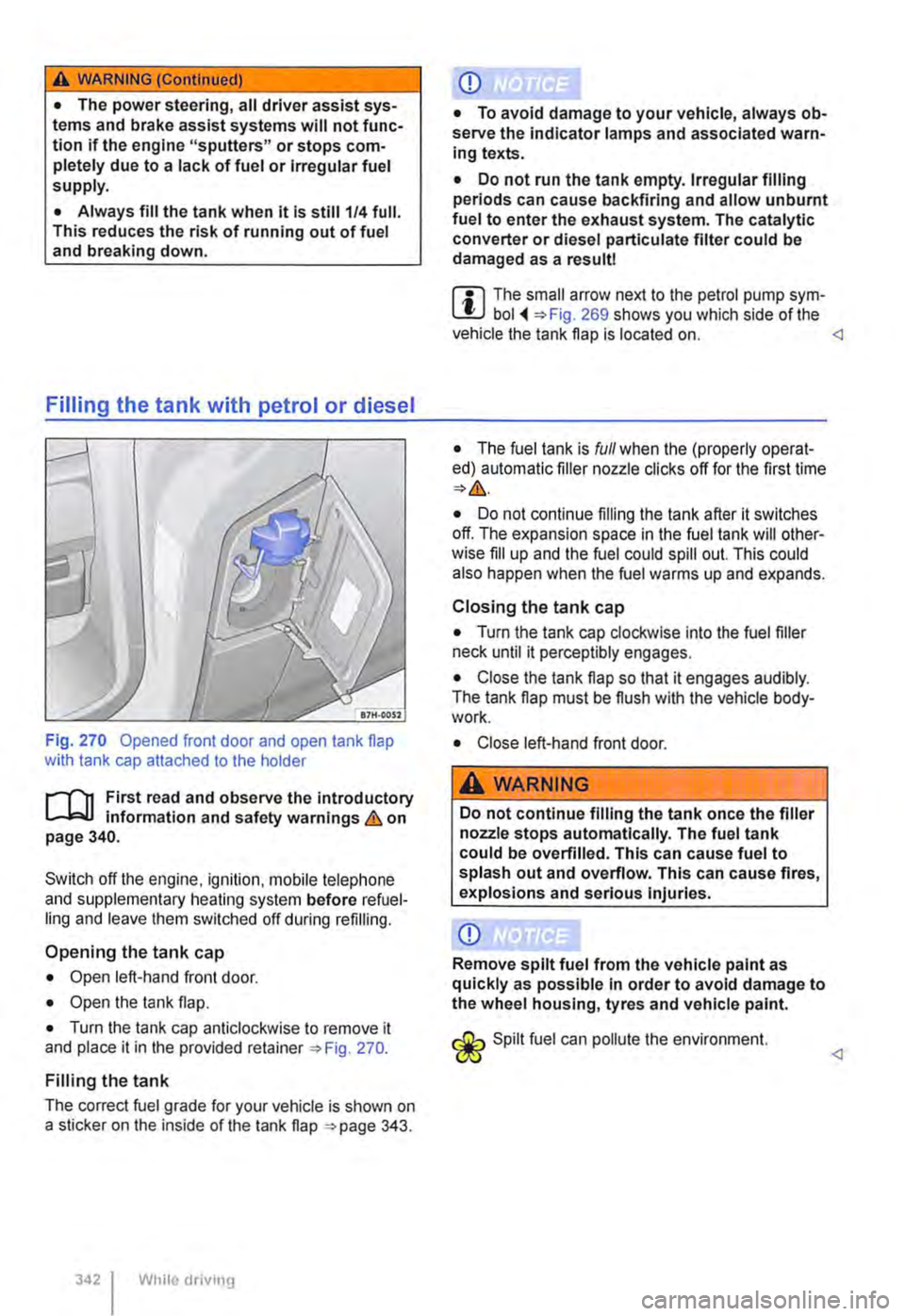
Fig. 270 Opened front door and open tank flap with tank cap attached to the holder
r--f"'n First read and observe the introductory L-.1=.1.1 information and safety warnings & on page 340.
Switch off the engine, ignilion. mobile lelephone and supplementary heating system before refuel-ling and leave them switched off during refilling.
Opening the tank cap
• Open left-hand front door.
• Open the lank flap.
• Turn the tank cap anticlockwise to remove it and place it in the provided retainer 270.
Filling the tank
The correct fuel grade for your vehicle is shown on a sticker on the inside of the tank flap 343.
While driv111g
Q)
• To avoid damage to your vehicle, always ob-serve the indicator lamps and associated warn-ing texts.
• Do not run the tank empty. Irregular filling periods can cause backfiring and allow unburnt fuel to enter the exhaust system. The catalytic converter or diesel partlculate filter could be damaged as a result!
m The small arrow next to the petrol pump sym-L!J bol 269 shows you which side of the vehicle the tank flap is located on.
• The fuel tank is full when the (properly operat-ed) automatic filler nozzle clicks off for the first time
• Do not continue filling the tank after it switches off. The expansion space in the fuel tank will other-wise fill up and the fuel could spill out. This could also happen when the fuel warms up and expands.
Closing the tank cap
• Turn the tank cap clockwise into the fuel filler neck until it perceptibly engages.
• Close the tank flap so that it engages audibly. The tank flap must be flush with the vehicle body-work.
• Close left-hand front door.
A WARNING
Do not continue filling the tank once the filler nozzle stops automatically. The fuel tank could be overfilled. This can cause fuel to splash out and overflow. This can cause fires, explosions and serious Injuries.
Q)
Remove spilt fuel from the vehicle paint as quickly as possible in order to avoid damage to the wheel housing, tyres and vehicle paint.
Spilt fuel can pollute lhe environment.
Page 371 of 486
A wARNING
New tyres will have to be run in as they will Initially have reduced grip and braking effect.
• Drive particularly carefully for the first 600 km in order to prevent accidents and se-rious injury.
A WARNING
Wheels must have the necessary freedom of operation. If the wheels do not have the nec-essary freedom of operation, the tyre could rub on parts of the running gear, the vehicle body and the brake lines. This can lead to a fault in the brake system and to tread separa-tion and thus to a tyre bursting.
Tyre pressure
r-T'n First read and observe the introductory L-k.U Information and safety warnings & on page 367.
The correct tyre pressure for factory-fitted tyres is shown on the tyre pressure label and applies to all-season, summer and winter tyres. The tyre pres-sure label is located on the lock column on the left front door.
If the tyre pressure is too low or too high, the tyres will wear prematurely and the vehicle will not han-dle well => &. The correct tyre pressure is particu-larly important at high speeds. Incorrect tyre pres-sure causes premature wear and can cause a tyre burst.
The pressure should therefore be checked at least once a month and before starting a journey.
The given tyre pressure applies to cold tyres. Tyre pressure is always higher in warm tyres than it is in cold tyres.
For this reason, never reduce the pressure in warm tyres to adjust the tyre pressure. This would result in low tyre pressures that could potentially cause the tyre to burst suddenly.
Checking tyre pressure
Always check the tyre inflation pressure on "cold" tyres. A "cold" tyre can be defined as one on a ve-hicle that has only been driven a few kilometres (miles) within 3 hours prior to the test and at low speeds.
A WARNING (Continued)
• The actual tyre size must not exceed the tyre dimensions of manufacturers approved by Volkswagen Commercial Vehicles and must not rub on any vehicle body parts.
m Despite identical size details, the actual size L!..J of the various tyre makes may vary from these specified dimensions, or the tyre contours may vary considerably.
m Volkswagen Commercial Vehicles-approved L!..J tyres are guaranteed to have the dimensions that are suitable for the vehicle. The salesperson will have to provide a certificate from the tyre man-ufacturer for other tyre makes to prove that the tyre is also suitable for the vehicle. This certificate must be stored in a safe place in the vehicle.
• The tyre pressures must be adjusted to suit a heavy vehicle load.
• After altering the tyre pressures, please ensure that the valve caps are screwed on and observe any information and instructions on setting the tyre monitoring system =>page 318.
The temporary spare wheel is filled to the highest tyre pressure permissible for the vehicle.
A WARNING
Too high or too low a pressure may cause the tyre to suddenly lose pressure or burst while the vehicle is in motion. This can cause seri-ous accidents and fatal Injuries.
• If the tyre pressure Is too low, it is possi-ble that the tyre temperature will increase to such an extent when driving that the tread peels off and the tyre bursts.
• Fast speeds or overloading of the vehicle can cause overheating, sudden tyre damage including tyre bursts and ripping of the tread surface and thus to a loss of control of the vehicle.
• If the tyre pressure is too low or too high, the tyres will wear prematurely and the vehi-cle will not handle well. .,.
Wheels and tyres 371
Page 380 of 486
Vehicle care and maintenance
Caring for and cleaning the vehicle exterior
o:n Introduction
This chapter contains information on the following subjects:
Washing the vehicle . . . . . . . . . . . . . . . 381
Washing the vehicle with a high-pressure cleaner . . . . . . . . . . . . . . . . . . . . . . . . . . . 382 Cleaning windows and exterior mirrors . . . . . . 382
Cleaning and changing wiper blades 383
Waxing and polishing the vehicle 384
Cleaning and caring for chrome and aluminium trim parts . . . . . . . . . . . . . . 385
Cleaning and caring for the decorative film . . 385
Cleaning wheels . . . . . . . . . . . . . . . . . . . . . 386
Care of rubber seals . . . . . . . . . . . . . . . . . . . . . 386
De-icing door lock cylinders . . . . . . • . . . . . . . . 387
Undersea! . . . . . . . . . . . . . . . . . . . . . . . . . . . . . . 387
Cleaning the engine compartment . 387
Regular and expert care helps to maintain the val-ue of the vehicle. Proper maintenance may also be one of the requirements for the approval of warran-ty claims in the event of corrosion or paint defects.
Suitable care products are available from Volkswa-gen Commercial Vehicles dealers.
Additional information and warnings:
• Preparation for working in the engine compart-ment ::-page 350
• Cleaning and caring for the interior ::-page 388
• Accessories, modifications, repairs and renewal of parts ::-page 394
A WARNING
Car care products can be toxic and hazard-ous. Unsuitable care products and Incorrect application of care products can cause acci-dents, serious Injuries, burns or poisoning.
• The care product must be kept In Its origi-nal sealed container.
380 Cleaning and maintenance
A WARNING (Continued)
• Read the manufacturer's Instructions .
• Never store car care products in empty food containers, bottles or any other non-original containers as people finding these containers may not know that they contain care products.
• Keep children away from care products .
• The products can give off harmful fumes during use. They should therefore only be used outside or In well-ventilated spaces.
• Never use fuel, turpentine, engine oil, nail varnish remover or other volatile fluids to wash, clean or care for your vehicle. These substances are toxic and highly Inflammable.
A WARNING
Incorrect care and cleaning of vehicle parts can Impair the safety features of the vehicle and thus cause serious Injury.
• Vehicle parts must be cleaned according to the manufacturer's Instructions.
• Only use approved or recommended cleaning products.
CD
Cleaning agents that contain solvents attack the material and can cause damage.
r:Q:... In the interests of environmental protection, "C!S the vehicle should only be washed in special-ly provided wash bays. This prevents waste water contaminated with oil, grease or fuel from entering the sewerage system. In some countries, washing vehicles anywhere else may be prohibited.
r:Q:... Environmentally-friendly care products "C!S should be used.
r:Q:... Leftover car care products should not be dis-"C!S posed of with ordinary household waste. Read the manufacturer's instructions.
Page 381 of 486
Washing the vehicle
r-f'n First read and observe the introductory Information and safety warnings & on page 380.
The longer substances such as insects, bird drop-pings, resinous tree sap, road dirt, industrial de-posits, tar, soot or road salt and other corrosive materials remain on the vehicle, the more damage they do to the paintwork. High temperatures (for in-stance in strong sunlight) accelerate the corrosion process. The underside of the vehicle should also be cleaned thoroughly and regularly.
Car washes
Please observe the signs on the automatic car wash. Before using an automatic car wash take the usual precautions, such as closing all windows and folding in the exterior mirrors, in order to avoid damage to the vehicle. You must consult the car wash operator if there are special parts on your ve-hicle such as spoilers, roof luggage carrier systems or radio aerials ::.CD.
The paint is so hard-wearing that the car can nor-mally be washed without problems in an automatic car wash. However, the effect on the paint de-pends to a large extent on the design of the car wash. Volkswagen Commercial Vehicles recom-mends the use of car washes without brushes.
To remove any wax residue from the windows and to stop wipers rubbing, please note the following points ::.page 382, Cleaning windows and exterior mirrors.
Washing the car by hand
When washing by hand, first soften the dirt with plenty of water and rinse off as well as possible.
Then clean the vehicle with a soft sponge, a glove or a brush using only light pressure. Start with the roof and work from the top to the bottom. Use a shampoo for very stubborn dirt only.
The sponge or glove should be wrung out thor-oughly at regular intervals.
Clean the wheels, sill panels etc. last. Use a differ-ent sponge for this purpose.
A WARNING
Parts of the vehicle with sharp edges can cause Injury.
• Protect your hands and arms from cuts on sharp parts, for example when cleaning the underbody or the inside of the wheel hous-lngs.
A WARNING
After the car has been washed, the braking effect could set in later than normal and ex-tend the braking distance as the brake discs and brake pads will be wet, or iced up In win-ter.
• You can "dry and de-ice" the brakes by performing careful braking manoeuvres. Make sure that you do not endanger any oth-er road users or violate any legal regulations when doing so.
CD
• The water should be no warmer than +so•c (+140.FJ.
• Do not wash the vehicle in direct sunlight in order to avoid damage to the vehicle palntwork.
• Never clean with insect sponges, rough kitchen sponges or similar products as these can damage the surface.
• Never clean the headlights with a dry cloth or sponge. Always use a wet cloth or sponge. lt is best to use soapy water.
• Washing the vehicle In cold weather: if the vehicle is rinsed with a hose, do not direct the water at the lock cylinders or the gaps around the doors, boot, or bonnet. The locks and seals could freeze.
CD
Observe the following guidelines before driving the vehicle into an automatic car wash in order to avoid damage to the vehicle:
• Ensure that the gap between the guide rails In the car wash is sufficient for the vehicle track. If the track is too narrow your wheels and tyres will be damaged.
• Switch off the rain sensor before driving the vehicle Into an automatic car wash.
• Check that the car wash is tall and wide enough for your vehicle.
• Fold In the exterior mirrors. Electrically fold-Ing exterior mirrors must be moved electrically. Do not fold them in and out by hand.
• In order to prevent damage to the palntwork on the bonnet, fold the wipers back onto the windscreen after drying the wiper blades. Do not drop the wipers onto the glass.
• Lock the tailgate to prevent it from opening accidentally In the car wash.
Page 382 of 486

Washing the vehicle with a high-pressure cleaner
I""""'T'n First read and observe the Introductory L.-lo:oJ.I information and safety warnings & on page 380.
Follow the instructions provided by the manufactur-er when cleaning your vehicle using a high-pres-sure cleaner. This applies in particular to the pres-sure and the spraying distance=>&.
Maintain sufficient distance to soft materials such as rubber hoses, insulation, and the ParkPilot sen-sors. The ParkPilot sensors are located in the front bumper, and in some cases also in the rear bump-er =>
A WARNING
The incorrect use of a high-pressure cleaner can cause visible and invisible long-term damage to tyres and other materials. This can cause accidents and serious injuries.
• Maintain sufficient distance between the washer jet and the tyres.
• Never clean the tyres with concentrated jet nozzles (dirt blasters). The tyres may incur visible and invisible damage even if cleaned briefly with the spray at a distance.
A WARNING
After the car has been washed, the braking effect could set in later than normal and ex-tend the braking distance as the brake discs and brake pads will be wet, or iced up in win-ter.
• You can "dry and de-ice" the brakes by performing careful braking manoeuvres. Make sure that you do not endanger any oth-er road users or violate any legal regulations when doing so.
CD
• The water may be no warmer than +so·c (+140.FJ.
• Do not wash the vehicle In direct sunlight In order to avoid damage to the vehicle palntwork.
• The ParkPilot sensors In the bumpers must be kept clean and free of Ice. When cleaning with pressure hoses or steam cleaners, the sensors should only be sprayed briefly and the steam/hose nozzle must be kept more than 10 cm away.
• Do not clean windows that are iced over or covered In snow with a high-pressure cleaner.
• Washing the vehicle in cold weather: If the vehicle is rinsed with a hose, do not direct the water Into the lock cylinders or the gaps round the doors, boot, or bonnet. The locks and seals could freeze.
I""""'T'n First read and observe the introductory L.-lo:oJ.I information and safety warnings & on page 380.
Cleaning windows and exterior mirrors
Moisten the windows and exterior mirrors with commercially available, alcohol-based glass clean-er.
382 Cleaning and maintenance
Dry the glass surfaces with a clean chamois leath-er or a lint-free cloth. Chamois leathers that have been used on painted surfaces are not suitable for use on glass surfaces. They will be soiled with wax deposits which could smear the surfaces.
Use window cleaner or a silicone remover to clean off rubber, oil, grease and silicone deposits =>
Page 387 of 486
De-icing door lock cylinders
....-m First read and observe the introductory L-I=JJ information and safety warnings & on page 380.
Volkswagen Commercial Vehicles recommends the use of genuine Volkswagen spray with lubricating and anti-corrosive properties to de-ice the lock cyl-inders.
Undersea I
....-m First read and observe the introductory L-I=JJ information and safety warnings & on page 380.
The underside of the vehicle is coated to protect it from corrosion and damage. The protective coating on the underside of the vehicle could be damaged when driving. Therefore, Volkswagen Commercial Vehicles recommends that the protective coating on the underside of the vehicle and on the running gear should be checked regularly and repaired if necessary.
Cleaning the engine compartment
....-m First read and observe the introductory L-I=JJ information and safety warnings & on page 380.
The engine compartment of any motor vehicle is a hazardous area L1l. 350.
The engine compartment should be cleaned by a qualified workshop. Corrosion protection could be removed and electrical components damaged if the compartment is cleaned incorrectly. Further-more, water could enter the vehicle interior directly via the plenum chamber
If the engine compartment is very dirty, we recom-mend that you always go to a qualified workshop to have it cleaned by a professional mechanic. Volkswagen Commercial Vehicles recommends us-ing a Volkswagen Commercial Vehicles dealership for this purpose.
Plenum chamber
The plenum chamber is located in the engine com-partment between the windscreen and the engine and has a perforated cover. Air from outside is
CD·
Do not use lock de-leers containing substances that dissolve grease, as this can cause the door lock cylinder to rust.
Undersea! and anti-corrosion coatings can ig-nite on the hot exhaust system or on other hot engine parts.
• Never apply undersea! or anti-corrosion coatings to the exhaust pipes, catalytic con-verter, heat shields or other vehicle compo-nents that become hot.
Leaves and other loose objects must be removed from the cover of the plenum chamber at regular intervals using a vacuum cleaner or by hand.
A WARNING
All work in the engine compartment carries the risk of injury, scalding, accidents and fire.
• Before carrying out any work, ensure that you are familiar with the requisite procedures and general safety regulations 350.
• Volkswagen Commercial Vehicles recom-mends having the work carried out by a quali-fied workshop.
CD
Water that has entered the plenum chamber via a manual process (e.g. from a high-pressure cleaner) can cause considerable damage to the
vehicle. "'
Vehicle care and maintenance I 387
Page 399 of 486
Additional functions that are contractually agreed with the customer, e.g. vehicle positioning in an emergency, allow certain vehicle data to be trans-mitted from the vehicle.
Event data recorder
The vehicle is not fitted with an event data record-er.
Event data recorders temporarily store vehicle in-formation. This provides precise information in the event of an accident. In vehicles with an airbag system, data that might be relevant in the event of an accident can be stored, e.g. impact speed, belt buckle status, seat positions and trigger speed. The scope of the data is manufacturer-specific.
An event data recorder may only be fitted if the owner has approved the procedure. This is cov-ered by legislation in some countries.
Reprogramming control units
All data for the control of components are stored in the control units. Some convenience functions, such as lane change flash, single door unlocking and displays, can be reprogrammed using special workshop equipment. If this is the case, the de-scriptions in your vehicle wallet will no longer cor-respond with the original functions. Volkswagen Commercial Vehicles recommends that any re-programming should be confirmed in the service schedule under "Workshop comments".
Information about possible reprogramming can be obtained from the Volkswagen dealership.
Reading the vehicle's event memory
There is a diagnostic interface for reading the event memories in the vehicle interior &. Data relating to the function and status of the electronic control units are stored in the event memory. Addi-tional information on the stored data is available from qualified workshops.
The diagnosis interface is located in the footwell on the driver side behind a cover next to the lever for opening the bonnet.
The event memory should only be read and reset by a qualified workshop.
After a fault has been rectified, the information in the memory pertaining to the fault is deleted. Other memory content is overwritten on an on-going ba-sis.
A WARNING
Incorrect use of the diagnostic Interface can cause faults, which can result in accidents and serious injuries.
• Never read the event memory using the di-agnostic Interface yourself.
• The diagnostic Interface should only be read by a qualified workshop.
external aerial
,...--.m First read and observe the introductory L--I=>U information and safety warnings & on page 394.
Both during telephone calls and in standby mode, mobile telephones transmit and receive radio waves, which may also be termed "high-frequency energy". Current scientific literature warns us that radio waves can be harmful to human beings if they exceed certain limits. Government bodies and international committees have introduced threshold values and guidelines to ensure that electromag-netic radiation produced by mobile telephones does not pose a hazard to health. However, there is no proven scientific evidence that demonstrates that cordless telephones are absolutely safe.
For this reason, some experts are calling for more precautions to be taken in the use of mobile tele-phones, by taking steps to reduce the level of per-sonal exposure to electromagnetic radiation.
If a mobile telephone that is not connected to the vehicle's external aerial is used inside the vehicle, the level of electromagnetic radiation could be higher than when the mobile telephone is connec-ted to an integrated aerial or any other external aerial.
If the vehicle is fitted with a suitable hands-free unit which enables the use of innumerable additional functions of Bluetooth® compatible mobile tele-phones, this will satisfy the legal requirements in many countries which permit the use of a mobile telephone in a vehicle only if a hands-free unit is used.
The factory-fitted hands-free system in your vehicle has been developed for use with mobile tele-phones that are compatible with Bluetooth®_ Mo-bile telephones must be carried in a suitable tele-phone holder or be stored securely in the vehicle. If a telephone holder is used it must be securely at-tached to the base plate. This is the only way to .,.
Vehicle care and maintenance 399