fuel consumption VOLKSWAGEN TRANSPORTER 2016 User Guide
[x] Cancel search | Manufacturer: VOLKSWAGEN, Model Year: 2016, Model line: TRANSPORTER, Model: VOLKSWAGEN TRANSPORTER 2016Pages: 486, PDF Size: 69.28 MB
Page 280 of 486
Saving fuel
1/100 km
-10°C
+20 oc
L----------------tkm 5 15 25 30
en-o11S
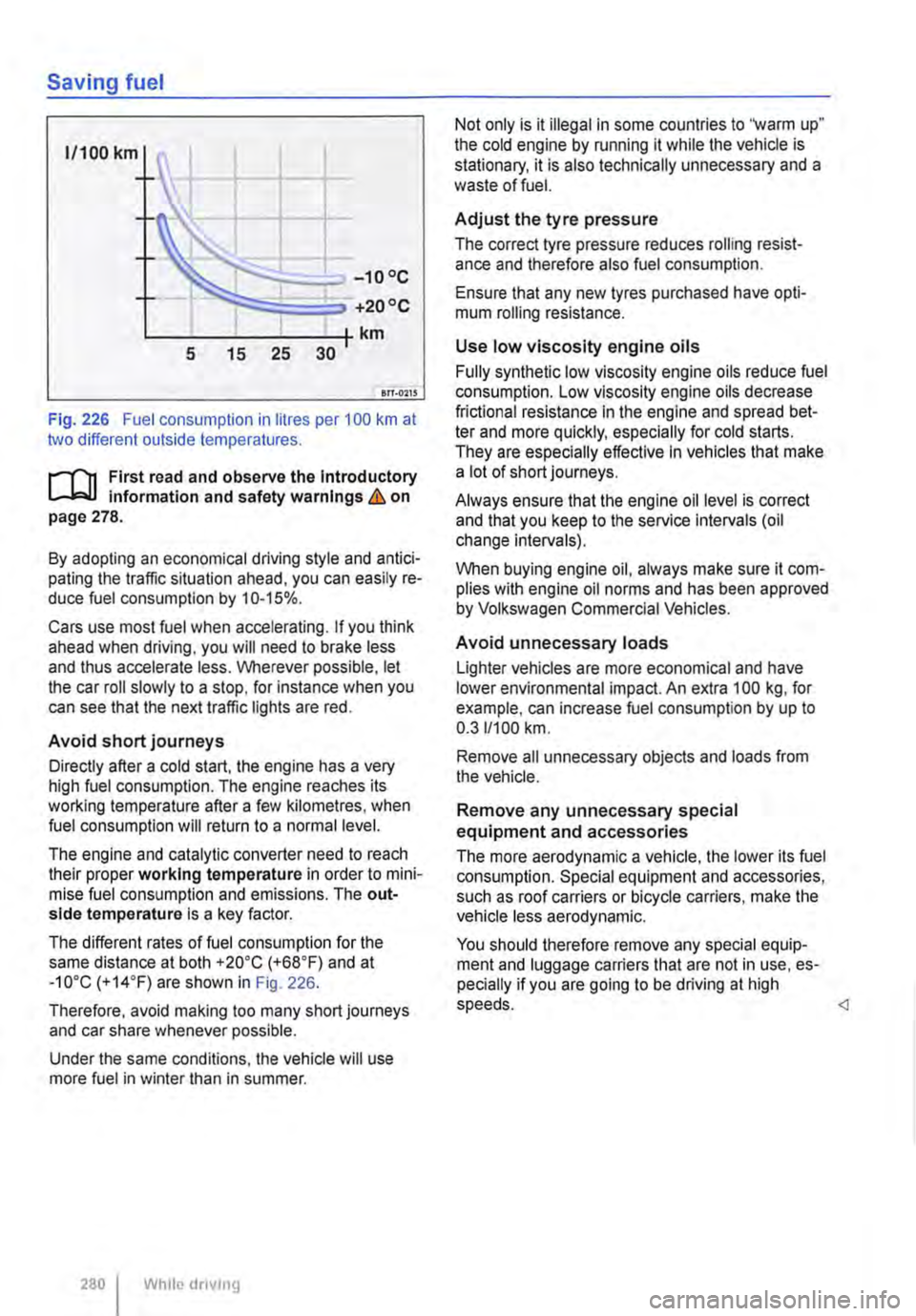
Fig. 226 Fuel consumption in litres per 100 km at two different outside temperatures.
r-1"'11 First read and observe the Introductory Information and safety warnings&. on page 278.
By adopting an economical driving style and antici-pating the traffic situation ahead, you can easily re-duce fuel consumption by 10-15%.
Cars use most fuel when accelerating. If you think ahead when driving, you will need to brake less and thus accelerate less. Wherever possible, let the car roll slowly to a stop, for instance when you can see that the next traffic lights are red.
Avoid short journeys
Directly after a cold start, the engine has a very high fuel consumption. The engine reaches its working temperature after a few kilometres, when fuel consumption will return to a normal level.
The engine and catalytic converter need to reach their proper working temperature in order to mini-mise fuel consumption and emissions. The out-side temperature is a key factor.
The different rates of fuel consumption for the same distance at both +20"C (+68"F) and at -10"C (+14"F) are shown in Fig. 226.
Therefore, avoid making too many short journeys and car share whenever possible.
Under the same conditions, the vehicle will use more fuel in winter than in summer.
280 I While dnvmg
Not only is it illegal in some countries to "warm up" the cold engine by running it while the vehicle is stationary, it is also technically unnecessary and a waste of fuel.
Adjust the tyre pressure
The correct tyre pressure reduces rolling resist-ance and therefore also fuel consumption.
Ensure that any new tyres purchased have opti-mum rolling resistance.
Use low viscosity engine oils
Fully synthetic low viscosity engine oils reduce fuel consumption. Low viscosity engine oils decrease frictional resistance in the engine and spread bet-ter and more quickly, especially for cold starts. They are especially effective In vehicles that make alotofshortjourneys.
Always ensure that the engine oil level is correct and that you keep to the service intervals (oil change intervals).
When buying engine oil, always make sure it com-plies with engine oil norms and has been approved by Volkswagen Commercial Vehicles.
Avoid unnecessary loads
Lighter vehicles are more economical and have lower environmental impact. An extra 100 kg, for example, can increase fuel consumption by up to 0.311100 km.
Remove all unnecessary objects and loads from the vehicle.
Remove any unnecessary special equipment and accessories
The more aerodynamic a vehicle, the lower its fuel consumption. Special equipment and accessories, such as roof carriers or bicycle carriers, make the vehicle less aerodynamic.
You should therefore remove any special equip-ment and luggage carriers that are not in use, es-pecially if you are going to be driving at high speeds.
Page 319 of 486
A WARNING
The intelligent tyre monitoring system tech-nology cannot overcome the laws of physics, and functions only within the limits of the system. Incorrect handling of the wheels and tyres can lead to a sudden loss of pressure in the tyres, tread separation and even tyre blow-out.
• Check tyre pressures regularly and always maintain the specified tyre pressure value =>page 367. If the tyre pressure is too low, it is possible that the tyre temperature will in· crease to such an extent that the tread peels off and the tyre bursts.
• Always maintain correct cold tyre pres-sure as listed on the tyre pressure label =>page 367.
• Check tyre Inflation pressure regularly when the tyres are cold. Adjust tyre pressure in the cold tyre to the recommended tyre pressure for the tyres Installed on your vehi· cle as necessary.
• Check your tyres regularly for signs of wear or damage.
• Never exceed the top speed and load per-mitted for the fitted tyres.
CD
If valve caps are missing, the valve could be damaged. Always use valve caps that comply with the factory-fitted valve cap specifications. Always screw on valve caps fully. Do not use metal valve caps.
Indicator lamp
Under-inflated tyres will increase fuel con-W sumption and tyre wear. A higher tyre pres-sure generally reduces the fuel consumption. How-ever, the maximum tyre pressures specified by the manufacturer must always be adhered to.
m When new tyres are driven at high speeds for L!..J the first time, they can expand slightly and trigger a one-off pressure warning.
m Old tyres should only be replaced by tyres L!..J that have been approved by Volkswagen Commercial Vehicles for the vehicle type.
m Do not rely solely on the tyre monitoring sys-L!..J tern. Check your tyres regularly to ensure that they are properly inflated and have no signs of damage, such as punctures, cuts, cracks, and blis-ters. Remove any objects that become embedded in the tyre tread but have not penetrated into the body of the tyre itself.
m The tyre monitoring system is adjusted for L!..J the factory-recommended tyre pressures to be found on the tyre pressure label.
Lit upa) Possible cause=>& Solution
Do not drive on! Reduce speed immedi· ately. Stop the vehicle as soon as possible
The tyre pressure of one tyre or several and when safe to do so. Do not undertake
tyres has decreased considerably in com-any extreme steering or braking manoeuvres!
(l) parison to the tyre pressure set by the Check all wheels and tyre pressures, and cor-rect if necessary =>page 367. The damaged driver, or the structure of the tyre is dam-tyre should be replaced. The tyre monitoring aged. system will have to be re-synchronised after changing the tyre pressure, or after changing one or more wheels =>page 321.
a) An acoustic warning will also be sounded, and a corresponding message may appear 1n the instrument cluster display.
Driver assist systems I 319
Page 343 of 486
Capacities
r--('n First read and observe the introductory L-W.I information and safety warnings & on page 340.
Checks when filling the tank
r--r'n First read and observe the introductory L-W.I information and safety warnings & on page 340.
Checklist
Never carry out any work on the engine or in the engine compartment if you are not familiar with the necessary procedures and the general safety re-quirements or if the correct operating equipment, fluids and unsuitable tools are not available 350, Preparation for working in the engine compartment! The work should be carried out by a qualified workshop if you are uncertain. Please en-sure that the following are checked regular1y, pref-erably every time you fill the tank:
..( Windscreen washer fluid level 116
..( Engine oil level 353
Fuel
c:QJ Introduction
This chapter contains information on the following subjects:
Petrol
Diesel ...
344 345
Different engines require different fuels. The facto-ry-fitted sticker on the inside of the tank flap indi-cates the fuel type that is required for your particu-lar vehicle.
Volkswagen Commercial Vehicles recommends us-ing fuels with a low sulphur content or which are sulphur-free in order to reduce fuel consumption and prevent damage to the engine.
If the engine is not running smoothly or begins to judder, this can indicate poor or inadequate fuel quality, e.g. water in the fuel. If these symptoms appear, reduce the vehicle speed immediately and drive to the nearest qualified workshop at medium engine speeds, avoiding high engine loading. If these symptoms occur immediately after the vehi-
Fuel tank capacity
Approx. 80.0 I,
..( Engine coolant level 358
..( Brake fluid level 269
..( Tyre pressure 367
..( Vehicle lighting necessary for traffic safety:
-Turn signals
-Side lights, dipped beam headlights and main beam headlights
-Tail light cluster
-Brake lights
-Rear fog light 1 08
Information on changing bulbs 432.
cle has been refuelled, switch the engine off as soon as it is safe to do so and seek expert assis-tance. This can help to prevent further damage.
Additional information and warnings:
• Filling the tank 340
• Engine management system and exhaust puri-fication system 407
• Service schedule
A WARNING
Incorrect handling of fuel can cause explo-sions, fire, serious burns and other injuries.
• Fuel is highly explosive and inflammable.
• Never handle fuel near open flames, sparks or glowing matter (e.g. cigarettes).
• Keep naked flames, hot parts and sparks at a safe distance.
At the filling station 1343
Page 344 of 486
A WARNING (Continued)
• Switch off your mobile telephone or two-way radio when dealing with fuel. Electro-magnetic radiation can generate sparks which can in turn start a fire.
• Avoid electrostatic discharge and electro-magnetic radiation in the direct vicinity of fuels.
• Never spill fuel in the vehicle or In the lug-gage compartment.
Petrol
1"'111 First read and observe the introductory L-lo::.l.l information and safety warnings & on page 343.
Petrol types
Vehicles with a petrol engine must be run on un-leaded petrol in compliance with the European standard EN 228 =>
Volkswagen Commercial Vehicles recommends petrol with a low sulphur content or sulphur-free petrol for use with this engine. This reduces petrol consumption.
Petrol additives
The quality of petrol influences the running proper-ties, performance and service life of the engine. This is why the vehicle should be refuelled with good quality petrol that has only non-metallic addi-tives pre-added by the petroleum industry. These petrol additives help to prevent corrosion. keep the fuel system clean, and prevent the build-up of de-posits in the engine.
If good quality petrol containing non-metallic addi-tives is not available, or if engine problems arise. the necessary petrol additives must be added to the petrol when refuelling =>
A WARNING (Continued)
• Comply with any relevant safety Informa-tion and legislation concerning the handling of fuels.
Not all petrol additives are effective. The use of un-suitable petrol additives can cause considerable damage to the engine and catalytic converter. Met-allic additives should be avoided at all times.
Petrol additives on sale that are intended to im-prove knock resistance or increase the octane number can also contain metallic additives =>
• Before filling up with petrol, check whether the fuel corresponds to the vehicle's require-ments according to the fuel standard Informa-tion at the pump.
• Only use fuel that complies with the EN 228 standard and has the correct octane number. Otherwise, the engine and the fuel system can suffer considerable damage. The engine can al-so lose power or fall.
• The use of unsuitable petrol additives can cause considerable damage to the engine and catalytic converter.
• If, In an emergency, you have to use petrol with an octane number lower than the recom-mended number, drive at medium engine speeds and avoid high engine loading. Avoid high engine speeds and heavy engine loads. Failure to do so can result In engine damage. Fill the tank with petrol with the correct octane number as soon as possible. .,.
Page 346 of 486
CD
• Your vehicle is not suitable for use with bio-diesel and must not be filled up or driven with biodiesel. Failure to observe this point can re-sult in damage to the fuel system and engine.
• Some diesel manufacturers blend biodiesel with diesel fuel in compliance with European Standard 590 or an equivalent standard (in Ger-many). Use of this diesel is allowed and will not damage the engine or fuel system.
• The diesel engine has been developed for use with diesel only. For this reason, petrol, heating oil or other unsuitable fuels may not be used. These fuels can cause serious damage to the fuel system and engine.
CD
• The service life of the diesel particulate filter can be reduced considerably if diesels with a high sulphur content are used. A Voikswagen Commercial Vehicles dealership will be able to tell you which countries have diesel with a high sulphur content.
o:::n Introduction
This chapter contains information on the following subjects:
Warning and indicator lamps Refilling Ad Blue® ... 347
348
SCR catalysts can be used to reduce emissions from diesel engines (SCR = Selective Catalytic Re-duction). The SCR catalyst uses Ad Blue® urea sol-ution to convert nitrogen oxides into nitrogen and water.
If the vehicle is equipped with this kind of emission control system for diesel vehicles, the filler neck for the Ad Blue® tank is located below the filler cap for the fuel tank.
The Ad Blue® level should be checked within the scope of the service work Service schedule.
Information on AdBiue®
The Ad Blue® consumption figures depend on the individual driving style, the system's operating tem-perature and the ambient temperature that the ve-hicle is operated in.
The vehicle is fitted with a separate tank for Ad Bl-ue®. The Ad Blue® tank holds approximately 13 li-tres. For technical reasons, the capacity may be slightly larger when refilling using refill bottles.
The Ad Blue® tank must never run empty. As of a remaining distance of approximately 2,400 km. the instrument cluster display will indicate that the
346 While drivmg
Ad Blue® must be refilled 348. If the re-maining range is 0 km, the engine cannot be star-ted anymore 347.
The Ad Blue® trademark is held by the German As-sociation of the Automobile Industry (VDA) in the USA, Germany, the European Union and other countries.
Additional information and warnings:
• Fuel 343
• Accessories, modifications, repairs and renewal of parts 394
A WARNING
If the AdBiue® level is too low, the vehicle cannot be restarted after the Ignition has been switched off. Starting with jump leads is also not possible.
• Refill AdBiue® at the latest when the re-maining distance reaches approximately 1,000 km.
• Never allow the Ad Blue® tank to run emp-ty.
A WARNING
Ad Blue® is an Irritant and corrosive fluid that can damage the skin, eyes and breathing passages upon contact.
Page 357 of 486
A WARNING (Continued)
• If engine oil is spilt on cold engine parts it can heat up and Ignite when the engine Is running.
• Always ensure that the engine oil filler cap Is securely tightened after refilling, and that the dipstick Is properly Inserted back Into the guide tube. This will prevent the engine oil from draining out on to hot engine compo-nents when the engine Is running.
CD
• Do not start the engine if the engine oil level Is above area@. Seek expert assistance. The catalytic converter and the engine could other-wise be damaged.
• When refilling or changing service fluids, please ensure that the correct fluids are added through the correct openings. Incorrect service fluids can cause serious functional problems and engine damage.
Engine oil consumption
n"'n First read and observe the introductory l.-J,:.ll information and safety warnings & on page 353.
Engine oil consumption can vary from engine to engine and can change during the working life of an engine.
The vehicle may consume up to 1.0 litre of engine oil per 2,000 km, depending on how you drive and the conditions in which the car is used. In new ve-
Changing engine oil
n"'n First read and observe the Introductory l.-J,:.ll Information and safety warnings & on page 353.
The engine oil must be changed regularly in ac-cordance with the data given in the service sched-ule.
The engine oil and filter change should be carried out by a qualified workshop due to the special tools and knowledge required, this also applies to the disposal of used oil. Volkswagen Commercial Vehi-cles recommends using a Volkswagen Commercial Vehicles dealership for this purpose.
The engine oil level must never be above I!!S area @. Otherwise oil can be drawn in through the crankcase breather and escape into the atmosphere via the exhaust system. <1
hicles. consumption is likely to be higher for the first 5,000 km. The engine oil level must therefore be checked at regular intervals, preferably when refuelling and before long journeys.
When the engine is working hard the oil level must be kept within area =>Fig. 274 @,for instance dur-ing long motorway cruising in summer, trailer tow-ing or climbing mountain passes. <1
More details on the service intervals can be found in the service schedule.
Additives in the engine oil can cause new engine oil to discolour quickly. This is normal and does not mean that the engine oil should be changed more frequently.
A WARNING
If, In exceptional cases, you have to carry out an oil change yourself, please note the fol-lowing:
• Always wear eye protection. .,.
In the engine compartment 357
Page 369 of 486
Storing tyres
Mark tyres before you remove them to indicate the direction of rotation. This ensures you will be able to mount them correctly when you replace them (left, right, front, rear). When removed, the wheels or tyres should be stored in a cool, dry and pref-erably dark place. Do not store tyres mounted on the rim vertically.
Any tyres not fitted on rims should be kept in suita-ble sleeves to protect against dirt and should be stored vertically (standing on the tread).
All-terrain tyres
Some vehicles can be fitted at the factory with "all-terrain tyres". These tyres have a deep-tread pro-file that alters the vehicle's driving properties (such as comfort, consumption, braking distance, corner-Ing behaviour, rolling noise)=>&.
A WARNING
Corrosive liquids and other substances can cause visible and Invisible damage to the tyres, which can cause the tyre to burst.
• Always keep chemicals, oils, lubricants, fuel, brake fluid and other corrosive substan-ces away from the tyres.
A WARNING
Old tyres (even if never used) can suddenly lose pressure or burst, especially at high speeds. This can cause accidents and seri-ous injuries.
• Avoid using tyres that are more than six years old. If you have no alternative, drive slowly and with extra care at all times.
Rims
,....-('n First read and observe the Introductory L-J.:.ll information and safety warnings & on page 367.
The design of the wheel bolts is matched to the rims. If different rims are fitted, the correct wheel bolts with the right length and correctly shaped bolt heads must be used. This ensures that wheels are fitted securely and that the brake system works properly =>page 420.
For technical reasons, it is not generally possible to use the wheels from other vehicles. This can al-so apply to wheels of the same vehicle type.
A WARNING
The deep-tread profile of all-terrain tyres can considerably increase the braking distance or cornering behaviour and thus cause acci-dents and serious injuries.
• Always bear the modified vehicle handling in mind, and drive carefully.
CD
Avoid heavy impacts and drive round obstacles whenever possible. Tyres, particularly low-pro-file tyres, can be considerably compressed and deformed by potholes and curb edges especial-ly. This can cause the tyre's webbing reinforce-ment to brake, and cause dents or rips on the side walls or deformations or cracks on the rims.
Old tyres should be disposed of as required !!IS by legislation.
Wheel bolts
Wheel boils must always be tightened with the cor-rect tightening torque =>page 420.
Rims with bolted-on rings
Rims with bolted-on rings consist of several com-ponents. These components are fastened using special bolts and special fastening technology. This ensures that the wheel functions proper1y, does not leak, remains safe and runs true. For this reason, damaged rims should be replaced. They may only .,..
Wheels and tyres I 369
Page 372 of 486
A WARNING (Continued)
• Check tyre pressures regularly, at least once a month, and before every long journey.
• All tyres must have the correct tyre pres-sure to suit the vehicle load.
• Never reduce excess pressure when the tyres are warm.
CD
• When attaching the tyre pressure gauge make sure that you do not position it at an an-gle to the valve shaft. This can damage the tyre valve.
Tread depth and wear indicators
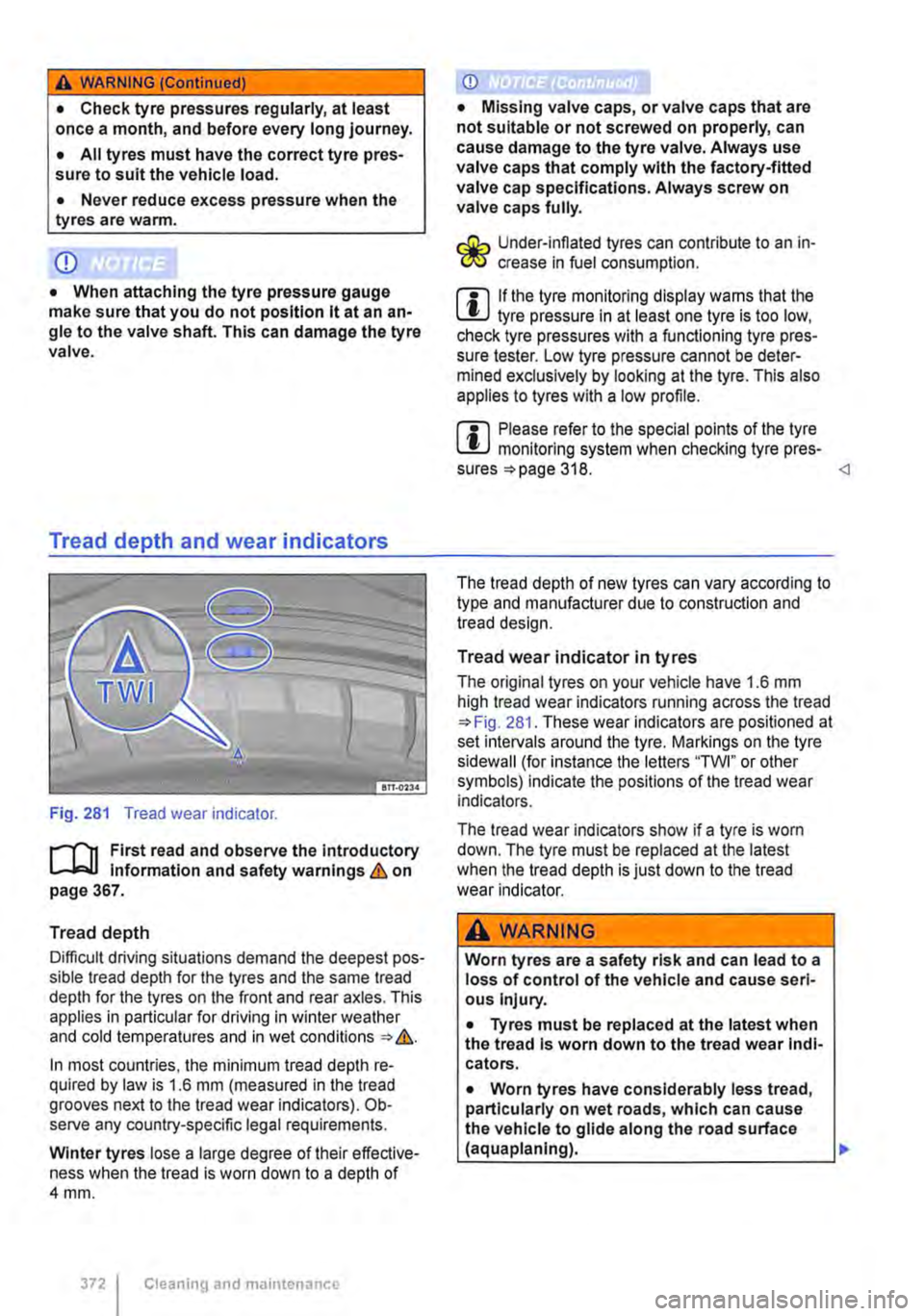
Fig. 281 Tread wear indicator.
r-fl1 First read and observe the Introductory L-.lo:::.l.l Information and safety warnings & on page 367.
Tread depth
Difficult driving situations demand the deepest pos-sible tread depth for the tyres and the same tread depth for the tyres on the front and rear axles. This applies in particular for driving in winter weather and cold temperatures and in wet conditions=>&.
In most countries, the minimum tread depth re-quired by law is 1.6 mm (measured in the tread grooves next to the tread wear indicators). Ob-serve any country-specific legal requirements.
Winter tyres lose a large degree of their effective-ness when the tread is worn down to a depth of 4mm.
3721 Cleaning and maintenance
CD
• Missing valve caps, or valve caps that are not suitable or not screwed on properly, can cause damage to the tyre valve. Always use valve caps that comply with the factory-fitted valve cap specifications. Always screw on valve caps fully.
Under-infiated tyres can contribute to an in-I!IS crease in fuel consumption.
m If the tyre monitoring display warns that the W tyre pressure in at least one tyre is too low, check tyre pressures with a functioning tyre pres-sure tester. Low tyre pressure cannot be deter-mined exclusively by looking at the tyre. This also applies to tyres with a low profile.
m Please refer to the special points of the tyre W monitoring system when checking tyre pres-sures =>page 318.
Tread wear indicator in tyres
The original tyres on your vehicle have 1.6 mm high tread wear indicators running across the tread =>Fig. 281. These wear indicators are positioned at set intervals around the tyre. Markings on the tyre sidewall (for instance the letters "TWI" or other symbols) indicate the positions of the tread wear indicators.
The tread wear indicators show if a tyre is worn down. The tyre must be replaced at the latest when the tread depth is just down to the tread wear indicator.
A WARNING
Worn tyres are a safety risk and can lead to a loss of control of the vehicle and cause seri-ous Injury.
• Tyres must be replaced at the latest when the tread Is worn down to the tread wear Indi-cators.
• Worn tyres have considerably less tread, particularly on wet roads, which can cause the vehicle to glide along the road surface (aquaplaning).
Page 378 of 486
z
w y
over 240 km/h (149 mph)
max. 270 kmlh (168 mph)
max. 300 kmlh (186 mph)
Winter tyres
r-f'n First read and observe the introductory L-J,::JJ information and safety warnings & on page 367.
In winter road conditions, winter tyres will consider-ably improve the car's handling. The design of summer tyres (width, rubber compound, tread pat-tern) gives less grip on ice and snow. Volkswagen Commercial Vehicles urgently recommends you use winter tyres or all-year tyres on all 4 wheels of the vehicle, particularly if winter conditions are ex-pected on the roads. Winter tyres will also improve the braking response of the vehicle and will help to reduce braking distances in winter weather. Volks-wagen Commercial Vehicles recommends that win-ter tyres be fitted to the vehicle at temperatures un-der+ 7•c (+45°F).
Winter tyres lose their effectiveness when the tread is worn down to a depth of 4 mm. Winter tyres also largely lose their effectiveness through ageing-regardless of the tread depth.
The following applies when using winter tyres:
• Observe any country-specific legal require-ments.
• Use winter tyres on all four wheels at the same time.
• Only use in winter road conditions.
• Only use the sizes of winter tyre that have been approved for the vehicle.
• Winter tyres must have the same type, size (rolling circumference) and the same tread pattern.
• Heed the maximum speed permitted by the speed index => &.
Speed limitation
Winter tyres have a speed limitation depending on the speed index =>page 375.
In some vehicle versions, a speed warning can be set in the menu MFD (multi function display) in the instrument cluster =>page 24.
378 I Cleaning and maintenance
Some tyre manufacturers use the code "ZR" for tyres with a highest permitted speed of over 240 km/h (149 mph).
If you use V-rated tyres the speed limits and re-quired tyre pressure will be determined by the en-gine size. You must ask a Volkswagen Commercial Vehicles dealership about the highest permitted speed and required tyre pressure.
Four-wheel drive (4MOTION)
Thanks to its four-wheel drive, the vehicle will have plenty of traction in winter conditions, even with the standard tyres. Nevertheless, Volkswagen Com-mercial Vehicles still recommends that winter tyres or all-year tyres should be fitted on all four wheels when winter road conditions are expected, mainly because this will give a better braking response.
Please refer to the appropriate information and notes when using snow chains =>page 379.
A WARNING
The Improved winter driving characteristics afforded by the winter tyres should not en-courage you to take any risks.
• Always adapt your speed and driving style to suit visibility, weather, road and traffic con-ditions.
• Never exceed the top speed and load per-mitted for the winter tyres that are fitted.
r:Q;-.. Summer tyres should be fitted in good time at the end of the winter. The vehicle handling is better if summer tyres are fitted at temperatures above +7•c (+45.F). They are quieter, do not wear so quickly and reduce fuel consumption.
m In vehicles with a tyre monitoring system, the l!.J systems have to "re-synchronise" after wheels are changed =>page 318.
m Volkswagen Commercial Vehicles dealer-l!.J ships can provide details on permissible win-
Page 408 of 486
Lit up Possible cause Solution
Drive in 4th gear (manual gearbox) or in gear D (DSG® dual clutch gearbox) at a speed of at
Diesel particulate filter has become satura-least 70 km/h (43 mph) for approximately 15 mi-nutes. ted with soot (except for courier vehicles). Observe the valid speed limits &. Go to the nearest qualified workshop if the indi-cator lamp still does not go out 409.
If possible, do not switch off the engine.
Only for specially equipped courier vehi-Please observe the applicable regulations for switching off the engine in special traffic situa-cles: lions (e.g. at level The indicator diesel particulate filter is being regenerated. lamp switches off when the diesel particulate fil-ter has been regenerated.
Flashes Possible cause Solution
Fault in engine management system (diesel The engine should be checked by a qualified } engine).
Misfiring, which damages the catalytic con-vert er.
Several warning and indicator lamps will light up briefly as a functional check when the ignition is switched on. They will go out after a few seconds.
A WARNING
Please observe legal requirements If cleaning the diesel particulate filter when in traffic.
• Follow driving recommendation only if visibility, weather, road and traffic conditions are suitable.
• Do not endanger other vehicles on the road.
A WARNING
The exhaust fumes contain carbon monoxide, an odourless and colourless toxic gas. Car-bon monoxide can cause people to lose con-sclousness. lt can also cause death.
• Never start or run the engine In unventlla-ted or closed spaces.
• Never leave the engine running If you leave the vehicle unattended.
Catalytic converter
,..-('n First read and observe the introductory L-J,:.U Information and safety warnings & on page 407.
408 I Cleaning and maintenance
workshop as soon as possible.
Decrease speed. Drive carefully to the next qualified workshop. The engine should be checked.
CD
To avoid damage to your vehicle, always ob-serve the Indicator lamps and associated warn-Ing texts.
m If the indicator lamps -.. c or EPC are lit up, L!J fuel consumption may be higher and engine performance reduced.