tire VOLKSWAGEN TRANSPORTER 2016 User Guide
[x] Cancel search | Manufacturer: VOLKSWAGEN, Model Year: 2016, Model line: TRANSPORTER, Model: VOLKSWAGEN TRANSPORTER 2016Pages: 486, PDF Size: 69.28 MB
Page 328 of 486
Settings for optimal road visibility
• Switch off air recirculation mode 330.
• Set blower® to level 1 or 2.
• Set the temperature selector G) to the required position.
• Open and position all vents on the dash panel.
• Turn the air distribution Fig. 258 0 to the desired position.
Rear window heating
A button for the rear window heating @ may be contained in the dash panel.
• When the engine is running, press the @ but-ton to switch on the rear window heating.
• The rear window heating is switched off auto-matically after approx. 10 minutes. To switch it off before the automatic switch-off, press the(!) but-ton again.
A WARNING
Stale air can quickly make the driver tired and affect their concentration, which in turn can cause collisions, accidents and serious inju-ries.
• Never switch off the blowers or switch on the air recirculatlon mode for an extended pe-riod as this prevents fresh air from entering the vehicle Interior.
.........r'n First read and observe the Introductory L-.lr:.ll Information and safety warnings & on page 322.
The cooling system for the vehicle interior only works when the engine is running and the blower is switched on.
The air conditioning system operates most effec-tively with the windows and the sliding/tilting roof closed. However, if the vehicle has heated up after standing in the sun for some time, the air inside can be cooled more quickly by opening the win-dows and the sliding/tilting roof for a short time.
Settings for optimal road visibility
Switching the cooling system on not only reduces the temperature of the vehicle interior, but also the humidity. This improves comfort for the vehicle oc-cupants and prevents the windows from misting when the outside humidity is high.
Climatic
• Switch off air recirculation mode 330.
• Set the blowers to the required level.
• Set the temperature to +22•c (+72.F).
• Open and position all vents on the dash panel 329.
• Turn the air distribution controller to the desired position.
• Press the@) button to switch the cooling sys-tem on. The indicator lamp in the button lights up.
328 I While driving
Cllmatronlc
• Press button.
• Set the temperature to +22•c (+72.F).
• Open and position all vents on the dash panel 329.
The cooling system cannot be switched on
The following criteria may prevent the cooling sys-tem from being switched on:
• The engine is not running.
• The blower is switched off.
• The air conditioning system fuse has blown.
• The ambient temperature is lower than approxi-mately +3"C (+38°F).
• The compressor has been temporarily switched off because the coolant temperature is too high.
• There is a different fault in the vehicle. The air conditioning system should be checked by a quali-fied workshop.
Things to note
If the humidity and temperature outside the vehicle are high, condensation can drip off the evaporator in the cooling system and form a pool underneath the vehicle. This is normal and does not indicate a
Page 329 of 486
m The windscreen may mist up after starting W the engine due to residual humidity in the air conditioning system. Switch the defrost function on in order to clear the windscreen of condensation or mist as quickly as possible.
A
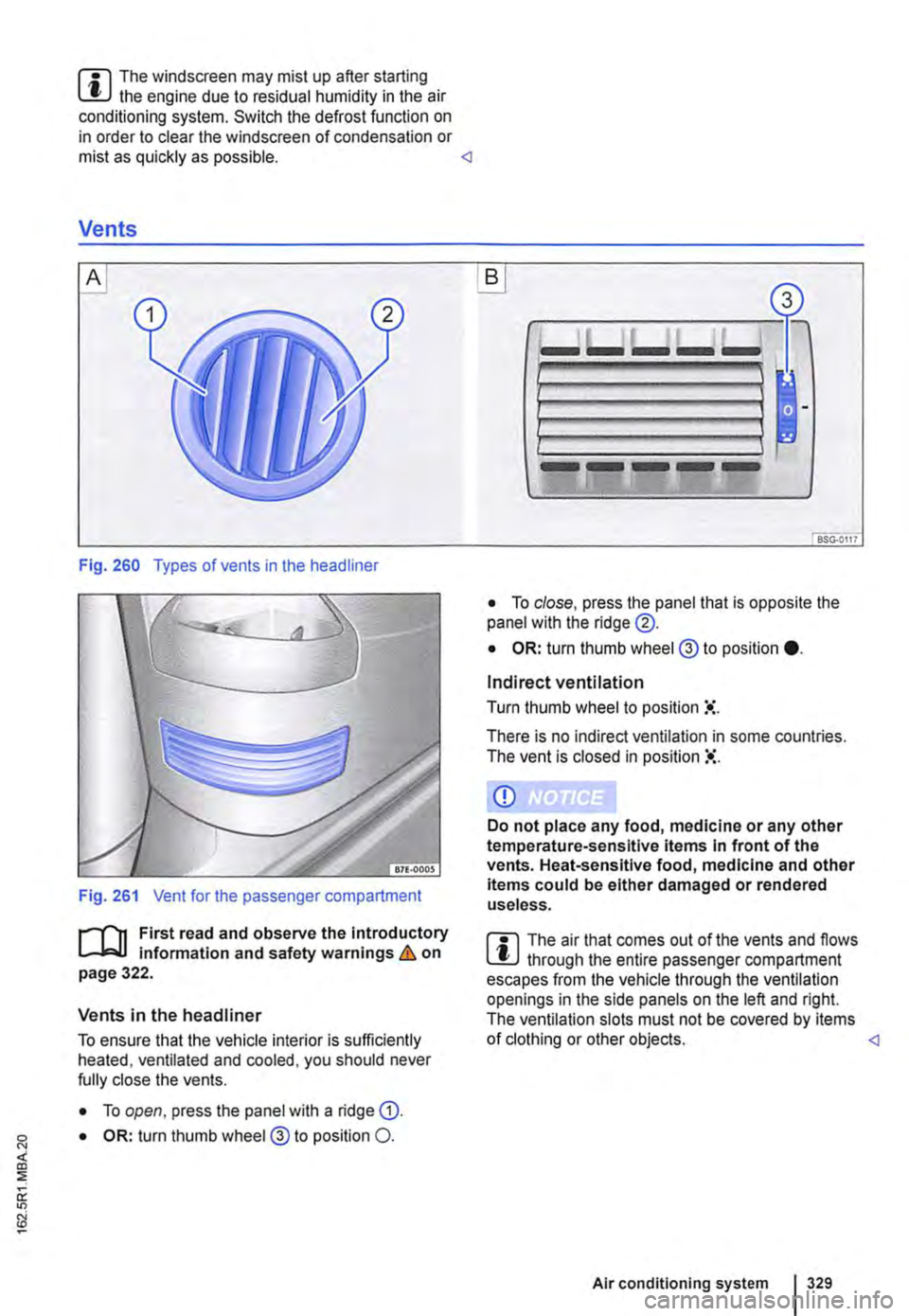
Fig. 260 Types of vents in the headliner
Fig. 261 Vent for the passenger compartment
1"'1'11 First read and observe the Introductory L-lo:.U information and safety warnings & on page 322.
Vents in the headliner
To ensure that the vehicle interior is sufficiently heated, ventilated and cooled, you should never fully close the vents.
• To open, press the panel with a ridge G).
• OR: turn thumb wheel@ to position 0.
IB
• To close, press the panel that is opposite the panel with the ridge @.
• OR: turn thumb wheel @to position e.
Indirect ventilation
Turn thumb wheel to position :-:.
There is no indirect ventilation in some countries. The vent is closed in position :-:.
CD
Do not place any food, medicine or any other temperature-sensitive items In front of the vents. Heat-sensitive food, medicine and other items could be either damaged or rendered useless.
m The air that comes out of the vents and flows W through the entire passenger compartment escapes from the vehicle through the ventilation openings in the side panels on the left and right. The ventilation slots must not be covered by items of clothing or other objects.
Page 330 of 486
Air recirculation mode
.-r'n First read and observe the introductory information and safety warnings .1:!. on page 322.
General notes
There are different types of air recirculation mode:
Manual air recirculation mode (Heating and fresh air system).
Manual air recirculation mode (air condi-tioning system).
Left indicator lamp lit up in the button: manual air recirculation mode (Ciima-
------------Right indicator lamp lit up in the button: automatic air recircutation mode (Ciima-tronic).
The air recirculation mode prevents outside air from entering the vehicle.
if the outside temperature is very low or very high, the manual air recirculation mode should be selec-ted for a short time in order to heat or cool the ve-hicle interior more quickly.
For safety reasons, the air recirculation mode will switch off if the@ button is pressed, or if the air distribution regulator is switched to lliil => .1:!,.
Switching the manual air recirculation mode on and off .o I c:;;:,
Switching on: press button repeatedly until the indicator lamp in the button lights up.
Switching off. press@) button until the indi-cator lamp in the button is no longer lit up.
Switching the manual air recirculation mode on and off in the Climatronic e<>A
Switching on: press the button until the left in-dicator lamp in the button tights up.
Switching off. press the repeatedly until the indicator lamp in the button is no longer lit up.
Function of the automatic air recirculation mode e<>A
In position a>• fresh air will enter the vehicle interi-or. The air recirculation mode will switch on auto-matically if the system detects an increase in the
330 I While driving
concentration of noxious substances in the outside air. The air recirculation mode will switch off as soon as this level has returned to normal.
The system cannot detect unpleasant odours.
The air recirculation mode will not be switched on automatically in certain circumstances such as when the ambient temperature is low or the air conditioning system has been switched on.
Switching the automatic air recirculation mode on and off
Switching on: press button repeatedly until the right indicator lamp in the button lights up.
Switching off: press button repeatedly until the indicator lamp in the button is no longer lit up.
A WARNING
Stale air can quickly make the driver tired and affect their concentration, which In turn can cause collisions, accidents and serious inju-ries.
• Never use the air reclrculation mode for an extended period as no fresh air will enter the vehicle Interior.
• If the cooling system is switched off, the windows can mist up very quickly In air recir-culatlon mode and reduce visibility consider-ably.
• Always switch off the air reclrculation mode when it is not required.
CD
In vehicles with an air conditioning system, do not smoke when the air reclrculatlon mode Is switched on. The smoke drawn Into the cooling system can leave a residue on the evaporator and the dust and pollen filter with active carbon insert, producing a lasting unpleasant odour.
m Cllmatronic: when reversing the vehicle, or l!J when the wash and wipe system is being used, the air recirculation mode will switch on tem-porarily to prevent exhaust emissions from entering the vehicle interior.
Page 358 of 486
A WARNING (Continued)
• Always allow the engine to cool down completely to avoid burns.
• Avoid raising your arms when removing the oil drain plug with your fingers to help prevent oil from running down your arm.
• Use a suitable container when draining the used oil. it must be at least large enough to hold the entire quantity of engine oil re-quired for refilling.
• Never store engine oil in empty food con-tainers, bottles or any other non-original con-tainers as people finding these containers may not know that they contain engine oil.
Coolant
o:::n Introduction
This chapter contains information on the following subjects:
Warning lamp and coolant temperature display . . . . . . . . . . . . . . . . . . . . . . . . . 359
Coolant specification . . . . . 360 Checking the coolant level and refilling coolant . . . . . . . . . . . . . 361
Never carry out any work on the engine coolant system if you are not familiar with the requisite pro-cedures, or if you do not have access to the cor-rect tools, operating equipment and fluids &. The work should be carried out by a qualified work-shop if you are uncertain. Volkswagen Commercial Vehicles recommends using a Volkswagen Com-mercial Vehicles dealership for this purpose.
Serious injuries can be caused if work is carried out incorrectly.
Additional information and warnings:
• Towing a trailer 139
• Preparation for working in the engine compart-ment 350
• Accessories, modifications, repairs and renewal of parts =>page 394
358 I Cleaning and maintenance
A WARNING (Continued)
• Engine oil is toxic and must be stored out of the reach of children.
r:Q:.. Before changing the engine oil, first find out W where old oil can be disposed of properly near you.
Used oil must be disposed of in accordance W with regulations governing the protection of the environment. Never dispose of old oil in loca-tions such as gardens, woods, sewerage systems, on streets and roads, or in rivers and waterways.
Engine coolant is poisonous and can cause serious Injuries.
• Engine coolant should only be kept in sealed original containers In a safe place.
• Never store engine coolant In empty food containers, bottles or any other non-original containers as people finding these containers may then drink the engine coolant.
• The engine coolant must be stored out of the reach of children.
• Please note that the amount of correct coolant additive used must be sufficient for the lowest ambient temperature that you ex-pect the vehicle to be exposed to.
• Coolant can freeze at extremely cold out-side temperatures, causing the vehicle to break down. Vehicle occupants with Inade-quate winter clothing could then freeze to death as the heating will also no longer func-tion.
Coolant and coolant additives can pollute the W environment. Spilt service fluids must be col-lected then disposed of properly and in an environ-mentally responsible way.
Page 390 of 486
• We recommend that you use a soft sponge or commercially available lint-free microfibre cloth for cleaning jobs
• Clean Alcantara® surfaces with a slightly damp cotton or woollen cloth or a commercially available lint-free microfibre cloth
General surface soiling of the upholstery and fabric trim can be cleaned with a commercially available foam cleaner.
If the upholstery and fabric trims are generally heavily soiled, consult a Volkswagen dealership for information on suitable cleaning methods before attempting any cleaning. If required, take the vehi-cle to a specialist cleaning company.
Treating stains
When treating stains, it may be necessary to clean the entire surface and not just the stain itself. This particularly applies if the surface shows general signs of wear. The cleaned area could otherwise be lighter than the surrounding area. If in doubt, consult a specialist cleaning company.
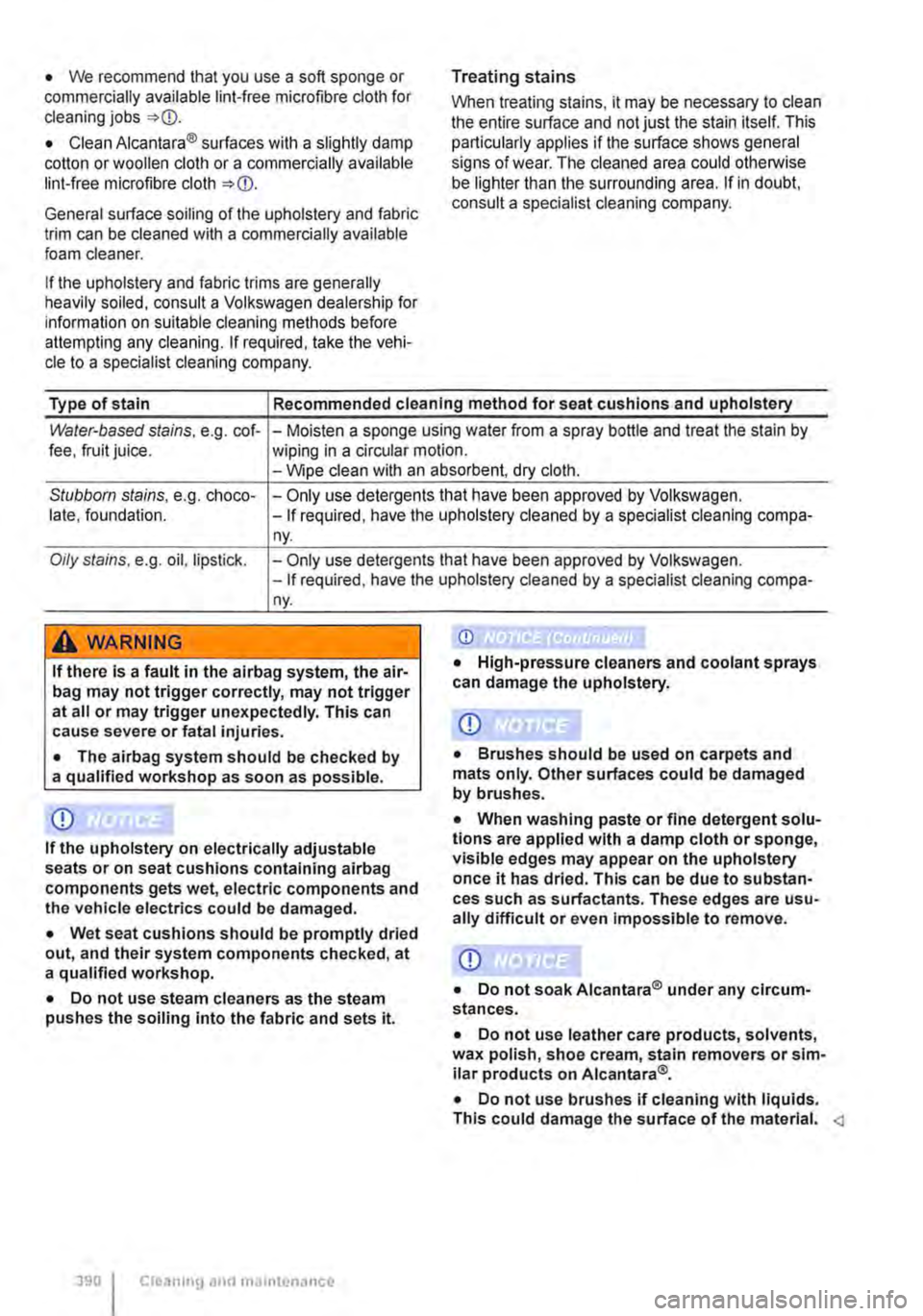
Type of stain Recommended cleaning method for seat cushions and upholstery
Water-based stains, e.g. cof-fee, fruit juice. -Moisten a sponge using water from a spray bottle and treat the stain by wiping in a circular motion. -Wipe clean with an absorbent, dry cloth.
Stubborn stains, e.g. choco--Only use detergents that have been approved by Volkswagen. late, foundation. -If required, have the upholstery cleaned by a specialist cleaning compa-ny.
Oily stains, e.g. oil, lipstick. -Only use detergents that have been approved by Volkswagen. -If required, have the upholstery cleaned by a specialist cleaning compa-ny.
A WARNING CD
If there is a fault in the airbag system, the air-bag may not trigger correctly, may not trigger at all or may trigger unexpectedly. This can cause severe or fatal injuries.
• The airbag system should be checked by a qualified workshop as soon as possible.
Q)
If the upholstery on electrically adjustable seats or on seat cushions containing airbag components gets wet, electric components and the vehicle electrics could be damaged.
• Wet seat cushions should be promptly dried out, and their system components checked, at a qualified workshop.
• Do not use steam cleaners as the steam pushes the soiling into the fabric and sets it.
390 Cleaning and maintenance
• High-pressure cleaners and coolant sprays can damage the upholstery.
Q)
• Brushes should be used on carpets and mats only. Other surfaces could be damaged by brushes.
• When washing paste or fine detergent solu-tions are applied with a damp cloth or sponge, visible edges may appear on the upholstery once it has dried. This can be due to substan-ces such as surfactants. These edges are usu-ally difficult or even Impossible to remove.
Q)
• Do not soak Alcantara® under any circum-stances.
• Do not use leather care products, solvents, wax polish, shoe cream, stain removers or sim-ilar products on Alcantara®.
• Do not use brushes if cleaning with liquids. This could damage the surface of the material.
Page 419 of 486
Wheel cover
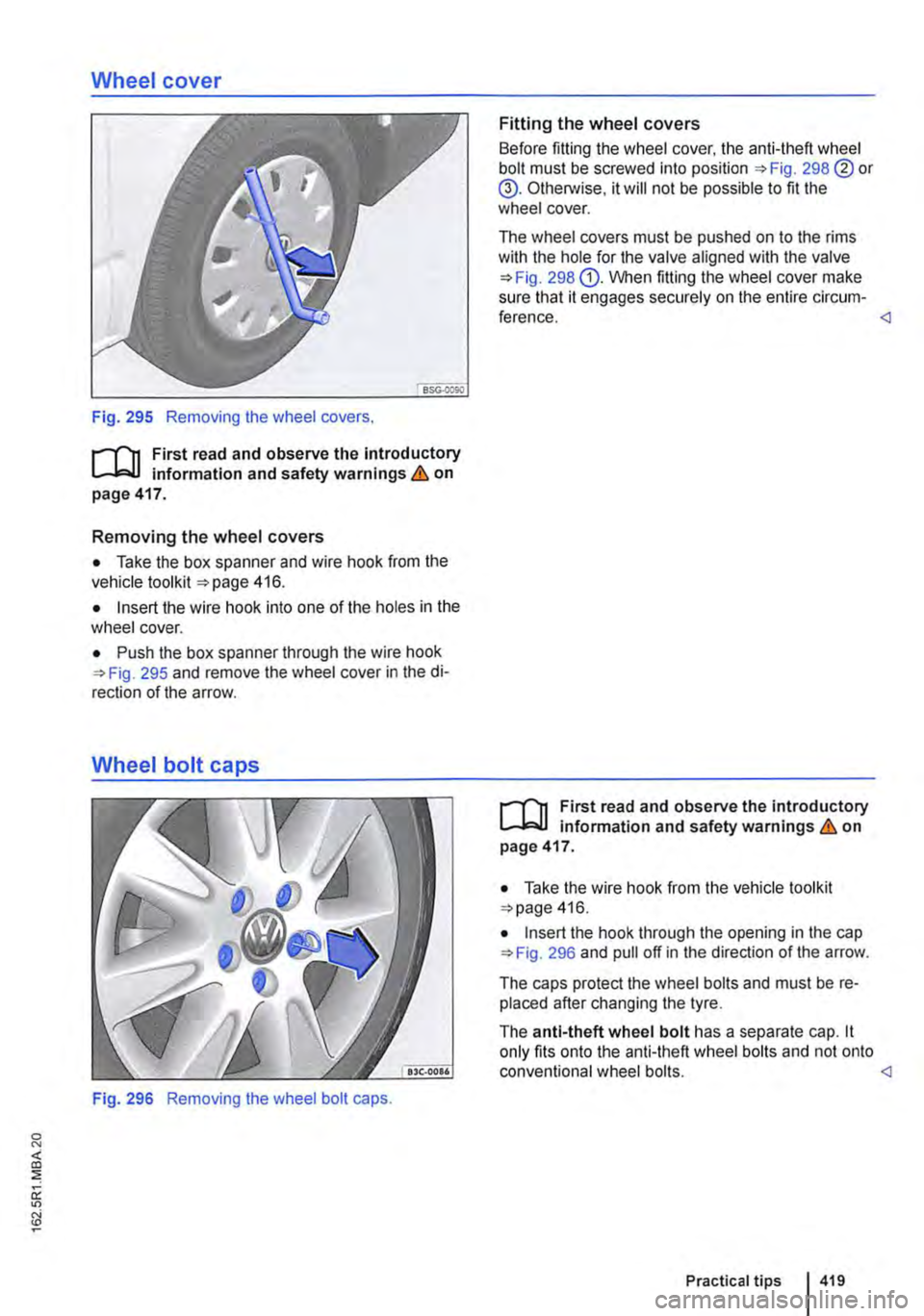
Fig. 295 Removing the wheel covers.
r-f"n First read and observe the Introductory information and safety warnings & on page 417.
Removing the wheel covers
• Take the box spanner and wire hook from the vehicle toolkit 416.
• Insert the wire hook into one of the holes in the wheel cover.
• Push the box spanner through the wire hook 295 and remove the wheel cover in the di-rection of the arrow.
Fig. 296 Removing the wheel bolt caps.
Fitting the wheel covers
Before fitting the wheel cover, the anti-theft wheel bolt must be screwed into position 298 ®or @. Otherwise, it will not be possible to fit the wheel cover.
The wheel covers must be pushed on to the rims with the hole for the valve aligned with the valve 298 G). When fitting the wheel cover make sure that it engages securely on the entire circum-ference.
• Take the wire hook from the vehicle tool kit 416.
• Insert the hook through the opening in the cap 296 and pull off in the direction of the arrow.
The caps protect the wheel bolts and must be re-placed after changing the tyre.
The anti-theft wheel bolt has a separate cap. it only fits onto the anti-theft wheel bolts and not onto conventional wheel bolts.
Page 428 of 486
A WARNING (Continued)
• Always follow the instructions In the checklist and observe the general safety pro-
Sealing and inflating tyres
r-"'('n First read and observe the Introductory L-J,.:.U Information and safety warnings & on page 425.
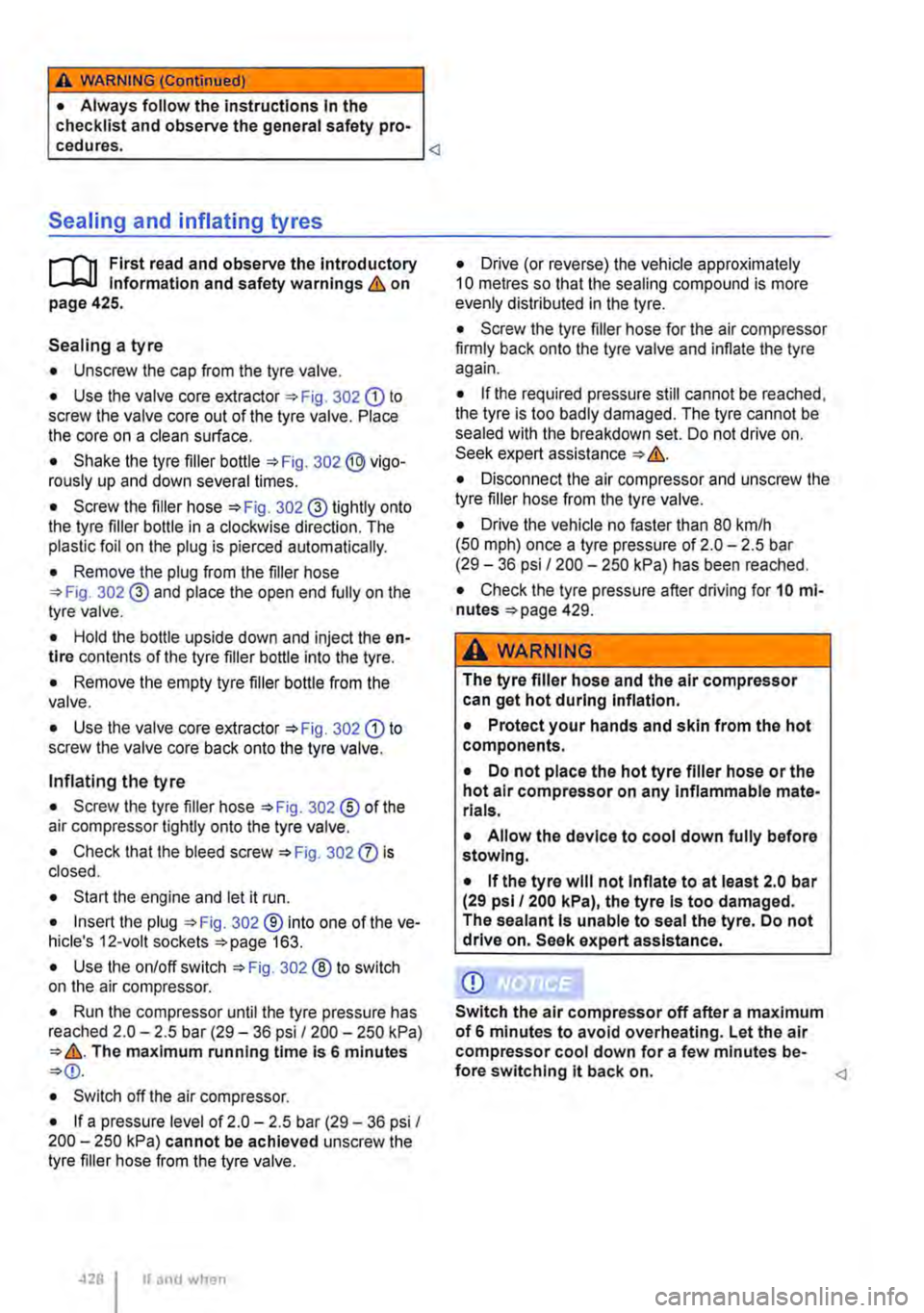
Sealing a tyre
• Unscrew the cap from the tyre valve.
• Use the valve core extractor 302 CD to screw the valve core out of the tyre valve. Place the core on a clean surface.
• Shake the tyre filler bottle 302 ® vigo-rously up and down several times.
• Screw the filler hose 302 @tightly onto the tyre filler bottle in a clockwise direction. The plastic foil on the plug is pierced automatically.
• Remove the plug from the filler hose 302@ and place the open end fully on the tyre valve.
• Hold the bottle upside down and inject the en-tire contents of the tyre filler bottle into the tyre.
• Remove the empty tyre filler bottle from the valve.
• Use the valve core extractor 302 CD to screw the valve core back onto the tyre valve.
Inflating the tyre
• Screw the tyre filler hose 302 ® of the air compressor tightly onto the tyre valve.
• Check that the bleed screw 302 (?) is closed.
• Start the engine and let it run.
• Insert the plug 302 ®into one of the ve-hicle's 12-volt sockets 163.
• Use the on/off switch 302 ®to switch on the air compressor.
• Run the compressor until the tyre pressure has reached 2.0-2.5 bar (29-36 psi I 200-250 kPa) maximum running time is 6 minutes
• Switch off the air compressor.
• If a pressure level of 2.0-2.5 bar (29-36 psi I 200 -250 kPa) cannot be achieved unscrew the tyre filler hose from the tyre valve.
428 I If and when
• Drive (or reverse) the vehicle approximately 1 0 metres so that the sealing compound is more evenly distributed in the tyre.
• Screw the tyre filler hose for the air compressor firmly back onto the tyre valve and inflate the tyre again.
• If the required pressure still cannot be reached, the tyre is too badly damaged. The tyre cannot be sealed with the breakdown set. Do not drive on. Seek expert assistance &.
• Disconnect the air compressor and unscrew the tyre filler hose from the tyre valve.
• Drive the vehicle no faster than 80 km/h (50 mph) once a tyre pressure of 2.0-2.5 bar (29-36 psi I 200-250 kPa) has been reached.
• Check the tyre pressure after driving for 10 mi-nutes 429.
A WARNING
The tyre filler hose and the air compressor can get hot during Inflation.
• Protect your hands and skin from the hot components.
• Do not place the hot tyre filler hose or the hot air compressor on any Inflammable mate-rials.
• Allow the device to cool down fully before stowing.
• If the tyre will not Inflate to at least 2.0 bar (29 psi/ 200 kPa), the tyre Is too damaged. The sealant Is unable to seal the tyre. Do not drive on. Seek expert assistance.
CD
Switch the air compressor off after a maximum of 6 minutes to avoid overheating. Let the air compressor cool down for a few minutes be-fore switching it back on.