tow bar VOLKSWAGEN TRANSPORTER 2016 User Guide
[x] Cancel search | Manufacturer: VOLKSWAGEN, Model Year: 2016, Model line: TRANSPORTER, Model: VOLKSWAGEN TRANSPORTER 2016Pages: 486, PDF Size: 69.28 MB
Page 235 of 486
Connecting the gas bottle
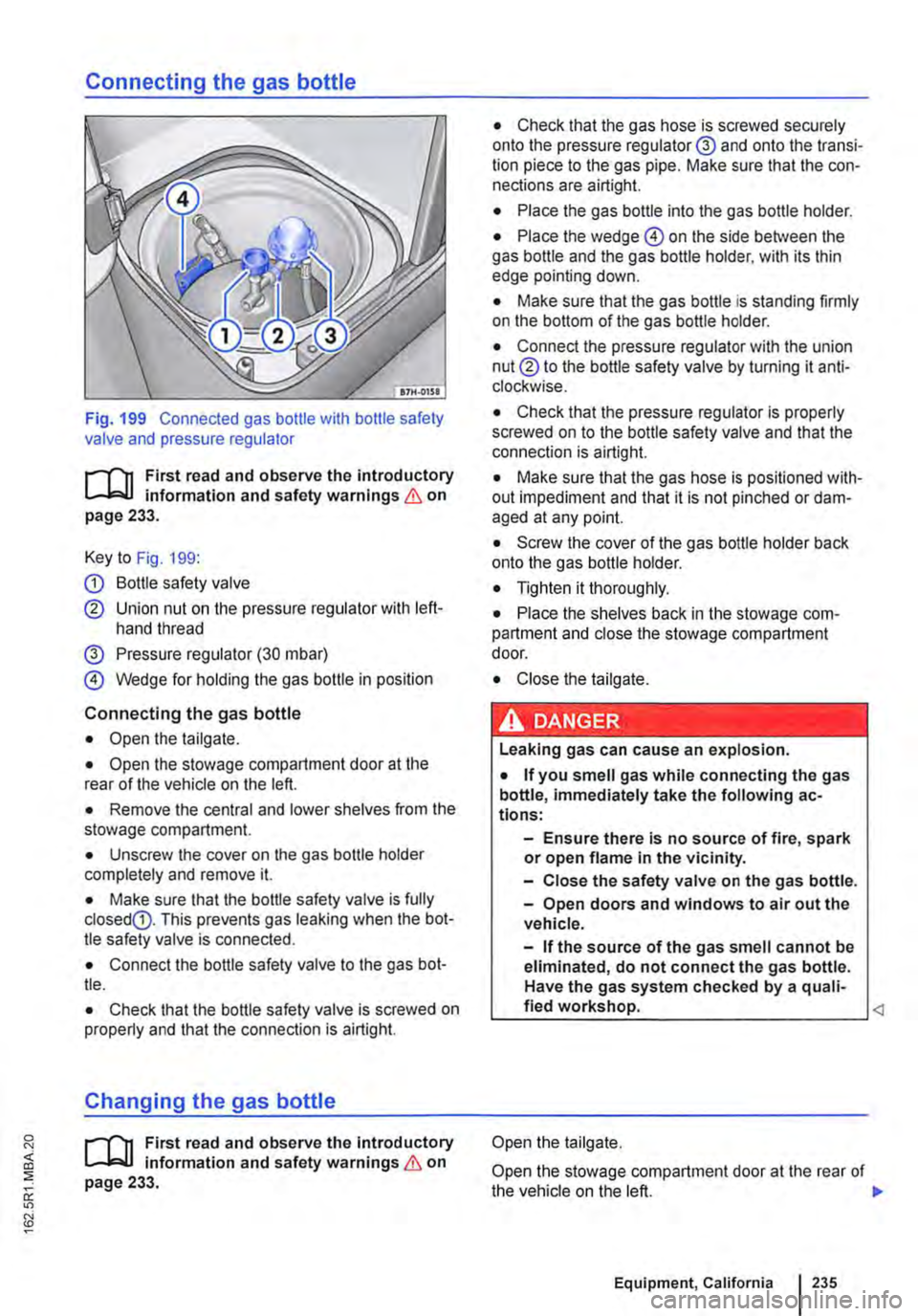
Fig. 199 Connected gas bottle with bottle safety valve and pressure regulator
r-l'n First read and observe the introductory L-J.:.IJ information and safety warnings & on page 233.
Key to Fig. 199:
G) Bottle safety valve
® Union nut on the pressure regulator with left-hand thread
@ Pressure regulator (30 mbar)
@ Wedge for holding the gas bottle in position
Connecting the gas bottle
• Open the tailgate.
• Open the stowage compartment door at the rear of the vehicle on the left.
• Remove the central and lower shelves from the stowage compartment.
• Unscrew the cover on the gas bottle holder completely and remove it.
• Make sure that the bottle safety valve is fully closedG). This prevents gas leaking when the bot-tle safety valve is connected.
• Connect the bottle safety valve to the gas bot-tle.
• Check that the bottle safety valve is screwed on properly and that the connection is airtight.
Changing the gas bottle
r-l'n First read and observe the Introductory L-J.:.IJ information and safety warnings & on page 233.
• Check that the gas hose is screwed securely onto the pressure regulator@ and onto the transi-tion piece to the gas pipe. Make sure that the con-nections are airtight.
• Place the gas bottle into the gas bottle holder.
• Place the wedge @ on the side between the gas bottle and the gas bottle holder. with its thin edge pointing down.
• Make sure that the gas bottle is standing firmly on the bottom of the gas bottle holder.
• Connect the pressure regulator with the union nut® to the bottle safety valve by turning it anti-clockwise.
• Check that the pressure regulator is properly screwed on to the bottle safety valve and that the connection is airtight.
• Make sure that the gas hose is positioned with-out impediment and that it is not pinched or dam-aged at any point.
• Screw the cover of the gas bottle holder back onto the gas bottle holder.
• Tighten it thoroughly.
• Place the shelves back in the stowage com-partment and close the stowage compartment door.
• Close the tailgate.
· &' DANGER .. --' • ,.,_.._.. '·-• I Leaking gas can cause an explosion.
• If you smell gas while connecting the gas bottle, immediately take the following ac-tions:
-Ensure there is no source of fire, spark or open flame in the vicinity.
-Close the safety valve on the gas bottle.
-Open doors and windows to air out the vehicle.
-If the source of the gas smell cannot be eliminated, do not connect the gas bottle. Have the gas system checked by a quali-fied workshop.
Open the stowage compartment door at the rear of the vehicle on the left. 11>
Equipment, California I 235
Page 312 of 486
System limits
r-('n First read and observe the Introductory L-J,:.U Information and safety warnings & on page 307.
The area monitoring system (Front Assist) has physical and system-related limits. The driver may therefore feel that, in certain circumstances, some Front Assist reactions occur unexpectedly or with a delay. You should therefore always be prepared to take full control of the vehicle if necessary.
The following conditions can prevent Front Assist from reacting, or cause a delay in its reaction:
• In tight bends.
• If the accelerator is fully depressed.
• If Front Assist is switched off or there is a fault.
• If TCS or ESC is switched off manually.
• If the ESC is taking corrective action.
• If there is a fault in several brake lights on the vehicle or on a trailer with an electrical connection to the vehicle.
• If the radar sensor is dirty or covered.
• If the vehicle is reversing.
• Under hard acceleration.
• In snow or heavy rain.
• In case of narrow vehicles, e.g. motorbikes.
• If vehicles are travelling slightly to the left or right of your vehicle.
• If vehicles are crossing in front of your vehicle.
• If there is oncoming traffic.
• In uncertain traffic situations.
• 1/Vhen loads or attachment parts on other vehi-cles protrude to the side, rear or above the normal dimensions of the vehicle.
COJ Introduction
This chapter contains information on the following subjects:
Indicator lamp ... .
Operation ....... .
Driving situations ..........•.............
313
314
315
The lane change assist system (Side As-
sist) provides assistance when checking
for traffic behind the vehicle.
The lane change assist system cannot be switched on if the factory-fitted towing bracket is electrically connected to the trailer. The lane change assist system must be switched off manually for non-fac-tory-fitted towing brackets.
The lane change assist system has been designed for use on surfaced roads only.
Additional information and warnings:
• Exterior views =<>page 5
• Volkswagen information system =<>page 24
• Accessories, modifications, repairs and renewal of parts =<>page 394.
3121 While drivmg
A WARNING
The Intelligent technology of the lane change assist system (Side Assist) cannot change the laws of physics or the system-related ve-hicle limitations. Always take care when us-Ing the lane change assist system as you could otherwise cause accidents or Injuries. The system Is not a substitute for the full concentration of the driver.
• Adapt your speed and distance from the vehicles ahead to suit visibility, weather, road and traffic conditions.
• Your hands should always be on the steer-Ing wheel so that you can steer at any time.
• Pay attention to the visual displays in the exterior mirror housing and in the Instrument cluster display, and respond to the com-mands.
• The lane change assist system may react to special roadside structures, e.g. high or offset crash barriers. This can lead to error warnings. ,..
Page 412 of 486
Making you and your vehicle safe
8S0.00)7
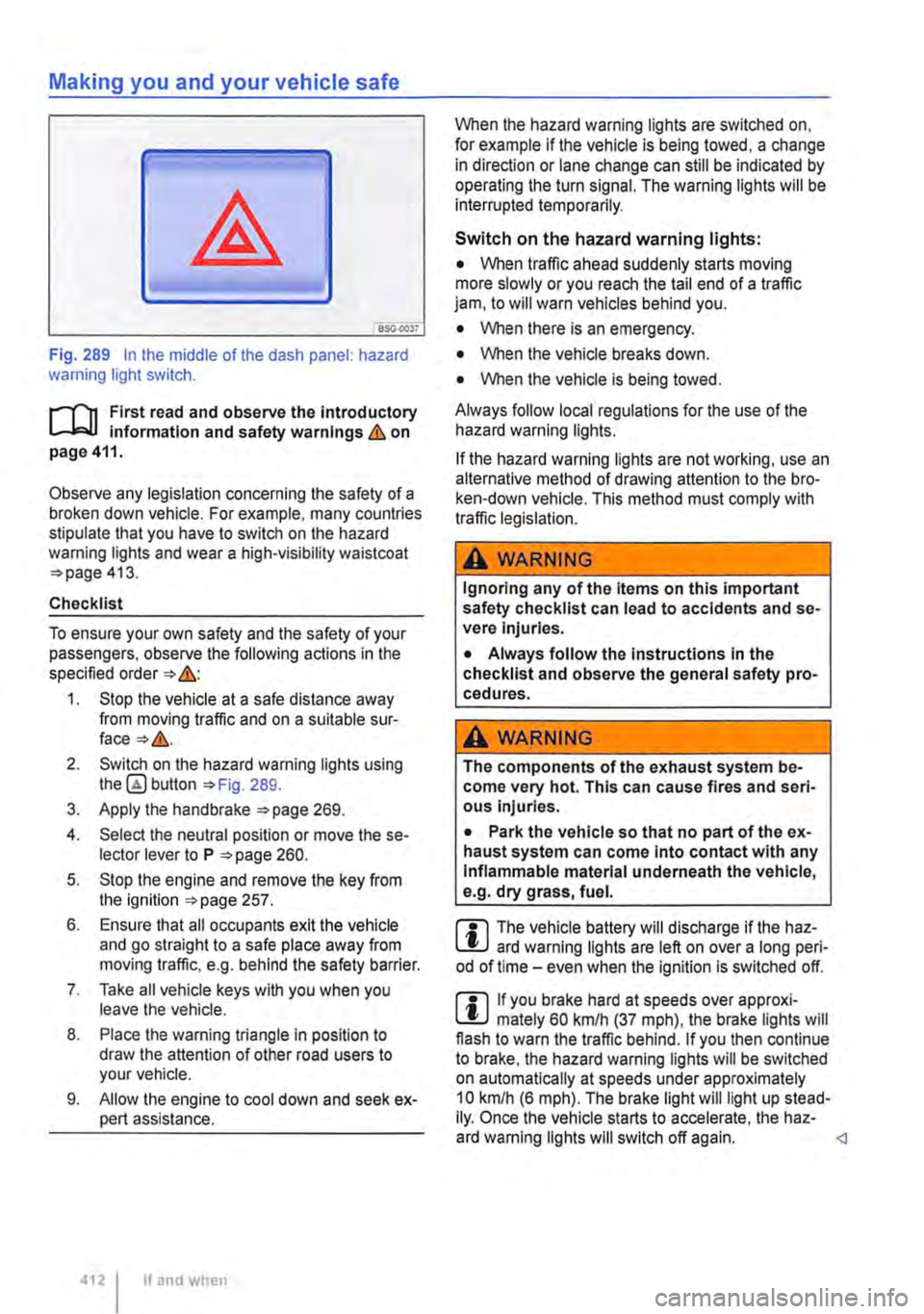
Fig. 289 In the middle of the dash panel: hazard warning light switch.
f"'""'('n First read and observe the Introductory L-lo:.U Information and safety warnings Lb. on page 411.
Observe any legislation concerning the safety of a broken down vehicle. For example, many countries stipulate that you have to switch on the hazard warning lights and wear a high-visibility waistcoat =>page 413.
Checklist
To ensure your own safety and the safety of your passengers, observe the following actions in the specified order => &:
1. Stop the vehicle at a safe distance away from moving traffic and on a suitable sur-face=>&.
2. Switch on the hazard warning lights using button =>Fig. 289.
3. Apply the handbrake =>page 269.
4. Select the neutral position or move the se-lector lever to P =>page 260.
5. Stop the engine and remove the key from the ignition =>page 257.
6. Ensure that all occupants exit the vehicle and go straight to a safe place away from moving traffic, e.g. behind the safety barrier.
7. Take all vehicle keys with you when you leave the vehicle.
8. Place the warning triangle in position to draw the attention of other road users to your vehicle.
9. Allow the engine to cool down and seek ex-pert assistance.
4121 If and when
When the hazard warning lights are switched on, for example if the vehicle is being towed, a change in direction or lane change can still be indicated by operating the turn signal. The warning lights will be interrupted temporarily.
Switch on the hazard warning lights:
• When traffic ahead suddenly starts moving more slowly or you reach the tail end of a traffic jam, to will warn vehicles behind you.
• When there is an emergency.
• When the vehicle breaks down.
• When the vehicle is being towed.
Always follow local regulations for the use of the hazard warning lights.
If the hazard warning lights are not working, use an alternative method of drawing attention to the bro-ken-down vehicle. This method must comply with traffic legislation.
A WARNING
Ignoring any of the items on this important safety checklist can lead to accidents and se-vere Injuries.
• Always follow the Instructions In the checklist and observe the general safety pro-cedures.
A wARNING
The components of the exhaust system be-come very hot. This can cause fires and seri-ous Injuries.
• Park the vehicle so that no part of the ex-haust system can come Into contact with any Inflammable material underneath the vehicle, e.g. dry grass, fuel.
m The vehicle battery will discharge if the haz-L.:!J ard warning lights are left on over a long peri-od of time -even when the Ignition is switched off.
m If you brake hard at speeds over approxi-L.:!J mately 60 km/h (37 mph), the brake lights will flash to warn the traffic behind. If you then continue to brake, the hazard warning lights will be switched on automatically at speeds under approximately 10 km/h (6 mph). The brake light will light up stead-Ily. Once the vehicle starts to accelerate, the haz-ard warning lights will switch off again.
Page 427 of 486
Contents of the breakdown set
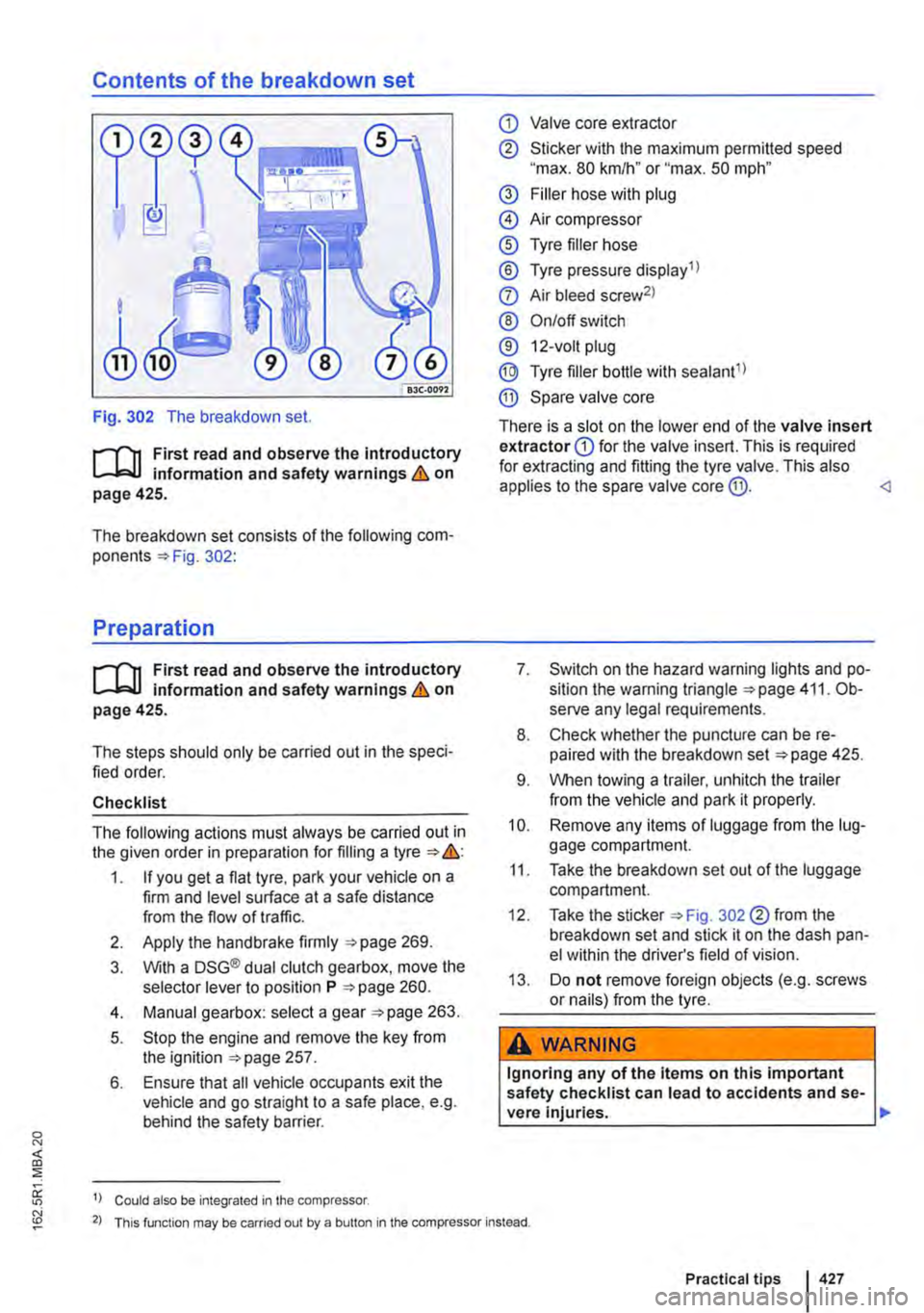
Fig. 302 The breakdown set.
r--T'n First read and observe the introductory L-L::.U information and safety warnings & on page 425.
The breakdown set consists of the following com-ponents 302:
Preparation
r--T'n First read and observe the introductory L-L::.U information and safety warnings & on page 425.
The steps should only be carried out in the speci-fied order.
Checklist
The following actions must always be carried out in the given order in preparation for filling a tyre &:
1. If you get a flat tyre, park your vehicle on a firm and level surface at a safe distance from the flow of traffic.
2. Apply the handbrake firmly 269.
3. With a DSG® dual clutch gearbox, move the selector lever to position P 260.
4. Manual gearbox: select a gear 263.
5. Stop the engine and remove the key from the ignition 257.
6. Ensure that all vehicle occupants exit the vehicle and go straight to a safe place, e.g. behind the safety barrier.
1) Could also be integrated in the compressor.
CD Valve core extractor
® Sticker with the maximum permitted speed "max. 80 km/h" or "max. 50 mph"
@ Filler hose with plug
@ Air compressor
® Tyre filler hose
® Tyre pressure display 1 l
0 Air bleed screw2l
® On/off switch
® 12-volt plug
@ Tyre filler bottle with sealant1l
® Spare valve core
There is a slot on the lower end of the valve insert extractor CD for the valve insert. This is required for extracting and fitting the tyre valve. This also applies to the spare valve core @.
8. Check whether the puncture can be re-paired with the breakdown set 425.
9. When towing a trailer, unhitch the trailer from the vehicle and park it properly.
10. Remove any items of luggage from the lug-gage compartment.
11. Take the breakdown set out of the luggage compartment.
12. Take the sticker 302 ®from the breakdown set and stick it on the dash pan-el within the driver's field of vision.
13. Do not remove foreign objects (e.g. screws or nails) from the tyre.
A WARNING
Ignoring any of the items on this important safety checklist can lead to accidents and se-vere Injuries. ,..
2) This function may be carried out by a button in the compressor instead.
Practical tips 427
Page 428 of 486
A WARNING (Continued)
• Always follow the instructions In the checklist and observe the general safety pro-
Sealing and inflating tyres
r-"'('n First read and observe the Introductory L-J,.:.U Information and safety warnings & on page 425.
Sealing a tyre
• Unscrew the cap from the tyre valve.
• Use the valve core extractor 302 CD to screw the valve core out of the tyre valve. Place the core on a clean surface.
• Shake the tyre filler bottle 302 ® vigo-rously up and down several times.
• Screw the filler hose 302 @tightly onto the tyre filler bottle in a clockwise direction. The plastic foil on the plug is pierced automatically.
• Remove the plug from the filler hose 302@ and place the open end fully on the tyre valve.
• Hold the bottle upside down and inject the en-tire contents of the tyre filler bottle into the tyre.
• Remove the empty tyre filler bottle from the valve.
• Use the valve core extractor 302 CD to screw the valve core back onto the tyre valve.
Inflating the tyre
• Screw the tyre filler hose 302 ® of the air compressor tightly onto the tyre valve.
• Check that the bleed screw 302 (?) is closed.
• Start the engine and let it run.
• Insert the plug 302 ®into one of the ve-hicle's 12-volt sockets 163.
• Use the on/off switch 302 ®to switch on the air compressor.
• Run the compressor until the tyre pressure has reached 2.0-2.5 bar (29-36 psi I 200-250 kPa) maximum running time is 6 minutes
• Switch off the air compressor.
• If a pressure level of 2.0-2.5 bar (29-36 psi I 200 -250 kPa) cannot be achieved unscrew the tyre filler hose from the tyre valve.
428 I If and when
• Drive (or reverse) the vehicle approximately 1 0 metres so that the sealing compound is more evenly distributed in the tyre.
• Screw the tyre filler hose for the air compressor firmly back onto the tyre valve and inflate the tyre again.
• If the required pressure still cannot be reached, the tyre is too badly damaged. The tyre cannot be sealed with the breakdown set. Do not drive on. Seek expert assistance &.
• Disconnect the air compressor and unscrew the tyre filler hose from the tyre valve.
• Drive the vehicle no faster than 80 km/h (50 mph) once a tyre pressure of 2.0-2.5 bar (29-36 psi I 200-250 kPa) has been reached.
• Check the tyre pressure after driving for 10 mi-nutes 429.
A WARNING
The tyre filler hose and the air compressor can get hot during Inflation.
• Protect your hands and skin from the hot components.
• Do not place the hot tyre filler hose or the hot air compressor on any Inflammable mate-rials.
• Allow the device to cool down fully before stowing.
• If the tyre will not Inflate to at least 2.0 bar (29 psi/ 200 kPa), the tyre Is too damaged. The sealant Is unable to seal the tyre. Do not drive on. Seek expert assistance.
CD
Switch the air compressor off after a maximum of 6 minutes to avoid overheating. Let the air compressor cool down for a few minutes be-fore switching it back on.
Page 447 of 486
• Switch on the ignition and the hazard warning lights.
• Once both vehicles are in motion, release the clutch.
• As soon as the engine starts, press the clutch and put the gear into neutral. This helps to prevent driving into the towing vehicle.
Notes on towing
i"""fl1 First read and observe the introductory L-W! information and safety warnings & on page 446.
Fixed towing eye at rear
On vehicles without a towing bracket there is a fixed towing eye under the bumper at the rear right.
Towing bracket instead of a fixed towing eye
If the vehicle has a factory-fitted towing bracket, it should also be used for towing other vehicles.
Tow rope or tow bar
lt is easier and safer to tow a vehicle with a tow bar. Only use a tow rope if you do not have a tow bar.
The tow rope should be slightly elastic to reduce the strain on both vehicles. lt is advisable to use a tow rope made of synthetic fibre or similarly elastic material.
Only attach the tow rope or tow bar to the specially provided towing eyes or to the towing bracket.
Vehicles with a factory-fitted towing bracket must be towed only with a tow bar that is specially designed for fitting to a ball coupling 139.
When your vehicle has to be towed:
• Switch on the ignition.
• Select the neutral position or move the selector lever to N 257.
• Release the handbrake. if necessary.
CD
When tow-starting, unburnt fuel can enter the catalytic converter and damage it. <1
• Do not allow the vehicle to be towed at speeds faster than 50 km/h (30 mph).
• Do not allow the vehicle to be towed further than 50 km.
• Vehicles with a DSG® dual clutch gearbox may only be towed by the breakdown truck with the front wheels raised.
Towing vehicles with four-wheel drive (4MOTION)
Vehicles with four-wheel drive (4MOTION) may be towed with a tow bar or tow rope. If the vehicle is towed with the rear or front axle raised, the engine must be switched off otherwise the drive train could be damaged.
When should your vehicle not be towed?
• If, due to damage, the vehicle gearbox no lon-ger contains any lubricant.
• If the vehicle battery is discharged.
• If the distance to be towed is further than 50 km -applies only to vehicles with the DSG® dual clutch gearbox.
• If the steering function or the operating clear-ance of the wheels cannot be ensured, e.g. after an accident.
Please comply with the following when towing another vehicle:
• Comply with legal regulations.
• Comply with the information on towing con-tained in the owner's manual for the other vehicle. <1
Practical tips
Page 450 of 486
Technical data
Technical data
Vehicle data
COJ Introduction
This chapter contains information on the following subjects:
Vehicle identification data . . . . . . . . . . . . . . . . . 451
Dimensions ........................... . 452
Unless otherwise specified, the technical data of the basic model apply. The values quoted here may differ if additional equipment is fitted, for differ-ent models, for special vehicles or if country-specif-ic equipment is fitted. All data in the official vehicle documents take precedence over these data.
Engine
The vehicle data sticker and the official vehicle documents show which engine is installed in your vehicle.
Weight
The values for the kerb weight in the following ta-bles apply for the road-ready vehicle with driver (75 kg), service fluids including fuel tank carrying 90% of its capacity and, if applicable, toolkit and spare tyre =>&.Additional equipment and retrofit-ted accessories increase the stated kerb weight and reduce the maximum permitted load accord-ingly.
The load comprises the weights of the following:
• Passengers
• Allluggage
• Roof load including the mounts or roof bars and the load carrier system
• Drawbar load when towing a trailer
Performance figures
The performance figures were measured without equipment which may influence performance, such as a roof carrier or mud flaps.
Gross combination weight rating
The gross combination weight ratings listed are on-ly applicable for altitudes up to 1 ,000 m above sea level. The maximum weight of the car and trailer must be reduced by approximately 10% for every further 1 ,000 m in altitude.
450 I Tcchn1cal data
Descriptions of the tables
Gearbox abbreviations: MG = manual gearbox, DSG® = dual clutch gearbox DSG®.
Additional information and warnings:
• Transporting =:o page 125
• Driving with respect for the environment =:.page 278
• Fuel =:.page 343
• Engine oil =:o page 353
• Engine coolant =:o page 358
• Wheels and tyres =>page 367
• Consumer information =>page 404
,A WARNING
Exceeding the maximum permissible weights, payload, dimensions, vehicle speed and axle weight rating could cause damage to the vehicle, accidents and serious Injuries.
• Do not exceed the permitted weights, loads, dimensions and maximum speeds.
• The actual axle loads must never exceed the maximum permissible axle loads.
• The payload and the distribution of the load In the vehicle have an effect on the driv-ing response and braking distance of the ve-hicle. Adjust your speed accordingly.
,A WARNING
Accidents and severe injuries can occur if the maximum permitted gross combination weight Is exceeded.
• Never exceed the specified gross combi-nation weight rating.
Page 465 of 486
Index
Numbers and Symbols
12-volt socket California . . . . . . . . . . . . . . . . . . . . . . . . . 244
2-seat arrangement Stowage compartment in armrest . . . . . . 184
2-seat arrangement, Business . . . . . . . . . . 182 Adjusting armrest . . . . . . . . . . . . . . . . . . . 184 Adjusting seats . . . . . . . . . . . . . . . . . . . . . 183 Ash tray . .. .. . . . .. . . .. . . • . .. . .. .. . 186 Centre console . . . . . • . . . . . . . . . . . . . . . 185 Cigarette lighter . . . . . . . • . . • . . . . . . . . . 186 Controls . . . . . . . . . . . . . . . . . . . . . . . . . . 183 Drink holder . . . . . . . . . . . . . . . . . . . . . . . 186 Features . . . . . . . . . . . . . . . . . . . . . . . . . . 182 Front stowage compartment . . . . . . . . . . 186 Moving . . . . . . . . . . . . . . . . . . . . . . . . . . . 185 Refrigerator box . . . . . . . . . . . . . . . . . . . . 186 Seat heater . . . . . . . . . . . . . . . . . . . . . . . 183 Upper stowage compartment . . . . . . . . . . 186 230-volt Euro socket . . . . . . . . . . . . . . . . . . 245
230-volt grounded safety socket . . . . . . . . 246
230-volt power supply . . . . . . . . . . . . . . . . . 245 Residual current circuit breaker . . . . . . . . 247
3-seat bench
A
Folding out the table . . . . . . . . . . . . . . . . . 74 Setting up the bed . . . . . . . . . . . . . • . . . . . 74
Abroad Extended trips with your vehicle 405 Selling the vehicle . . . . . . . . . . . . . . . . . . 405
ABS see Brake support systems . . . . . . . . . . . 275
ACC see Adaptive cruise control (ACC) . . . . . . 298
Accessing a service message . . . . . . . . . . . 23
Accessories . . . . . . . . . . . . . . . . . . . . . . . . . 394
Acoustic warnings Seat belt not fastened . . . . . . . . . . . . . . . . 80
Adaptive chassis control Fault . . . . . . . . . . . . . . . . . . . . . . . . . 317, 318 Function . . . . . . . . . . . . . . . . . . . . . . . . . . 318 Operation . . . . . . . . . . . . . . . . . 318
Adaptive chassis control (DCC) . . . . . . . . . 317 Indicator lamp . . . . . . . . . . . . . . . . . . . . . 317
Adaptive cruise control (ACC) . . . . . . . . . . 298 Displays . . . . . . . . . . . . . . . . . . . . . . . . . . 300 Fault . . . . . . . . . . . . . . . . . . . . . . . . . . . . . 299 Indicator lamp . . . . . . . . . . . . . . . . . . . . . 300 Operating . . . . . . . . . . . . . . . . . . . . . . . . . 302 Radar sensor . . . . . . . . . . . . . . . . . . . . . . 301 Special driving situations . . . . . . . . . . . . . 305
Switching off temporarily . . . . . . . . . . . . . 304 Warning lamp . . . . . . . . . . . . . . . • . . • . . . 300
Ad Blue Indicator lamp . . . . . . . . . . . . . . . . . • . . . 347 Information . . . . . . . . . . . . . . . . . . . . . . . . 346 Refilling . . . . . . . . . . . . . . . . . . . . . . . . . . 348 Specification . . . . . . . . . . . . . . . . . . . . . . . 348 Tank capacity . . . . . . . . . . . . . . . . . . . . . . 346 Warning lamp . . . . . . . . . . . . . . . . . . . . . . 347
Additional battery California . . . . . . . . . . . . . . . . . . . . . . . . . 248 Charging . . . . . . . . . . . . . . . . . . . . . . . . . 247
Adjust Electrically adjustable front seat . . . . . . . . 66 Single seats in the passenger compartment .7.3
Adjusting Correct sitting position . . . . . . . . . . . . . . . . 63 Headlight range ..................... 113 Head restraints . . . . . . . . . . . . . . . . . . . . . . 67 Mechanical front seats . . . . . . . . . . . . . . . . 65 Memory seats . . . . . . . . . . . . . . . . . . . . . . 70 Single seats in the passenger compartment .73 Steering wheel . . . . . . . . . . . . . . . . . . . . . . 68
Adjusts Electric lumbar support adjustment . . . . . . 66
Aerial . . . . . . . . . . . . . . . . . . . . . . . . . . 124.406
AGM battery . . . . . . . . . . . . . . . . . . . . . . . . . 248
........................ Cleaning the dash panel . . . . . . . . . . . . . 392 Combined curtain and side airbags . . . . . . 94 Curtain airbags . . . . . . . . . . . . . . . . . . . . . . 95 Description . . . . . . . . . . . . . . . . . . . . . . . . . 90 Differences between front passenger front airbag systems . . . . . . . . . . . . . . . . . . . . 89 Faults . . . . . . . . . . . . • . . • . . . . . . . . . . . . 397 Front airbags . . . • . . • . . . . . • . . . . . • . . . . 92 Function . . . . . . . . . . . . . . . . . . . . . . . . . . . 90 Indicator lamp . . . . . . . . . . . . . . . . . . . . . . 89 Repairs . . . . . . . . . . . . . . . . . . . . . . . . . . . 397 Switching off the front passenger front air-bag . . . . . . . . . . . . . . . . . . . . . . . . . . . . . 93 Switching off with the key switch . . . . . . . . 93 Using child seats . . . . . . . . . . . . . . . . . . . . 93 Vehicle care . . . . . . . . . . . . . . . . . . . . . . . 392
Air conditioning system . . . . . . . . . . . . . . . 322 Air recirculation mode . . . . . . . . . . . . . . . 330 Climatic . . . . . . . . . . . . . . . . . . . . . . . . . . 323 Climatronic . . . . . • . . . . . . . . . . . . . . . . . . 325 Controls . . . . . . . . . . . . . . . . . . . . . . 323, 325 Fault . . . . . . . . . . . . . . . . . . . . . . . . . . . . . 328 Indirect ventilation . . . . . . . . . . . . . . . . . . 329 Information . . . . . . . . . . • . . • . . . . . . . . . . 328 Settings . . . . . . . . . . . . . . . . . . . . . . . . . . 328 Things to note . . . . . . . . . . . . . . . . . . . . . 328
Index 465
Page 470 of 486
Supplementary heater . . . . . . • . . . . . . . . 345 Winter diesel . . . . . . . . . . . . . . . . . . . . . . 345
Diesel engines Technical data . . . . . . . . . . . • . . . . . . . . . 455
Diesel partlcutate filter . . . . . . • . . . . . . . . . 409 ............................. 408 Gear-change indicator . . . . . . . . . . . . . . . 268 Indicator lamp . . . . . . . . . . . • . . . . . . . . . 407 Regeneration . . . . . . . . . . . . . . . . . . . . . . 409 Things to note . . . . . . . . . . . . . . . . . . . . . 346
Differential lock see Brake support systems . . . . . . . . . . . 275
Digital clock . . . . . . . . . . . . . . . . . . . . . . . . . . 20
Digital voice enhancement . . . . . . . . . . . . . 173 Setting the volume . . . . . . . . • . . • . . . . . . 173 Switching on and off . . . . . . . . . . . . . . . . . 173
Dimensions . . . . . . . . . . . . . . . . . . . . . . . . . 452
Dipped beam headlights . . . . . . . . . . . . . . . 108
Display Adaptive cruise control . . . . . . . . . . . . . . . 300
Displays . . . . . . . . . . . . . . . . . . . . . . . . . . 20, 21 Area monitoring system . . . . . . . . . . . . . . 308 Front Assist .. .. .. .. .. .. .. .. .. . .. .. 308 Instrument cluster . . . . . . . . . . . . . . . . . . . 21
Disposal Airbag system . . . . . . . . . . . . . . . . . . . . . 407 Belt tensioner . . . . . . . . . . . . • . . . . . . . . . . 87 End-of-life vehicle . . . . . . . . . . . . . . . . . . 407
Door arresters . . . . . . . . . . . . . . . . . . . . . . . . 54
Door release lever . . . . . . . . . . . . . . . . . . . . 5, 9
Doors .................•............. 45 Manual opening . . . . . . . . . . . . . . . . . . . . 414 Warning lamp . . . . . . . . . • . . . . . • . . . . . . . 45
Drawbar load . . . . . . . . . . . . . . . . . . . . . . . . 140 Loading the trailer . . . . . . . . • . . . . . . . . . 146
Drawers .....................•....... 76
Drink holder . . . . . . . . . . . . . . . . . . . . . • . . . 153 California . . . . . . . . . • . . • . . . . . . . . • . . . 215 Centre console . . . . . . . . . . . . . . . . . . . . . 154 Living area . . . . . . . . . . . . . . . . . . . . . . . . 154
Driver Alert System . . . . . . . . . . . . . . . . . . . 315 Fault . . . . . . . . . . . . . . . . • . . . . . . . . • . . . 316 Function . . . . . . . . . . . . . • . . . . . • . . • . . . 316 Operation by the user . . • . . . . . . . . • . . . 316 Switching on and off........ . . . . . . . . . 316
Driver assist systems see Assist systems . . . . . . . . . . . . . . . . . 282 Driver door Overview ........................... 9
Driving Before setting off . . . . . . . . . . . . . . . . . . . . 33 Data recording . . . . . . . . . . . . . . . . . . . . . 398 Driving abroad . . . • . . . . . . . . . . . . . . . . . . 34 Driving tips . . . . . . . . . . . . . . . . . . . . . . . . . 33 Economically . . . . . . . . . . . . . . . . . . . . . . 278 Engine and transmission guard . . . . . . . . . 33
470 I Index
Fuel gauge . . . . . . . . . . . . . . . . . . . . . . . . 341 Fuel level too low . . . . . . . . . . . . . . . . . . . 341 Off-road driving . . . . . . . . . . . . . . . . . . . . . 33 Parking on a downward incline . . . . . . . . 272 Parking on an upward incline . . . . . . . . . . 272 Preparing for a journey . . . . . . . . . . . . . . . 33 Pulling away on an incline . . . . . . . . . . . . 267 Stopping on an incline . . . . . . . . . . . . . . . 267 Through salt water . . . . . . . . . . . . . . . . . . . 35 Towing ........................... 448 Water on the roads . . . . . . . . . . . • . . . . . . . 35 With a trailer . . . . . . . . . . . . . . . . . . . . . . . 146 with dual clutch gearbox . . . . . . . . . . . . . 266 With Loaded vehicle . . . . . . . . . . . . . . . . . 125 With respect for the environment . . . . . . . 278
Driving abroad Checklist . . . . . . . . . . . . . . . . . . . . . . . . . . 34 Headlights . . . . . . . . . . . . . . . . . • . . • . . . . 111
Driving economically . . . . . . . . . . . . . . . . . 278
Driving safely . . . . . . . . . . . . . . . . . . . . . . . . . 33
Driving through salt water . . . . . . . . . . . . . . 35
Driving through water . . . . . . . . . . • . . . . . . . 35
Driving tips . . . . . . . . . . . . . . . . . . . . . . . . . . . 33 Spare wheel . . . . . . . . . . . . . . . . . . . . . . . 374
Driving with respect for the environment . 278
DSG see Dual clutch gearbox . . . • . . • . . . . . . 266
DSG dual clutch gearbox Changing gear . . . . . . . . . . . . . . . . . . . . . 264 Fault . . . . . . . . . . . . . . . . . . . . . . . . . . . . . 267 Malfunction . . . . . . . . . . . . . . . . . . . . . . . . 268 Pulling away on an incline . . . . . . . . . . . . 267 Safety interlock for ignition key . . . . . . . . 258 Stopping on an incline . . . . . . . . . . . . . . . 267
Dual clutch gearbox . . . . . . . . . . . . . . 260, 266 also refer to Changing gears . . . . . . . . . . 260 Coasting function . . . . . . . . . . . . . . . . . . . 266 Driving . . . . . . . . . . . . . . . . . • . . . . . . . . . 266 Dual clutch gearbox . . . . . . . . . . . . . . . . . 266 Kickdown function . . . . . . . . . . . . . . . . . . 266 Towing ........................... 447 Unlocking the selector lever lock manually .4.15
Dual clutch gearbox DSG . . . . . . . . . . . . . . 264
Dust filter . . . . . . . . . . . . . . . . . . . . . . . . . . . 322
DVD player . . . . . . . . • . . • . . . . . . . . . . . . . . 167 Main menu . . . . . . . . . • . . • . . . . . . . . . . . 171 Settings . . . . . . . . . . . . . . . . . . . . . . . . . . 171
DVE ................................ 173
Dynamic headlight range control .....•... 113
E
E10 Refuelling . . . . . . . . . . . . . . . . . . . • . . . . . 344 EDL see Brake support systems . . . . . . . . . . . 275
Page 481 of 486
<. CD
" "'
Temperature display Coolant . . . . . . . . . . . . . . . . . . . . . . . . . . . 359 Outside temperature . . . . . . . . . . . . . . . . . 21
Things to note Automatic car wash . . . . . . . . . . . . . . . . . 381 Diesel particulate filter . . . . . . . . . . . . . . . 346 Disconnecting the vehicle battery . . . . . . . 24 Engine juddering . . . . . . . . . . . . . . . . . . . 343 Engine not running smoothly . . . . . . . . . . 343 Folding in the mirrors . . . . . . . . . . . . . . . . 124 High-pressure cleaner . . . . . . . . . . . 144, 382 If vehicle has not been used for long peri-ods.............................. 39 Parking . . . . . . . . • . . . . . . . . . . 269, 272, 453 ParkPilot . . . . . . . . . . . . . . . . . . . . . . 288, 290 Push-starting . . . . . . . . . . . . . . . . . . . . . . 257 Radio reception . . . . . . . . . . . . . . . . . . . . 406 Removing the vehicle key . . . . . . . . . . . . 258 Smoke . . . . . . . . . . . . . . . . . . . . . . . 339, 345 Switch-off delay . . . . . . . . . . . . . . . . . . . . 334 Tow-starting . . . . . . . . . . . . . . . . . . . 257, 446 Towing .................•......... 447 Towing a trailer . . . . . . . . . . . . . . . . . . . . . 147 Washing the vehicle . . . . . . . . . . . . . . . . . 381 Water underneath the vehicle . . . . . . . . . 328 Wipers ............................ 118
Tightening torque Wheel bolts . . . . . . . . . . . . . . . . . . . . . . . 421
Timer .....................•.......... 20
TIN................................. 376
Tiptronic . . . . . . . . . . . . . . . . . . • . . . . . . . . . 266
Toolkit see Vehicle toolkit . . . . . . . . • . . . . . . . . . 416 Torches . . . . . . . . . . . . . . . . . . . . . . . . . . . . . 152 Small torch . . . . . . . . . . . . . . . . . . . . . . . . 152 Torch behind front passenger seat . . . . . . 153
Tow-starting . . . . . . . . . . . . . . . . . . . . . 257, 446 Things to note . . . . . . . . . . . . . . . . . . . . . 446 Towing . . . . . . . . . . . . . . . . • . . . . . . . . . . . . 139 Another vehicle . . . . . . . . . . • . . . . . • . . . 447 Driving notes . . . . . . . . . . . . . . . . . . • . . . 448 Dual clutch gearbox . . . . • . . . . . . . . • . . . 447 Four-wheel drive . . . . . . . . . . . . . . . . . . . 447 Manual gearbox . . . . . . . . . . . . . . . . . . . . 447 Removing cover for towing eye at front . . 448 Technical requirements . . . . . . . . . . . . . . 141 Things to note . . . . . . . . . . . . . . . . . . . . . 447 Tow bar .......................... 447 Towing bracket . . . . . • . . . . . . . . . . . . . . . 447 Towing eye . . . . . . . . . . . . . . . . . . . . . . . . 448 Tow rope . . . . . . . . . . . . . . . . . . . . . . . . . 447 When not to tow . . . . . . . . . . . . . . . . . . . . 447 Your vehicle . . . . . . . . . . • . . . . . . . . . . . . 447
Towing bracket Fault . . . . . . . . . . . . . • . . . . . . . . . . . . . . . 145 Fitting . . . . . . . . . . . . . . . • . . . . . . . . . . . . 142 Removing . . . . . . . . . . . . . . . . . . . . . . . . . 144
Retrofitting . . . . . . . . . . . . . . . . . . . . . . . . 149 see Trailer . . . • . . . . . . . . . . . . . . . . . . . . 139
Towing eye . . . . . . . . . . . . . . . . . . . . . . . . . . 448 Rear . . . . . . . . . . . . . . . . . . . . . . . . . . . . . 447 Removing cover . . . . . . . . . . . . . . . . . . . . 448
Traction . . . . . . . . . . . . . . . . . . . . . . . . . . . . . 376
Traction control system (TCSI . . . . . . 275, 276
Trailer Anti-snaking coupling . . . . . . . . . . . . . . . . 142 Anti-theft alarm . . . . . . . . . . . . . . . . . . . . . 145 Connecting . . . . . . . . . . . . . . . . . . . . . . . . 144 Drawbar load . . . . . . . . . . . . . . . . . . 140, 146 Driving . . . . . . . . . . . . . . . . . . . . . . . . . . . 146 Emergency breakaway cable ...... 141,145 Exterior mirrors . . . . . . . . . . . . . . . . . . . . 142 Fault . . . . . . . . . . . . . . . . . . . . . . . . . . . . . 145 Fire extinguisher . . . . . . . . . . . . . • . . . . . 142 Fitting the ball coupling . . . . . . . . . . . . . . 142 Headlight adjustment . . . . . . . . . . . . . . . . 146 Hitching . . . . . . . . . . . . . . . . . . . . . . . . . . 144 Loading . . . . . . . . . . . . . . . . . . . . . . . . . . 146 ParkPilot . . . . . . . . . . . . . . . . . . 288, 290, 291 Rear lights .................... 141,145 Removable ball coupling . . . . . . . . . . . . . 142 Removing the ball coupling . . . . . • . . . . . 144 Retrofitting a towing bracket . . . . . . . . . . 149 Socket . . . . . . . . . . . . . . . . . . . . . . . . . . . 145 Towing . . . . . . . . . . . . . . . . . . . . . . . 139, 146 Trailer stabilisation . . . . . . . . . . . . . . . . . . 14 7 Trailer weight . . . . . . . . . . . . . . . . . . 146, 450 Trailer stabilisation . . . . . . . . . . . . . . . . . . . 14 7
Trailer weight Loading the trailer . . . . . . . . . . . . . . . . . . 146 max. permissible . . . . . . . . . . . . . . . . . . . 450
Transporting Buckle straps . . . . . . . . . . . . . . . . . . . . . . 128 Driving with an open tailgate . . . . • . . . . . 129 Driving with open wing doors . . . . . . . . . . 129 Fastening rings . . . . . . . . . . . . . . . . . . . . 134 Net partition . . . . . . . . . . . . . . . . . . . . . . . 136 Ratchet straps . . . . . . . . . . . . . . . . . . . . . 128 Roof carrier . . . . . . . . . . . . . . . . . . . . . . . 139 T-shaped fastening ring . . . . . . . . . . . . . . 135 Trailer weight . . . . . . . . . . . . . . . . . . . . . . 450
Transporting items . . . . . . . . . . . . . . . . . . . 125 Driving tips . . . . . . . . . . . . . . . . . . . . . . . . 130 Loading the trailer . . . . . . . . . . . . . . . . . . 146 Roof carrier . . . . . . . . . . . . . . . . . . . . . . . 137 Stowing cargo . . . . . . . . . . . . . . . . . . . . . 127 Stowing items of luggage . . . . . . . . . . . . . 126 Towing . . . . . . . . . . . . . . . . . . . . . . . 139, 146
Tread depth . . . . . . . . . . . . . . . . . . . . . . . . . 372
Tread wear . . . . . • . . . . . . . . . . . . . . . . . . . . 376 Trip recorder . . . . . . . . . . . . . . . . . . . . • . . . . 20 Troubleshooting . . . . . . . . . . . . . . . . . . . . . 410
Turn Single seats in the passenger compartment .7.3
Index I 481