check oil VOLKSWAGEN TRANSPORTER 2016 Owner's Manual
[x] Cancel search | Manufacturer: VOLKSWAGEN, Model Year: 2016, Model line: TRANSPORTER, Model: VOLKSWAGEN TRANSPORTER 2016Pages: 486, PDF Size: 69.28 MB
Page 354 of 486
A WARNING
Incorrect handling of engine oil can cause se-rious burns and other Injuries.
• Always wear eye protection when han-dling engine oil.
• Engine oil is toxic and must be stored out of the reach of children.
• Engine oil must be kept in the closed orig-inal container. This also applies to used oil until it is disposed of.
• Never use empty food containers, bottles or other containers to store engine oil as oth-er people may then drink the engine oil.
Warning and indicator lamps
A WARNING (Continued)
• Regular contact with engine oil can dam-age the skin. Skin that has been in contact with engine oil should be washed thoroughly with water and soap.
• Engine oil becomes extremely hot when the engine is running and can scald skin se-verely. Always allow the engine to cool down.
Leaking or spilt engine oil can pollute the en-(!Jtf vironment. Spilt service fluids must be collec-ted then disposed of properly and in an environ-mentally responsible way.
Lit up Possible cause
Engine oil level is too low. -
Flashes Possible cause
c:e:r. Engine oil pressure is too low.
r... Fault in the engine oil system.
A WARNING
Failure to observe illuminated warning lamps and text messages can lead to your vehicle breaking down in traffic, and can cause acci-dent and serious injury.
• Never ignore any illuminated warning lamps or text messages.
Engine oil specification
rT'n First read and observe the introductory L-J,::.U information and safety warnings & on page 353.
354 I Cleaning and maintenance
Solution
Switch off the engine. Check the engine oil level "'Page 356.
Solution
t Do not drive on I Switch off the engine. Check the engine oillev-el. • Do not drive on or remain at idling speed if the warning lamp is flashing even if the engine oil level is correct. The engine could otherwise be damaged. Seek expert assistance.
Go to a qualified workshop. The engine oil sen-sor should be checked.
A WARNING (Continued)
• Stop the vehicle as soon as possible and when safe to do so.
Q)
Failure to observe illuminated Indicator lamps and text messages can lead to your vehicle be-ing damaged.
Page 356 of 486
Checking the engine oil level and refilling engine oil
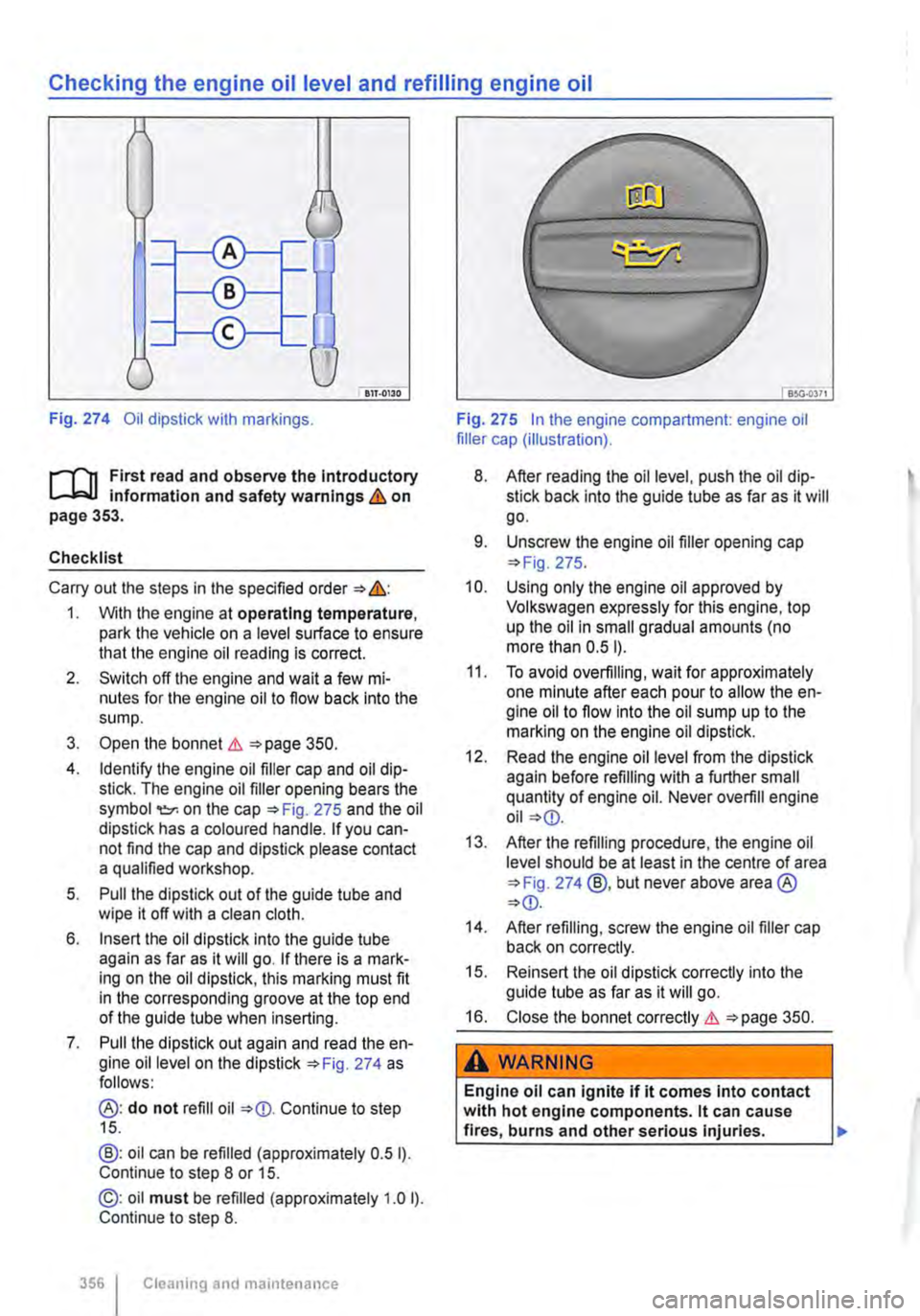
Fig. 274 Oil dipstick with markings.
r-111 First read and observe the Introductory L-W! information and safety warnings & on page 353.
Checklist
Carry out the steps in the specified order &:
1. With the engine at operating temperature, park the vehicle on a level surface to ensure that the engine oil reading is correct.
2. Switch off the engine and wait a few mi-nutes for the engine oil to flow back into the sump.
3. Open the bonnet&. 350.
4. Identify the engine oil filler cap and oil dip-stick. The engine oil filler opening bears the symbol 'l!:r. on the cap 275 and the oil dipstick has a coloured handle. If you can-not find the cap and dipstick please contact a qualified workshop.
5. Pull the dipstick out of the guide tube and wipe it off with a clean cloth.
6. Insert the oil dipstick into the guide tube again as far as it will go. If there is a mark-ing on the oil dipstick, this marking must fit in the corresponding groove at the top end of the guide tube when inserting.
7. Pull the dipstick out again and read the en-gine oil level on the dipstick 274 as follows:
@: do not refill oil Continue to step 15.
@: oil can be refilled (approximately 0.5 1). Continue to step 8 or 15.
©: oil must be refilled (approximately 1.0 1). Continue to step 8.
356 I Cleaning and maintenance
Fig. 275 in the engine compartment: engine oil filler cap (illustration).
8. After reading the oil level, push the oil dip-stick back into the guide tube as far as it will go.
9. Unscrew the engine oil filler opening cap =>Fig. 275.
1 0. Using only the engine oil approved by Volkswagen expressly for this engine, top up the oil in small gradual amounts (no more than 0.5 1).
11. To avoid overfilling, wait for approximately one minute after each pour to allow the en-gine oil to flow into the oil sump up to the marking on the engine oil dipstick.
12. Read the engine oil level from the dipstick again before refilling with a further small quantity of engine oil. Never overfill engine oil
13. After the refilling procedure, the engine oil level should be at least in the centre of area =>Fig. 274 @,but never above area®
14. After refilling, screw the engine oil filler cap back on correctly.
15. Re insert the oil dipstick correctly into the guide tube as far as it will go.
16. Close the bonnet correctly & 350.
A WARNING
Engine oil can Ignite if it comes into contact with hot engine components. lt can cause fires, burns and other serious Injuries.
Page 357 of 486
A WARNING (Continued)
• If engine oil is spilt on cold engine parts it can heat up and Ignite when the engine Is running.
• Always ensure that the engine oil filler cap Is securely tightened after refilling, and that the dipstick Is properly Inserted back Into the guide tube. This will prevent the engine oil from draining out on to hot engine compo-nents when the engine Is running.
CD
• Do not start the engine if the engine oil level Is above area@. Seek expert assistance. The catalytic converter and the engine could other-wise be damaged.
• When refilling or changing service fluids, please ensure that the correct fluids are added through the correct openings. Incorrect service fluids can cause serious functional problems and engine damage.
Engine oil consumption
n"'n First read and observe the introductory l.-J,:.ll information and safety warnings & on page 353.
Engine oil consumption can vary from engine to engine and can change during the working life of an engine.
The vehicle may consume up to 1.0 litre of engine oil per 2,000 km, depending on how you drive and the conditions in which the car is used. In new ve-
Changing engine oil
n"'n First read and observe the Introductory l.-J,:.ll Information and safety warnings & on page 353.
The engine oil must be changed regularly in ac-cordance with the data given in the service sched-ule.
The engine oil and filter change should be carried out by a qualified workshop due to the special tools and knowledge required, this also applies to the disposal of used oil. Volkswagen Commercial Vehi-cles recommends using a Volkswagen Commercial Vehicles dealership for this purpose.
The engine oil level must never be above I!!S area @. Otherwise oil can be drawn in through the crankcase breather and escape into the atmosphere via the exhaust system. <1
hicles. consumption is likely to be higher for the first 5,000 km. The engine oil level must therefore be checked at regular intervals, preferably when refuelling and before long journeys.
When the engine is working hard the oil level must be kept within area =>Fig. 274 @,for instance dur-ing long motorway cruising in summer, trailer tow-ing or climbing mountain passes. <1
More details on the service intervals can be found in the service schedule.
Additives in the engine oil can cause new engine oil to discolour quickly. This is normal and does not mean that the engine oil should be changed more frequently.
A WARNING
If, In exceptional cases, you have to carry out an oil change yourself, please note the fol-lowing:
• Always wear eye protection. .,.
In the engine compartment 357
Page 358 of 486
A WARNING (Continued)
• Always allow the engine to cool down completely to avoid burns.
• Avoid raising your arms when removing the oil drain plug with your fingers to help prevent oil from running down your arm.
• Use a suitable container when draining the used oil. it must be at least large enough to hold the entire quantity of engine oil re-quired for refilling.
• Never store engine oil in empty food con-tainers, bottles or any other non-original con-tainers as people finding these containers may not know that they contain engine oil.
Coolant
o:::n Introduction
This chapter contains information on the following subjects:
Warning lamp and coolant temperature display . . . . . . . . . . . . . . . . . . . . . . . . . 359
Coolant specification . . . . . 360 Checking the coolant level and refilling coolant . . . . . . . . . . . . . 361
Never carry out any work on the engine coolant system if you are not familiar with the requisite pro-cedures, or if you do not have access to the cor-rect tools, operating equipment and fluids &. The work should be carried out by a qualified work-shop if you are uncertain. Volkswagen Commercial Vehicles recommends using a Volkswagen Com-mercial Vehicles dealership for this purpose.
Serious injuries can be caused if work is carried out incorrectly.
Additional information and warnings:
• Towing a trailer 139
• Preparation for working in the engine compart-ment 350
• Accessories, modifications, repairs and renewal of parts =>page 394
358 I Cleaning and maintenance
A WARNING (Continued)
• Engine oil is toxic and must be stored out of the reach of children.
r:Q:.. Before changing the engine oil, first find out W where old oil can be disposed of properly near you.
Used oil must be disposed of in accordance W with regulations governing the protection of the environment. Never dispose of old oil in loca-tions such as gardens, woods, sewerage systems, on streets and roads, or in rivers and waterways.
Engine coolant is poisonous and can cause serious Injuries.
• Engine coolant should only be kept in sealed original containers In a safe place.
• Never store engine coolant In empty food containers, bottles or any other non-original containers as people finding these containers may then drink the engine coolant.
• The engine coolant must be stored out of the reach of children.
• Please note that the amount of correct coolant additive used must be sufficient for the lowest ambient temperature that you ex-pect the vehicle to be exposed to.
• Coolant can freeze at extremely cold out-side temperatures, causing the vehicle to break down. Vehicle occupants with Inade-quate winter clothing could then freeze to death as the heating will also no longer func-tion.
Coolant and coolant additives can pollute the W environment. Spilt service fluids must be col-lected then disposed of properly and in an environ-mentally responsible way.
Page 368 of 486

type. Refer to the vehicle documentation and ask a Volkswagen Commercial Vehicles dealership if necessary.
//.(/ '\
'(j
... '5I'
IJ
7rr.Oii2
Fig. 280 How to swap wheels.
.....-r'n First read and observe the introductory L-W! Information and safety warnings & on page 367.
The tyres are the most used and most underesti-mated parts of a vehicle. Tyres are very important as the narrow tyre surfaces are the only contact between the vehicle and the road.
The service life of tyres is dependent on tyre pres-sure, driving style handling and fitting.
The tyres and wheel rims are an essential part of the vehicle's design. The tyres and rims approved by Volkswagen Commercial Vehicles are specially matched to the characteristics of the vehicle and make a major contribution to good road holding and safe handling.
Avoiding damage to the tyres
• If you have to drive over a kerb or similar obsta-cle, drive slowly and at a right angle if possible.
• Inspect the tyres regularly for damage such as cuts. cracks or blisters.
• Remove foreign objects that are in the outer tyre tread and have not penetrated the Inner tyre 373.
• Always respond to any warning messages giv-en by the tyre monitoring system=:opage 318.
• Damaged or worn tyres must be replaced im-mediately =:o page 373.
• Regularly check the tyres for hidden damage =:-page 373.
368 Cleaning and maintenance
• Never exceed the top speed and load permitted for the tyres that are fitted =:o page 375.
• Protect the wheels, including the spare wheel, from contact with corrosive substances, including oils, lubricants, fuel and brake fluid =:o &.
• Replace missing dust caps immediately.
Tyres with directional tread pattern
Tyres with directional tread pattern have been de-veloped to roll in one direction only. An arrow on the tyre sidewall indicates the direction of rotation on tyres with directional tread =:o page 375. The di-rection of rotation must be adhered to. This is the only guarantee for optimum grip and helps to avoid aquaplaning, excessive noise and wear.
If, however, the tyre is fitted in the opposite direc-tion to the tread pattern, you must take more care when driving as the tyre is now no longer being used according to its designation. This is particu-larly important on wet roads. The tyres must be re-placed as quickly as possible or be fitted with the tread in the correct direction.
Rotating wheels front to rear
Regularly rotating the wheels as shown in the illus-tration =:o Fig. 280 is recommended to help ensure that tyres wear evenly. All the tyres will then last for about the same time.
Volkswagen Commercial Vehicles recommends having the wheels changed by a qualified work-shop.
Tyres that are older than 6 years
Tyres age through physical and chemical process-es that can impair their function. Tyres that are stored unused for an extended period will harden and become brittle more quickly than tyres which are in constant use.
Volkswagen Commercial Vehicles recommends re-placing tyres that are more than 6 years old with new tyres. This also applies for tyres, including the spare wheel, which appear to still be in good con-dition and whose tread depth has not yet reached the minimum value stipulated by legislation =:o &.
The age of a tyre can be determined from the man-ufacturing date, which Is a component of the tyre identification number (TIN) =:o page 375. .,..
Page 381 of 486
Washing the vehicle
r-f'n First read and observe the introductory Information and safety warnings & on page 380.
The longer substances such as insects, bird drop-pings, resinous tree sap, road dirt, industrial de-posits, tar, soot or road salt and other corrosive materials remain on the vehicle, the more damage they do to the paintwork. High temperatures (for in-stance in strong sunlight) accelerate the corrosion process. The underside of the vehicle should also be cleaned thoroughly and regularly.
Car washes
Please observe the signs on the automatic car wash. Before using an automatic car wash take the usual precautions, such as closing all windows and folding in the exterior mirrors, in order to avoid damage to the vehicle. You must consult the car wash operator if there are special parts on your ve-hicle such as spoilers, roof luggage carrier systems or radio aerials ::.CD.
The paint is so hard-wearing that the car can nor-mally be washed without problems in an automatic car wash. However, the effect on the paint de-pends to a large extent on the design of the car wash. Volkswagen Commercial Vehicles recom-mends the use of car washes without brushes.
To remove any wax residue from the windows and to stop wipers rubbing, please note the following points ::.page 382, Cleaning windows and exterior mirrors.
Washing the car by hand
When washing by hand, first soften the dirt with plenty of water and rinse off as well as possible.
Then clean the vehicle with a soft sponge, a glove or a brush using only light pressure. Start with the roof and work from the top to the bottom. Use a shampoo for very stubborn dirt only.
The sponge or glove should be wrung out thor-oughly at regular intervals.
Clean the wheels, sill panels etc. last. Use a differ-ent sponge for this purpose.
A WARNING
Parts of the vehicle with sharp edges can cause Injury.
• Protect your hands and arms from cuts on sharp parts, for example when cleaning the underbody or the inside of the wheel hous-lngs.
A WARNING
After the car has been washed, the braking effect could set in later than normal and ex-tend the braking distance as the brake discs and brake pads will be wet, or iced up In win-ter.
• You can "dry and de-ice" the brakes by performing careful braking manoeuvres. Make sure that you do not endanger any oth-er road users or violate any legal regulations when doing so.
CD
• The water should be no warmer than +so•c (+140.FJ.
• Do not wash the vehicle in direct sunlight in order to avoid damage to the vehicle palntwork.
• Never clean with insect sponges, rough kitchen sponges or similar products as these can damage the surface.
• Never clean the headlights with a dry cloth or sponge. Always use a wet cloth or sponge. lt is best to use soapy water.
• Washing the vehicle In cold weather: if the vehicle is rinsed with a hose, do not direct the water at the lock cylinders or the gaps around the doors, boot, or bonnet. The locks and seals could freeze.
CD
Observe the following guidelines before driving the vehicle into an automatic car wash in order to avoid damage to the vehicle:
• Ensure that the gap between the guide rails In the car wash is sufficient for the vehicle track. If the track is too narrow your wheels and tyres will be damaged.
• Switch off the rain sensor before driving the vehicle Into an automatic car wash.
• Check that the car wash is tall and wide enough for your vehicle.
• Fold In the exterior mirrors. Electrically fold-Ing exterior mirrors must be moved electrically. Do not fold them in and out by hand.
• In order to prevent damage to the palntwork on the bonnet, fold the wipers back onto the windscreen after drying the wiper blades. Do not drop the wipers onto the glass.
• Lock the tailgate to prevent it from opening accidentally In the car wash.
Page 390 of 486
• We recommend that you use a soft sponge or commercially available lint-free microfibre cloth for cleaning jobs
• Clean Alcantara® surfaces with a slightly damp cotton or woollen cloth or a commercially available lint-free microfibre cloth
General surface soiling of the upholstery and fabric trim can be cleaned with a commercially available foam cleaner.
If the upholstery and fabric trims are generally heavily soiled, consult a Volkswagen dealership for information on suitable cleaning methods before attempting any cleaning. If required, take the vehi-cle to a specialist cleaning company.
Treating stains
When treating stains, it may be necessary to clean the entire surface and not just the stain itself. This particularly applies if the surface shows general signs of wear. The cleaned area could otherwise be lighter than the surrounding area. If in doubt, consult a specialist cleaning company.
Type of stain Recommended cleaning method for seat cushions and upholstery
Water-based stains, e.g. cof-fee, fruit juice. -Moisten a sponge using water from a spray bottle and treat the stain by wiping in a circular motion. -Wipe clean with an absorbent, dry cloth.
Stubborn stains, e.g. choco--Only use detergents that have been approved by Volkswagen. late, foundation. -If required, have the upholstery cleaned by a specialist cleaning compa-ny.
Oily stains, e.g. oil, lipstick. -Only use detergents that have been approved by Volkswagen. -If required, have the upholstery cleaned by a specialist cleaning compa-ny.
A WARNING CD
If there is a fault in the airbag system, the air-bag may not trigger correctly, may not trigger at all or may trigger unexpectedly. This can cause severe or fatal injuries.
• The airbag system should be checked by a qualified workshop as soon as possible.
Q)
If the upholstery on electrically adjustable seats or on seat cushions containing airbag components gets wet, electric components and the vehicle electrics could be damaged.
• Wet seat cushions should be promptly dried out, and their system components checked, at a qualified workshop.
• Do not use steam cleaners as the steam pushes the soiling into the fabric and sets it.
390 Cleaning and maintenance
• High-pressure cleaners and coolant sprays can damage the upholstery.
Q)
• Brushes should be used on carpets and mats only. Other surfaces could be damaged by brushes.
• When washing paste or fine detergent solu-tions are applied with a damp cloth or sponge, visible edges may appear on the upholstery once it has dried. This can be due to substan-ces such as surfactants. These edges are usu-ally difficult or even Impossible to remove.
Q)
• Do not soak Alcantara® under any circum-stances.
• Do not use leather care products, solvents, wax polish, shoe cream, stain removers or sim-ilar products on Alcantara®.
• Do not use brushes if cleaning with liquids. This could damage the surface of the material.
Page 393 of 486
A wARNING
Check the condition of all seat belts regularly. If the belt webbing or any other part of the seat belt becomes damaged have it removed and replaced immediately by a qualified workshop. Damaged seat belts are very dan-gerous and can cause severe or fatal injuries.
• Never use chemical cleaning agents on the seat belts or their components. Further-more the seat belts may not come Into con-tact with corrosive fluids, solvents or sharp objects. These could considerably weaken the webbing.
• After cleaning, allow seat belts to dry completely before rolling them up. Otherwise the automatic belt retractors could become damaged and thus Impair their function.
Cleaning cool box
)""""'('n First read and observe the Introductory L.-J,:,JJ Information and safety warnings & on page 388.
Cleaning seat rails
)""""'('n First read and observe the introductory information and safety warnings & on page 388.
Clean the surface of the seat rails on a regular ba-sis
• Use a narrow nozzle on a vacuum cleaner to remove sand, dirt etc. from the seat rails.
Cleaning opaque shades
)""""'('n First read and observe the introductory information and safety warnings & on page 388.
For the best cleaning results have the opaque shades dry cleaned.
A WARNING (ConUnued)
• Avoid allowing foreign bodies or liquids to enter the slot for the seat belt buckle. This could prevent the belt buckle and seat belt from working properly.
• Never try to repair, modify or remove the seat belts yourself.
• Damaged seat belts must be replaced im-mediately with new seat belts approved by Volkswagen Commercial Vehicles for your ve-hicle type. Seat belts subjected to stress and stretched during an accident must be re-placed by a qualified workshop. Renewal may be necessary even if there is no apparent damage. The belt anchorage should also be checked.
• Clean the cool box with a household detergent before using it for the first time and whenever it needs cleaning.
• To prevent mould and mildew from forming in the cool box when it is not being used for long peri-ods, place a folded dry towel between the box and its lid.
CD
If seats are moved when the seat rails are soiled, the seat rails and the seat feet could be damaged.
Please refer to the information on the labels sewn into the opaque shades before cleaning in a wash-ing machine.
Vehicle care and maintenance 393
Page 401 of 486
Vehicle lifting points
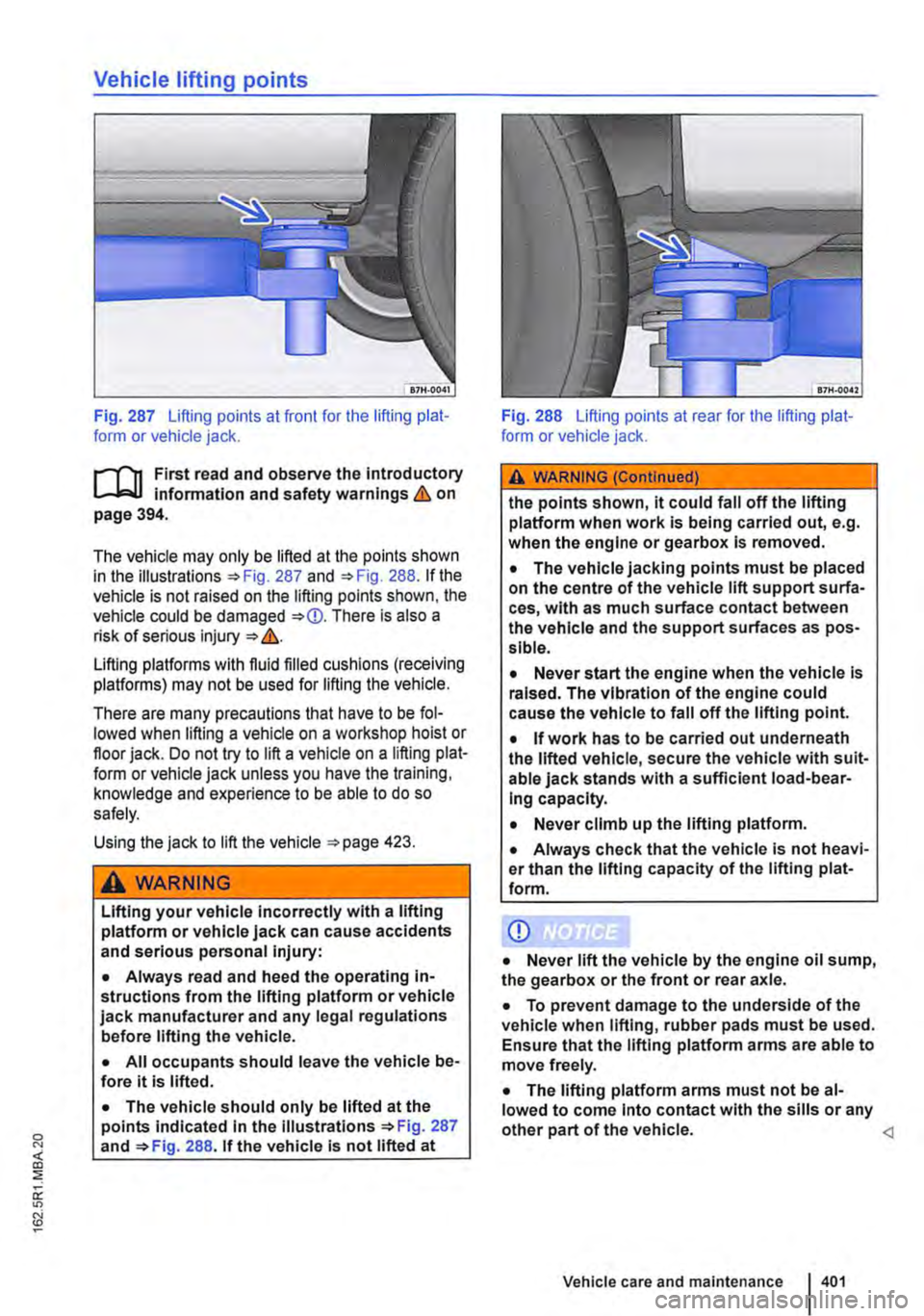
Fig. 287 Lifting points at front for the lifting plat-form or vehicle jack.
First read and observe the introductory l.-J,::..U information and safety warnings & on page 394.
The vehicle may only be lifted at the points shown in the illustrations =>Fig. 287 and =>Fig. 288. If the vehicle is not raised on the lifting points shown, the vehicle could be damaged =>
Lifting platforms with fluid filled cushions (receiving platforms) may not be used for lifting the vehicle.
There are many precautions that have to be fol-lowed when lifting a vehide on a workshop hoist or floor jack. Do not try to lift a vehicle on a lifting plat-form or vehicle jack unless you have the training, knowledge and experience to be able to do so safely.
Using the jack to lift the vehicle =>page 423.
A WARNING
Lifting your vehicle incorrectly with a lifting platform or vehicle jack can cause accidents and serious personal injury:
• Always read and heed the operating in-structions from the lifting platform or vehicle jack manufacturer and any legal regulations before lifting the vehicle.
• All occupants should leave the vehicle be-fore it is lifted.
• The vehicle should only be lifted at the points indicated In the illustrations =>Fig. 287 and =>Fig. 288. If the vehicle is not lifted at
Fig. 288 Lifting points at rear for lhe lifting plat-form or vehicle jack.
A WARNING_(Contlnued)
the points shown, it could fall off the lifting platform when work is being carried out, e.g. when the engine or gearbox is removed.
• The vehicle jacking points must be placed on the centre of the vehicle lift support surfa-ces, with as much surface contact between the vehicle and the support surfaces as pos-sible.
• Never start the engine when the vehicle is raised. The vibration of the engine could cause the vehicle to fall off the lifting point.
• If work has to be carried out underneath the lifted vehicle, secure the vehicle with suit-able jack stands with a sufficient load-bear-ing capacity.
• Never climb up the lifting platform.
• Always check that the vehicle is not heavi-er than the lifting capacity of the lifting plat-form.
CD
• Never lift the vehicle by the engine oil sump, the gearbox or the front or rear axle.
• To prevent damage to the underside of the vehicle when lifting, rubber pads must be used. Ensure that the lifting platform arms are able to move freely.
• The lifting platform arms must not be al-lowed to come Into contact with the sills or any other part of the vehicle.
Page 407 of 486
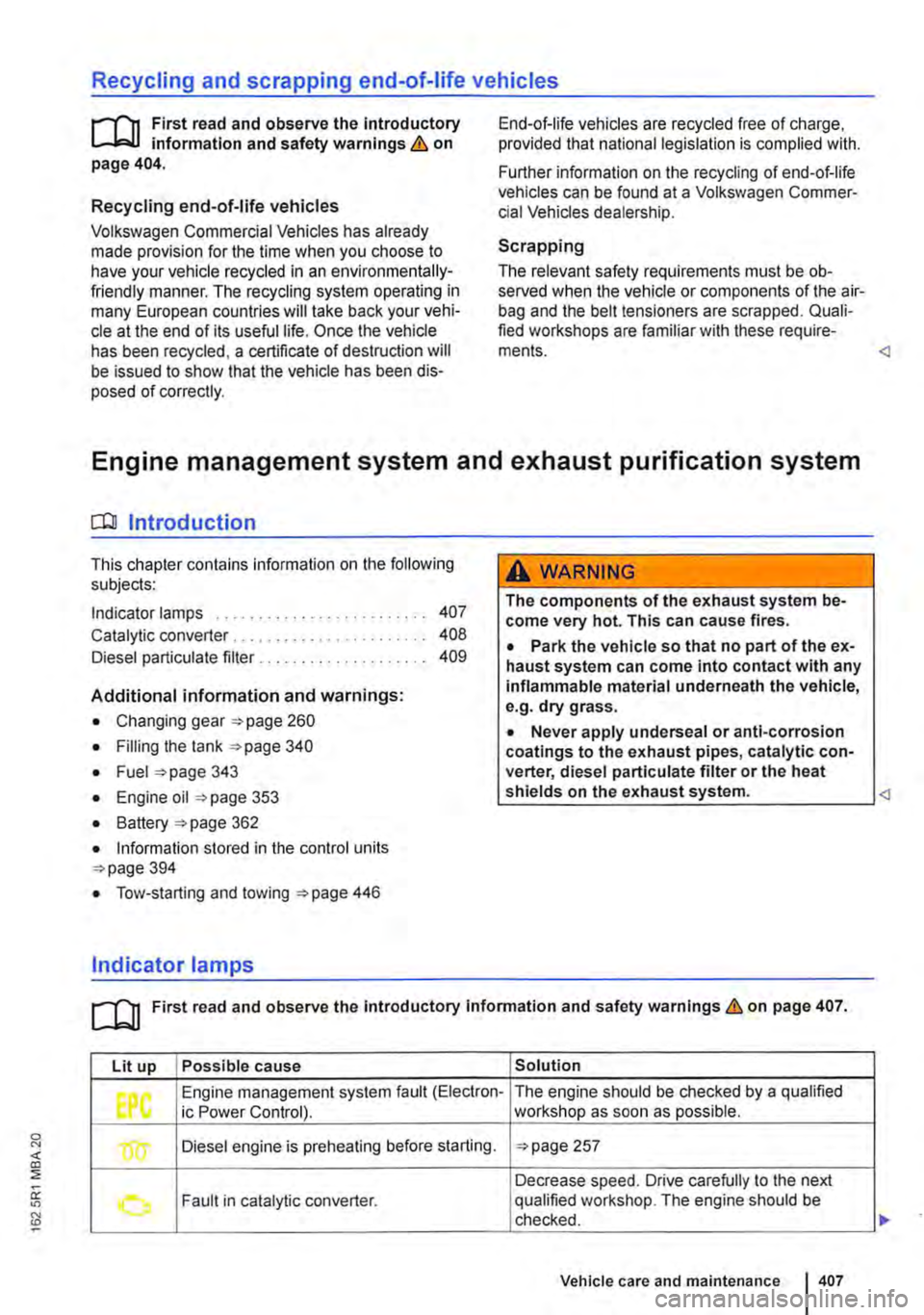
Recycling and scrapping end-of-life vehicles
rl'l1 First read and observe the Introductory L-J,:,JJ information and safety warnings & on page 404.
Recycling end-of-life vehicles
Volkswagen Commercial Vehicles has already made provision for the time when you choose to have your vehicle recycled in an environmentally-friendly manner. The recycling system operating in many European countries will take back your vehi-cle at the end of its useful life. Once the vehicle has been recycled, a certificate of destruction will be issued to show that the vehicle has been dis-posed of correctly.
End-of-life vehicles are recycled free of charge, provided that national legislation is complied with.
Further information on the recycling of end-of-life vehicles can be found at a Volkswagen Commer-cial Vehicles dealership.
Scrapping
The relevant safety requirements must be ob-served when the vehicle or components of the air-bag and the belt tensioners are scrapped. Quali-fied workshops are familiar with these require-ments.
o:JJ Introduction
This chapter contains information on the following subjects:
Indicator lamps . . . . . . . . . . . . . . . . 407
Catalytic converter . . . . . . . . . . . . . . . . . . . . . . 408 Diesel particulate filter . . . . . . . . . . 409
Additional information and warnings:
• Changing gear =>page 260
• Filling the tank =>page 340
• Fuel =>page 343
• Engine oil =>page 353
• Battery =>page 362
• Information stored in the control units =>page 394
• Tow-starting and towing =>page 446
Indicator lamps
A WARNING
The components of the exhaust system be-come very hot. This can cause fires.
• Park the vehicle so that no part of the ex-haust system can come into contact with any inflammable material underneath the vehicle, e.g. dry grass.
• Never apply undersea! or anti-corrosion coatings to the exhaust pipes, catalytic con-verter, diesel particulate fitter or the heat shields on the exhaust system.
lit up Possible cause Solution
Engine management system fault {Electron-The engine should be checked by a qualified
J ic Power Control). workshop as soon as possible.
R Diesel engine is preheating before starting. =>page 257
Decrease speed. Drive carefully to the next Fault in catalytic converter . qualified workshop. The engine should be ..... checked.
Vehicle care and maintenance 407