tow VOLKSWAGEN TRANSPORTER 2018 Owners Manual
[x] Cancel search | Manufacturer: VOLKSWAGEN, Model Year: 2018, Model line: TRANSPORTER, Model: VOLKSWAGEN TRANSPORTER 2018Pages: 486, PDF Size: 69.28 MB
Page 367 of 486
Wheels and tyres
Useful information about wheels and tyres
o:::n Introduction
This chapter contains information on the following subjects:
Handling wheels and tyres .............. .
Rims
368
369
New wheels and tyres . . . . . . . . . . . . . . . . . . . 370 Tyre pressure . . . . . . . . . . . . . . . . 371
Tread depth and wear indicators 372 Tyre damage 373
Spare wheel . . . . . . . . . . . . . . . . . . . . . . . . . . . . 374
Tyre lettering . . . . . . . . . . . . . . . . . . . . . . . . . . . 375
Winter tyres . . . . . . . . . . • . • • . . . . . . . . . . . . 378 Snow chains . . . . . . . . . . . . . . . . . 379
Volkswagen Commercial Vehicles recommends that work on tyres and wheels is carried out by a qualified workshop. They are familiar with the pro-cedure and have the necessary special tools and spare parts and the proper facilities for disposing of the old tyres. Volkswagen Commercial Vehicles recommends using a Volkswagen Commercial Ve-hicles dealership for this purpose.
Additional information and warnings:
• Transporting 125
• Towing a trailer 139
• Braking, stopping and parking 269
• Tyre monitoring system 318
• Cleaning and caring for the vehicle exterior 380
• Consumer information 404
• Vehicle tool kit 416
• Hubcaps 417
• Changing a wheel 420
• Breakdown set 425
A WARNING
New tyres or tyres which are old, worn down or damaged cannot provide full levels of vehi-cle control and braking power.
• Incorrect handling of wheels and tyres can reduce vehicle safety and cause accidents and serious injuries.
A WARNING (Continued)
• All four wheels must be fitted with radial tyres of the same type, size (rolling circum-ference) and the same tread.
• New tyres will have to be run In as they will initially have reduced grip and braking ef-fect. Drive particularly carefully for the first 600 km in order to prevent accidents and se-rious injury.
• Check tyre pressures regularly and always keep to the specified tyre pressure value. If the tyre pressure is too low, it Is possible that the tyre temperature will Increase to such an extent when driving that the tread peels off and the tyre bursts.
• Never drive with worn tyres or tyres that are damaged (cuts, cracks or blisters). Driv-Ing with tyres in this condition can result in blown tyres, accidents and serious Injuries. Worn or damaged tyres must be replaced as soon as possible.
• Never exceed the top speed and load per-mitted for the fitted tyres.
• The effectiveness of the driver assist sys-tems and brake support systems depends on the tyre grip.
• If you notice unusual vibration or if the ve-hicle pulls to one side when driving, stop the car immediately and check the wheels and tyres for damage.
• In order to reduce the risk of losing con-trol of the vehicle, and the risk of accident and serious injury, never loosen the bolts on rims with bolted on rim rings.
• Do not use wheels or tyres if you do not know their history. Used wheels and tyres could be damaged, even If the damage is not visible.
• Old tyres (even if never used) can sudden-ly Jose pressure or burst, especially at high speeds. This can cause accidents and seri-ous injuries. Avoid using tyres that are more than six years old. If you have no alternative, drive slowly and with extra care at all times.
m For technical reasons, it is not generally pos-L!.J sible to use the wheels from other vehicles. This can also apply to wheels of the same vehicle .,.
Wheels and tyres I 367
Page 374 of 486
Spare wheel
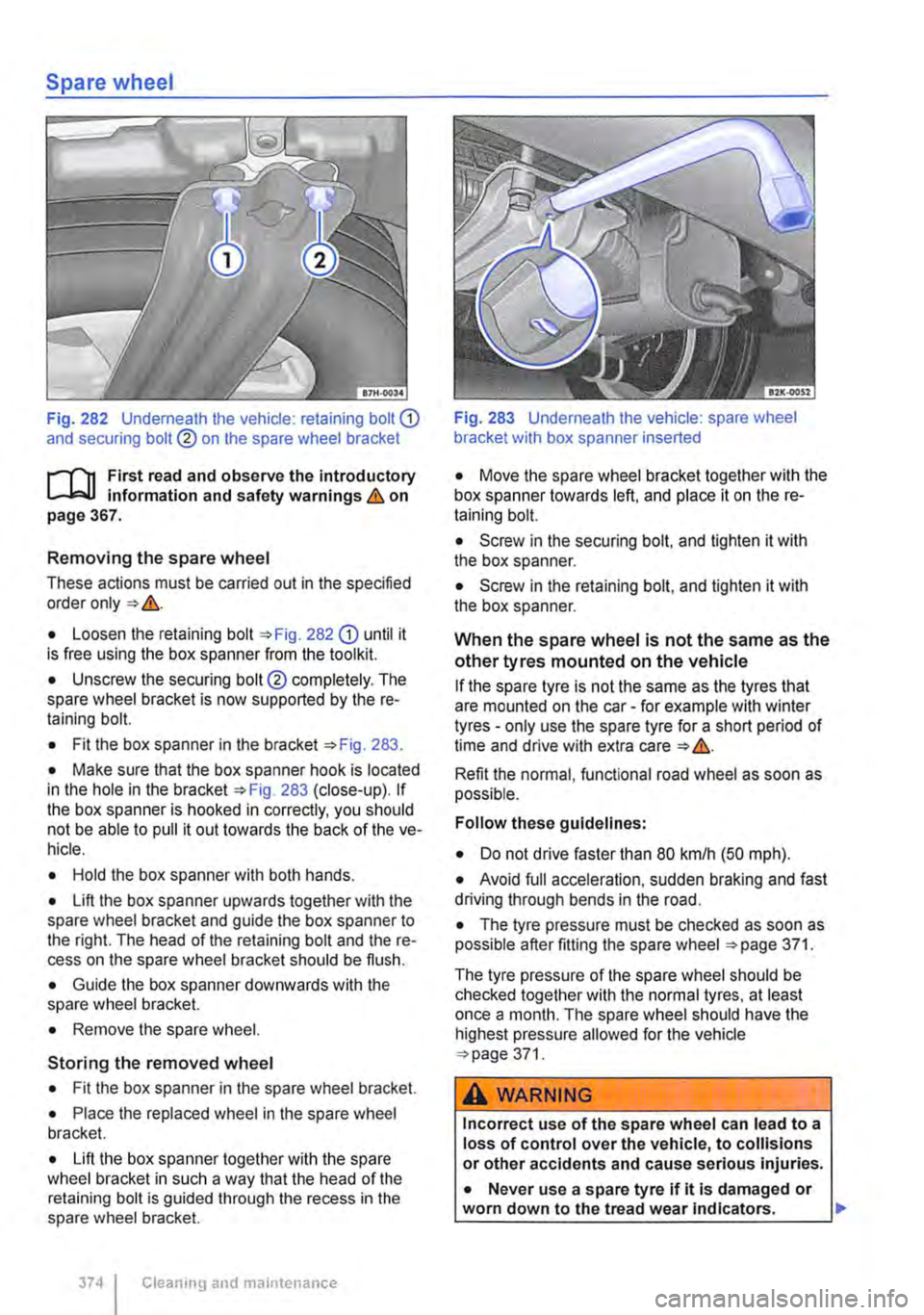
Fig. 282 Underneath the vehicle: retaining bolt G) and securing bolt® on the spare wheel bracket
r-T'n First read and observe the introductory L.-.lo:.U Information and safety warnings & on page 367.
Removing the spare wheel
These actions must be carried out in the specified order only &.
• Loosen the retaining bolt 282 G) until it is free using the box spanner from the toolkit.
• Unscrew the securing bolt® completely. The spare wheel bracket is now supported by the re-taining bolt.
• Fit the box spanner in the bracket 283.
• Make sure that the box spanner hook is located in the hole in the bracket 283 (close-up). If the box spanner is hooked in correctly, you should not be able to pull it out towards the back of the ve-hicle.
• Hold the box spanner with both hands.
• Lift the box spanner upwards together with the spare wheel bracket and guide the box spanner to the right. The head of the retaining bolt and the re-cess on the spare wheel bracket should be flush.
• Guide the box spanner downwards with the spare wheel bracket.
• Remove the spare wheel.
Storing the removed wheel
• Fit the box spanner in the spare wheel bracket.
• Place the replaced wheel in the spare wheel bracket.
• Lift the box spanner together with the spare wheel bracket in such a way that the head of the retaining bolt is guided through the recess in the spare wheel bracket.
374 I Cleaning and maintenance
Fig. 283 Underneath the vehicle: spare wheel bracket with box spanner inserted
• Move the spare wheel bracket together with the box spanner towards left, and place it on the re-taining bolt.
• Screw in the securing bolt, and tighten it with the box spanner.
• Screw in the retaining bolt, and tighten it with the box spanner.
When the spare wheel is not the same as the
other tyres mounted on the vehicle
If the spare tyre is not the same as the tyres that are mounted on the car-for example with winter tyres -only use the spare tyre for a short period of time and drive with extra care &.
Refit the normal, functional road wheel as soon as possible.
Follow these guidelines:
• Do not drive faster than 80 km/h (50 m ph).
• Avoid full acceleration, sudden braking and fast driving through bends in the road.
• The tyre pressure must be checked as soon as possible after fitting the spare wheel =>page 371.
The tyre pressure of the spare wheel should be checked together with the normal tyres, at least once a month. The spare wheel should have the highest pressure allowed for the vehicle 371.
A WARNING
Incorrect use of the spare wheel can lead to a loss of control over the vehicle, to collisions or other accidents and cause serious injuries.
• Never use a spare tyre if it is damaged or worn down to the tread wear Indicators. .,..
Page 375 of 486
A WARNING (Continued)
• In some vehicles, the spare wheel could be smaller than the standard wheel. The small spare wheel has a sticker with the text "80 km/h" or "50 mph". This is the maximum speed at which you are permitted to drive with this tyre.
• Never drive faster than 80 km/h (50 mph). Do not accelerate quickly, brake suddenly or drive at high speed through bends.
• The spare wheel must always be secured firmly with the wheel bolts supplied by the factory.
Tyre lettering
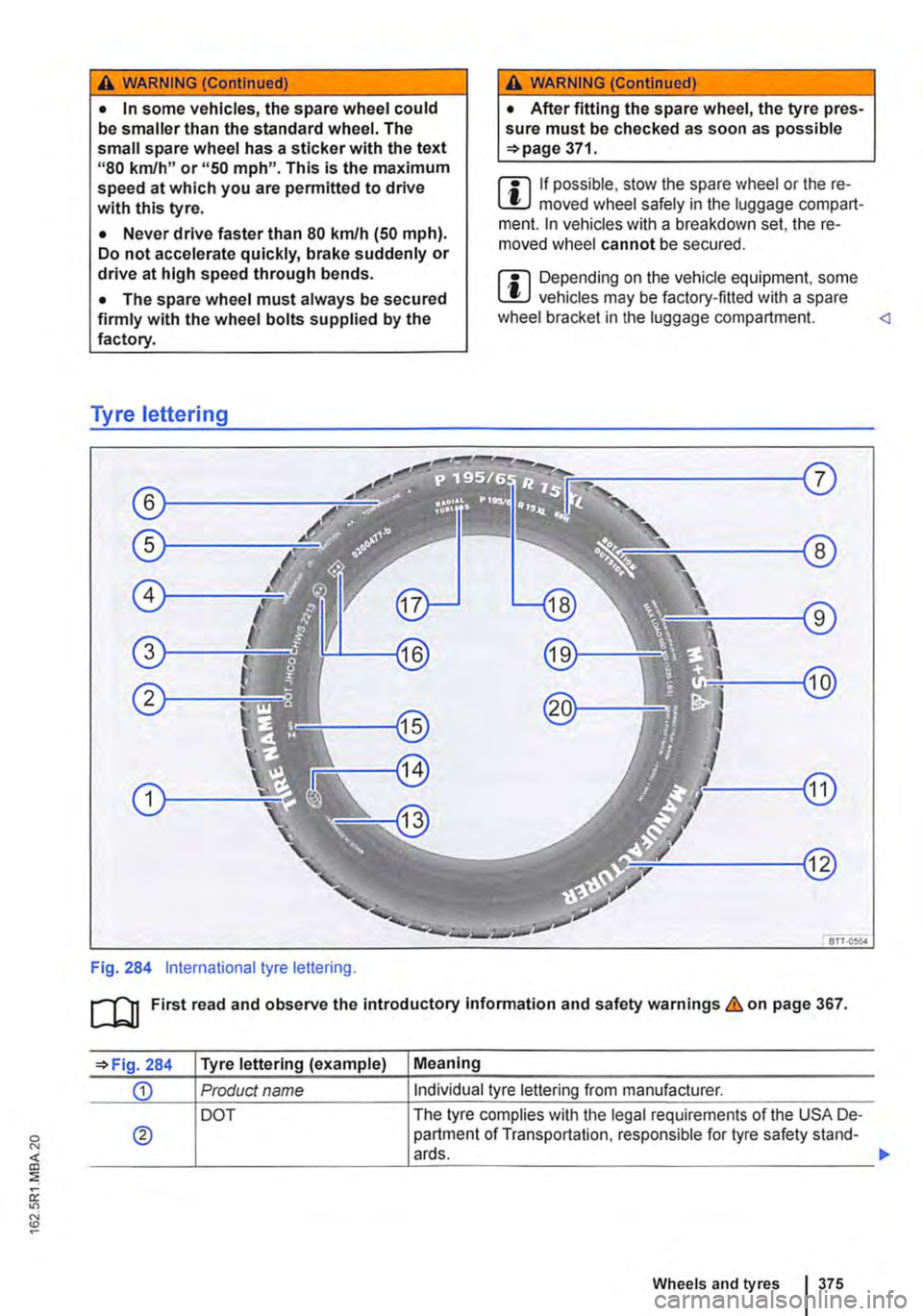
Fig. 284 International tyre lettering.
A WARNING (Continued)
• After fitting the spare wheel, the tyre pres-sure must be checked as soon as possible =>page 371.
m If possible, stow the spare wheel or the re-L!..J moved wheel safely in the luggage compart-ment. In vehicles with a breakdown set, the re-moved wheel cannot be secured.
m Depending on the vehicle equipment, some L!..J vehicles may be factory-fitted with a spare wheel bracket in the luggage compartment.
=>Fig. 284 Tyre lettering (example) Meaning
G) Product name Individual tyre lettering from manufacturer.
DOT The tyre complies with the legal requirements of the USA De-
0 partment of Transportation, responsible for tyre safety stand-ards.
Wheels and tyres 375
Page 388 of 486
r1ih In the interests of environmental protection, 'r!!S the engine compartment should be washed only in specially provided wash bays. This pre-vents toxic waste water containing oil, grease and
fuel from entering the sewerage system. In some districts, washing the engine compartment any-where else may be prohibited.
o::JJ Introduction
This chapter contains information on the following subjects:
Handling seat covers . . . . . . . . . . . . . . . . . . . . 389
Cleaning cloth seat covers, fabric trim and Alcantara® upholstery . . . . . . . . . . . . . . . . . . . . 389
Cleaning and caring for natural leather covers 391
Cleaning leatherette upholstery . . 392
Cleaning stowage compartments, drink holders and ash trays . . . . . . . . . . . . . . . . . . . . 392 Cleaning and caring for the dash panel, wooden trims and plastic parts . . . . . . . . . . 392
Cleaning seat belts . . . . . . . . . . . . . . . . . . . . . . 392 Cleaning cool box . . . . . . . . . . . . . • . . . . . . . . . 393
Cleaning seat rails . . . . . . . . . . . . . . . . . . . 393
Cleaning opaque shades 393
Modern fabrics, such as dark denim, are often not colourfast. Light-coloured upholstery (soft materials or leather) is particularly sensitive to staining caused by these fabrics, even if you are careful. This is not caused by a fault in the upholstery, but by the non-colourfast nature of the garments.
Leaving stains, dirt and other deposits on the sur-face of vehicle components and cloth seat covers for a long time can make it difficult to clean and treat them. Stains, dirt and deposits may become impossible to remove, particularly if left for a long time.
Additional information and warnings:
• Cleaning and caring for the vehicle exterior 380
• Accessories, modifications, repairs and renewal of parts 394
A WARNING
Car care products can be toxic and hazard-ous. Unsuitable care products and Incorrect application of care products can cause acci-dents, serious injuries, burns or poisoning.
388 Cleaning and maintenance
A WARNING (Continued)
• The care product must be kept In its origi-nal sealed container.
• Read the manufacturer's Instructions.
• Never store car care products in empty food containers, bottles or any other non-original containers as people finding these containers may not know that they contain care products.
• Keep children away from care products.
• The products can give off harmful fumes during use. They should therefore only be used outside or In well-ventilated spaces.
• Never use fuel, turpentine, engine oil, nail varnish remover or other volatile fluids to wash, clean or care for your vehicle. These substances are toxic and highly Inflammable.
A WARNING
Incorrect care and cleaning of vehicle parts can Impair the safety features of the vehicle and cause serious Injury.
• Vehicle parts must be cleaned according to the manufacturer's Instructions.
• Only use approved or recommended cleaning products.
CD
• Cleaning products that contain solvents at-tack the material and may cause Irreparable damage.
• Stains, dirt and other deposits containing aggressive and solvent-based Ingredients at-tack the material and may cause Irreparable damage, even If only left for a short time.
• Stains, dirt and other deposits should be re-moved as quickly as possible and not allowed to dry In.
• To avoid damage, stubborn stains should be removed by a specialist cleaning company, .,.
Page 392 of 486
Cleaning leatherette upholstery
,......-('n First read and observe the introductory information and safety warnings & on page 388.
Only use water and neutral detergents to clean the ieatherette upholstery.
CD
Do not use solvents, wax polish, shoe cream, spot removers or similar products on the leath-erette upholstery. These may cause the materi-al to become hard and brittle prematurely.
,......-('n First read and observe the introductory information and safety warnings & on page 388.
Cleaning stowage compartments and drink holders
Some stowage compartments and drink holders have a removable rubber insert in the base.
• Moisten a clean, lint-free cloth with water and clean the parts.
• If this does not provide satisfactory results, use a special solvent-free plastic cleaning product.
Cleaning the ashtray
• Remove and empty the ashtray.
• Wipe the ashtray with a cloth to clean it.
To clean the snuffer, use a toothpick or similar ob-ject to pick out the ashes.
,......-('n First read and observe the introductory Information and safety warnings & on page 388.
• Moisten a clean, lint-free cloth with water and clean the parts.
• Treat plastic parts (inside and outside the vehi-cle) and the dash panel with a special solvent-free plastic cleaning and care product that has been approved by Volkswagen Commercial Vehicles
""'&.
• Treat wooden trims with a mild soap solution.
Cleaning seat belts
,......-('n First read and observe the introductory information and safety warnings & on page 388.
Large particles of dirt on the automatic belt prevent it from roiling back properly and thus from working effectively.
The seat belts must never be removed for cleaning purposes.
3921 Cleaning and maintenance
A WARNING
Cleaning agents that contain solvents cause the surface of the airbag modules to become porous. In an accident that triggers the air-bag, loose plastic parts can cause serious in-jury.
• Never clean the dash panel or the airbag covers with cleansers that contain solvents.
• Carefully pull the dirty seat belt right out and leave it out.
• Clean the seat belt with a mild soap solution.
• Allow the seat belt fabric to dry completely.
• Do not allow the seat belt to roil up until it has dried completely. 11>
Page 393 of 486
A wARNING
Check the condition of all seat belts regularly. If the belt webbing or any other part of the seat belt becomes damaged have it removed and replaced immediately by a qualified workshop. Damaged seat belts are very dan-gerous and can cause severe or fatal injuries.
• Never use chemical cleaning agents on the seat belts or their components. Further-more the seat belts may not come Into con-tact with corrosive fluids, solvents or sharp objects. These could considerably weaken the webbing.
• After cleaning, allow seat belts to dry completely before rolling them up. Otherwise the automatic belt retractors could become damaged and thus Impair their function.
Cleaning cool box
)""""'('n First read and observe the Introductory L.-J,:,JJ Information and safety warnings & on page 388.
Cleaning seat rails
)""""'('n First read and observe the introductory information and safety warnings & on page 388.
Clean the surface of the seat rails on a regular ba-sis
• Use a narrow nozzle on a vacuum cleaner to remove sand, dirt etc. from the seat rails.
Cleaning opaque shades
)""""'('n First read and observe the introductory information and safety warnings & on page 388.
For the best cleaning results have the opaque shades dry cleaned.
A WARNING (ConUnued)
• Avoid allowing foreign bodies or liquids to enter the slot for the seat belt buckle. This could prevent the belt buckle and seat belt from working properly.
• Never try to repair, modify or remove the seat belts yourself.
• Damaged seat belts must be replaced im-mediately with new seat belts approved by Volkswagen Commercial Vehicles for your ve-hicle type. Seat belts subjected to stress and stretched during an accident must be re-placed by a qualified workshop. Renewal may be necessary even if there is no apparent damage. The belt anchorage should also be checked.
• Clean the cool box with a household detergent before using it for the first time and whenever it needs cleaning.
• To prevent mould and mildew from forming in the cool box when it is not being used for long peri-ods, place a folded dry towel between the box and its lid.
CD
If seats are moved when the seat rails are soiled, the seat rails and the seat feet could be damaged.
Please refer to the information on the labels sewn into the opaque shades before cleaning in a wash-ing machine.
Vehicle care and maintenance 393
Page 394 of 486
Accessories, modifications, repairs and renewal of parts
o::n Introduction
This chapter contains information on the following subjects:
Running-in 394
Accessories and replacement parts 395 Service fluids and consumables . . . . . . . . . . . 395
Repairs and technical modifications . . . . . . . . 396
Repairs and faults in the airbag system . . . . . 397
Retrofitting two-way radios . . . . . . . . . . . . . . . . 398
Information stored in the control units . . . . . . . 398 Using a mobile telephone in the vehicle without a connection to the external aerial . . 399
Vehicle lifting points 401
Additional information and warnings:
• Seat belts '*page 79
• Airbag system '*page 87
• Towing a trailer 139
• Ashtray and cigarette lighter 161
• Electrical sockets 163
• Braking, stopping and parking '*page 269
• Pull-away assist systems 282
• ParkPilot 287
• Reversing camera (Rear Assist) '*page 291
• Cruise control system (CCS) 295
• Driver Alert System 315
• Tyre monitoring system 318
• Preparation for working in the engine compart-ment page 350
• Engine oil 353
• Engine coolant '*page 358
• Battery 362
Running-in
r--('n First read and observe the introductory L-J.:.lJ information and safety warnings & on page 394.
Please follow the regulations concerning running-in new parts.
394 I Cleaning and maintenance
• Cleaning and caring for the vehicle exterior 380
• Cleaning and caring for the interior 388
• Consumer information 404
• Radio, provision for mobile tele-phone, infotainment system, navigation system
A WARNING
Unsuitable spare parts and accessories, In-correctly carried out work, modifications and repairs can lead to damage to the vehicle and cause accidents and serious Injuries.
• Volkswagen Commercial Vehicles strongly recommends you use only approved Volks-wagen accessories and Volkswagen Genuine Parts®. These parts and accessories have been specially tested by Volkswagen Com-mercial Vehicles for suitability, reliability and safety.
• Repairs and modifications to your vehicle should only be carried out by a qualified workshop. Qualified workshops have the nec-essary tools, diagnostic equipment, repair In-formation and qualified personnel.
• Never fit parts to your vehicle that are In any way different from the factory-fitted parts.
• Never secure or mount objects such as drink holders or telephone holders on or next to the airbag covers or within the deployment zone of the airbag.
• Only use rim/tyre combinations which have been approved by Volkswagen Commer-cial Vehicles for your vehicle type.
Any new engine has to be run in during the first 1 ,500 kilometres. During its first few hours of run-ning, the internal friction in the engine is greater than later on when all the moving parts have bed-ded down.
The style of driving during the first 1 ,500 kilometres will also affect the engine quality. Even after this time-and especially with a cold engine-drive the .,.
Page 398 of 486
Retrofitting two-way radios
.--m First read and observe the introductory L-.lc.U information and safety warnings & on page 394.
You will need an external aerial to use a two-way radio in the vehicle.
Any retrofit installation of electrical or electronic equipment in the vehicle will affect its vehicle type approval. Under certain circumstances, this can negate the type approval for the vehicle.
Volkswagen Commercial Vehicles has approved the vehicle for use with two-way radios providing the following conditions are observed:
• Correct installation of external aerial.
• A maximum transmitting power of 10 watts.
The equipment can only operate at maximum range with an external aerial.
Check first with a qualified workshop if you wish to use a two-way radio with a transmitting power of over 10 watts. Qualified workshops are familiar with the technical options for retrofitting. Volkswa-gen Commercial Vehicles recommends using a Volkswagen Commercial Vehicles dealership for this purpose.
Information stored in the control units
.--m First read and observe the introductory L-.lc.U Information and safety warnings & on page 394.
Your vehicle is factory fitted with electronic control units which are responsible for engine and gearbox management. The control units also monitor the function of the exhaust system and the airbags.
These electronic control units continuously evalu-ate data relevant to the vehicle while the vehicle is being driven. Only these data will be stored if there are any faults recorded or any deviations from the specified values. This is generally displayed by the indicator lamps on the instrument cluster.
Special units are required to read and evaluate da-ta stored in the control units.
These data are stored so that specialist workshops can diagnose and solve problems. The following data may have been stored:
• Engine and gearbox-relevant data.
• Speed.
• Direction of travel.
398 Cleaning and maintenance
Please comply with relevant legislation and the in-structions and information given in the operating manuals for radio equipment.
A WARNING
If radio equipment is not secured or not prop-erly secured in the vehicle, it could be flung though the interior during a sudden driving or braking manoeuvre, or In the event of an accident. This can cause Injuries.
• While the vehicle is in motion, always se-cure radio equipment properly outside the airbag deployment zone or stow them away safely.
A CAUTION
If you use two-way radios in the car without an external aerial, electromagnetic radiation in the vehicle could exceed limit values. This also applies to external aerials which have not been correctly installed.
• Two-way radios should only be used In the vehicle If an external aerial Is properly connected.
• Braking power.
• Seat belt monitor.
The control units never record conversations that take place in the vehicle. it is neither possible nor permitted to use the stored data to create move-ment profiles.
When the vehicle is being used, situations may arise in which the stored data (alone or in conjunc-tion with other information such as accident re-ports, vehicle damage, witness statements etc.) can become assignable to a particular person, whereby consultation of an expert and use of the expert's information may be necessary.
In vehicles with an emergency call function via a mobile telephone or other units, the current loca-tion can be transmitted. In the event of an accident in which the control units register that an airbag has been triggered, the system can automatically send out a signal. This depends on your service provider. Transmission is possible only in areas
Page 400 of 486
ensure that the mobile telephone is securely at-tached to the dash panel and always within reach of the driver. Depending on which hands-free sys-tem is installed, the connection between the mobile telephone and the external aerial is established ei-ther via the telephone holder or via an existing Bluetooth® connection between the mobile tele-phone and the vehicle.
Connecting the mobile telephone is to a telephone aerial integrated in the vehicle or to an external tel-ephone aerial reduces the electromagnetic radia-tion generated by the telephone which could affect the human body. Using an aerial also improves the quality of the signal.
If a mobile telephone is used in the vehicle interior without this hands-free system, it is not safely se-cured in the vehicle and also not connected to the vehicle's external telephone aerial. Furthermore, the mobile telephone is not being charged in the telephone holder. lt is also likely that the telephone connection will be disrupted and the signal strength will be poor.
No mobile telephone should be used in the vehicle unless it is connected to a hands-free unit. Volks-wagen Commercial Vehicles recommends the use of an external aerial when a mobile telephone is used in the vehicle.
Bluetooth® is a registered trademark of Blue-tooth® SIG, Inc.
A WARNING
Any mobile telephone that Is not secured or is incorrectly secured In the vehicle could be flung though the Interior during a sudden driving or braking manoeuvre, or In the event of an accident. This could cause Injuries.
• Mobile telephones, other devices and tele-phone accessories such as telephone hold-ers, notepads and portable navigation devi-ces must always be secured properly outside of the alrbag deployment zones or be stowed In a safe place whilst the vehicle Is In motion.
400 I Cleaning and maintenance
A WARNING
If mobile telephones or two-way radios that are not connected to an external aerial are used, electromagnetic radiation In the vehicle could exceed limit values and thus be a health hazard for drivers and other vehicle occupants. This also applies to external aer-ials which have not been correctly Installed.
• Keep mobile telephone aerials at least 20 cm away from pacemakers, as the telephones may affect their functioning.
• Do not carry a mobile telephone in your breast pocket above a pacemaker when the telephone Is switched on or In standby mode.
• Switch off the mobile telephone Immedi-ately If you suspect it may be Interfering with a pacemaker.
Page 402 of 486
Mobile on line services
c:QJ Introduction
This chapter contains information on the following subjects:
Volkswagen Car-Net services Applications (apps) .. 402 404
Information on the Volkswagen Car-Net
mobile online services and applications
(apps) can be transmitted directly to your
vehicle and integrated.
For information on Volkswagen Car-Net services and applications, their availability and the related technical requirements and compatible devices go to www.volkswagen-commercial-vehicles-carnet.com.
Additional information and warnings:
• 399, Using a mobile telephone in the vehicle without a connection to the external aerial
• Radio. provision for mobile tele-phone, infotainment system, navigation system
A WARNING
If mobile equipment is not secured or Is in-correctly secured in the vehicle, it could be flung though the interior during a sudden driving or braking manoeuvre, or in the event of an accident. This can cause injuries.
Volkswagen Car-Net services
r--T'n First read and observe the introductory l-J,:.lJ information and safety warnings & on page 402.
402 I Cleaning and maintenance
A WARNING (Continued)
• While the vehicle is in motion, always se-cure mobile equipment properly outside the airbag deployment zone or stow them away safely.
A WARNING
Unsuitable or incorrect use of applications and Volkswagen Car-Net services can cause damage to the vehicle, accidents or serious injury.
• Volkswagen recommends that you only use Volkswagen applications and Volkswa-gen Car-Net services for your vehicle.
• Protect the mobile device and the applica-tions on it from misuse.
• Never make changes to applications or Volkswagen Car-Net services.
• Observe the user guide for your mobile device.
A WARNING
Using applications and Volkswagen Car-Net services while driving can distract you from the road. Accidents and Injuries can occur if the driver is distracted.
• Always drive carefully and responsibly.
CD
Your mobile devices must always be switched off In areas where special regulations apply and when the use of such devices Is not per-mitted. The radiation emitted by these mobile devices when switched on could interfere with sensitive technical and medical equipment, possibly resulting in malfunction of or damage to the equipment.