child lock VOLKSWAGEN TRANSPORTER 2018 User Guide
[x] Cancel search | Manufacturer: VOLKSWAGEN, Model Year: 2018, Model line: TRANSPORTER, Model: VOLKSWAGEN TRANSPORTER 2018Pages: 486, PDF Size: 69.28 MB
Page 55 of 486
Opening the wing door from the inside
• Make sure that the child proof lock is not active and that the safety knob is in the upper position 35{!).
• Pull the lever® to unlock the wing doors.
• Push the left-hand wing door back to open it. <1
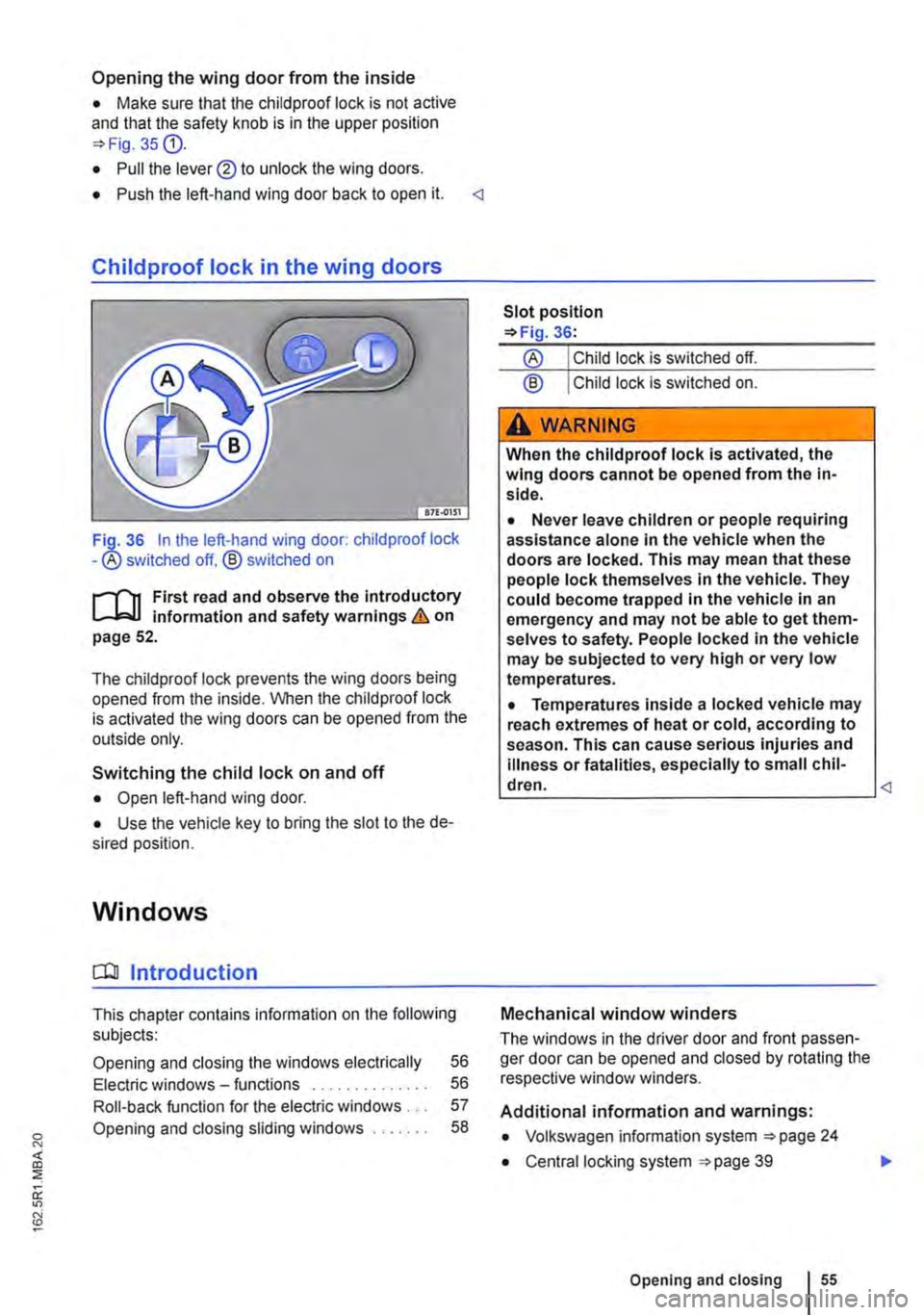
Childproof lock in the wing doors
36 In the left-hand wing door: child proof lock -® switched off. ® switched on
,......,.., First read and observe the introductory information and safety warnings & on page 52.
The chiidproof lock prevents the wing doors being opened from the inside. When the child proof lock is activated the wing doors can be opened from the outside only.
Switching the child lock on and off
• Open left-hand wing door.
• Use the vehicle key to bring the slot to the de-sired position.
Windows
a:n Introduction
This chapter contains information on the following subjects:
Opening and closing the windows electrically 56
Electric windows -functions . . . . . . . . . . . . . . 56
Roll-back function for the electric windows . . . 57
Opening and closing sliding windows . . . . . . . 58
® Child lock is switched on.
A WARNING
When the child proof lock is activated, the wing doors cannot be opened from the in-side.
• Never leave children or people requiring assistance alone in the vehicle when the doors are locked. This may mean that these people lock themselves in the vehicle. They could become trapped in the vehicle in an emergency and may not be able to get them-selves to safety. People locked in the vehicle may be subjected to very high or very low temperatures.
• Temperatures inside a locked vehicle may reach extremes of heat or cold, according to season. This can cause serious injuries and illness or fatalities, especially to small chil-dren. <1
Mechanical window winders
The windows in the driver door and front passen-ger door can be opened and closed by rotating the respective window winders.
Additional information and warnings:
• Volkswagen information system 24
• Central locking system 39
Opening and closing I 55
..
Page 56 of 486
A WARNING
Always take care when using the mechanical or electric windows otherwise you could cause serious accidents or injuries.
• Windows should only be opened or closed when you are sure that nobody is In their op-erating area.
• Never leave children or people requiring assistance alone in the vehicle when the ve-hicle is locked. Electric windows can no lon-ger be opened in an emergency.
A WARNING (Continued)
• Always take all vehicle keys with you ev-ery time you leave the vehicle. The electric windows can still be operated using the but-tons several minutes after the ignition has been switched off, provided the driver door and the front passenger door are not opened.
CD
During sudden rain showers, water can enter the vehicle interior via open windows and cause damage to the vehicle.
'----------------: BSG-0031
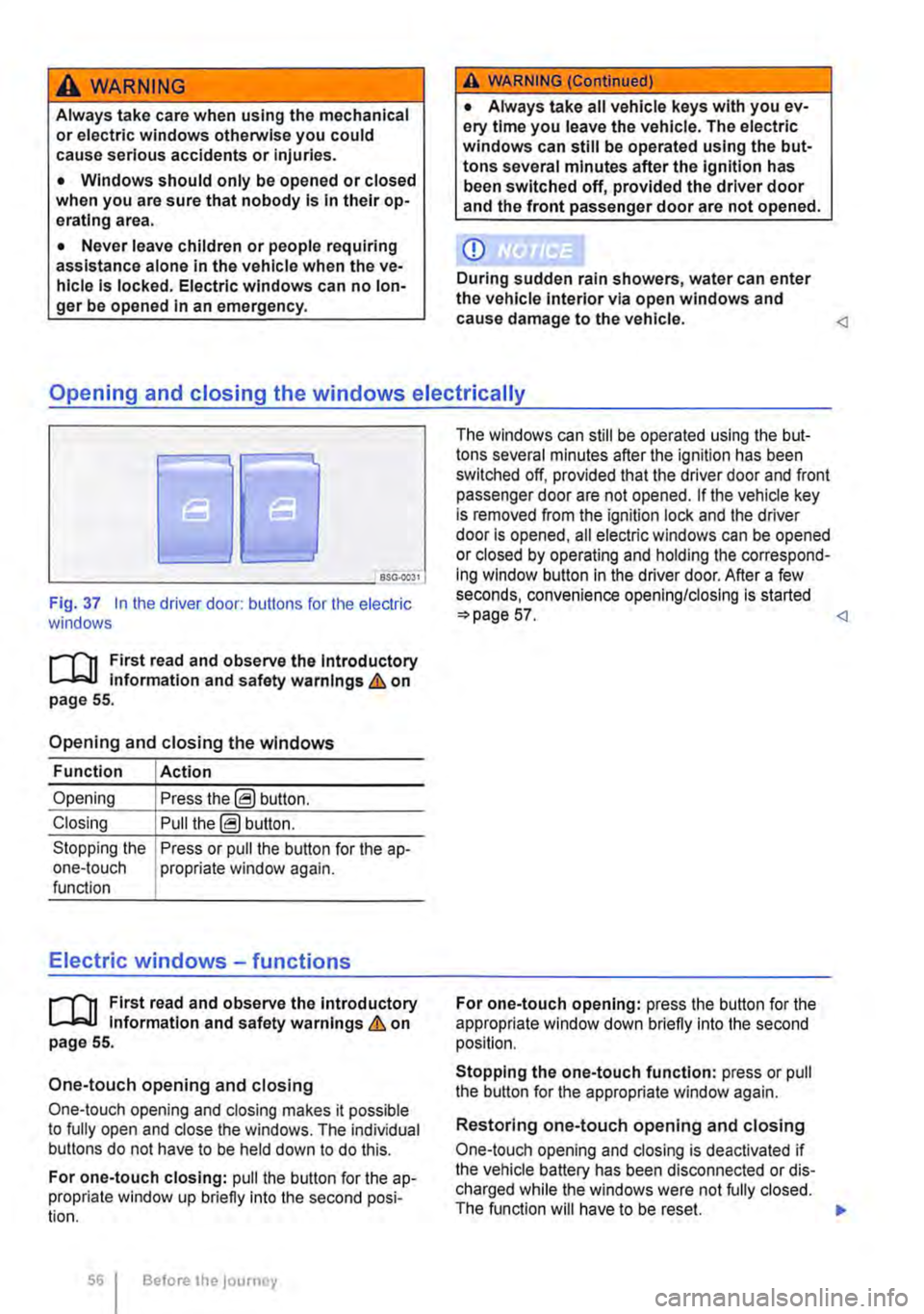
Fig. 37 In the driver door: butlons for the electric windows
r-111 First read and observe the Introductory L-J,::.JJ information and safety warnings & on page 55.
Opening and closing the windows
Function Action
Opening Press the@ button.
Closing Pull the@ button.
Stopping the Press or pull the button for the a p-one-touch propriate window again. function
Electric windows -functions
r-111 First read and observe the introductory L-J,::.JJ information and safety warnings & on page 55.
One-touch opening and closing
One-touch opening and closing makes it possible to fully open and close the windows. The individual buttons do not have to be held down to do this.
For one-touch closing: pull the butlon for the ap-propriate window up briefly into the second posi-tion.
56 Before the journey
The windows can still be operated using lhe but-tons several minutes after the ignition has been switched off, provided that the driver door and front passenger door are not opened. If the vehicle key is removed from the ignition lock and lhe driver door Is opened, all electric windows can be opened or closed by operating and holding lhe correspond-ing window button in the driver door. After a few seconds, convenience opening/closing is started 57.
Stopping the one-touch function: press or pull the button for the appropriate window again.
Restoring one-touch opening and closing
One-touch opening and closing is deactivated if the vehicle battery has been disconnected or dis-charged while the windows were not fully closed. The function will have to be reset.
Page 57 of 486
• Close all windows and doors.
• Pull up the button for the window and hold it in this position for at least one second.
• Let go of the button then pull it up again and hold it in this position. One-touch opening and closing is now ready for operation.
The one-touch function can be restored for individ-ual windows or for several windows at the same time.
Convenience opening and closing
There are three different ways of opening and clos-ing all electric windows simultaneously when the ignition is switched off:
• Press and hold the locking or unlocking button in the remote control key.
• To interrupt this function, let go of the locking or unlocking button.
• OR: hold the vehicle key in the driver door lock cylinder in either the locking or the unlocking posi-tion until all windows are either opened or closed.
• To interrupt this function, turn the vehicle key in the opposite direction.
• OR: after switching the ignition off and opening the driver and front passenger doors, push or pull the@ button in the required direction for at least two seconds.
During convenience closing, first the windows and then the sliding/tilting roof will be closed.
A WARNING
Careless or unsupervised use of the electric windows can cause serious Injuries.
• The electric windows should only be opened or closed when you are sure that no-body is in their operating area.
• Never leave children or people requiring assistance alone In the vehicle when the ve-hicle is locked. The windows can no longer be opened In an emergency.
• Always take all vehicle keys with you ev-ery time you leave the vehicle. The windows can still be operated using the buttons sever-al minutes after the Ignition has been switch-ed off, provided that the driver door and front passenger door are not opened.
m One-touch opening and closing and the roii-L!J back function will not work if there is a fault in the electric windows. Go to a qualified workshop.
l"""l'l1 First read and observe the Introductory l-J,a,IJ Information and safety warnings & on page 55.
The roll-back function for the electric windows can reduce the risk of Injuries when the windows are closing :) &. If the one-touch closing function for a window does not work because it is stiff or is being obstructed, the window will automatically open again.
• Check to see why the window has not closed.
• Try to close the window again.
• If the window is again prevented from closing within approximately 10 seconds of the first at-tempt because it is stiff or obstructed, the automat-ic closing function is switched off for approximately 10 seconds.
• If the window is still obstructed, the window stops at this point. To close the window without the roll-back function, press the button again within 1 0 seconds :) &.
Closing the window without the roll-back function
• Try to close the window again within approxi-mately 10 seconds by holding the button. The roll-back function will be deactivated for a small section of the path of the closing window.
• If the closing procedure takes longer than ap-proximately 10 seconds, the roll-back function will be reactivated. The window will then stop again if it is stiff or meets another obstacle.
• Please go to a qualified workshop if the window still cannot be closed.
A WARNING
Closing the electric windows without the roll-back function could lead to severe Injuries.
• Always take care when closing electric windows. 11>
Opening and closing
Page 59 of 486
A WARNING (Continued)
• Never leave children or people requiring assistance alone in the car, particularly if they have access to the vehicle key. Unsuper-vised use of the vehicle key can lock the ve-hicle, start the engine, switch on the ignition and operate the sliding/tilting roof.
• The sliding/tilting roof can be operated for a short period after the ignition has been switched off, provided that the driver door and front passenger door are not opened.
CD
• In order to avoid damage in winter, remove ice and snow from the roof of the vehicle be-fore opening or tilting the sliding/tilting roof.
m Leaves and other loose items must be re-L.!:J moved from the guide rails of the sliding/tilt-ing roof at regular inteNals, either by hand or using a vacuum cleaner.
m If there is a fault in the sliding/tilting roof, the L.!:J roil-back function will not work properly. Go to a qualified workshop.
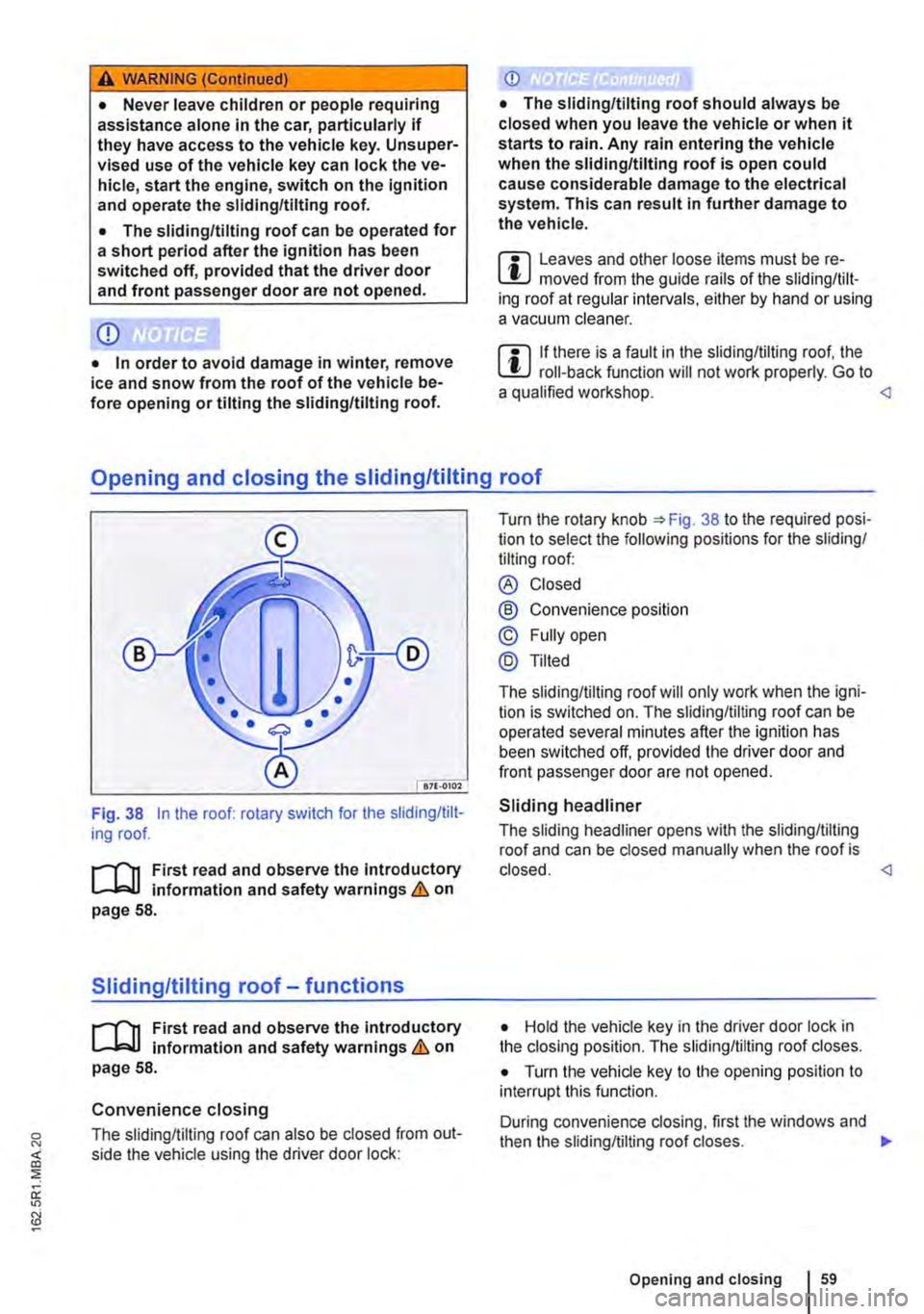
Fig. 38 In the roof: rotary switch for the sliding/tilt-ing roof.
r-T'n First read and observe the Introductory L-J,::.jJ information and safety warnings & on page 58.
Sliding/tilting roof-functions
r-T'n First read and obseNe the Introductory L-J,::.jJ information and safety warnings & on page 58.
Convenience closing
The sliding/tilting roof can also be closed from out-side the vehicle using the driver door lock:
Turn the rotary knob 38 to the required posi-tion to select the following positions for the sliding/ tilting roof:
® Closed
@ Convenience position
© Fully open
@Tilted
The sliding/tilting roof will only work when the igni-tion is switched on. The sliding/tilting roof can be operated several minutes after the ignition has been switched off, provided the driver door and front passenger door are not opened.
Sliding headliner
The sliding headliner opens with the sliding/tilting roof and can be closed manually when the roof is closed.
• Turn the vehicle key to the opening position to interrupt this function.
During convenience dosing, first the windows and then the sliding/tilting roof closes. .,..
Opening and closing 159
Page 62 of 486
A WARNING (Continued)
• Only adjust the height and tilt of the seat or move lt forwards and backwards when the area around the seat is clear.
• There should be no objects in the adjust-ment area of the front seats.
• Make sure that there is no dirt in the areas within which the front seats can be adjusted (and locked In place).
A WARNING
Cigarette lighters in the vehicle could be damaged or accidentally lit. This could lead to serious burns and other Injuries.
• Before adjusting the seats always make sure that there is no lighter on or near the moveable parts of the seat.
• Before closing stowage areas or compart-ments always ensure that there Is no lighter in the way.
• Never stow lighters in stowage areas or compartments or on other surfaces In the ve-hicle. Cigarette lighters may self-Ignite on high-temperature surfaces, especially In sum-
The dangers of assuming an incorrect sitting position
.....-m First read and observe the Introductory L-.bU information and safety warnings & on page 61.
If the seat belts are not worn or are worn incorrect-ly, the risk of severe or fatal injuries increases. Seat belts can only provide optimal protection if the seat belt routing is correct. Assuming an incorrect sitting position considerably impairs the level of protection provided by a seat belt. This could lead to severe or even fatal injuries. The risk of severe or fatal injuries is especially increased when a de-ploying airbag strikes a vehicle occupant who has assumed an incorrect sitting position. The driver is responsible for all occupants transported in the ve-hicle, especially children.
The following list contains examples of sitting posi-tions that can be dangerous for all vehicle occu-pants.
Whenever the vehicle is in motion:
• Never stand in the vehicle.
• Never stand on the seats.
• Never kneel on the seats.
• Never tilt the backrest too far to the rear.
• Never lean against the dash panel.
• Never lie on the seats in the passenger com-partment.
• Never sit on the front edge of a seat.
• Never sit sideways.
Before the journey
• Never lean out of a window .
• Never put your feet out of a window.
• Never put your feet on the dash panel.
• Never place your feet on the seat cushion or seat backrest.
• Never travel in a footwell.
• Never sit on the armrest.
• Never travel on a seat without wearing the seat belt.
• Never use the bed.
• Never travel in the luggage compartment or on the load surface.
A WARNING
Every Incorrect sitting position In the vehicle Increases the risk of severe or fatal Injuries In the event of an accident or sudden driving or braking manoeuvre.
• All vehicle occupants must maintain a cor-rect sitting position and wear their seat belt properly while the vehicle Is In motion.
• Sitting In an incorrect position, not fasten-ing the seat belt, or too short a distance to the alrbag exposes the occupants to critical or fatal injuries, especially if the alrbags de-ploy and strike an occupant who has as-sumed an Incorrect sitting position.
Page 69 of 486
A WARNING (Continued)
• The steering wheel must always point to-wards the chest and not towards the face. This ensures that the driver front airbag pro-vides maximum protection in the event of an accident.
• While driving, always keep both hands on the outside of the steering wheel (at the 9 o'clock and 3 o'clock positions =>Fig. 47). This reduces the risk of injury if the driver front alrbag Is triggered.
Seat functions, front
a:n Introduction
This chapter contains information on the following subjects:
Seat heating . . . . . . . . . . . . . . . . . . . • • • . . . . . . 69
Memory seats . . . . . . . . . . . . . . . . . . . 70
Rotating front seats . . . . . . . . . . . . . . . . . . . . . . 71
Additional information and warnings:
• Adjusting the seat position =>page 61
• Seat bells =>page 79
• Airbag system =>page 87
• Child seats (accessories) 96
• Heating, ventilating, cooling 322
Seat heating
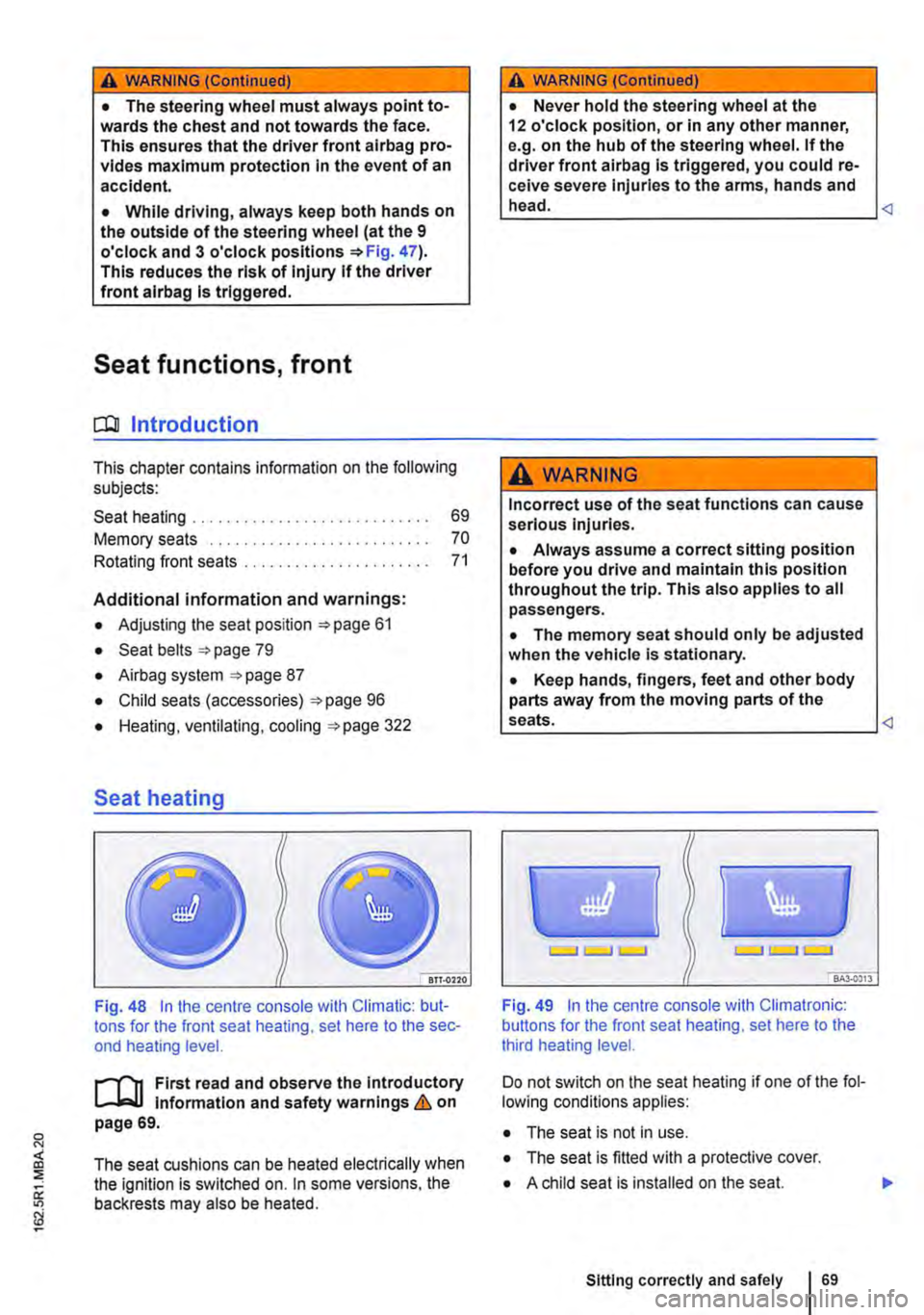
Fig. 48 In the centre console with Climatic: but-tons for the front seat heating, set here to the sec-ond heating level.
First read and observe the Introductory l-J,:.,U Information and safety warnings & on page 69.
The seat cushions can be heated electrically when the ignition is switched on. In some versions, the backrests may also be heated.
A WARNING (Continued)
• Never hold the steering wheel at the 12 o'clock position, or in any other manner, e.g. on the hub of the steering wheel. If the driver front airbag is triggered, you could re-ceive severe Injuries to the arms, hands and head.
A WARNING
Incorrect use of the seat functions can cause serious injuries.
• Always assume a correct sitting position before you drive and maintain this position throughout the trip. This also applies to all passengers.
• The memory seat should only be adjusted when the vehicle Is stationary.
• Keep hands, fingers, feet and other body parts away from the moving parts of the seats.
Fig. 49 In the centre console with Climatronic: buttons for the front seat heating, set here to the third heating level.
Do not switch on the seat heating if one of the fol-lowing conditions applies:
• The seat is not in use.
• The seat is fitted with a protective cover.
• A child seat is installed on the seat.
Sitting correctly and safely 69
Page 84 of 486
Fasten the seat belt even if you are unable to undo the twist. However, the twist should not be in part of the seat belt that comes into direct contact with the body. The twist should be corrected immediate-ly by a qualified workshop.
A WARNING
Using seat belts incorrectly Increases the risk of severe or fatal Injuries.
Fastening and unfastening seat belts
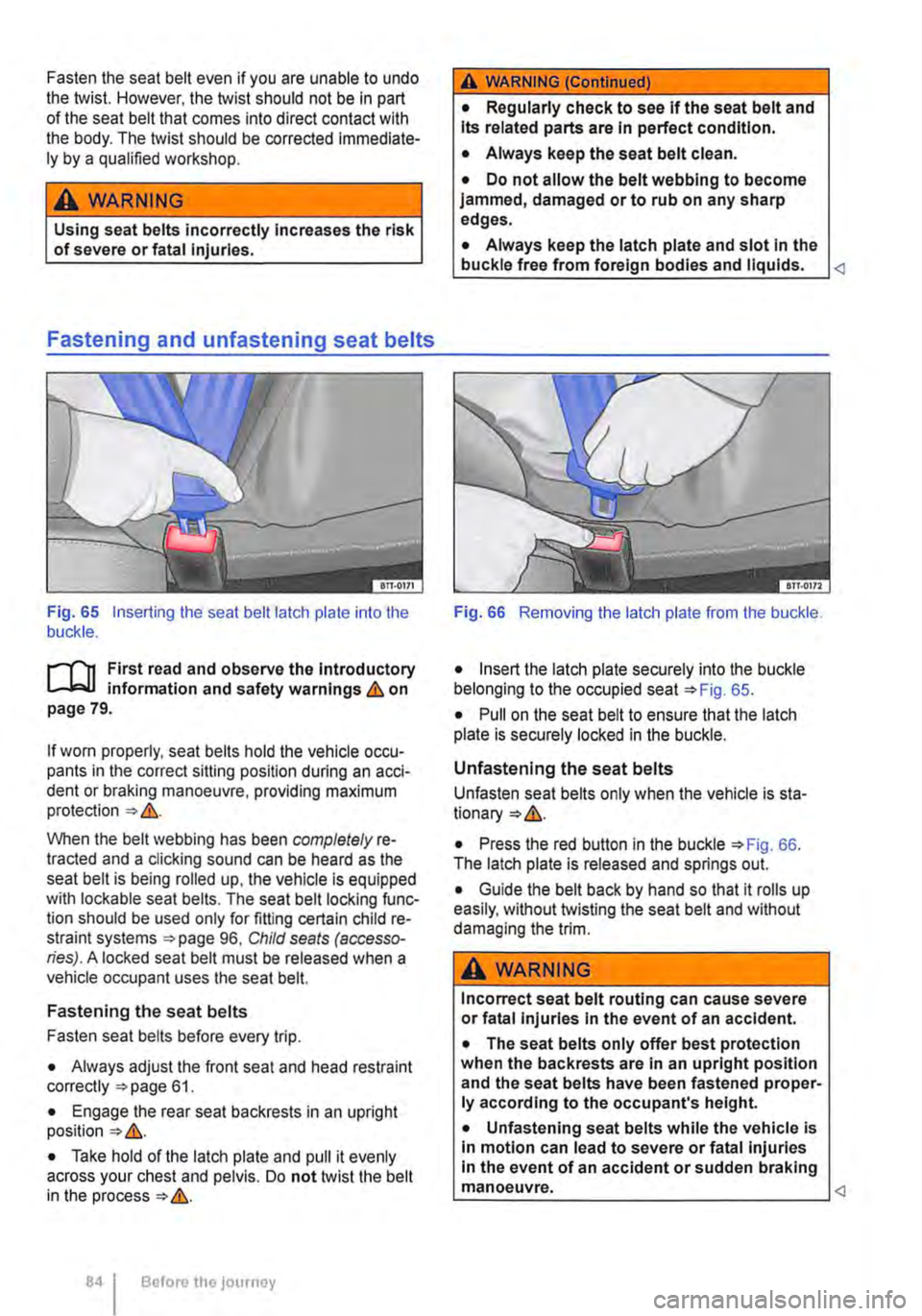
Fig. 65 Inserting the seat belt latch plate into lhe buckle.
f""'"'1'l1 First read and observe the Introductory L-J,:.iJ information and safety warnings & on page 79.
If worn properly, seat belts hold the vehicle occu-pants in the correct sitting position during an acci-dent or braking manoeuvre, providing maximum protection &.
When the belt webbing has been completely re-tracted and a clicking sound can be heard as the seat belt is being rolled up, the vehicle is equipped with lockable seat belts. The seat belt locking func-tion should be used only for fitting certain child re-straint systems 96, Child seals (accesso-ries). A locked seat belt must be released when a vehicle occupant uses the seat belt.
Fastening the seat belts
Fasten seat belts before every trip.
• Always adjust the front seat and head restraint correctly 61.
• Engage the rear seat backrests in an upright position &.
• Take hold of the latch plate and pull it evenly across your chest and pelvis. Do not twist the belt in the process &.
Before the journey
A WARNING (Continued)
• Regularly check to see if the seat belt and Its related parts are In perfect condition.
• Always keep the seat belt clean.
• Do not allow the belt webbing to become jammed, damaged or to rub on any sharp edges.
• Always keep the latch plate and slot In the buckle free from foreign bodies and liquids.
• Insert the latch plate securely into the buckle belonging to the occupied seat 65.
• Pull on the seat belt to ensure that the latch plate is securely locked in the buckle.
Unfastening the seat belts
Unfasten seat belts only when the vehicle is sta-
• Press the red button in the buckle 66. The latch plate is released and springs out.
• Guide the belt back by hand so that it rolls up easily, without twisting the seat belt and without damaging the trim.
A WARNING
Incorrect seat belt routing can cause severe or fatal Injuries In the event of an accident.
• The seat belts only offer best protection when the backrests are In an upright position and the seat belts have been fastened proper-ly according to the occupant's height.
• Unfastening seat belts while the vehicle is In motion can lead to severe or fatal injuries In the event of an accident or sudden braking manoeuvre. <1
Page 88 of 486
are not a substitute for seat belts. Seat belts must always be worn, even when the front seats are equipped with front airbags.
Additional information and warnings:
• Driving tips 33
• Central locking system 39
• Correct sitting position 61
• Seat belts 79
• Child seats (accessories) 96
• Cleaning and caring for the interior 388
• Accessories, modifications, repairs and renewal of parts 394
• Consumer information 404
A WARNING
Never rely solely on the airbag system for your protection.
• Even if an alrbag is triggered, it only offers auxiliary protection.
• The airbag system offers the best level of protection, and reduces the risk of injury, when seat belts are properly worn 79, Seat belts.
• Before every trip, each vehicle occupant must adopt the correct sitting position, cor-rectly fasten the seat belt belonging to their seat and keep it fastened properly throughout the trip. This applies to ail vehicle occupants and also in urban traffic.
A WARNING
The risk of injury increases if there are any objects between the vehicle occupants and the deployment area of the airbag when it is triggered. This will alter the deployment zone of the airbag, or the objects will be flung against the body.
• Never hold any objects in your hand or on your lap while the vehicle is in motion.
• Never transport any objects on the front passenger seal The objects could enter the deployment zone of the airbag during sudden braking or driving manoeuvres and then be flung dangerously through the vehicle interi-or if the airbag is activated.
• Vehicle occupants sitting on the front seats and rear outer seats must never carry any people, pets or objects in the deployment zone between themselves and the airbags. Make sure that children and passengers also keep to this rule.
BB I Before the journey
A WARNING
External devices in the vehicle that are not properly secured can be flung though the in-terior and cause injuries, if there is a sudden driving or braking manoeuvre, or in the event of an accident.
• You should never position or attach an ex-ternal device on a door, on the windscreen or above or near to the areas marked "AIRBAG" on the steering wheel, the dash panel and the seat backrests, or between these areas and the vehicle occupants. External devices can cause serious Injury in an accident, especial-ly when the airbags deploy.
A WARNING
The alrbag system can only be triggered once. The system will have to be replaced if the airbags have been triggered.
• Alrbags that have deployed and any affec-ted system parts must be immediately re-placed with new parts that are approved by Volkswagen Commercial Vehicles for the re-spective vehicle.
• Repairs and modifications to your vehicle should only be carried out by a qualified workshop. Qualified workshops have the nec-essary tools, diagnostic equipment, repair in-formation and qualified personnel.
• Never use recycled alrbag components or components that have been taken from end-of-life vehicles in your vehicle.
• Never alter any components of the airbag system.
A WARNING
Fine dust particles or steam may be released when the alrbags trigger. This Is normal and does not mean that there is a fire in the vehi-cle.
• The fine dust can cause irritation to the skin and eye membranes and cause breath-ing difficulties, particularly for people suffer-ing from asthma or people who have {had) other respiratory problems. To help reduce breathing difficulties, get out of the vehicle or open the windows or doors for more fresh air.
• If you come into contact with the dust, you should wash your hands and face with a mild soap and water before eating.
• Do not let the dust get into your eyes or into open wounds.
Page 93 of 486
A DANGE;R (Continued) --
• No other people, animals or objects may be carried between the occupants of the front seats and the alrbag deployment zone. Make sure that children and passengers also keep to this rule.
• Do not attach any objects, e.g. mobile nav-igation devices, to the windscreen above the front alrbag on the front passenger side.
• Do not cover or stick anything on the steering wheel hub or the soft plastic surface of the alrbag unit In the dash panel on the front passenger side, and do not modify them In any way.
A WARNING
The front alrbags are deployed In front of the steering wheel "*Fig. 71 and dash panel '*Fig. 72.
• When driving, always hold the steering wheel with both hands on the outside of the ring at the 9 o'clock and 3 o'clock positions.
• Adjust the driver seat so that there is at least 25 cm between your breastbone and the hub of the steering wheel. Contact a qualified workshop if your physical build makes this Impracticable.
• Adjust the front passenger seat so that the distance between the passenger and the
__ ____
Switching the front passenger front airbag on and off manually using the
key-operated switch
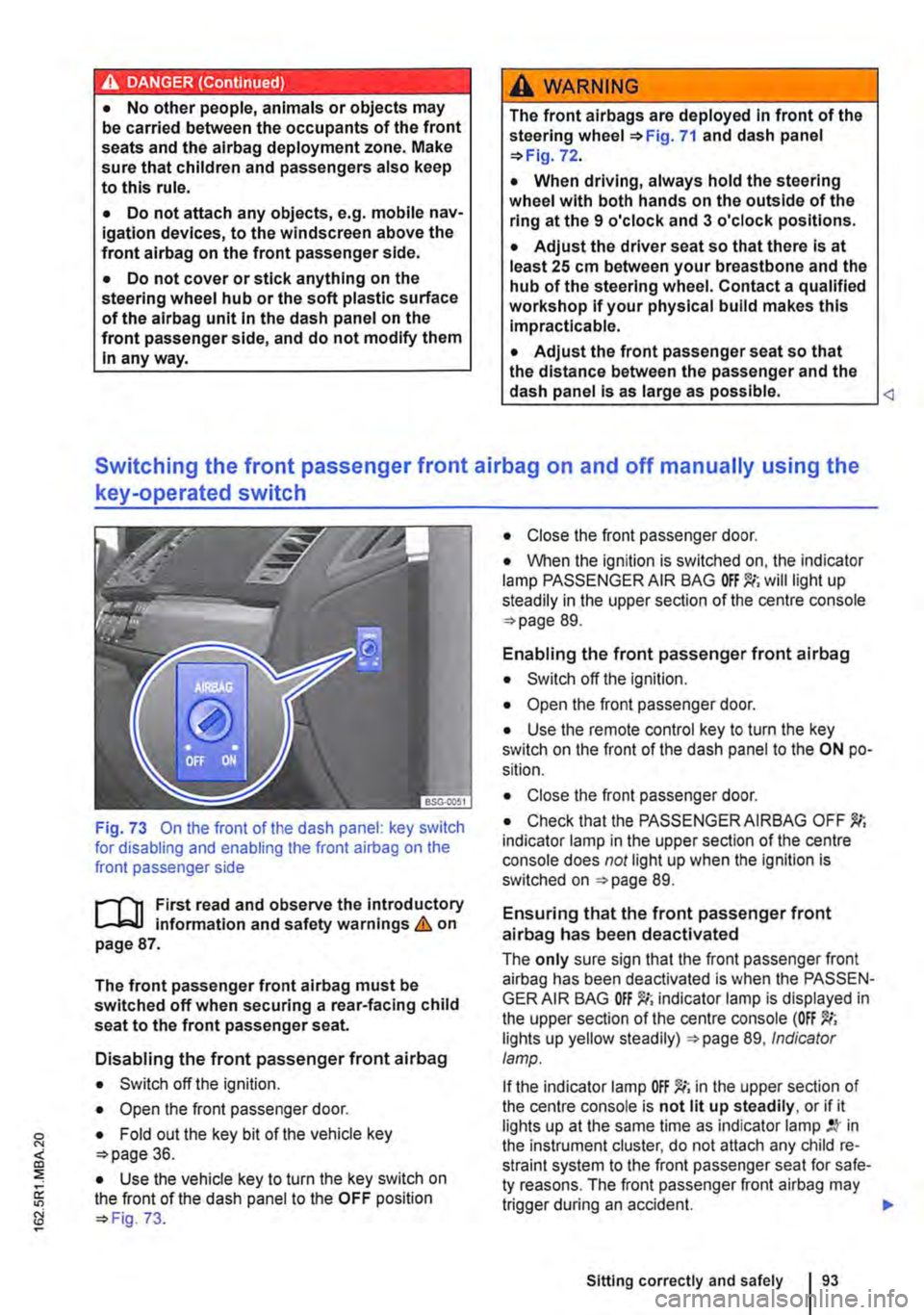
Fig. 73 On the front of the dash panel: key switch for disabling and enabling the front airbag on the front passenger side
l""'rn First read and observe the introductory L-J,::.U information and safety warnings&. on page 87.
The front passenger front airbag must be switched off when securing a rear-facing child seat to the front passenger seat.
Disabling the front passenger front airbag
• Switch off the ignition.
• Open the front passenger door.
• Fold out the key bit of the vehicle key o>page 36.
• Use the vehicle key to turn the key switch on the front of the dash panel to the OFF position o> Fig. 73.
• Close the front passenger door.
• When the ignition is switched on, the indicator lamp PASSENGER AIR BAG will light up steadily in the upper section of the centre console o> page 89.
Enabling the front passenger front airbag
• Switch off the ignition.
• Open the front passenger door.
• Use the remote control key to turn the key switch on the front of the dash panel to the ON po-sition.
• Close the front passenger door.
• Check that the PASSENGER AIRBAG OFF indicator lamp in the upper section of the centre console does not light up when the Ignition is switched on =>page 89.
Ensuring that the front passenger front airbag has been deactivated
The only sure sign that the front passenger front airbag has been deactivated is when the PASSEN-GER AIR BAG indicator lamp is displayed in the upper section of the centre console (OFF lights up yellow steadily) =>page 89, Indicator lamp.
If the indicator lamp OFF )!(; in the upper section of the centre console is not lit up steadily, or if it lights up at the same time as indicator lamp in the instrument cluster, do not attach any child re-straint system to the front passenger seat for safe-ty reasons. The front passenger front airbag may trigger during an accident.
Sitting correctly and safely
Page 102 of 486
• Push the attachment arms on the child seat into the ISOFIX anchor points 79 as shown by the arrows. The child seat must click and audibly securely into place.
• Fasten the upper strap (top tether) into the cor-responding retaining rings 80 or 81.
• Stretch the belt so that the child seat is posi-tioned high on the rear seat backrest.
• After the child seat has been removed, fold up the head restraint or install it accordingly.
Securing child seats with a seat belt
r-111 First read and observe the Introductory L--lo:oU information and safety warnings & on page 96.
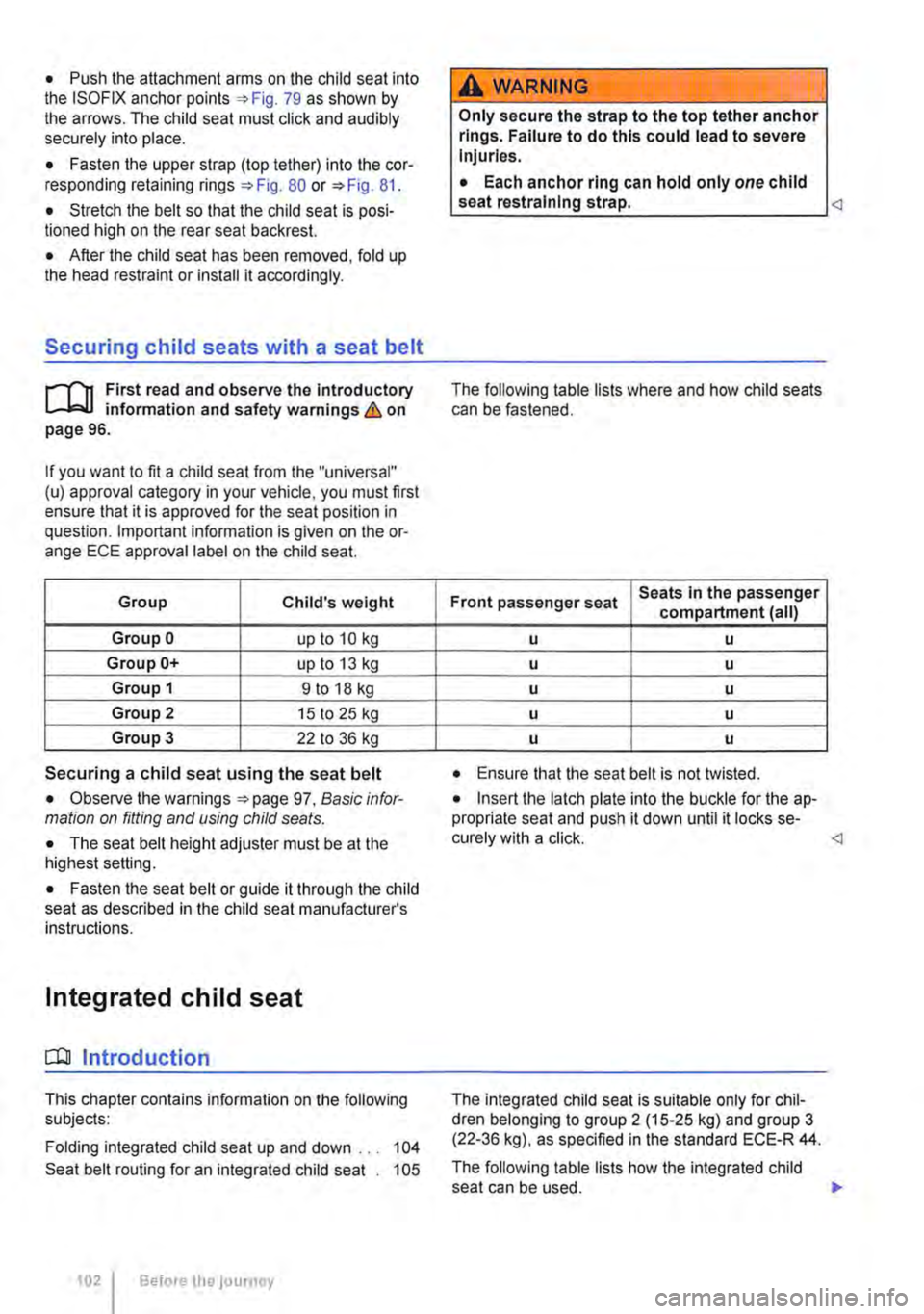
If you want to fit a child seat from the "universal" (u) approval category in your vehicle. you must first ensure that it is approved for the seat position in question. Important information is given on the or-ange ECE approval label on the child seat.
Group Child's weight
Group 0 up to 10 kg
Group 0+ up to 13 kg
Group 1 9 to 18 kg
Group 2 15 to 25 kg
Group 3 22 to 36 kg
Securing a child seat using the seat belt
• Observe the warnings 97, Basic infor-mation on fitting and using child seals.
• The seat belt height adjuster must be at the highest setting.
• Fasten the seat belt or guide it through the child seat as described in the child seat manufacturer's instructions.
Integrated child seat
o::n Introduction
This chapter contains information on the following subjects:
Folding integrated child seat up and down ... 104
Seat belt routing for an integrated child seat . 105
102 Before the journey
A WARNING
Only secure the strap to the top tether anchor rings. Failure to do this could lead to severe Injuries.
• Each anchor ring can hold only one child seat restraining strap.
Front passenger seat Seats In the passenger compartment (all)
u u
u u
u u
u u
u u
• Ensure that the seat belt is not twisted.
• Insert the latch plate into the buckle for the ap-propriate seat and push it down until it locks se-curely with a click.
The following table lists how the integrated child seat can be used. .,..