oil change VOLKSWAGEN TRANSPORTER 2018 User Guide
[x] Cancel search | Manufacturer: VOLKSWAGEN, Model Year: 2018, Model line: TRANSPORTER, Model: VOLKSWAGEN TRANSPORTER 2018Pages: 486, PDF Size: 69.28 MB
Page 280 of 486
Saving fuel
1/100 km
-10°C
+20 oc
L----------------tkm 5 15 25 30
en-o11S
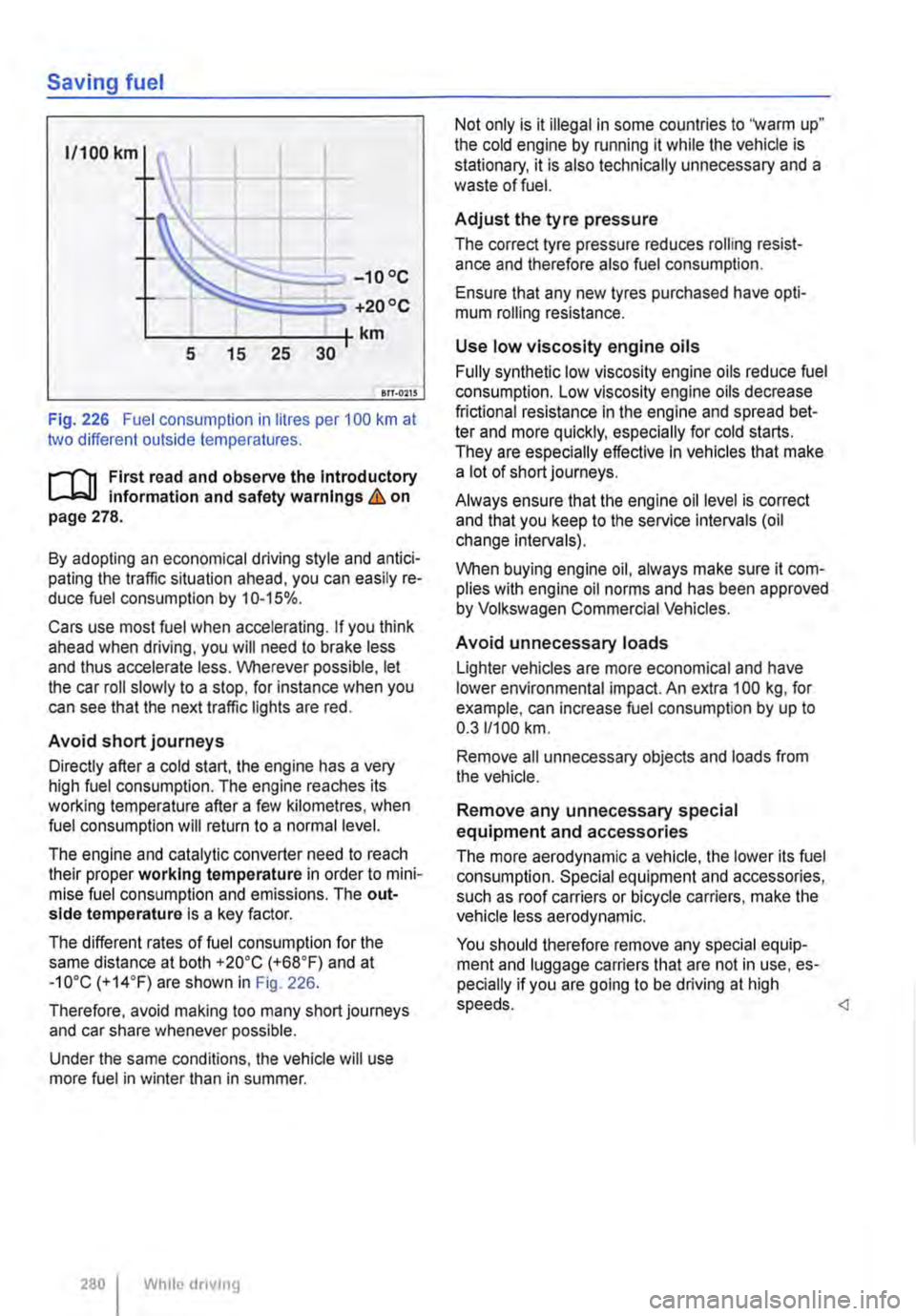
Fig. 226 Fuel consumption in litres per 100 km at two different outside temperatures.
r-1"'11 First read and observe the Introductory Information and safety warnings&. on page 278.
By adopting an economical driving style and antici-pating the traffic situation ahead, you can easily re-duce fuel consumption by 10-15%.
Cars use most fuel when accelerating. If you think ahead when driving, you will need to brake less and thus accelerate less. Wherever possible, let the car roll slowly to a stop, for instance when you can see that the next traffic lights are red.
Avoid short journeys
Directly after a cold start, the engine has a very high fuel consumption. The engine reaches its working temperature after a few kilometres, when fuel consumption will return to a normal level.
The engine and catalytic converter need to reach their proper working temperature in order to mini-mise fuel consumption and emissions. The out-side temperature is a key factor.
The different rates of fuel consumption for the same distance at both +20"C (+68"F) and at -10"C (+14"F) are shown in Fig. 226.
Therefore, avoid making too many short journeys and car share whenever possible.
Under the same conditions, the vehicle will use more fuel in winter than in summer.
280 I While dnvmg
Not only is it illegal in some countries to "warm up" the cold engine by running it while the vehicle is stationary, it is also technically unnecessary and a waste of fuel.
Adjust the tyre pressure
The correct tyre pressure reduces rolling resist-ance and therefore also fuel consumption.
Ensure that any new tyres purchased have opti-mum rolling resistance.
Use low viscosity engine oils
Fully synthetic low viscosity engine oils reduce fuel consumption. Low viscosity engine oils decrease frictional resistance in the engine and spread bet-ter and more quickly, especially for cold starts. They are especially effective In vehicles that make alotofshortjourneys.
Always ensure that the engine oil level is correct and that you keep to the service intervals (oil change intervals).
When buying engine oil, always make sure it com-plies with engine oil norms and has been approved by Volkswagen Commercial Vehicles.
Avoid unnecessary loads
Lighter vehicles are more economical and have lower environmental impact. An extra 100 kg, for example, can increase fuel consumption by up to 0.311100 km.
Remove all unnecessary objects and loads from the vehicle.
Remove any unnecessary special equipment and accessories
The more aerodynamic a vehicle, the lower its fuel consumption. Special equipment and accessories, such as roof carriers or bicycle carriers, make the vehicle less aerodynamic.
You should therefore remove any special equip-ment and luggage carriers that are not in use, es-pecially if you are going to be driving at high speeds.
Page 308 of 486
A WARNING (Continued)
• Front Assist can Issue unnecessary warn-ings and carry out unwanted braking inter-ventions when Its function is Impaired, e.g. if the position of the radar sensor has been soiled or changed.
• The Front Assist does not react to per-sons, animals or vehicles crossing or ap-proaching In the same lane.
• The driver must be prepared to take full control of the vehicle at all times.
m The brake pedal feels "harder" when Front W Assist triggers the brakes.
Displays
A
m Automatic brake intervention by Front Assist W can be stopped by using the accelerator or through steering intervention.
m Deactivate Front Assist if it does not function W as described in this chapter, e.g. if multiple unwanted interventions occur, deactivate Front As-sist and have the system checked by a qualified workshop as soon as possible. Volkswagen recom-mends using a Volkswagen dealership for this pur-pose. <1
BSG 0075
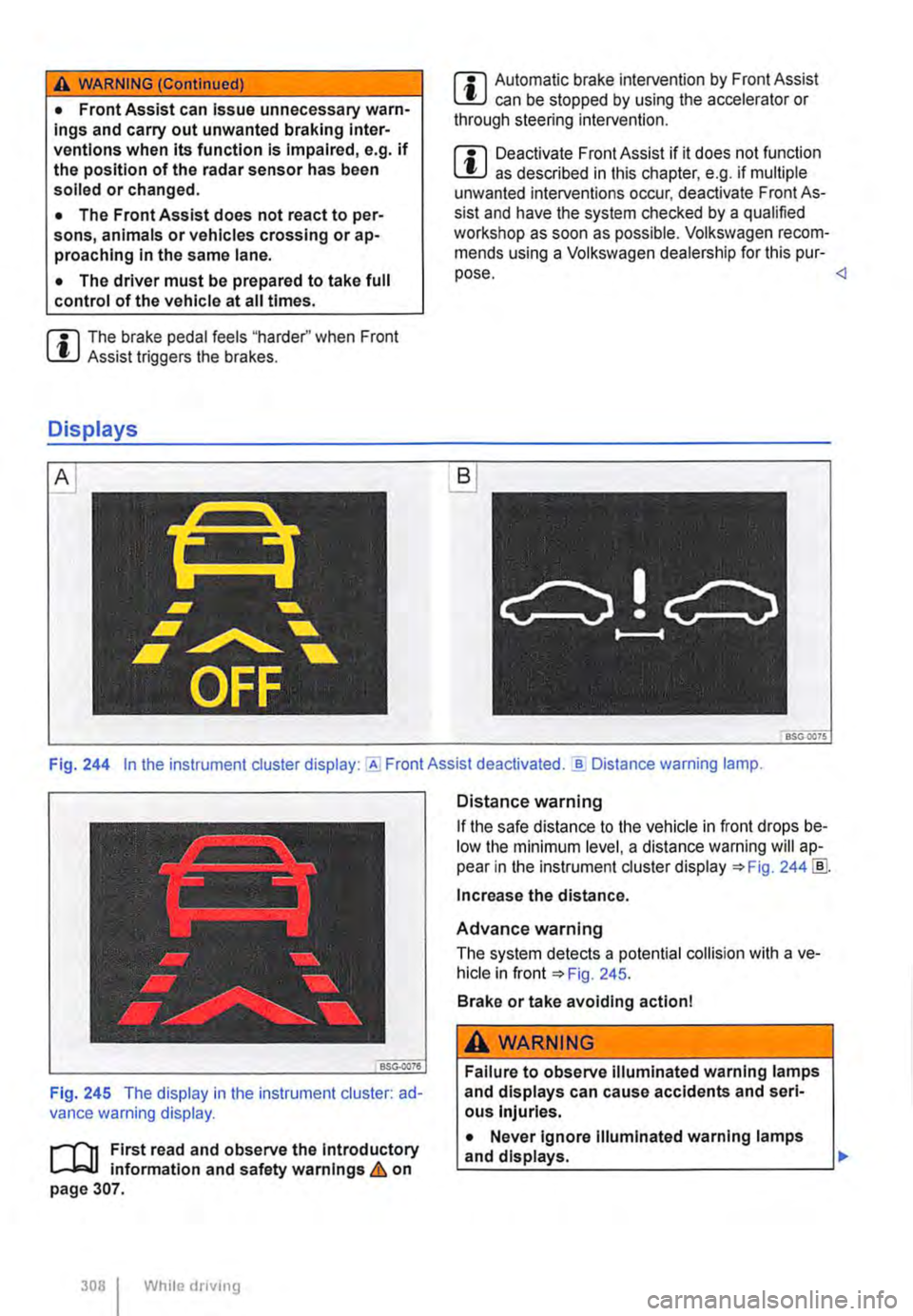
Fig. 244 In the instrument cluster display: Assist deactivated . ..!!. Distance warning lamp.
Fig. 245 The display in the instrument cluster: ad-vance warning display.
,....--m First read and observe the Introductory l.-.J,:.,U information and safety warnings & on page 307.
308 I While dnving
Distance warning
If the safe distance to the vehicle in front drops be-low the minimum level, a distance warning will ap-pear in the instrument cluster display ::.Fig. 244 !ID.
Increase the distance.
Advance warning
The system detects a potential collision with a ve-hicle in front ::.Fig. 245.
Brake or take avoiding action!
A WARNING
Failure to observe illuminated warning lamps and displays can cause accidents and seri-ous Injuries.
• Never ignore Illuminated warning lamps
La_n_d __
Page 314 of 486
Operation
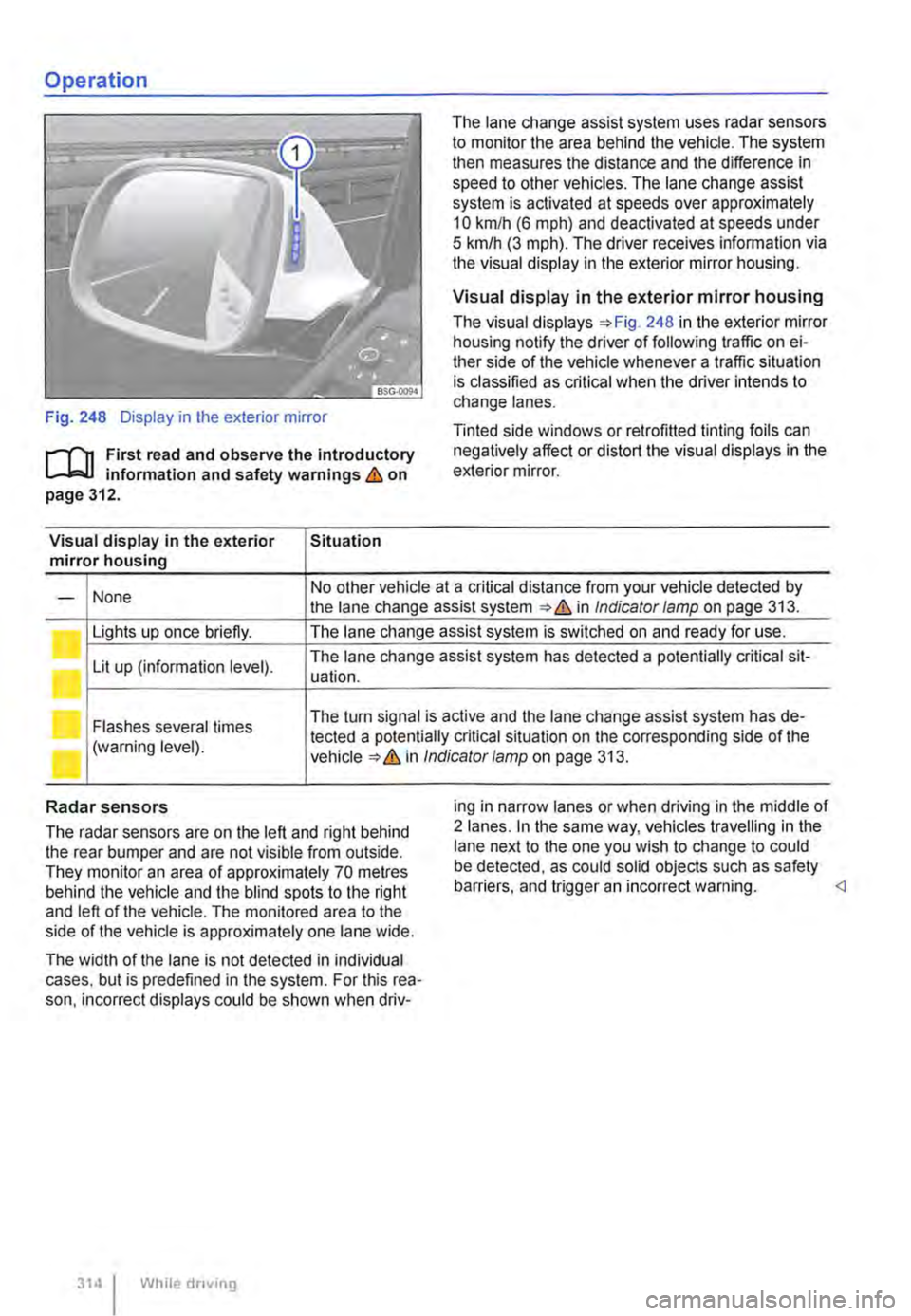
Fig. 248 Display in the exterior mirror
r-f"n First read and observe the introductory L-W! information and safety warnings & on page 312.
Visual display in the exterior Situation mirror housing
The lane change assist system uses radar sensors to monitor the area behind the vehicle. The system then measures the distance and the difference in speed to other vehicles. The lane change assist system is activated at speeds over approximately 10 km/h (6 m ph) and deactivated at speeds under 5 km/h (3 mph). The driver receives infonmation via the visual display in the exterior mirror housing.
Visual display in the exterior mirror housing
The visual displays 248 in the exterior mirror housing notify the driver of following traffic on ei-ther side of the vehicle whenever a traffic situation is classified as critical when the driver intends to change lanes.
Tinted side windows or retrofitted tinting foils can negatively affect or distort the visual displays in the exterior mirror.
None No other vehicle at a critical distance from your vehicle detected by -the lane change assist system & in Indicator lamp on page 313.
Lights up once briefly. The lane change assist system is switched on and ready for use.
Lit up (information level). The lane change assist system has detected a potentially critical sit-uation.
Flashes several times The turn signal is active and the lane change assist system has de-
(warning level). tected a potentially critical situation on the corresponding side of the in Indicator/amp on page 313.
Radar sensors
The radar sensors are on the left and right behind the rear bumper and are not visible from outside. They monitor an area of approximately 70 metres behind the vehicle and the blind spots to the right and left of the vehicle. The monitored area to the side of the vehicle is approximately one lane wide.
The width of the lane is not detected in individual cases. but is predefined in the system. For this rea-son. incorrect displays could be shown when driv-
314 I While driving
ing in narrow lanes or when driving in the middle of 2 lanes. In the same way, vehicles travelling in the lane next to the one you wish to change to could be detected, as could solid objects such as safety barriers. and trigger an incorrect warning.
Page 355 of 486
The correct engine oil is important for the function and service life of the engine. A special high quali-ty multigrade oil has been filled at the factory and this can normally be used as an all-season oil.
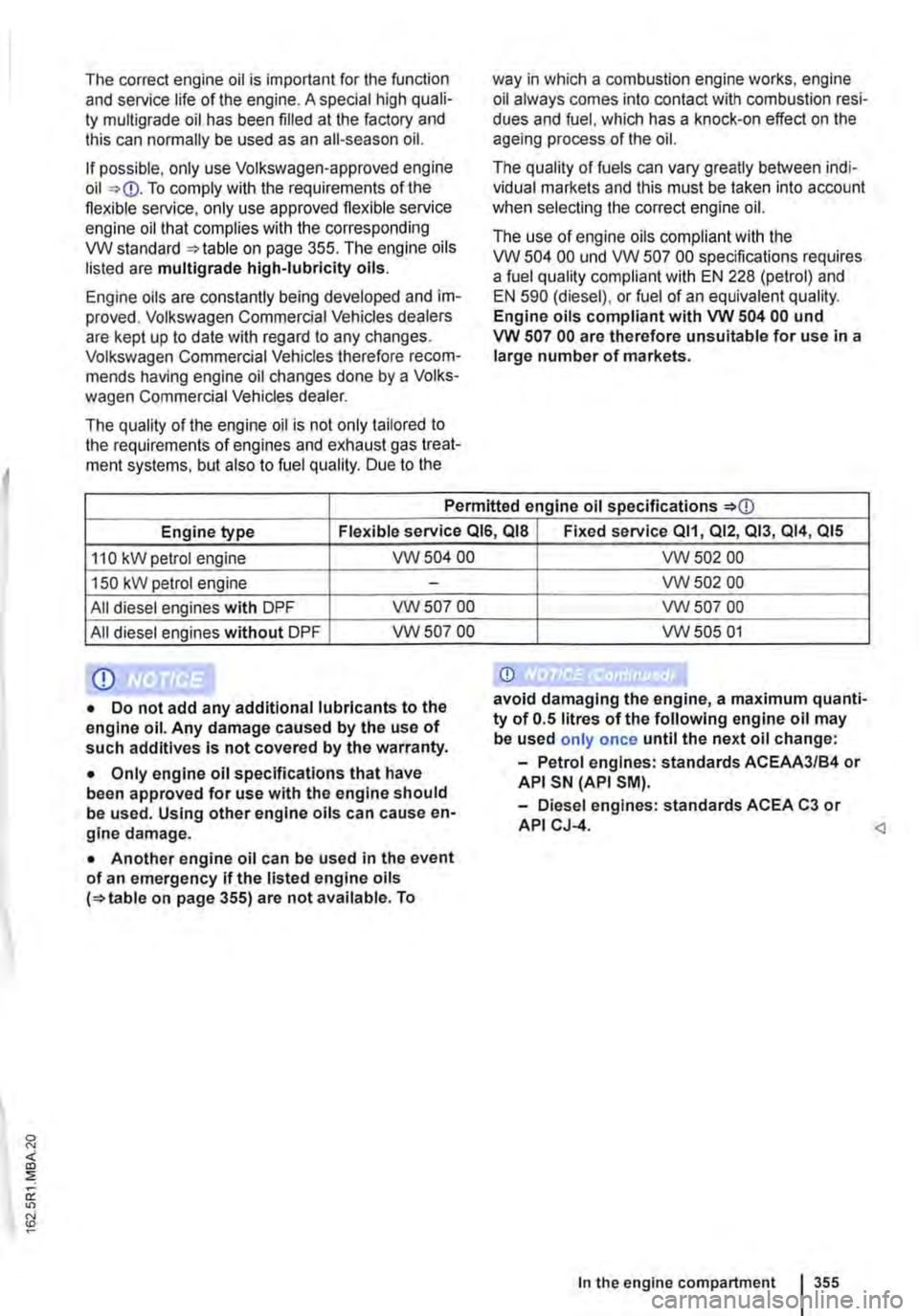
If possible, only use Volkswagen-approved engine oil =>CD. To comply with the requirements of the flexible service, only use approved flexible service engine oil that complies with the corresponding VW standard =>table on page 355. The engine oils listed are multigrade high-lubricity oils.
Engine oils are constantly being developed and im-proved. Volkswagen Commercial Vehicles dealers are kept up to date with regard to any changes. Volkswagen Commercial Vehicles therefore recom-mends having engine oil changes done by a Volks-wagen Commercial Vehicles dealer.
The quality of the engine oil is not only tailored to the requirements of engines and exhaust gas treat-ment systems, but also to fuel quality. Due to the
way in which a combustion engine works, engine oil always comes into contact with combustion resi-dues and fuel, which has a knock-on effect on the ageing process of the oil.
The quality of fuels can vary greatly between indi-vidual markets and this must be taken into account when selecting the correct engine oil.
The use of engine oils compliant with the VW 504 00 und VW 507 00 specifications requires a fuel quality compliant with EN 228 (petrol) and EN 590 (diesel), or fuel of an equivalent quality. Engine oils compliant with VW 504 00 und VW 507 00 are therefore unsuitable for use in a large number of markets.
Permitted engine oil specifications =>CD
Engine type Flexible service QIS, QIS Fixed service Ql1, Ql2, Q13, Ql4, Ql5
110 kW petrol engine VW504 00
150 kW petrol engine -
All diesel engines with DPF VW507 00
All diesel engines without DPF VW507 00
CD
• Do not add any additional lubricants to the engine oil. Any damage caused by the use of such additives is not covered by the warranty.
• Only engine oil specifications that have been approved for use with the engine should be used. Using other engine oils can cause en-gine damage.
• Another engine oil can be used in the event of an emergency if the listed engine oils (=>table on page 355) are not available. To
vw 502 00
VW502 00
VW507 00
VW505 01
CD
avoid damaging the engine, a maximum quanti-ty of 0.5 litres of the following engine oil may be used only once until the next oil change:
-Petrol engines: standards ACEAA3/B4 or API SN (API SM).
-Diesel engines: standards ACEA C3 or APICJ4.
In the engine compartment 1355
Page 357 of 486
A WARNING (Continued)
• If engine oil is spilt on cold engine parts it can heat up and Ignite when the engine Is running.
• Always ensure that the engine oil filler cap Is securely tightened after refilling, and that the dipstick Is properly Inserted back Into the guide tube. This will prevent the engine oil from draining out on to hot engine compo-nents when the engine Is running.
CD
• Do not start the engine if the engine oil level Is above area@. Seek expert assistance. The catalytic converter and the engine could other-wise be damaged.
• When refilling or changing service fluids, please ensure that the correct fluids are added through the correct openings. Incorrect service fluids can cause serious functional problems and engine damage.
Engine oil consumption
n"'n First read and observe the introductory l.-J,:.ll information and safety warnings & on page 353.
Engine oil consumption can vary from engine to engine and can change during the working life of an engine.
The vehicle may consume up to 1.0 litre of engine oil per 2,000 km, depending on how you drive and the conditions in which the car is used. In new ve-
Changing engine oil
n"'n First read and observe the Introductory l.-J,:.ll Information and safety warnings & on page 353.
The engine oil must be changed regularly in ac-cordance with the data given in the service sched-ule.
The engine oil and filter change should be carried out by a qualified workshop due to the special tools and knowledge required, this also applies to the disposal of used oil. Volkswagen Commercial Vehi-cles recommends using a Volkswagen Commercial Vehicles dealership for this purpose.
The engine oil level must never be above I!!S area @. Otherwise oil can be drawn in through the crankcase breather and escape into the atmosphere via the exhaust system. <1
hicles. consumption is likely to be higher for the first 5,000 km. The engine oil level must therefore be checked at regular intervals, preferably when refuelling and before long journeys.
When the engine is working hard the oil level must be kept within area =>Fig. 274 @,for instance dur-ing long motorway cruising in summer, trailer tow-ing or climbing mountain passes. <1
More details on the service intervals can be found in the service schedule.
Additives in the engine oil can cause new engine oil to discolour quickly. This is normal and does not mean that the engine oil should be changed more frequently.
A WARNING
If, In exceptional cases, you have to carry out an oil change yourself, please note the fol-lowing:
• Always wear eye protection. .,.
In the engine compartment 357
Page 360 of 486
Coolant specification
r-l"'n First read and observe the Introductory l..-J,::,U Information and safety warnings & on page 358.
The cooling system is filled at the factory with a mixture of specially prepared water and at least 40% coolant additive G 13 (fl-VW 774 J). The coolant additive is dyed purple. This mixture of wa-ter and coolant additive gives the necessary frost protection down to -2s•c (-13.F) and protects the alloy parts of the cooling system against corrosion. The mixture also prevents scaling and raises the boiling point of the coolant.
In order to protect the coolant system, the propor-tion of coolant additive must always be at least 40%, even if anti-freeze is not required in warm weather and warm climates.
If greater frost protection is required in very cold climates, the proportion of anti-freeze additive can be increased. However, the percentage of coolant additive should not exceed 60%, as this would re-duce the frost protection and the cooling effect.
When refilling the coolant, a mixture of distilled water and at least 40% coolant additive G 13 or G 12 plus-plus (TL-VW 774 G) (both of which are dyed purple) must be used in order to obtain the optimum corrosion protection =>(]). Mixing G 13 with the coolant additives G 12 plus (Tl-VW774 F), G 12 (dyed red) orG 11 (dyed blue-green) will significantly decrease the level of corro-sion protection and should therefore be avoided =>
Insufficient anti-freeze In the coolant system can cause the engine to break down and cause serious Injuries.
• Please note that the amount of correct coolant additive used must be sufficient for the lowest ambient temperature that you ex-pect the vehicle to be exposed to.
• Coolant can freeze at extremely cold out-side temperatures, causing the vehicle to break down. Vehicle occupants with Inade-quate winter clothing could then freeze to death as the heating will also no longer func-tion.
360 I Cleaning and maintenance
CD
Never mix genuine coolant additives with other coolants that have not been approved by Volks-wagen. Mixing other coolants could cause seri-ous damage to the engine and cooling system.
• If the liquid in the coolant expansion tank is brown instead of purple, for example, G 13 has been mixed with another unsuitable engine coolant. The coolant must be changed as soon as possible if this Is the case. Failure to ob-serve this point can result In serious faults or engine damage.
Coolant and coolant additives can pollute the "7!1:5 environment. Spilt service fluids must be col-lected then disposed of properly and in an environ-mentally responsible way.
Page 368 of 486

type. Refer to the vehicle documentation and ask a Volkswagen Commercial Vehicles dealership if necessary.
//.(/ '\
'(j
... '5I'
IJ
7rr.Oii2
Fig. 280 How to swap wheels.
.....-r'n First read and observe the introductory L-W! Information and safety warnings & on page 367.
The tyres are the most used and most underesti-mated parts of a vehicle. Tyres are very important as the narrow tyre surfaces are the only contact between the vehicle and the road.
The service life of tyres is dependent on tyre pres-sure, driving style handling and fitting.
The tyres and wheel rims are an essential part of the vehicle's design. The tyres and rims approved by Volkswagen Commercial Vehicles are specially matched to the characteristics of the vehicle and make a major contribution to good road holding and safe handling.
Avoiding damage to the tyres
• If you have to drive over a kerb or similar obsta-cle, drive slowly and at a right angle if possible.
• Inspect the tyres regularly for damage such as cuts. cracks or blisters.
• Remove foreign objects that are in the outer tyre tread and have not penetrated the Inner tyre 373.
• Always respond to any warning messages giv-en by the tyre monitoring system=:opage 318.
• Damaged or worn tyres must be replaced im-mediately =:o page 373.
• Regularly check the tyres for hidden damage =:-page 373.
368 Cleaning and maintenance
• Never exceed the top speed and load permitted for the tyres that are fitted =:o page 375.
• Protect the wheels, including the spare wheel, from contact with corrosive substances, including oils, lubricants, fuel and brake fluid =:o &.
• Replace missing dust caps immediately.
Tyres with directional tread pattern
Tyres with directional tread pattern have been de-veloped to roll in one direction only. An arrow on the tyre sidewall indicates the direction of rotation on tyres with directional tread =:o page 375. The di-rection of rotation must be adhered to. This is the only guarantee for optimum grip and helps to avoid aquaplaning, excessive noise and wear.
If, however, the tyre is fitted in the opposite direc-tion to the tread pattern, you must take more care when driving as the tyre is now no longer being used according to its designation. This is particu-larly important on wet roads. The tyres must be re-placed as quickly as possible or be fitted with the tread in the correct direction.
Rotating wheels front to rear
Regularly rotating the wheels as shown in the illus-tration =:o Fig. 280 is recommended to help ensure that tyres wear evenly. All the tyres will then last for about the same time.
Volkswagen Commercial Vehicles recommends having the wheels changed by a qualified work-shop.
Tyres that are older than 6 years
Tyres age through physical and chemical process-es that can impair their function. Tyres that are stored unused for an extended period will harden and become brittle more quickly than tyres which are in constant use.
Volkswagen Commercial Vehicles recommends re-placing tyres that are more than 6 years old with new tyres. This also applies for tyres, including the spare wheel, which appear to still be in good con-dition and whose tread depth has not yet reached the minimum value stipulated by legislation =:o &.
The age of a tyre can be determined from the man-ufacturing date, which Is a component of the tyre identification number (TIN) =:o page 375. .,..
Page 396 of 486
should be replaced at a qualified workshop. Volks-wagen Commercial Vehicles dealers are kept up to date with regard to any changes.
A WARNING
Unsuitable service fluids and consumables, and the Incorrect use of these fluids and con-sumables, can cause accidents, serious inju-ries, burns or poisoning.
• Service fluids must be kept In their origi-nal sealed container.
• Never store service fluids In empty food containers, bottles or any other non-original containers as people finding these containers could drink them.
• Keep children away from all service fluids and consumables.
• Always read and follow the Information and warnings on the service fluid packaging.
Repairs and technical modifications
.....-T'n First read and observe the Introductory l-J,::JJ Information and safety warnings & on page 394.
Repairs and modifications must always be car-ried out according to Volkswagen Commercial Vehicles specifications =:ob:,!
Unauthorised modifications to the electronic com-ponents or software in the vehicle may cause faults. As the electronic components are linked to-gether in networks. other systems may be affected by the faults. This can seriously impair safety, lead to excessive wear of components, and also invalid-ate the type approval for the vehicle.
The Volkswagen Commercial Vehicles dealer can-not be held liable for any damage caused by tech-nical modifications and/or work performed incor-rectly.
The Volkswagen Commercial Vehicles dealer can-not be held liable for any damage caused by tech-nical modifications and/or work performed incor-rectly. This is also not covered by the Volkswagen guarantee.
3961 Clt!aning and maintenance
A WARNING (Continued)
• When using products that give off harmful fumes, always work outdoors or In a well-ventilated area.
• Never use fuel, turpentine, engine oil, nail varnish remover or other volatile fluids for vehicle care. They are toxic and highly flam-mable. They could cause fires and explo-sions.
CD
• Only use suitable service fluids for refilling. Never use the wrong service fluid. Failure to observe this warning can result In serious mal-functions and engine damage.
• Optional equipment and other accessories In front of the air Inlet reduce the cooling effect of the coolant. The engine may overheat at high ambient temperatures and high engine loads.
Leaking service fluids can pollute the envi-C!IS ronment. Spilt service fluids must be collec-ted in suitable containers and disposed of properly and with respect for the environment.
Vehicles with special auxiliary equipment or body parts
The manufacturer of these components must en-sure that these parts (fittings) adhere to the stipula-ted environmental laws and regulations, particular-ly the EU directive 2000/53/EC concerning end-of-life vehicles and EU directive 2003/11/EC concern-ing the restriction on the marketing and use of cer-tain dangerous substances and preparations.
The vehicle owner should keep all assembly docu-mentation for these auxiliary fittings, and pass it on to any scrapping company later engaged. This is to facilitate environmentally responsible disposal for all vehicles, Including refitted vehicles.
Windscreen repairs
To function properly, some items of equipment re-quire a camera or sensor, which Is located on the inside of the windscreen near the interior mirror. If the windscreen in the viewing field of the camera ,..
Page 468 of 486
ccs ................................ 295
Central control panel, California . . . . . . . . 204 Cleaning the display . . . . . . . . . . . . . . . . . 254 Controls . . . . . . . . . . . . . . . . . . . . . . . . . . 204 Countdown timer . . . . . . . . . . . . . . . . . . . 207 Display . . . . . . . . . . . . . . . . . . . . . . . . . . . 205 Malfunction . . . . . . . . . . . . . . . . . . . • . . . . 206 Menu structure . . . . . . . . . . . . . . . . . . . . . 206 Programming the wake up time . . . • . . . . 207 Warning messages . . . . . . . . . . . . . . . . . 206
Central locking button . . . . . . . . . . . . . . . . . 42
Central locking system . . . . . . . . . . . . . . . . . 39 Anti-theft alarm . . . . . . . . • . . . . . . . . . . • . . 43 Central locking button . . . . . . . . . . . . . • . . 42 Description . . . . . . . . . . . . . . . . . . . . . . . . . 40 Locking from outside . . . . . . . . . . . . . . . . . 40 Locking or unlocking from inside . . . . . . . . 42 SAFELOCK mechanism . . . . . . . . . . . . . . 42 Single door opening . . . . . . . . . . . . . . . . . . 40 Unlocking from outside . . . . . . . . . . . . . . . 40
Central table Base position . . . . . . . . . . . . . . . • . . . . . . 157 Filling . . . . . . . . . . . . . . . . . . . . . . . . . . . . 158 Lowering the table module . . . . . • . . . . . . 157 Moving . . . . . . . . . . . . . . . . . . . . . . . . . . . 157 Moving the table module . . . . . . • . . . . . . 157 Opening the table surfaces . . . . . . . • . . . 157 Raising the table module . . . . . . . . . . . . . 157 Removing . . . . . . . . . . . . . . . . . . . . . . . . . 158
Centre armrest 3-seat bench . . . . . . . . . . . . . . . . . . • . . . . 78
Centre console, comfort version . . . . . . . . . 13
Centre console, standard version . . . . . . . . 12
Changing a wheel . . . . . . . . . . . . . . . . • . . . 420 After changing a wheel . . . . . . . . • . . . . . 425 Changing a wheel . . . . . . . . . . . . . . . . . . 424 Lifting the vehicle . . . . . . . . . . . . . . . . . . . 423 More than one damaged tyre . . . . . . . . . . 420 Preparation . . . . . . . . . . . . . . . . . . . . . . . 420 Wheel bolts . . . . . • . . . . . . . . . . . . . . . . . 421
Changing bulbs . . . . . . . . . . . . . . . . . . . . . . 432 Checklist . . . . . . . . . . . . . . . . . . . . . . . . . 433 Daytime running light in H4 halogen head-lights . . . . . . . . . . . . . . . . . . . . . . . . . . . 435 Daytime running light in H7 halogen head-lights . . . . . . . . . . . . . . . . . . . . . . . . . . . 437 Dipped beam in H4 halogen headlights . . 435 Dipped beam In H7 halogen headlights . . 437 Fog light . . . . . . . . . . . . . . . . . . . . . . . . . . 439 Indicator lamp . . . . . . . . . . . . . . . . . . . . . 433 In front bumper . . . . . . . . . . . . . . . . . . . . . 439 in H4 halogen headlights . . . . . . . . . . • . . 435 in H7 halogen headlights . . . . . . . . . . . . . 437 in the LED headlight . . . . . . . . . . . . . . . . . 438 LED headlights . . . . . . . . . . • . . . . . . . . . . 434 LED tail light cluster . . . . . . • . . . . . . . . . . 442 LED tail lights . . . . . . . . • . . . . . . . . . . . . . 434
468 I Index
Main beam in H4 halogen headlights . . . . 435 Main beam in H7 halogen headlights . . . . 437 Number plate light . . . . . . . . . . . . . . . . . . 434 Preparation . . . . . . . . . . . . . . . . . . . . . . . 433 Side light in H4 halogen headlights . . . . . 435 Side light in H7 halogen headlights . . . . . 437 Side turn signal . . . . . . . . . . . . . . . . . . . . 443 Tail light cluster on vehicles with tailgate . 440 Tail light cluster on vehicles with wing doors . . . . . . . . . . . . . . . . . . . . . . . . . . . 441 Tail lights with LEDs . . . . . . . . . . . . . . . . . 442 Turn signal bulb in the LED headlight . . . 438 Turn signal light in H4 halogen headlights 435 Turn signal light in H7 halogen headlights 437
Changing gear DSG dual clutch gearbox . . . . . . . . . . . . . 264 Gear-change indicator . . . . . . . . . . . . . . . 268 Selecting a gear (dual clutch gearbox) . . 264 Unlocking the selector lever lock manually .4.15 Warning and indicator lamps . . . . . . . . . . 261 With Tiptronic . . . . . . . . . . . . . . . . . . • . . . 266
Changing gears . . . . . . . . . . . . . . . . . . . . . . 260 Manual gearbox . . . . . . . . . . . . . . . . . . . . 263 Selecting a gear (manual gearbox) . . . . . 263
Charger.. . . . . . . . . . . . . . . . . . . . . . . . . . . . 247
Chassis number . . . . . . . . . . . . . . • . . . . . . 451
Checking the oil level . . . . . . . . . . . . . . . . . 356
Checklist Before working in the engine compartment .352 Breakdown set . . . . . . . . . . . . . . . . . . . . . 427 Broken down . . . . . . . . . . . . . . . . • . . . . . 412 Changing bulbs . . . . . . . . . . . . . . . . . . . . 433 Checking the engine oil level . . . . . . . . . . 356 Checks when filling the tank . . . . . . . . . . 343 Driving abroad . . . . . . . . . . . . . . . • . . . . . . 34 Driving safely . . . . . . . . . . . . . . . . . . . 33, 252 Emergency . . . . . . . . . . . . . . . . . . . . . . . . 412 Lifting the vehicle with the jack . . . . . . . . 423 Preparation for a journey . . . . . . . . . . 33, 252 Preparation for changing a wheel . . . . . . 420 Refilling the engine oil . . . . . . . . . . . . . . . 356 Seat belts . . . . . . . . . . . . . . . . . . . . . . . . . . 83 Seat covers . . . . . . . . . . . . . . . . . . . . . . . 389
Checks when filling the tank . . . . . . . . . . . 343
Childproof lock . . . . . . . . . . . . . . . . . . . . . . 255 Sliding doors . . . . . . . . . . . . . . . . . . . . . . . 48 Tailgate . . . . . . . . . . . . . . . . . . . . . . . . . . . . 52 Wing doors . . . . . . . . . . . . . . . . . . . . . . • . . 55
Child seat . . . . . . . . . . . . . . . . . . . . . . . . . . . . 96 Airbag sticker . . . . . . . . . . . . . . . . . • . . . . . 97 Approval categories . . . . . . . . . . . . . . . . . . 99 Integrated child seat . . . . . . . . . . . . . . . . . 102 Securing systems . . . . . . . . . . . . . . . . . . . . 99 Securing with a lockable seat bell . . . . . . 102 Securing with a seat belt . . . . . . . . . . . . . 102 Securing with ISO FIX . . . . . . . . . . . . . . . . 100 Securing with the top tether strap . . . . . . 101
Page 473 of 486
Gear-change Indicator . . . . . . . . . . • . . . . . 268
Glasses compartent . . . . . . . . . . . . . . . . . . 152
Glove compartment Lights ............................. 114 see Stowage areas . . . . . . . . . . . . . . . . . 151
Gross vehicle weight rating . . . . . . . . . . . . 450
Guide rail system In the rear vehicle floor Business . . . . . . . . . . . . . . . . . . . . . . . . . 133 California . . . . . . . . . . . . . . . . . . . . . . . . . 133 Multivan . . . . . . . . . . . . . . . . . . . . . . . . . . 133
H
Handbrake
Hands-free system in the passenger com· partment
271
See Rear-seat telephony . . . . . . . . . . . . . 187 Hazard warning lights . . . . . . . . . . . . . . . . . 412
Headlight range control ............. 11,113 Dynamic headlight range control . . . . . . . . 113
Headlights . . . . . . . . . . . . . . . . . . . . . . . . . . 108 Cleaning system . . • . . . . . . . . . . . . . . . . . 118 Driving abroad . . . . . . . . . . . . . . . . . . . . . . 111 Headlight (LED) . . . . . . . . . . . . . . . . . . . . . . 434
Head restraints . . . . . . . . . . . . . . . . . . . . . . . 67
Heat-insulating glass windscreen . . . . . . . . . . . . . . . . . . . . . . . . . 116
Heated seats . . . . . . . . . . . . . . . . . . . . . . . . . 69
Heating and fresh air system Controls . . . . . . . . . . . . . . . . . . . . . . . . . . 327
High-pressure cleaner . . . . . . . . . . . . . . . . 382
High-visibility waistcoat . . . . . . . . . . . . . . . 413
Hill Descent Assist . . . . . . . . . . • . . • . . . . . 285
Hill Hold Assist . . . . . . . . . . . . . . . . . . . . . . 284
Horn ................•................ 11
Hubcaps . . . . . . . . . . . . . . . . . . . . . . . . 417, 420 Centre cover . . . . . . . . . . . . . . . . . . . . . . 418 Wheel bolt caps . . . . . . . . . . . . . . • . . . . . 419 Wheel cover . . . . . . . . . . . . . . . . . . . . . . . 419
ICC 173
Identification number . . . . . . . . . . . . . . . . . 451
If and when.......................... 410
Ignition see Engine and ignition . . . . . . . . . . . . . . 257
Ignition key see Key . . . . . . . . . . . . . . . . . . . . . . . . . . . 37
Ignition lock . . . . . . . . . . . . . . . . . . . . 258 Non-authorised vehicle key . . . . . . . . . . . 258 Withdrawal lock . . . . . . . . . . . . . . . . . . . . 258
Immobilizer . . . . . . . . . . . . . . . . . . . . . . . . . . 260 Fault ............................. 257 In-car communication system . . . . . 173
Indicator lamp Adaptive chassis control (DCC) 317 Adaptive cruise control (ACC) . . . . • . . . . 300 AdBiue . . . . . . ............. 347 Airbag system . . . . . . . . . . . . . . . . . . . . . . 89 Brake pad wear indicator . . . . . . . . . . . . . 270 Brake system . . . . . . . . . . . . . . . . . . . . . . 270 Catalytic converter . . . . . . . . . . . . . . . . . . 407 Changing bulbs . . . . . . . . . . . . . . . . . . . . 433 Changing gear . . . . . . . . . . . . . . . . . . . . . 261 Checking the oil level . . . . . . • . . . . . . . . . 354 Coolant . . . . . . . . . . . . . . . . . • . . . . . . . . . 359 Cruise control system . . . . . . . . . . . . . . . 296 Depress brake . . . . . . . . . . . . . . . . . . . . . 270 Diesel particulate filter . . . . . . . . . . . . . . . 407 Engine management system . . . . . . . . . . 407 Engine oil sensor . . . . . . . . . . . . . . . . . . . 354 ESC . . . . . . . . . . . . . . . . . . . . . . . . . . . . . 270 Exhaust purification system . . . . . . . . . . . 407 Filling the tank . . . . . . . . . . . . . . . . . . . . . 341 Fuel level . . . . . . . . . . . . . . . . . . . . . . . . . 341 In the driver door . . . . . . . . . . . . . . . . . . . . 43 Lane change assist system . . . . . . . . . . . 313 Lights . . . . . . . . . . . . . . . . . . . . . . . . . . . . 106 Overview . . . . . . . . . . . . . . . . . . . . . . . . . . 16 Remote control key . . . . . . . . . . . . . . . . . . 38 Seat belt . . . . . . . . . . . . . . . . . . . . . . . . . . . 80 Tyre monitoring system . . . . . . . . . . . . . . 319 Windscreen washer fluid level . . . . . . . . . . 117
Indirect ventilation . . . . . . . . . . . . . . . . . . . . 329
Information stored in the control units . . . 398 Infrared-reflecting windscreen . . . . . . . . . . . 116
Instrument cluster . . . . . . . . . . . . . . . . . . . . . 16 Displays . . . . . . . . . . . . . . . . . . . . . 20, 21, 25 Indicator lamps . . . . . . . . . . . . . . . . . . . . . . 16 Instruments . . . . . . . . . . . . . . . . . . . . . . . . 20 Menu structure . . . . . . . . . . . . . . . . . . . . . . 25 Service interval display . . . . . . . . . . . . . . . 22 Symbols ........................... 16 Using menus . . . . . . . . . . . . . . . . . . . . . . . 27 Warning lamps . . . . . . . . . . . . . . . . . . . . . . 16 Instruments . . . . . . . . . . . . . . . . . • . . . . . . . . 20
Integrated child seat . . . . . . . . . . . . . . . . . . 102 Seat belt routing . . . . . . . . . . . . . . . . . . . . 1 05
Interior lights ................ , ........ 114
Interior lights, California . . . . . . . . . . . . . . . 208 Living area . . . . . . . . . . . . . . . . . . . . . . . . 209 Pop-up roof . . . . . . . . . . . • . . . . . . . . • . . 21 0 Interior mirror . . . . . . . . . . . . . . . . . . . . . . . . 122
Interior monitoring system . . . . . . . . . . . . . . 44 ISOFIX.............................. 100 see Child seat . . . . . . . . . . . . . . . . . . • . . . 96
Index 473