ECU VOLKSWAGEN TRANSPORTER 2018 Owner's Manual
[x] Cancel search | Manufacturer: VOLKSWAGEN, Model Year: 2018, Model line: TRANSPORTER, Model: VOLKSWAGEN TRANSPORTER 2018Pages: 486, PDF Size: 69.28 MB
Page 88 of 486
are not a substitute for seat belts. Seat belts must always be worn, even when the front seats are equipped with front airbags.
Additional information and warnings:
• Driving tips 33
• Central locking system 39
• Correct sitting position 61
• Seat belts 79
• Child seats (accessories) 96
• Cleaning and caring for the interior 388
• Accessories, modifications, repairs and renewal of parts 394
• Consumer information 404
A WARNING
Never rely solely on the airbag system for your protection.
• Even if an alrbag is triggered, it only offers auxiliary protection.
• The airbag system offers the best level of protection, and reduces the risk of injury, when seat belts are properly worn 79, Seat belts.
• Before every trip, each vehicle occupant must adopt the correct sitting position, cor-rectly fasten the seat belt belonging to their seat and keep it fastened properly throughout the trip. This applies to ail vehicle occupants and also in urban traffic.
A WARNING
The risk of injury increases if there are any objects between the vehicle occupants and the deployment area of the airbag when it is triggered. This will alter the deployment zone of the airbag, or the objects will be flung against the body.
• Never hold any objects in your hand or on your lap while the vehicle is in motion.
• Never transport any objects on the front passenger seal The objects could enter the deployment zone of the airbag during sudden braking or driving manoeuvres and then be flung dangerously through the vehicle interi-or if the airbag is activated.
• Vehicle occupants sitting on the front seats and rear outer seats must never carry any people, pets or objects in the deployment zone between themselves and the airbags. Make sure that children and passengers also keep to this rule.
BB I Before the journey
A WARNING
External devices in the vehicle that are not properly secured can be flung though the in-terior and cause injuries, if there is a sudden driving or braking manoeuvre, or in the event of an accident.
• You should never position or attach an ex-ternal device on a door, on the windscreen or above or near to the areas marked "AIRBAG" on the steering wheel, the dash panel and the seat backrests, or between these areas and the vehicle occupants. External devices can cause serious Injury in an accident, especial-ly when the airbags deploy.
A WARNING
The alrbag system can only be triggered once. The system will have to be replaced if the airbags have been triggered.
• Alrbags that have deployed and any affec-ted system parts must be immediately re-placed with new parts that are approved by Volkswagen Commercial Vehicles for the re-spective vehicle.
• Repairs and modifications to your vehicle should only be carried out by a qualified workshop. Qualified workshops have the nec-essary tools, diagnostic equipment, repair in-formation and qualified personnel.
• Never use recycled alrbag components or components that have been taken from end-of-life vehicles in your vehicle.
• Never alter any components of the airbag system.
A WARNING
Fine dust particles or steam may be released when the alrbags trigger. This Is normal and does not mean that there is a fire in the vehi-cle.
• The fine dust can cause irritation to the skin and eye membranes and cause breath-ing difficulties, particularly for people suffer-ing from asthma or people who have {had) other respiratory problems. To help reduce breathing difficulties, get out of the vehicle or open the windows or doors for more fresh air.
• If you come into contact with the dust, you should wash your hands and face with a mild soap and water before eating.
• Do not let the dust get into your eyes or into open wounds.
Page 93 of 486
A DANGE;R (Continued) --
• No other people, animals or objects may be carried between the occupants of the front seats and the alrbag deployment zone. Make sure that children and passengers also keep to this rule.
• Do not attach any objects, e.g. mobile nav-igation devices, to the windscreen above the front alrbag on the front passenger side.
• Do not cover or stick anything on the steering wheel hub or the soft plastic surface of the alrbag unit In the dash panel on the front passenger side, and do not modify them In any way.
A WARNING
The front alrbags are deployed In front of the steering wheel "*Fig. 71 and dash panel '*Fig. 72.
• When driving, always hold the steering wheel with both hands on the outside of the ring at the 9 o'clock and 3 o'clock positions.
• Adjust the driver seat so that there is at least 25 cm between your breastbone and the hub of the steering wheel. Contact a qualified workshop if your physical build makes this Impracticable.
• Adjust the front passenger seat so that the distance between the passenger and the
__ ____
Switching the front passenger front airbag on and off manually using the
key-operated switch
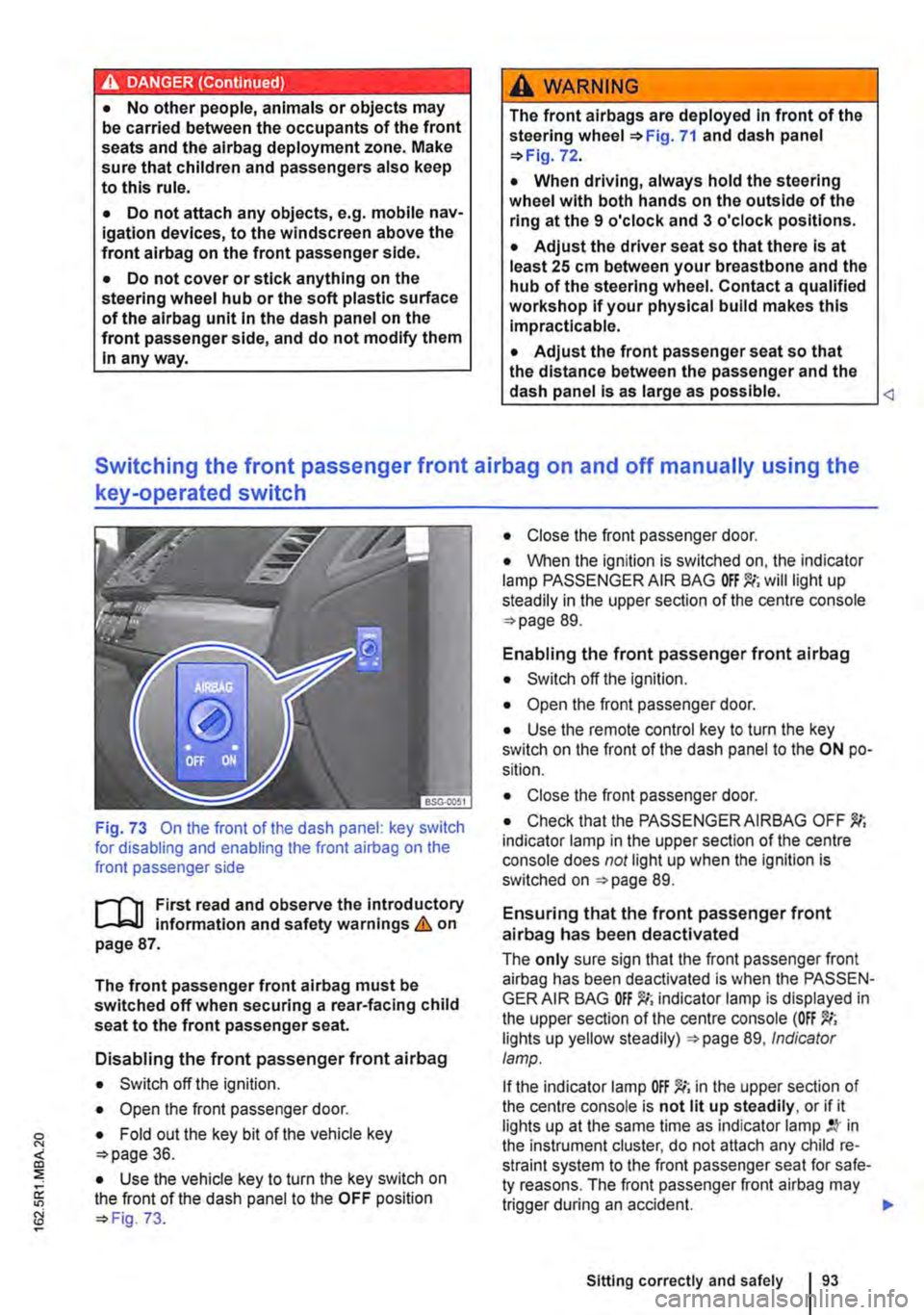
Fig. 73 On the front of the dash panel: key switch for disabling and enabling the front airbag on the front passenger side
l""'rn First read and observe the introductory L-J,::.U information and safety warnings&. on page 87.
The front passenger front airbag must be switched off when securing a rear-facing child seat to the front passenger seat.
Disabling the front passenger front airbag
• Switch off the ignition.
• Open the front passenger door.
• Fold out the key bit of the vehicle key o>page 36.
• Use the vehicle key to turn the key switch on the front of the dash panel to the OFF position o> Fig. 73.
• Close the front passenger door.
• When the ignition is switched on, the indicator lamp PASSENGER AIR BAG will light up steadily in the upper section of the centre console o> page 89.
Enabling the front passenger front airbag
• Switch off the ignition.
• Open the front passenger door.
• Use the remote control key to turn the key switch on the front of the dash panel to the ON po-sition.
• Close the front passenger door.
• Check that the PASSENGER AIRBAG OFF indicator lamp in the upper section of the centre console does not light up when the Ignition is switched on =>page 89.
Ensuring that the front passenger front airbag has been deactivated
The only sure sign that the front passenger front airbag has been deactivated is when the PASSEN-GER AIR BAG indicator lamp is displayed in the upper section of the centre console (OFF lights up yellow steadily) =>page 89, Indicator lamp.
If the indicator lamp OFF )!(; in the upper section of the centre console is not lit up steadily, or if it lights up at the same time as indicator lamp in the instrument cluster, do not attach any child re-straint system to the front passenger seat for safe-ty reasons. The front passenger front airbag may trigger during an accident.
Sitting correctly and safely
Page 95 of 486
A wARNING
Incorrect use of the driver and front passen-ger seat could hinder the proper function of the combined curtain and side airbags and cause serious injury.
• Never remove the front seats from the ve-hicle or alter any components of these seats.
Curtain airbags
A WARNING (Continued)
• If too much pressure is applied to the back rest side bolster, the combined curtain and side airbags may not be triggered cor-rectly, may not trigger at all or may trigger unexpectedly.
• Any damage to the original seat uphols-tery or around the seams of the combined curtain and side airbag units must be re-paired immediately by a qualified workshop.
r-111 First read and observe the introductory l..-W information and safety warnings & on page 87.
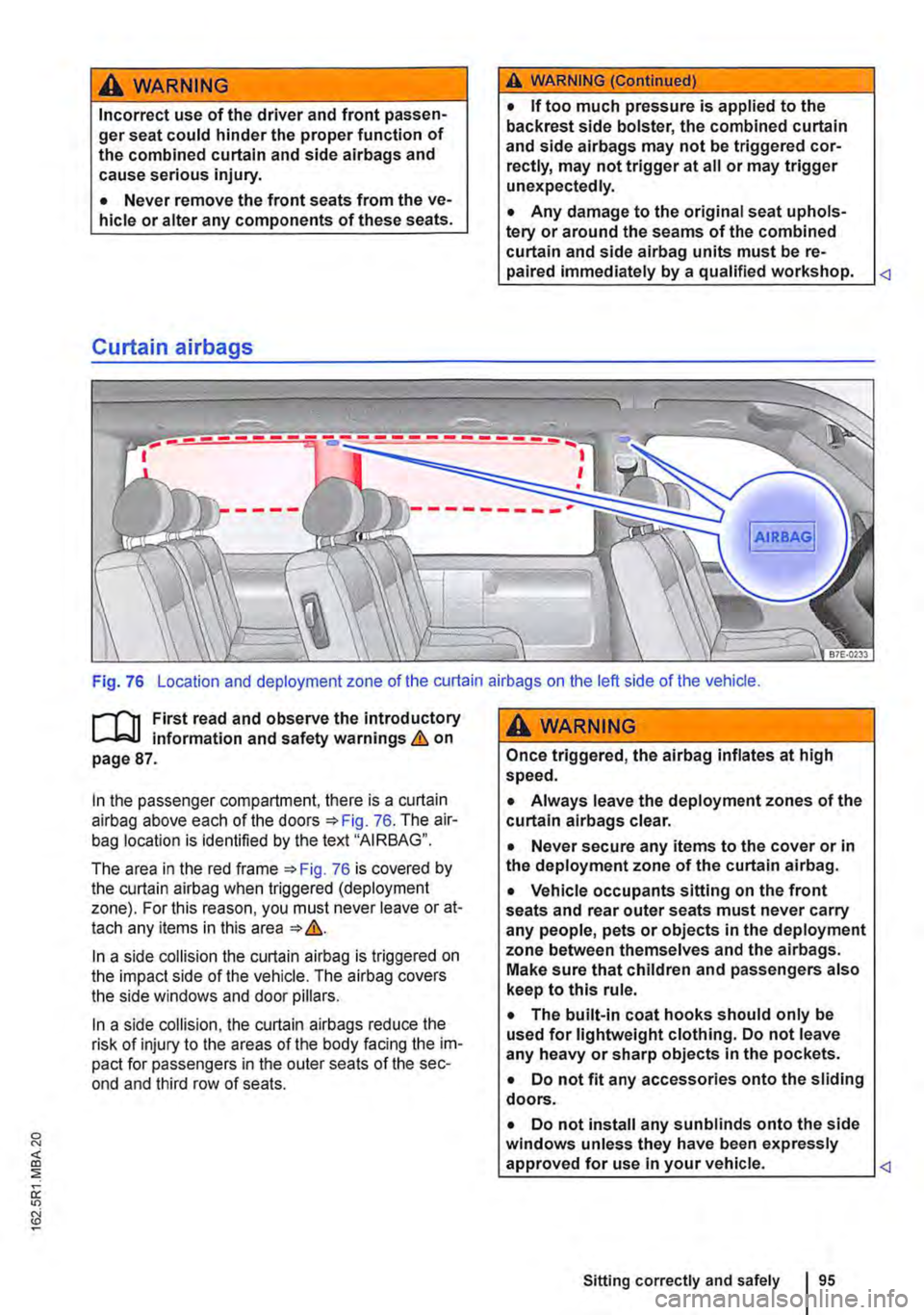
In the passenger compartment, there is a curtain airbag above each of the doors =>Fig. 76. The air-bag location is identified by the text "AIRBAG".
The area in the red frame =>Fig. 76 is covered by the curtain airbag when triggered (deployment zone). For this reason, you must never leave or at-tach any items in this area => &.
In a side collision the curtain airbag is triggered on the impact side of the vehicle. The airbag covers the side windows and door pillars.
In a side collision, the curtain airbags reduce the risk of injury to the areas of the body facing the im-pact for passengers in the outer seats of the sec-ond and third row of seats.
A WARNING
Once triggered, the airbag inflates at high speed.
• Always leave the deployment zones of the curtain alrbags clear.
• Never secure any items to the cover or in the deployment zone of the curtain airbag.
• Vehicle occupants sitting on the front seats and rear outer seats must never carry any people, pets or objects in the deployment zone between themselves and the airbags. Make sure that children and passengers also keep to this rule.
• The built-in coat hooks should only be used for lightweight clothing. Do not leave any heavy or sharp objects in the pockets.
• Do not fit any accessories onto the sliding doors.
• Do not install any sun blinds onto the side windows unless they have been expressly approved for use In your vehicle.
Page 96 of 486
Child seats (accessories)
ClJJ Introduction
This chapter contains information on the following subjects:
Basic information on fitting and using child seats . . . . . . . . . . . . . . . . . . . . . . . . . . . . . . . . . . 97 Types of child seat . . . . . . . . . . . . . . . . . . . . . . . 98 Securing systems . . . . . . . . . . . . . . . . . . . . . . . 99 Securing a child seat with ISOFIX . . . . . . . . . . 100 Securing child seats with the upper strap (top tether) . . . . . . . . . . . . . . . . . . . . . . . . . . . . . . . . . 1 01 Securing child seats with a seat belt . . . . . . . . 102
Using child seats can reduce the risk of Injury to the child if there is an accident. Always use child seats when driving with children.
Note the following:
• Child seats are classified into groups depend-ing on the size, age and weight of child for which they are designed.
• Various securing systems are used to secure child seats in the vehicle.
For safety reasons child seats should always be fit-ted to the rear seats. They should only be fitted to the front passenger seat in exceptional cases.
Volkswagen Commercial Vehicles recommends us-ing child seats from Volkswagen's range of acces-sories. These child seats have been developed and approved for use in Volkswagen vehicles.
Additional information and warnings:
• Seat belts 79
• Airbag system 87
• Integrated child seats 102
A WARNING
If children are not secured or are inadequate-ly secured, they are at greater risk of serious or even fatal injury. Please note the following:
• Children who are either under 12 years of age or less than 150 cm tall must not be car-ried In the vehicle if they are not secured In a suitable child seat while the vehicle Is In mo-tion. Regulations in some countries may dif-fer, and must be complied with.
96 Before the journey
A WARNING (Continued)
• Always secure children in the vehicle in a suitable child seat. The seat used must be ap-propriate to the child's height, weight and age.
• Never fasten more than one child Into one child seat.
• Under no circumstances should children or babies be held in a passenger's or drivers lap while driving.
• Never leave a child unsupervised in a child seat.
• Never allow a child to be carried In a vehi-cle without being properly secured, and nev-er allow a child to stand up or to kneel on a seat, or to sit Incorrectly while the car is In motion. This is particularly Important for chil-dren carried on the front passenger seat. In an accident, children may sustain serious In-juries to themselves and others.
• The child seat can only provide maximum protection if the seat belt Is routed correctly around it. Always ensure that the seat belt is routed as specified In the instructions provi-ded by the child seat manufacturer. If the seat belt is routed Incorrectly it may cause injuries even in a minor accident.
• After an accident, it Is vital to replace any child seats that were in use during the acci-dent, as they could have sustained non-visi· ble damage.
m The standards and regulations governing the l!..J use of child seats and child seat securing mechanisms differ from country to country. Not all countries allow you to transport children on the front passenger seat. Legislation and legal require-ments take precedence over the information given in this owner's manual.
m If a child seat is used on a single seat with l!..J Easy Entry function, the seats located behind that seat are difficult to access. Therefore, a child seat should be used on another rear seat, if possi-ble.
Page 97 of 486
![VOLKSWAGEN TRANSPORTER 2018 Owners Manual Basic information on fitting and using child seats
A AIRBAG
(®
(!]
c:::J
BTT·I20J
Fig. 77 Airbag information sticker on the sun vi-sor.
r""(n First read and observe the introductory L.....J](/img/18/55780/w960_55780-96.png "VOLKSWAGEN TRANSPORTER 2018 Owners Manual Basic information on fitting and using child seats
A AIRBAG
(®
(!]
c:::J
BTT·I20J
Fig. 77 Airbag information sticker on the sun vi-sor.
r\"\"(n First read and observe the introductory L.....J")
Basic information on fitting and using child seats
A AIRBAG
(®
(!]
c:::J
BTT·I20J
Fig. 77 Airbag information sticker on the sun vi-sor.
r""'('n First read and observe the introductory L.....Ja,U information and safety warnings & on page 96.
Information on fitting a child seat
Observe the following general information when fit-ling a child seat. This information is relevant what-ever child seat securing system is being used.
• Read and follow the instructions provided by the child seat manufacturer =:-&.
• Whenever possible, fit child seats to one of the rear seats on the front passenger side so that chil-dren can exit the vehicle on the kerb side.
• Deactivate the front passenger front airbag if fit-ting a rear-facing child seat on the front passenger seat.
• If a child seat is fitted on the front passenger seat, move the backrest to the upright position. slide the seat back as far as it will go, and set the seat height adjustment and belt height adjuster to the highest position.
• When fitting a child seat on the vehicle's rear seats, leave as much unencumbered space as possible around the child seat. If necessary, adjust the position of the relevant front seat. When doing so, ensure that the driver or front passenger can stili maintain a correct sitting position =:-page 61.
• Adjust the seat backrest angle so that the child seat lies flush against the backrest.
• When using child seats with a backrest, remove the vehicle head restraints and stow them safely in the vehicle =:-page 61. Reinstall the head restraint after the child seat has been removed.
Airbag sticker
The vehicle may be provided with stickers giving key information about the front passenger front air-bag. The information on these stickers may vary from country to country. The stickers may be at-tached on the sun visor for the driver and/or front passenger=:-Fig. 77.
11 is essential to note the warning information shown on these stickers before installing a rear-facing child seat =:-&.
Risks involved in carrying children on the front passenger seat
If you are using a rear-facing child seat, the front passenger front airbag can cause critical or poten-tially fatal injuries when it inflates =:-&.
Rear-facing child seat may only be used on the front passenger seat if the front passenger front airbag has been deactivated. An indicator lamp in the centre console lights up steadily when the front passenger front airbag has been effectively deacti-vated. Deactivating the front passenger front air-bag =:-page 87.
If using a front-facing child seat, do not deacti-vate the front passenger front airbag.
When fitting a child seat, make sure that it is as far away as possible from the front passenger airbag. The front passenger front airbag can cause severe injuries when it inflates =:-&.
Some child seats are not suitable for use on the front passenger seat. Any child seat fitted on the front passenger seat must be specially authorised by the manufacturer for this use in vehicles with front and side airbags. Volkswagen dealers hips keep an up-to-date list of authorised child seats.
Risks presented by side airbags
Any child on the front passenger seat may be hit on the head and severely injured by the front side airbag inflating =:-&.
If you use a rear-facing child seat on the front passenger seat the child in it is at increased risk of sustaining critical or fatal injuries In the event of an accident.
• Deactivate the front passenger front air-bag. If the front passenger front airbag can-not be deactivated no rear-facing child seat may be used. 11>
Sitting correctly and safely
Page 99 of 486
Not every child will fit in the child seat specified for their weight group. Likewise, not every seat will fit in every vehicle. Therefore it is vital to check that the child fits properly in their child seat and that the child seat can be securely fastened in the vehicle.
Child seat approval categories
Child seats can be classified as universal, semi-universal or vehicle-specific (all in accordance with regulation ECE-R 44), or as i-Size (in accordance with regulation ECE-R 129).
• Universal: child seats with universal approval are approved for use in all vehicles. No type list is required. ISOFIX child seats with universal appro-val must also be securing using a strap over the top of the vehicle seat (top tether).
• Semi-universal: semi-universal approval re-quires other safety devices for attaching the seat (that require additional testing) in addition to the
Securing systems
1""111 First read and observe the introductory L-J,::.U information and safety warnings & on page 96.
Different countries use different securing systems for safely fitting child seats in the vehicle.
Key terms for securing systems
• ISO FIX: ISOFIX is a standardised securing sys-tem for fitting child seats in the vehicle quickly and safely. The SOFIX attachment system creates a rigid connection between the child seat and the car body.
Any compatible child seat has two rigid attachment arms that click into ISOFIX attachment points at the bottom of the backrest. The ISOFIX securing system as described here is specific to the EU =:o page 100. An upper strap (top tether) and/or support leg may sometimes have to be used in ad-dition to the ISO FIX anchor points described above.
• Three-point automatic seat belt. lt is better to secure child seats using the ISOFIX system, if available, rather than with a three-point automatic seat belt =>page 102.
standard requirements for universal approval. Child seats with semi-universal approval come with a type list. The seats should only be used in vehi-cles that are included on this list.
• Vehicle-specific: child seats with vehicle spe-cific approval must have undergone dynamic test-ing in each model of vehicle for which it is ap-proved. These child seats also come with a type list.
• i-Size: child seats classified as must conform to the installation and safety requirements prescribed in regulation ECE-R 129. Contact the child seat manufacturer to find out which child seats are ap-proved for this vehicle in accordance with i-Size. <1
Additional securing points:
• Top tether: this strap at the top of the child seat is routed over the vehicle seat backrest and hooked to an anchor ring on the seat backs =:.page 101.
• Support leg: some child seats are propped up with a support leg resting on the floor of the vehi-cle. This support leg helps to prevent the child seat from tipping forward in a crash =:.&.
Recommended child seat securing systems
Volkswagen Commercial Vehicles recommends that child seats are secured as follows:
• Infant carrier or rear-facing child seat: ISO-FIX and support leg.
• Front-facing child seat: ISOFIX and top tether and possibly support leg also.
A WARNING
Incorrect use of the support leg can cause severe or fatal injuries.
• Make sure that the support leg is always correctly and safely Installed.
Sitting correctly and safely 99
Page 100 of 486
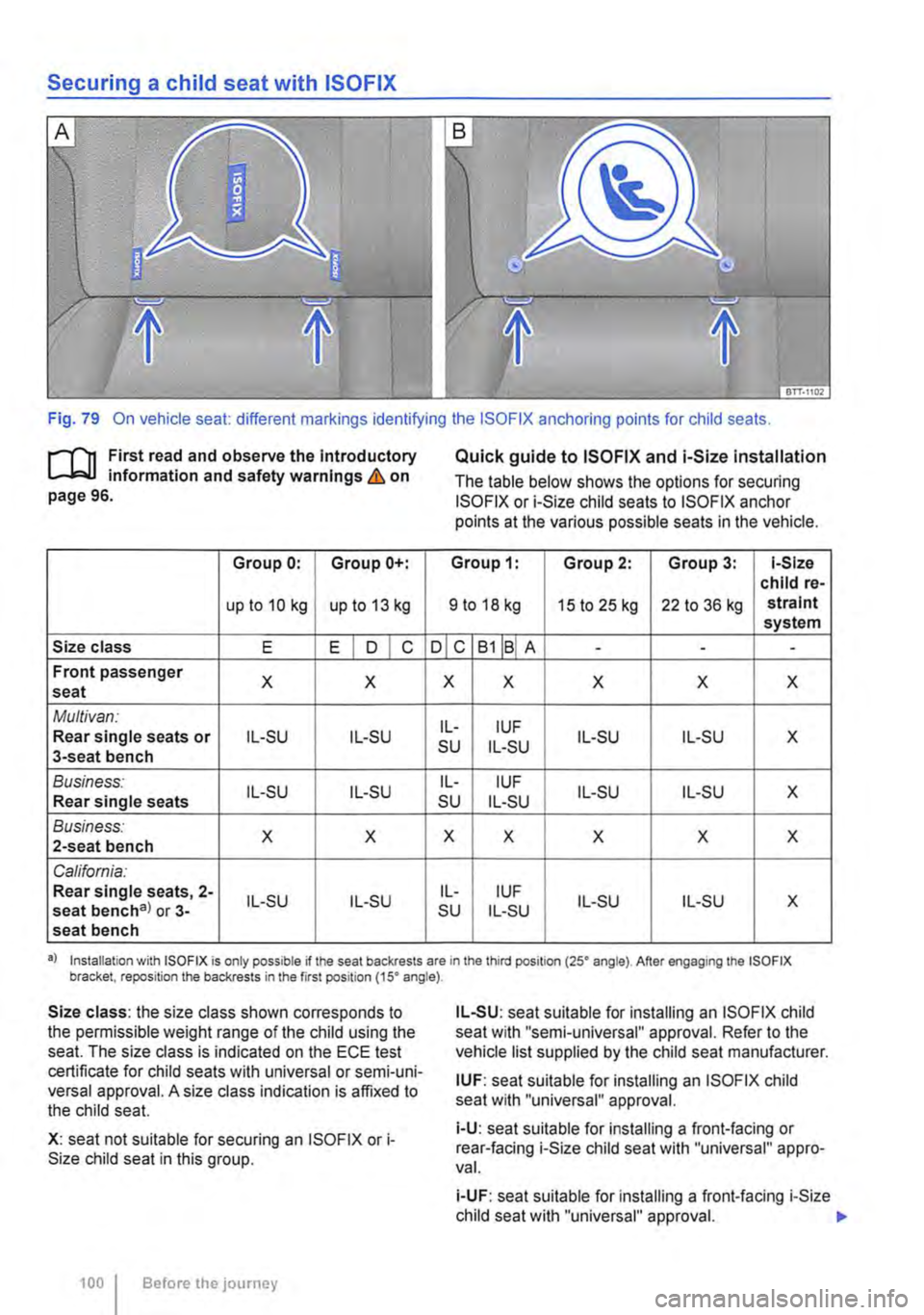
Fig. 79 On vehicle seat: different markings identifying the ISOFIX anchoring points for child seats.
1"'1'11 First read and observe the Introductory l..-J,::,IJ information and safety warnings & on page 96.
Group 0: Group 0+:
upto10kg up to 13 kg
Size class E EIDIC
Front passenger X X seat
Multivan: Rear single seats or IL-SU IL-SU 3-seat bench
Business: IL-SU IL-SU Rear single seats
Business: X X 2-seat bench
California: Rear single seats, 2-IL-SU IL-SU seat bencha> or 3-seat bench
Quick guide to ISO FIX and i-Size installation
The table below shows the options for securing ISO FIX or i-Size child seats to ISOFIX anchor points at the various possible seats in the vehicle.
Group 1: Group 2: Group 3: 1-Size child re-
9 to 18 kg 15 to 25 kg 22 to 36 kg strain! system
ojc B1jBI A ---
X X X X X
IL-IUF su IL-SU IL-SU IL-SU X
IL-IUF IL-SU IL-SU X su IL-SU
X X X X X
IL-IUF IL-SU IL-SU X su IL-SU
•> Installation with ISOFIX is only possible if the seat backrests are in the third position (25' angle). After engaging the ISOFIX bracket, reposition the backrests in the first position (15' angle).
Size class: the size class shown corresponds to the permissible weight range of the child using the seat. The size class is indicated on the ECE test certificate for child seats with universal or semi-uni-versal approval. A size class indication is affixed to the child seat.
X: seat not suitable for securing an ISOFIX or i-Size child seat in this group.
100 I Before the journey
IL-SU: seat suitable for installing an ISOFIX child seat with "semi-universal" approval. Refer to the vehicle list supplied by the child seat manufacturer.
IUF: seat suitable for installing an ISOFIX child seat with "universal" approval.
i-U: seat suitable for installing a front-facing or rear-facing i-Size child seat with "universal" appro-val.
i-UF: seat suitable for installing a front-facing i-Size child seat with "universal" approval.
Page 101 of 486
Installing child seats with ISOFIX ISOFIX/i-
Size
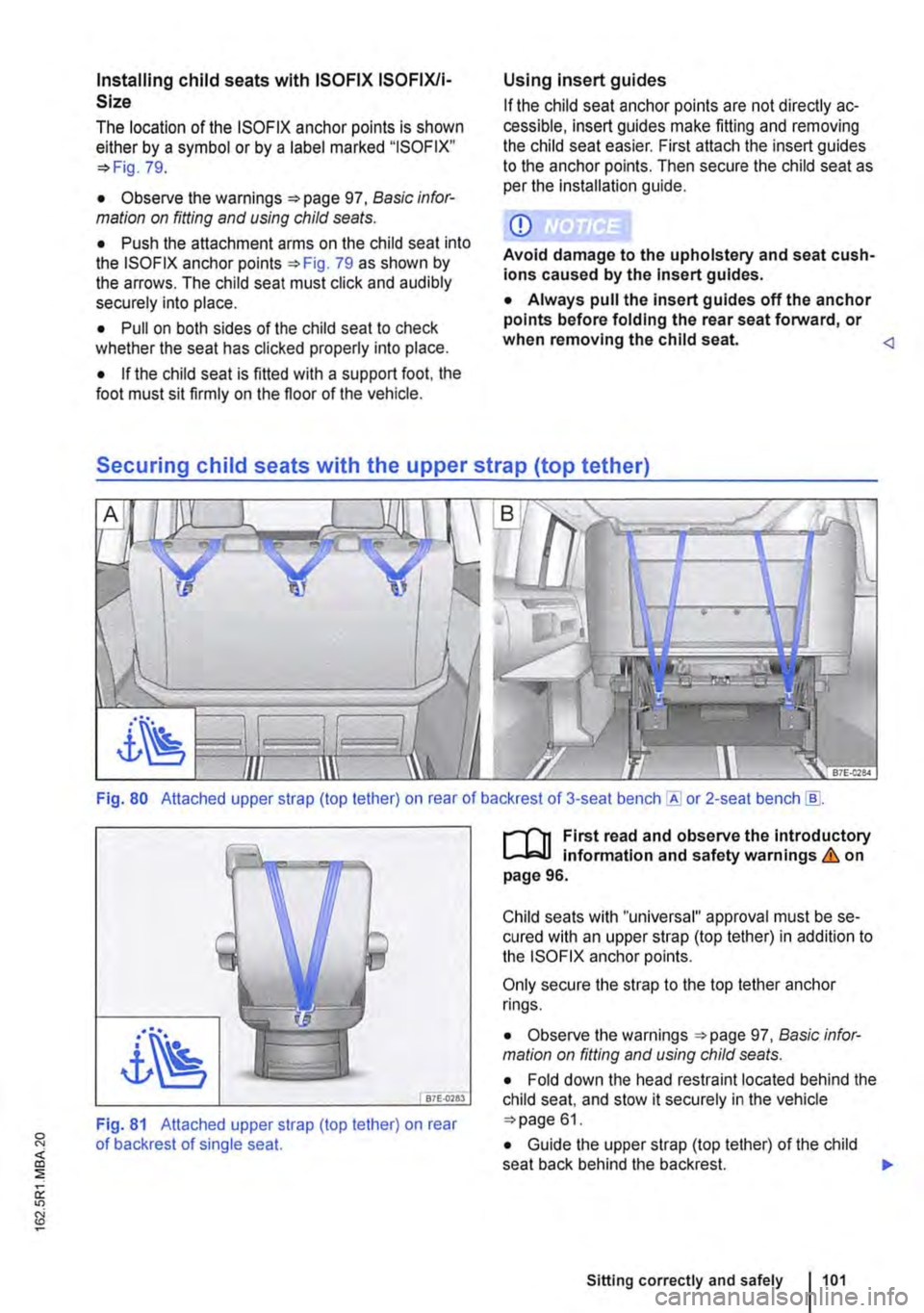
The location of the ISO FIX anchor points is shown either by a symbol or by a label marked "ISOFIX" 79.
• Observe the warnings 97, Basic infor-mation on fitting and using child seats.
• Push the attachment arms on the child seat into the ISOFIX anchor points 79 as shown by the arrows. The child seat must click and audibly securely into place.
• Pull on both sides of the child seat to check whether the seat has clicked properly into place.
• If the child seat is fitted with a support foot, the foot must sit firmly on the floor of the vehicle.
Using insert guides
If the child seat anchor points are not directly ac-cessible, insert guides make fitting and removing the child seat easier. First attach the insert guides to the anchor points. Then secure the child seat as per the installation guide.
CD
Avoid damage to the upholstery and seat cush-ions caused by the Insert guides.
• Always pull the insert guides off the anchor points before folding the rear seat forward, or when removing the child seat.
Fig. 80 Attached upper strap (top tether) on rear of backrest of 3-seat or 2-seat bench [ID.
87E-0783
Fig. 81 Attached upper strap (top tether) on rear of backrest of single seat.
r-1'11 First read and observe the Introductory L-lcJ.I Information and safety warnings & on page 96.
Child seats with "universal" approval must be se-cured with an upper strap (top tether) in addition to the ISOFIX anchor points.
Only secure the strap to the top tether anchor rings.
• Observe the warnings 97, Basic infor-mation on fitting and using child seats.
• Fold down the head restraint located behind the child seat, and stow it securely in the vehicle 61.
• Guide the upper strap (top tether) of the child seat back behind the backrest. )I>
Sitting correctly and safely 1101
Page 102 of 486
• Push the attachment arms on the child seat into the ISOFIX anchor points 79 as shown by the arrows. The child seat must click and audibly securely into place.
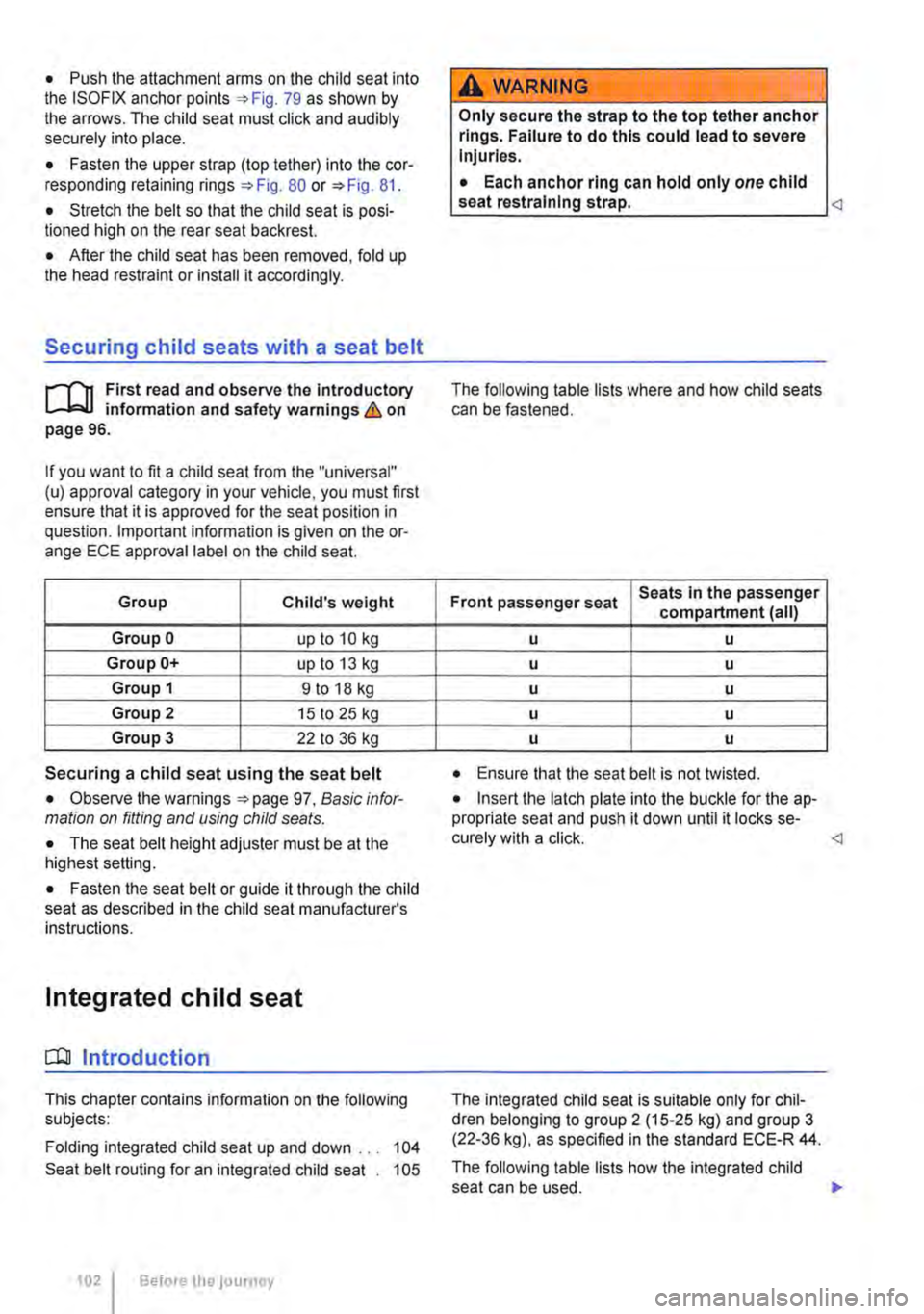
• Fasten the upper strap (top tether) into the cor-responding retaining rings 80 or 81.
• Stretch the belt so that the child seat is posi-tioned high on the rear seat backrest.
• After the child seat has been removed, fold up the head restraint or install it accordingly.
Securing child seats with a seat belt
r-111 First read and observe the Introductory L--lo:oU information and safety warnings & on page 96.
If you want to fit a child seat from the "universal" (u) approval category in your vehicle. you must first ensure that it is approved for the seat position in question. Important information is given on the or-ange ECE approval label on the child seat.
Group Child's weight
Group 0 up to 10 kg
Group 0+ up to 13 kg
Group 1 9 to 18 kg
Group 2 15 to 25 kg
Group 3 22 to 36 kg
Securing a child seat using the seat belt
• Observe the warnings 97, Basic infor-mation on fitting and using child seals.
• The seat belt height adjuster must be at the highest setting.
• Fasten the seat belt or guide it through the child seat as described in the child seat manufacturer's instructions.
Integrated child seat
o::n Introduction
This chapter contains information on the following subjects:
Folding integrated child seat up and down ... 104
Seat belt routing for an integrated child seat . 105
102 Before the journey
A WARNING
Only secure the strap to the top tether anchor rings. Failure to do this could lead to severe Injuries.
• Each anchor ring can hold only one child seat restraining strap.
Front passenger seat Seats In the passenger compartment (all)
u u
u u
u u
u u
u u
• Ensure that the seat belt is not twisted.
• Insert the latch plate into the buckle for the ap-propriate seat and push it down until it locks se-curely with a click.
The following table lists how the integrated child seat can be used. .,..
Page 103 of 486
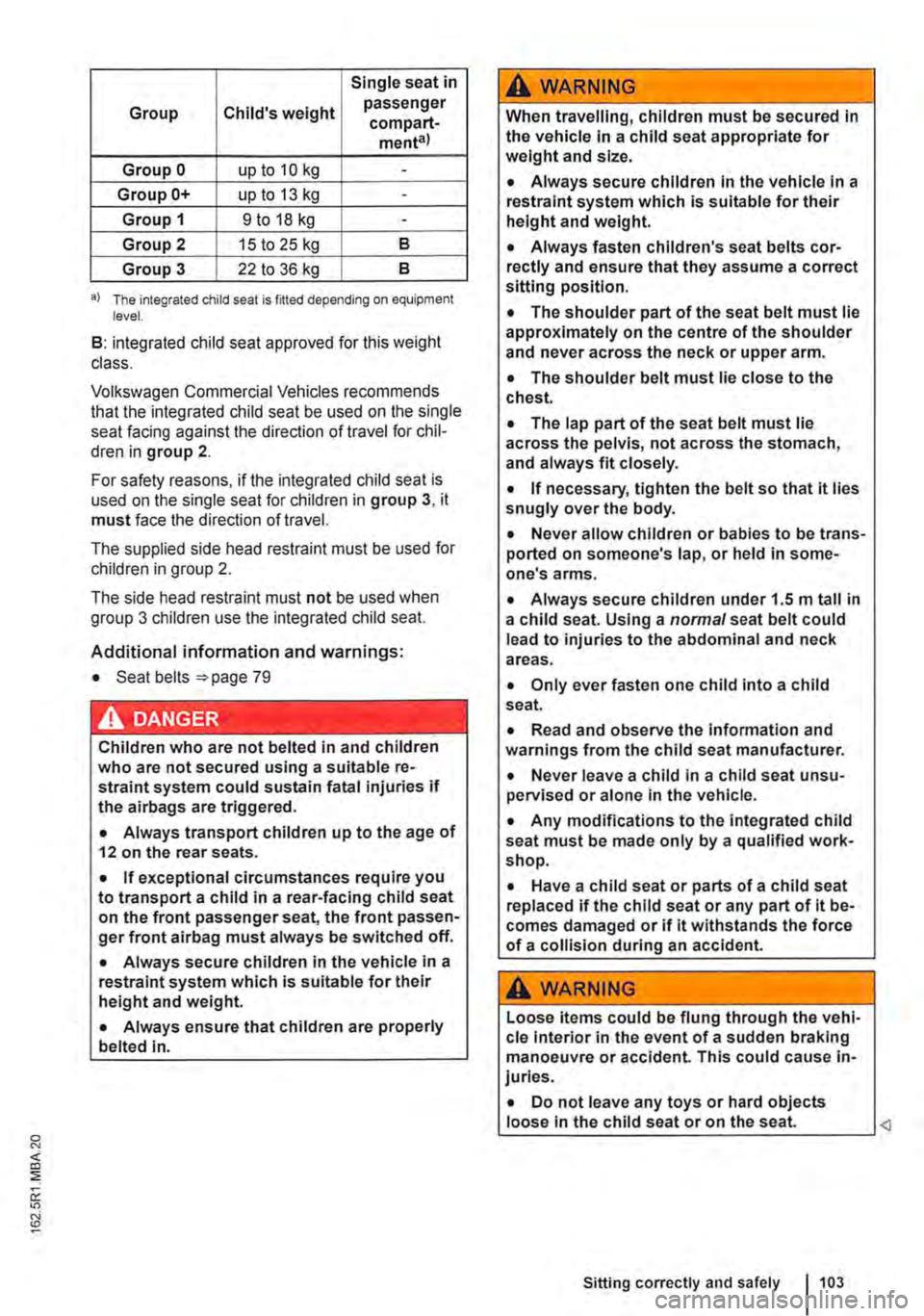
Single seat in
Group Child's weight passenger compart-menta)
Group 0 up to 10 kg -
Group 0+ up to 13 kg -
Group 1 9 to 18 kg -
Group 2 15 to 25 kg 8
Group 3 22 to 36 kg 8
a) The integrated child seat is fijted depending on equipment level.
8: integrated child seat approved for this weight class.
Volkswagen Commercial Vehicles recommends that the integrated child seat be used on the single seat facing against the direction of travel for chil-dren in group 2.
For safety reasons, if the integrated child seat is used on the single seat for children in group 3, it must face the direction of travel.
The supplied side head restraint must be used for children in group 2.
The side head restraint must not be used when group 3 children use the integrated child seat.
Additional information and warnings:
• Seat belts =:. page 79
Children who are not belted in and children who are not secured using a suitable re-straint system could sustain fatal injuries if the airbags are triggered.
• Always transport children up to the age of 12 on the rear seats.
• If exceptional circumstances require you to transport a child in a rear-facing child seat on the front passenger seat, the front passen-ger front airbag must always be switched off.
• Always secure children in the vehicle in a restraint system which is suitable for their height and weight.
• Always ensure that children are properly belted In.
A WARNING
When travelling, children must be secured In the vehicle In a child seat appropriate for weight and size.
• Always secure children In the vehicle in a restraint system which is suitable for their height and weight.
• Always fasten children's seat belts cor-rectly and ensure that they assume a correct sitting position.
• The shoulder part of the seat belt must lie approximately on the centre of the shoulder and never across the neck or upper arm.
• The shoulder belt must lie close to the chest.
• The lap part of the seat belt must lie across the pelvis, not across the stomach, and always fit closely.
• If necessary, tighten the belt so that it lies snugly over the body.
• Never allow children or babies to be trans-ported on someone's lap, or held In some-one's arms.
• Always secure children under 1.5 m tall in a child seat. Using a normal seat belt could lead to injuries to the abdominal and neck areas.
• Only ever fasten one child into a child seat.
• Read and observe the information and warnings from the child seat manufacturer.
• Never leave a child in a child seat unsu-pervised or alone In the vehicle.
• Any modifications to the integrated child seat must be made only by a qualified work-shop.
• Have a child seat or parts of a child seat replaced if the child seat or any part of it be-comes damaged or if it withstands the force of a collision during an accident.
A WARNING
Loose items could be flung through the vehi-cle interior in the event of a sudden braking manoeuvre or accident. This could cause in-juries.
• Do not leave any toys or hard objects loose in the child seat or on the seat. <1
Sitting correctly and safely 103