change wheel VOLKSWAGEN TRANSPORTER 2018 Owner's Manual
[x] Cancel search | Manufacturer: VOLKSWAGEN, Model Year: 2018, Model line: TRANSPORTER, Model: VOLKSWAGEN TRANSPORTER 2018Pages: 486, PDF Size: 69.28 MB
Page 298 of 486
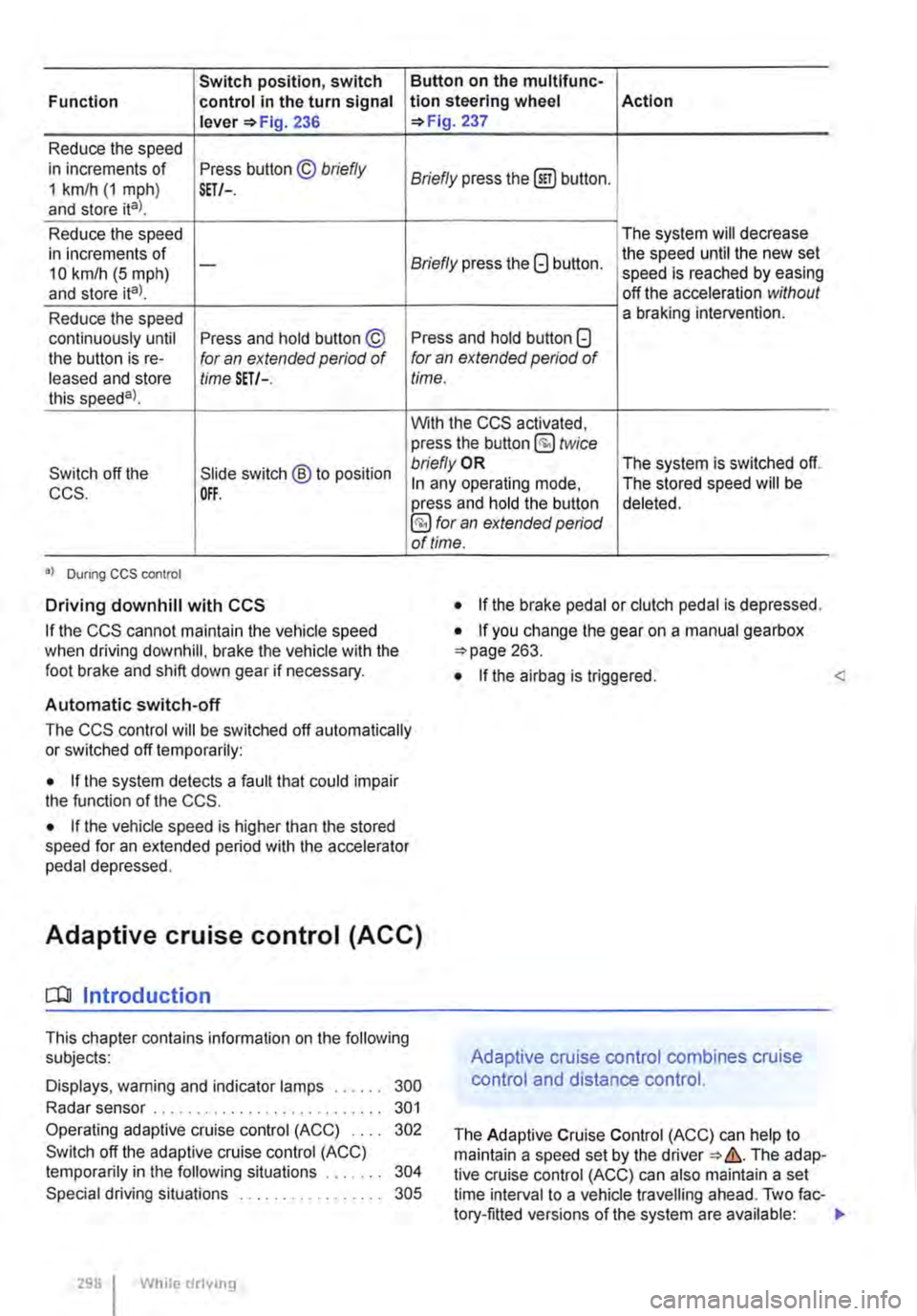
Switch position, switch Function control in the turn signal lever 236
Reduce the speed in increments of Press button © briefly 1 km/h (1 mph) and store ital. SET/-.
Reduce the speed in increments of 10 km/h (5 mph) -
and store ita).
Reduce the speed continuously until Press and hold button © the button is re-for an extended period of leased and store time SET/-. this speeda)_
Switch off the Slide switch ® to position CCS. OFF.
•I Dunng CCS control
Driving downhill with CCS
If the CCS cannot maintain the vehicle speed when driving downhill, brake the vehicle with the foot brake and shift down gear if necessary.
Automatic switch-off
Button on the multlfunc-tion steering wheel Action 237
Briefly press the (ili) button.
The system will decrease
Briefly press the G button. the speed until the new set speed is reached by easing off the acceleration without a braking intervention.
Press and hold button G for an extended period of time.
With the CCS activated, press the button @ twice bn'eflyOR The system is switched off. In any operating mode, The stored speed will be press and hold the button deleted. §) for an extended period of time.
• If the brake pedal or clutch pedal is depressed.
• If you change the gear on a manual gearbox 263.
• If the airbag is triggered. <
The CCS control will be switched off automatically or switched off temporarily:
• If the system detects a fault that could impair the function of the CCS.
• If the vehicle speed is higher than the stored speed for an extended period with the accelerator pedal depressed.
Adaptive cruise control (ACC)
dJ Introduction
This chapter contains information on the following subjects:
Displays, warning and indicator lamps . . . . . . 300
Radar sensor . . . . . . . . . . . . . . . . . . . . . . . . . . . 301
Operating adaptive cruise control (ACC) 302
Switch off the adaptive cruise control (ACC) temporarily in the following situations . . . . . 304
Special driving situations . . . . . . . . . . . . 305
298 I While drivmg
Adaptive cruise control combines cruise
control and distance control.
The Adaptive Cruise Control (ACC) can help to maintain a speed set by the The adap-tive cruise control (ACC) can also maintain a set time interval to a vehicle travelling ahead. Two fac-tory-fitted versions of the system are available: .,
Page 306 of 486
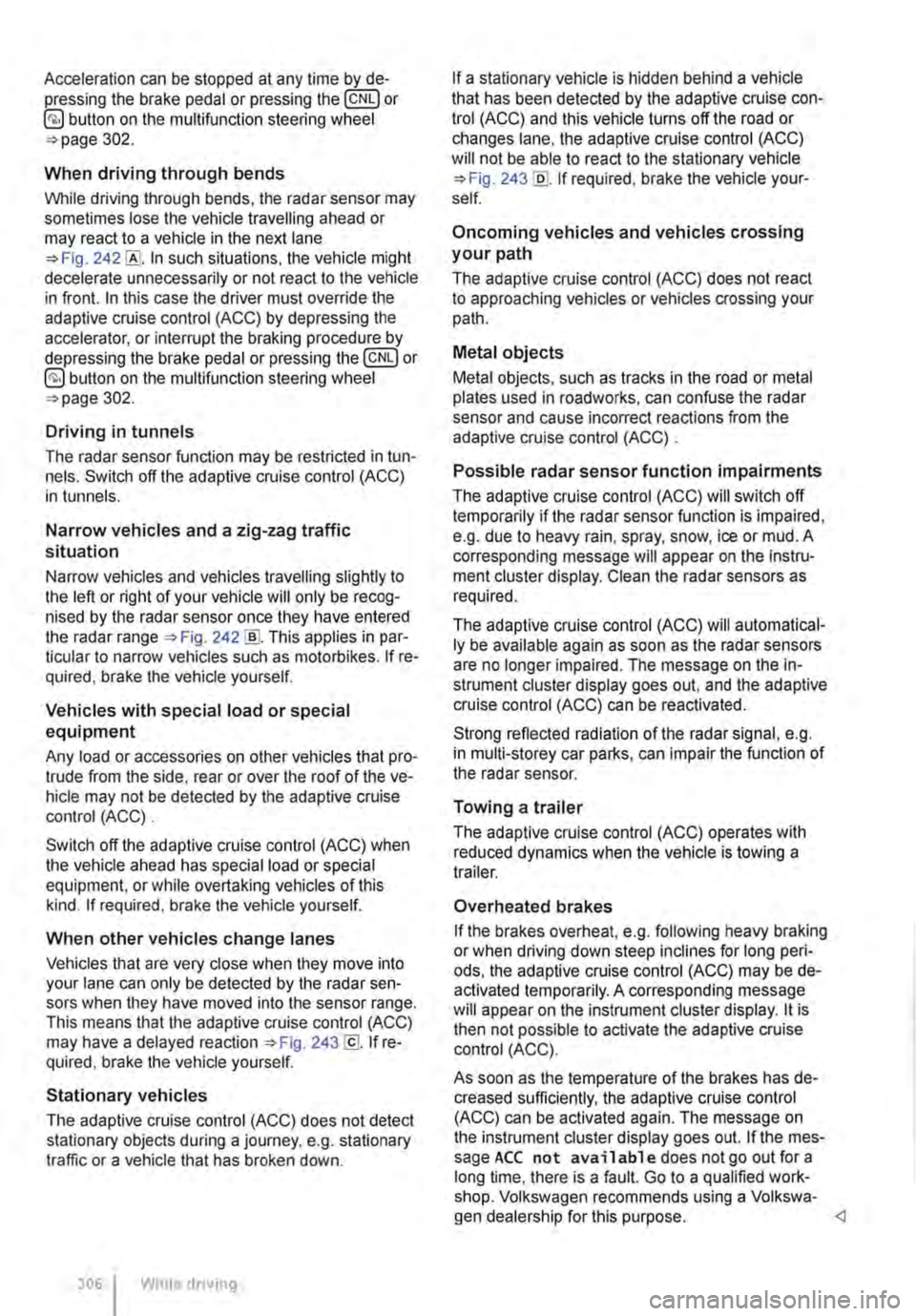
Acceleration can be stopped at any time by de-pressing the brake pedal or pressing the(@ or @ button on the multifunction steering wheel 302.
When driving through bends
While driving through bends, the radar sensor may sometimes lose the vehicle travelling ahead or may react to a vehicle in the next lane 242 !Al. In such situations, the vehicle might decelerate unnecessarily or not react to the vehicle in front. In this case the driver must override the adaptive cruise control (ACC) by depressing the accelerator, or interrupt the braking procedure by depressing the brake pedal or pressing or @ button on the multifunction steering wheel 302.
Driving in tunnels
The radar sensor function may be restricted in tun-nels. Switch off the adaptive cruise control (ACC) in tunnels.
Narrow vehicles and a zig-zag traffic situation
Narrow vehicles and vehicles travelling slightly to the left or right of your vehicle will only be recog-nised by the radar sensor once they have entered the radar range 242@ This applies in par-ticular to narrow vehicles such as motorbikes. If re-quired, brake the vehicle yourself.
Vehicles with special load or special equipment
Any load or accessories on other vehicles that pro-trude from the side, rear or over the roof of the ve-hicle may not be detected by the adaptive cruise control (ACC) .
Switch off the adaptive cruise control (ACC) when the vehicle ahead has special load or special equipment, or while overtaking vehicles of this kind. If required. brake the vehicle yourself.
When other vehicles change lanes
Vehicles that are very close when they move into your lane can only be detected by the radar sen-sors when they have moved into the sensor range. This means that the adaptive cruise control (ACC) may have a delayed reaction =>Fig. 243@]. If re-quired, brake the vehicle yourself.
Stationary vehicles
The adaptive cruise control (ACC) does not detect stationary objects during a journey, e.g. stationary traffic or a vehicle that has broken down.
306 I While driving
If a stationary vehicle is hidden behind a vehicle that has been detected by the adaptive cruise con-trol (ACC) and this vehicle turns off the road or changes lane, the adaptive cruise control (ACC) will not be able to react to the stationary vehicle 243 [Q]. If required, brake the vehicle your-self.
Oncoming vehicles and vehicles crossing your path
The adaptive cruise control (ACC) does not react to approaching vehicles or vehicles crossing your path.
Metal objects
Metal objects, such as tracks in the road or metal plates used in roadworks, can confuse the radar sensor and cause incorrect reactions from the adaptive cruise control (ACC) .
Possible radar sensor function impairments
The adaptive cruise control (ACC) will switch off temporarily if the radar sensor function is impaired, e.g. due to heavy rain, spray, snow, ice or mud. A corresponding message will appear on the instru-ment cluster display. Clean the radar sensors as required.
The adaptive cruise control (ACC) will automatical-ly be available again as soon as the radar sensors are no longer impaired. The message on the in-strument cluster display goes out, and the adaptive cruise control (ACC) can be reactivated.
Strong reflected radiation of the radar signal, e.g. in multi-storey car parks, can impair the function of the radar sensor.
Towing a trailer
The adaptive cruise control (ACC) operates with reduced dynamics when the vehicle is towing a trailer.
Overheated brakes
If the brakes overheat, e.g. following heavy braking or when driving down steep inclines for long peri-ods, the adaptive cruise control (ACC) may be de-activated temporarily. A corresponding message will appear on the instrument cluster display. lt is then not possible to activate the adaptive cruise control (ACC).
As soon as the temperature of the brakes has de-creased sufficiently, the adaptive cruise control (ACC) can be activated again. The message on the instrument cluster display goes out. If the mes-sage ACC not ava i 1 able does not go out for a long time, there is a fault. Go to a qualified work-shop. Volkswagen recommends using a Volkswa-gen dealership for this purpose.
Page 312 of 486
System limits
r-('n First read and observe the Introductory L-J,:.U Information and safety warnings & on page 307.
The area monitoring system (Front Assist) has physical and system-related limits. The driver may therefore feel that, in certain circumstances, some Front Assist reactions occur unexpectedly or with a delay. You should therefore always be prepared to take full control of the vehicle if necessary.
The following conditions can prevent Front Assist from reacting, or cause a delay in its reaction:
• In tight bends.
• If the accelerator is fully depressed.
• If Front Assist is switched off or there is a fault.
• If TCS or ESC is switched off manually.
• If the ESC is taking corrective action.
• If there is a fault in several brake lights on the vehicle or on a trailer with an electrical connection to the vehicle.
• If the radar sensor is dirty or covered.
• If the vehicle is reversing.
• Under hard acceleration.
• In snow or heavy rain.
• In case of narrow vehicles, e.g. motorbikes.
• If vehicles are travelling slightly to the left or right of your vehicle.
• If vehicles are crossing in front of your vehicle.
• If there is oncoming traffic.
• In uncertain traffic situations.
• 1/Vhen loads or attachment parts on other vehi-cles protrude to the side, rear or above the normal dimensions of the vehicle.
COJ Introduction
This chapter contains information on the following subjects:
Indicator lamp ... .
Operation ....... .
Driving situations ..........•.............
313
314
315
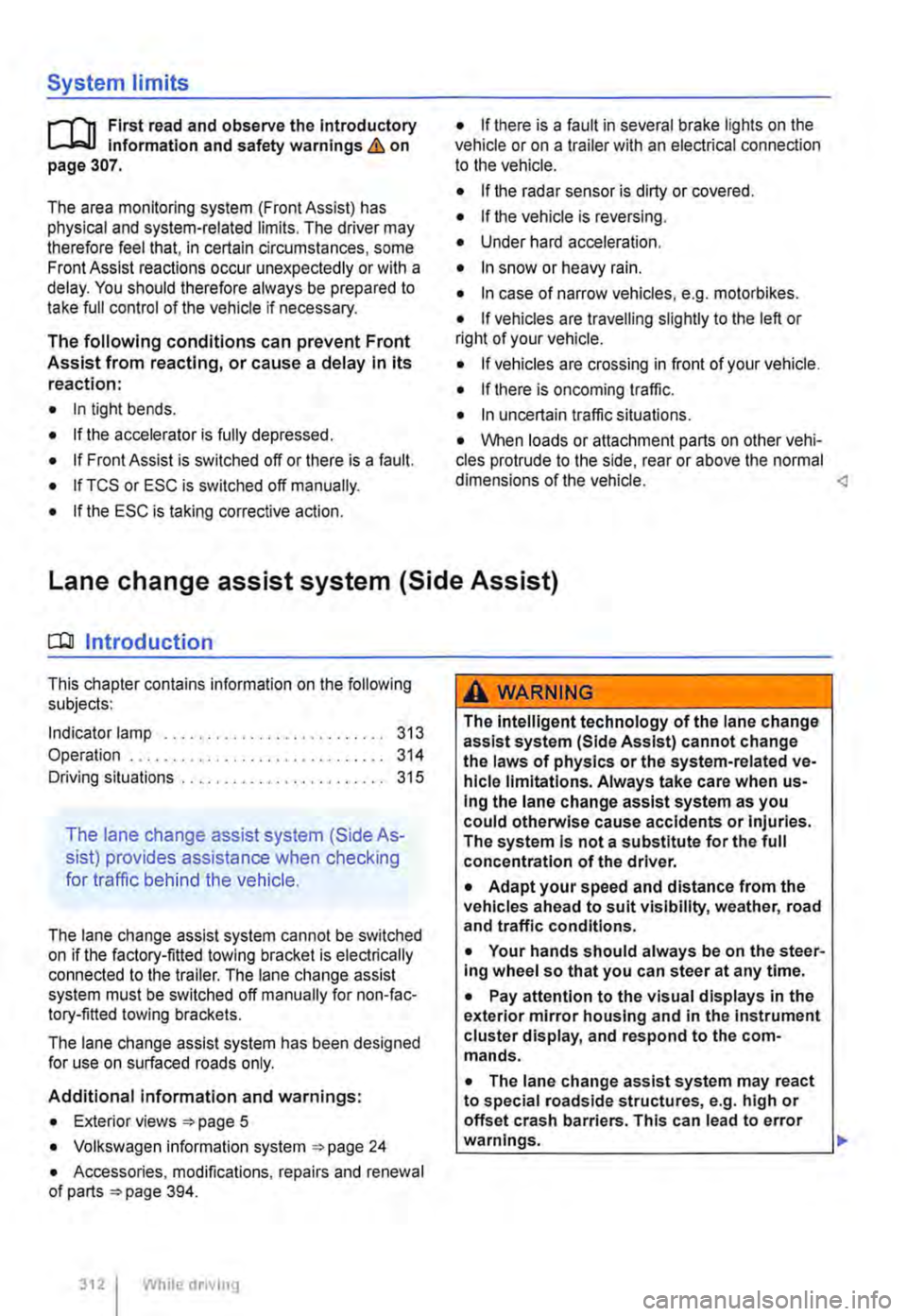
The lane change assist system (Side As-
sist) provides assistance when checking
for traffic behind the vehicle.
The lane change assist system cannot be switched on if the factory-fitted towing bracket is electrically connected to the trailer. The lane change assist system must be switched off manually for non-fac-tory-fitted towing brackets.
The lane change assist system has been designed for use on surfaced roads only.
Additional information and warnings:
• Exterior views =<>page 5
• Volkswagen information system =<>page 24
• Accessories, modifications, repairs and renewal of parts =<>page 394.
3121 While drivmg
A WARNING
The Intelligent technology of the lane change assist system (Side Assist) cannot change the laws of physics or the system-related ve-hicle limitations. Always take care when us-Ing the lane change assist system as you could otherwise cause accidents or Injuries. The system Is not a substitute for the full concentration of the driver.
• Adapt your speed and distance from the vehicles ahead to suit visibility, weather, road and traffic conditions.
• Your hands should always be on the steer-Ing wheel so that you can steer at any time.
• Pay attention to the visual displays in the exterior mirror housing and in the Instrument cluster display, and respond to the com-mands.
• The lane change assist system may react to special roadside structures, e.g. high or offset crash barriers. This can lead to error warnings. ,..
Page 320 of 486
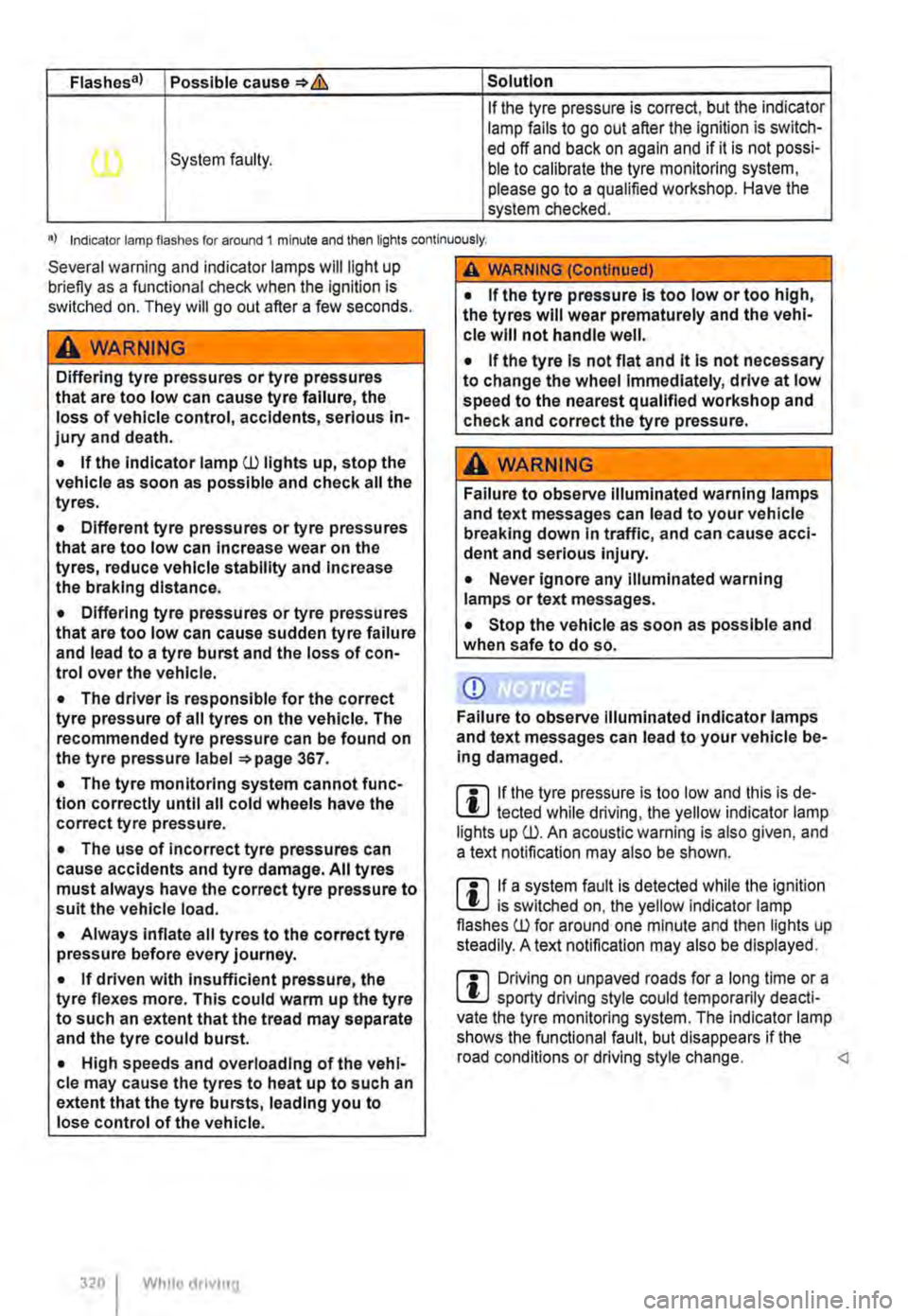
Flashes a) Possible cause*& Solution
If the tyre pressure is correct, but the indicator lamp fails to go out after the ignilion is switch-
(l) System faulty. ed off and back on again and if it is not possi-ble to calibrate the tyre monitoring system, please go to a qualified workshop. Have the system checked.
•I Indicator lamp flashes for around 1 minute and then lights continuously.
Several warning and indicator lamps will light up briefly as a functional check when the lgnilion is switched on. They will go out after a few seconds.
A WARNING
Differing tyre pressures or tyre pressures that are too low can cause tyre failure, the loss of vehicle control, accidents, serious in-jury and death.
• If the Indicator lamp (l) lights up, stop the vehicle as soon as possible and check all the tyres.
• Different tyre pressures or tyre pressures that are too low can Increase wear on the tyres, reduce vehicle stability and Increase the braking distance.
• Differing tyre pressures or tyre pressures that are too low can cause sudden tyre failure and lead to a tyre burst and the loss of con-trol over the vehicle.
• The driver Is responsible for the correct tyre pressure of all tyres on the vehicle. The recommended tyre pressure can be found on the tyre pressure label 367.
• The tyre monitoring system cannot func-tion correctly until all cold wheels have the correct tyre pressure.
• The use of Incorrect tyre pressures can cause accidents and tyre damage. All tyres must always have the correct tyre pressure to suit the vehicle load.
• Always Inflate all tyres to the correct tyre pressure before every journey.
• If driven with Insufficient pressure, the tyre flexes more. This could warm up the tyre to such an extent that the tread may separate and the tyre could burst.
• High speeds and overloading of the vehi-cle may cause the tyres to heat up to such an extent that the tyre bursts, leading you to lose control of the vehicle.
320 I Whllo drivmg
A WARNING (Continued)
• If the tyre pressure Is too low or too high, the tyres will wear prematurely and the vehl-cle will not handle well.
• If the tyre Is not flat and it Is not necessary to change the wheel immediately, drive at low speed to the nearest qualified workshop and check and correct the tyre pressure.
A WARNING
Failure to observe illuminated warning lamps and text messages can lead to your vehicle breaking down In traffic, and can cause acci-dent and serious injury.
• Never ignore any illuminated warning lamps or text messages.
• Stop the vehicle as soon as possible and when safe to do so.
CD
Failure to observe Illuminated Indicator lamps and text messages can lead to your vehicle be-Ing damaged.
m If the tyre pressure is too low and this is de-L!..) tected while driving, the yellow indicator lamp lights up (l). An acoustic warning is also given, and a text notification may also be shown.
m If a system fault is detected while the ignition L!..J is switched on, the yellow Indicator lamp flashes (l) for around one minute and then lights up steadily. A text notification may also be displayed.
m Driving on unpaved roads for a long time or a L!..J sporty driving style could temporarily deacti-vate the tyre monitoring system. The Indicator lamp shows the functional fault, but disappears if the road conditions or driving style change.
Page 321 of 486
Function and control
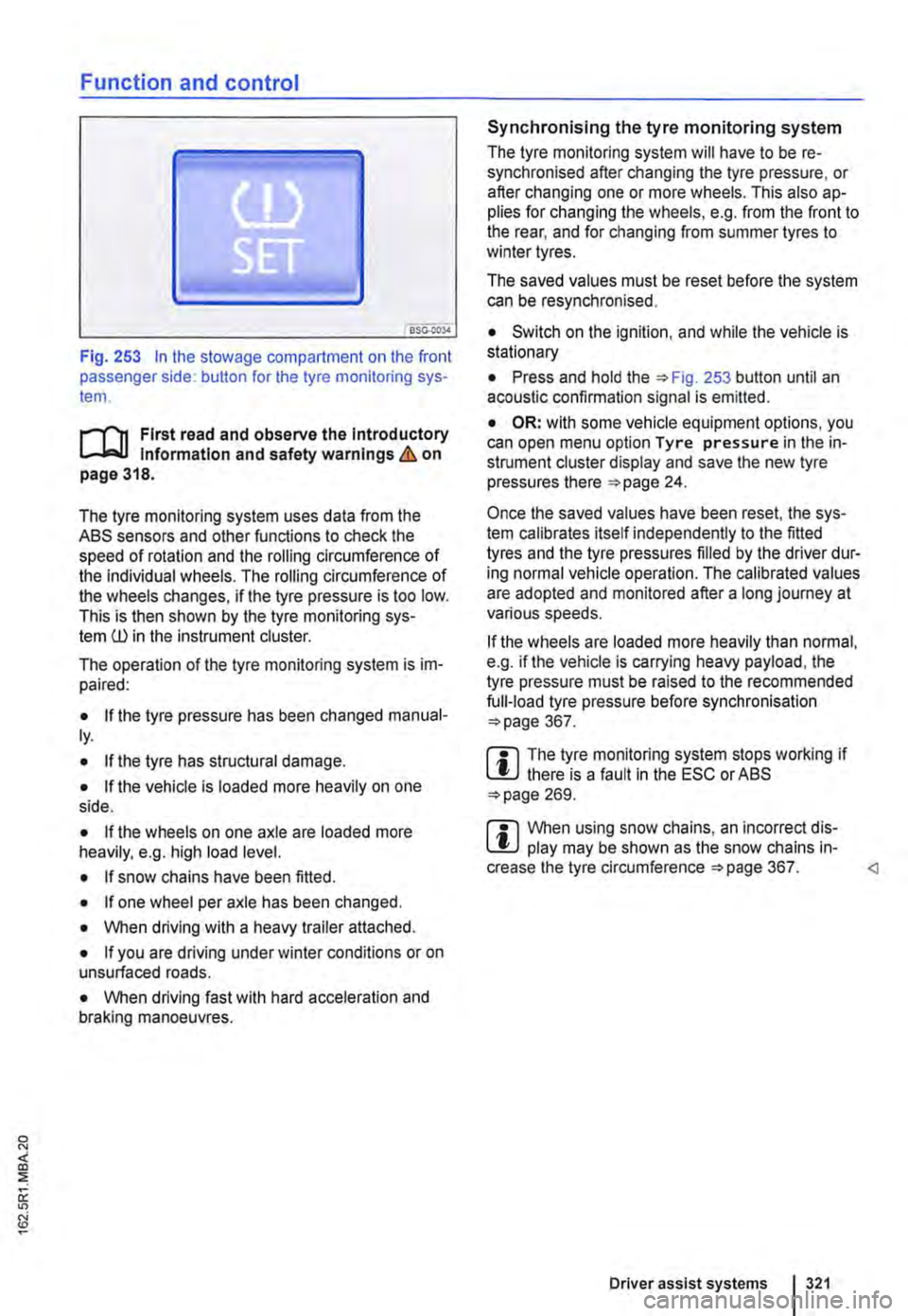
Fig. 253 In the stowage compartment on the front passenger side: button for the tyre monitoring sys-tem.
l"'"""f'n First read and observe the Introductory l.-J,.:,LL Information and safety warnings & on page 318.
The tyre monitoring system uses data from the ASS sensors and other functions to check the speed of rotation and the rolling circumference of the individual wheels. The rolling circumference of the wheels changes, if the tyre pressure is too low. This is then shown by the tyre monitoring sys-tem ill in the instrument cluster.
The operation of the tyre monitoring system is im-paired:
• If the tyre pressure has been changed manual-ly.
• If the tyre has structural damage.
• If the vehicle Is loaded more heavily on one side.
• If the wheels on one axle are loaded more heavily, e.g. high load level.
• If snow chains have been fitted.
• If one wheel per axle has been changed.
• When driving with a heavy trailer attached.
• If you are driving under winter conditions or on unsurfaced roads.
• When driving fast with hard acceleration and braking manoeuvres.
Synchronising the tyre monitoring system
The tyre monitoring system will have to be re-synchronised after changing the tyre pressure, or after changing one or more wheels. This also ap-plies for changing the wheels, e.g. from the front to the rear, and for changing from summer tyres to winter tyres.
The saved values must be reset before the system can be resynchronised.
• Switch on the ignition, and while the vehicle is stationary
• Press and hold the =>Fig. 253 button until an acoustic confirmation signal is emitted.
• OR: with some vehicle equipment options, you can open menu option Tyre pressure in the in-strument cluster display and save the new tyre pressures there =>page 24.
Once the saved values have been reset, the sys-tem calibrates itself independently to the fitted tyres and the tyre pressures filled by the driver dur-ing normal vehicle operation. The calibrated values are adopted and monitored after a long journey at various speeds.
If the wheels are loaded more heavily than normal, e.g. if the vehicle is carrying heavy payload, the tyre pressure must be raised to the recommended full-load tyre pressure before synchronisation =>page 367.
m The tyre monitoring system stops working if l!.J there is a fault in the ESC or ASS =>page 269.
m When using snow chains, an incorrect dis-l!.J play may be shown as the snow chains in-crease the tyre circumference =>page 367.
Page 368 of 486

type. Refer to the vehicle documentation and ask a Volkswagen Commercial Vehicles dealership if necessary.
//.(/ '\
'(j
... '5I'
IJ
7rr.Oii2
Fig. 280 How to swap wheels.
.....-r'n First read and observe the introductory L-W! Information and safety warnings & on page 367.
The tyres are the most used and most underesti-mated parts of a vehicle. Tyres are very important as the narrow tyre surfaces are the only contact between the vehicle and the road.
The service life of tyres is dependent on tyre pres-sure, driving style handling and fitting.
The tyres and wheel rims are an essential part of the vehicle's design. The tyres and rims approved by Volkswagen Commercial Vehicles are specially matched to the characteristics of the vehicle and make a major contribution to good road holding and safe handling.
Avoiding damage to the tyres
• If you have to drive over a kerb or similar obsta-cle, drive slowly and at a right angle if possible.
• Inspect the tyres regularly for damage such as cuts. cracks or blisters.
• Remove foreign objects that are in the outer tyre tread and have not penetrated the Inner tyre 373.
• Always respond to any warning messages giv-en by the tyre monitoring system=:opage 318.
• Damaged or worn tyres must be replaced im-mediately =:o page 373.
• Regularly check the tyres for hidden damage =:-page 373.
368 Cleaning and maintenance
• Never exceed the top speed and load permitted for the tyres that are fitted =:o page 375.
• Protect the wheels, including the spare wheel, from contact with corrosive substances, including oils, lubricants, fuel and brake fluid =:o &.
• Replace missing dust caps immediately.
Tyres with directional tread pattern
Tyres with directional tread pattern have been de-veloped to roll in one direction only. An arrow on the tyre sidewall indicates the direction of rotation on tyres with directional tread =:o page 375. The di-rection of rotation must be adhered to. This is the only guarantee for optimum grip and helps to avoid aquaplaning, excessive noise and wear.
If, however, the tyre is fitted in the opposite direc-tion to the tread pattern, you must take more care when driving as the tyre is now no longer being used according to its designation. This is particu-larly important on wet roads. The tyres must be re-placed as quickly as possible or be fitted with the tread in the correct direction.
Rotating wheels front to rear
Regularly rotating the wheels as shown in the illus-tration =:o Fig. 280 is recommended to help ensure that tyres wear evenly. All the tyres will then last for about the same time.
Volkswagen Commercial Vehicles recommends having the wheels changed by a qualified work-shop.
Tyres that are older than 6 years
Tyres age through physical and chemical process-es that can impair their function. Tyres that are stored unused for an extended period will harden and become brittle more quickly than tyres which are in constant use.
Volkswagen Commercial Vehicles recommends re-placing tyres that are more than 6 years old with new tyres. This also applies for tyres, including the spare wheel, which appear to still be in good con-dition and whose tread depth has not yet reached the minimum value stipulated by legislation =:o &.
The age of a tyre can be determined from the man-ufacturing date, which Is a component of the tyre identification number (TIN) =:o page 375. .,..
Page 370 of 486
be repaired by a qualified workshop. Volkswagen Commercial Vehides recommends using a Volks-wagen Commercial Vehicles dealership for this purpose => &.
Rims with bolted-on trims
Rims may have removable trims that are attached to the rim with self-locking bolts. Damaged trims may only be repaired by a qualified workshop. Volkswagen Commercial Vehicles recommends us-ing a Volkswagen Commercial Vehicles dealership for this purpose => &.
Rim identification
In some countries, new rims are legally required to contain certain specifications on them. The follow-ing information may appear on the rims (varying from region to region):
• Seal of conformity
• Rim size
• Name of manufacturer or brand name
• Date manufactured (month/year)
• Country of origin
• Production number
New wheels and tyres
r--f'n First read and observe the introductory L-Wl information and safety warnings & on page 367.
New tyres
• Drive particularly carefully for the first 600 km with new tyres as the tyres have to be run in. Tyres that have not been run in have reduced grip=>& and braking effect => &.
• All four wheels must be fitted with radial tyres of the same type, size (rolling circumference) and the same tread.
• The tread depth of new tyres may vary, accord-ing to the type and make of tyre and the tread pat-tern.
370 I Clcanmg and maintenance
• Raw materials batch number
• Product code
A WARNING
The use of unsuitable or damaged rims can impair vehicle safety and cause accidents and serious injury.
• Only use rims that have been approved for the vehicle.
• Check the rims regularly for damage and replace as necessary.
A WARNING
Incorrect loosening and tightening of the bolts on rims with bolted-on rings can cause accidents and serious Injury.
• Never remove the bolts on rims with bot-ted-on rings.
• All work on rims with bolted-on rings must be carried out by a qualified workshop. Volks-wagen Commercial Vehicles recommends us-ing a Volkswagen Commercial Vehicles deal-ership for this purpose.
Replacing tyres
• Tyres should be replaced at least in pairs and not individually (i.e. both front tyres or both rear tyres together) => &.
• Old tyres should only be replaced by tyres that have been approved by Volkswagen Commercial Vehicles for the vehicle type. Make sure that the tyres used are correct in respect of size, diameter. load-carrying capacity and maximum speed.
• Never use tyres with an effective size that is larger than tyres approved by Volkswagen Com-mercial Vehicles. Larger wheels could rub against the body or other parts of the vehide.
Additional information for vehicles with tyre monitoring system
For vehides with a tyre monitoring system, the sys-tem will have to be "re-synchronised" after any wheel changes, regardless of whether the wheel in question is being fitted in the same or in a different position =>page 318.
Further information about the tyre monitoring sys-tem, how it functions and what you must know
Page 373 of 486
A WARNING (Continued)
• Worn tyres reduce the possibility of con-trolling the vehicle well in normal and difficult driving situations and Increase braking dis-tance and the risk of sliding.
...--m First read and observe the introductory l-.W.I Information and safety warnings&,. on page 367.
Damage to tyres and rims is often not readily visi-ble. Any unusual vibrations or signs that the car is pulling to one side may indicate that one of the tyres is damaged =:. &,..
• Reduce your speed immediately if you suspect that a wheel is damaged.
• Check the tyres and rims for damage.
• If the tyre is damaged, do not drive on. Seek expert assistance.
• If there is no visible damage, drive slowly and cautiously to the next qualified workshop in order to have the vehicle checked.
Foreign bodies in the tyre
• Leave the foreign body in the tyre if it has en-tered the inner tyre. However, foreign bodies that are stuck between the tyre tread blocks can be re-moved.
• For vehicles with a spare wheel: where appro-priate, change the damaged wheel =:>page 420 If required, seek expert assistance when changing the damaged wheel. Volkswagen Commercial Ve-hicles recommends using a Volkswagen Commer-cial Vehicles dealership for this purpose.
• For vehicles with a breakdown set: the tyre can be sealed and pumped up using the tools in the breakdown set =:.page 425. Go to a qualified workshop. Volkswagen Commercial Vehicles rec-ommends using a Volkswagen Commercial Vehi-cles dealership for this purpose.
Tyre wear
The tyre wear is affected by several factors, for ex-ample:
• Driving style.
• Unbalanced wheels.
• Running gear setting.
Driving style-fast cornering, heavy acceleration and hard braking all increase tyre wear. The run-ning gear should be checked by a qualified work-shop if the tyres show excessive wear despite a normal driving style.
Unbalanced wheels -the wheels on new vehicles are balanced. However, various factors encoun-tered in normal driving can cause them to become unbalanced, which results in steering vibration. Un-balanced wheels will affect levels of wear on the steering system and the suspension. In this case the wheels should be balanced again. New tyres have to be balanced after fitting.
Running gear setting-incorrect wheel alignment causes excessive tyre wear, impairing the safety of the vehicle. The wheel alignment should be checked by a qualified workshop if tyres show ex-cessive wear.
A WARNING
If you notice unusual vibration or the car pull-Ing to one side while the vehicle is In motion, this may indicate that one of the tyres is dam-aged.
• Reduce speed immediately and park the vehicle without obstructing traffic.
• Check the tyres and rims for damage.
• Never drive on if wheels or tyres are dam-aged. Seek expert assistance Instead.
• If there Is no visible damage, drive slowly and cautiously to the next qualified workshop In order to have the vehicle checked.
Page 378 of 486
z
w y
over 240 km/h (149 mph)
max. 270 kmlh (168 mph)
max. 300 kmlh (186 mph)
Winter tyres
r-f'n First read and observe the introductory L-J,::JJ information and safety warnings & on page 367.
In winter road conditions, winter tyres will consider-ably improve the car's handling. The design of summer tyres (width, rubber compound, tread pat-tern) gives less grip on ice and snow. Volkswagen Commercial Vehicles urgently recommends you use winter tyres or all-year tyres on all 4 wheels of the vehicle, particularly if winter conditions are ex-pected on the roads. Winter tyres will also improve the braking response of the vehicle and will help to reduce braking distances in winter weather. Volks-wagen Commercial Vehicles recommends that win-ter tyres be fitted to the vehicle at temperatures un-der+ 7•c (+45°F).
Winter tyres lose their effectiveness when the tread is worn down to a depth of 4 mm. Winter tyres also largely lose their effectiveness through ageing-regardless of the tread depth.
The following applies when using winter tyres:
• Observe any country-specific legal require-ments.
• Use winter tyres on all four wheels at the same time.
• Only use in winter road conditions.
• Only use the sizes of winter tyre that have been approved for the vehicle.
• Winter tyres must have the same type, size (rolling circumference) and the same tread pattern.
• Heed the maximum speed permitted by the speed index => &.
Speed limitation
Winter tyres have a speed limitation depending on the speed index =>page 375.
In some vehicle versions, a speed warning can be set in the menu MFD (multi function display) in the instrument cluster =>page 24.
378 I Cleaning and maintenance
Some tyre manufacturers use the code "ZR" for tyres with a highest permitted speed of over 240 km/h (149 mph).
If you use V-rated tyres the speed limits and re-quired tyre pressure will be determined by the en-gine size. You must ask a Volkswagen Commercial Vehicles dealership about the highest permitted speed and required tyre pressure.
Four-wheel drive (4MOTION)
Thanks to its four-wheel drive, the vehicle will have plenty of traction in winter conditions, even with the standard tyres. Nevertheless, Volkswagen Com-mercial Vehicles still recommends that winter tyres or all-year tyres should be fitted on all four wheels when winter road conditions are expected, mainly because this will give a better braking response.
Please refer to the appropriate information and notes when using snow chains =>page 379.
A WARNING
The Improved winter driving characteristics afforded by the winter tyres should not en-courage you to take any risks.
• Always adapt your speed and driving style to suit visibility, weather, road and traffic con-ditions.
• Never exceed the top speed and load per-mitted for the winter tyres that are fitted.
r:Q;-.. Summer tyres should be fitted in good time at the end of the winter. The vehicle handling is better if summer tyres are fitted at temperatures above +7•c (+45.F). They are quieter, do not wear so quickly and reduce fuel consumption.
m In vehicles with a tyre monitoring system, the l!.J systems have to "re-synchronise" after wheels are changed =>page 318.
m Volkswagen Commercial Vehicles dealer-l!.J ships can provide details on permissible win-
Page 411 of 486
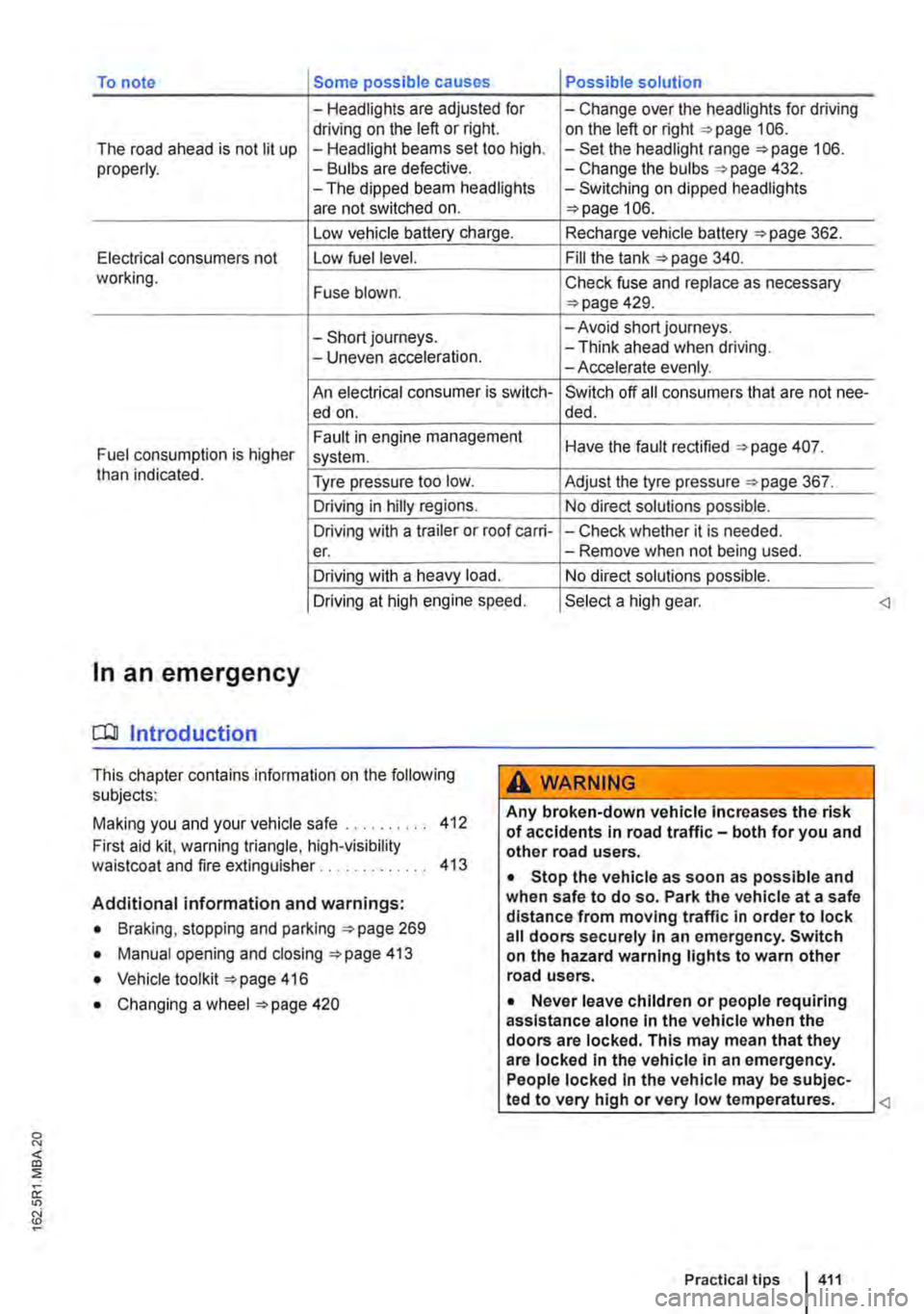
To note Some possible causes Possible solution
-Headlights are adjusted for -Change over the headlights for driving driving on the left or right. on the left or right 106. The road ahead is not lit up -Headlight beams set too high. -Set the headlight range 106. properly. -Bulbs are defective. -Change the bulbs 432. -The dipped beam headlights -Switching on dipped headlights are not switched on. 106.
Low vehicle battery charge. Recharge vehicle battery 362.
Electrical consumers not Low fuel level. Fill the tank 340. working. Fuse blown. Check fuse and replace as necessary 429.
-Short journeys. -Avoid short journeys.
-Uneven acceleration. -Think ahead when driving. -Accelerate evenly.
An electrical consumer is switch-Switch off all consumers that are not nee-ed on. de d.
Fault in engine management Have the fault rectified 407. Fuel consumption is higher system. than indicated. Tyre pressure too low. Adjust the tyre pressure 367.
Driving in hilly regions. No direct solutions possible.
Driving with a trailer or roof carri--Check whether it is needed. er. -Remove when not being used.
Driving with a heavy load. No direct solutions possible.
Driving at high engine speed. Select a high gear.
In an emergency
COl Introduction
This chapter contains information on the following subjects:
Making you and your vehicle safe . . 412
First aid kit. warning triangle, high-visibility waistcoat and fire extinguisher . . . . . . . . . . . . . 413
Additional information and warnings:
• Braking, stopping and parking 269
• Manual opening and closing 413
• Vehicle toolkit 416
• Changing a wheel 420
A WARNING
Any broken-down vehicle Increases the risk of accidents in road traffic-both for you and other road users.
• Stop the vehicle as soon as possible and when safe to do so. Park the vehicle at a safe distance from moving traffic In order to lock all doors securely In an emergency. Switch on the hazard warning lights to warn other road users.
• Never leave children or people requiring assistance alone In the vehicle when the doors are locked. This may mean that they are locked In the vehicle in an emergency. People locked In the vehicle may be subjec-