seats VOLKSWAGEN TRANSPORTER 2018 Workshop Manual
[x] Cancel search | Manufacturer: VOLKSWAGEN, Model Year: 2018, Model line: TRANSPORTER, Model: VOLKSWAGEN TRANSPORTER 2018Pages: 486, PDF Size: 69.28 MB
Page 196 of 486
• Make sure that the backrest of the bench seaU bed is in the upright position and securely engag-ed.
Bed (bench seat/bed)
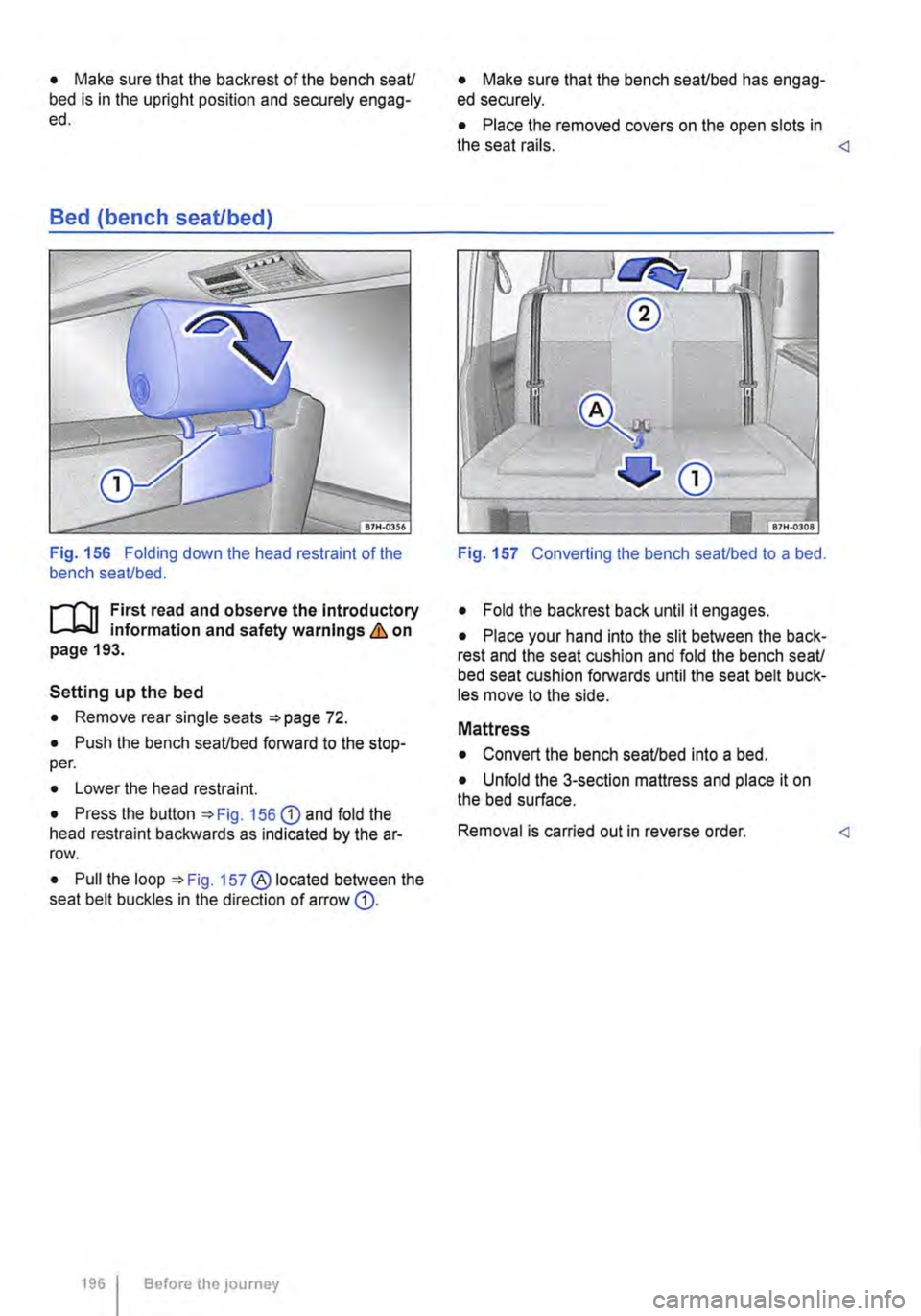
Fig. 156 Folding down the head restraint of the bench seaUbed.
r-111 First read and observe the Introductory 1-J,::JJ information and safety warnings & on page 193.
Setting up the bed
• Remove rear single seats =>page 72.
• Push the bench seaUbed forward to the stop-per.
• Lower the head restraint.
• Press the button =>Fig. 156 G) and fold the head restraint backwards as indicated by the ar-row.
• Pull the loop =>Fig. 157 ® located between the seat belt buckles in the direction of arrow G).
1961 Before the journey
• Make sure that the bench seaUbed has engag-ed securely.
• Place the removed covers on the open slots in the seat rails.
• Fold the backrest back until it engages.
• Place your hand into the slit between the back-rest and the seat cushion and fold the bench seaU bed seat cushion forwards until the seat belt buck-les move to the side.
Mattress
• Convert the bench seaUbed into a bed.
• Unfold the 3-section mattress and place it on the bed surface.
Removal is carried out in reverse order.
Page 198 of 486
Components of the mattress, 3-seat bench
87E-0263
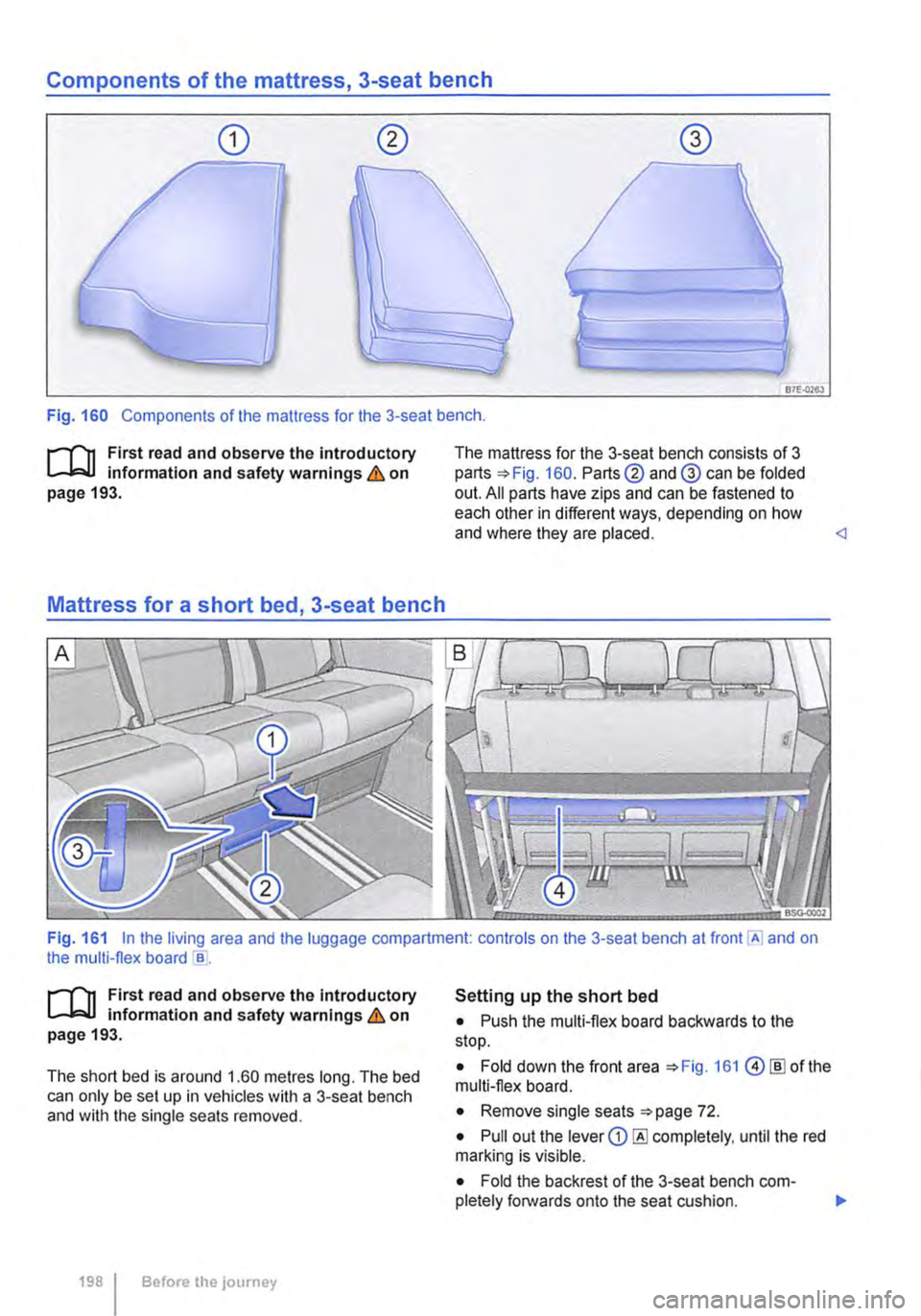
Fig. 160 Components of the mattress for the 3-seat bench .
.--m First read and observe the introductory l.-l=.U information and safety warnings & on page 193.
Mattress for a short bed, 3-seat bench
The mattress for the 3-seat bench consists of 3 parts 160. Parts@ and@ can be folded out. All parts have zips and can be fastened to each other in different ways, depending on how and where they are placed.
.--m First read and observe the Introductory l.-l=.U information and safety warnings & on page 193.
The short bed is around 1.60 metres long. The bed can only be set up in vehicles with a 3-seat bench and with the single seats removed.
198 I Before the journey
Setting up the short bed
• Push the multi-flex board backwards to the stop.
• Fold down the front area 161 @[ID of the multi-flex board.
• Remove single seats 72.
• Pull out the lever CD completely, until the red marking is visible.
• Fold the backrest of the 3-seat bench com-pletely forwards onto the seat cushion. 11>
Page 199 of 486
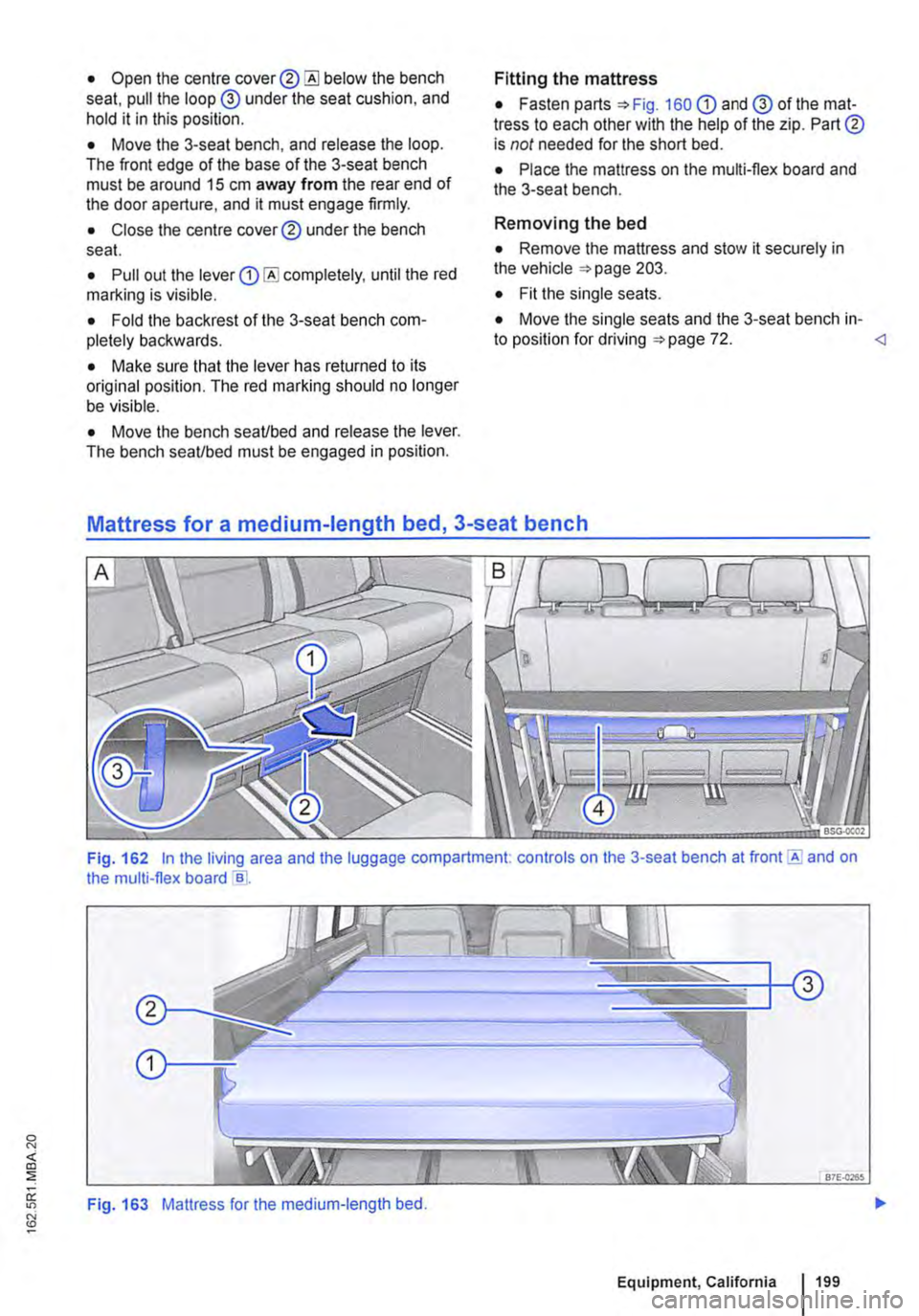
• Open the centre cover® below the bench seat, pull the loop @ under the seat cushion, and hold it in this position.
• Move the 3-seat bench, and release the loop. The front edge of the base of the 3-seat bench must be around 15 cm away from the rear end of the door aperture, and it must engage firmly.
• Close the centre cover® under the bench seat.
• Pull out the lever completely, until the red marlling is visible.
• Fold the backrest of the 3-seat bench com-pletely backwards.
• Make sure that the lever has returned to its original position. The red marking should no longer be visible.
• Move the bench seaVbed and release the lever. The bench seaVbed must be engaged in position.
Fitting the mattress
• Fasten parts =>Fig. 160 G) and @ of the mat-tress to each other with the help of the zip. Part® is not needed for the short bed.
• Place the mattress on the multi-flex board and the 3-seat bench.
Removing the bed
• Remove the mattress and stow it securely in the vehicle =>page 203.
• Fit the single seats.
• Move the single seats and the 3-seat bench in-to position for driving =>page 72.
Fig. 162 In the living area and the luggage compartment. controls on the 3-seat bench at front E and on the multi-flex board e .
Fig. 163 Mattress for the medium-length bed.
Equipment, California 199
Page 200 of 486
,...-m First read and observe the Introductory L--W.I Information and safety warnings & on page 193.
The medium-length bed is around 1.80 metres long. The bed can only be set up In vehicles with a 3-seat bench and with the single seats removed.
Setting up the medium-length bed
• Push the multi-flex board backwards to the stop.
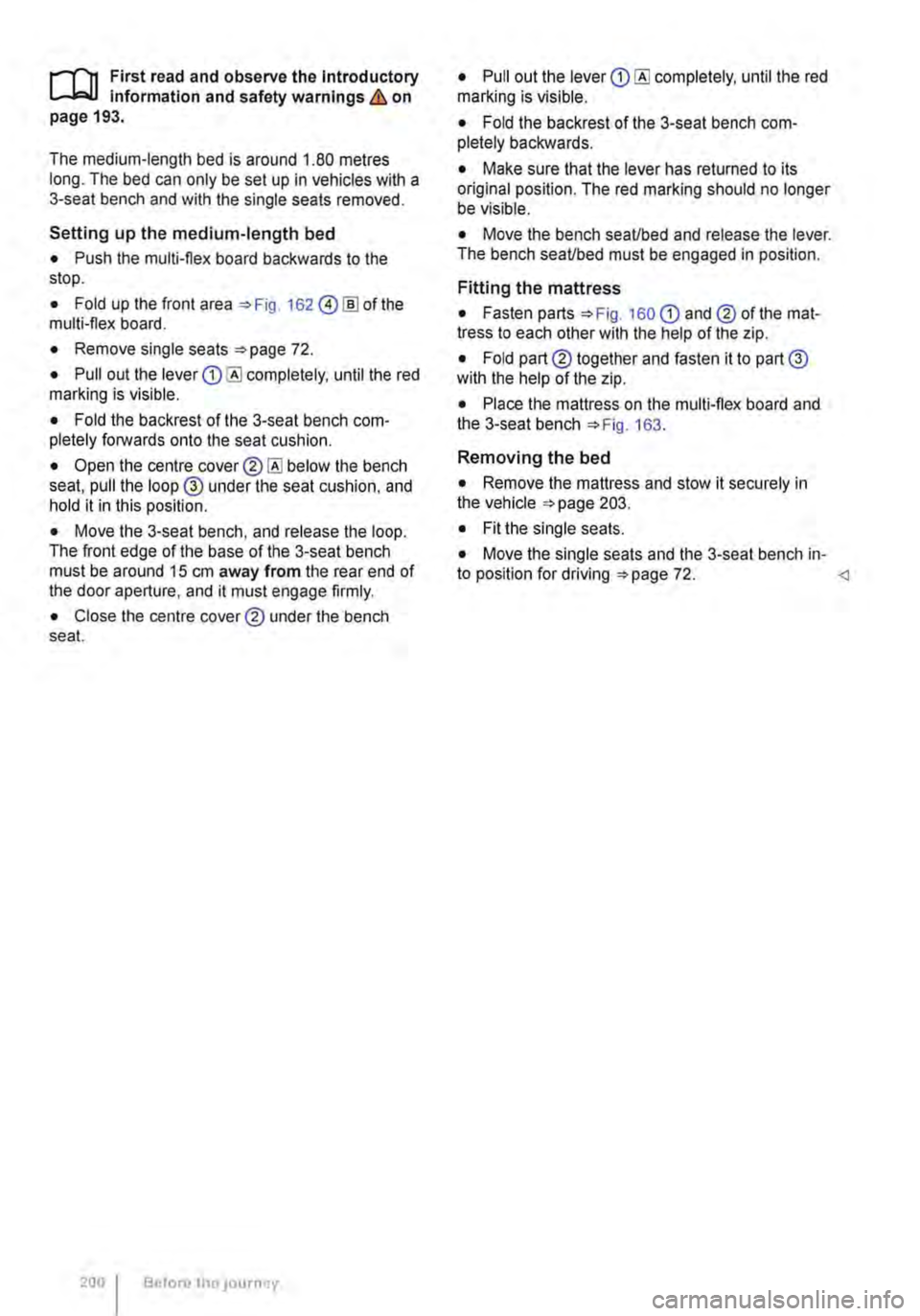
• Fold up the front area 162 @!ID of the multi-flex board.
• Remove single seats 72.
• Pull out the lever completely, until the red marking is visible.
• Fold the backrest of the 3-seat bench com-pletely forwards onto the seat cushion.
• Open the centre below the bench seat, pull the loop @ under the seat cushion, and hold it in this position.
• Move the 3-seat bench, and release the loop. The front edge of the base of the 3-seat bench must be around 15 cm away from the rear end of the door aperture, and it must engage firmly.
• Close the centre cover® under the bench seat.
200 Before tho JOurney
• Pull out the lever completely, until the red marking is visible.
• Fold the backrest of the 3-seat bench com-pletely backwards.
• Make sure that the lever has returned to its original position. The red marking should no longer be visible.
• Move the bench seaUbed and release the lever. The bench seaUbed must be engaged in position.
Fitting the mattress
• Fasten parts 160 CD and® of the mat-tress to each other with the help of the zip.
• Fold part® together and fasten it to part@ with the help of the zip.
• Place the mattress on the multi-flex board and the 3-seat bench 163.
Removing the bed
• Remove the mattress and stow it securely in the vehicle 203.
• Fit the single seats.
• Move the single seats and the 3-seat bench in-to position for driving 72.
Page 201 of 486
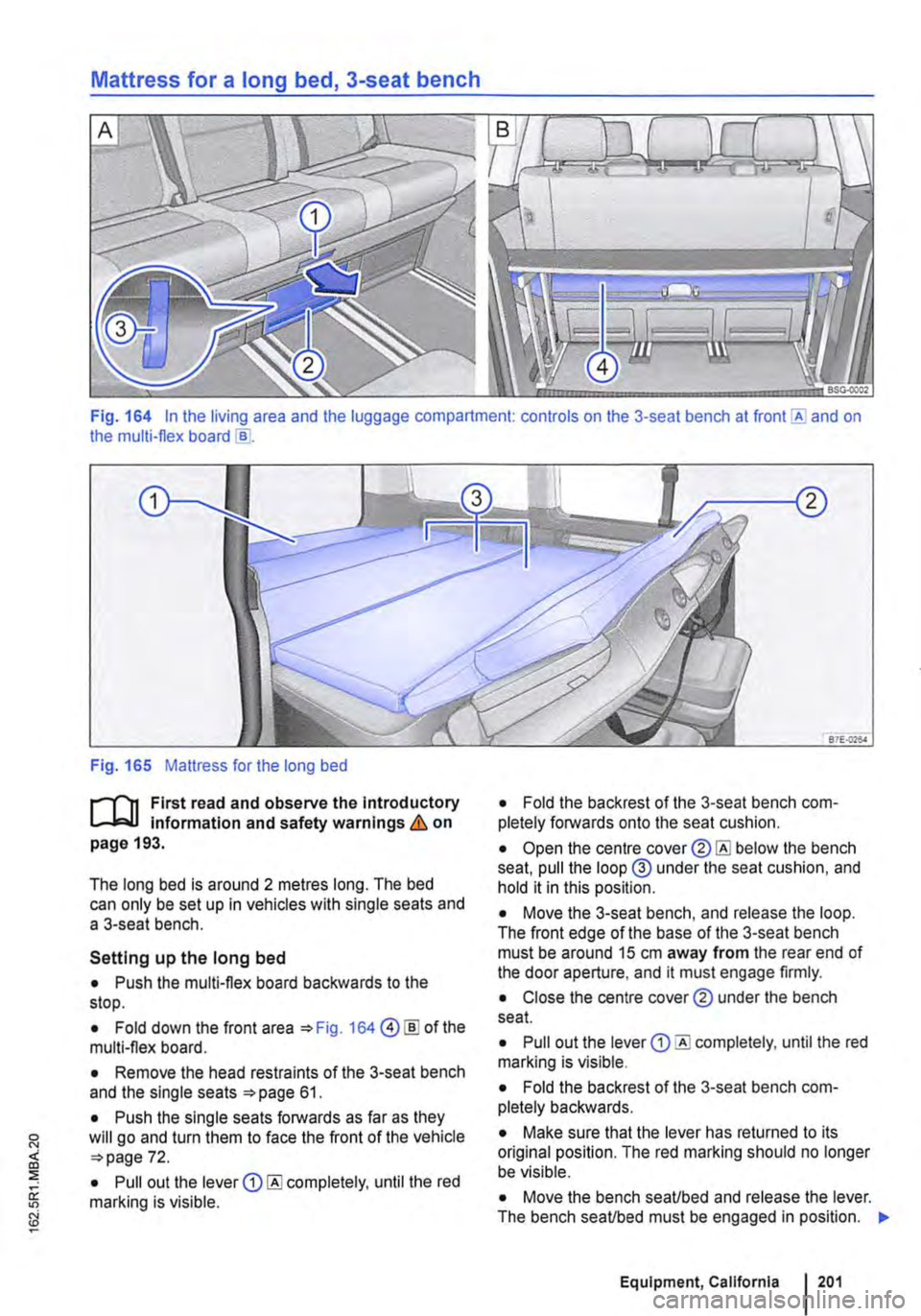
Mattress for a long bed, 3-seat bench
Fig. 164 In the living area and the luggage compartment: controls on the 3-seat bench at and on the multi-flex board
Fig. 165 Mattress for the long bed
r-1'lt First read and observe the Introductory L-J,:::..U Information and safety warnings & on page 193.
The long bed is around 2 metres long. The bed can only be set up in vehicles with single seats and a 3-seat bench.
Setting up the long bed
• Push the multi-flex board backwards to the stop.
• Fold down the front area 164@ [ID of the multi-flex board.
• Remove the head restraints of the 3-seat bench and the single seats 61.
• Push the single seats forwards as far as they will go and turn them to face the front of the vehicle 72.
• Pull out the lever completely, until the red marking is visible.
• Fold the backrest of the 3-seat bench com-pletely forwards onto the seat cushion.
• Open the centre below the bench seat, pull the loop@ under the seat cushion, and hold it in this position.
• Move the 3-seat bench, and release the loop. The front edge of the base of the 3-seat bench must be around 15 cm away from the rear end of the door aperture, and it must engage firmly.
• Close the centre cover® under the bench seat.
• Pull out the lever completely, until the red marking is visible.
• Fold the backrest of the 3-seat bench com-pletely backwards.
• Make sure that the lever has returned to its original position. The red marking should no longer be visible.
• Move the bench seaUbed and release the lever. The bench seaUbed must be engaged in position. "'
Equipment, California 201
Page 202 of 486
Fitting the mattress
• Fasten parts =>Fig. 160 CD and@ of the mat-tress to each other with the help of the zip.
• Fasten part® of the mattress to the other side of part@ at the zip.
• Tilt the backrests of the single seats a little if necessary in order to have a slanting surface to lean against.
• If you wish, fit the head restraints of the single seats the wrong way round in order to have an ad-ditional surface to lean against => &.
• Place the mattress on the multi-flex board, the 3-seat bench and the single seats =>Fig. 165.
Removing the bed
• Remove the mattress and stow it securely in the vehicle =>page 203.
• Move the single seats and the 3-seat bench in-to position for driving =>page 72.
• Fit the head restraints correctly => &.
202 I Before the journey
A wARNING
Driving without head restraints or with incor-rectly adjusted head restraints Increases the risk of severe or fatal injuries in the event of an accident or sudden driving or braking ma-noeuvre.
• If a seat is occupied, the head restraint for that seat must be fitted and adjusted correct-ly.
• Each vehicle occupant must adjust the head restraint to suit their body size, to help reduce the risk of neck Injuries In an acci-dent. As far as possible, the upper edge of the head restraint must be level with the top of the head, but not lower than eye level. Po-sition the back of your head In the middle and as close to the head restraint as possible.
• Never adjust, fit or remove the head re-straint while the vehicle Is In motion.
• Head restraints that have been removed or fitted the wrong way round should be correct-ly fitted again Immediately so that passen-gers are properly protected.
Page 211 of 486
• Stowage page 1 50
• Cleaning and caring for the interior 388
A WARNING
Loose objects may be flung through the vehi-cle interior in the event of a sudden driving or braking manoeuvre. This can cause serious injury and can also lead to loss of control of the vehicle.
• Do not stow any pets or any hard, heavy or sharp objects in the vehicle's open stow-age compartments, in the luggage net, on the dash panel, on the shelf behind the rear seats or in items of clothing and bags in the vehicle interior.
• Always keep stowage compartments closed while the vehicle is in motion.
A WARNING
Objects in the driver footweli can hinder ped-al operation. This can lead to loss of control of the vehicle and increase the risk of serious injury.
• Please ensure that all pedals can always be operated without any hindrance.
• The foot mats must always be properly se-cured in the footwell.
• No additional foot mats or other floor cov-erings should be placed over the fitted foot mat.
• Ensure that no objects can enter the driv-er footwell while the vehicle is in motion.
• If there are any objects in the footwell, re-move them when the vehicle is parked.
A WARNING
Improper use of the stowage compartments can cause serious injury.
• Never fill stowage compartments beyond their capacity.
A WARNING (Continued)
• Always take care when closing stowage compartments that nobody is within their functional area.
A WARNING
Cigarette lighters in the vehicle could be damaged or accidentally lit. This could lead to serious burns and other injuries.
• Before adjusting the seats always make sure that there is no lighter on or near the moveable parts of the seat.
• Before closing stowage areas or compart-ments always ensure that there is no lighter in the way.
• Never stow lighters in stowage areas or compartments or on other surfaces in the ve-hicle. Cigarette lighters may self-ignite on high-temperature surfaces, especially in sum-mer.
CD
• Hard objects on the shelf can chafe against the wires of the heating element in the rear win-dow and cause damage.
• Do not store any heat-sensitive objects, food or medicines inside the vehicle. Hot and cold temperatures could damage them or ren-der them unusable.
• Objects stored in the vehicle that are made from transparent materials, such as glasses, magnifying glasses or transparent suction cups on the windows, can concentrate the sun's rays and thus cause damage to the vehi-cle.
m Always ensure that the ventilation openings L!J between the rear window and the stowage area are uncovered to allow stale air to escape from the vehicle.
Page 218 of 486
Manual pop-up roof, California
C::O Introduction
This chapter contains information on the following subjects:
Opening the manual pop-up roof.......... 219
Closing the manual pop-up roof . 220
Roller shutter
Above the front seats there is a roller shutter, which must always be closed while the vehicle is in motion. This prevents the pop-up roof canvas from hanging down through the ceiling access and blocking the driver's view. Keeping the roller shut-ter closed also reduces wind noise while the vehi-cle is in motion.
A WARNING
Incorrect handling of the manual pop-up roof can cause accidents and serious injuries.
• Never drive the vehicle with the pop-up roof open. The pop-up roof must always be completely closed and securely locked while the vehicle is in motion.
• Never drive with people in the pop-up roof.
• Only open or close the pop-up roof while the vehicle Is stationary.
• Only mount a luggage roof rack when the pop-up roof is completely closed and secure-ly locked.
A WARNING
Careless or inattentive use of the manual pop-up roof could cause serious Injuries.
• The pop-up roof should only be opened or closed when you are sure that nobody is in its operating area.
• Never leave children or people requiring assistance alone in the vehicle.
• Always take all vehicle keys with you ev-ery time you leave the vehicle.
218 I Before the journey
CD
Incorrect handling of the manual pop-up roof can cause damage to it or to other parts of the vehicle.
• Make sure there Is adequate space before opening the pop-up roof.
• When closing the pop-up roof, always open the roller shutter and one of the vehicle doors to allow the excess air pressure to escape.
• Only close the pop-up roof when it is dry to prevent the build up of mould or mildew.
• Open the pop-up roof occasionally to air it out when it Is not being used for long periods oftime.
• Clean the pop-up roof bellows with water only. Never use household cleaners or Impreg-nating fabric treatment products.
• Close the pop-up roof during storms with driving rain and wind gusts. Otherwise the bel-lows could leak despite their specially treated fabric.
Page 219 of 486
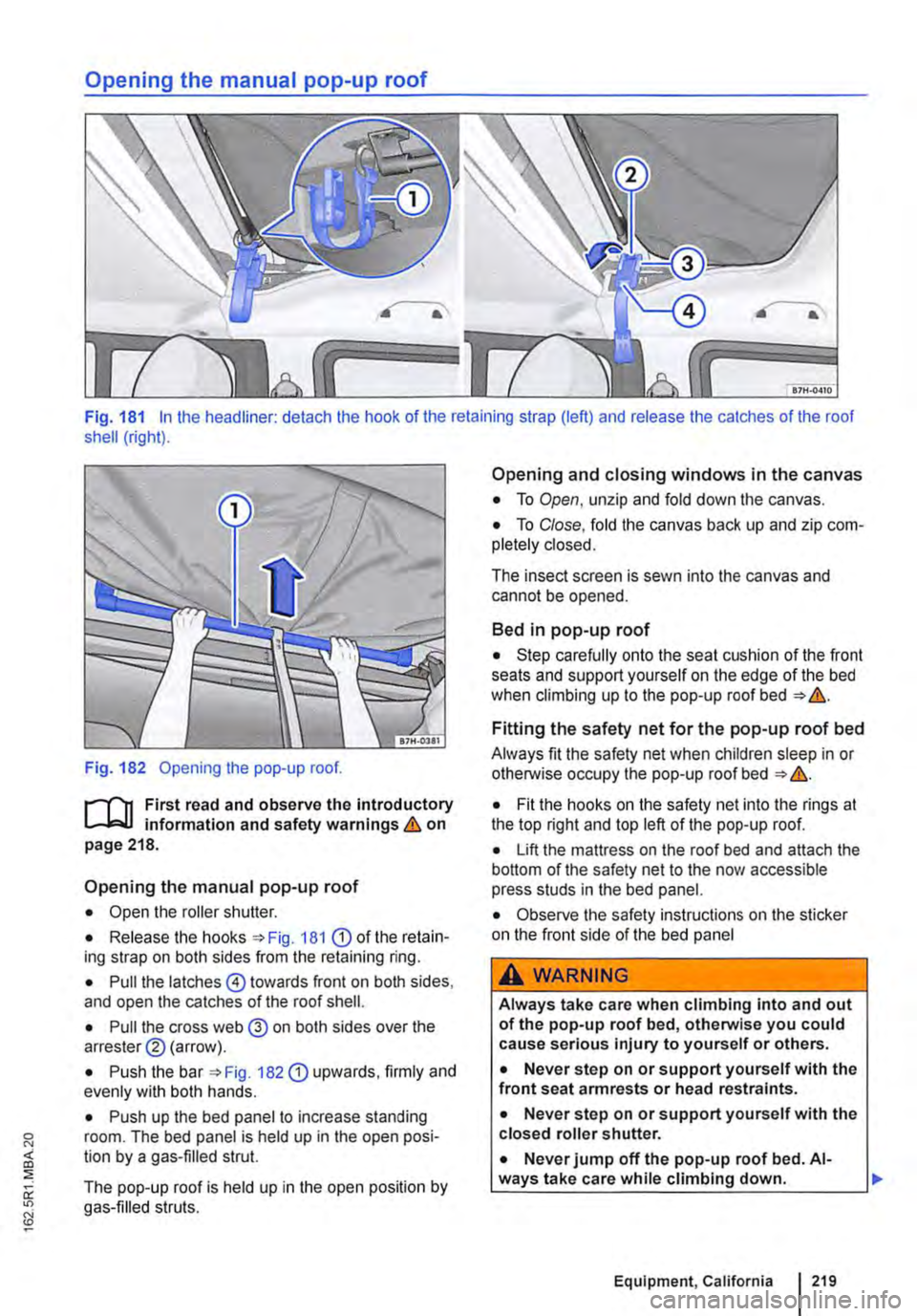
Opening the manual pop-up roof
Fig. 181 In the headliner: detach the hook of the retaining strap (left) and release the catches of the roof shell (right).
Fig. 182 Opening the pop-up roof.
r""'('n First read and observe the introductory L-W.I information and safety warnings & on page 218.
Opening the manual pop-up roof
• Open the roller shutter.
• Release the hooks =>Fig. 181 CD of the retain-ing strap on both sides from the retaining ring.
• Pull the latches @) towards front on both sides, and open the catches of the roof shell.
• Pull the cross web @ on both sides over the arrester® (arrow).
• Push the bar 182 CD upwards, firmly and evenly with both hands.
• Push up the bed panel to increase standing room. The bed panel is held up in the open posi-tion by a gas-filled strut.
The pop-up roof is held up in the open position by gas-filled struts.
Opening and closing windows in the canvas
• To Open, unzip and fold down the canvas.
• To Close, fold the canvas back up and zip com-pletely closed.
The insect screen is sewn into the canvas and cannot be opened.
Bed in pop-up roof
• Step carefully onto the seat cushion of the front seats and support yourself on the edge of the bed when climbing up to the pop-up roof bed => &.
Fitting the safety net for the pop-up roof bed
Always fit the safety net when children sleep in or otherwise occupy the pop-up roof bed => &.
• Fit the hooks on the safety net into the rings at the top right and top left of the pop-up roof.
• Lift the mattress on the roof bed and attach the bottom of the safety net to the now accessible press studs in the bed panel.
• Observe the safety instructions on the sticker on the front side of the bed panel
aAWARNING
Always take care when climbing into and out of the pop-up roof bed, otherwise you could cause serious injury to yourself or others.
• Never step on or support yourself with the front seat armrests or head restraints.
• Never step on or support yourself with the closed roller shutter.
• Never jump off the pop-up roof bed. Al-ways take care while climbing down. Ill>
Equipment, California I 219
Page 221 of 486
Electric pop-up roof, California
o:IJ Introduction
This chapter contains information on the following subjects:
Opening the electric pop-up roof . . . . . . . . . . . 222
Closing the electric pop-up roof . . . 223
Preliminary work for closing the electric pop-up roof manually . . . . . . . . . . . . . . . . . . . . . . . . 224
Closing the electric pop-up roof manually . 225 Securing the pop-up roof manually from outside the vehicle . . . . . 225
Roller shutter
Above the front seats there is a roller shutter, which must always be closed while the vehicle is in motion. This prevents the pop-up roof canvas from hanging down through the ceiling access and blocking the driver's view. Keeping the roller shut-ter closed also reduces wind noise while the vehi-cle is in motion.
Additional information:
• Central control panel 204
• Rectifying faults on the camping equipment 254
• Winter conditions 253
• Vehicle tool kit 416
A WARNING
Incorrect handling of the pop-up roof can cause accidents and serious Injuries.
• Never drive the vehicle with the pop-up roof open. The pop-up roof must always be completely closed and securely locked while the vehicle Is In motion.
• Never drive with people In the pop-up roof.
• Only open or close the pop-up roof while the vehicle Is stationary.
• Only mount a luggage roof rack when the pop-up roof is completely closed and secure-ly locked.
A WARNING
Careless or inattentive use of the pop-up roof could cause serious Injuries.
• The pop-up roof should only be opened or closed when you are sure that nobody is in its operating area.
A WARNING (Continued)
• Never leave children or people requiring assistance alone In the vehicle.
• Always take all vehicle keys with you ev-ery time you leave the vehicle.
A WARNING
Driving at high vehicle speeds and with a strong headwind after closing the pop-up roof manually could cause the pop-up roof to lift up or open on Its own and potentially cause serious Injuries.
• If you close the pop-up roof manually, do not drive faster than 60 km/h.
• Drive especially carefully and slowly In the presence of a strong headwind.
• The pop-up roof should be checked by a qualified workshop as soon as possible.
CD
Incorrect handling of the pop-up roof can cause damage to it or to other parts of the vehi-cle.
• Make sure there is adequate space before opening the pop-up roof.
• When closing the pop-up roof, always open the roller shutter and one of the vehicle doors to allow the excess air pressure to escape.
• Only close the pop-up roof when it is dry to prevent the build up of mould or mildew.
• Open the pop-up roof occasionally to air it out when it is not being used for long periods of time.
• Clean the pop-up roof bellows with water only. Never use household cleaners or Impreg-nating fabric treatment products.
• Close the pop-up roof during storms with driving rain and wind gusts. Otherwise the bel-lows could leak despite their specially treated fabric.
m Roof hydraulics: the pop-up height of the W pop-up roof will be checked automatically and altered if necessary at regular intervals after the ignition has been switched off and the ignition key removed: first after 10 hours and then every five hours. .,.
Equipment, California 221