towing VOLKSWAGEN TRANSPORTER 2018 Workshop Manual
[x] Cancel search | Manufacturer: VOLKSWAGEN, Model Year: 2018, Model line: TRANSPORTER, Model: VOLKSWAGEN TRANSPORTER 2018Pages: 486, PDF Size: 69.28 MB
Page 423 of 486
Lifting the vehicle with the jack
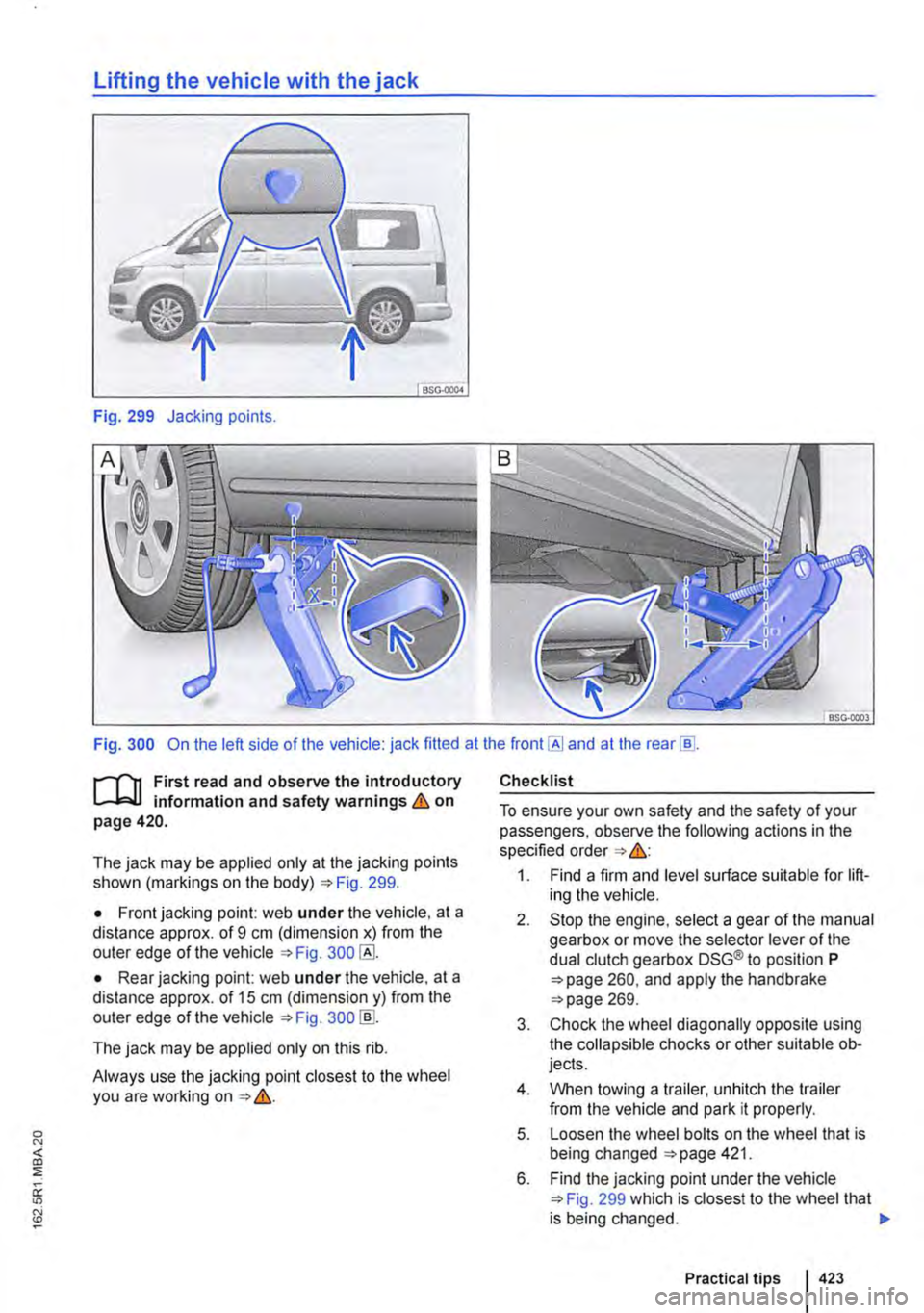
Fig. 299 Jacking points.
Fig. 300 On the left side of the vehicle: jack fitted at the front [AI and at the rear [ID.
r-('n First read and observe the introductory l.,...Jc.ll information and safety warnings & on page 420.
The jack may be applied only at the jacking points shown (markings on the body) '*Fig. 299.
• Front jacking point: web under the vehicle, at a distance approx. of 9 cm (dimension x) from the outer edge of the vehicle 300
• Rear jacking point: web under the vehicle, at a distance approx. of 15 cm (dimension y) from the outer edge of the vehicle 300 [ID.
The jack may be applied only on this rib.
Always use the jacking point closest to the wheel you are working on &.
Checklist
To ensure your own safety and the safety of your passengers, observe the following actions in the specified order &:
1. Find a firm and level surface suitable for lift-ing the vehicle.
2. Stop the engine, select a gear of the manual gearbox or move the selector lever of the dual clutch gearbox DSG® to position P '*page 260, and apply the handbrake 269.
3. Chock the wheel diagonally opposite using the collapsible chocks or other suitable ob-jects.
4. When towing a trailer, unhitch the trailer from the vehicle and park it properly.
5. Loosen the wheel bolts on the wheel that is being changed 421.
6. Find the jacking point under the vehicle '*Fig. 299 which is closest to the wheel that is being changed. .,.
Practical tips I 423
Page 427 of 486
Contents of the breakdown set
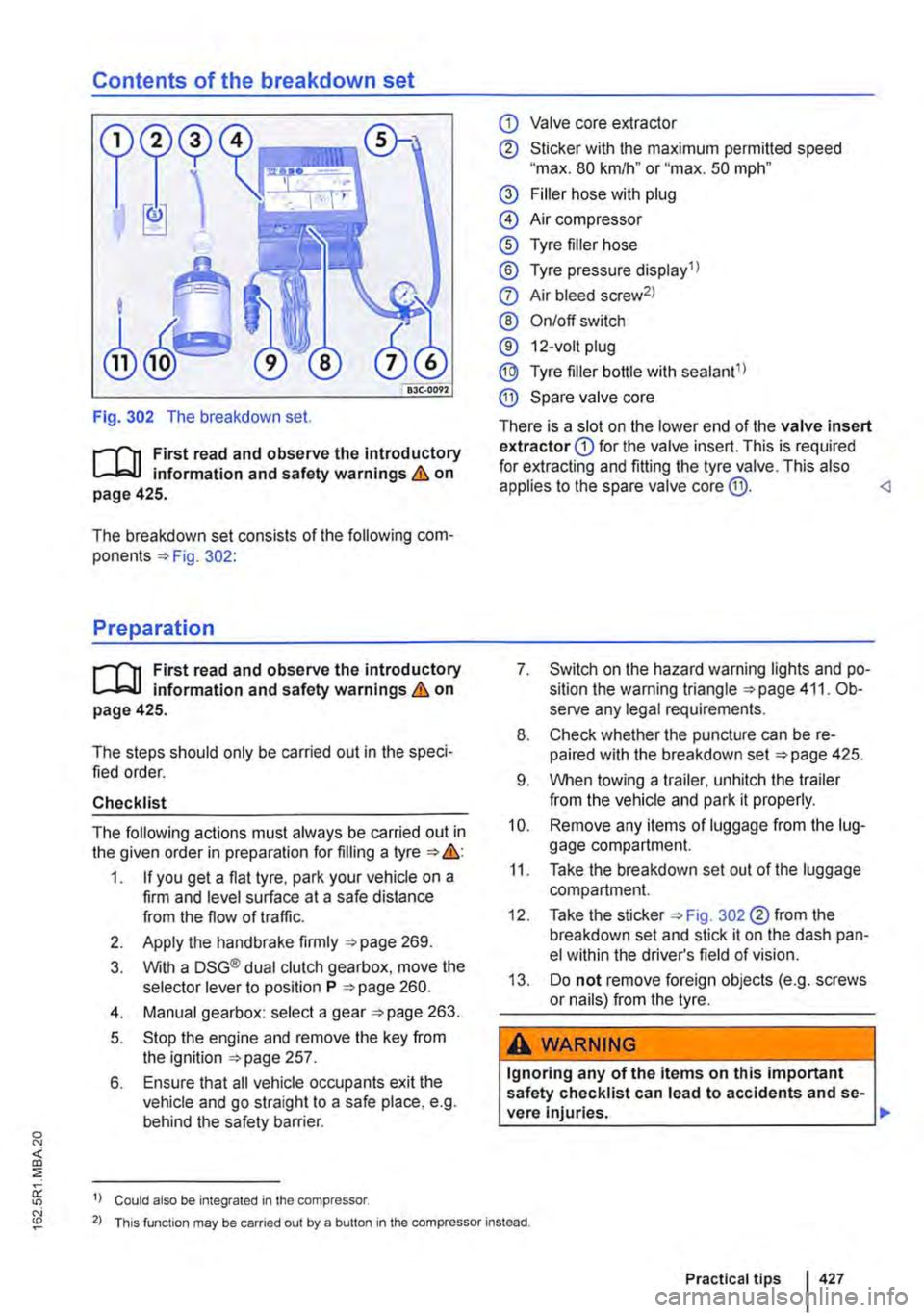
Fig. 302 The breakdown set.
r--T'n First read and observe the introductory L-L::.U information and safety warnings & on page 425.
The breakdown set consists of the following com-ponents 302:
Preparation
r--T'n First read and observe the introductory L-L::.U information and safety warnings & on page 425.
The steps should only be carried out in the speci-fied order.
Checklist
The following actions must always be carried out in the given order in preparation for filling a tyre &:
1. If you get a flat tyre, park your vehicle on a firm and level surface at a safe distance from the flow of traffic.
2. Apply the handbrake firmly 269.
3. With a DSG® dual clutch gearbox, move the selector lever to position P 260.
4. Manual gearbox: select a gear 263.
5. Stop the engine and remove the key from the ignition 257.
6. Ensure that all vehicle occupants exit the vehicle and go straight to a safe place, e.g. behind the safety barrier.
1) Could also be integrated in the compressor.
CD Valve core extractor
® Sticker with the maximum permitted speed "max. 80 km/h" or "max. 50 mph"
@ Filler hose with plug
@ Air compressor
® Tyre filler hose
® Tyre pressure display 1 l
0 Air bleed screw2l
® On/off switch
® 12-volt plug
@ Tyre filler bottle with sealant1l
® Spare valve core
There is a slot on the lower end of the valve insert extractor CD for the valve insert. This is required for extracting and fitting the tyre valve. This also applies to the spare valve core @.
8. Check whether the puncture can be re-paired with the breakdown set 425.
9. When towing a trailer, unhitch the trailer from the vehicle and park it properly.
10. Remove any items of luggage from the lug-gage compartment.
11. Take the breakdown set out of the luggage compartment.
12. Take the sticker 302 ®from the breakdown set and stick it on the dash pan-el within the driver's field of vision.
13. Do not remove foreign objects (e.g. screws or nails) from the tyre.
A WARNING
Ignoring any of the items on this important safety checklist can lead to accidents and se-vere Injuries. ,..
2) This function may be carried out by a button in the compressor instead.
Practical tips 427
Page 428 of 486
A WARNING (Continued)
• Always follow the instructions In the checklist and observe the general safety pro-
Sealing and inflating tyres
r-"'('n First read and observe the Introductory L-J,.:.U Information and safety warnings & on page 425.
Sealing a tyre
• Unscrew the cap from the tyre valve.
• Use the valve core extractor 302 CD to screw the valve core out of the tyre valve. Place the core on a clean surface.
• Shake the tyre filler bottle 302 ® vigo-rously up and down several times.
• Screw the filler hose 302 @tightly onto the tyre filler bottle in a clockwise direction. The plastic foil on the plug is pierced automatically.
• Remove the plug from the filler hose 302@ and place the open end fully on the tyre valve.
• Hold the bottle upside down and inject the en-tire contents of the tyre filler bottle into the tyre.
• Remove the empty tyre filler bottle from the valve.
• Use the valve core extractor 302 CD to screw the valve core back onto the tyre valve.
Inflating the tyre
• Screw the tyre filler hose 302 ® of the air compressor tightly onto the tyre valve.
• Check that the bleed screw 302 (?) is closed.
• Start the engine and let it run.
• Insert the plug 302 ®into one of the ve-hicle's 12-volt sockets 163.
• Use the on/off switch 302 ®to switch on the air compressor.
• Run the compressor until the tyre pressure has reached 2.0-2.5 bar (29-36 psi I 200-250 kPa) maximum running time is 6 minutes
• Switch off the air compressor.
• If a pressure level of 2.0-2.5 bar (29-36 psi I 200 -250 kPa) cannot be achieved unscrew the tyre filler hose from the tyre valve.
428 I If and when
• Drive (or reverse) the vehicle approximately 1 0 metres so that the sealing compound is more evenly distributed in the tyre.
• Screw the tyre filler hose for the air compressor firmly back onto the tyre valve and inflate the tyre again.
• If the required pressure still cannot be reached, the tyre is too badly damaged. The tyre cannot be sealed with the breakdown set. Do not drive on. Seek expert assistance &.
• Disconnect the air compressor and unscrew the tyre filler hose from the tyre valve.
• Drive the vehicle no faster than 80 km/h (50 mph) once a tyre pressure of 2.0-2.5 bar (29-36 psi I 200-250 kPa) has been reached.
• Check the tyre pressure after driving for 10 mi-nutes 429.
A WARNING
The tyre filler hose and the air compressor can get hot during Inflation.
• Protect your hands and skin from the hot components.
• Do not place the hot tyre filler hose or the hot air compressor on any Inflammable mate-rials.
• Allow the device to cool down fully before stowing.
• If the tyre will not Inflate to at least 2.0 bar (29 psi/ 200 kPa), the tyre Is too damaged. The sealant Is unable to seal the tyre. Do not drive on. Seek expert assistance.
CD
Switch the air compressor off after a maximum of 6 minutes to avoid overheating. Let the air compressor cool down for a few minutes be-fore switching it back on.
Page 445 of 486
r'l11 First read and observe the Introductory L-J,:.,U Information and safety warnings & on page 443.
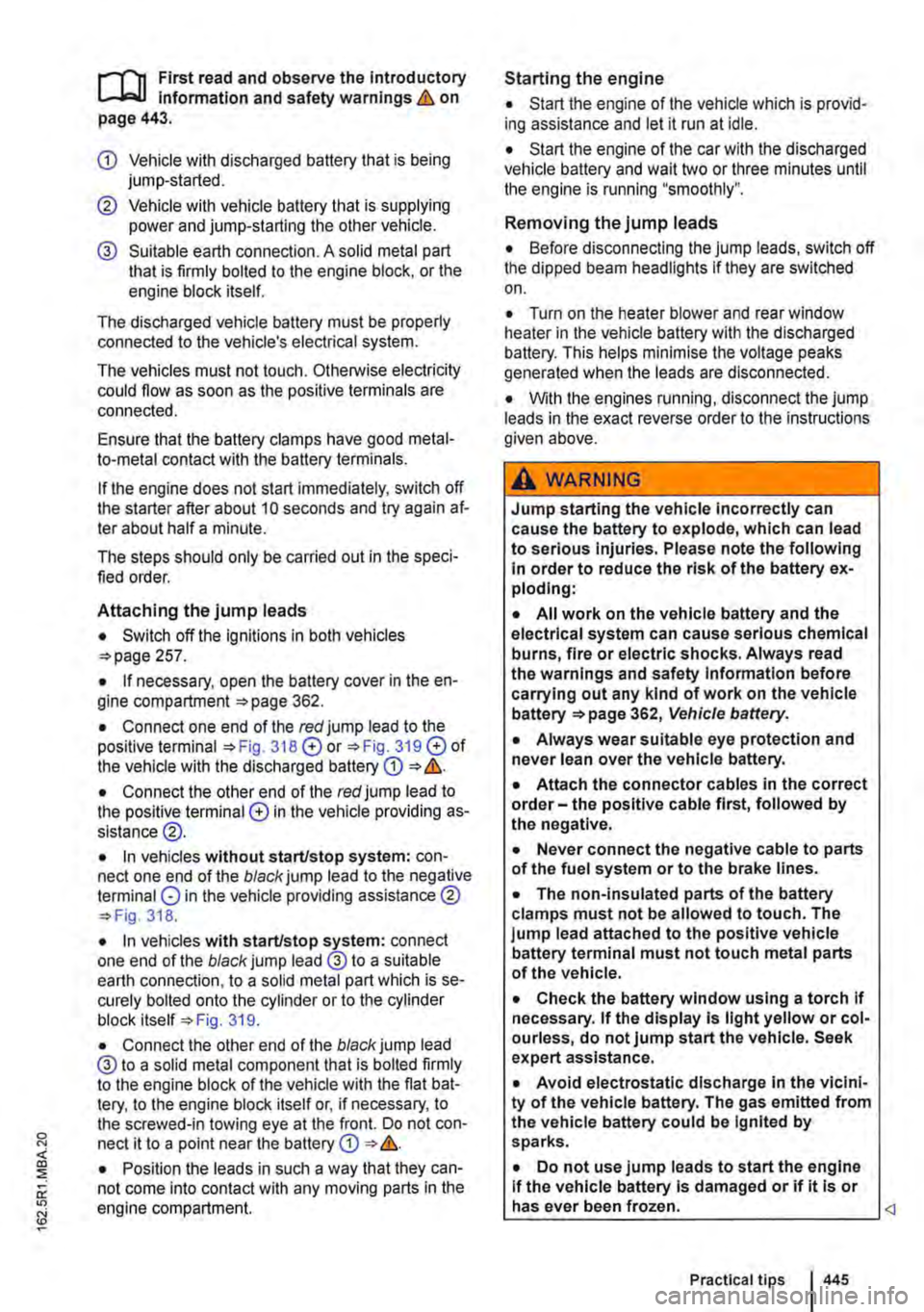
CD Vehicle with discharged battery that is being jump-started.
@ Vehicle with vehicle battery that is supplying power and jump-starting the other vehicle.
@ Suitable earth connection. A solid metal part that is firmly bolted to the engine block, or the engine block itself.
The discharged vehicle battery must be properly connected to the vehicle's electrical system.
The vehicles must not touch. Otherwise electricity could flow as soon as the positive terminals are connected.
Ensure that the battery clamps have good metal-to-metal contact with the battery terminals.
If the engine does not start immediately, switch off the starter after about 10 seconds and try again af-ter about half a minute.
The steps should only be carried out in the speci-fied order.
Attaching the jump leads
• Switch off the ignitions In both vehicles 257.
• If necessary, open the battery cover in the en-gine compartment 362.
• Connect one end of the red jump lead to the positive terminal 318 E) or 319 E) of the vehicle with the discharged battery CD &.
• Connect the other end of the red jump lead to the positive terminal E) In the vehicle providing as-sistance@.
• In vehicles without start/stop system: con-nect one end of the black jump lead to the negative terminal 0 in the vehicle providing assistance @ 318.
• In vehicles with start/stop system: connect one end of the black jump lead @to a suitable earth connection, to a solid metal part which is se-curely bolted onto the cylinder or to the cylinder block itself =:-Fig. 319.
• Connect the other end of the black jump lead @ to a solid metal component that is bolted firmly to the engine block of the vehicle with the flat bat-tery, to the engine block itself or, if necessary, to the screwed-in towing eye at the front. Do not con-nect it to a point near the battery CD &.
• Position the leads in such a way that they can-not come into contact with any moving parts in the engine compartment.
Starting the engine
• Start the engine of the vehicle which is provid-ing assistance and let it run at idle.
• Start the engine of the car with the discharged vehicle battery and wait two or three minutes until the engine is running "smoothly".
Removing the jump leads
• Before disconnecting the jump leads, switch off the dipped beam headlights If they are switched on.
• Turn on the heater blower and rear window heater in the vehicle battery with the discharged battery. This helps minimise the voltage peaks generated when the leads are disconnected.
• With the engines running, disconnect the jump leads in the exact reverse order to the instructions given above.
A WARNING
Jump starting the vehicle Incorrectly can cause the battery to explode, which can lead to serious injuries. Please note the following In order to reduce the risk of the battery ex-ploding:
• All work on the vehicle battery and the electrical system can cause serious chemical burns, fire or electric shocks. Always read the warnings and safety Information before carrying out any kind of work on the vehicle battery 362, Vehicle battery.
• Always wear suitable eye protection and never lean over the vehicle battery.
• Attach the connector cables In the correct order-the positive cable first, followed by the negative.
• Never connect the negative cable to parts of the fuel system or to the brake lines.
• The non-insulated parts of the battery clamps must not be allowed to touch. The jump lead attached to the positive vehicle battery terminal must not touch metal parts of the vehicle.
• Check the battery window using a torch If necessary. If the display Is light yellow or col-ourless, do not jump start the vehicle. Seek expert assistance.
• Avoid electrostatic discharge In the vicini-ty of the vehicle battery. The gas emitted from the vehicle battery could be Ignited by sparks.
• Do not use jump leads to start the engine If the vehicle battery Is damaged or if it is or has ever been frozen.
Page 446 of 486
Tow-starting and towing
0::0 Introduction
This chapter contains information on the following subjects:
Notes on tow-starting . . . . . . . . . . . . . . . . . . . . 446
Notes on towing . . . . . . . . . . . . . . . . . . . . . . . . . 447
Fitting the towing eye at front . . . . . . . . . . . . 448 Notes on driving while towing . . . . . . . . . . . . . . 448
Observe any legal requirements when towing.
For technical reasons, vehicles with a dis-charged battery must not be tow-started.
Towing a vehicle when the engine is switched off and the ignition is switched on discharges the vehi-cle battery. Depending on the vehicle battery charge level, the drop in voltage can be large enough after just a few minutes that electrical con-sumers in the vehicle will no longer function, e.g. the hazard warning lights.
Additional information and warnings:
• Exterior views =>page 5
• Changing gear =>page 257
• Engine management system and exhaust puri-fication system =>page 407
• Jump starting =>page 443
A wARNING
Never tow a vehicle that has no power sup-ply.
• Never remove the key from the ignition. The steering lock may be activated and you will no longer be able to steer the vehicle. This can lead to a loss of control of the vehi-cle, accidents and serious injuries.
Notes on tow-starting
t""""("'n First read and observe the introductory L-.lc:.JJ information and safety warnings & on page 446.
Vehicles should not be tow-started wherever possible. Use jump leads to start the engine in· stead =>page 443.
For technical reasons, the following vehicles can-not be tow-started:
4461 If and when
A WARNING (Continued)
• If the power supply to the towed vehicle is disconnected, stop towing immediately and seek expert assistance.
A WARNING
If a vehicle is being towed, the vehicle han-dling and braking effect will change signifi-cantly. Please note the following in order to reduce the risk of an accident or serious inju-ries:
• Notes for the driver of the towed vehicle:
-You will need to depress the brake ped-al more vigorously than normal as the brake servo is not working. Always be careful not to drive Into the vehicle that is pulling your vehicle.
-You will need to turn the steering wheel more vigorously as the power-assisted steering function Is not working.
• Notes for the driver of the towing vehicle
-Accelerate carefully and gently.
-Avoid sudden braking and driving ma· noeuvres.
-Brake earlier than normal by pressing lightly on the brake pedal.
CD
• Remove and install the cover and the tow-ing eye carefully so as to avoid damage to the vehicle, e.g. the palntwork.
• Unburnt fuel can enter the catalytic convert· er and damage it while the vehicle Is being tow-ed.
• If the vehicle battery has discharged, the en-gine control units will not function properly.
However, if the vehicle still has to be tow-started (manual gearbox):
• Engage second or third gear.
• Keep the clutch pressed down.
Page 447 of 486
• Switch on the ignition and the hazard warning lights.
• Once both vehicles are in motion, release the clutch.
• As soon as the engine starts, press the clutch and put the gear into neutral. This helps to prevent driving into the towing vehicle.
Notes on towing
i"""fl1 First read and observe the introductory L-W! information and safety warnings & on page 446.
Fixed towing eye at rear
On vehicles without a towing bracket there is a fixed towing eye under the bumper at the rear right.
Towing bracket instead of a fixed towing eye
If the vehicle has a factory-fitted towing bracket, it should also be used for towing other vehicles.
Tow rope or tow bar
lt is easier and safer to tow a vehicle with a tow bar. Only use a tow rope if you do not have a tow bar.
The tow rope should be slightly elastic to reduce the strain on both vehicles. lt is advisable to use a tow rope made of synthetic fibre or similarly elastic material.
Only attach the tow rope or tow bar to the specially provided towing eyes or to the towing bracket.
Vehicles with a factory-fitted towing bracket must be towed only with a tow bar that is specially designed for fitting to a ball coupling 139.
When your vehicle has to be towed:
• Switch on the ignition.
• Select the neutral position or move the selector lever to N 257.
• Release the handbrake. if necessary.
CD
When tow-starting, unburnt fuel can enter the catalytic converter and damage it. <1
• Do not allow the vehicle to be towed at speeds faster than 50 km/h (30 mph).
• Do not allow the vehicle to be towed further than 50 km.
• Vehicles with a DSG® dual clutch gearbox may only be towed by the breakdown truck with the front wheels raised.
Towing vehicles with four-wheel drive (4MOTION)
Vehicles with four-wheel drive (4MOTION) may be towed with a tow bar or tow rope. If the vehicle is towed with the rear or front axle raised, the engine must be switched off otherwise the drive train could be damaged.
When should your vehicle not be towed?
• If, due to damage, the vehicle gearbox no lon-ger contains any lubricant.
• If the vehicle battery is discharged.
• If the distance to be towed is further than 50 km -applies only to vehicles with the DSG® dual clutch gearbox.
• If the steering function or the operating clear-ance of the wheels cannot be ensured, e.g. after an accident.
Please comply with the following when towing another vehicle:
• Comply with legal regulations.
• Comply with the information on towing con-tained in the owner's manual for the other vehicle. <1
Practical tips
Page 448 of 486
Fitting the towing eye at front
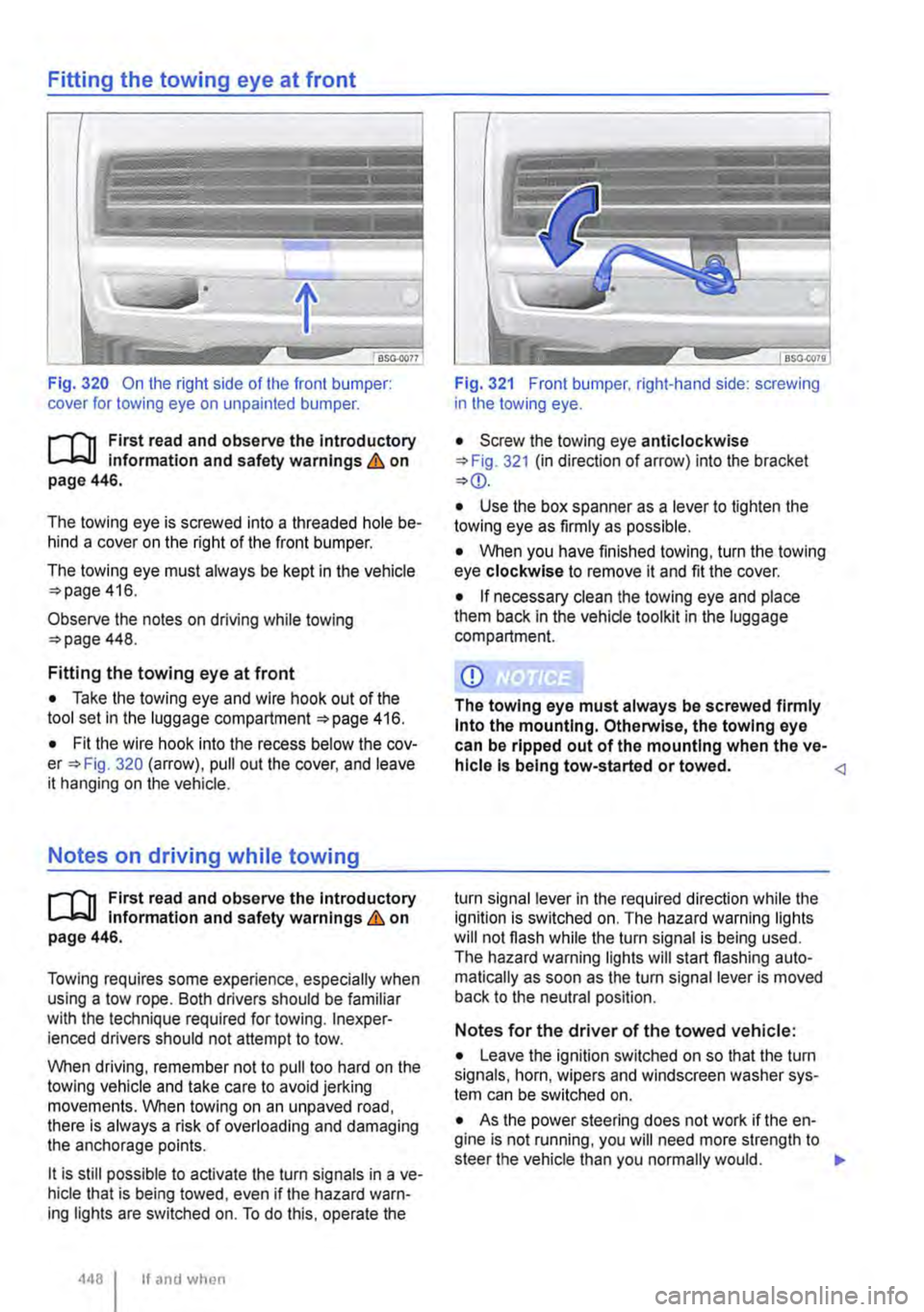
Fig. 320 On the right side of the front bumper: cover for towing eye on unpainted bumper.
l"""('n First read and observe the Introductory L-Jo:.U Information and safety warnings & on page 446.
The towing eye is screwed into a threaded hole be-hind a cover on the right of the front bumper.
The towing eye must always be kept in the vehicle 416.
Observe the notes on driving while towing 448.
Fitting the towing eye at front
• Take the towing eye and wire hook out of the tool set in the luggage compartment 416.
• Fit the wire hook into the recess below the cov-Fig. 320 (arrow). pull out the cover, and leave it hanging on the vehicle.
Notes on driving while towing
l"""('n First read and observe the introductory L-Jo:.U Information and safety warnings & on page 446.
Towing requires some experience, especially when using a tow rope. Both drivers should be familiar with the technique required for towing. lnexper· ienced drivers should not attempt to tow.
When driving, remember not to pull too hard on the towing vehicle and take care to avoid jerking movements. When towing on an unpaved road, there is always a risk of overloading and damaging the anchorage points.
lt is still possible to activate the turn signals in a ve-hicle that is being towed, even if the hazard warn-ing lights are switched on. To do this, operate the
4481 If and when
Fig. 321 Front bumper. right-hand side: screwing in the towing eye.
• Screw the towing eye anticlockwise 321 (in direction of arrow) into the bracket
• Use the box spanner as a lever to tighten the towing eye as firmly as possible.
• When you have finished towing, turn the towing eye clockwise to remove it and fit the cover.
• If necessary clean the towing eye and place them back in the vehide toolkit in the luggage compartment.
CD
The towing eye must always be screwed firmly Into the mounting. Otherwise, the towing eye can be ripped out of the mounting when the ve-hicle Is being tow-started or towed.
Notes for the driver of the towed vehicle:
• Leave the ignition switched on so that the turn signals, horn, wipers and windscreen washer sys-tem can be switched on.
• As the power steering does not work if the en-gine is not running, you will need more strength to steer the vehicle than you normally would. .,.
Page 449 of 486
• You will need to depress the brake pedal more vigorously than normal as the brake servo is not working. Do not drive too close to the towing vehi-cle.
• Read and comply with the Information and notes In the owner's manual of the towing vehicle.
Notes for the driver of the towing vehicle
• Accelerate carefully and gently. Avoid any sud-den driving manoeuvres.
• Brake earlier than normal by pressing lightly on the brake pedal.
• Read and comply with any information and notes in the owner's manual of the towed vehicle.
Page 450 of 486
Technical data
Technical data
Vehicle data
COJ Introduction
This chapter contains information on the following subjects:
Vehicle identification data . . . . . . . . . . . . . . . . . 451
Dimensions ........................... . 452
Unless otherwise specified, the technical data of the basic model apply. The values quoted here may differ if additional equipment is fitted, for differ-ent models, for special vehicles or if country-specif-ic equipment is fitted. All data in the official vehicle documents take precedence over these data.
Engine
The vehicle data sticker and the official vehicle documents show which engine is installed in your vehicle.
Weight
The values for the kerb weight in the following ta-bles apply for the road-ready vehicle with driver (75 kg), service fluids including fuel tank carrying 90% of its capacity and, if applicable, toolkit and spare tyre =>&.Additional equipment and retrofit-ted accessories increase the stated kerb weight and reduce the maximum permitted load accord-ingly.
The load comprises the weights of the following:
• Passengers
• Allluggage
• Roof load including the mounts or roof bars and the load carrier system
• Drawbar load when towing a trailer
Performance figures
The performance figures were measured without equipment which may influence performance, such as a roof carrier or mud flaps.
Gross combination weight rating
The gross combination weight ratings listed are on-ly applicable for altitudes up to 1 ,000 m above sea level. The maximum weight of the car and trailer must be reduced by approximately 10% for every further 1 ,000 m in altitude.
450 I Tcchn1cal data
Descriptions of the tables
Gearbox abbreviations: MG = manual gearbox, DSG® = dual clutch gearbox DSG®.
Additional information and warnings:
• Transporting =:o page 125
• Driving with respect for the environment =:.page 278
• Fuel =:.page 343
• Engine oil =:o page 353
• Engine coolant =:o page 358
• Wheels and tyres =>page 367
• Consumer information =>page 404
,A WARNING
Exceeding the maximum permissible weights, payload, dimensions, vehicle speed and axle weight rating could cause damage to the vehicle, accidents and serious Injuries.
• Do not exceed the permitted weights, loads, dimensions and maximum speeds.
• The actual axle loads must never exceed the maximum permissible axle loads.
• The payload and the distribution of the load In the vehicle have an effect on the driv-ing response and braking distance of the ve-hicle. Adjust your speed accordingly.
,A WARNING
Accidents and severe injuries can occur if the maximum permitted gross combination weight Is exceeded.
• Never exceed the specified gross combi-nation weight rating.
Page 470 of 486
Supplementary heater . . . . . . • . . . . . . . . 345 Winter diesel . . . . . . . . . . . . . . . . . . . . . . 345
Diesel engines Technical data . . . . . . . . . . . • . . . . . . . . . 455
Diesel partlcutate filter . . . . . . • . . . . . . . . . 409 ............................. 408 Gear-change indicator . . . . . . . . . . . . . . . 268 Indicator lamp . . . . . . . . . . . • . . . . . . . . . 407 Regeneration . . . . . . . . . . . . . . . . . . . . . . 409 Things to note . . . . . . . . . . . . . . . . . . . . . 346
Differential lock see Brake support systems . . . . . . . . . . . 275
Digital clock . . . . . . . . . . . . . . . . . . . . . . . . . . 20
Digital voice enhancement . . . . . . . . . . . . . 173 Setting the volume . . . . . . . . • . . • . . . . . . 173 Switching on and off . . . . . . . . . . . . . . . . . 173
Dimensions . . . . . . . . . . . . . . . . . . . . . . . . . 452
Dipped beam headlights . . . . . . . . . . . . . . . 108
Display Adaptive cruise control . . . . . . . . . . . . . . . 300
Displays . . . . . . . . . . . . . . . . . . . . . . . . . . 20, 21 Area monitoring system . . . . . . . . . . . . . . 308 Front Assist .. .. .. .. .. .. .. .. .. . .. .. 308 Instrument cluster . . . . . . . . . . . . . . . . . . . 21
Disposal Airbag system . . . . . . . . . . . . . . . . . . . . . 407 Belt tensioner . . . . . . . . . . . . • . . . . . . . . . . 87 End-of-life vehicle . . . . . . . . . . . . . . . . . . 407
Door arresters . . . . . . . . . . . . . . . . . . . . . . . . 54
Door release lever . . . . . . . . . . . . . . . . . . . . 5, 9
Doors .................•............. 45 Manual opening . . . . . . . . . . . . . . . . . . . . 414 Warning lamp . . . . . . . . . • . . . . . • . . . . . . . 45
Drawbar load . . . . . . . . . . . . . . . . . . . . . . . . 140 Loading the trailer . . . . . . . . • . . . . . . . . . 146
Drawers .....................•....... 76
Drink holder . . . . . . . . . . . . . . . . . . . . . • . . . 153 California . . . . . . . . . • . . • . . . . . . . . • . . . 215 Centre console . . . . . . . . . . . . . . . . . . . . . 154 Living area . . . . . . . . . . . . . . . . . . . . . . . . 154
Driver Alert System . . . . . . . . . . . . . . . . . . . 315 Fault . . . . . . . . . . . . . . . . • . . . . . . . . • . . . 316 Function . . . . . . . . . . . . . • . . . . . • . . • . . . 316 Operation by the user . . • . . . . . . . . • . . . 316 Switching on and off........ . . . . . . . . . 316
Driver assist systems see Assist systems . . . . . . . . . . . . . . . . . 282 Driver door Overview ........................... 9
Driving Before setting off . . . . . . . . . . . . . . . . . . . . 33 Data recording . . . . . . . . . . . . . . . . . . . . . 398 Driving abroad . . . • . . . . . . . . . . . . . . . . . . 34 Driving tips . . . . . . . . . . . . . . . . . . . . . . . . . 33 Economically . . . . . . . . . . . . . . . . . . . . . . 278 Engine and transmission guard . . . . . . . . . 33
470 I Index
Fuel gauge . . . . . . . . . . . . . . . . . . . . . . . . 341 Fuel level too low . . . . . . . . . . . . . . . . . . . 341 Off-road driving . . . . . . . . . . . . . . . . . . . . . 33 Parking on a downward incline . . . . . . . . 272 Parking on an upward incline . . . . . . . . . . 272 Preparing for a journey . . . . . . . . . . . . . . . 33 Pulling away on an incline . . . . . . . . . . . . 267 Stopping on an incline . . . . . . . . . . . . . . . 267 Through salt water . . . . . . . . . . . . . . . . . . . 35 Towing ........................... 448 Water on the roads . . . . . . . . . . . • . . . . . . . 35 With a trailer . . . . . . . . . . . . . . . . . . . . . . . 146 with dual clutch gearbox . . . . . . . . . . . . . 266 With Loaded vehicle . . . . . . . . . . . . . . . . . 125 With respect for the environment . . . . . . . 278
Driving abroad Checklist . . . . . . . . . . . . . . . . . . . . . . . . . . 34 Headlights . . . . . . . . . . . . . . . . . • . . • . . . . 111
Driving economically . . . . . . . . . . . . . . . . . 278
Driving safely . . . . . . . . . . . . . . . . . . . . . . . . . 33
Driving through salt water . . . . . . . . . . . . . . 35
Driving through water . . . . . . . . . . • . . . . . . . 35
Driving tips . . . . . . . . . . . . . . . . . . . . . . . . . . . 33 Spare wheel . . . . . . . . . . . . . . . . . . . . . . . 374
Driving with respect for the environment . 278
DSG see Dual clutch gearbox . . . • . . • . . . . . . 266
DSG dual clutch gearbox Changing gear . . . . . . . . . . . . . . . . . . . . . 264 Fault . . . . . . . . . . . . . . . . . . . . . . . . . . . . . 267 Malfunction . . . . . . . . . . . . . . . . . . . . . . . . 268 Pulling away on an incline . . . . . . . . . . . . 267 Safety interlock for ignition key . . . . . . . . 258 Stopping on an incline . . . . . . . . . . . . . . . 267
Dual clutch gearbox . . . . . . . . . . . . . . 260, 266 also refer to Changing gears . . . . . . . . . . 260 Coasting function . . . . . . . . . . . . . . . . . . . 266 Driving . . . . . . . . . . . . . . . . . • . . . . . . . . . 266 Dual clutch gearbox . . . . . . . . . . . . . . . . . 266 Kickdown function . . . . . . . . . . . . . . . . . . 266 Towing ........................... 447 Unlocking the selector lever lock manually .4.15
Dual clutch gearbox DSG . . . . . . . . . . . . . . 264
Dust filter . . . . . . . . . . . . . . . . . . . . . . . . . . . 322
DVD player . . . . . . . . • . . • . . . . . . . . . . . . . . 167 Main menu . . . . . . . . . • . . • . . . . . . . . . . . 171 Settings . . . . . . . . . . . . . . . . . . . . . . . . . . 171
DVE ................................ 173
Dynamic headlight range control .....•... 113
E
E10 Refuelling . . . . . . . . . . . . . . . . . . . • . . . . . 344 EDL see Brake support systems . . . . . . . . . . . 275