tyre VOLKSWAGEN TRANSPORTER 2021 Workshop Manual
[x] Cancel search | Manufacturer: VOLKSWAGEN, Model Year: 2021, Model line: TRANSPORTER, Model: VOLKSWAGEN TRANSPORTER 2021Pages: 486, PDF Size: 69.28 MB
Page 421 of 486
Checklist (Continued)
8. VI/hen towing a trailer, unhitch the trailer from the vehicle and park it properly.
9. Remove any items of luggage from the lug-gage compartment.
10. Remove the spare wheel and vehicle tools from the vehicle.
11. Remove the hubcaps =>page 417.
Wheel bolts
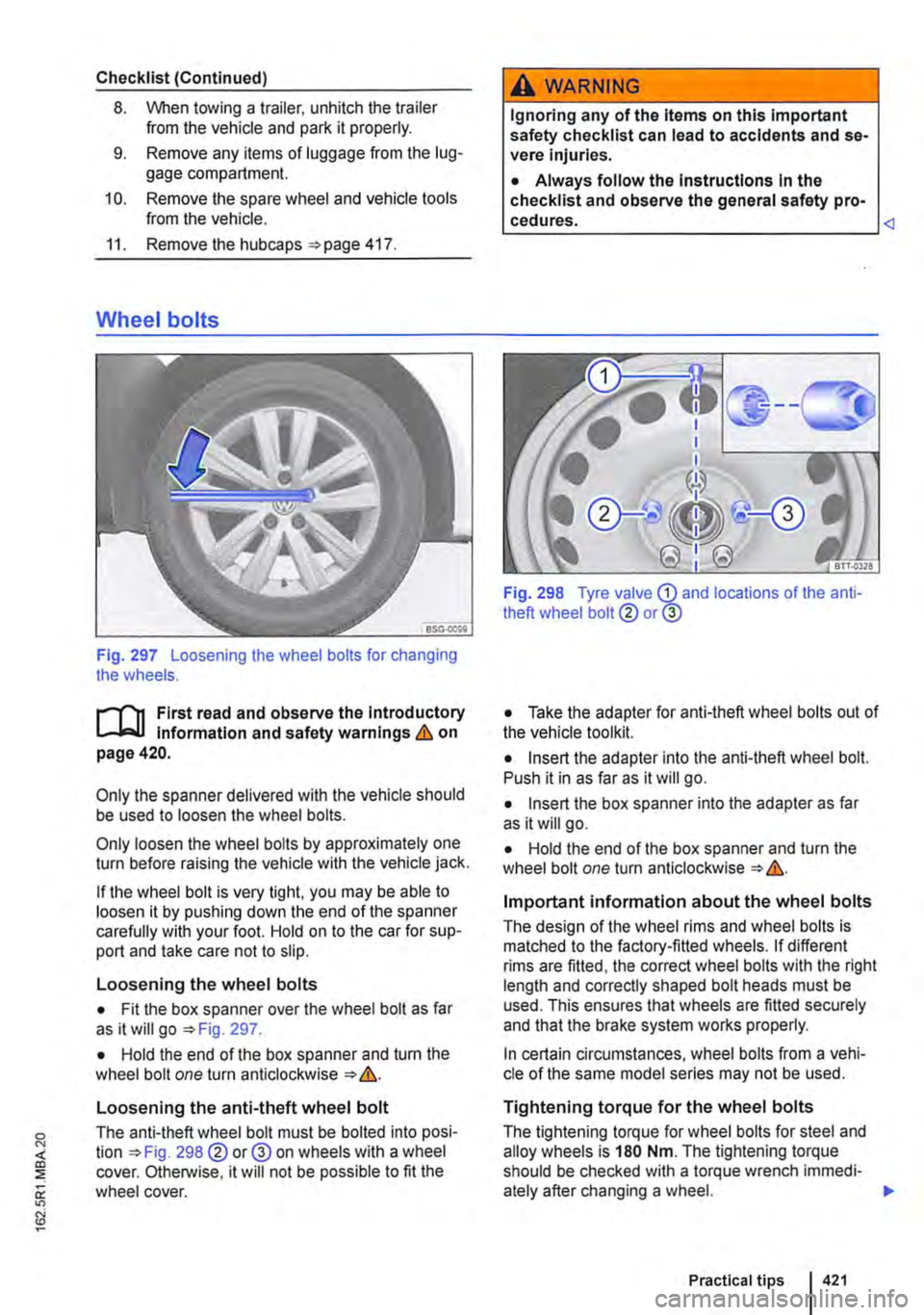
Fig. 297 Loosening the wheel bolts for changing the wheels.
r-"f"'n First read and observe the Introductory l.-J,:..LJ Information and safety warnings & on page420.
Only the spanner delivered with the vehicle should be used to loosen the wheel bolts.
Only loosen the wheel bolts by approximately one turn before raising the vehicle with the vehicle jack.
If the wheel bolt is very tight, you may be able to loosen it by pushing down the end of the spanner carefully with your foot. Hold on to the car for sup-port and take care not to slip.
Loosening the wheel bolts
• Fit the box spanner over the wheel bolt as far as it will go =>Fig. 297.
• Hold the end of the box spanner and turn the wheel bolt one turn anticlockwise => &.
Loosening the anti-theft wheel bolt
The anti-theft wheel bolt must be bolted into posi-tion =>Fig. 298@ or@ on wheels with a wheel cover. Otherwise, it will not be possible to fit the wheel cover.
A WARNING
Ignoring any of the Items on this Important safety checklist can lead to accidents and se-vere Injuries.
• Always follow the Instructions In the checklist and observe the general safety pro-
Fig. 298 Tyre valve G) and locations of the anti-theft wheel bolt@ or@
• Take the adapter for anti-theft wheel bolts out of the vehicle toolkit.
• Insert the adapter into the anti-theft wheel bolt. Push it in as far as it will go.
• Insert the box spanner into the adapter as far as it will go.
• Hold the end of the box spanner and turn the wheel bolt one turn anticlockwise => &.
Important information about the wheel bolts
The design of the wheel rims and wheel bolts is matched to the factory-fitted wheels. If different rims are fitted, the correct wheel bolts with the right length and correctly shaped bolt heads must be used. This ensures that wheels are fitted securely and that the brake system works properly.
In certain circumstances, wheel bolts from a vehi-cle of the same model series may not be used.
Tightening torque for the wheel bolts
The tightening torque for wheel bolts for steel and alloy wheels is 180 Nm. The tightening torque should be checked with a torque wrench immedi-ately after changing a wheel. .,.
Practical tips 421
Page 424 of 486
Checklist (Continued)
7. Raise the vehicle jack until it just fits under the jacking point of the vehicle.
8. Make sure that the foot of the jack is resting securely on the ground with its whole sur-face and that its axis of rotation is posi-tioned precisely, i.e. vertically beneath the point of application. For better clarity, extend the line from the point of application to the axis of rotation of the jack foot =>Fig. 300.
9. Position the vehicle jack. At the same time, continue to crank the claw up until it is in po-sition around the vertical rib underneath the vehicle => Fig. 300.
10. Crank the vehicle jack further until the wheel is just clear of the ground.
A WARNING
Incorrect use of the vehicle jack can cause the vehicle to slip off the jack, which can lead to severe Injuries. Please note the following points In order to reduce the risk of Injuries:
• Only use vehicle jacks which have been approved by Volkswagen Commercial Vehi-cles for your vehicle type. Other vehicle jacks could slip out of position-this Includes vehi-cle jacks supplied with other Volkswagen models.
• The ground must be firm and level. Soft ground or surfaces at an Incline under the ve-hicle jack may cause the vehicle to slip off the jack. If necessary use a large, strong board or similar support for the vehicle jack.
Changing a wheel
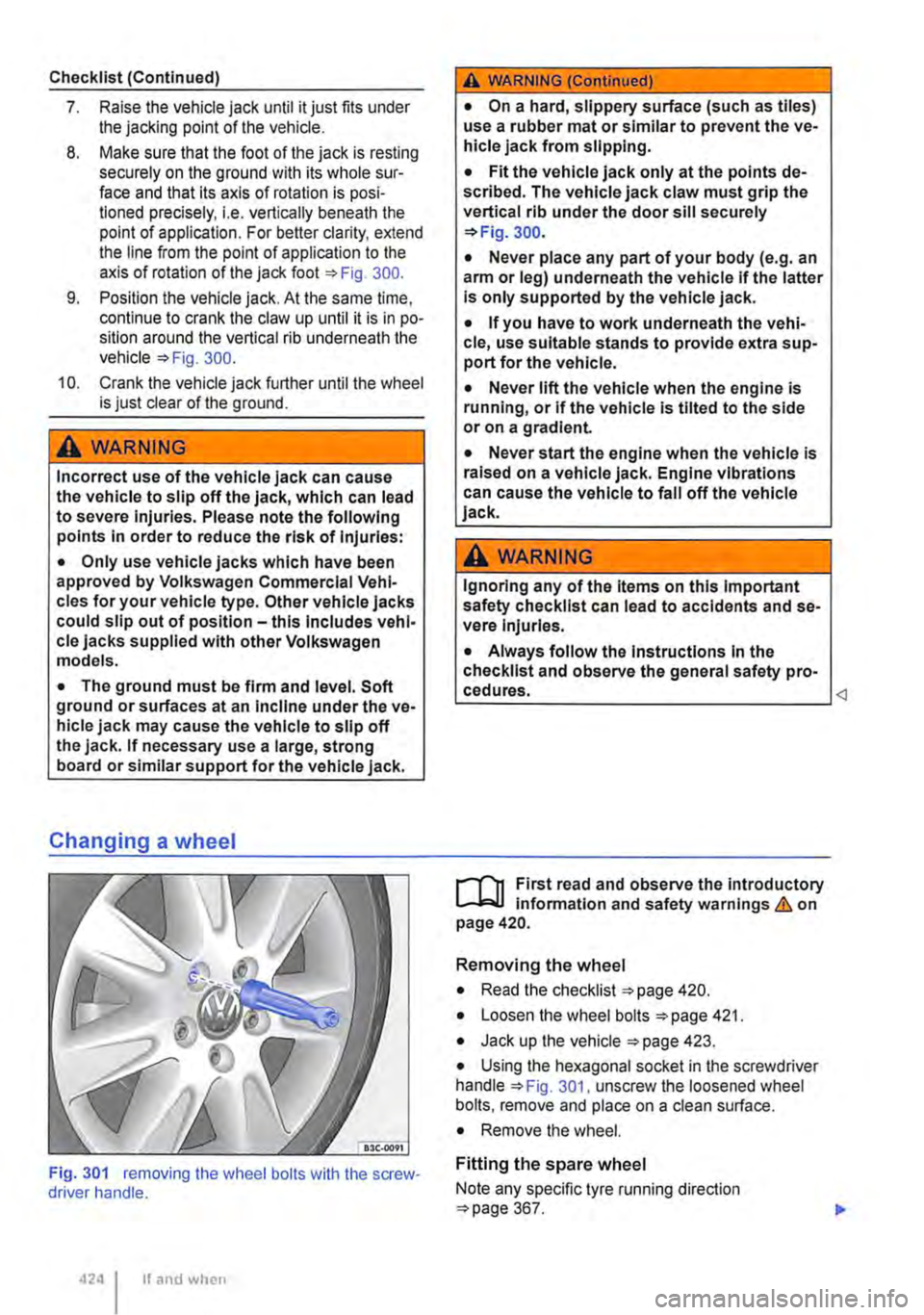
Fig. 301 removing the wheel bolts with the screw-driver handle.
424 If and when
A WARNING (ConUnued)
• On a hard, slippery surface (such as tiles) use a rubber mat or similar to prevent the ve-hicle jack from slipping.
• Fit the vehicle jack only at the points de-scribed. The vehicle jack claw must grip the vertical rib under the door sill securely =>Fig. 300.
• Never place any part of your body (e.g. an arm or leg) underneath the vehicle If the latter Is only supported by the vehicle jack.
• If you have to work underneath the vehi-cle, use suitable stands to provide extra sup-port for the vehicle.
• Never lift the vehicle when the engine is running, or If the vehicle is tilted to the side or on a gradient
• Never start the engine when the vehicle is raised on a vehicle jack. Engine vibrations can cause the vehicle to fall off the vehicle jack.
A WARNING
Ignoring any of the Items on this Important safety checklist can lead to accidents and se-vere Injuries.
• Always follow the Instructions In the checklist and observe the general safety pro-
r--('n First read and observe the introductory L-J.:.I.J information and safety warnings & on page 420.
Removing the wheel
• Read the checklist =>page 420.
• Loosen the wheel bolts =>page 421.
• Jack up the vehicle =>page 423.
• Using the hexagonal socket in the screwdriver handle =>Fig. 301, unscrew the loosened wheel bolts, remove and place on a clean surface.
• Remove the wheel.
Fitting the spare wheel
Note any specific tyre running direction =>page 367.
Page 425 of 486
• Clean the area around the fastening holes of the spare wheel.
• Position the spare wheel.
• Insert the anti-theft wheel bolt using the adapter at position 298 @or® and tighten it slight-ly.
• Screw in all the other wheel bolts in a clockwise direction and use the box spanner to tighten them gently.
• Lower the vehicle with the jack.
• Use the box spanner to tighten all the wheel bolts securely in a clockwise direction &. Do not tighten the bolts in clockwise or anticlockwise se-quence. Tighten them in diagonal sequence.
• Fit the cover caps, centre covers or wheel cov-ers 417.
After changing a wheel
rl'l1 First read and observe the Introductory L-.lo:.ll Information and safety warnings & on page 420.
• If necessary, clean the vehicle tools and stow them safely in the vehicle 416.
• Stow the spare wheel or the removed wheel safely under the vehicle.
Breakdown set
CQJ Introduction
This chapter contains information on the following subjects:
Storing . . . . . . . . . . . . . . . . . . . . 426
Contents of the breakdown set . . . . . . . . . . . . 427 Preparation . . . . . . . . . . . . . . . . . . . . . . . . . . . 427
Sealing and inflating tyres . . . . • . . . . . . . 428
Test after driving for 10 minutes . . . . 429
You can use the breakdown set (tyre mobility set) to safely seal any tyre damage caused by foreign bodies or punctures (up to 4 mm (0.16 Inches) in diameter). Do not remove foreign objects (e.g. screws or nails) from the tyrel
Once the sealant has been added to the tyre, the tyre pressure must be checked again after approxi-mately 10 minutes of driving.
,A WARNING
Incorrect torque or incorrect use of wheel bolts can lead to a loss of control of the vehi-cle, cause accidents and serious Injuries.
• Always keep all wheel bolts and threads In the wheel hubs clean and free from oil and grease. The wheel bolts must be easy to turn and be tightened to the specified torque.
• The hexagonal socket In the screwdriver handle should only be used for turning wheel bolts, not use for loosening or tightening them.
• The damaged wheel should be replaced as soon as possible.
m In vehicles with a tyre monitoring system, the L!..J system may have to "re-learn" if new tyres are fitted 318.
Only use the breakdown set if the car is parked in a safe place, you are familiar with the required ac-tions and safety procedures, and you have access to the correct breakdown set. Seek expert assis-tance if this is not the case.
The tyre sealant must not be used:
• If the rim is damaged.
• If the outside temperature is below -2o•c (-4 ·F).
• If there are cuts or punctures in the tyre that are larger than 4 mm. .,.
Practical tips 425
Page 426 of 486
• If the tyre pressure is very low or the tyres are flat.
• If the use-by date on the tyre filler bottle has ex-pired.
Additional information and warnings:
• Vehicle key set 36
• Seat functions, front 69
• Stowage 150
• Braking, stopping and parking =>page 269
• Wheels and tyres 367
• In an emergency 411
• Hubcaps 417
A WARNING
Using the breakdown set can be dangerous, especially if the tyres are inflated at the road-side. Please note the following points In or-der to reduce the risk of serious injuries:
• Stop the vehicle as soon as possible and when safe to do so. Park the vehicle at a safe distance from moving traffic in order to fill the tyre.
• Check that the surface the vehicle is parked on is level and firm.
• All passengers, and children in particular, must be at a safe distance and away from your area of work.
• Switch on the hazard warning lights to warn other road users.
• The breakdown set should only be used if you feel confident with carrying out the pro-cedure. If not, seek expert assistance.
Storing
rT'n First read and observe the introductory L-W.I information and safety warnings & on page 425.
Model
Multivan
California
426 I If and when
A WARNING (Continued)
• Tyres repaired with the breakdown set are intended for temporary, emergency use only. They should only be used until you can reach the nearest qualified workshop.
• Tyres that have been repaired using the breakdown set should be replaced as soon as possible.
• Sealant Is hazardous to health and must be washed off Immediately if it gets onto the skin.
• The breakdown set must be stored out of the reach of children.
• Never use a vehicle jack, even If it Is ap-proved for the vehicle.
• Always switch off the engine, apply the handbrake and move the selector lever to the position P or select a gear on a manual gear-box In order to reduce the risk of unintended vehicle movement.
A WARNING
Tyres that have been filled with sealant will not handle In the same way as a standard tyre.
• Never drive faster than 80 km/h (50 mph).
• Avoid full acceleration, sudden braking and fast driving through bends In the road.
• Drive for just 10 minutes at no more than 80 km/h (50 m ph) and then check the tyre.
Dispose of used or out-of-date sealant in ac-W cordance with legal requirements.
m You can get a new tyre filler bottle from a L!:J Volkswagen Commercial Vehicles dealership.
m Observe the separate instructions from the l!:J manufacturer of the breakdown set. <1
The breakdown set can be located in different pla-ces depending on the model.
Stowage
In the drawer in the 3-seat bench or in the drawer of the rear left single seat.
Behind the load-through hatch cover on the side of the bench seat/bed. <1
Page 427 of 486
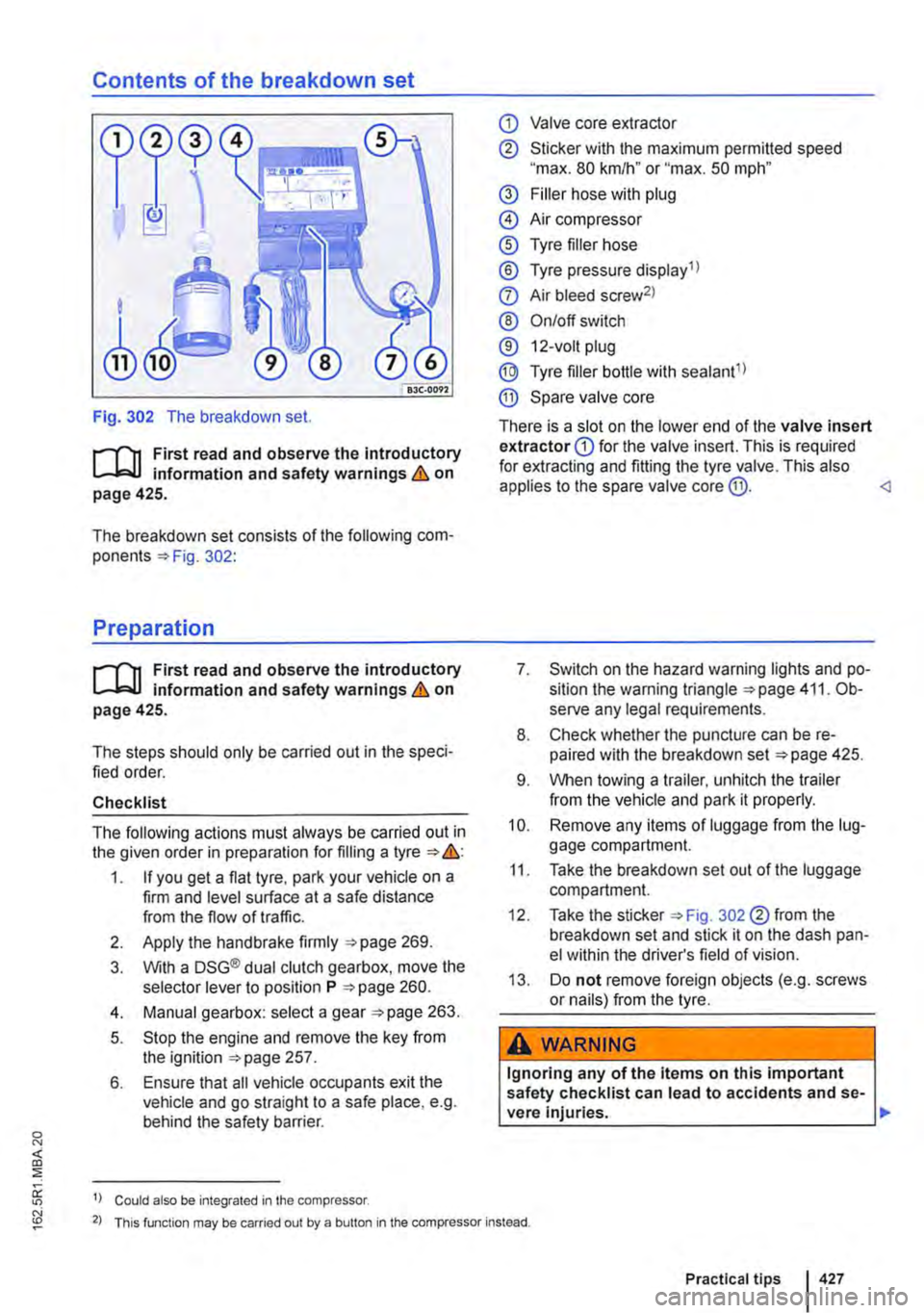
Contents of the breakdown set
Fig. 302 The breakdown set.
r--T'n First read and observe the introductory L-L::.U information and safety warnings & on page 425.
The breakdown set consists of the following com-ponents 302:
Preparation
r--T'n First read and observe the introductory L-L::.U information and safety warnings & on page 425.
The steps should only be carried out in the speci-fied order.
Checklist
The following actions must always be carried out in the given order in preparation for filling a tyre &:
1. If you get a flat tyre, park your vehicle on a firm and level surface at a safe distance from the flow of traffic.
2. Apply the handbrake firmly 269.
3. With a DSG® dual clutch gearbox, move the selector lever to position P 260.
4. Manual gearbox: select a gear 263.
5. Stop the engine and remove the key from the ignition 257.
6. Ensure that all vehicle occupants exit the vehicle and go straight to a safe place, e.g. behind the safety barrier.
1) Could also be integrated in the compressor.
CD Valve core extractor
® Sticker with the maximum permitted speed "max. 80 km/h" or "max. 50 mph"
@ Filler hose with plug
@ Air compressor
® Tyre filler hose
® Tyre pressure display 1 l
0 Air bleed screw2l
® On/off switch
® 12-volt plug
@ Tyre filler bottle with sealant1l
® Spare valve core
There is a slot on the lower end of the valve insert extractor CD for the valve insert. This is required for extracting and fitting the tyre valve. This also applies to the spare valve core @.
8. Check whether the puncture can be re-paired with the breakdown set 425.
9. When towing a trailer, unhitch the trailer from the vehicle and park it properly.
10. Remove any items of luggage from the lug-gage compartment.
11. Take the breakdown set out of the luggage compartment.
12. Take the sticker 302 ®from the breakdown set and stick it on the dash pan-el within the driver's field of vision.
13. Do not remove foreign objects (e.g. screws or nails) from the tyre.
A WARNING
Ignoring any of the items on this important safety checklist can lead to accidents and se-vere Injuries. ,..
2) This function may be carried out by a button in the compressor instead.
Practical tips 427
Page 428 of 486
A WARNING (Continued)
• Always follow the instructions In the checklist and observe the general safety pro-
Sealing and inflating tyres
r-"'('n First read and observe the Introductory L-J,.:.U Information and safety warnings & on page 425.
Sealing a tyre
• Unscrew the cap from the tyre valve.
• Use the valve core extractor 302 CD to screw the valve core out of the tyre valve. Place the core on a clean surface.
• Shake the tyre filler bottle 302 ® vigo-rously up and down several times.
• Screw the filler hose 302 @tightly onto the tyre filler bottle in a clockwise direction. The plastic foil on the plug is pierced automatically.
• Remove the plug from the filler hose 302@ and place the open end fully on the tyre valve.
• Hold the bottle upside down and inject the en-tire contents of the tyre filler bottle into the tyre.
• Remove the empty tyre filler bottle from the valve.
• Use the valve core extractor 302 CD to screw the valve core back onto the tyre valve.
Inflating the tyre
• Screw the tyre filler hose 302 ® of the air compressor tightly onto the tyre valve.
• Check that the bleed screw 302 (?) is closed.
• Start the engine and let it run.
• Insert the plug 302 ®into one of the ve-hicle's 12-volt sockets 163.
• Use the on/off switch 302 ®to switch on the air compressor.
• Run the compressor until the tyre pressure has reached 2.0-2.5 bar (29-36 psi I 200-250 kPa) maximum running time is 6 minutes
• Switch off the air compressor.
• If a pressure level of 2.0-2.5 bar (29-36 psi I 200 -250 kPa) cannot be achieved unscrew the tyre filler hose from the tyre valve.
428 I If and when
• Drive (or reverse) the vehicle approximately 1 0 metres so that the sealing compound is more evenly distributed in the tyre.
• Screw the tyre filler hose for the air compressor firmly back onto the tyre valve and inflate the tyre again.
• If the required pressure still cannot be reached, the tyre is too badly damaged. The tyre cannot be sealed with the breakdown set. Do not drive on. Seek expert assistance &.
• Disconnect the air compressor and unscrew the tyre filler hose from the tyre valve.
• Drive the vehicle no faster than 80 km/h (50 mph) once a tyre pressure of 2.0-2.5 bar (29-36 psi I 200-250 kPa) has been reached.
• Check the tyre pressure after driving for 10 mi-nutes 429.
A WARNING
The tyre filler hose and the air compressor can get hot during Inflation.
• Protect your hands and skin from the hot components.
• Do not place the hot tyre filler hose or the hot air compressor on any Inflammable mate-rials.
• Allow the device to cool down fully before stowing.
• If the tyre will not Inflate to at least 2.0 bar (29 psi/ 200 kPa), the tyre Is too damaged. The sealant Is unable to seal the tyre. Do not drive on. Seek expert assistance.
CD
Switch the air compressor off after a maximum of 6 minutes to avoid overheating. Let the air compressor cool down for a few minutes be-fore switching it back on.
Page 429 of 486
Test after driving for 10 minutes
r-'('n First read and observe the Introductory L-J,:.LI Information and safety warnings & on page 425.
Reconnect the tyre filler hose =>Fig. 302 ®and check the tyre pressure on the Tyre Pressure Loss Indicator®.
1.3 bar (19 psi /130 kPa) and lower:
• Do not drive on I The tyre cannot be sealed adequately with the breakdown set.
• Seek expert assistance => &.
1.4 bar (20 psi /140 kPa) and higher:
• Set the tyre pressure back to the correct value =>page 367.
• Resume your journey to the nearest qualified workshop. Do not exceed a maximum speed of 80 km/h (50 mph).
• The damaged tyre should be replaced at the qualified workshop.
Fuses
i:llJ Introduction
This chapter contains information on the following subjects:
Fuse box in the dash panel . . . . . . . . . . . . . . . 430
Fuses in the engine compartment . . . . . . . . . . 431 Changing a blown fuse ................... 431
At the time of print we are unable to provide an up-to-date overview of the locations of the fuses for the electrical consumers. This is because the vehi-cle is under constant development, because fuses are assigned differently depending on the vehicle equipment level and because several consumers may use a single fuse. You can get more informa-tion about the fuse layout from a Volkswagen Com-mercial Vehicles dealership.
Several electrical consumers could share a single fuse. Conversely, a single consumer could have more than one fuse.
Therefore fuses should only be replaced when the cause of the fault has been rectified. If a new fuse blows shortly after insertion, have the electrical system checked by a qualified workshop as soon as possible.
A WARNING
Driving with an unsealed tyre is dangerous as it can cause accidents and serious Injuries.
• Do not carry on driving if the tyre pressure Is 1.3 bar (19 psi /130 kPa) or lower.
• Seek expert assistance.
• Drink holder =>page 153
• Preparation for working in the engine compart-ment =>page 350
• Battery =>page 362
A WARNING
High voltages in the electrical system can cause electric shocks, serious burns and death.
• Never touch the electrical wiring of the ig-nition system.
• Avoid causing short circuits in the electri-cal system.
A WARNING
Using unsuitable or repaired fuses and bridg-ing an electrical circuit without fuses can cause a fire and serious injuries.
Practical tips I 429
Page 450 of 486
Technical data
Technical data
Vehicle data
COJ Introduction
This chapter contains information on the following subjects:
Vehicle identification data . . . . . . . . . . . . . . . . . 451
Dimensions ........................... . 452
Unless otherwise specified, the technical data of the basic model apply. The values quoted here may differ if additional equipment is fitted, for differ-ent models, for special vehicles or if country-specif-ic equipment is fitted. All data in the official vehicle documents take precedence over these data.
Engine
The vehicle data sticker and the official vehicle documents show which engine is installed in your vehicle.
Weight
The values for the kerb weight in the following ta-bles apply for the road-ready vehicle with driver (75 kg), service fluids including fuel tank carrying 90% of its capacity and, if applicable, toolkit and spare tyre =>&.Additional equipment and retrofit-ted accessories increase the stated kerb weight and reduce the maximum permitted load accord-ingly.
The load comprises the weights of the following:
• Passengers
• Allluggage
• Roof load including the mounts or roof bars and the load carrier system
• Drawbar load when towing a trailer
Performance figures
The performance figures were measured without equipment which may influence performance, such as a roof carrier or mud flaps.
Gross combination weight rating
The gross combination weight ratings listed are on-ly applicable for altitudes up to 1 ,000 m above sea level. The maximum weight of the car and trailer must be reduced by approximately 10% for every further 1 ,000 m in altitude.
450 I Tcchn1cal data
Descriptions of the tables
Gearbox abbreviations: MG = manual gearbox, DSG® = dual clutch gearbox DSG®.
Additional information and warnings:
• Transporting =:o page 125
• Driving with respect for the environment =:.page 278
• Fuel =:.page 343
• Engine oil =:o page 353
• Engine coolant =:o page 358
• Wheels and tyres =>page 367
• Consumer information =>page 404
,A WARNING
Exceeding the maximum permissible weights, payload, dimensions, vehicle speed and axle weight rating could cause damage to the vehicle, accidents and serious Injuries.
• Do not exceed the permitted weights, loads, dimensions and maximum speeds.
• The actual axle loads must never exceed the maximum permissible axle loads.
• The payload and the distribution of the load In the vehicle have an effect on the driv-ing response and braking distance of the ve-hicle. Adjust your speed accordingly.
,A WARNING
Accidents and severe injuries can occur if the maximum permitted gross combination weight Is exceeded.
• Never exceed the specified gross combi-nation weight rating.
Page 452 of 486
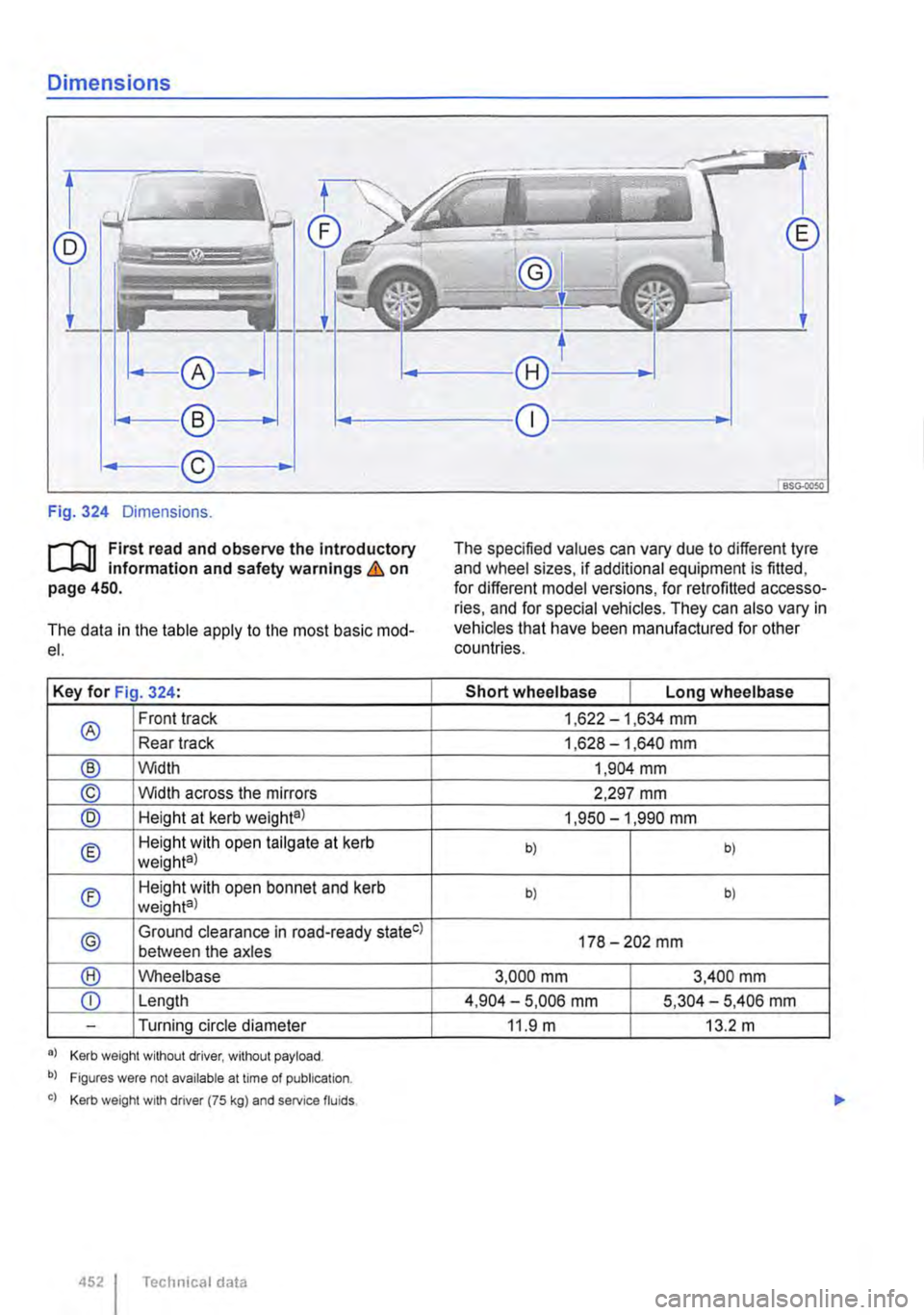
Dimensions
Fig. 324 Dimensions.
l""""'('n First read and observe the introductory L-J,.:.U information and safety warnings & on page 450.
The data in the table apply to the most basic mod-el.
Key for Fig. 324:
® Front track
Rear track
® Width
© Width across the mirrors
@ Height at kerb weight8l
® Height with open tailgate at kerb weight8l
® Height with open bonnet and kerb weight8l
@ Ground clearance in road-ready statecl between the axles
® Wheelbase
CD Length
-Turning circle diameter
•l Kerb weight without driver, without payload.
b) Figures were not available at time of publication.
c) Kerb weight with driver (75 kg) and service fluids.
452 I Technical data
The specified values can vary due to different tyre and wheel sizes, if additional equipment is fitted, for different model versions, for retrofitted accesso-ries, and for special vehicles. They can also vary in vehicles that have been manufactured for other countries.
Short wheelbase Long wheelbase
1,622 -1,634 mm
1,628 -1,640 mm
1,904 mm
2,297 mm
1,950-1 ,990 mm
b) b)
b) b)
178-202 mm
3,000 mm 3,400 mm
4,904-5,006 mm 5,304 -5,406 mm
11.9 m 13.2 m
Page 466 of 486

Vents ............................ 329 Windscreen heating . . . . . . . . . . . . . . . . . 331
Air conditioning system, California . . . . . . 250
Air reclrculation mode . . . . . . . . . . . . . . . . 330 Operation . . . . . . . . . . . . . . . . . . . . . . . . . 330 Switching off . . . . . . . . . . . . . . . . . . . . . . . 330 Switching off temporarily . . . . . . . . . . . . . 330
Alarm system . . . . . . . . . . . . . . . . . . . . . . . . . 43 Alcantara . . . . . . . . . . . . . . . . . . . . . . . . . . . 389
Alternator . . . . . . . . . . . . • . . . . . • . . . . . . . . 364
Aluminium . . . . . . . . . . . . . . . . . . . . . . . . . . 385
Anodised surfaces . . . . . . . . . . . . . . . . . . . 385
Anti-freeze . . . . . . . . . . . . . . . . . . . . • . . . . . 360 Anti-lock brake system (ABS) . . . . . . . . . . 275 Anti-snaking coupling Trailer . . . . . . . . . . . . . . . . . . . . . . . . . . . . 142
Anti-theft alarm . . . . . . . • . . . . . . . . • . . . . . . 43 Anti-tow alarm . . . . . . . . . . . . . . . . . . . . . . 44 Description . . . . . . . . . . . . . . . . . . . . . . . . . 43 Interior monitoring system . . . • . . . . . . . . . 44 Risk of false alarm . . . . . . . . . . . . . . . . . . . 44 Trailer . . . . . . . . . . . . . . . . . . . . . . . . . . . . 145 Anti-theft wheel bolts . . . . . . . . . 417, 420, 421
Anti-tow alarm . . . . . . . . . . . . . . 44
Applications . . . . . . . . . . . . • . . . . . 404
Apps ............................... 404 Area monitoring system . . . . . . . . . . . . . . . 307 City Emergency Brake function ......... 311 Displays . . . . . . . . . . . . . . . . . . . . . . . . . . 308 Fault . . . . . . . . . . . . . . . . . . . . . . . . . . . . . 308 Radar sensor . . . . . . . . . . . . . . . . . . . . . . 309 System limits . . . . . . . . . . . . . . . . . . . . . . 312
Armrest, 2-seat arrangement, Business Adjusting . . . . . . . . . . . . . . . . . . . . . . . . . 184 Stowage compartment . . . . . . . . . • . . . . . 184
Armrest, 3-seat bench . . . . . . . . . . . . . . . . . . 78
Ashtray . . . . . . . . . . . . . . . . . . . . . . . . . . . . . 161 Front. . . . . . . . . . . . . . . . . . . . . . . . . . . . . 162 Rear . . . . . . . . . . . . . . . . . . . . . . . . . . . . . 162 Removable . . . . . . . . . . . . . . . . . . . . . . . . 162 Assist systems Adaptive chassis control (DCC) . . . . . . . . 317 Adaptive cruise control (ACC) . . . . . . . . . 298 Anti-lock brake system (ABS) . . . . . . . . . 275 Area monitoring system (Front Assist) . . . 307 Automatic Post-Collision Braking System 274 Brake Assist system (BAS) . . . . . . . . . . . 275 ccs ............................. 295 Cruise control system . . . . . . . . . . . . • . . 295 Driver Alert System .. .. .. .. .. . .. .. .. 315 Electronic differential lock (EDL) . . . . . . . 275 Electronic stability control (ESC) . . . . . . . 274 Hill Descent Assist . . . . . . . . . . . . . . . . . . 285 Hill Hold Assist . . . . . . . . . . . . . . . • . . . . . 284 Lane change assist system . . . . . . . . . . . 312 Parking aid . . . . . . . . . . . . . . . . . . . . . . . . 287
466 Index
Parking aid (front and rear) . . . • . . . . . . . 289 Parking aid (only at rear) . . . . . . . . . . . . . 288 ParkPilot . . . . . . . . . . . . . . . . . . . . . . . . . . 287 ParkPilot (front and rear) . . . . . . . . . . . . . 289 ParkPilot (only at rear) . . . . . . . . . . . . . . . 288 Rear Assist (reversing camera) . . . . . . . . 291 Recommendation for rest breaks....... 315 Reversing camera . . . . . . . . . . . . . . . . . . 291 Side Assist (lane change assist system) . 312 Start/stop . . . . . . . . . . . . . . . . . . . . . . . . . 283 Traction control system (TCS) . . . . . 275, 276 Tyre monitoring system . . . . . . . . . . 318, 321
Asymmetrical tyres . . . . . . . . . . . . . . . . . . . 377
Automatic belt retractor . . . . . . . . . . . . . . . . 86 Automatic car wash . . . . . . . . . . . . . . . . . . 381
Automatic gearbox See Dual clutch gearbox . . . . . . . . . . . . . 260 see Dual clutch gearbox DSG . . . . . . . . . 264 Automatic headlight control ............. 110
Automatic Post-Collision Braking System 274
Automatic switch-off for electrical consum-ers .............................. . 366
Auxiliary air heater See Supplementary heater .......... . 332 Auxiliary coolant heater Remote control .................... . See Supplementary heater .......... .
Auxiliary equipment or body parts ..... .
335 332
396
Auxiliary heater Remote control .................... . see Supplementary heater ........... . See Supplementary heater .......... . Switch-off delay ..............•.....
335 251 332 334 Awning ............................. 226 Closing . . . . . . . . . . . . . . . . . . . . . • . . . . . 227 Opening . . . . . . . . . . . . . . . . . . . . . . . . . . 227 Removing and fitting . . . . . . . . . . • . . . . . 228
Axle weight rating . . . . . . . . . . . . . . • . . . . . 450
8
Ball coupling Fitting . . . . . . . . . . . . . . . . . . . . . . • . . . . . 142 Mounting . . . . . . . . . . . . . . . . . . . . . . . . . 142 Ready position . . . . . . . . . . . . . . . . . . . . . 142 Removing . . . . . . . . . . . . . . . . . . . . . . . . . 144
BAS see Brake support systems . . . . . . . . . . . 275 Battery Discharge . . . . . . . . . . . . . . . . . . . . . . . . . 339 Remote control (supplementary heating sys-tem) . . . . . . . . . . . . . . . . . . . . . . . . . . . . 337 Replacing in remote control key . . . . . . . . . 38 see Vehicle battery . . . . . . . . . . . . . . . . . . 362
Battery charger . . . . . . . . . . . . . . . . • . . . . . 24 7
Bed extension . . . . . . . . . . . . . . . . . . . . . . . . 77