tow VOLVO 240 1990 User Guide
[x] Cancel search | Manufacturer: VOLVO, Model Year: 1990, Model line: 240, Model: VOLVO 240 1990Pages: 143, PDF Size: 2.32 MB
Page 64 of 143

Volvo 1990 240 Model
pg. 50 Trailer hauling
When preparing for trailer hauling, observe the following:
l Use a trailer hitch which meets Federal Safety Standards for rear end co\
llisions (FMVSS 301 -75).
For trailer weights exceeding 2,000 lbs (908 kgs) use only a trailer h\
itch offered as a Genuine Volvo
Accessory.
l Maximum trailer weight recommended by Volvo is 3,300 lbs (1,500 kg). \
However, for cars with automatic transmission, an optional Volvo automat\
ic transmission oil cooler
must be installed when trailer weight exceeds 2,000 lbs (908 kgs). Wit\
h manual transmission, 5th gear
should not be used while towing. Observe legal requirements of the state\
in which the vehicles are
registered.
All Volvo models are equipped with energy absorbing shock mounted bumper\
s. Trailer hitch installation
should not interfere with the proper operation of the bumper system.
WARNING! Bumper-attached trailer hitches must not be used on Volvo's, no\
r should safety chains be
attached to the bumper.
Trailer hitches attaching to the vehicle rear axle must not be used.
WARNING! Never connect a trailer's hydraulic-brake system directly to th\
e vehicle brake system, nor
a trailer's lighting system directly to the vehicle lighting system. Con\
sult your nearest authorized
Volvo dealer for correct installation.
Trailer hauling does not normally present any particular problems, but t\
ake into consideration:
l Recommended hitch tongue load is 110 lbs (50 kgs) for trailer weights \
below 2,650 lbs (1,200 kgs)
and 143-154 lbs (65-70 kgs) for trailer weights above 2,650 lbs (1,20\
0 kgs). However, it must not
exceed 200 lbs (90 kgs).
l For trailer weights between 2,650-3,300 lbs (1,200-1,500 kgs) a top sp\
eed of 50 mph (80 km/h)
should never be exceeded.
l Engine and transmission are subject to increased loads. Therefore, engin\
e coolant temperature should
be closely watched when driving in hot climate or hilly terrain. Use low\
er gear and turn off air
conditioner if temperature gauge pointer enters the red range.
l Avoid overload and other abusive operation.
l Hauling a trailer affects handling, durability and economy.
file:///K|/ownersdocs/1990/1990_240/90240_11.htm (1 of 6)12/30/2006 8:\
25:06 AM
Page 65 of 143
.
l More frequent vehicle maint")
Volvo 1990 240 Model
l It is necessary to balance trailer brakes with the towing vehicle brakes\
to provide a safe stop (check
and observe State regulations).
l More frequent vehicle maintenance is required.
l Remove the ball and drawbar assembly when the hitch is not being used.
l Increase tire pressure to recommended full-load pressure. See section 'W\
heels and Tires."
Note: Refer to section entitled "Automatic transmission" for additional \
trailer hauling
tips.
Warning: Do not drive with trunk lid or tailgate
open!
Poisonous exhaust gases may enter via the open trunk lid or tailgate. (\
This is especially true for wagon
models.)
If the trunk lid or tailgate for any reason must be open, proceed as fol\
lows:
l Close the windows.
l Set the heating system controls for floor and defroster to max. and the \
blower to full speed (4). See
section titled "Heating and Ventilation".
Handling, roadholding
Vehicle load, tire design and inflation pressure are important for prope\
r handling. Therefore check that
the tires are inflated to the recommended pressure according to the vehi\
cle load.
Loads should be distributed so that capacity weight or maximum permissib\
le axle loads are not
exceeded.
It is recommended to use tires of the same make and dimensions on all fo\
ur wheels.
Warning: Do not mix radial ply and bias ply tires as this will adversely\
alter the vehicle handling
characteristics.
Roof rack
Permanent and removable roof racks are available from Volvo Accessories.\
file:///K|/ownersdocs/1990/1990_240/90240_11.htm (2 of 6)12/30/2006 8:\
25:06 AM
Page 67 of 143

Volvo 1990 240 Model
The power assist to the brakes functions only when the engine is running\
. When the car is moving
without the engine running the brake pedal pressure required to stop the\
car is increased 3- 4 times.
The brake pedal feels stiff and hard.
Disc brake noise: A slight-to-moderate amount of disc brake "squeal" is \
considered normal.
Air dam (front spoiler)
A non-factory air dam can negatively influence the normal flow of coolin\
g air to the front wheel brakes.
(See section titled "Wheels and Tires").
If one of the brake circuits should malfunction the red warning light wi\
ll come on
(See section titled "Warning Lights".)
The pedal stroke increases slightly and the pedal feels softer but the p\
edal pressure required does not
increase noticeably.
If the light comes on while driving and the brake pedal can be depressed\
further than normal, it is an
indication that one of the brake circuits is not functioning. Stop immed\
iately, open engine hood and
check brake fluid level.
Reservoir empty: do NOT drive. Tow car to shop for check/repair of brake\
system. Reservoir not empty:
proceed immediately and with caution to a Volvo dealer for an inspection\
of the brake system.
Severe strain on the brake system
The brakes will be subject to severe strain when driving in mountains or\
hilly areas. The speed is usually
low which means that the cooling of the brake is less efficient than whe\
n driving on level roads.
To reduce the strain on the brakes it is advisable not to use the brakes\
excessively.
Instead, shift into a lower gear and let the engine help with the brakin\
g. A good rule is to use the same
gear downhill as would be used ascending the same grade. For vehicles wi\
th automatic transmission use
position 2, or in some cases, 1.
file:///K|/ownersdocs/1990/1990_240/90240_11.htm (4 of 6)12/30/2006 8:\
25:06 AM
Page 68 of 143

Volvo 1990 240 Model
pg. 52 Catalytic Converter
Catalytic Converter Cautions
l Keep your engine properly tuned. Certain engine malfunctions, particular\
ly involving the electrical,
fuel or ignition systems, may cause unusually high converter temperature\
s. Do not continue to operate
your vehicle it you detect engine misfire, noticeable loss of power or o\
ther unusual operating conditions,
such as engine overheating or backfiring. A properly-tuned engine will h\
elp in avoiding malfunctions
that could damage the Catalytic Converter.
l Remember that tampering with or unauthorized modifications to the engine\
or the vehicle may be
illegal and can cause catalyst or exhaust system overheating. This inclu\
des:
-- Altering fuel injection settings or components.
-- Adjusting ignition timing beyond specified limits.
-- Altering emission system components or location or removing component\
s.
-- Use of leaded fuel.
WARNING: Do not park your car over combustible materials, such as grass \
or leaves, which can
come into contact with the hot exhaust system and cause such materials t\
o ignite under certain wind
and weather conditions.
l Excessive starter cranking (in excess of one continuous minute) with a\
n intermittently firing or
flooded engine, can cause catalyst or exhaust system overheating. This a\
lso applies to lengthy pushing or
towing of vehicle to start (manual transmissions only). Do not attempt\
to start a car with automatic
file:///K|/ownersdocs/1990/1990_240/90240_11.htm (5 of 6)12/30/2006 8:\
25:06 AM
Page 69 of 143

Volvo 1990 240 Model
transmission by pushing or towing .
CAUTION: Unleaded fuel is required for cars with catalytic converter. A \
label on the instrument panel
and rear fender, near the filler inlet, will remind owners and filling s\
tation attendants of this
requirement.
Important! It is unlawful to dispense leaded fuel into any vehicle label\
ed "unleaded gasoline only".
Contents | Top of Page
file:///K|/ownersdocs/1990/1990_240/90240_11.htm (6 of 6)12/30/2006 8:\
25:06 AM
Page 82 of 143
 oil/oil filter change interva\
l
Oil quality
According to API SG or alternatively API SF.
l Oils with designations SO/CD, SF/CC")
Volvo 1990 240 Model
pg. 62 Engine Oil, 5,000-mile (8,000-km) oil/oil filter change interva\
l
Oil quality
According to API SG or alternatively API SF.
l Oils with designations SO/CD, SF/CC and SF/CD comply with these requirem\
ents.
Viscosity (stable ambient temperatures):
Volvo recommends the use of energy-conserving oils. Look for the API lab\
el. Synthetic or
semisynthetic oils may be used if their specifications comply with the o\
il quality requirements.
Volvo does not recommend oil additives, as they can adversely affect the\
engine.
Changing oil and oil filter
Oil and oil filter are first changed at the 600-1,200 mile (1,000-2,000\
km) service. Thereafter, changes
should be made as specified by this table:
Capacity
Including oil filter: 4.0 US qts = 3.85 litres
Check oil level when filling fuel.
SAE 15W/40 is recommended for use in driving conditions that raise oil t\
emperature and increase oil
consumption (i.e., mountain driving, trailer towing).
file:///K|/ownersdocs/1990/1990_240/90240_13.htm (6 of 9)12/30/2006 8:\
25:08 AM
Page 83 of 143
 label.")
Volvo 1990 240 Model
Note: SAE 15W/40 must not be used at low ambient temperatures; see visco\
sity
chart.
Volvo recommends the use of oils with the American Petroleum Institute (\
API) label. This
label certifies that the oil conforms to the applicable standards and sp\
ecifications of the
API.
If driving conditions include: Then the correct oil/oil filter change interval
is:
l Extended periods of idling and/or low-speed
operation
l Frequent short trips (less than 7 miles = 11 km)
l Extended periods of driving in dusty and/or sandy
areas
l Trailer towing
l Driving in mountainous areas EVERY 3 MONTHS
or 5,000 miles = 8,000 km
WHICHEVER COMES FIRST
l Primarily highway driving
l Frequent trips of longer than 7 miles = 11 km
EVERY 6 MONTHS
or 5,000 miles = 8,000 km
WHICHEVER COMES FIRST
pg. 63 Cooling system
file:///K|/ownersdocs/1990/1990_240/90240_13.htm (7 of 9)12/30/2006 8:\
25:08 AM
Page 100 of 143

Volvo 1990 240 Model
Cooling system
The risk of overheating is greatest, especially in hot weather, when:
- towing a trailer up steep inclines for prolonged periods at full throt\
tle, and at low engine rpm.
- idling for prolonged periods while the air conditioning system is in o\
peration.
- stopping the engine suddenly after high speed driving, so called after\
-boiling.
To avoid overheating. the following rules should be followed.
l Reduce speed and downshift when towing a trailer up long steep inclines.\
The risk of over heating can
be reduced by switching off the air conditioning system for a short whil\
e.
l Do not let the engine idle unnecessarily.
l Do not stop the engine immediately after high-speed driving, but allow t\
he engine to idle for 1/2 - 1
minute before switching off.
When the risk of overheating is imminent, or in the event of overheating\
, (the temperature gauge goes
repeatedly into, or stays continually in, the red section) the followin\
g precautions should be taken:
l Switch off the air conditioning system and switch the heater to full (m\
aximum) position.
l Stop the car and put the gear lever into neutral position-position N. Do\
not stop the engine!
l Increase the engine speed to approx. 2000 rpm (twice idling speed).
l Check the level of coolant in the expansion tank. Top-up, if necessary
pg. 75 Alternator, Jump starting
Electrical System cautions
When changing the battery or when carrying out work involving the electr\
ical system, the following
should be observed:
1 A battery connection to the wrong terminal will damage the diodes. Bef\
ore connections are made,
check the polarity of the battery with a voltmeter.
2 If booster batteries are used for starting, they must be properly conn\
ected to prevent the diodes from
being damaged. For correct connection, see "Jump starting".
3 The battery leads should be disconnected any time the battery is being\
charged.
file:///K|/ownersdocs/1990/1990_240/90240_15.htm (8 of 10)12/30/2006 8\
:25:09 AM
Page 106 of 143
Volvo 1990 240 Model
3 Rear turn signal 32 21 Ba 15s 1156
4 Tail light 4 5 Ba 15s 67
5 Reflector - - - -
6 Brake light/tail
light* 32/3
21/5 BaY
15d 1157
*Right side lamp holders are white. Left side lamp holders are black. pg. 78 Replacing bulbs
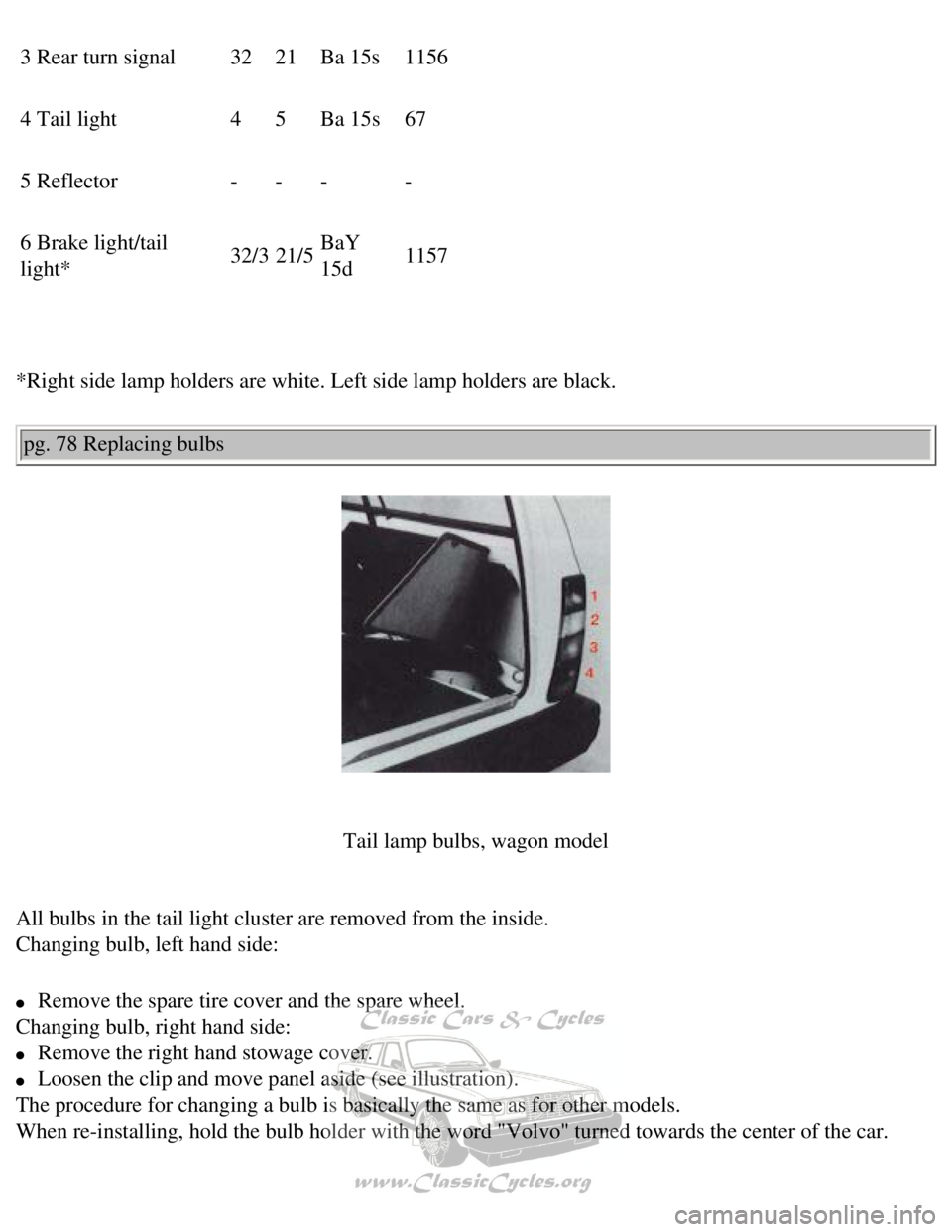
Tail lamp bulbs, wagon model
All bulbs in the tail light cluster are removed from the inside.
Changing bulb, left hand side:
l Remove the spare tire cover and the spare wheel.
Changing bulb, right hand side:
l Remove the right hand stowage cover.
l Loosen the clip and move panel aside (see illustration).
The procedure for changing a bulb is basically the same as for other mod\
els.
When re-installing, hold the bulb holder with the word "Volvo" turned to\
wards the center of the car.
file:///K|/ownersdocs/1990/1990_240/90240_16.htm (4 of 10)12/30/2006 8\
:25:10 AM