brake VOLVO 240 1990 Owner's Manual
[x] Cancel search | Manufacturer: VOLVO, Model Year: 1990, Model line: 240, Model: VOLVO 240 1990Pages: 143, PDF Size: 2.32 MB
Page 66 of 143
Volvo 1990 240 Model
l Observe the following points when in use.
l Avoid point loads. Distribute the load evenly.
l Place the heavy cargo at bottom of load.
l Observe that center of gravity and handling are influenced by the load w\
eight.
l Increasing load size increases wind resistance.
l Anchor the cargo correctly with a cord.
l Drive carefully. Avoid rapid starts, heavy cornering and heavy braking. \
l Max. roof load is 220 lbs (100 kg); use a root rack with a sufficient \
load rating.
pg. 51 Automatic transmission, Brake system
The following "Special Tips" apply to cars with automatic transmission
l For steep hills and when driving for prolonged periods at low speeds, po\
sition 1 should be selected.
Avoid, however, repeated changes since this can cause overheating of the\
transmission oil. For driving
on mountain roads with long persistent uphill gradients, select position\
2.
l When negotiating long, steep, downhill slopes, position 1 should be sele\
cted and position 2 for less
severe inclines, in order to obtain the best possible engine braking eff\
ect.
Do not hold the car stationary on an incline by using the accelerator pe\
dal. Instead, engage the hand
brake. This prevents the transmission oil from becoming overheated.
l 4th gear must be disengaged when hauling a trailer!
l If an additional transmission oil cooler is installed you can haul a tra\
iler with the overdrive engaged.
See next "special tip".
l When driving with heavy trailers, it is recommended that an additional o\
il cooler be installed. This
applies especially when driving under severe conditions e.g. mountain dr\
iving or prolonged driving at
high speeds without breaks. The additional oil cooler is available as a \
genuine Volvo accessory.
Regarding oil change, see section titled "Transmission oil".
Moisture on brake discs and brake pads affects braking.
Driving in rain and slush or passing through a normal car wash can cause\
water to collect on the brake
discs and pads. This will cause a delay in braking effect when the pedal\
is depressed. To avoid such a
delay, when the brakes are needed, depress the pedal occasionally when d\
riving in rain or slush.
This will remove the water from the brakes.
This should also be done after washing or starting in very damp weather.\
If the brake power assist does not function --
file:///K|/ownersdocs/1990/1990_240/90240_11.htm (3 of 6)12/30/2006 8:\
25:06 AM
Page 67 of 143

Volvo 1990 240 Model
The power assist to the brakes functions only when the engine is running\
. When the car is moving
without the engine running the brake pedal pressure required to stop the\
car is increased 3- 4 times.
The brake pedal feels stiff and hard.
Disc brake noise: A slight-to-moderate amount of disc brake "squeal" is \
considered normal.
Air dam (front spoiler)
A non-factory air dam can negatively influence the normal flow of coolin\
g air to the front wheel brakes.
(See section titled "Wheels and Tires").
If one of the brake circuits should malfunction the red warning light wi\
ll come on
(See section titled "Warning Lights".)
The pedal stroke increases slightly and the pedal feels softer but the p\
edal pressure required does not
increase noticeably.
If the light comes on while driving and the brake pedal can be depressed\
further than normal, it is an
indication that one of the brake circuits is not functioning. Stop immed\
iately, open engine hood and
check brake fluid level.
Reservoir empty: do NOT drive. Tow car to shop for check/repair of brake\
system. Reservoir not empty:
proceed immediately and with caution to a Volvo dealer for an inspection\
of the brake system.
Severe strain on the brake system
The brakes will be subject to severe strain when driving in mountains or\
hilly areas. The speed is usually
low which means that the cooling of the brake is less efficient than whe\
n driving on level roads.
To reduce the strain on the brakes it is advisable not to use the brakes\
excessively.
Instead, shift into a lower gear and let the engine help with the brakin\
g. A good rule is to use the same
gear downhill as would be used ascending the same grade. For vehicles wi\
th automatic transmission use
position 2, or in some cases, 1.
file:///K|/ownersdocs/1990/1990_240/90240_11.htm (4 of 6)12/30/2006 8:\
25:06 AM
Page 70 of 143
Volvo 1990 240 Model
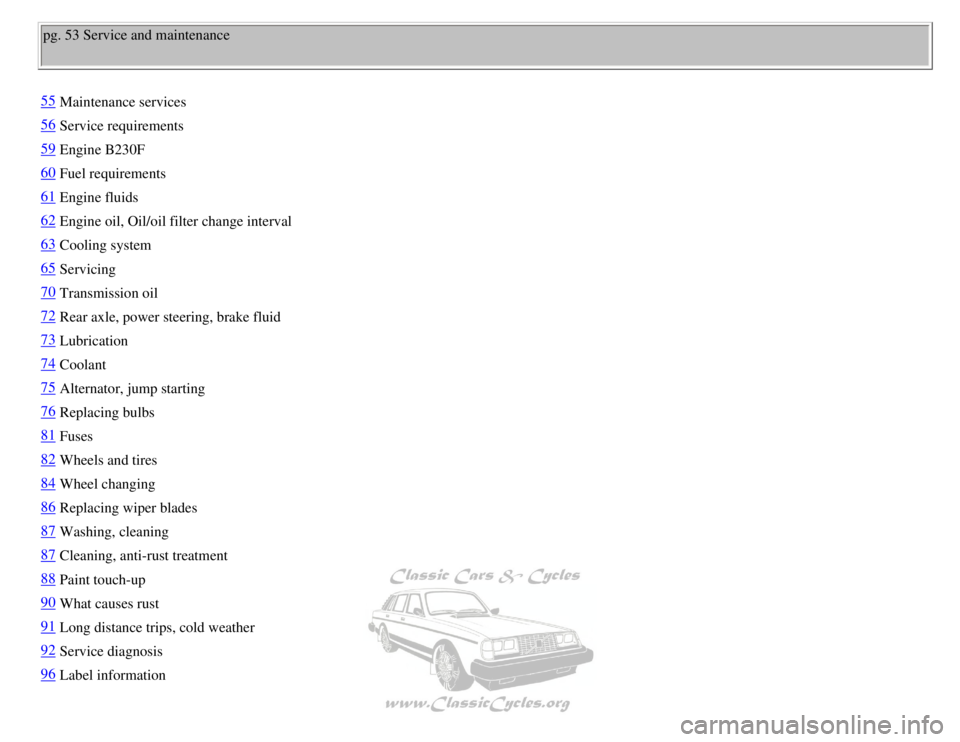
pg. 53 Service and maintenance
55Maintenance services
56Service requirements
59Engine B230F
60Fuel requirements
61Engine fluids
62Engine oil, Oil/oil filter change interval
63Cooling system
65Servicing
70Transmission oil
72Rear axle, power steering, brake fluid
73Lubrication
74Coolant
75Alternator, jump starting
76Replacing bulbs
81Fuses
82Wheels and tires
84Wheel changing
86Replacing wiper blades
87Washing, cleaning
87Cleaning, anti-rust treatment
88Paint touch-up
90What causes rust
91Long distance trips, cold weather
92Service diagnosis
96Label information
file:///K|/ownersdocs/1990/1990_240/90240_12.htm (1 of 7)12/30/2006 8:\
25:07 AM
Page 75 of 143
Volvo 1990 240 Model
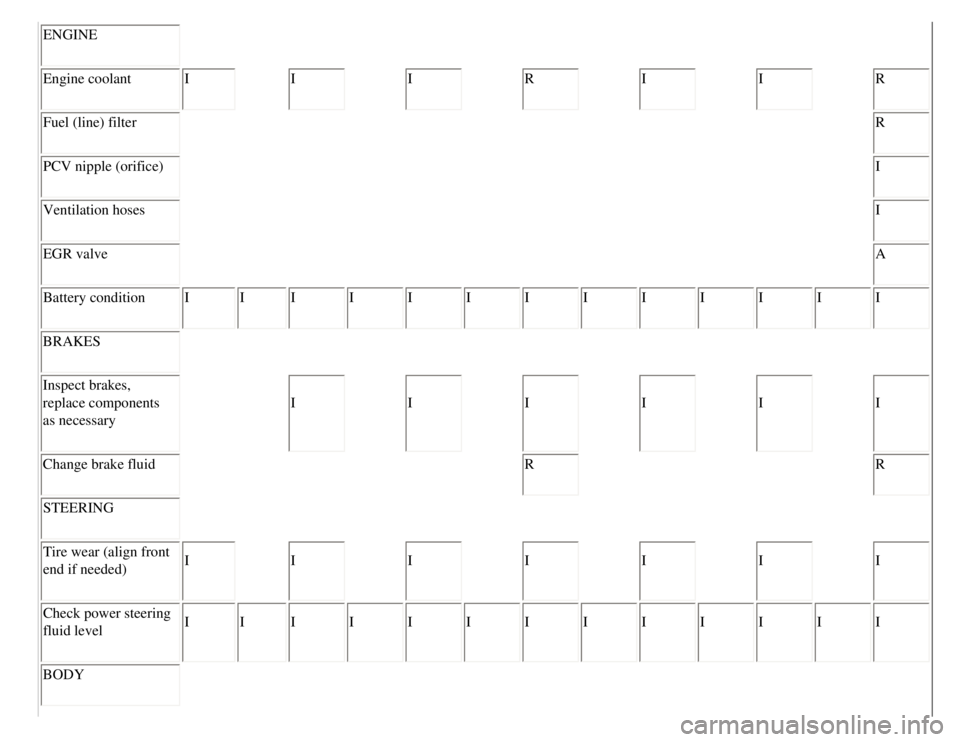
ENGINE
Engine coolant I I I R I I R
Fuel (line) filter R
PCV nipple (orifice) I
Ventilation hoses I
EGR valve A
Battery condition I I I I I I I I I I I I I
BRAKES
Inspect brakes,
replace components
as necessary I
I I I I I
Change brake fluid R R
STEERING
Tire wear (align front
end if needed) I
I I I I I I
Check power steering
fluid level I
I I I I I I I I I I I I
BODY
file:///K|/ownersdocs/1990/1990_240/90240_12.htm (6 of 7)12/30/2006 8:\
25:07 AM
Page 77 of 143
Volvo 1990 240 Model
pg. 58 Servicing Engine
The following items should be checked weekly Description
by the owner. (This only takes a few moments.) on page
Engine oil level 61
Brake fluid 72
Radiator coolant level 74
Tire pressures (including spare) 82, 103
Operation of all lights -
Horns -
Windshield wipers -
Level of windshield fluid -
The following should also be carried out at Description
regular intervals on page
Washing 87
Polishing 87
Cleaning 87
Rust protection inspection 87 pg. 59 Servicing Engine
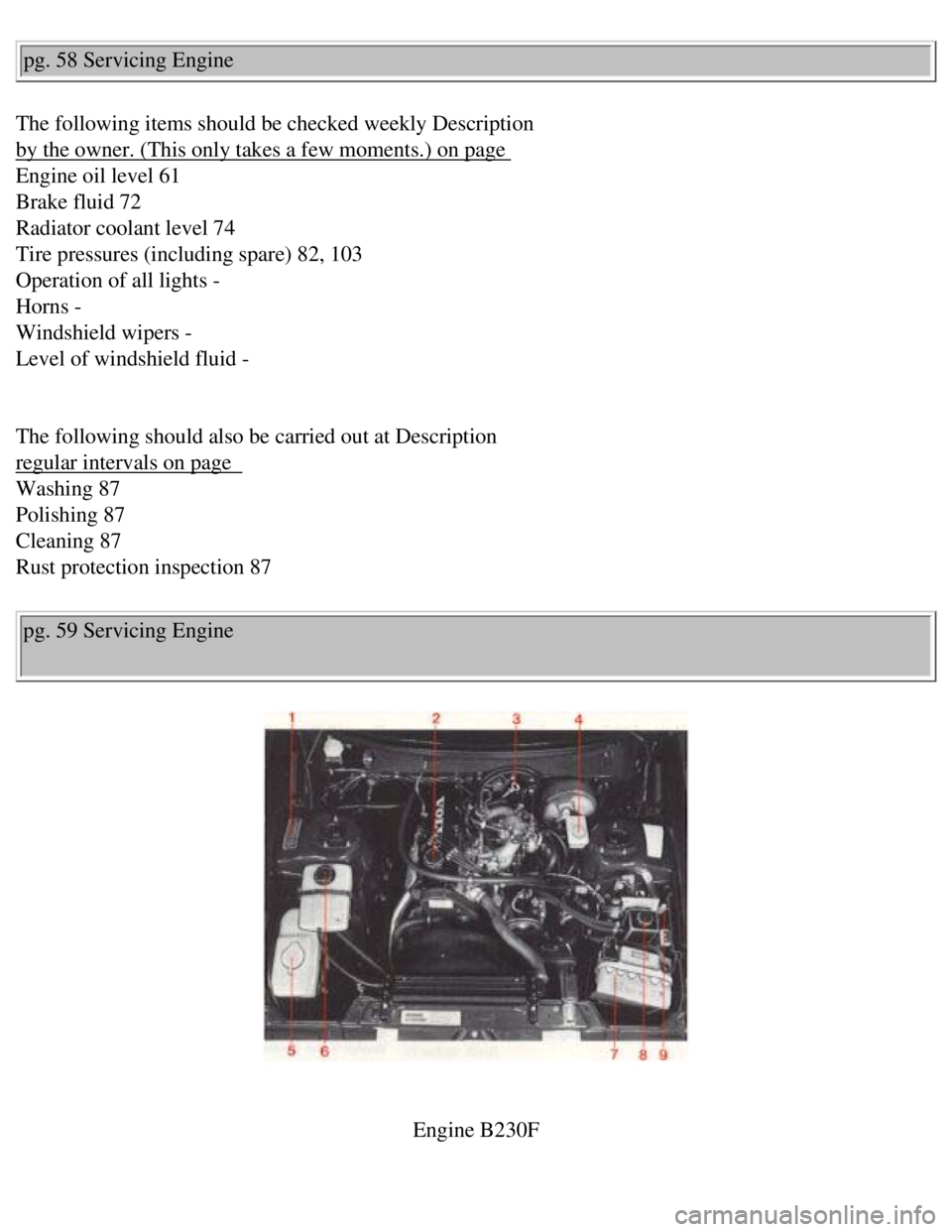
Engine B230F
file:///K|/ownersdocs/1990/1990_240/90240_13.htm (1 of 9)12/30/2006 8:\
25:08 AM
Page 78 of 143
Volvo 1990 240 Model
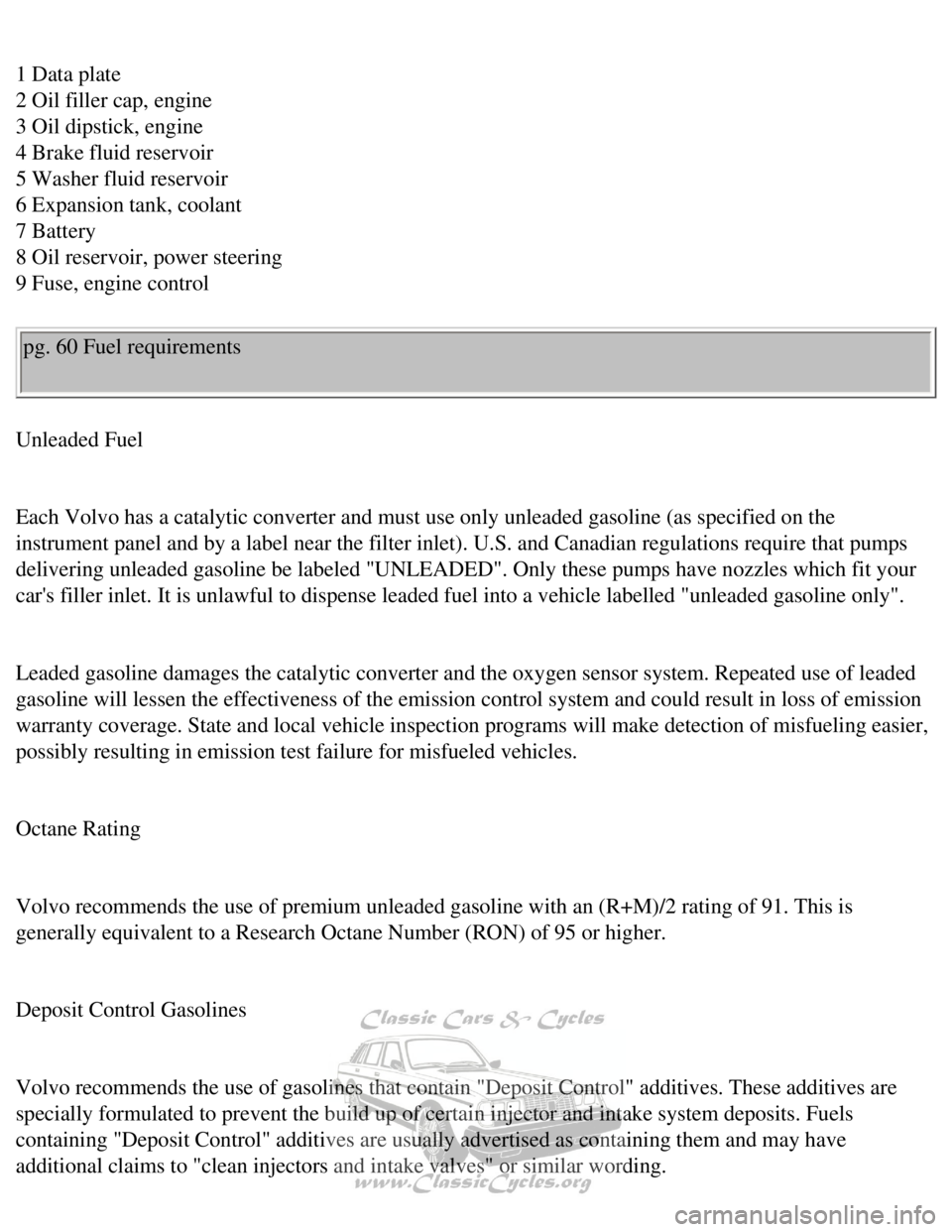
1 Data plate
2 Oil filler cap, engine
3 Oil dipstick, engine
4 Brake fluid reservoir
5 Washer fluid reservoir
6 Expansion tank, coolant
7 Battery
8 Oil reservoir, power steering
9 Fuse, engine control pg. 60 Fuel requirements
Unleaded Fuel
Each Volvo has a catalytic converter and must use only unleaded gasoline\
(as specified on the
instrument panel and by a label near the filter inlet). U.S. and Canadi\
an regulations require that pumps
delivering unleaded gasoline be labeled "UNLEADED". Only these pumps hav\
e nozzles which fit your
car's filler inlet. It is unlawful to dispense leaded fuel into a vehicl\
e labelled "unleaded gasoline only".
Leaded gasoline damages the catalytic converter and the oxygen sensor sy\
stem. Repeated use of leaded
gasoline will lessen the effectiveness of the emission control system an\
d could result in loss of emission
warranty coverage. State and local vehicle inspection programs will make\
detection of misfueling easier,
possibly resulting in emission test failure for misfueled vehicles.
Octane Rating
Volvo recommends the use of premium unleaded gasoline with an (R+M)/2 \
rating of 91. This is
generally equivalent to a Research Octane Number (RON) of 95 or higher\
.
Deposit Control Gasolines
Volvo recommends the use of gasolines that contain "Deposit Control" add\
itives. These additives are
specially formulated to prevent the build up of certain injector and int\
ake system deposits. Fuels
containing "Deposit Control" additives are usually advertised as contain\
ing them and may have
additional claims to "clean injectors and intake valves" or similar word\
ing.
file:///K|/ownersdocs/1990/1990_240/90240_13.htm (2 of 9)12/30/2006 8:\
25:08 AM
Page 81 of 143

Volvo 1990 240 Model
Brake fluid
Without removing the cap, check that the level is above the MIN mark. Br\
ake fluid DOT 4. See "Brake
fluid" section.
Battery
Check level in conjunction with normal service or once a year. Electroly\
te level 1/4" - 3/8"(5-10 mm)
above plates. Use distilled water. Never add acid.
Warning:
Battery gases are explosive if brought in contact with open flame or
sparks.
Washer fluid Coolant reservoir
Washer fluid
Washer fluid reservoir. Water and solvent (in wintertime, use windshiel\
d washer anti-freeze). See
"Washer fluid reservoir" section.
file:///K|/ownersdocs/1990/1990_240/90240_13.htm (5 of 9)12/30/2006 8:\
25:08 AM
Page 86 of 143
 inspection. A lo")
Volvo 1990 240 Model
pg. 64 Service requirements
Engine Mechanical Components
Torque manifold nuts
The manifold nuts should be torqued at the 600-1,200 mile (1,000-2,000 \
km) inspection. A loose
manifold could alter air/fuel ratio and cause an increase in emission an\
d/or poor driveability.
Valves
The valve clearance should be checked every 30,000 miles (48,000 km). \
Vacuum fittings, hoses and connections
Unstable idle, misfiring or poor emission control is often caused by lea\
king vacuum hoses or
connections. Check hoses and connections on distributor vacuum unit, EGR\
valve (where applicable)
and connections on heater control servo systems and hydraulic brake serv\
o.
Exhaust Gas Recirculation (EGR)
This system operates by returning some of the exhaust gases to the engin\
e to be recombusted: since this
lowers the combustion temperature the amount of nitrogen oxides released\
into the atmosphere is
reduced.
The EGR valve should be cleaned at the 60,000 mile inspection and therea\
fter cleaned every 25,000
miles (40,000 km).
Timing belt
The timing belt tensioner should be adjusted at the 600-1,200 mile (1,0\
00-2,000 km) inspection.
file:///K|/ownersdocs/1990/1990_240/90240_14.htm (1 of 7)12/30/2006 8:\
25:08 AM
Page 95 of 143
Volvo 1990 240 Model
WARNING! The oil may be very
hot!
Do not use rags which can leave lint on the dipstick.
The transmission is topped up via the dipstick tube.
The space between the MIN and MAX marks on the dipstick corresponds to 0\
.5 US qts (0.5 liter). Do
not fill the transmission with too much oil, since this can result in oi\
l being ejected from the
transmission.
Too little oil, on the other hand, can negatively affect transmission op\
eration, particularly in very cold
weather.
pg. 72 Rear axle oil, Power steering fluid, Brake fluid
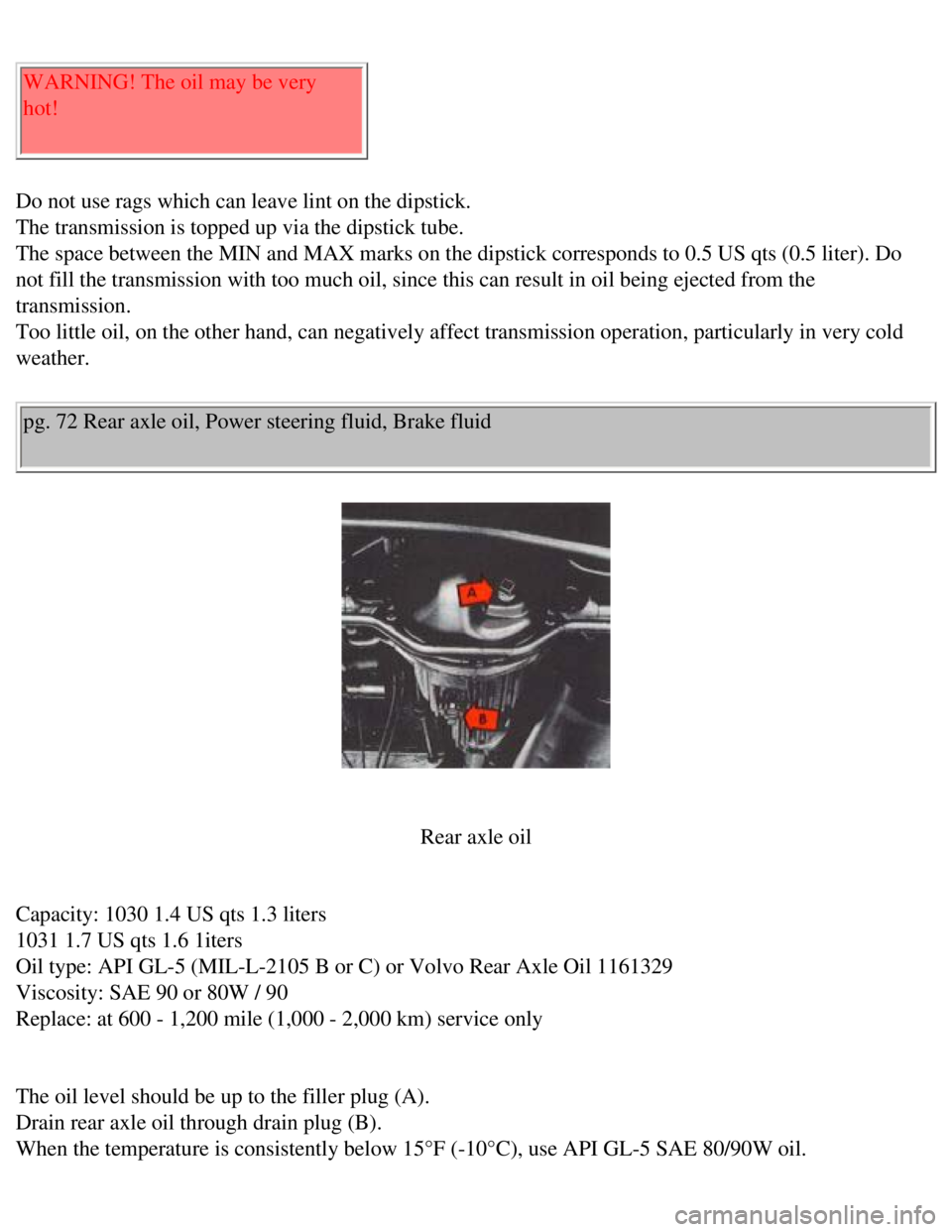
Rear axle oil
Capacity: 1030 1.4 US qts 1.3 liters
1031 1.7 US qts 1.6 1iters
Oil type: API GL-5 (MIL-L-2105 B or C) or Volvo Rear Axle Oil 1161329 \
Viscosity: SAE 90 or 80W / 90
Replace: at 600 - 1,200 mile (1,000 - 2,000 km) service only
The oil level should be up to the filler plug (A).
Drain rear axle oil through drain plug (B).
When the temperature is consistently below 15°F (-10°C), use API\
GL-5 SAE 80/90W oil.
file:///K|/ownersdocs/1990/1990_240/90240_15.htm (3 of 10)12/30/2006 8\
:25:09 AM
Page 96 of 143

Volvo 1990 240 Model
Cars equipped with limited slip differentials should use oils with prope\
r additives.
Power steering fluid
Capacity: 0.8 US qts = 0.75 1iters
Fluid type: ATF
Replace: no fluid change required.
The dipstick is attached to the cap. Fluid level should be between MIN a\
nd MAX marks. Add fluid
when the level is at the ADD mark.
Brake fluid
file:///K|/ownersdocs/1990/1990_240/90240_15.htm (4 of 10)12/30/2006 8\
:25:09 AM