oil level VOLVO 240 1990 Owners Manual
[x] Cancel search | Manufacturer: VOLVO, Model Year: 1990, Model line: 240, Model: VOLVO 240 1990Pages: 143, PDF Size: 2.32 MB
Page 8 of 143
Volvo 1990 240 Model
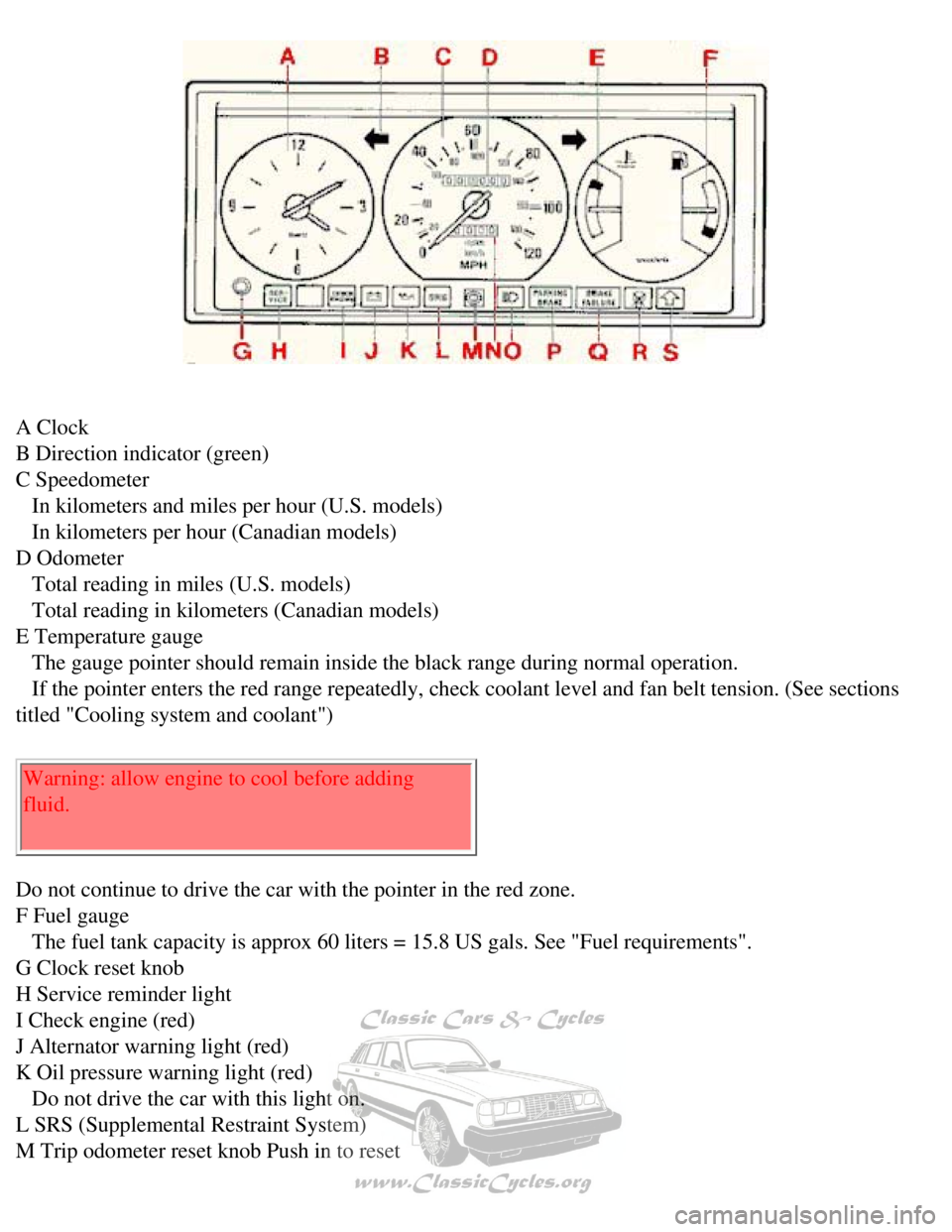
A Clock
B Direction indicator (green)
C Speedometer
In kilometers and miles per hour (U.S. models)
In kilometers per hour (Canadian models)
D Odometer
Total reading in miles (U.S. models)
Total reading in kilometers (Canadian models)
E Temperature gauge
The gauge pointer should remain inside the black range during normal \
operation.
If the pointer enters the red range repeatedly, check coolant level a\
nd fan belt tension. (See sections
titled "Cooling system and coolant") Warning: allow engine to cool before adding
fluid.
Do not continue to drive the car with the pointer in the red zone.
F Fuel gauge
The fuel tank capacity is approx 60 liters = 15.8 US gals. See "Fuel \
requirements".
G Clock reset knob
H Service reminder light
I Check engine (red)
J Alternator warning light (red)
K Oil pressure warning light (red)
Do not drive the car with this light on.
L SRS (Supplemental Restraint System)
M Trip odometer reset knob Push in to reset
file:///K|/ownersdocs/1990/1990_240/90240_01.htm (4 of 5)12/30/2006 8:\
25:01 AM
Page 10 of 143

Volvo 1990 240 Model
pg. 11 Warning lights
The warning lights described on this page should never be on when drivin\
g
When the ignition is turned on, and before the engine starts, all of the\
warning lights should be on to test
the function of the bulbs. Should a light not go off after the engine ha\
s started, the system indicated
should be inspected. (However, the parking brake reminder light will no\
t go off until the parking brake
is fully released.)
Alternator warning light (red)
If the light comes on while the engine is running,
check the tension of the alternator drive belt as soon
as possible. (See section titled "Cooling system".)
NOTE: This warning light is illuminated if the
alternator is not charging. However, alternator,
parking brake, brake failure, and bulb failure will
be illuminated at the same time due to the design
of the system
Parking brake reminder light (red)
This light will be on when the parking brake
(hand brake) is applied. The parking brake lever
is situated between the front seats. Canadian
models are equipped with this warning light:
Bulb failure warning light (yellow)
The light will come on if any of the following bulbs
are defective:
one of the lower beams
one of the tail lights
one of the brake lights (when the brake pedal is
depressed).
See section on "Replacing Bulbs."
Oil pressure warning light (red)
If the light comes on during driving, the oil
pressure is too low. Stop the engine immediately
and check the engine oil level. See section titled
"Engine Oil". Do not continue to drive the car
with this light on.
After hard driving, the light will come on
occasionally when the engine is idling. This is
normal, provided it goes off when the engine
speed is increased.
file:///K|/ownersdocs/1990/1990_240/90240_02.htm (1 of 4)12/30/2006 8:\
25:02 AM
Page 62 of 143

Volvo 1990 240 Model
Precautionary steps to observe when towing
Please check with state and local authorities before attempting this typ\
e of towing as vehicles being
towed are subject to regulations regarding maximum towing speed, length \
and type of towing device,
lighting, etc.
l Steering must be unlocked.
l Remember that power brake and power steering assists will not be availab\
le when engine is
inoperative. Pedal pressure required is 3 - 4 times above normal and gre\
ater steering effort must be
employed.
l Towing cars equipped with automatic transmission:
-- Gear selector in position N. Check transmission oil level (see secti\
on titled "Transmission oil").
-- Maximum speed: 20 mph (30 km/h).
-- Maximum distance with rear wheels on ground: 20 miles (30 km).
CAUTION!
Do not attempt to start the car by pushing or pulling as damage to catal\
ytic converter can
result.
Jump starting, see section titled "alternator, jump starting".
NOTE:
Refer lo the section regarding "On-
Call"
pg. 49 Tow-truck information
Only use wheel lift or flat bed equipment.
CAUTION:
Sling-type equipment applied at the font will damage radiator and air co\
nditioning lines. It is equally
important not to use sling-type equipment at the rear or apply lifting e\
quipment inside the rear wheels;
serious damage to the rear axle may result.
file:///K|/ownersdocs/1990/1990_240/90240_10.htm (6 of 7)12/30/2006 8:\
25:05 AM
Page 67 of 143

Volvo 1990 240 Model
The power assist to the brakes functions only when the engine is running\
. When the car is moving
without the engine running the brake pedal pressure required to stop the\
car is increased 3- 4 times.
The brake pedal feels stiff and hard.
Disc brake noise: A slight-to-moderate amount of disc brake "squeal" is \
considered normal.
Air dam (front spoiler)
A non-factory air dam can negatively influence the normal flow of coolin\
g air to the front wheel brakes.
(See section titled "Wheels and Tires").
If one of the brake circuits should malfunction the red warning light wi\
ll come on
(See section titled "Warning Lights".)
The pedal stroke increases slightly and the pedal feels softer but the p\
edal pressure required does not
increase noticeably.
If the light comes on while driving and the brake pedal can be depressed\
further than normal, it is an
indication that one of the brake circuits is not functioning. Stop immed\
iately, open engine hood and
check brake fluid level.
Reservoir empty: do NOT drive. Tow car to shop for check/repair of brake\
system. Reservoir not empty:
proceed immediately and with caution to a Volvo dealer for an inspection\
of the brake system.
Severe strain on the brake system
The brakes will be subject to severe strain when driving in mountains or\
hilly areas. The speed is usually
low which means that the cooling of the brake is less efficient than whe\
n driving on level roads.
To reduce the strain on the brakes it is advisable not to use the brakes\
excessively.
Instead, shift into a lower gear and let the engine help with the brakin\
g. A good rule is to use the same
gear downhill as would be used ascending the same grade. For vehicles wi\
th automatic transmission use
position 2, or in some cases, 1.
file:///K|/ownersdocs/1990/1990_240/90240_11.htm (4 of 6)12/30/2006 8:\
25:06 AM
Page 77 of 143
Volvo 1990 240 Model
pg. 58 Servicing Engine
The following items should be checked weekly Description
by the owner. (This only takes a few moments.) on page
Engine oil level 61
Brake fluid 72
Radiator coolant level 74
Tire pressures (including spare) 82, 103
Operation of all lights -
Horns -
Windshield wipers -
Level of windshield fluid -
The following should also be carried out at Description
regular intervals on page
Washing 87
Polishing 87
Cleaning 87
Rust protection inspection 87 pg. 59 Servicing Engine
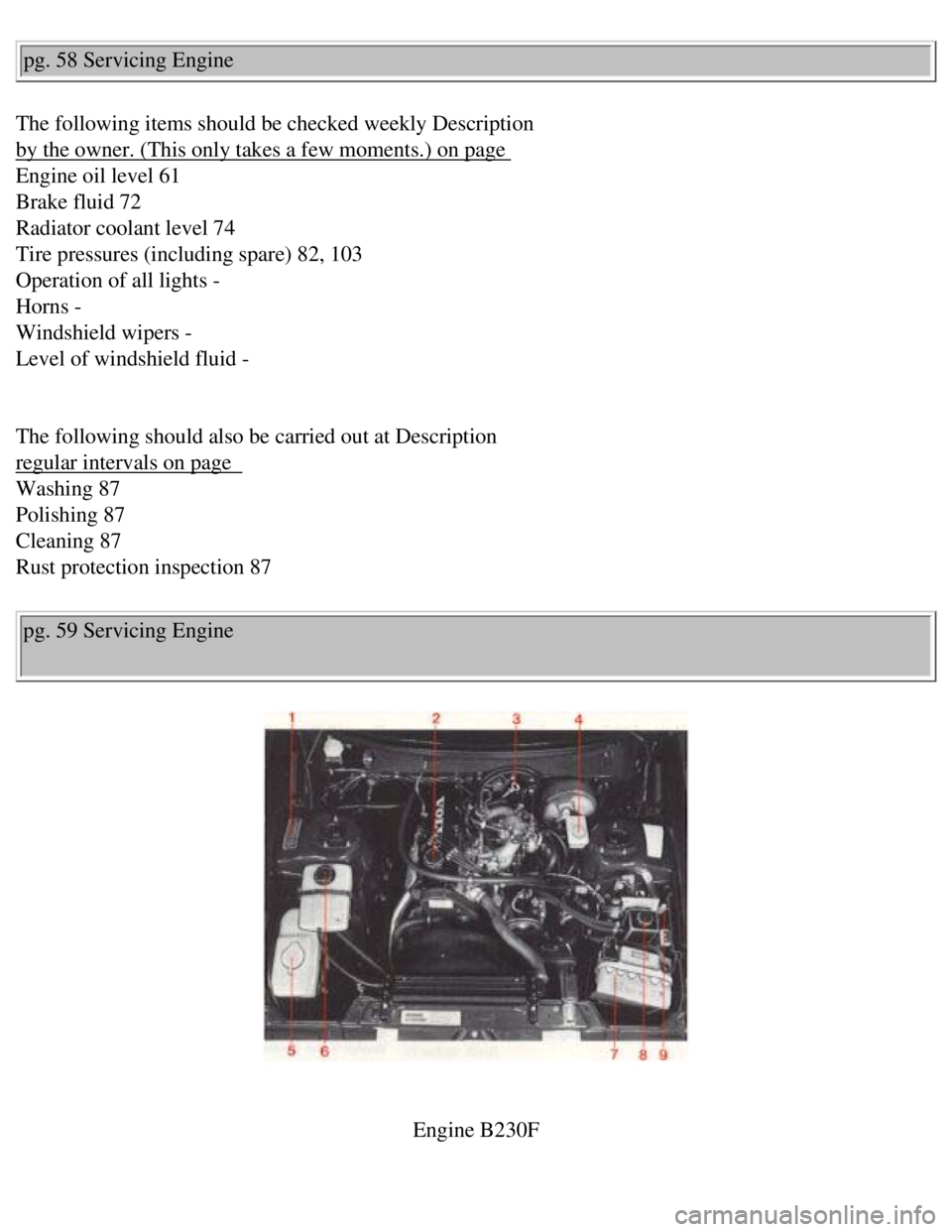
Engine B230F
file:///K|/ownersdocs/1990/1990_240/90240_13.htm (1 of 9)12/30/2006 8:\
25:08 AM
Page 80 of 143

Volvo 1990 240 Model
Checking oil level
The oil level should be checked each time the fuel tank is refilled. Be \
sure the oil level is maintained
between the upper and lower marks on the dipstick. Low oil level can cau\
se internal damage to the
engine and overfilling can result in high oil consumption. The distance \
between the dipstick marks
represents approx. 1 quart (1 liter) of oil.
Changing oil filter
Replace the oil filter at every oil change. If the oil filter is changed\
separately, 1/2 US qt = 1/2 liter of oil
should be added.
To add oil or change oil
Add oil of the same kind as already used. See engine oil section.
Note: Allow engine to cool before changing
oil.
Coolant
Maintain fluid level between MAX and MIN marks on expansion tank. Mixtur\
e of 50 percent Volvo
antifreeze type C (blue-green) or similar and 50 percent water should \
be used. See "Coolant" section.
file:///K|/ownersdocs/1990/1990_240/90240_13.htm (4 of 9)12/30/2006 8:\
25:08 AM
Page 82 of 143
 oil/oil filter change interva\
l
Oil quality
According to API SG or alternatively API SF.
l Oils with designations SO/CD, SF/CC")
Volvo 1990 240 Model
pg. 62 Engine Oil, 5,000-mile (8,000-km) oil/oil filter change interva\
l
Oil quality
According to API SG or alternatively API SF.
l Oils with designations SO/CD, SF/CC and SF/CD comply with these requirem\
ents.
Viscosity (stable ambient temperatures):
Volvo recommends the use of energy-conserving oils. Look for the API lab\
el. Synthetic or
semisynthetic oils may be used if their specifications comply with the o\
il quality requirements.
Volvo does not recommend oil additives, as they can adversely affect the\
engine.
Changing oil and oil filter
Oil and oil filter are first changed at the 600-1,200 mile (1,000-2,000\
km) service. Thereafter, changes
should be made as specified by this table:
Capacity
Including oil filter: 4.0 US qts = 3.85 litres
Check oil level when filling fuel.
SAE 15W/40 is recommended for use in driving conditions that raise oil t\
emperature and increase oil
consumption (i.e., mountain driving, trailer towing).
file:///K|/ownersdocs/1990/1990_240/90240_13.htm (6 of 9)12/30/2006 8:\
25:08 AM
Page 93 of 143
Volvo 1990 240 Model
pg. 70 Manual transmission
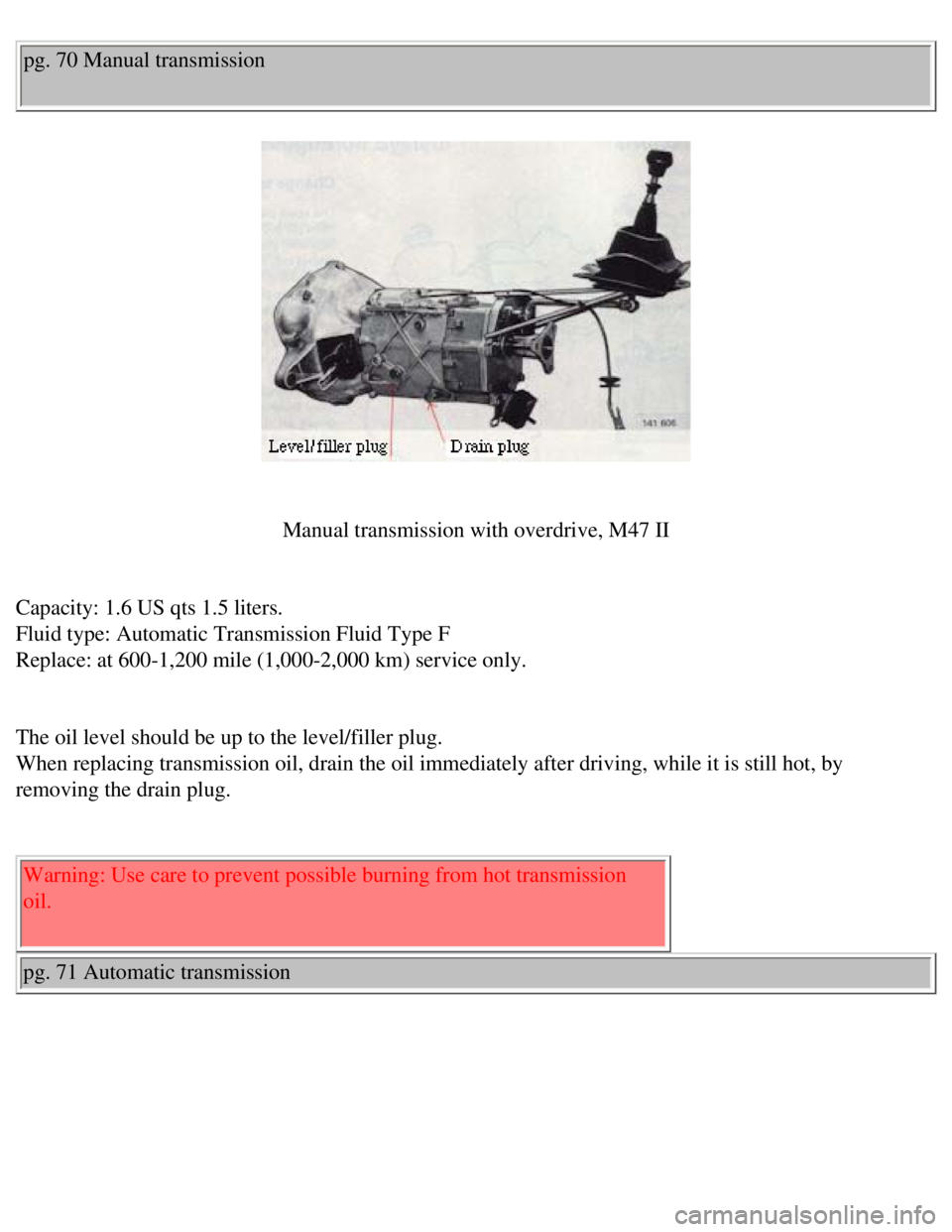
Manual transmission with overdrive, M47 II
Capacity: 1.6 US qts 1.5 liters.
Fluid type: Automatic Transmission Fluid Type F
Replace: at 600-1,200 mile (1,000-2,000 km) service only.
The oil level should be up to the level/filler plug.
When replacing transmission oil, drain the oil immediately after driving\
, while it is still hot, by
removing the drain plug.
Warning: Use care to prevent possible burning from hot transmission
oil.
pg. 71 Automatic transmission
file:///K|/ownersdocs/1990/1990_240/90240_15.htm (1 of 10)12/30/2006 8\
:25:09 AM
Page 94 of 143
Volvo 1990 240 Model
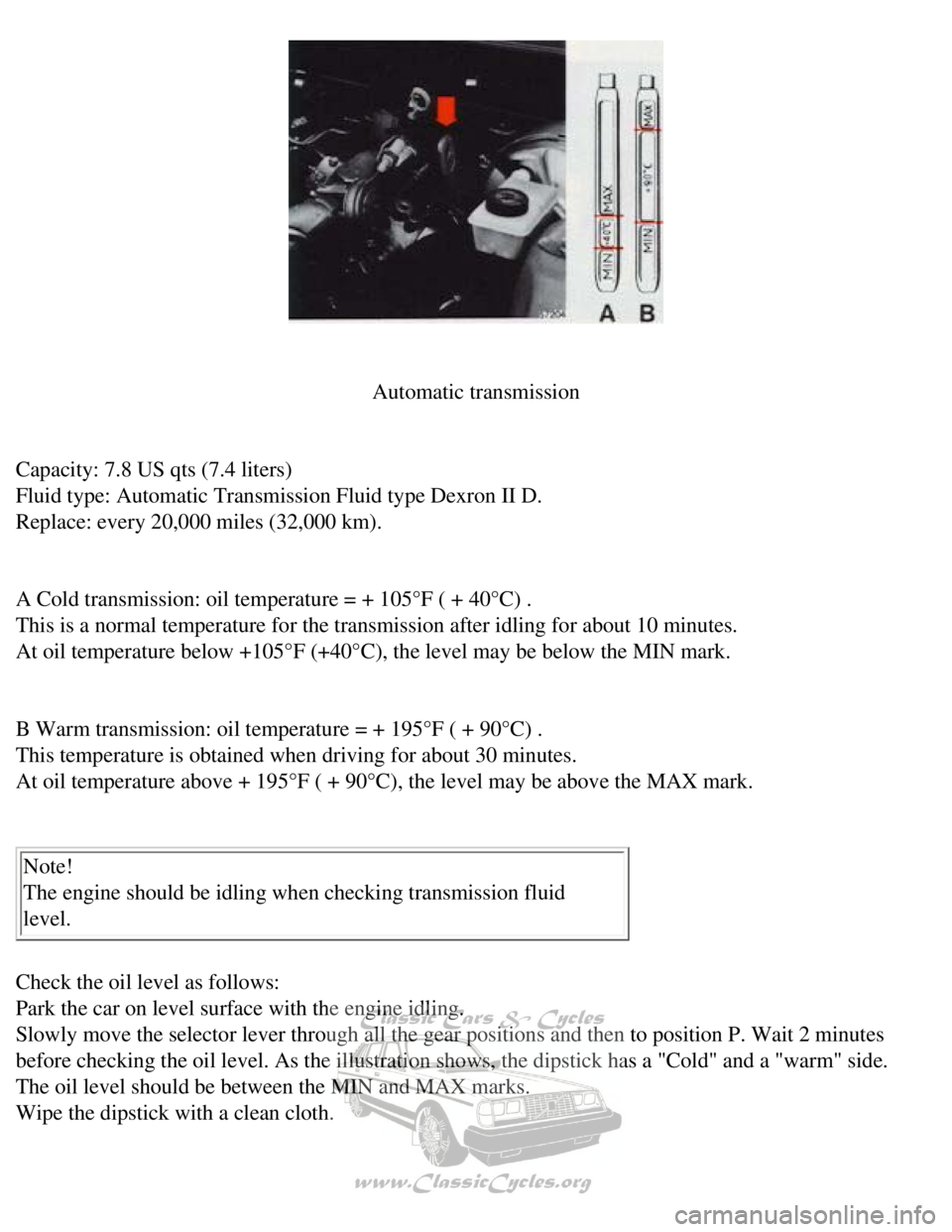
Automatic transmission
Capacity: 7.8 US qts (7.4 liters)
Fluid type: Automatic Transmission Fluid type Dexron II D.
Replace: every 20,000 miles (32,000 km).
A Cold transmission: oil temperature = + 105°F ( + 40°C) .
This is a normal temperature for the transmission after idling for about\
10 minutes.
At oil temperature below +105°F (+40°C), the level may be below \
the MIN mark.
B Warm transmission: oil temperature = + 195°F ( + 90°C) .
This temperature is obtained when driving for about 30 minutes.
At oil temperature above + 195°F ( + 90°C), the level may be abo\
ve the MAX mark.
Note!
The engine should be idling when checking transmission fluid
level.
Check the oil level as follows:
Park the car on level surface with the engine idling.
Slowly move the selector lever through all the gear positions and then t\
o position P. Wait 2 minutes
before checking the oil level. As the illustration shows, the dipstick h\
as a "Cold" and a "warm" side.
The oil level should be between the MIN and MAX marks.
Wipe the dipstick with a clean cloth.
file:///K|/ownersdocs/1990/1990_240/90240_15.htm (2 of 10)12/30/2006 8\
:25:09 AM
Page 95 of 143
Volvo 1990 240 Model
WARNING! The oil may be very
hot!
Do not use rags which can leave lint on the dipstick.
The transmission is topped up via the dipstick tube.
The space between the MIN and MAX marks on the dipstick corresponds to 0\
.5 US qts (0.5 liter). Do
not fill the transmission with too much oil, since this can result in oi\
l being ejected from the
transmission.
Too little oil, on the other hand, can negatively affect transmission op\
eration, particularly in very cold
weather.
pg. 72 Rear axle oil, Power steering fluid, Brake fluid
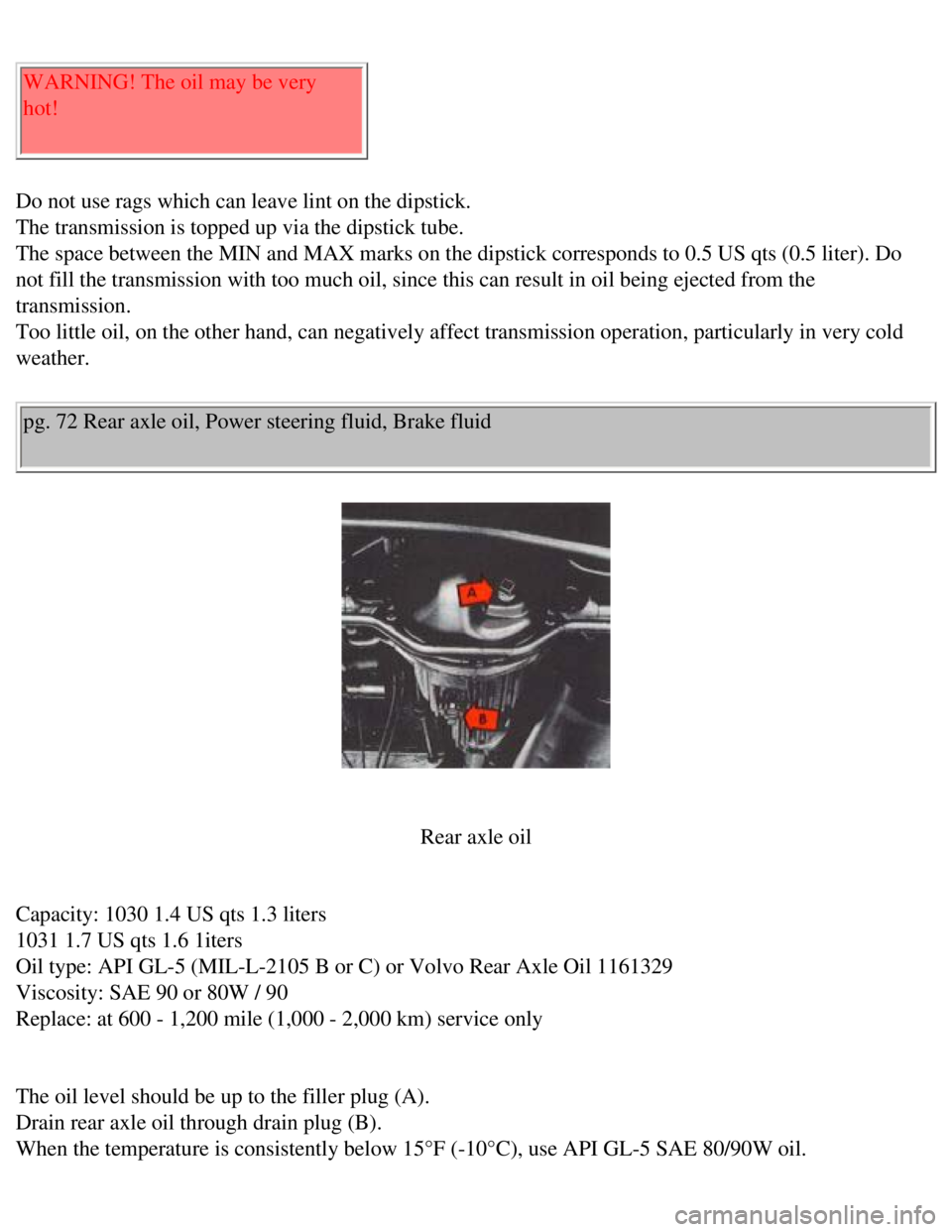
Rear axle oil
Capacity: 1030 1.4 US qts 1.3 liters
1031 1.7 US qts 1.6 1iters
Oil type: API GL-5 (MIL-L-2105 B or C) or Volvo Rear Axle Oil 1161329 \
Viscosity: SAE 90 or 80W / 90
Replace: at 600 - 1,200 mile (1,000 - 2,000 km) service only
The oil level should be up to the filler plug (A).
Drain rear axle oil through drain plug (B).
When the temperature is consistently below 15°F (-10°C), use API\
GL-5 SAE 80/90W oil.
file:///K|/ownersdocs/1990/1990_240/90240_15.htm (3 of 10)12/30/2006 8\
:25:09 AM