transmission fluid VOLVO 240 1990 Owners Manual
[x] Cancel search | Manufacturer: VOLVO, Model Year: 1990, Model line: 240, Model: VOLVO 240 1990Pages: 143, PDF Size: 2.32 MB
Page 67 of 143

Volvo 1990 240 Model
The power assist to the brakes functions only when the engine is running\
. When the car is moving
without the engine running the brake pedal pressure required to stop the\
car is increased 3- 4 times.
The brake pedal feels stiff and hard.
Disc brake noise: A slight-to-moderate amount of disc brake "squeal" is \
considered normal.
Air dam (front spoiler)
A non-factory air dam can negatively influence the normal flow of coolin\
g air to the front wheel brakes.
(See section titled "Wheels and Tires").
If one of the brake circuits should malfunction the red warning light wi\
ll come on
(See section titled "Warning Lights".)
The pedal stroke increases slightly and the pedal feels softer but the p\
edal pressure required does not
increase noticeably.
If the light comes on while driving and the brake pedal can be depressed\
further than normal, it is an
indication that one of the brake circuits is not functioning. Stop immed\
iately, open engine hood and
check brake fluid level.
Reservoir empty: do NOT drive. Tow car to shop for check/repair of brake\
system. Reservoir not empty:
proceed immediately and with caution to a Volvo dealer for an inspection\
of the brake system.
Severe strain on the brake system
The brakes will be subject to severe strain when driving in mountains or\
hilly areas. The speed is usually
low which means that the cooling of the brake is less efficient than whe\
n driving on level roads.
To reduce the strain on the brakes it is advisable not to use the brakes\
excessively.
Instead, shift into a lower gear and let the engine help with the brakin\
g. A good rule is to use the same
gear downhill as would be used ascending the same grade. For vehicles wi\
th automatic transmission use
position 2, or in some cases, 1.
file:///K|/ownersdocs/1990/1990_240/90240_11.htm (4 of 6)12/30/2006 8:\
25:06 AM
Page 70 of 143
Volvo 1990 240 Model
pg. 53 Service and maintenance
55Maintenance services
56Service requirements
59Engine B230F
60Fuel requirements
61Engine fluids
62Engine oil, Oil/oil filter change interval
63Cooling system
65Servicing
70Transmission oil
72Rear axle, power steering, brake fluid
73Lubrication
74Coolant
75Alternator, jump starting
76Replacing bulbs
81Fuses
82Wheels and tires
84Wheel changing
86Replacing wiper blades
87Washing, cleaning
87Cleaning, anti-rust treatment
88Paint touch-up
90What causes rust
91Long distance trips, cold weather
92Service diagnosis
96Label information
file:///K|/ownersdocs/1990/1990_240/90240_12.htm (1 of 7)12/30/2006 8:\
25:07 AM
Page 93 of 143
Volvo 1990 240 Model
pg. 70 Manual transmission
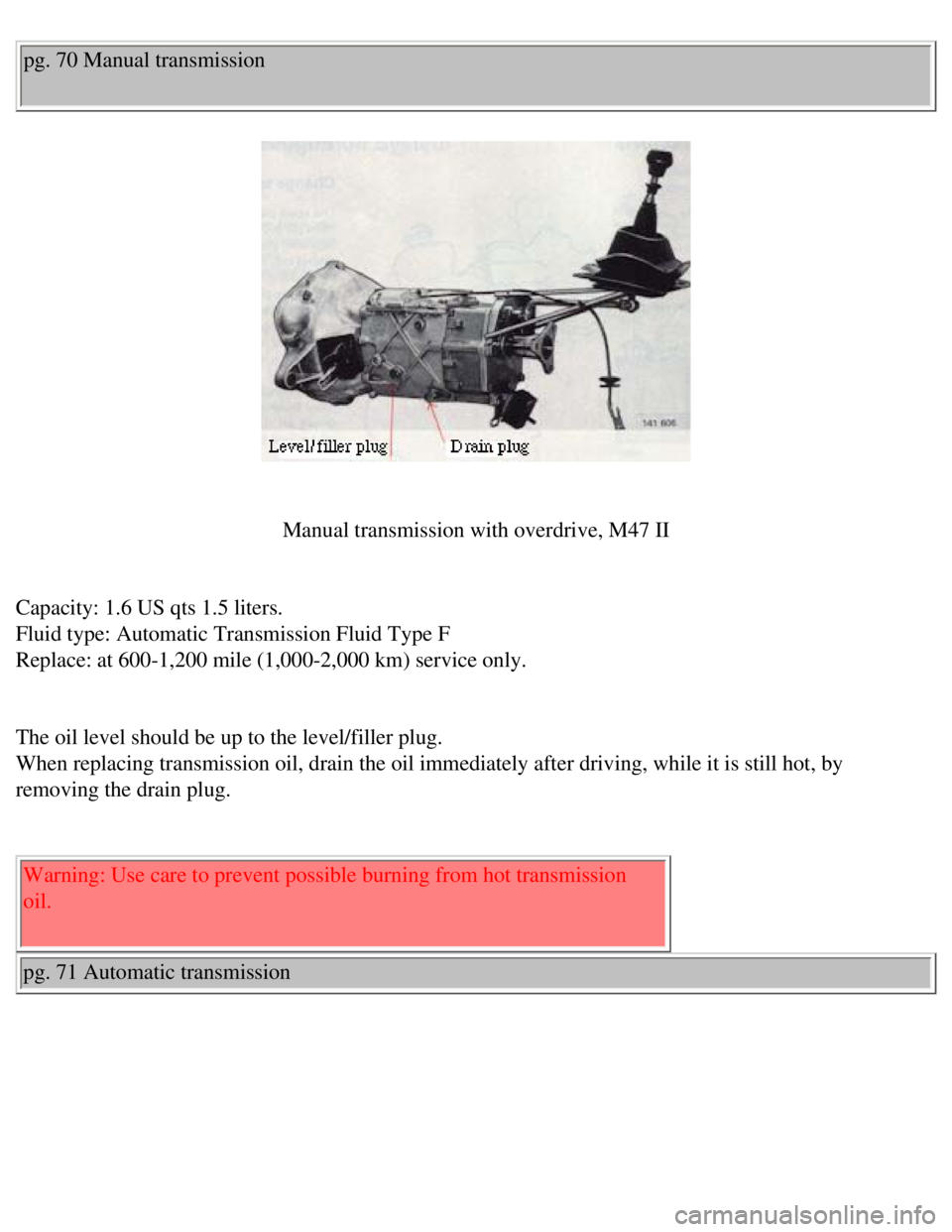
Manual transmission with overdrive, M47 II
Capacity: 1.6 US qts 1.5 liters.
Fluid type: Automatic Transmission Fluid Type F
Replace: at 600-1,200 mile (1,000-2,000 km) service only.
The oil level should be up to the level/filler plug.
When replacing transmission oil, drain the oil immediately after driving\
, while it is still hot, by
removing the drain plug.
Warning: Use care to prevent possible burning from hot transmission
oil.
pg. 71 Automatic transmission
file:///K|/ownersdocs/1990/1990_240/90240_15.htm (1 of 10)12/30/2006 8\
:25:09 AM
Page 94 of 143
Volvo 1990 240 Model
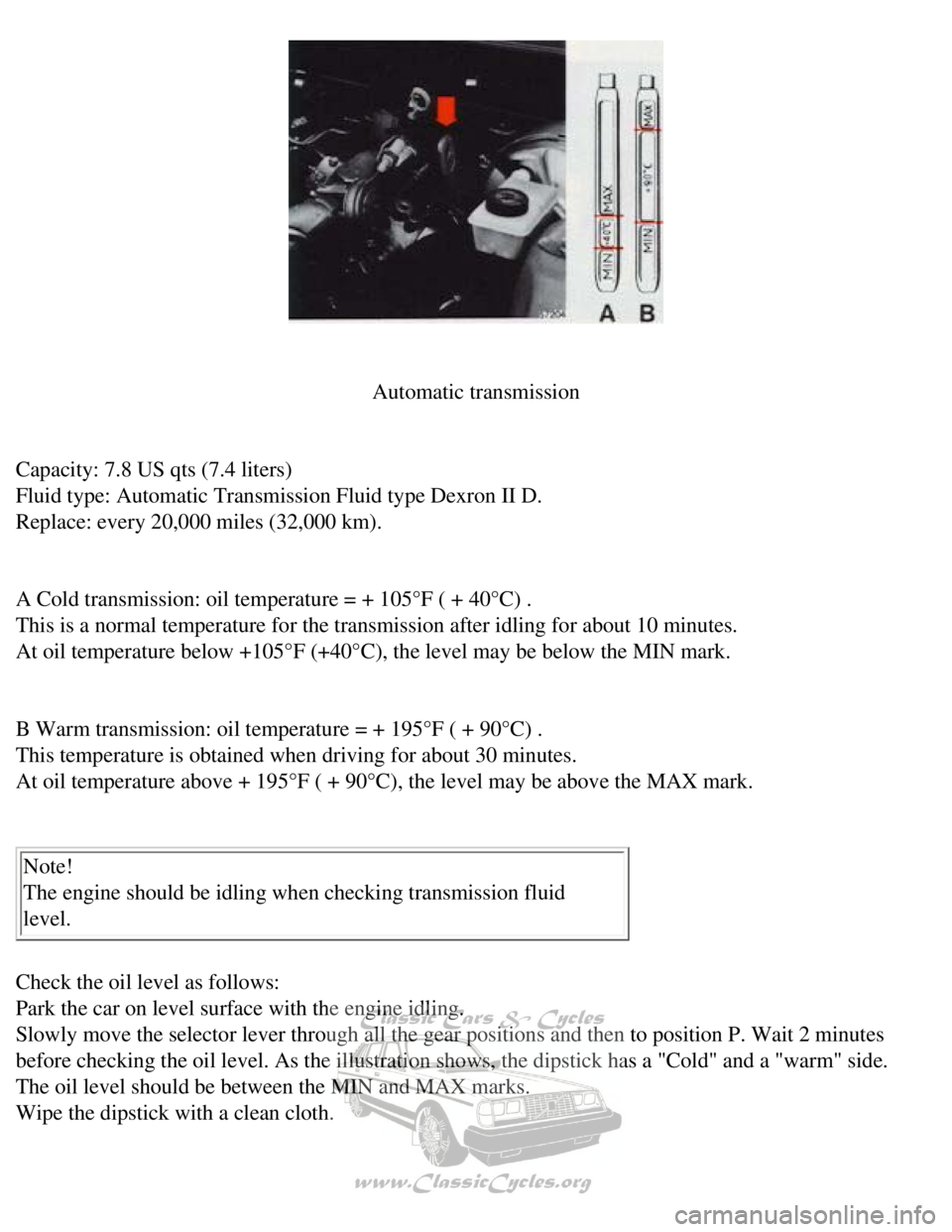
Automatic transmission
Capacity: 7.8 US qts (7.4 liters)
Fluid type: Automatic Transmission Fluid type Dexron II D.
Replace: every 20,000 miles (32,000 km).
A Cold transmission: oil temperature = + 105°F ( + 40°C) .
This is a normal temperature for the transmission after idling for about\
10 minutes.
At oil temperature below +105°F (+40°C), the level may be below \
the MIN mark.
B Warm transmission: oil temperature = + 195°F ( + 90°C) .
This temperature is obtained when driving for about 30 minutes.
At oil temperature above + 195°F ( + 90°C), the level may be abo\
ve the MAX mark.
Note!
The engine should be idling when checking transmission fluid
level.
Check the oil level as follows:
Park the car on level surface with the engine idling.
Slowly move the selector lever through all the gear positions and then t\
o position P. Wait 2 minutes
before checking the oil level. As the illustration shows, the dipstick h\
as a "Cold" and a "warm" side.
The oil level should be between the MIN and MAX marks.
Wipe the dipstick with a clean cloth.
file:///K|/ownersdocs/1990/1990_240/90240_15.htm (2 of 10)12/30/2006 8\
:25:09 AM
Page 95 of 143
Volvo 1990 240 Model
WARNING! The oil may be very
hot!
Do not use rags which can leave lint on the dipstick.
The transmission is topped up via the dipstick tube.
The space between the MIN and MAX marks on the dipstick corresponds to 0\
.5 US qts (0.5 liter). Do
not fill the transmission with too much oil, since this can result in oi\
l being ejected from the
transmission.
Too little oil, on the other hand, can negatively affect transmission op\
eration, particularly in very cold
weather.
pg. 72 Rear axle oil, Power steering fluid, Brake fluid
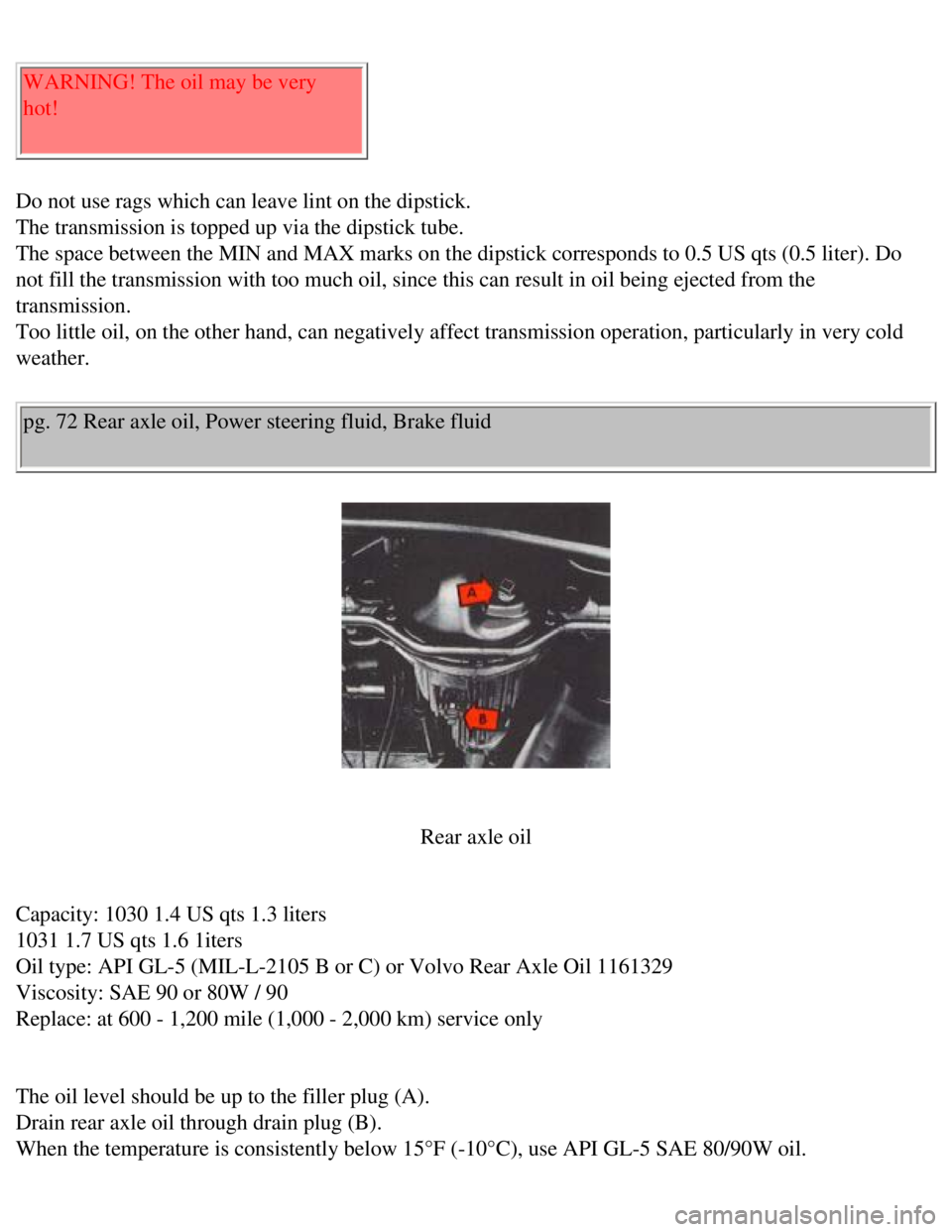
Rear axle oil
Capacity: 1030 1.4 US qts 1.3 liters
1031 1.7 US qts 1.6 1iters
Oil type: API GL-5 (MIL-L-2105 B or C) or Volvo Rear Axle Oil 1161329 \
Viscosity: SAE 90 or 80W / 90
Replace: at 600 - 1,200 mile (1,000 - 2,000 km) service only
The oil level should be up to the filler plug (A).
Drain rear axle oil through drain plug (B).
When the temperature is consistently below 15°F (-10°C), use API\
GL-5 SAE 80/90W oil.
file:///K|/ownersdocs/1990/1990_240/90240_15.htm (3 of 10)12/30/2006 8\
:25:09 AM
Page 123 of 143

Volvo 1990 240 Model
pg. 91 Long distance trips, Cold weather
Prior to a long distance trip
Have your car checked at a Volvo dealer. Preventive maintenance will hel\
p to ensure a trouble free trip.
Remember to take along a Volvo dealer directory.
The main items to check are listed below:
1. Brakes, front wheel alignment and steering gear.
2. Engine running condition.
3. Fuel system operation.
4. Oil leaks: engine, transmission, rear axle.
5. Cooling system for leaks or worn hoses.
6. Examine tires carefully, replace worn tires.
7. Battery and terminals.
8. Tool equipment.
9. Lighting.
10. Drive belts, for tightness and wear.
11. All fluid levels.
Cold weather/Engine fuel system
During the winter, large variations in temperature cause condensation to\
form in the fuel tank and can
impair the running of the engine. This can be reduced by adding dry gas \
to the fuel. There is less risk of
condensation forming in the fuel tank if it is kept full or nearly full.\
Engine cooling system
Volvo type C (blue-green) coolant should be used all year round. The c\
ooling system should always
contain water plus anti-freeze and rust inhibitor, even during the summe\
r. Experience has also shown
that extremely weak anti-freeze solutions (10-25 percent) are ineffect\
ive for rust protection. For this
reason, the quantity of antifreeze/summer coolant should be about 50 per\
cent of the solution. This
lowers the freezing point to - 30 ° F (-35 ° C).
Engine lubricating system
file:///K|/ownersdocs/1990/1990_240/90240_19.htm (1 of 7)12/30/2006 8:\
25:13 AM
Page 136 of 143

Volvo 1990 240 Model
Capacities
Fuel tank 15.8 US
gals 60 liters
Cooling system
-manual transmission
-automatic transmission
-expansion tank
separately
9.9 US qts
9.7 US qts
0.7 US qts
9.4 liters
9.2 liters
0.6 liters
Engine:
-oil and filter change
-oil changed separately
4.0 US qts
3.5 US qts
3.85
liters
3.35
liters
Transmission:
-manual, M47 II
-automatic, AW70
1.6 US qts
7.8 US qts
1.5 liters
7.4 liters
Rear axle -1030
-1031 1.4 US qts
1.7 US qts 1.3 liters
1.6 liters
Power steering gear 0.8 US qts 0.75
liters
Windshield washer fluid 3.4 US qts 3.2 liters
ELECTRICAL SYSTEM
12 V, negative ground. Voltage-controlled alternator.
Single-wire system with chassis and engine used as conductors.
Voltage 12 V
file:///K|/ownersdocs/1990/1990_240/90240_20.htm (7 of 14)12/30/2006 8\
:25:15 AM