check oil VOLVO 850 1996 Owners Manual
[x] Cancel search | Manufacturer: VOLVO, Model Year: 1996, Model line: 850, Model: VOLVO 850 1996Pages: 265, PDF Size: 4.57 MB
Page 7 of 265
1996 Volvo 850
21 Traction Control System (option)
22 Malfunction indicator lamp
(See
page 1:4 for more information)
23 (Not in use)
* Warning light is amber.
pg. 1:4 Warning lights
The warning lights described on pages
1:4 and 1:5 should never stay on when driving
When the ignition key is turned on, and before the engine starts, all of\
the warning lights should be on to test the function of the
bulbs. Should a light not go off after the engine has started, the syste\
m indicated should be inspected. However, the parking brake
reminder light will not go off until the parking brake is fully released\
.
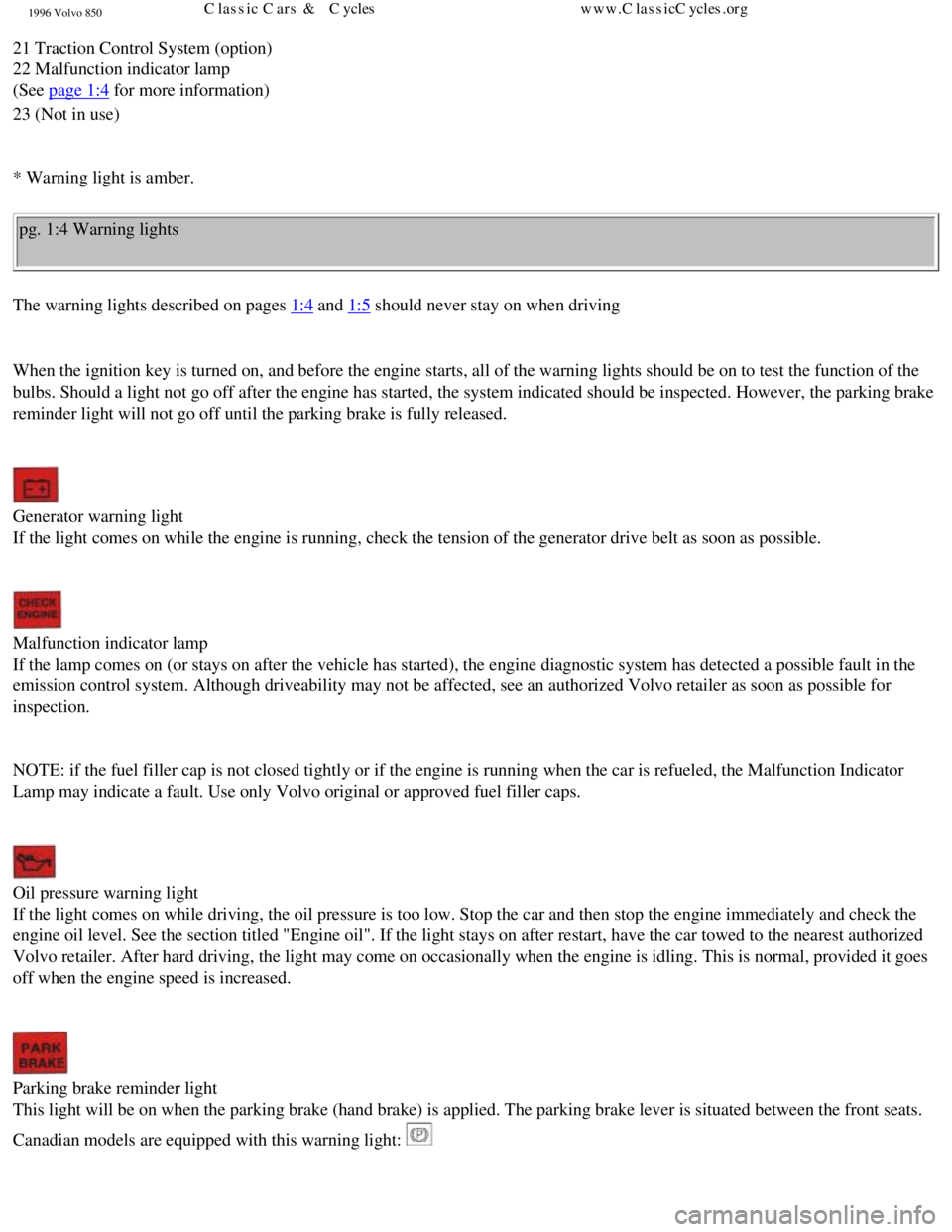
Generator warning light
If the light comes on while the engine is running, check the tension of \
the generator drive belt as soon as possible.
Malfunction indicator lamp
If the lamp comes on (or stays on after the vehicle has started), the \
engine diagnostic system has detected a possible fault in the
emission control system. Although driveability may not be affected, see \
an authorized Volvo retailer as soon as possible for
inspection.
NOTE: if the fuel filler cap is not closed tightly or if the engine is r\
unning when the car is refueled, the Malfunction Indicator
Lamp may indicate a fault. Use only Volvo original or approved fuel fill\
er caps.
Oil pressure warning light
If the light comes on while driving, the oil pressure is too low. Stop t\
he car and then stop the engine immediately and check the
engine oil level. See the section titled "Engine oil". If the light stay\
s on after restart, have the car towed to the nearest authorized
Volvo retailer. After hard driving, the light may come on occasionally w\
hen the engine is idling. This is normal, provided it goes
off when the engine speed is increased.
Parking brake reminder light
This light will be on when the parking brake (hand brake) is applied. \
The parking brake lever is situated between the front seats.
Canadian models are equipped with this warning light:
file:///K|/ownersdocs/1996/1996_850/96850_101.htm (5 of 7)12/30/2006 9\
:58:55 AMClassic Cars & Cycles www.ClassicCycles.org
Page 160 of 265

1996 Volvo 850
NOTE - ENGINE OIL:
Although some oil consumption during normal engine operation, more oil i\
s consumed when the engine
is new as the internal parts generate higher friction while wearing-in t\
o each other. From the time the
engine is new until the first service is performed, the oil consumption \
could be higher than normal. For
this reason, it is especially important to check the oil every time you \
refuel your car during this period.
See page 8:10.
In general, the rate of oil consumption depends on such factors as: engi\
ne temperature, length of trip,
driving conditions, oil viscosity and quality, engine speed and accelera\
tion/deceleration.
Checking your engine oil level each time the car is refuelled is one of \
the most important items you can
perform to help keep your car in good running order.
Manual transmission
The following speeds should not be exceeded during the break-in period: \
Up to 600 miles
(1000 km) 600 - 1,200 miles
(1000 - 2000 km)
1st gear 20 mph (30 km/h) 25 mph (40 km/h)
2nd gear 30 mph (50 km/h) 40 mph (70 km/h)
3rd gear 45 mph (80 km/h) 65 mph (100 km/
h)
4th gear 70 mph (110 km/
h) 80 mph (130 km/
h)
5th gear/
overdrive 80 mph (130 km/
h) 95 mph (150 km/
h)
Posted speed limits should not be exceeded.
file:///K|/ownersdocs/1996/1996_850/96850_401.htm (2 of 8)12/30/2006 9\
:59:32 AMClassic Cars & Cycles www.ClassicCycles.org
Page 163 of 265

1996 Volvo 850
CAUTION: Take care not to spill gasoline during refueling. Gasolines con\
taining alcohol can cause
damage to painted surfaces, which may not be covered under the New Vehic\
le Limited Warranty.
Do not use gasoline containing methanol (methyl alcohol, wood alcohol)\
. This practice can result in
vehicle performance deterioration and can damage critical parts in the f\
uel system. Such damage may
not be covered under the New Vehicle Limited Warranty.
pg. 4:4 Driving economy
Economical driving does not necessarily mean driving slowly
Better driving economy may be obtained by thinking ahead, avoiding rapid\
starts and stops and
adjusting the speed of your vehicle to immediate traffic conditions. Obs\
erve the following rules:
l Bring the engine to normal operating temperature as soon as possible by \
driving with a light foot on
the accelerator pedal for the first minutes of operation. A cold engine \
uses more fuel and is subject to
increased wear.
l Whenever possible, avoid using the car for driving short distances. This\
does not allow the engine to
reach normal operating temperature.
l Drive carefully and avoid rapid acceleration and hard braking.
l Do not exceed speed limit.
l Avoid carrying unnecessary items (extra load) in the car.
l Check tire pressure regularly (check when tires are cold).
l Remove snow tires when threat of snow or ice has ended.
l Note that roof racks, ski racks, etc., increase air resistance and there\
by fuel consumption.
l Avoid using automatic transmission kick-down feature unless necessary.
l Avoid using the air conditioning when it is not required. When engaged, \
the air conditioner's
compressor places places an additional load on the engine.
l If your car is equipped with the optional Trip Computer, utilizing the f\
uel consumption modes can
help you "learn" how to drive more economically.
Other factors which decrease gas mileage are:
l Low tire pressure
l Worn or dirty spark plugs
l Incorrect spark plug gap
l Dirty air cleaner
l Dirty engine oil and clogged oil filter
l Dragging brakes
l Incorrect front end alignment
file:///K|/ownersdocs/1996/1996_850/96850_401.htm (5 of 8)12/30/2006 9\
:59:32 AMClassic Cars & Cycles www.ClassicCycles.org
Page 164 of 265
rive or 5th gear (manual transmissions) should be used as\
o")
1996 Volvo 850
Some of the above mentioned items and others are checked at the standard\
Maintenance Service
intervals.
NOTE: ( D )rive or 5th gear (manual transmissions) should be used as\
often as possible to help improve
fuel economy. pg. 4:5 Starting the engine
Starting and stopping
1. Fasten the seat belt.
WARNING! Before starting, check that the seat and steering wheel are adj\
usted properly. Make sure
the brake pedal can be depressed completely. Move the seat closer if nec\
essary. Refer to section "front
seats".
2. Apply the parking brake, if not already set. The gear selector ( aut\
omatic transmission ) is locked in
the ( P )ark position ( SHIFT LOCK ).
3. Without touching the accelerator pedal , turn the ignition key to the\
starting position. Allow the starter
to operate for 5-10 seconds (turbo: 10 seconds). Release the key as so\
on as the engine starts. If the
engine fails to start, repeat step 3.
For cold starts at altitudes above 6000 ft (1800 m), depress the accel\
erator pedal halfway and turn the
key to the starting position. Release the accelerator pedal slowly when \
the engine starts.
4. To release the gear selector from the (P)ark position (automatic t\
ransmission), the ignition key must
be in position II and the brake pedal must be depressed.
See page 6:18 for instructions on manually
overriding the SHIFTLOCK system.
Do not race a cold engine immediately after starting. Oil flow may not r\
each some lubricating points fast
enough to prevent engine damage.
NOTE: (Automatic transmission only)
file:///K|/ownersdocs/1996/1996_850/96850_401.htm (6 of 8)12/30/2006 9\
:59:32 AMClassic Cars & Cycles www.ClassicCycles.org
Page 177 of 265
1996 Volvo 850
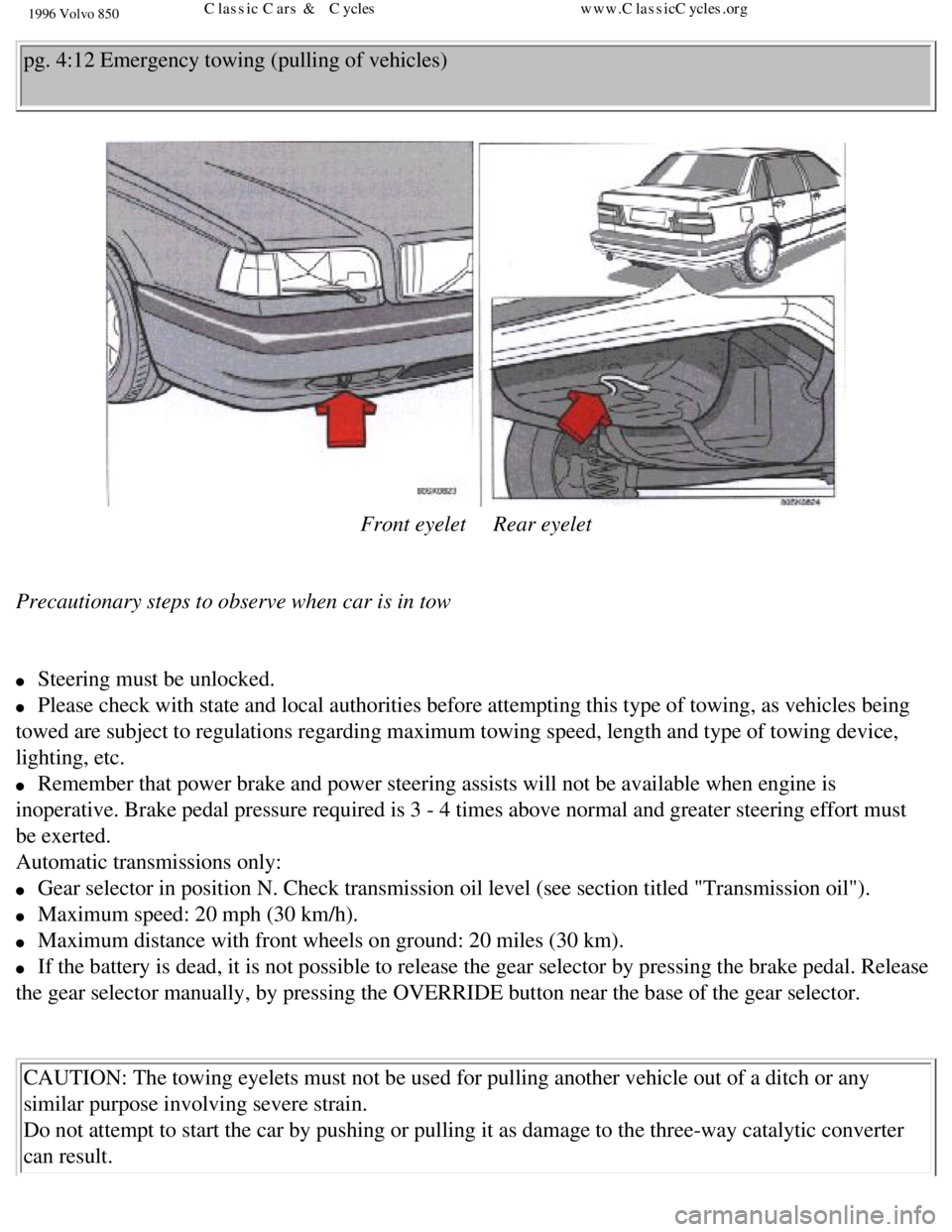
pg. 4:12 Emergency towing (pulling of vehicles)
Front eyelet Rear eyelet
Precautionary steps to observe when car is in tow
l Steering must be unlocked.
l Please check with state and local authorities before attempting this typ\
e of towing, as vehicles being
towed are subject to regulations regarding maximum towing speed, length \
and type of towing device,
lighting, etc.
l Remember that power brake and power steering assists will not be availab\
le when engine is
inoperative. Brake pedal pressure required is 3 - 4 times above normal a\
nd greater steering effort must
be exerted.
Automatic transmissions only:
l Gear selector in position N. Check transmission oil level (see section \
titled "Transmission oil").
l Maximum speed: 20 mph (30 km/h).
l Maximum distance with front wheels on ground: 20 miles (30 km).
l If the battery is dead, it is not possible to release the gear selector \
by pressing the brake pedal. Release
the gear selector manually, by pressing the OVERRIDE button near the bas\
e of the gear selector.
CAUTION: The towing eyelets must not be used for pulling another vehicle\
out of a ditch or any
similar purpose involving severe strain.
Do not attempt to start the car by pushing or pulling it as damage to th\
e three-way catalytic converter
can result.
file:///K|/ownersdocs/1996/1996_850/96850_412.htm (1 of 10)12/30/2006 \
9:59:35 AMClassic Cars & Cycles www.ClassicCycles.org
Page 183 of 265

1996 Volvo 850
pg. 4:17 Trailer towing
When preparing for trailer towing, observe the following:
l Volvo recommends the use of Volvo trailer hitches which are specially de\
signed for the car. For
trailer weights exceeding 2000 lbs. (908 kg), use only a trailer hitch\
offered as a Genuine Volvo
accessory.
NOTE: Models with automatic transmission are equipped with a transmissio\
n oil cooler as standard
equipment. This cooler helps prevent overheating of the transmission dur\
ing times of increased load, as
when towing a trailer.
l Maximum trailer weight recommended by Volvo is:
Trailers without brakes : 1100 lbs (500kg)
Trailers with brakes: 2" (50 mm) ball - 3300 lbs (1500 kg), 1 7/8" (\
47 mm) ball - 2000 lbs (908 kg).
Observe the legal requirements of the state/province in which the vehicl\
es are registered. All Volvo
models are equipped with energy-absorbing shock-mounted bumpers. Trailer\
hitch installation should
not interfere with the proper operation of this bumper system.
Trailer towing does not normally present any particular problems, but ta\
ke into consideration:
l Increase tire pressure to recommended full. See section "Wheels and tire\
s".
l Recommended hitch tongue load is 110 (50 kgs) for trailer weights belo\
w 2,650 lbs (1,200 kgs) and
165 lbs (75 kgs) for trailer weights above 2,650 lbs (1,200 kgs). Fo\
r trailer weights between 2,650-3,300
lbs (1,200-1,500 kgs) a top speed of 50 mph (80 km/h) should never b\
e exceeded.
l Engine and transmission are subject to increased loads. Therefore, engin\
e coolant temperature should
be closely watched when driving in hot climates or hilly terrain. Use lo\
wer gear and turn off air
conditioner if temperature gauge pointer enters the red range.
l Avoid overload and other abusive operation.
l Hauling a trailer affects handling, durability, and economy.
l It is necessary to balance trailer brakes with the towing vehicle brakes\
to provide a safe stop (check
and observe State/Local regulations).
l Do not connect the trailer's brake system directly to the vehicle's brak\
e system.
l More frequent vehicle maintenance is required.
l Remove the ball and drawbar assembly when the hitch is not being used.
l Volvo recommends the use of synthetic engine oil when towing a trailer o\
ver long distances or in
file:///K|/ownersdocs/1996/1996_850/96850_412.htm (7 of 10)12/30/2006 \
9:59:35 AMClassic Cars & Cycles www.ClassicCycles.org
Page 184 of 265

1996 Volvo 850
mountainous areas.
NOTE: Refer to section "Automatic transmission" for additional trailer h\
auling tips.
WARNING!
l Bumper-attached trailer hitches must not be used on Volvos, nor should s\
afety chains be attached to
the bumper.
l Trailer hitches attaching to the vehicle rear axle must not be used.
l Never connect a trailer's hydraulic brake system directly to the vehicle\
brake system, nor a trailer's
lighting system directly to the vehicle lighting system. Consult your ne\
arest authorized Volvo retailer
for correct installation.
pg. 4:18 Winter driving
Cold weather precautions
l If you wish to check your car before the approach of cold weather, the f\
ollowing advice is worth
noting:
l Make sure that the engine coolant contains at least 50 percent antifreez\
e: that is, 3.7 qts. (3.5 liters)
Volvo Genuine Coolant/Antifreeze. This gives protection against freezing\
down to -31°F (-35°C). See
section "Coolant". The use of "recycled" antifreeze is not approved by V\
olvo. Different types of
antifreeze may not be mixed.
l Try to keep the fuel tank well filled - this prevents the formation of c\
ondensation in the tank. In
addition in extremely cold weather conditions it is worthwhile to add fu\
el line de-icer before refueling.
l The viscosity of the engine oil is important. Oil with low viscosity (t\
hinner oil) improves cold-
weather starting as well as decreasing fuel consumption while the engine\
is warming up. For winter use,
5W-30 oil, particularly the synthetic type, is recommended. Be sure to u\
se good quality oil but do not
use this cold-weather oil for hard driving or in warm weather. See secti\
on "Engine oil" for more
information.
l The load placed on the battery is greater during the winter since the he\
ater, windshield wipers,
lighting etc. are used more often. Moreover, the capacity of the battery\
decreases as the temperature
drops. In very cold weather, a poorly charged battery can freeze and be \
damaged. It is therefore
advisable to check the state of charge more frequently and spray an anti\
-rust oil on the battery posts.
l Volvo recommends the use of snow tires on all four wheels for winter dri\
ving - see section "Wheels
and tires".
l To prevent the washer reservoir from freezing, add washer solvents conta\
ining antifreeze (see page
file:///K|/ownersdocs/1996/1996_850/96850_412.htm (8 of 10)12/30/2006 \
9:59:35 AMClassic Cars & Cycles www.ClassicCycles.org
Page 185 of 265
. This is important sin\
ce the dirt is often splashed on
the windshield during winter driving, thus requiring frequent use of the\")
1996 Volvo 850
8:15 for the location of the washer fluid reservoir). This is important sin\
ce the dirt is often splashed on
the windshield during winter driving, thus requiring frequent use of the\
washers and wipers. The Volvo
Washer Solvent should be diluted as follows:
Down to 14°F (-10°C): 1 part anti-freeze and 4 parts water
Down to 5°F (-15°C): 1 part anti-freeze and 3 parts water
Down to 0°F (-18°C): 1 part anti-freeze and 2 parts water
Down to -18°F (-28°): 1 part anti-freeze and 1 part water
l When driving in temperatures below 15 F (-10 C), we recommend the use \
of Volvo's radiator guard to
help the engine reach normal operating temperature as quickly as possibl\
e. This guard should not be
used when towing a trailer.
l Use Volvo Teflon Lock Spray in the locks.
NOTE: Avoid the use of de-icing spray as they can cause damage to the lo\
cks.
Winter/Wet mode
Enhanced Vehicle Traction
This mode may be selected for starting/moving off on slippery roads. In \
this mode:
* In position D, the gearbox starts in 3rd gear and changes up to 4th ge\
ar.
* In position 3, 2nd gear is locked and there is no change up to 3rd gea\
r.
In position L, first gear is locked.
* These positions always offer the kick-down feature.
pg. 4:19 Long distance trips, City driving
Before a long distance trip
It is always worthwhile to have your car checked at a Volvo retailer bef\
ore driving long distances. Your
retailer will also be able to supply you with bulbs, fuses, spark plugs \
and wiper blades for your use in the
event that problems occur.
If you prefer to check the car yourself, please note the following:
l Check that the engine runs smoothly and that fuel consumption is normal.\
l Check engine oil, coolant levels, and for possible fuel leakage.
l Check transmission oil level.
file:///K|/ownersdocs/1996/1996_850/96850_412.htm (9 of 10)12/30/2006 \
9:59:35 AMClassic Cars & Cycles www.ClassicCycles.org
Page 230 of 265

1996 Volvo 850
Maintenance Operation thousand miles
(thousand km) 10
(16) 20
(32) 30
(48) 40
(64) 50
(80) 60
(96)
ENGINE SYSTEM MAINTENANCE
ENGINE
Fuel (Line) Filter¹
PCV Nipple (orifice)/hoses,clean I
Battery I I I I I I
BRAKES
Inspect brakes, replace components as necessary I I I I I I
Brake Fluid²
STEERING/SUSPENSION
Rotate tires/check wear (align front end if
needed.) I
I I I I I
Check power steering fluid level. I I I I I I
Grease front link arm stops L L L L L L
BODY
Power antenna (clean) I I I I I I
Trunk/hood, hinges and latches L L L L L L
1) Replace at 100,000 miles (160,000 km)
2) Brake fluid should be changed at owner request every second year (o\
nce a year if the car is driven in
mountainous areas or in areas with high humidity).
The following items should be checked weekly by the driver (it takes on\
ly a few minutes).
Engine oil level Horns
Brake fluid level Windshield wipers
Radiator coolant level Tire pressure (all five tires)
Operation of all lights Level of windshield washer fluid
The following should also be carried out at regular intervals:
Washing
Polishing
Cleaning
Rust protection
file:///K|/ownersdocs/1996/1996_850/96850_801.htm (5 of 6)12/30/2006 9\
:59:50 AMClassic Cars & Cycles www.ClassicCycles.org
Page 232 of 265

The following precautions must be observed when carrying out repairs to \
the vehicle
WARNING! The distributor ignition system operates at very high volta")
1996 Volvo 850
pg. 8:6 Servicing (cont.)
The following precautions must be observed when carrying out repairs to \
the vehicle
WARNING! The distributor ignition system operates at very high voltages.\
Special safety precautions
must be followed to prevent injury. Always turn the ignition off when:
l Connecting engine test and diagnostic equipment to the vehicle (timing \
light, tach-dwell tester,
ignition oscilloscope, etc.).
l Replacing distributor ignition components e.g. plugs, coil, etc.
l Do not touch any part of the distributor ignition system while the engin\
e is running. This may result
in unintended movements and body injury.
Battery
l Check that the battery cables are correctly connected and properly tight\
ened.
l Never disconnect the battery when the engine is running, for example whe\
n changing the battery.
l The battery should be disconnected when a boost charger is used.
l Switch off the radio before disconnecting the battery. If your radio has\
an anti-theft code and the
battery is disconnected, the radio code has to be re-entered in order fo\
r the radio to function.
Replacing spark plugs
The spark plugs should be changed every 30,000 miles (48,000 km). Howe\
ver, city driving or fast
highway driving may necessitate changing after 15,000 miles (24,000 km)\
of driving. When installing
new plugs, be sure to fit the right type and use correct torque, see "Sp\
ecifications". When changing the
plugs, check that the suppressor connectors are in good condition. Crack\
ed or damaged connectors
should be replaced. When changing the spark plugs, clean the terminals a\
nd the rubber seals.
Hoisting the car
If a garage jack is used to lift the car, the two jack attachments point\
s should be used. They are specially
reinforced to bear the weight of the car. A garage jack can also be plac\
ed under the front of the engine
file:///K|/ownersdocs/1996/1996_850/96850_806.htm (1 of 11)12/30/2006 \
9:59:52 AMClassic Cars & Cycles www.ClassicCycles.org