oil level VOLVO 850 1996 Owners Manual
[x] Cancel search | Manufacturer: VOLVO, Model Year: 1996, Model line: 850, Model: VOLVO 850 1996Pages: 265, PDF Size: 4.57 MB
Page 6 of 265

1996 Volvo 850
Used for measuring shorter distances. The last digit indicates 1/10 mile\
/kilometer. A black number on a white background =
original speedometer. A red number on a white background = replacement s\
peedometer.
9 Tachometer
Reads thousands of engine rpm. Engine should not be operated in red rang\
e. The highest permitted constant engine speed is
6,300 rpm (turbo: 6,200 rpm, B 5252 S: 6,000 rpm). pg. 1:3 Indicator and warning lights
1 Turn signal, left
2 Turn signal , right
3 (Not in use)
4 Low washer fluid level
If the lamp glows continuously when the engine is running, there is only\
about 1/2 - 1 US qt. remaining in the washer fluid
reservoir.
5 Low fuel level
When the lamp glows, only about 1.8 US gals. (8 liters) of fuel remain\
6 Rear fog light
7 High beams
8 (Not in use)
9 Bulb failure warning sensor
10 (Not in use)
11 (Not in use)
12 SRS
13 Generator not charging
14 Low engine oil pressure
15 Brake warning light
16 Parking brake applied
17 ABS-system
18 Ambient temperature warning light* (certain models)
(see pp. 1:11 or 1:14 for more information)
19 Transmission mode "W", or gear positions 3 or L engaged (automatic t\
ransmissions)
20 Low coolant level
file:///K|/ownersdocs/1996/1996_850/96850_101.htm (4 of 7)12/30/2006 9\
:58:55 AMClassic Cars & Cycles www.ClassicCycles.org
Page 7 of 265
1996 Volvo 850
21 Traction Control System (option)
22 Malfunction indicator lamp
(See
page 1:4 for more information)
23 (Not in use)
* Warning light is amber.
pg. 1:4 Warning lights
The warning lights described on pages
1:4 and 1:5 should never stay on when driving
When the ignition key is turned on, and before the engine starts, all of\
the warning lights should be on to test the function of the
bulbs. Should a light not go off after the engine has started, the syste\
m indicated should be inspected. However, the parking brake
reminder light will not go off until the parking brake is fully released\
.
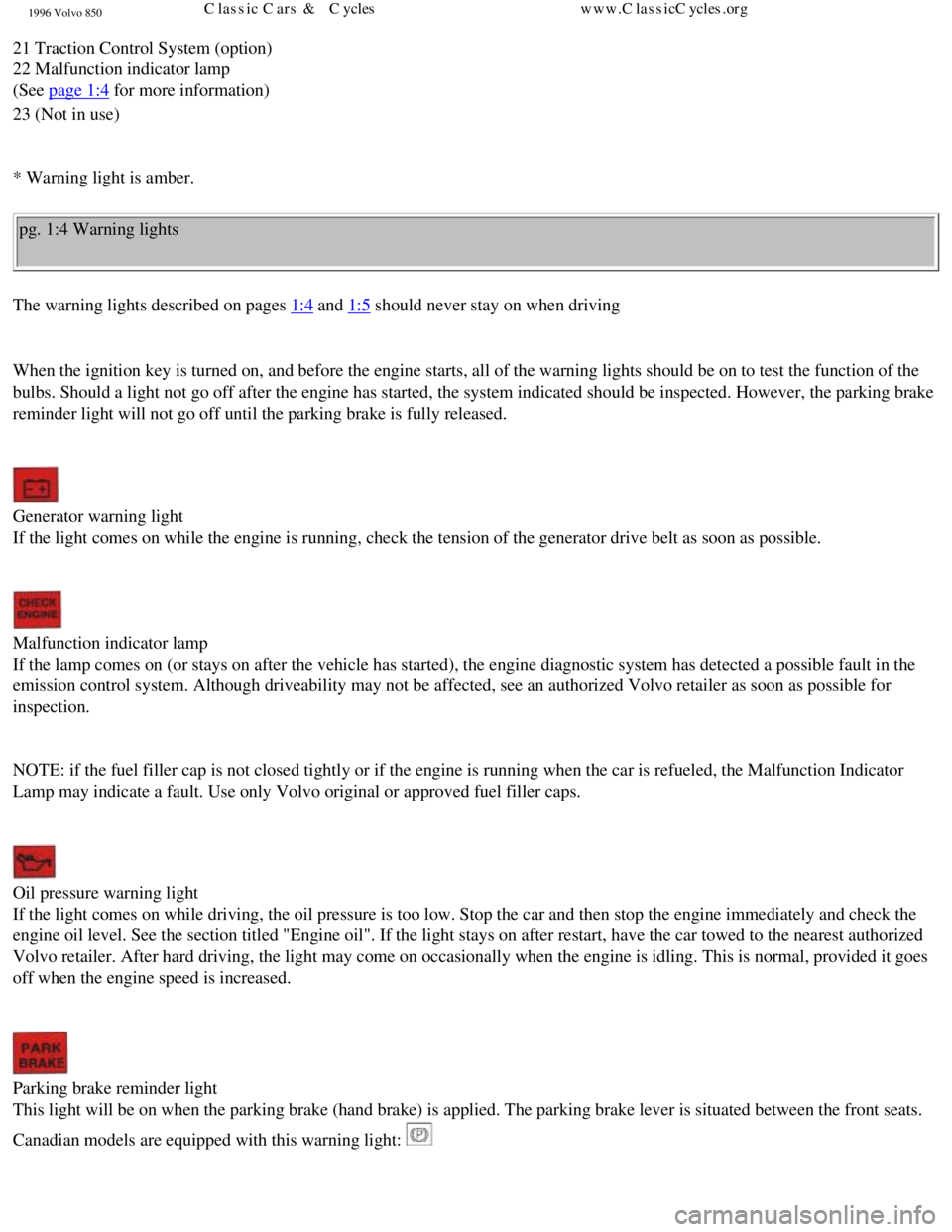
Generator warning light
If the light comes on while the engine is running, check the tension of \
the generator drive belt as soon as possible.
Malfunction indicator lamp
If the lamp comes on (or stays on after the vehicle has started), the \
engine diagnostic system has detected a possible fault in the
emission control system. Although driveability may not be affected, see \
an authorized Volvo retailer as soon as possible for
inspection.
NOTE: if the fuel filler cap is not closed tightly or if the engine is r\
unning when the car is refueled, the Malfunction Indicator
Lamp may indicate a fault. Use only Volvo original or approved fuel fill\
er caps.
Oil pressure warning light
If the light comes on while driving, the oil pressure is too low. Stop t\
he car and then stop the engine immediately and check the
engine oil level. See the section titled "Engine oil". If the light stay\
s on after restart, have the car towed to the nearest authorized
Volvo retailer. After hard driving, the light may come on occasionally w\
hen the engine is idling. This is normal, provided it goes
off when the engine speed is increased.
Parking brake reminder light
This light will be on when the parking brake (hand brake) is applied. \
The parking brake lever is situated between the front seats.
Canadian models are equipped with this warning light:
file:///K|/ownersdocs/1996/1996_850/96850_101.htm (5 of 7)12/30/2006 9\
:58:55 AMClassic Cars & Cycles www.ClassicCycles.org
Page 160 of 265

1996 Volvo 850
NOTE - ENGINE OIL:
Although some oil consumption during normal engine operation, more oil i\
s consumed when the engine
is new as the internal parts generate higher friction while wearing-in t\
o each other. From the time the
engine is new until the first service is performed, the oil consumption \
could be higher than normal. For
this reason, it is especially important to check the oil every time you \
refuel your car during this period.
See page 8:10.
In general, the rate of oil consumption depends on such factors as: engi\
ne temperature, length of trip,
driving conditions, oil viscosity and quality, engine speed and accelera\
tion/deceleration.
Checking your engine oil level each time the car is refuelled is one of \
the most important items you can
perform to help keep your car in good running order.
Manual transmission
The following speeds should not be exceeded during the break-in period: \
Up to 600 miles
(1000 km) 600 - 1,200 miles
(1000 - 2000 km)
1st gear 20 mph (30 km/h) 25 mph (40 km/h)
2nd gear 30 mph (50 km/h) 40 mph (70 km/h)
3rd gear 45 mph (80 km/h) 65 mph (100 km/
h)
4th gear 70 mph (110 km/
h) 80 mph (130 km/
h)
5th gear/
overdrive 80 mph (130 km/
h) 95 mph (150 km/
h)
Posted speed limits should not be exceeded.
file:///K|/ownersdocs/1996/1996_850/96850_401.htm (2 of 8)12/30/2006 9\
:59:32 AMClassic Cars & Cycles www.ClassicCycles.org
Page 177 of 265
1996 Volvo 850
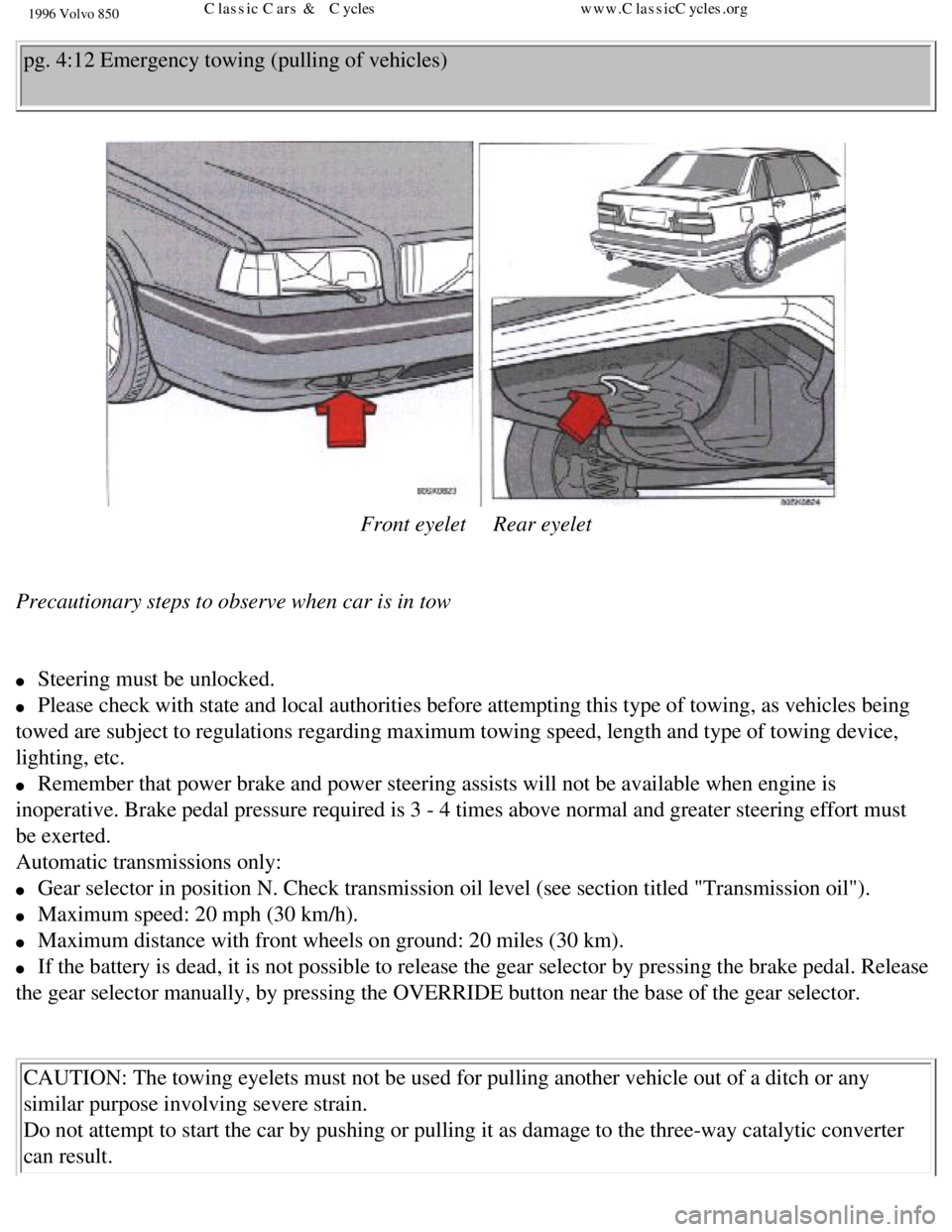
pg. 4:12 Emergency towing (pulling of vehicles)
Front eyelet Rear eyelet
Precautionary steps to observe when car is in tow
l Steering must be unlocked.
l Please check with state and local authorities before attempting this typ\
e of towing, as vehicles being
towed are subject to regulations regarding maximum towing speed, length \
and type of towing device,
lighting, etc.
l Remember that power brake and power steering assists will not be availab\
le when engine is
inoperative. Brake pedal pressure required is 3 - 4 times above normal a\
nd greater steering effort must
be exerted.
Automatic transmissions only:
l Gear selector in position N. Check transmission oil level (see section \
titled "Transmission oil").
l Maximum speed: 20 mph (30 km/h).
l Maximum distance with front wheels on ground: 20 miles (30 km).
l If the battery is dead, it is not possible to release the gear selector \
by pressing the brake pedal. Release
the gear selector manually, by pressing the OVERRIDE button near the bas\
e of the gear selector.
CAUTION: The towing eyelets must not be used for pulling another vehicle\
out of a ditch or any
similar purpose involving severe strain.
Do not attempt to start the car by pushing or pulling it as damage to th\
e three-way catalytic converter
can result.
file:///K|/ownersdocs/1996/1996_850/96850_412.htm (1 of 10)12/30/2006 \
9:59:35 AMClassic Cars & Cycles www.ClassicCycles.org
Page 185 of 265
. This is important sin\
ce the dirt is often splashed on
the windshield during winter driving, thus requiring frequent use of the\")
1996 Volvo 850
8:15 for the location of the washer fluid reservoir). This is important sin\
ce the dirt is often splashed on
the windshield during winter driving, thus requiring frequent use of the\
washers and wipers. The Volvo
Washer Solvent should be diluted as follows:
Down to 14°F (-10°C): 1 part anti-freeze and 4 parts water
Down to 5°F (-15°C): 1 part anti-freeze and 3 parts water
Down to 0°F (-18°C): 1 part anti-freeze and 2 parts water
Down to -18°F (-28°): 1 part anti-freeze and 1 part water
l When driving in temperatures below 15 F (-10 C), we recommend the use \
of Volvo's radiator guard to
help the engine reach normal operating temperature as quickly as possibl\
e. This guard should not be
used when towing a trailer.
l Use Volvo Teflon Lock Spray in the locks.
NOTE: Avoid the use of de-icing spray as they can cause damage to the lo\
cks.
Winter/Wet mode
Enhanced Vehicle Traction
This mode may be selected for starting/moving off on slippery roads. In \
this mode:
* In position D, the gearbox starts in 3rd gear and changes up to 4th ge\
ar.
* In position 3, 2nd gear is locked and there is no change up to 3rd gea\
r.
In position L, first gear is locked.
* These positions always offer the kick-down feature.
pg. 4:19 Long distance trips, City driving
Before a long distance trip
It is always worthwhile to have your car checked at a Volvo retailer bef\
ore driving long distances. Your
retailer will also be able to supply you with bulbs, fuses, spark plugs \
and wiper blades for your use in the
event that problems occur.
If you prefer to check the car yourself, please note the following:
l Check that the engine runs smoothly and that fuel consumption is normal.\
l Check engine oil, coolant levels, and for possible fuel leakage.
l Check transmission oil level.
file:///K|/ownersdocs/1996/1996_850/96850_412.htm (9 of 10)12/30/2006 \
9:59:35 AMClassic Cars & Cycles www.ClassicCycles.org
Page 230 of 265

1996 Volvo 850
Maintenance Operation thousand miles
(thousand km) 10
(16) 20
(32) 30
(48) 40
(64) 50
(80) 60
(96)
ENGINE SYSTEM MAINTENANCE
ENGINE
Fuel (Line) Filter¹
PCV Nipple (orifice)/hoses,clean I
Battery I I I I I I
BRAKES
Inspect brakes, replace components as necessary I I I I I I
Brake Fluid²
STEERING/SUSPENSION
Rotate tires/check wear (align front end if
needed.) I
I I I I I
Check power steering fluid level. I I I I I I
Grease front link arm stops L L L L L L
BODY
Power antenna (clean) I I I I I I
Trunk/hood, hinges and latches L L L L L L
1) Replace at 100,000 miles (160,000 km)
2) Brake fluid should be changed at owner request every second year (o\
nce a year if the car is driven in
mountainous areas or in areas with high humidity).
The following items should be checked weekly by the driver (it takes on\
ly a few minutes).
Engine oil level Horns
Brake fluid level Windshield wipers
Radiator coolant level Tire pressure (all five tires)
Operation of all lights Level of windshield washer fluid
The following should also be carried out at regular intervals:
Washing
Polishing
Cleaning
Rust protection
file:///K|/ownersdocs/1996/1996_850/96850_801.htm (5 of 6)12/30/2006 9\
:59:50 AMClassic Cars & Cycles www.ClassicCycles.org
Page 237 of 265
1996 Volvo 850
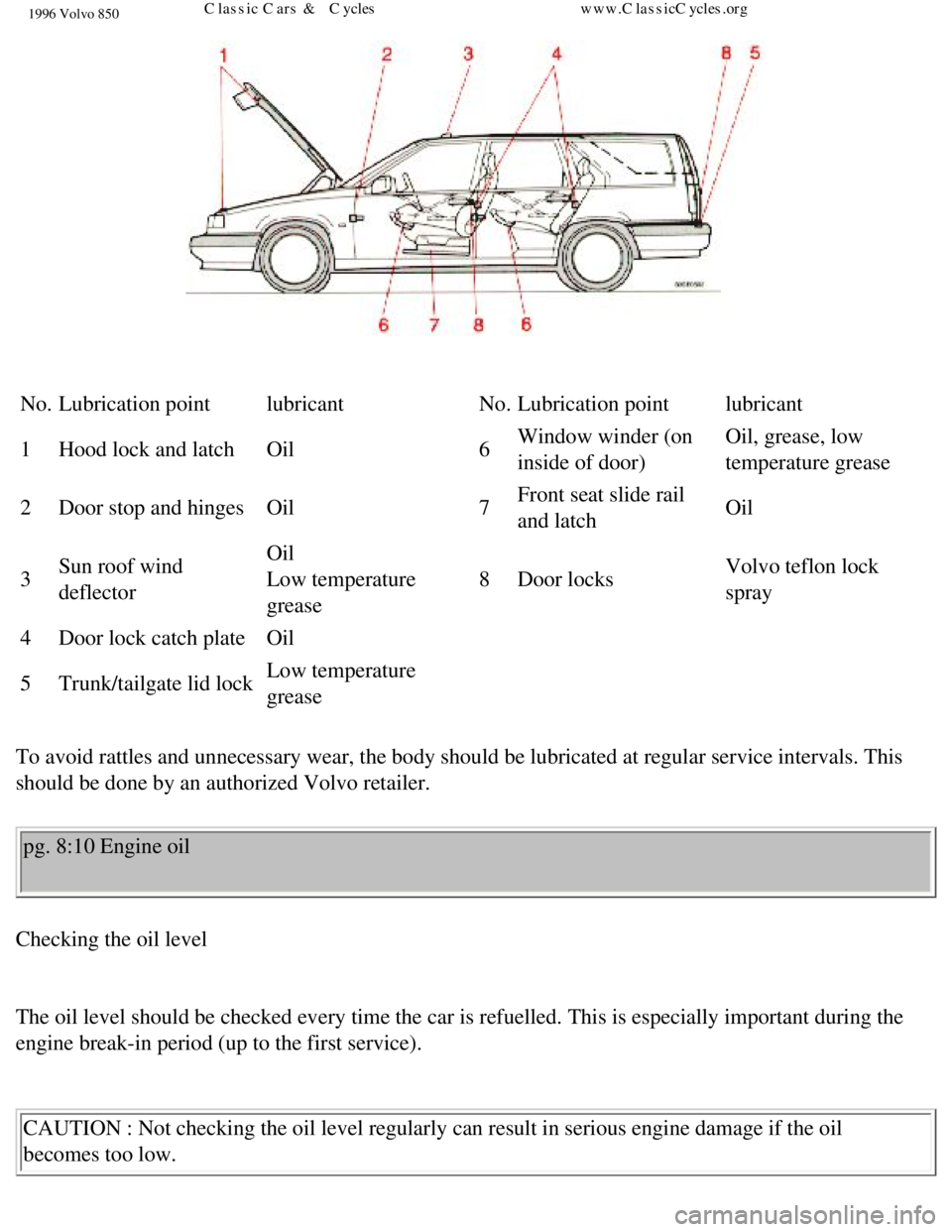
No. Lubrication point lubricant No. Lubrication point lubricant
1 Hood lock and latch Oil 6 Window winder (on
inside of door) Oil, grease, low
temperature grease
2 Door stop and hinges Oil 7 Front seat slide rail
and latch Oil
3 Sun roof wind
deflector Oil
Low temperature
grease
8
Door locks Volvo teflon lock
spray
4 Door lock catch plate Oil
5 Trunk/tailgate lid lock Low temperature
grease
To avoid rattles and unnecessary wear, the body should be lubricated at \
regular service intervals. This
should be done by an authorized Volvo retailer.
pg. 8:10 Engine oil
Checking the oil level
The oil level should be checked every time the car is refuelled. This is\
especially important during the
engine break-in period (up to the first service).
CAUTION : Not checking the oil level regularly can result in serious eng\
ine damage if the oil
becomes too low.
file:///K|/ownersdocs/1996/1996_850/96850_806.htm (6 of 11)12/30/2006 \
9:59:52 AMClassic Cars & Cycles www.ClassicCycles.org
Page 238 of 265

1996 Volvo 850
Park the car on a level surface and wait for at least 3 minutes after th\
e engine has been switched off. Be
sure the oil level is maintained between the upper and lower marks on th\
e dipstick. Low oil level can
cause internal damage to the engine and over-filling can result in high \
oil consumption. The distance
between the dipstick marks represents approx. 1 US qts (1 liter)*. The\
oil should preferably be checked
when cold, before the engine has been started.
* Certain models: 1.6 US qts (1.5 liters)
NOTE: The engine must be stopped when checking the oil.
Draining the oil
Drain the oil after driving while it is still warm.
WARNING! The oil may be very
hot.
If you change the engine oil and filter yourself, your Volvo retailer ca\
n assist you in disposing of the
used oil. Engine oil can be harmful to your skin - gloves should worn wh\
en performing this work.
To add or change oil
Add oil of the same kind as already used. Capacity (including filter):\
5.6 US qts (5.3 liters) (certain
models: 6.1 US qts/5.8 liters). Turbo models: 5.6 US qts (5.3 liters)\
.** The oil filter should be replaced
at every oil change
** Add 0.95 qts (0.9 liters) if the oil cooler has been drained.
file:///K|/ownersdocs/1996/1996_850/96850_806.htm (7 of 11)12/30/2006 \
9:59:52 AMClassic Cars & Cycles www.ClassicCycles.org
Page 241 of 265
 labels. These labels certify the oi\
l conforms to the
applicable standards and specifications of the API.
pg. 8:12 Power steering fluid, Br")
1996 Volvo 850
American Petroleum Institute (API) labels. These labels certify the oi\
l conforms to the
applicable standards and specifications of the API.
pg. 8:12 Power steering fluid, Brake/clutch fluid reservoir
Power steering fluid
The dipstick has marks for checking hot and cold oil. The oil level when\
the engine is cold must never
be higher than the COLD mark. After the engine has reached normal operat\
ing temperature, the level
may not be higher than the HOT mark. Top up when the level is at the ADD\
mark.
Check the level at every service.
Fluid type: ATF
Replace: no fluid change required.
Brake and clutch systems
The brake and clutch systems share the same fluid reservoir. The fluid l\
evel should be between the MIN
file:///K|/ownersdocs/1996/1996_850/96850_806.htm (10 of 11)12/30/2006\
9:59:52 AMClassic Cars & Cycles www.ClassicCycles.org
Page 243 of 265

1996 Volvo 850
pg. 8:13 Automatic transmission fluid
Check the oil level as follows:
Park the car on a level surface with the engine idling . Slowly move the\
gear selector lever through all
the shift positions and then to position P. Wait 3 minutes before checki\
ng the oil level.
As the illustration shows, the dipstick has a COLD and a HOT side. The o\
il level should between the
MIN and MAX marks. Wipe the dipstick with a clean cloth.
WARNING! The oil may be very
hot.
Do not use rags that could leave lint on the dipstick. The transmission \
is topped up via the dipstick tube.
The space between the MIN and MAX marks on the dipstick corresponds to 0\
.5 US qt. (0.5 liter). Do
not fill the transmission with too much oil, since this can result in oi\
l being ejected from the
transmission. Too little oil, on the other hand, can negatively affect t\
ransmission operation, particularly
in very cold weather.
A Cold transmission: oil temperature 105° F (40° C). This is a n\
ormal temperature for the transmission
after idling for about 10 minutes. At oil temperatures below 105° F (\
40° C), the level may be below the
MIN mark.
B Warm transmission: oil temperature 169° F (80° C). This temper\
ature after driving for about 30
minutes. At oil temperatures above 190° F (90° C), the level may\
be above the MAX mark.
Fluid type: ATF Dexron IIE/III and Mercon.
file:///K|/ownersdocs/1996/1996_850/96850_813.htm (1 of 7)12/30/2006 9\
:59:53 AMClassic Cars & Cycles www.ClassicCycles.org