fuel pressure VOLVO C30 2009 Owner´s Manual
[x] Cancel search | Manufacturer: VOLVO, Model Year: 2009, Model line: C30, Model: VOLVO C30 2009Pages: 274, PDF Size: 6.82 MB
Page 173 of 274
07 Wheels and tires
Tire designations
07
173
Maximum Load: Indicates the maximum
load in pounds and kilograms that can be
carried by the tire. Refer to the vehicle's tire
information placard or the safety certifica-
tion label, located on the B-Pillar or the
driver's door or on the inside of the fuel filler
door on Canadian models, for the correct
tire pressure for your vehicle.Treadwear, Traction, and Temperature
grades: See page 176 for more informa-
tion.Maximum permissible inflation
pressure: The greatest amount of air pres-
sure that should ever be put in the tire. This
limit is set by the tire manufacturer.
The tire suppliers may have additional mark-
ings, notes or warnings such as standard load,
radial tubeless, etc.
Page 174 of 274
07 Wheels and tiresGlossary of tire terminology
07174
Terminology•
Tire information placard: A placard
showing the OE (Original Equipment) tire
sizes, recommended inflation pressure,
and the maximum weight the vehicle can
carry.
•
Tire Identification Number (TIN): A num-
ber on the sidewall of each tire providing
information about the tire brand and man-
ufacturing plant, tire size and date of man-
ufacturer.
•
Inflation pressure: A measure of the
amount of air in a tire.
•
Standard load: A class of P-metric or Met-
ric tires designed to carry a maximum load
at 35 psi [37 psi (2.5 bar) for Metric tires].
Increasing the inflation pressure beyond
this pressure will not increase the tires load
carrying capability.
•
Extra load: A class of P-metric or Metric
tires designed to carry a heavier maximum
load at 41 psi [43 psi (2.9 bar) for Metric
tires]. Increasing the inflation pressure
beyond this pressure will not increase the
tires load carrying capability.
•
kPa: Kilopascal, a metric unit of air pres-
sure.
•
PSI: Pounds per square inch, a standard
unit of air pressure.
•
B-pillar: The structural member at the side
of the vehicle behind the front door.
•
Bead area of the tire: Area of the tire next
to the rim.
•
Sidewall of the tire: Area between the
bead area and the tread.
•
Tread area of the tire: Area of the perim-
eter of the tire that contacts the road when
mounted on the vehicle.
•
Rim: The metal support (wheel) for a tire or
a tire and tube assembly upon which the
tire beads are seated.
•
Maximum load rating: a figure indicating
the maximum load in pounds and kilo-
grams that can be carried by the tire. This
rating is established by the tire manufac-
turer.
•
Maximum permissible inflation pres-
sure: the greatest amount of air pressure
that should ever be put in the tire. This limit
is set by the tire manufacturer.
•
Recommended tire inflation pressure:
inflation pressure, established by Volvo,
which is based on the type of tires that are
mounted on a vehicle at the factory. This
inflation pressure is affected by the number
of occupants in the car, the amount of
cargo, and the speed at which the vehicle
will be driven for a prolonged period. This
information can be found on the tire infla-
tion placard(s) located on the driver's sideB-pillar or on the inside of the fuel filler door
on Canadian models, and in the tire infla-
tion table in this chapter.
•
Cold tires: The tires are considered to be
cold when they have the same temperature
as the surrounding (ambient) air. This tem-
perature is normally reached after the car
has been parked for at least 3 hours.
Properly loading your vehicle will provide maxi-
mum return of vehicle design performance.
Page 178 of 274

07 Wheels and tiresTemporary spare
07178
Temporary spareThe spare tire in your car is called a "Temporary
Spare".
Recommended tire pressure (see the placard
on the B-pillar or on the fuel filler door) should
be maintained irrespective of which position on
the car the temporary spare tire is used on.
In the event of damage to this tire, a new one
can be purchased from your Volvo retailer.
WARNING
Current legislation prohibits the use of the
"Temporary Spare" tire other than as a tem-
porary replacement for a punctured tire. It
must be replaced as soon as possible by a
standard tire. Road holding and handling
may be affected with the "Temporary
Spare" in use. Do not exceed a speed of
50 mph (80 km/h) with the "Temporary
Spare" in use.
CAUTION
The car must not be driven with wheels of
different dimensions or with a spare tire
other than the one that came with the car.
The use of different size wheels can seri-
ously damage your car's transmission.
Page 188 of 274
07 Wheels and tiresTire Pressure Monitoring System (TPMS)
07188
IntroductionThe tire pressure monitoring system uses sen-
sors mounted in the tire valves to check infla-
tion pressure levels. When the vehicle is
moving at a speed of approximately 20 mph
(30 km/h) or faster, these sensors transmit
inflation pressure data to a receiver located in
the vehicle.
NOTE
USA – FCC ID: KR5S122780002
This device complies with part 15 of the
FCC rules. Operation is subject to the fol-
lowing conditions: (1) This device may not
cause harmful interference, and (2) this
device must accept any interference
received, including interference that may
cause undesired operation.When low inflation pressure is detected, TPMS
will light up the tire pressure warning light (also
referred to as a telltale) in the instrument panel,
and will display a message in the text window.
The wording of this message is determined by
the degree of inflation pressure loss.
NOTE
If a fault occurs in TPMS, the tire pressure
warning light will flash for approximately
1 minute and
TIRE PRESS SYST
SERVICE REQUIRED
will be displayed.
Each tire, including the spare (if provided),
should be checked monthly when cold and
inflated to the inflation pressure recommended
by the vehicle manufacturer on the vehicle
placard or tire inflation pressure label. (If your
vehicle has tires of a different size than the size
indicated on the vehicle placard or tire inflation
pressure label, you should determine the
proper tire inflation pressure for those tires.)
As an added safety feature, your vehicle has
been equipped with a tire pressure monitoring
system (TPMS) that illuminates a low tire pres-
sure telltale when one or more of your tires is
significantly under-inflated. Accordingly, when
the low tire pressure telltale illuminates, you
should stop and check your tires as soon as
possible, and inflate them to the proper pres-
sure. Driving on a significantly under-inflated
tire causes the tire to overheat and can lead to
tire failure. Under-inflation also reduces fuel
efficiency and tire tread life, and may affect the
vehicle's handling and stopping ability.
Please note that the TPMS is not a substitute
for proper tire maintenance, and it is the driv-er's responsibility to maintain correct tire pres-
sure, even if under-inflation has not reached
the level to trigger illumination of the TPMS low
tire pressure telltale.
Your vehicle has also been equipped with a
TPMS malfunction indicator to indicate when
the system is not operating properly. The
TPMS malfunction indicator is combined with
the low tire pressure telltale. When the system
detects a malfunction, the telltale will flash for
approximately one minute and then remain
continuously illuminated. This sequence will
continue upon subsequent vehicle start-ups as
long as the malfunction exists. When the mal-
function indicator is illuminated, the system
may not be able to detect or signal low tire
pressure as intended. TPMS malfunctions may
occur for a variety of reasons, including the
installation of replacement or alternate tires or
wheels on the vehicle that prevent the TPMS
from functioning properly. Always check the
TPMS malfunction telltale after replacing one
or more tires or wheels on your vehicle to
ensure that the replacement or alternate tires
and wheels allow the TPMS to continue to
function properly.
Page 193 of 274

08 Car care
Washing and cleaning the car
08``193
CAUTION
•
During high pressure washing, the
spray mouthpiece must never be closer
to the vehicle than 13" (30 cm). Do not
spray into the locks.
•
Dirt, snow, etc., on the headlights can
reduce lighting capacity considerably.
Clean the headlights regularly, for
example when refueling.
•
When washing or steam cleaning the
engine, avoid spraying water or steam
directly on the electrical components or
toward the rear side of the engine.
•
Always close the moonroof (option) and
sun shade before washing your vehicle.
•
Never use abrasive cleaning agents on
the moonroof.
•
Never use wax on the rubber seals
around the moonroof.
Automatic washing – simple and quickWe do NOT recommend washing your car in an
automatic wash during the first six months
(because the paint will not have hardened suf-
ficiently).
An automatic wash is a simple and quick way
to clean your car, but it is worth remembering
that it may not be as thorough as when you
yourself go over the car with sponge and water.Keeping the underbody clean is most impor-
tant, especially in the winter. Some automatic
washers do not have facilities for washing the
underbody.
CAUTION
•
Before driving into an automatic car
wash, turn off the optional rain sensor
to avoid damaging the windshield wip-
ers.
•
Make sure that side view mirrors, auxil-
iary lamps, etc, are secure, and that any
antenna(s) are retracted or removed.
Otherwise there is risk of the machine
dislodging them
•
Chromed wheels: Clean chrome-
plated wheels using the same deter-
gents used for the body of the vehicle.
Aggressive wheel-cleaning agents can
permanently stain chrome-plated
wheels.WARNING
•
When the car is driven immediately after
being washed, apply the brakes several
times in order to remove any moisture
from the brake linings.
•
Engine cleaning agents should not be
used when the engine is warm. This
constitutes a fire risk.
Exterior lightingCondensation may form temporarily on the
inside of the lenses of exterior lights such as
headlights, fog lights, or taillights. This is nor-
mal and the lights are designed to withstand
moisture. Normally, condensation will dissi-
pate after the lights have been on for a short
time.Polishing and Waxing•
Normally, polishing is not required during
the first year after delivery, however, wax-
ing may be beneficial.
•
Before applying polish or wax the vehicle
must be washed and dried. Tar spots can
be removed with kerosene or tar remover.
Difficult spots may require a fine rubbing
compound.
•
After polishing use liquid or paste wax.
•
Several commercially available products
contain both polish and wax.
•
Waxing alone does not substitute for pol-
ishing a dull surface.
•
A wide range of polymer-based waxes can
be purchased today. These waxes are easy
to use and produce a long-lasting, high-
gloss finish that protects the bodywork
against oxidation, road dirt and fading.
•
Do not polish or wax your vehicle in direct
sunlight (the surface of the vehicle should
not be warmer than 113 °F (45 °C).
Page 202 of 274
09 Maintenance and servicingMaintaining your car
09202
Owner maintenancePeriodic maintenance requirements and inter-
vals are described in your vehicle's Warranty
and Service Records Information booklet.
The following points can be carried out
between the normally scheduled maintenance
services.Each time the car is refueled:•
Check the engine oil level.
•
Clean the windshield, windshield wipers,
headlights, and taillights.
Monthly:•
Check cold tire pressure in all tires. Inspect
the tires for wear.
•
Check that engine coolant and other fluid
levels are between the indicated "min" and
"max" markings.
•
Clean interior glass surfaces with a glass
cleaner and soft paper towels.
•
Wipe driver information displays with a soft
cloth.
•
Visually inspect battery terminals for cor-
rosion. Corrosion may indicate a loose ter-
minal connector, or a battery near the end
of its useful service life. Consult a trained
and qualified Volvo service technician for
additional information.
As needed:•
Wash the car, including the undercarriage,
to reduce wear that can be caused by a
buildup of dirt, and corrosion that can be
caused by salt residues.
•
Clean leaves and twigs from air intake
vents at the base of the windshield, and
from other places where they may collect.NOTE
Complete service information for qualified
technicians is available online for purchase
or subscription at www.volvotechinfo.com.Emission inspection readinessWhat is an Onboard Diagnostic System
(OBD II)?OBD II is part of your vehicle's computerized
engine management system. It stores diagnos-
tic information about your vehicle's emission
controls. It can light the Check Engine light
(MIL) if it detects an emission control "fault." A
"fault" is a component or system that is not
performing within an expected range. A fault
may be permanent or temporary. OBD II will
store a message about any fault.
How Do States Use OBD II for Emission
Inspections?Many states connect a computer directly to a
vehicle's OBD II system. The inspector can
then read "faults." In some states, this type of
inspection has replaced the tailpipe emission
test.How Can My Vehicle Fail OBD II Emission
Inspection?Your vehicle can fail OBD II emission inspec-
tion for any of the following reasons.•
If your Check Engine (MIL) light is lit, your
vehicle may fail inspection.
•
If your vehicle's Check Engine light was lit,
but went out without any action on your
part, OBD II will still have a recorded fault.
Your vehicle may pass or fail, depending
on the inspection practices in your area.
•
If you had recent service that required dis-
connecting the battery, OBD II diagnostic
information may be incomplete and "not
ready" for inspection. A vehicle that is not
ready may fail inspection.
How Can I Prepare for My Next OBD II
Emission Inspection?•
If your Check Engine (MIL) light is lit – or
was lit but went out without service, have
Page 224 of 274
09 Maintenance and servicingFuses
09224
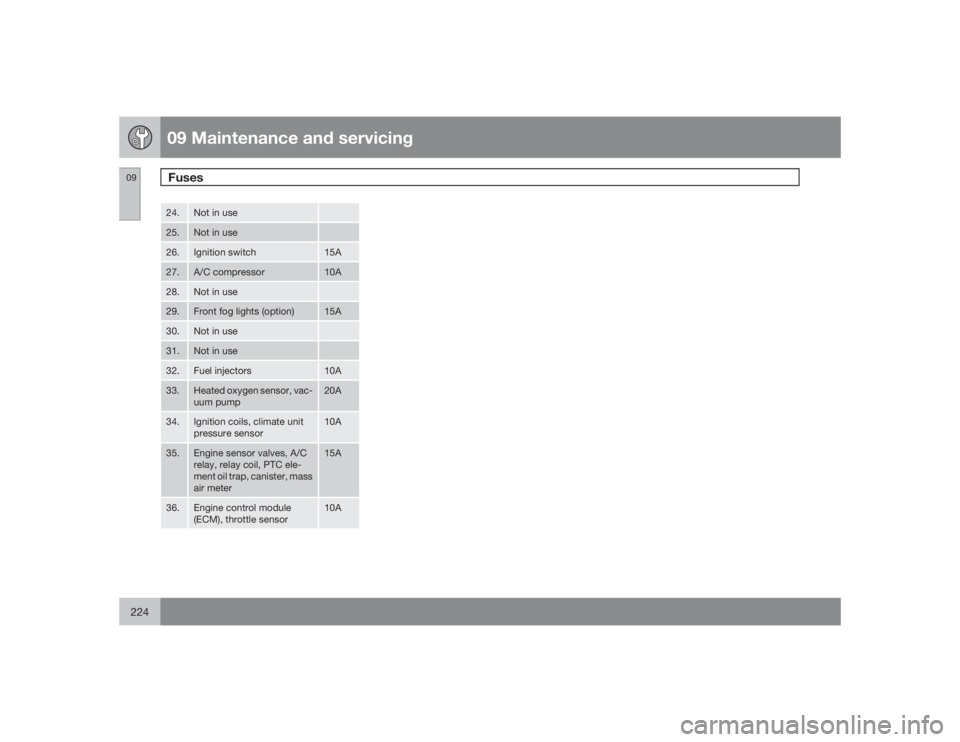
24.
Not in use
25.
Not in use
26.
Ignition switch
15A
27.
A/C compressor
10A
28.
Not in use
29.
Front fog lights (option)
15A
30.
Not in use
31.
Not in use
32.
Fuel injectors
10A
33.
Heated oxygen sensor, vac-
uum pump
20A
34.
Ignition coils, climate unit
pressure sensor
10A
35.
Engine sensor valves, A/C
relay, relay coil, PTC ele-
ment oil trap, canister, mass
air meter
15A
36.
Engine control module
(ECM), throttle sensor
10A
Page 261 of 274
11 Specifications
Engine specifications
11
261
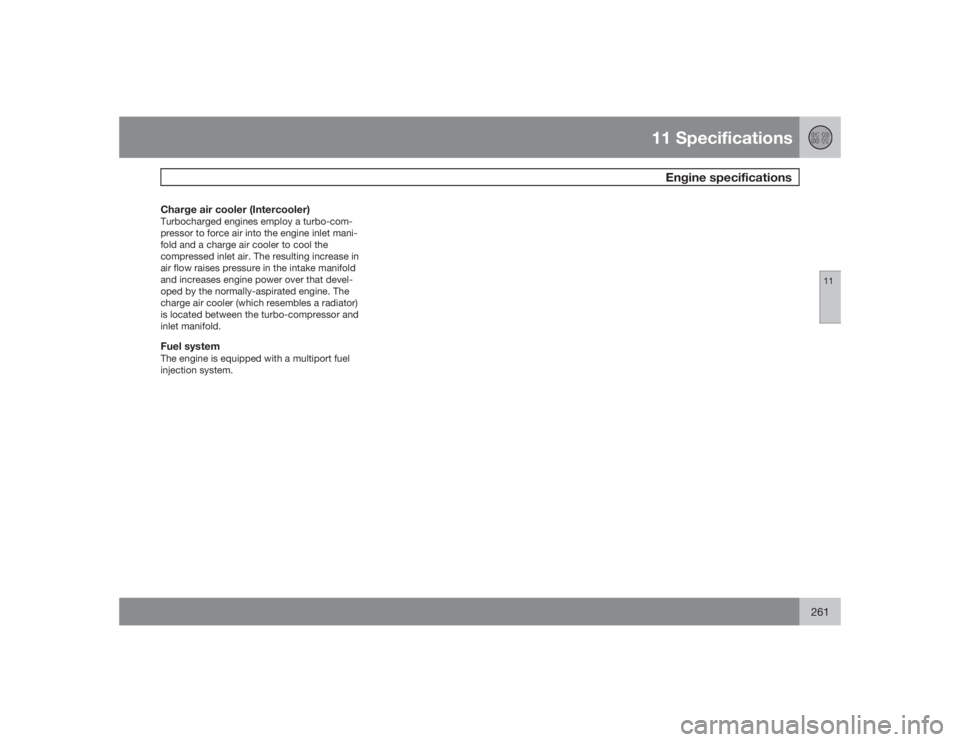
Charge air cooler (Intercooler)Turbocharged engines employ a turbo-com-
pressor to force air into the engine inlet mani-
fold and a charge air cooler to cool the
compressed inlet air. The resulting increase in
air flow raises pressure in the intake manifold
and increases engine power over that devel-
oped by the normally-aspirated engine. The
charge air cooler (which resembles a radiator)
is located between the turbo-compressor and
inlet manifold.Fuel systemThe engine is equipped with a multiport fuel
injection system.