service indicator VOLVO C30 2009 Owner´s Manual
[x] Cancel search | Manufacturer: VOLVO, Model Year: 2009, Model line: C30, Model: VOLVO C30 2009Pages: 274, PDF Size: 6.82 MB
Page 160 of 274
06 Starting and drivingBlind Spot Information System (BLIS)–option
06160
when the system is switched off, and a text
message is displayed.
•
BLIS can be switched on again by pressing
the button. The indicator light in the button
will illuminate and a new text message will
be displayed. Press the READ button, see
page 60, to erase the message.
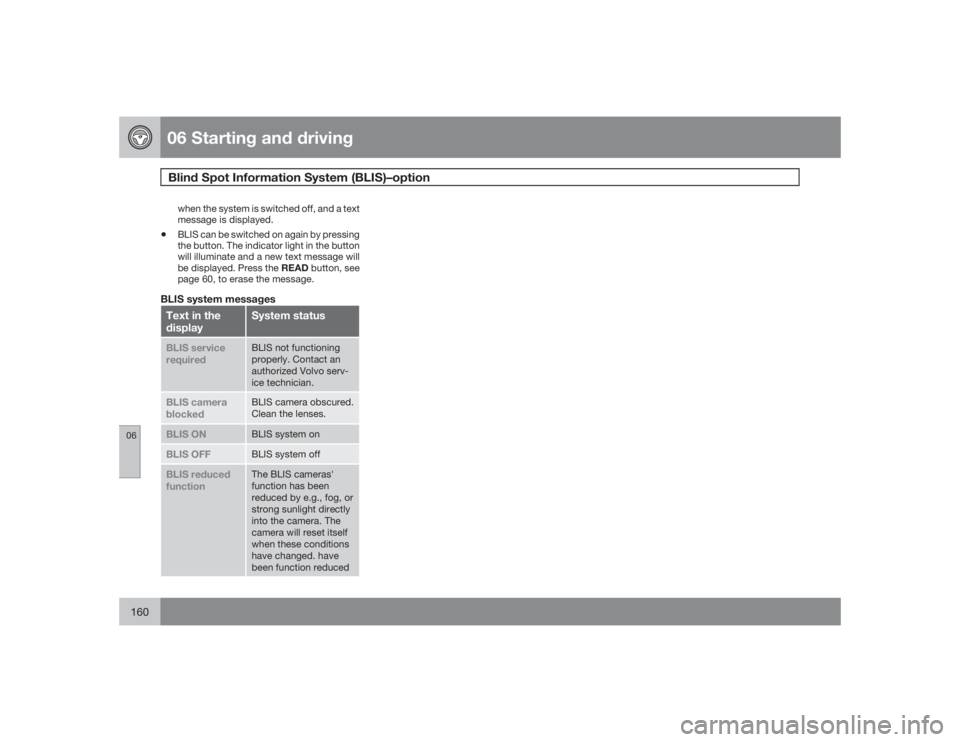
BLIS system messagesText in the
display
System status
BLIS service
required
BLIS not functioning
properly. Contact an
authorized Volvo serv-
ice technician.
BLIS camera
blocked
BLIS camera obscured.
Clean the lenses.
BLIS ON
BLIS system on
BLIS OFF
BLIS system off
BLIS reduced
function
The BLIS cameras'
function has been
reduced by e.g., fog, or
strong sunlight directly
into the camera. The
camera will reset itself
when these conditions
have changed. have
been function reduced
Page 162 of 274
06 Starting and drivingPark assist (Option/accessory)
06162
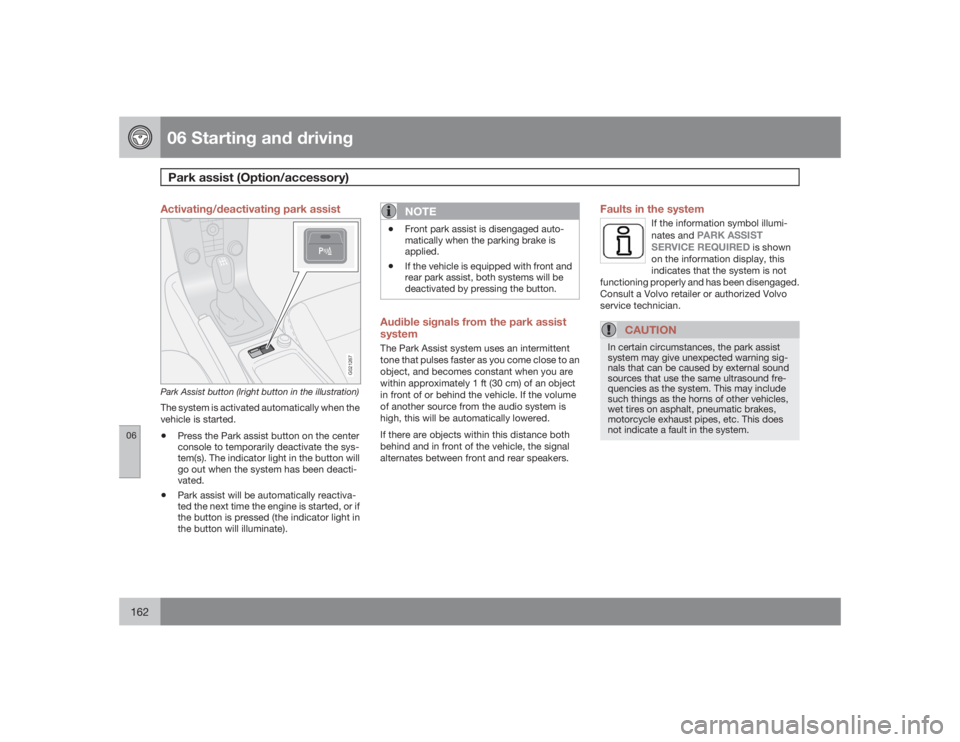
Activating/deactivating park assist
G021267
Park Assist button (lright button in the illustration)The system is activated automatically when the
vehicle is started.•
Press the Park assist button on the center
console to temporarily deactivate the sys-
tem(s). The indicator light in the button will
go out when the system has been deacti-
vated.
•
Park assist will be automatically reactiva-
ted the next time the engine is started, or if
the button is pressed (the indicator light in
the button will illuminate).
NOTE
•
Front park assist is disengaged auto-
matically when the parking brake is
applied.
•
If the vehicle is equipped with front and
rear park assist, both systems will be
deactivated by pressing the button.
Audible signals from the park assist
systemThe Park Assist system uses an intermittent
tone that pulses faster as you come close to an
object, and becomes constant when you are
within approximately 1 ft (30 cm) of an object
in front of or behind the vehicle. If the volume
of another source from the audio system is
high, this will be automatically lowered.
If there are objects within this distance both
behind and in front of the vehicle, the signal
alternates between front and rear speakers.
Faults in the system
If the information symbol illumi-
nates and
PARK ASSIST
SERVICE REQUIRED
is shown
on the information display, this
indicates that the system is not
functioning properly and has been disengaged.
Consult a Volvo retailer or authorized Volvo
service technician.
CAUTION
In certain circumstances, the park assist
system may give unexpected warning sig-
nals that can be caused by external sound
sources that use the same ultrasound fre-
quencies as the system. This may include
such things as the horns of other vehicles,
wet tires on asphalt, pneumatic brakes,
motorcycle exhaust pipes, etc. This does
not indicate a fault in the system.
Page 167 of 274
07 Wheels and tires
General information
07
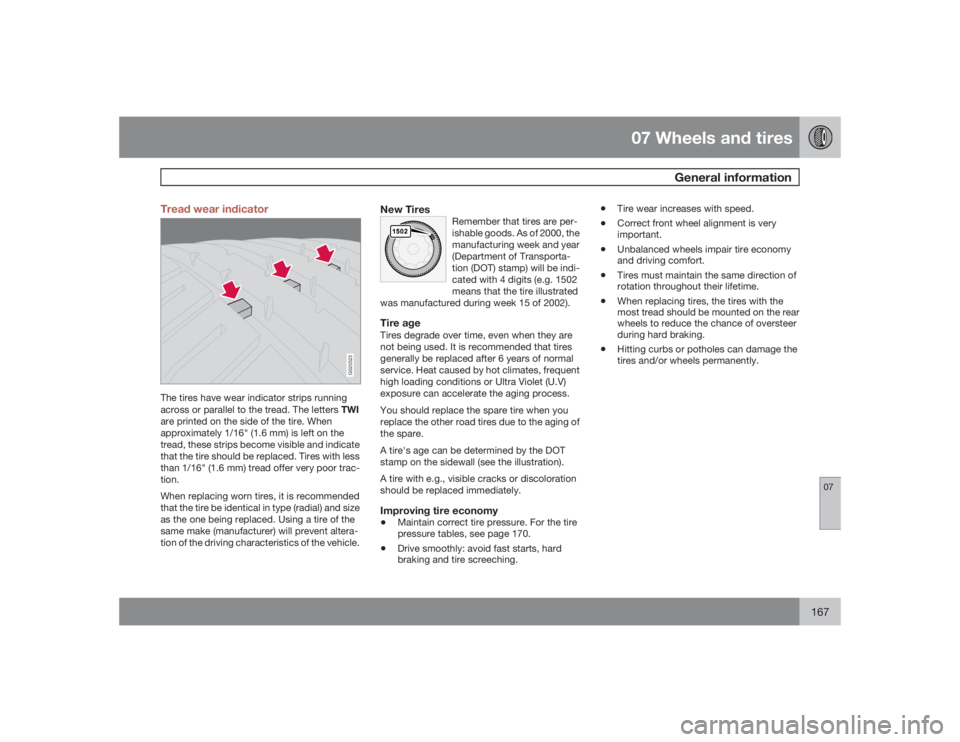
167 Tread wear indicator
G020323
The tires have wear indicator strips running
across or parallel to the tread. The letters TWI
are printed on the side of the tire. When
approximately 1/16" (1.6 mm) is left on the
tread, these strips become visible and indicate
that the tire should be replaced. Tires with less
than 1/16" (1.6 mm) tread offer very poor trac-
tion.
When replacing worn tires, it is recommended
that the tire be identical in type (radial) and size
as the one being replaced. Using a tire of the
same make (manufacturer) will prevent altera-
tion of the driving characteristics of the vehicle.
New Tires
Remember that tires are per-
ishable goods. As of 2000, the
manufacturing week and year
(Department of Transporta-
tion (DOT) stamp) will be indi-
cated with 4 digits (e.g. 1502
means that the tire illustrated
was manufactured during week 15 of 2002).
Tire ageTires degrade over time, even when they are
not being used. It is recommended that tires
generally be replaced after 6 years of normal
service. Heat caused by hot climates, frequent
high loading conditions or Ultra Violet (U.V)
exposure can accelerate the aging process.
You should replace the spare tire when you
replace the other road tires due to the aging of
the spare.
A tire's age can be determined by the DOT
stamp on the sidewall (see the illustration).
A tire with e.g., visible cracks or discoloration
should be replaced immediately.Improving tire economy•
Maintain correct tire pressure. For the tire
pressure tables, see page 170.
•
Drive smoothly: avoid fast starts, hard
braking and tire screeching.
•
Tire wear increases with speed.
•
Correct front wheel alignment is very
important.
•
Unbalanced wheels impair tire economy
and driving comfort.
•
Tires must maintain the same direction of
rotation throughout their lifetime.
•
When replacing tires, the tires with the
most tread should be mounted on the rear
wheels to reduce the chance of oversteer
during hard braking.
•
Hitting curbs or potholes can damage the
tires and/or wheels permanently.
Page 188 of 274
07 Wheels and tiresTire Pressure Monitoring System (TPMS)
07188
IntroductionThe tire pressure monitoring system uses sen-
sors mounted in the tire valves to check infla-
tion pressure levels. When the vehicle is
moving at a speed of approximately 20 mph
(30 km/h) or faster, these sensors transmit
inflation pressure data to a receiver located in
the vehicle.
NOTE
USA – FCC ID: KR5S122780002
This device complies with part 15 of the
FCC rules. Operation is subject to the fol-
lowing conditions: (1) This device may not
cause harmful interference, and (2) this
device must accept any interference
received, including interference that may
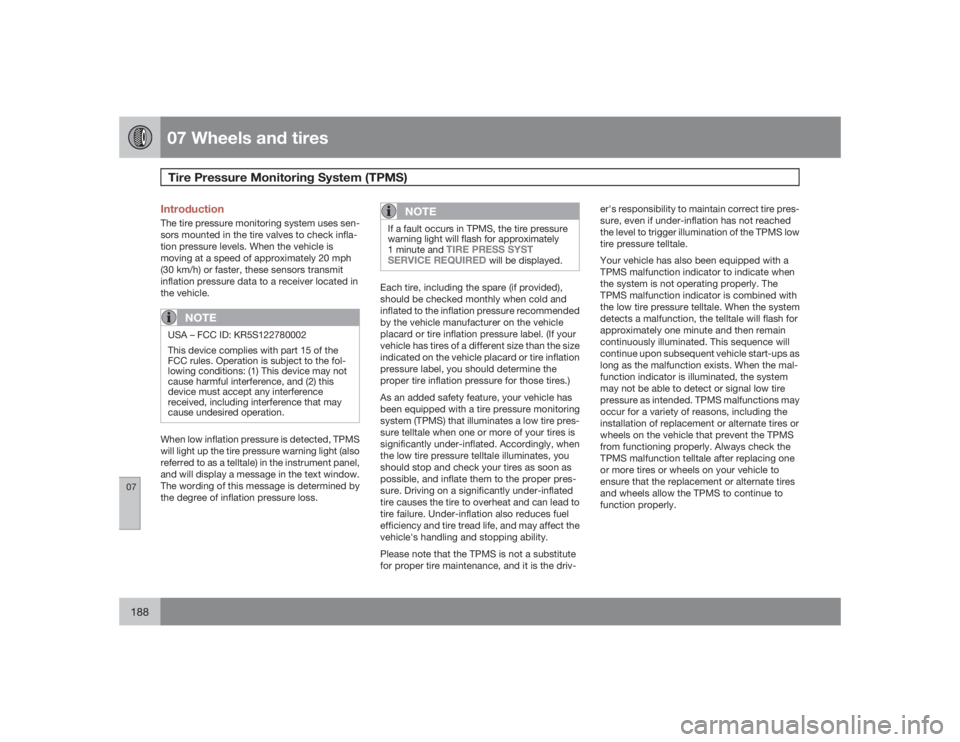
cause undesired operation.When low inflation pressure is detected, TPMS
will light up the tire pressure warning light (also
referred to as a telltale) in the instrument panel,
and will display a message in the text window.
The wording of this message is determined by
the degree of inflation pressure loss.
NOTE
If a fault occurs in TPMS, the tire pressure
warning light will flash for approximately
1 minute and
TIRE PRESS SYST
SERVICE REQUIRED
will be displayed.
Each tire, including the spare (if provided),
should be checked monthly when cold and
inflated to the inflation pressure recommended
by the vehicle manufacturer on the vehicle
placard or tire inflation pressure label. (If your
vehicle has tires of a different size than the size
indicated on the vehicle placard or tire inflation
pressure label, you should determine the
proper tire inflation pressure for those tires.)
As an added safety feature, your vehicle has
been equipped with a tire pressure monitoring
system (TPMS) that illuminates a low tire pres-
sure telltale when one or more of your tires is
significantly under-inflated. Accordingly, when
the low tire pressure telltale illuminates, you
should stop and check your tires as soon as
possible, and inflate them to the proper pres-
sure. Driving on a significantly under-inflated
tire causes the tire to overheat and can lead to
tire failure. Under-inflation also reduces fuel
efficiency and tire tread life, and may affect the
vehicle's handling and stopping ability.
Please note that the TPMS is not a substitute
for proper tire maintenance, and it is the driv-er's responsibility to maintain correct tire pres-
sure, even if under-inflation has not reached
the level to trigger illumination of the TPMS low
tire pressure telltale.
Your vehicle has also been equipped with a
TPMS malfunction indicator to indicate when
the system is not operating properly. The
TPMS malfunction indicator is combined with
the low tire pressure telltale. When the system
detects a malfunction, the telltale will flash for
approximately one minute and then remain
continuously illuminated. This sequence will
continue upon subsequent vehicle start-ups as
long as the malfunction exists. When the mal-
function indicator is illuminated, the system
may not be able to detect or signal low tire
pressure as intended. TPMS malfunctions may
occur for a variety of reasons, including the
installation of replacement or alternate tires or
wheels on the vehicle that prevent the TPMS
from functioning properly. Always check the
TPMS malfunction telltale after replacing one
or more tires or wheels on your vehicle to
ensure that the replacement or alternate tires
and wheels allow the TPMS to continue to
function properly.
Page 211 of 274
09 Maintenance and servicing
Battery
09``211 Battery maintenance
Driving habits and conditions, climate, the
number of starts, etc., all affect the service life
and function of the battery. In order for your
battery to perform satisfactorily, keep the fol-
lowing in mind:
Check the fluid level in each cell in the battery
every 24 months or every 15,000
1 miles
(24,000 km), whichever is sooner.
•
Use a screw driver to open the caps or
cover and a flashlight to inspect the level.
•
If necessary, add distilled water. The level
should never be above the indicator.
•
The fluid level should be checked if the
battery has been recharged.
•
After inspection, be sure the cap over each
battery cell or the cover is securely in
place.
•
Check that the battery cables are correctly
connected and properly tightened.
•
Never disconnect the battery when the
engine is running, or when the key is in the
ignition. This could damage the vehicle's
electrical system.
•
The battery should be disconnected from
the vehicle when a battery charger is used
directly on the battery.
WARNING
PROPOSITION 65 WARNING!
Battery posts, terminals, and related acces-
sories contain lead and lead compounds,
chemicals known to the state of California
to cause cancer and reproductive harm.
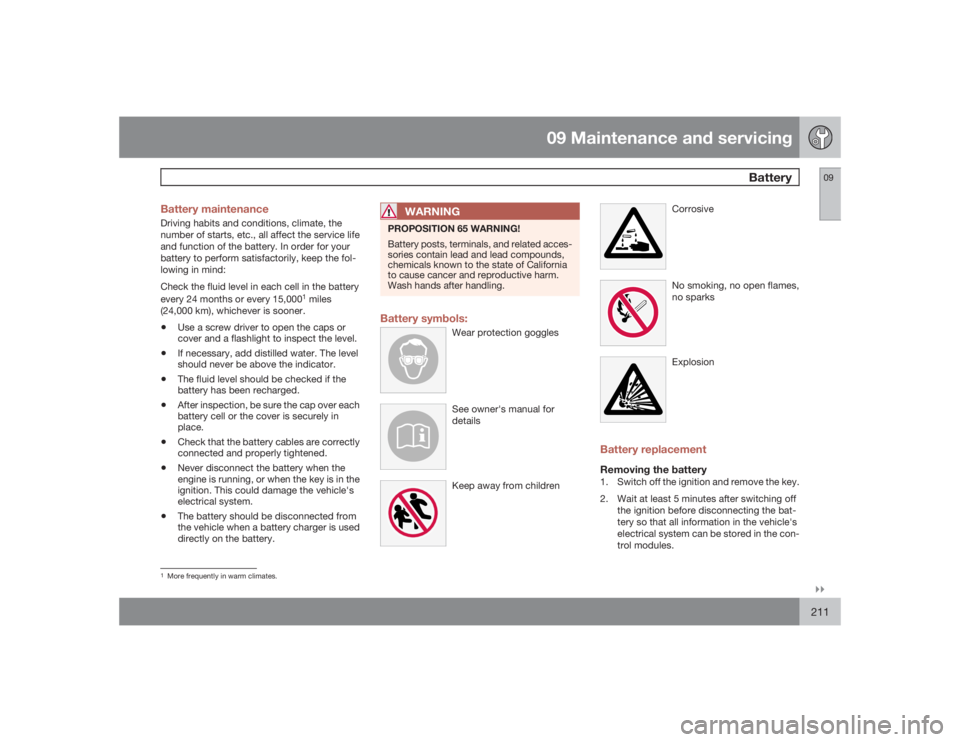
Wash hands after handling.Battery symbols:
Wear protection gogglesSee owner's manual for
detailsKeep away from children
CorrosiveNo smoking, no open flames,
no sparksExplosion
Battery replacementRemoving the battery1. Switch off the ignition and remove the key.
2. Wait at least 5 minutes after switching off
the ignition before disconnecting the bat-
tery so that all information in the vehicle's
electrical system can be stored in the con-
trol modules.
1More frequently in warm climates.