warning light VOLVO C30 2009 Owner´s Manual
[x] Cancel search | Manufacturer: VOLVO, Model Year: 2009, Model line: C30, Model: VOLVO C30 2009Pages: 274, PDF Size: 6.82 MB
Page 108 of 274
04 InteriorStorage compartments
04108
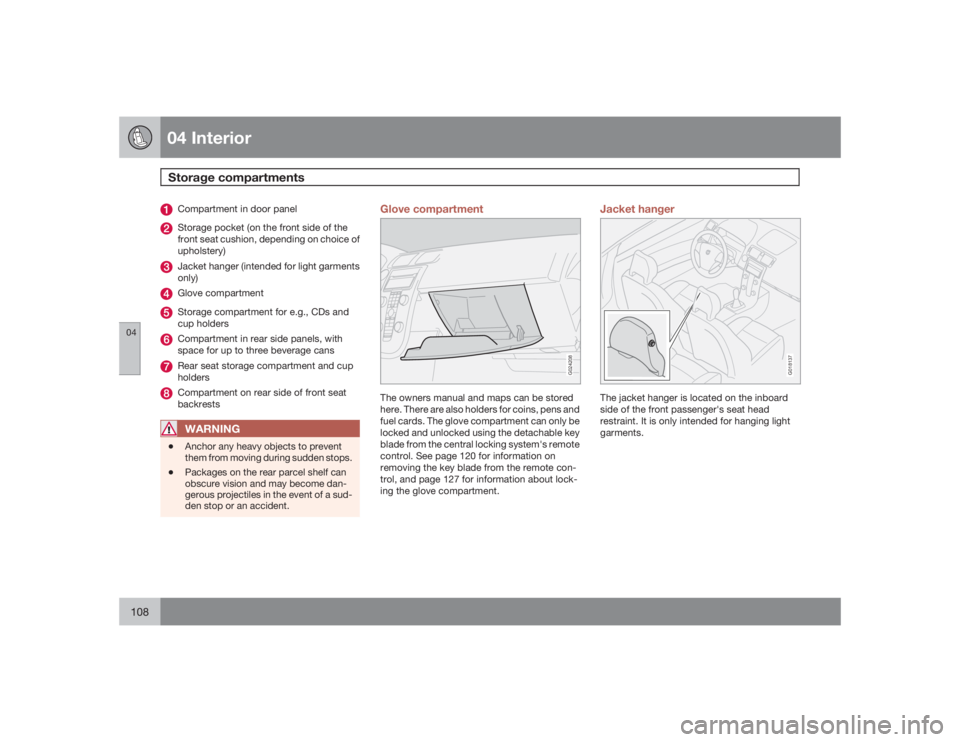
Compartment in door panelStorage pocket (on the front side of the
front seat cushion, depending on choice of
upholstery)Jacket hanger (intended for light garments
only)Glove compartmentStorage compartment for e.g., CDs and
cup holdersCompartment in rear side panels, with
space for up to three beverage cansRear seat storage compartment and cup
holdersCompartment on rear side of front seat
backrestsWARNING
•
Anchor any heavy objects to prevent
them from moving during sudden stops.
•
Packages on the rear parcel shelf can
obscure vision and may become dan-
gerous projectiles in the event of a sud-
den stop or an accident.
Glove compartment
G024208
The owners manual and maps can be stored
here. There are also holders for coins, pens and
fuel cards. The glove compartment can only be
locked and unlocked using the detachable key
blade from the central locking system's remote
control. See page 120 for information on
removing the key blade from the remote con-
trol, and page 127 for information about lock-
ing the glove compartment.
Jacket hanger
G018137
The jacket hanger is located on the inboard
side of the front passenger's seat head
restraint. It is only intended for hanging light
garments.
Page 134 of 274
06 Starting and drivingGeneral information
06134
Economical driving conserves natural
resourcesBetter driving economy may be obtained by
thinking ahead, avoiding rapid starts and stops
and adjusting the speed of your vehicle to
immediate traffic conditions.
Observe the following rules:•
Bring the engine to normal operating tem-
perature as soon as possible by driving
with a light foot on the accelerator pedal for
the first few minutes of operation. A cold
engine uses more fuel and is subject to
increased wear.
•
Whenever possible, avoid using the vehicle
for driving short distances. This does not
allow the engine to reach normal operating
temperature.
•
Drive carefully and avoid rapid acceleration
and hard braking.
•
Use the transmission's Drive (D) position
as often as possible and avoid using kick-
down.
•
Do not exceed posted speed limits.
•
Avoid carrying unnecessary items (extra
load) in the vehicle.
•
Maintain correct tire pressure. Check tire
pressure regularly (when tires are cold).
•
Remove snow tires when threat of snow or
ice has ended.
•
Note that roof racks, ski racks, etc,
increase air resistance and also fuel con-
sumption.
•
At highway driving speeds, fuel consump-
tion will be lower with the air conditioning
on and the windows closed than with the
air conditioning off and the windows open.
•
Using the onboard trip computer's fuel
consumption modes can help you learn
how to drive more economically.
Other factors that decrease gas mileage
are:•
Dirty air cleaner
•
Dirty engine oil and clogged oil filter
•
Dragging brakes
•
Incorrect front end alignment
Some of the above mentioned items and others
are checked at the standard maintenance
intervals.
WARNING
Driving with the liftgate open: Driving with
the liftgate open could lead to poisonous
exhaust gases entering the passenger com-
partment. If the liftgate must be kept open
for any reason, proceed as follows:
1. Close the windows.
2. Set the ventilation system control to air
flow to floor, windshield and side win-
dows and the blower control to its high-
est setting.Weight distribution affects handlingAt the specified curb weight your vehicle has a
tendency to understeer, which means that the
steering wheel has to be turned more than
might seem appropriate for the curvature of a
bend. This ensures good stability and reduces
the risk of rear wheel skid. Remember that
these properties can alter with the vehicle load.
The heavier the load in the cargo area, the less
the tendency to understeer.
Page 135 of 274
06 Starting and driving
General information
06``135 Handling, roadholding
Vehicle load, tire design and inflation pressure
all affect vehicle handling. Therefore, check
that the tires are inflated to the recommended
pressure according to the vehicle load. See the
"Tire pressure" section. Loads should be dis-
tributed so that capacity weight or maximum
permissible axle loads are not exceeded.Driving through waterThe vehicle can be driven through water up to
a depth of approximately 9 in. (25 cm), at a
maximum speed of 6 mph (10 km/h).•
Take particular care when driving through
flowing water.
•
Clean the electrical connections for trailer
wiring after driving in mud or water
•
When driving through water, maintain low
speed and do not stop in the water.WARNING
After driving through water, press lightly on
the brake pedal to ensure that the brakes
are functioning normally. Water or mud can
make the brake linings slippery, resulting in
delayed braking effect.
CAUTION
•
Engine damage will occur if water is
drawn into the air cleaner.
•
If the vehicle is driven through water
deeper than 9 in (25 cm), water may
enter the differential and the transmis-
sion. This reduces the oil's lubricating
capacity and may shorten the service
life of these components.
•
Do not allow the vehicle to stand in
water up to the door sills longer than
absolutely necessary. This could result
in electrical malfunctions.
•
If the engine has been stopped while the
car is in water, do not attempt to restart
the engine. Have the car towed out of
the water.
Cold weather precautionsIf you wish to check your vehicle before the
approach of cold weather, the following advice
is worth noting:•
Make sure that the engine coolant contains
50 percent antifreeze. Any other mixture
will reduce freeze protection. This gives
protection against freezing down to –31 °F
(–35 °C). See section "Coolant". The use of
"recycled" antifreeze is not approved byVolvo. Different types of antifreeze must
not be mixed.
•
Volvo recommends using only genuine
Volvo antifreeze in your vehicle's radiator.
Your Volvo retailer stocks plenty of Volvo
engine coolant to help protect your vehicle
during cold weather.
•
Try to keep the fuel tank well filled – this
prevents the formation of condensation in
the tank. In addition, in extremely cold
weather conditions it is worthwhile to add
fuel line de-icer before refueling.
•
The viscosity of the engine oil is important.
Oil with low viscosity (thinner oil) improves
cold-weather starting as well as decreas-
ing fuel consumption while the engine is
warming up. For winter use, 5W-30 oil, par-
ticularly the synthetic type
1, is recom-
mended. Be sure to use good quality oil but
do not use cold-weather oil for hard driving
or in warm weather, see page 259 for more
information.
•
The load placed on the battery is greater
during the winter since the windshield wip-
ers, lighting, etc. are used more often.
Moreover, the capacity of the battery
decreases as the temperature drops. In
very cold weather, a poorly charged bat-
tery can freeze and be damaged. It is there-
fore advisable to check the state of charge
1Synthetic oil is not used when the oil is changed at the normal maintenance intervals except at owner request and at additional charge. Please consult your Volvo retailer.
Page 137 of 274
06 Starting and driving
General information
06
137
•
Check state of the battery's charge.
•
Examine tires carefully (the spare tire as
well), and replace those that are worn.
Check tire pressures.
•
The brakes, front wheel alignment, and
steering gear should be checked by your
Volvo retailer only.
•
Check all lights, including high beams.
•
Reflective warning triangles are legally
required in some states/provinces.
•
Have a word with your Volvo retailer if you
intend to drive in countries where it may be
difficult to obtain the correct fuel.
•
Consider your destination. If you will be
driving through an area where snow or ice
are likely to occur, consider snow tires.
Page 140 of 274
06 Starting and drivingFuel requirements
06140
RefuelingThe fuel tank is designed to accommodate
possible expansion of the fuel in hot weather,
see page 257 for fuel tank volume. Be aware
that the "usable" tank capacity will be some-
what less than the specified maximum. When
the fuel level is low, such factors as ambient
temperature, the fuel's "Reid vapor pressure"
characteristics, and terrain can affect the fuel
pump's ability to supply the engine with an
adequate supply of fuel. Therefore, it is advis-
able to refuel as soon as possible when the
needle nears the red zone, or when the fuel
warning light comes on.
CAUTION
•
Do not refuel with the engine running
1.
Turn the ignition off or to position I. If the
ignition is on, an incorrect reading could
occur in the fuel gauge
•
After refueling, close the fuel filler cap
by turning it clockwise until it clicks into
place.
•
Avoid overfilling the fuel tank. Do not
press the handle on the filler nozzle
more than one extra time. Too much
fuel in the tank in hot weather conditions
can cause the fuel to overflow. Overfill-
ing could also cause damage to the
emission control systems.
•
Avoid spilling gasoline during refueling.
In addition to causing damage to the
environment, gasolines containing
alcohol can cause damage to painted
surfaces, which may not be covered
under the New Vehicle Limited War-
ranty.
•
Do not use gasolines containing meth-
anol (methyl alcohol, wood alcohol).
This practice can result in vehicle per-
formance deterioration and can dam-
age critical parts in the fuel system.
Such damage may not be covered
under the New Vehicle Limited War-
ranty.
1If the fuel filler cap is not closed tightly or if the engine is running when the vehicle is refueled, the Check Engine Light (malfunction indicator lamp) may indicate a fault. However, your vehicle’s
performance will not be affected. Use only Volvo original or approved fuel filler caps.
Page 142 of 274
06 Starting and drivingStarting the vehicle
06142
To start the engine
WARNING
Before starting, check that the seat, steering
wheel and mirrors are adjusted properly.
Make sure the brake pedal can be
depressed completely. Adjust the seat if
necessary.1. Fasten the seat belt.
2. Apply the parking brake if not already set.
The gear selector should be locked in the
Park (P) position (Shiftlock). See also page
148.
Manual transmission: The clutch must be
fully depressed.
NOTE
After a cold start, idle speed may be notice-
ably higher than normal for a short period.
This is done to help bring components in the
emission control system to their normal
operating temperature as quickly as possi-
ble, which enables them to control emis-
sions and help reduce the vehicle's impact
on the environment.3. The vehicle is equipped with an autostart
feature. Without touching the throttlepedal, turn the key to position III and
release it. The starter motor will then oper-
ate automatically (for up to ten seconds)
until the engine starts. If the engine fails to
start, repeat this step.
4. To release the gear selector from the Park
(P) position, the engine must be running (or
the ignition key must be in position II) and
the brake pedal must be depressed.
5. Select the desired gear. On models with an
automatic transmission, the gear engages
after a very slight delay which is especially
noticeable when selecting R.
NOTE
•
Immobilizer: If two of the keys to your
vehicle are close together, e.g., on the
same key ring when you try to start the
vehicle, this could cause interference in
the immobilizer system and result in the
vehicle not starting. If this should occur,
remove one of the keys from the key
ring before trying to start the vehicle
again.
•
Keylock: Models equipped an auto-
matic transmission have a keylock sys-
tem. When the engine is switched off,
the gear selector must be in the Park
(P) position before the key can be
removed from the ignition switch
1.
•
When starting in cold weather, the
transmission may shift up at slightly
higher engine speeds than normal until
the automatic transmission fluid rea-
ches normal operating temperature.
•
Do not race a cold engine immediately
after starting. Oil flow may not reach
some lubrication points fast enough to
prevent engine damage.
1The optional keyless drive start control does not need to be removed from the ignition switch.
Page 149 of 274
06 Starting and driving
Brake system
06``149 Brake circuit malfunction
The brake system is a hydraulic system con-
sisting of two separate brake circuits. If a prob-
lem should occur in one of these circuits, it is
still possible to stop the vehicle with the other
brake circuit.
If the brake pedal must be depressed farther
than normal and requires greater foot pressure,
the stopping distance will be longer.
A warning light in the instrument panel will light
up to warn the driver that a fault has occurred.
If this light comes on while driving or braking,
stop immediately and check the brake fluid
level in the reservoir.
NOTE
Press the brake pedal hard and maintain
pressure on the pedal – do not pump the
brakes.
WARNING
If the fluid level is below the MIN mark in the
reservoir or if a brake system message is
shown in the information display, DO NOT
DRIVE. Have the vehicle towed to a Volvo
retailer and have the brake system inspec-
ted.
Power brakes function only when the
engine is runningThe power brakes utilize vacuum pressure
which is only created when the engine is run-
ning. Never let the vehicle roll to a stop with the
engine switched off.
If the power brakes are not working, the brake
pedal must be pressed approximately five
times harder than usual to make up for the lack
of power assistance. This can happen for
example when towing your vehicle or if the
engine is switched off when the vehicle is roll-
ing. The brake pedal feels harder than usual.Water on brake discs and brake pads
affects brakingDriving in rain and slush or passing through an
automatic car wash can cause water to collect
on the brake discs and pads. This will cause a
delay in braking effect when the pedal is
depressed. To avoid such a delay when the
brakes are needed, depress the pedal occa-
sionally when driving through rain, slush, etc.
This will remove the water from the brakes.
Check that brake application feels normal. This
should also be done after washing or starting
in very damp or cold weather.
Severe strain on the brake systemThe brakes will be subject to severe strain
when driving in mountains or hilly areas, or
when towing a trailer. Vehicle speed is usually
slower, which means that the cooling of the
brakes is less efficient than when driving on
level roads. To reduce the strain on the brakes,
shift into a lower gear and let the engine help
with the braking. Do not forget that if you are
towing a trailer, the brakes will be subjected to
a greater than normal load.Anti-lock brakes (ABS)The Anti-lock Braking System (ABS) helps to
improve vehicle control (stopping and steering)
during severe braking conditions by limiting
brake lockup. When the system "senses"
impending lockup, braking pressure is auto-
matically modulated in order to help prevent
lockup that could lead to a skid.
The system performs a self-diagnostic test
when the engine is started and when the
vehicle first reaches a speed of approxi-
mately 12 mph (20 km/h). The brake pedal will
pulsate several times and a sound may be
audible from the ABS control module. This is
normal.
Page 150 of 274
06 Starting and drivingBrake system
06150
For optimal ABS braking effect:1. Press down on the brake pedal with full
force. The pedal will pulsate.
2. Steer the vehicle in the direction of travel
and keep the brake pedal depressed.Electronic Brake Force Distribution
(EBD)EBD is an integrated part of the ABS system.
EBD regulates the hydraulic pressure to the
rear brakes to help provide optimal braking
capacity.
The switching of the ABS modulator will be
audible and the brake pedal will pulsate during
braking. Please be aware that ABS does not
increase the absolute braking potential of the
vehicle. While control will be enhanced, ABS
will not shorten stopping distances on slippery
surfaces.
If the warning lamp lights up there is a mal-
function of the ABS system (the standard brak-
ing system will still function) and the vehicle
should be driven cautiously to a trained and
qualified Volvo service technicianfor inspec-
tion.
WARNING
If the BRAKES and ABS warning symbols
light at the same time, there may be a prob-
lem in the brake system. If the brake fluid
level is normal in these circumstances, drive
carefully to a trained and qualified Volvo
service technician to have the brake system
checked.Emergency Brake Assistance – EBAEBA is designed to provide full brake effect
immediately in the event of sudden, hard brak-
ing. The system is activated by the speed with
which the brake pedal is depressed.
When the EBA system is activated, the brake
pedal will go down and pressure in the brake
system immediately increases to the maximum
level. Maintain full pressure on the brake pedal
in order to utilize the system completely. EBA
is automatically deactivated when the brake
pedal is released.
NOTE
•
When the EBA system is activated, the
brake pedal will go down and pressure
in the brake system immediately increa-
ses to the maximum level. You must
maintain full pressure on the brake
pedal in order to utilize the system com-
pletely. There will be no braking effect if
the pedal is released. EBA is automati-
cally deactivated when the brake pedal
is released.
•
When the vehicle has been parked for
some time, the brake pedal may sink
more than usual when the engine is
started. This is normal and the pedal will
return to its usual position when it is
released.
Page 152 of 274
06 Starting and drivingStability system
06152
WARNING
The car's handling and stability characteris-
tics will be altered if the DSTC system func-
tions have been disabled.DSTC-related messages in the text
window•
"TRACTION CONTROL TEMPORARILY
OFF
" – The system has been temporarily
switched off due to high brake temperature
and will automatically switch on again
when the brakes have cooled.
•
"ANTI SKID SERVICE REQUIRED
" – the
system has been automatically disen-
gaged due to a fault. A trained and qualified
Volvo service technician retailer should
check the system.
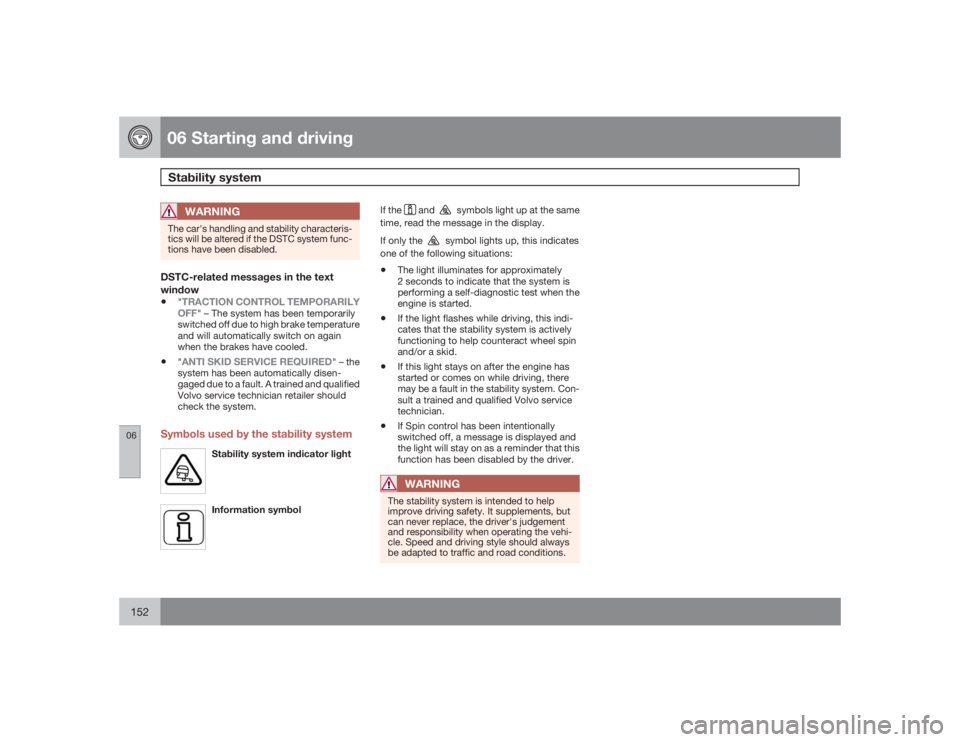
Symbols used by the stability system
Stability system indicator lightInformation symbol
If the
and
symbols light up at the same
time, read the message in the display.
If only the symbol lights up, this indicates
one of the following situations:
•
The light illuminates for approximately
2 seconds to indicate that the system is
performing a self-diagnostic test when the
engine is started.
•
If the light flashes while driving, this indi-
cates that the stability system is actively
functioning to help counteract wheel spin
and/or a skid.
•
If this light stays on after the engine has
started or comes on while driving, there
may be a fault in the stability system. Con-
sult a trained and qualified Volvo service
technician.
•
If Spin control has been intentionally
switched off, a message is displayed and
the light will stay on as a reminder that this
function has been disabled by the driver.WARNING
The stability system is intended to help
improve driving safety. It supplements, but
can never replace, the driver's judgement
and responsibility when operating the vehi-
cle. Speed and driving style should always
be adapted to traffic and road conditions.
Page 154 of 274
06 Starting and drivingTowing
06154
WARNING
•
Never allow a vehicle to be towed with-
out a driver behind the wheel of the
disabled vehicle.
•
Never remove the key from the ignition
while the vehicle is moving. The steering
wheel could lock, making it impossible
to steer the vehicle.
•
When the engine is not running, steering
resistance and the effort needed to
apply the brakes will be great.
•
Never attempt to tow a vehicle with a
dead battery at night.CAUTION
•
Check with state and local authorities
before attempting this type of towing,
as vehicles being towed are subject to
regulations regarding maximum towing
speed, length and type of towing
device, lighting, marker flags, etc.
•
Never attempt to push- or tow-start a
vehicle with a dead battery. This would
inject unburned fuel into the three-way
catalytic converter(s), causing over-
heating, backfiring, and damage, see
page 155 for instructions on jump star-
ting the vehicle.
Towing vehicles with front wheel driveVolvo recommends the use of flat bed equip-
ment for towing vehicles with front wheel drive.
If wheel lift equipment must be used, please
use extreme caution to help avoid damage to
the vehicle.
In this case, the vehicle should be towed with
the rear wheels on the ground if at all possible.
If it is absolutely necessary to tow the vehicle
with the front wheels on the ground, please
refer to the towing information on the previous
page.•
Sling-type equipment applied at the front
will damage radiator and air conditioning
lines.
•
It is equally important not to use sling-type
equipment at the rear or apply lifting equip-
ment inside the rear wheels; serious dam-
age to the rear axle may result.
•
If the vehicle is being towed on a flat bed
truck, the towing eyelets must not be used
to secure the vehicle on the flat bed. Con-
sult the tow truck operator.
WARNING
•
Remember that the power brakes and
power steering will not function when
engine is not running. The braking and
steering systems will function but the
brake pedal pressure required is
3 – 5 times above normal and greater
steering effort must be exerted.
•
The towing eyelets must not be used for
pulling the vehicle out of a ditch or for
any similar purpose involving severe
strain. Do not use the towing eyelets to
pull the vehicle up onto a flat bed tow
truck.