towing VOLVO C30 2011 Owner´s Manual
[x] Cancel search | Manufacturer: VOLVO, Model Year: 2011, Model line: C30, Model: VOLVO C30 2011Pages: 290, PDF Size: 6.56 MB
Page 184 of 290
07 Wheels and tires
Vehicle loading
07
184
Loading the vehicle
Before loading your vehicle, familiarize yourself
with the following terms for determining your
vehicle's weight ratings, with or without a
trailer, from the vehicle's Federal/Canadian
Motor Vehicle Safety Standards (FMVSS/
CMVSS) label, and the vehicle's tire informa-
tion placard:
Curb weightThe weight of the vehicle including a full tank
of fuel and all standard equipment. It does not
include passengers, cargo, or optional equip-
ment.
Capacity weightAll weight added to the curb weight, including
cargo and optional equipment. When towing,
trailer hitch tongue load is also part of cargo
weight.
Permissible axle weightThe maximum allowable weight that can be
carried by a single axle (front or rear). These
numbers are shown on the Federal/Canadian
Motor Vehicle Safety Standards (FMVSS/
CMVSS) label. The total load on each axle must
never exceed its maximum permissible weight.
Gross vehicle weight (GVW)The vehicle's curb weight + cargo + passen-
gers.
NOTE
•The location of the various labels in your
vehicle can be found on page 266.
•A table listing important weight limits for
your vehicle can be found on page
269.
Steps for Determining Correct Load
Limit
1. Locate the statement "the combined
weight of occupants and cargo should
never exceed XXX pounds" on your vehi-
cle's placard.
2. Determine the combined weight of the
driver and passengers that will be riding in
your vehicle.
3. Subtract the combined weight of the driver
and passengers from XXX kilograms or
XXX pounds.
4. The resulting figure equals the available
amount of cargo and luggage load
capacity. For example, if the "XXX" amount
equals 1400 lbs. and there will be five
150 lbs. passengers in your vehicle, the
amount of available cargo and luggage
load capacity is 650 lbs. (1400–750 (5×150)
= 650 lbs.)5. Determine the combined weight of luggage
and cargo being loaded on the vehicle.
That weight may not safely exceed the
available cargo and luggage load capacity
calculated in Step 4.
WARNING
•Exceeding the permissible axle weight,
gross vehicle weight, or any other
weight rating limits can cause tire over-
heating resulting in permanent defor-
mation or catastrophic failure.
•Do not use replacement tires with lower
load carrying capacities than the tires
that were original equipment on the
vehicle because this will lower the vehi-
cle's GVW rating. Use only tires with the
correct load carrying capacity. Consult
your Volvo retailer for information.
Page 192 of 290
07 Wheels and tires
Tire Sealing System*
07
192* Option/accessory, for more information, see Introduction.
Stowing the tire sealing system
1. Return the tire sealing system to its storage
position.
2. Put the retaining bracket in its proper posi-
tion.
3. Tighten the screw that holds the bracket in
place.
Be sure the bracket is correctly installed and
the screw tightened to help keep the tire seal-
ing system from rattling.
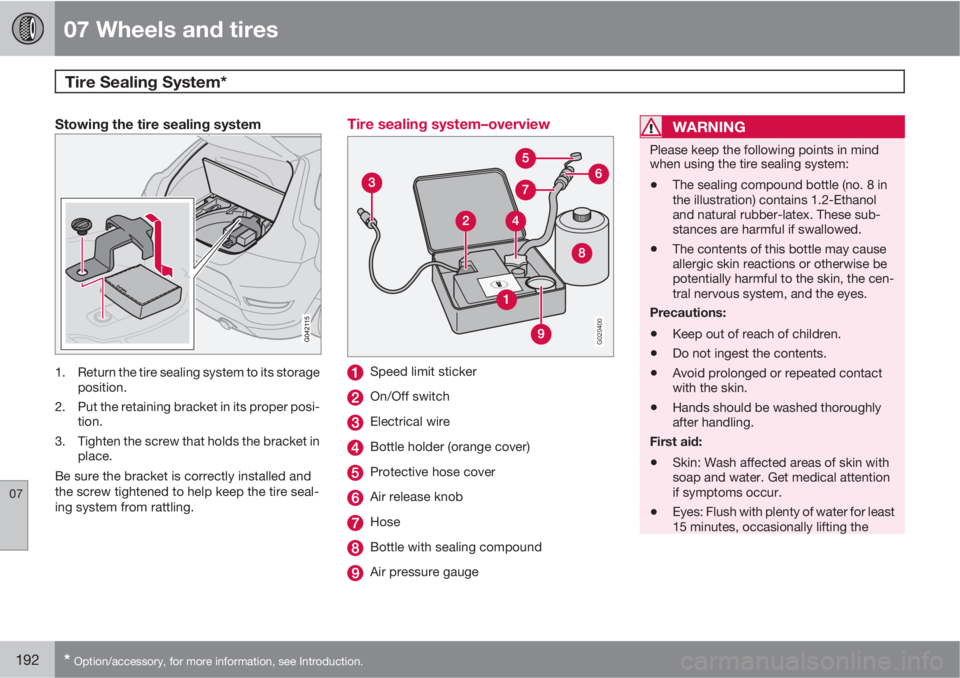
Tire sealing system–overview
G020400
Speed limit sticker
On/Off switch
Electrical wire
Bottle holder (orange cover)
Protective hose cover
Air release knob
Hose
Bottle with sealing compound
Air pressure gauge
WARNING
Please keep the following points in mind
when using the tire sealing system:
•The sealing compound bottle (no. 8 in
the illustration) contains 1.2-Ethanol
and natural rubber-latex. These sub-
stances are harmful if swallowed.
•The contents of this bottle may cause
allergic skin reactions or otherwise be
potentially harmful to the skin, the cen-
tral nervous system, and the eyes.
Precautions:
•Keep out of reach of children.
•Do not ingest the contents.
•Avoid prolonged or repeated contact
with the skin.
•Hands should be washed thoroughly
after handling.
First aid:
•Skin: Wash affected areas of skin with
soap and water. Get medical attention
if symptoms occur.
•Eyes: Flush with plenty of water for least
15 minutes, occasionally lifting the
Page 194 of 290
07 Wheels and tires
Tire Sealing System*
07
194* Option/accessory, for more information, see Introduction.
7. Remove the valve cap from the tire’s infla-
tion valve and screw the tire sealing sys-
tem’s hose connector onto the valve as
tightly as possible by hand.
8. Connect the electrical wire to the nearest
12-volt socket in the vehicle.
9. Start the vehicle’s engine.
10. Start the tire sealing system’s compressor
by pressing the on/off switch to position I.
WARNING
•Never stand next to the tire being inflated
when the compressor is in operation.
•If cracks, bubbles, etc. form on the tire,
switch off the compressor immediately.
•If there is visible damage to the sidewall
or the rim, the tire cannot be repaired.
The vehicle should not be driven if this
occurs. Contact a towing service or
Volvo On Call Roadside Assistance if
applicable.
NOTE
The air pressure gauge will temporarily
show an increase in pressure to approxi-
mately 88 psi (6 bar) while the sealing com-
pound is being pumped into the tire. The
pressure should return to a normal level
after approximately 30 seconds.
11. Within seven minutes, inflate the tire to
between 22—44 psi (1.8—3.0 bar). Switch
off the compressor briefly to get a clear
reading from the pressure gauge. The
compressor should not be used for more
than 10 minutes at a time to avoid over-
heating.
CAUTION
The compressor should not be used for
more than 10 minutes at a time to avoid
overheating.
WARNING
If the pressure remains below 22 psi
(1.8 bar) after approximately seven minutes,
turn off the compressor. In this case, the
hole is too large to be sealed and the vehicle
should not be driven.
12. Switch off the compressor and disconnect
the electrical wire from the 12-volt socket.
13. Unscrew the hose from the tire’s inflation
valve and reinstall the valve cap.
14. Immediately drive the vehicle for approxi-
mately 2 miles (3 km) at a maximum speed
of 50 mph (80 km/h) to distribute the seal-
ing compound in the tire.
CAUTION
If your vehicle is equipped with the Tire
Pressure Monitoring System (TPMS), the
use of the sealing compound may lead to
incorrect tire pressure readings or in rare
cases, damage to the tire pressure sensor.
Use the tire sealing system to check and
adjust the damaged tire's inflation pressure.
NOTE
•Safely stow the tire sealing system in a
convenient place as it will soon be used
again to check the tire’s inflation pres-
sure.
•The empty bottle of sealing compound
cannot be removed from the bottle
holder. Consult a trained and qualified
Volvo service technician to have the
bottle removed and properly disposed
of.
Page 271 of 290
11 Specifications
Fuel, oils, and fluids
11
271
NOTE
The transmission oil does not normally need
to be changed during the service life of the
vehicle. However, it may be necessary to
replace the oil if the vehicle is often driven
in areas of sustained temperature extremes
(hot or cold), when towing a trailer over long
distances, for prolonged driving in moun-
tainous areas, or if the vehicle is often driven
short distances in temperatures under 40 °F
(5 °C).
Page 284 of 290
12 Index
12
284
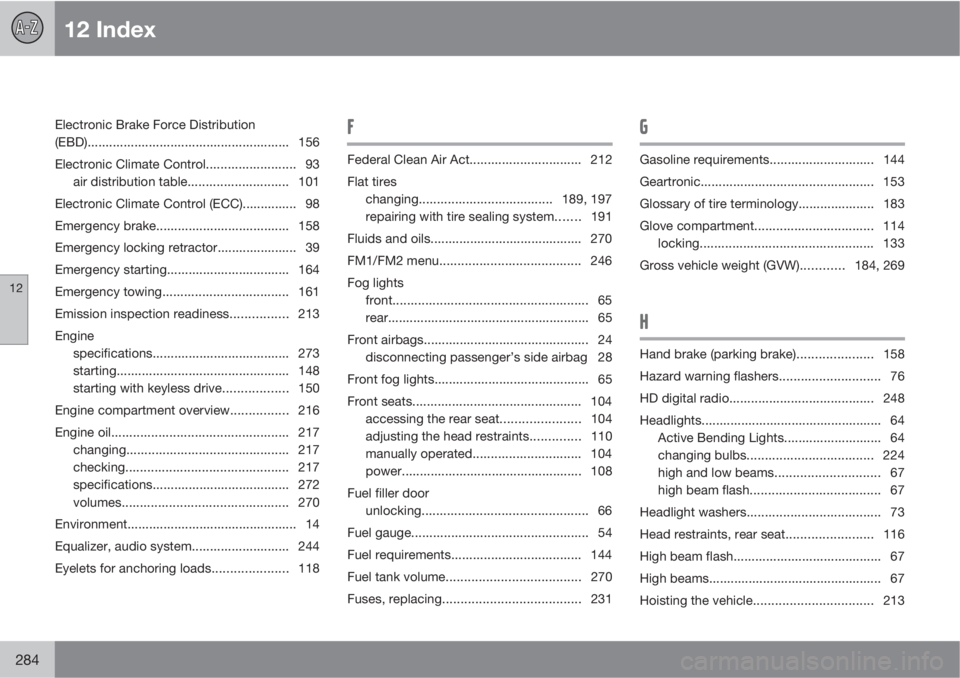
Electronic Brake Force Distribution
(EBD)........................................................ 156
Electronic Climate Control......................... 93
air distribution table............................ 101
Electronic Climate Control (ECC)............... 98
Emergency brake..................................... 158
Emergency locking retractor...................... 39
Emergency starting.................................. 164
Emergency towing................................... 161
Emission inspection readiness................ 213
Engine
specifications...................................... 273
starting................................................ 148
starting with keyless drive.................. 150
Engine compartment overview................216
Engine oil................................................. 217
changing............................................. 217
checking............................................. 217
specifications...................................... 272
volumes.............................................. 270
Environment............................................... 14
Equalizer, audio system........................... 244
Eyelets for anchoring loads..................... 118F
Federal Clean Air Act............................... 212
Flat tires
changing..................................... 189, 197
repairing with tire sealing system....... 191
Fluids and oils.......................................... 270
FM1/FM2 menu....................................... 246
Fog lights
front...................................................... 65
rear........................................................ 65
Front airbags.............................................. 24
disconnecting passenger’s side airbag 28
Front fog lights........................................... 65
Front seats............................................... 104
accessing the rear seat...................... 104
adjusting the head restraints.............. 110
manually operated.............................. 104
power.................................................. 108
Fuel filler door
unlocking.............................................. 66
Fuel gauge................................................. 54
Fuel requirements.................................... 144
Fuel tank volume.....................................270
Fuses, replacing......................................231
G
Gasoline requirements............................. 144
Geartronic................................................ 153
Glossary of tire terminology..................... 183
Glove compartment................................. 114
locking................................................ 133
Gross vehicle weight (GVW)............184, 269
H
Hand brake (parking brake)..................... 158
Hazard warning flashers............................ 76
HD digital radio........................................ 248
Headlights.................................................. 64
Active Bending Lights........................... 64
changing bulbs................................... 224
high and low beams............................. 67
high beam flash.................................... 67
Headlight washers..................................... 73
Head restraints, rear seat........................116
High beam flash......................................... 67
High beams................................................ 67
Hoisting the vehicle.................................213
Page 288 of 290
12 Index
12
288
inflation pressure table, US models.... 179
load ratings......................................... 178
rotation............................................... 175
snow...................................................186
spare................................................... 187
spare tire (location)............................. 189
speed ratings...................................... 178
storing................................................. 175
studded............................................... 186
tire pressure monitoring system......... 199
tire sealing system.............................. 191
tread wear indicator............................ 176
uniform tire quality grading................. 185
winter driving...................................... 186
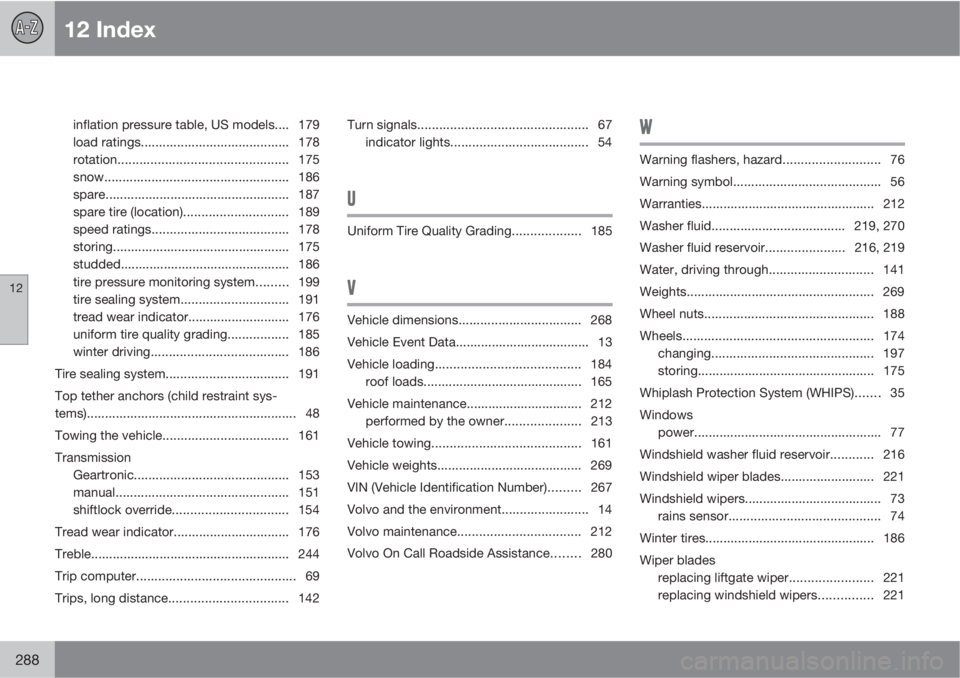
Tire sealing system.................................. 191
Top tether anchors (child restraint sys-
tems).......................................................... 48
Towing the vehicle................................... 161
Transmission
Geartronic........................................... 153
manual................................................151
shiftlock override................................ 154
Tread wear indicator................................ 176
Treble....................................................... 244
Trip computer............................................ 69
Trips, long distance................................. 142Turn signals............................................... 67
indicator lights...................................... 54
U
Uniform Tire Quality Grading...................185
V
Vehicle dimensions.................................. 268
Vehicle Event Data..................................... 13
Vehicle loading........................................ 184
roof loads............................................ 165
Vehicle maintenance................................ 212
performed by the owner.....................213
Vehicle towing.........................................161
Vehicle weights........................................ 269
VIN (Vehicle Identification Number)......... 267
Volvo and the environment........................ 14
Volvo maintenance.................................. 212
Volvo On Call Roadside Assistance........ 280
W
Warning flashers, hazard........................... 76
Warning symbol......................................... 56
Warranties................................................ 212
Washer fluid..................................... 219, 270
Washer fluid reservoir......................216, 219
Water, driving through............................. 141
Weights.................................................... 269
Wheel nuts............................................... 188
Wheels.....................................................174
changing............................................. 197
storing................................................. 175
Whiplash Protection System (WHIPS)....... 35
Windows
power.................................................... 77
Windshield washer fluid reservoir............216
Windshield wiper blades.......................... 221
Windshield wipers...................................... 73
rains sensor.......................................... 74
Winter tires............................................... 186
Wiper blades
replacing liftgate wiper....................... 221
replacing windshield wipers............... 221