flat tire VOLVO C30 2013 Owner´s Manual
[x] Cancel search | Manufacturer: VOLVO, Model Year: 2013, Model line: C30, Model: VOLVO C30 2013Pages: 300, PDF Size: 6.58 MB
Page 196 of 300

07 Wheels and tires
Tire Sealing System*
07
194* Option/accessory, for more information, see Introduction.
13. Unscrew the hose from the tire’s inflation
valve and reinstall the valve cap.
14. Immediately drive the vehicle for approxi-
mately 2 miles (3 km) at a maximum speed
of 50 mph (80 km/h) to distribute the seal-
ing compound in the tire.
CAUTION
If your vehicle is equipped with the Tire
Pressure Monitoring System (TPMS), the
use of the sealing compound may lead to
incorrect tire pressure readings or in rare
cases, damage to the tire pressure sensor.
Use the tire sealing system to check and
adjust the damaged tire's inflation pressure.
NOTE
•Safely stow the tire sealing system in a
convenient place as it will soon be used
again to check the tire’s inflation pres-
sure.
•The empty bottle of sealing compound
cannot be removed from the bottle
holder. Consult a trained and qualified
Volvo service technician to have the
bottle removed and properly disposed
of.
WARNING
If heavy vibrations, unsteady steering
behavior, or noises should occur while driv-
ing, reduce speed and park the vehicle in a
safe place. Recheck the tire for bumps,
cracks, or other visible damage, and
recheck its inflation pressure. If the pressure
is below 19 psi (1.3 bar), do not continue
driving. Have the vehicle towed to a trained
and qualified Volvo service technician.
Stage 2: Checking inflation pressure1. Connect the tire sealing system as descri-
bed in stage 1.
2. Refer to the inflation pressure table for the
correct inflation pressure. If the tire needs
to be inflated, start the tire sealing system’s
compressor. If necessary, release air from
the tire by turning the air release knob
counterclockwise.
CAUTION
The compressor should not be used for
more than 10 minutes at a time to avoid
overheating.
WARNING
If you interrupt your trip for more than 1
hour, check the inflation pressure in the
damaged tire again before continuing.
Replacing the sealing compound
container
The sealing compound container must be
replaced if:
•the tire sealing system has been used to
repair a tire
•the container’s expiration date has passed
(see the date on decal).
NOTE
•After use, the sealing compound bottle,
the hose, and certain other system
components must be replaced. Please
consult your Volvo retailer for replace-
ment parts.
•If the sealing compound bottle’s expi-
ration date has passed, please take it to
a Volvo retailer or a recycling station
that can properly dispose of harmful
substances.
Page 197 of 300
07 Wheels and tires
Tire Sealing System*
07
* Option/accessory, for more information, see Introduction.195 Inflating tires
The tire sealing system can be used to inflate
the tires. To do so:
1. Park the car in a safe place.
2. The compressor should be switched off.
Ensure that the on/off switch is in posi-
tion 0 (the 0 side of the switch should be
pressed down).
3. Take out the electrical wire and hose.
4. Remove the valve cap from the tire’s infla-
tion valve and screw the hose connector
onto the valve as tightly as possible by
hand.
5. Connect the electrical wire to the nearest
12-volt socket in the vehicle.
6. Start the vehicle’s engine.WARNING
•The vehicle’s engine should be running
when the tire sealing system is used to
avoid battery drain. Therefore, be sure
the vehicle is parked in a well ventilated
place, or outdoors, before using the sys-
tem. The parking brake should be
securely applied and on models with an
automatic transmission, the gear selec-
tor should be in the P (park) position.
•Children should never be left unattended
in the vehicle when the engine is running.
7. Check the tire’s inflation pressure on the
gauge. Switch off the compressor briefly to
get a clear reading from the pressure
gauge.
8. Refer to the tire inflation table for the cor-
rect inflation pressure. If the tire needs to
be inflated, start the tire sealing system’s
compressor (press the on/off switch to
position I). If necessary, release air from the
tire by turning the air release knob coun-
terclockwise.
CAUTION
The compressor should not be used for
more than 10 minutes at a time to avoid
overheating.
9. Turn off the compressor (press the on/off
switch to position 0) when the correct infla-
tion pressure has been reached.
10. Unscrew the hose from the tire’s inflation
valve and reinstall the valve cap.
11. Disconnect the electrical wire from the
12-volt socket.
Page 202 of 300
07 Wheels and tires
Changing a wheel
07
200
Removing the wheel
See page 197 for information on accessing the
jack and tools for changing a wheel.
1. Apply the parking brake.
2.
Put the gear selector in Park (P) or reverse
on models with a manual transmission.
3. Block the wheels that are on the ground
with wooden blocks or large stones.
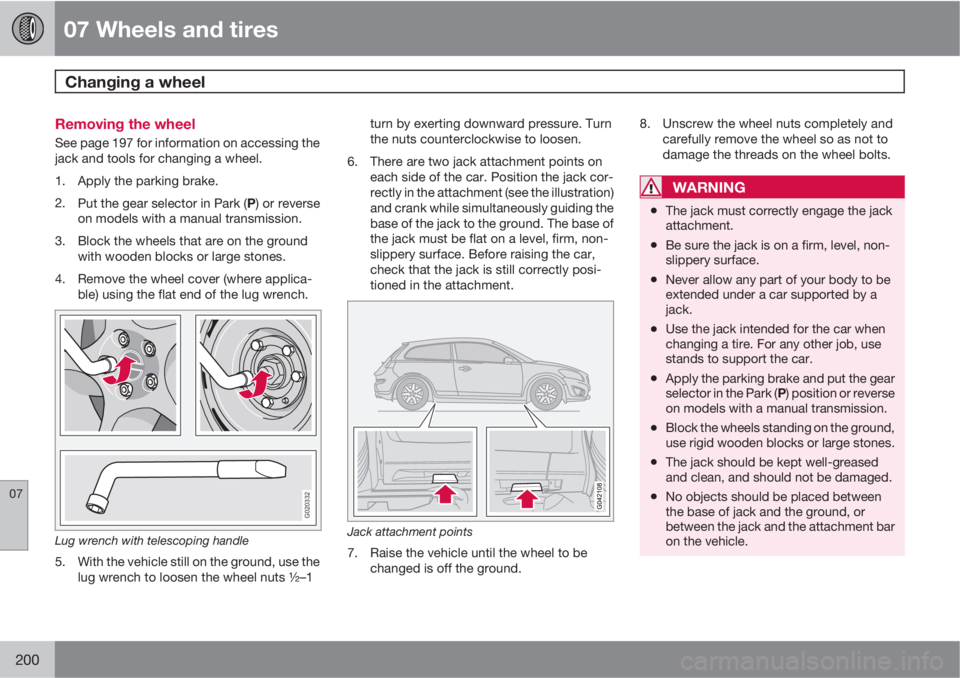
4. Remove the wheel cover (where applica-
ble) using the flat end of the lug wrench.
G020332
Lug wrench with telescoping handle
5. With the vehicle still on the ground, use the
lug wrench to loosen the wheel nuts ½–1turn by exerting downward pressure. Turn
the nuts counterclockwise to loosen.
6. There are two jack attachment points on
each side of the car. Position the jack cor-
rectly in the attachment (see the illustration)
and crank while simultaneously guiding the
base of the jack to the ground. The base of
the jack must be flat on a level, firm, non-
slippery surface. Before raising the car,
check that the jack is still correctly posi-
tioned in the attachment.
Jack attachment points
7. Raise the vehicle until the wheel to be
changed is off the ground.8. Unscrew the wheel nuts completely and
carefully remove the wheel so as not to
damage the threads on the wheel bolts.
WARNING
•The jack must correctly engage the jack
attachment.
•Be sure the jack is on a firm, level, non-
slippery surface.
•Never allow any part of your body to be
extended under a car supported by a
jack.
•Use the jack intended for the car when
changing a tire. For any other job, use
stands to support the car.
•Apply the parking brake and put the gear
selector in the Park (P) position or reverse
on models with a manual transmission.
•Block the wheels standing on the ground,
use rigid wooden blocks or large stones.
•The jack should be kept well-greased
and clean, and should not be damaged.
•No objects should be placed between
the base of jack and the ground, or
between the jack and the attachment bar
on the vehicle.
Page 203 of 300
07 Wheels and tires
Changing a wheel
07
201
NOTE
The jack provided with your vehicle is
intended to be used only in temporary sit-
uations such as changing wheels in the
event of a flat tire. Only the jack that came
with your particular model should be used
to lift the vehicle. If the vehicle needs to be
lifted more frequently or for a prolonged
period, using a garage jack or hoist is rec-
ommended. Always follow this device’s
instructions for use.
Installing the wheel
1. Clean the contact surfaces between the
wheel and hub.
2. Lift the wheel and place it on the hub.
3. Install the wheel nuts and hand-tighten
them. Using the lug wrench, tighten cross-
wise until all nuts are snug.
4. Lower the vehicle to the ground and alter-
nately tighten the bolts crosswise to
81 ft. lbs. (110 Nm) or 96 ft. lbs. (130 Nm),
depending on the type of wheel/wheel nuts
used on your vehicle. See also 199 for
additional information.
5. Install the wheel cover (where applicable).
See page 197 for information on returning the
jack and tools to their proper storage positions.On vehicles equipped with the tire sealing sys-
tem, the jack should be cranked down as far as
possible and returned to its storage position in
the foam block.
WARNING
The jack and any tools should always be
returned to their proper storage compart-
ments after use to help keep them securely
in place in the event of sudden braking, etc.
Page 204 of 300

07 Wheels and tires
Tire Pressure Monitoring System (TPMS)
07
202
Introduction
The tire pressure monitoring system1 uses sen-
sors mounted in the tire valves to check infla-
tion pressure levels. When the vehicle is mov-
ing at a speed of approximately 20 mph
(30 km/h) or faster, these sensors transmit
inflation pressure data to a receiver located in
the vehicle.
NOTE
USA – FCC ID: KR5S122780002
This device complies with part 15 of the
FCC rules. Operation is subject to the fol-
lowing conditions: (1) This device may not
cause harmful interference, and (2) this
device must accept any interference
received, including interference that may
cause undesired operation.
When low inflation pressure is detected, TPMS
will light up the tire pressure warning light
(also referred to as a telltale) in the instrument
panel and will display one of the following mes-
sages in the text window:
LOW TIRE PRESS.
CHECK TIRES or TIRE PRESSURE LOW.
NOTE
If a fault occurs in TPMS, the tire pressure
warning light will flash for approximately
1 minute and
TIRE PRESS SYST
SERVICE REQUIRED will be displayed.
Each tire, including the spare (if provided),
should be checked monthly when cold and
inflated to the inflation pressure recommended
by the vehicle manufacturer on the vehicle
placard or tire inflation pressure label. (If your
vehicle has tires of a different size than the size
indicated on the vehicle placard or tire inflation
pressure label, you should determine the
proper tire inflation pressure for those tires.)
As an added safety feature, your vehicle has
been equipped with a tire pressure monitoring
system (TPMS) that illuminates a low tire pres-
sure telltale when one or more of your tires is
significantly under-inflated. Accordingly, when
the low tire pressure telltale illuminates, you
should stop and check your tires as soon as
possible, and inflate them to the proper pres-
sure. Driving on a significantly under-inflated
tire causes the tire to overheat and can lead to
tire failure. Under-inflation also reduces fuel
efficiency and tire tread life, and may affect the
vehicle's handling and stopping ability.Please note that the TPMS is not a substitute
for proper tire maintenance, and it is the driv-
er's responsibility to maintain correct tire pres-
sure, even if under-inflation has not reached
the level to trigger illumination of the TPMS low
tire pressure telltale.
Your vehicle has also been equipped with a
TPMS malfunction indicator to indicate when
the system is not operating properly. The
TPMS malfunction indicator is combined with
the low tire pressure telltale . When the system
detects a malfunction, the telltale will flash for
approximately one minute and then remain
continuously illuminated. This sequence will
continue upon subsequent vehicle start-ups as
long as the malfunction exists. When the mal-
function indicator is illuminated, the system
may not be able to detect or signal low tire
pressure as intended. TPMS malfunctions may
occur for a variety of reasons, including the
installation of replacement or alternate tires or
wheels on the vehicle that prevent the TPMS
from functioning properly. Always check the
TPMS malfunction telltale after replacing one
or more tires or wheels on your vehicle to
ensure that the replacement or alternate tires
and wheels allow the TPMS to continue to
function properly.
1U.S. models only
Page 205 of 300

07 Wheels and tires
Tire Pressure Monitoring System (TPMS)
07
203
NOTE
•TPMS indicates low tire pressure but
does not replace normal tire mainte-
nance. For information on correct tire
pressure, please refer to the table on on
page 183, or consult your Volvo retailer.
•The tire pressure warning light will not
identify which tire is underinflated. Be
sure to check all four tires.
•A certain amount of air seepage from
the tires occurs naturally and tire pres-
sure fluctuates with seasonal changes
in temperature. Always check tire pres-
sure regularly.
Erasing warning messagesWhen a low tire pressure warning message has
been displayed, and the tire pressure warning
light has come on:
1. Use a tire pressure gauge to check the
inflation pressure of all four tires.
2. Re-inflate the tire(s) to the correct pressure
(consult the tire pressure placard or the
table, see page 183 ).
3. In certain cases, it may be necessary to
drive the vehicle for several minutes at a
speed of 20 mph (30 km/h) or faster. Thiswill erase the warning text and the warning
light will go out.
WARNING
Incorrect inflation pressure could lead to tire
failure, resulting in a loss of control of the
vehicle.
Changing wheels with TPMSPlease note the following when changing or
replacing the factory installed TPMS wheels/
tires on the vehicle:
•Only the factory-mounted wheels are
equipped with TPMS sensors in the valves.
•If the vehicle is equipped with a temporary
spare tire, this tire does not have a TPMS
sensor.
•If wheels without TPMS sensors are moun-
ted on the vehicle, TIRE PRESS SYST
SERVICE REQUIRED will be displayed
each time the vehicle is driven above
25 mph (40 km/h) for 10 minutes or more.
•Once TPMS sensors are properly installed,
the warning message should not reappear.
If the message is still displayed, drive the
vehicle for several minutes at a speed of
20 mph (30 km/h) or faster to erase the
message.
•Volvo recommends that TPMS sensors be
fitted on all wheels used on the vehicle.Volvo does not recommend moving sen-
sors back and forth between sets of
wheels.
NOTE
•If you change to tires with a different
recommended inflation pressure, the
TPMS system must be recalibrated to
these tires. This must be done by an
authorized Volvo retailer or workshop.
•If a tire is changed, or if the TPMS sen-
sor is moved to another wheel, the sen-
sor's seal, nut, and valve core should be
replaced.
•When installing TPMS sensors, the
vehicle must be parked for at least
15 minutes with the ignition off. If the
vehicle is driven within 15 minutes, a
TPMS error message will be displayed.
CAUTION
When inflating tires with TPMS valves, press
the pump's mouthpiece straight onto the
valve to help avoid bending or otherwise
damaging the valve.
Page 206 of 300
07 Wheels and tires
Tire Pressure Monitoring System (TPMS)
07
204* Option/accessory, for more information, see Introduction.
Self-supporting run flat tires (SST)*
Self-supporting run flat tires are available as
optional equipment. The vehicle must be
equipped with the Tire Pressure Monitoring
System (TPMS) if tires of this type are installed.
Tires of this type have specially reinforced
sidewalls that make it possible to continue
driving to a limited extent even though the tire
has lost some or all of its inflation pressure.
These tires are mounted on special rims (nor-
mal tires can also be mounted on these rims).
If an SST tire loses inflation pressure, the yel-
low TPMS symbol illuminates in the instrument
panel and a text message is also displayed. If
this happens, reduce speed to not more than
50 mph (80 km/h). The tire should be replaced
as soon as possible.
Drive carefully; it may be difficult to determine
which tire is damaged. To find the damaged
tire, check the inflation pressure in all four tires.WARNING
•SST tires should only be mounted by
service technicians who are familiar
with tires of this type.
•SST tires may only be mounted on vehi-
cles equipped with TPMS.
•Do not drive faster than 50 mph
(80 km/h) if TPMS indicates that a tire
has lost inflation pressure.
•Do not drive farther than 50 miles
(80 km) before replacing a damaged
SST tire.
•Drive carefully and avoid e.g., hard
braking or fast turns.
•SST tires must be replaced if they are
damaged. A tire of this type cannot be
repaired.
Page 275 of 300
11 Specifications
Label information
11
273
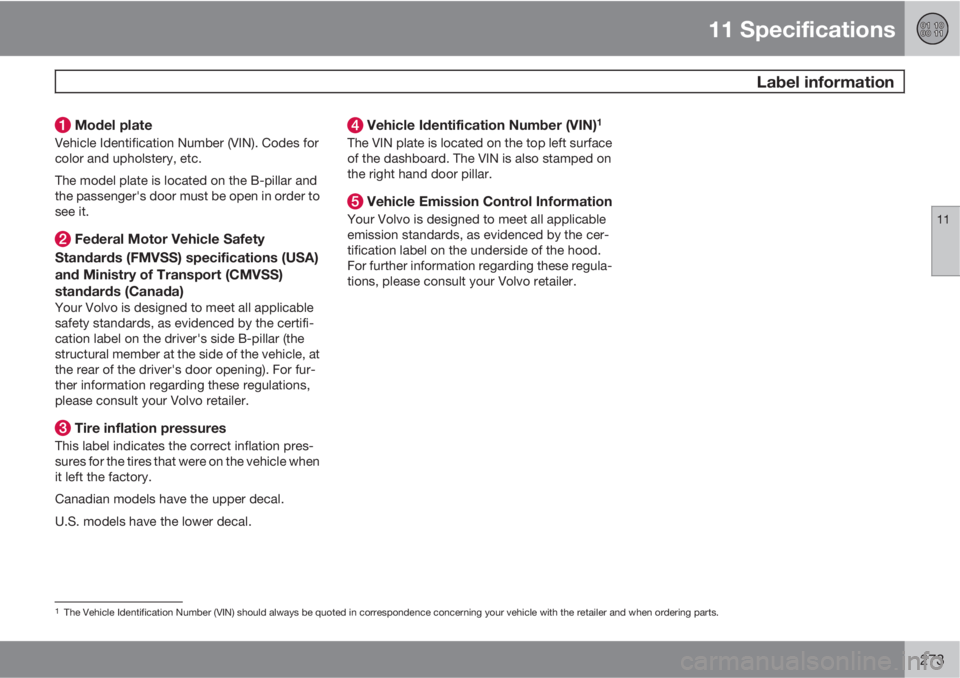
Model plate
Vehicle Identification Number (VIN). Codes for
color and upholstery, etc.
The model plate is located on the B-pillar and
the passenger's door must be open in order to
see it.
Federal Motor Vehicle Safety
Standards (FMVSS) specifications (USA)
and Ministry of Transport (CMVSS)
standards (Canada)
Your Volvo is designed to meet all applicable
safety standards, as evidenced by the certifi-
cation label on the driver's side B-pillar (the
structural member at the side of the vehicle, at
the rear of the driver's door opening). For fur-
ther information regarding these regulations,
please consult your Volvo retailer.
Tire inflation pressures
This label indicates the correct inflation pres-
sures for the tires that were on the vehicle when
it left the factory.
Canadian models have the upper decal.
U.S. models have the lower decal.
Vehicle Identification Number (VIN)1
The VIN plate is located on the top left surface
of the dashboard. The VIN is also stamped on
the right hand door pillar.
Vehicle Emission Control Information
Your Volvo is designed to meet all applicable
emission standards, as evidenced by the cer-
tification label on the underside of the hood.
For further information regarding these regula-
tions, please consult your Volvo retailer.
1The Vehicle Identification Number (VIN) should always be quoted in correspondence concerning your vehicle with the retailer and when ordering parts.
Page 292 of 300
12 Index
12
290
E
Economical driving.................................. 142
Electrical current – conserving................ 144
Electrically operated moonroof.................. 82
Electrical system...................................... 282
Electronic Brake Force Distribution (EBD) 160
Electronic Climate Control......................... 93
air distribution table............................ 102
Electronic Climate Control (ECC)............... 98
Emergency brake..................................... 162
Emergency locking retractor...................... 39
Emergency starting.................................. 168
Emergency towing................................... 165
Emission inspection readiness................ 217
Engine
specifications...................................... 280
starting................................................ 150
starting with keyless drive.................. 152
Engine compartment overview................220
Engine oil.........................................221, 279
changing............................................. 221
checking............................................. 221
volumes.............................................. 277Environment............................................... 13
Equalizer, audio system........................... 251
Eyelets for anchoring loads..................... 120
F
Federal Clean Air Act............................... 216
Flat tires
changing..................................... 197, 200
repairing with tire sealing system....... 190
Floor mats
cleaning.............................................. 211
placing correctly.........................150, 152
Fluids and oils.......................................... 277
FM1/FM2 menu....................................... 252
Fog lights
front...................................................... 66
rear........................................................ 66
Front airbags.............................................. 24
disconnecting passenger’s side airbag 28
Front fog lights........................................... 66
Front seats............................................... 106
accessing the rear seat...................... 106
adjusting the head restraints.............. 111manually operated.............................. 106
power.................................................. 109
Fuel filler door
unlocking.............................................. 67
Fuel gauge................................................. 54
Fuel requirements.................................... 146
Fuel tank volume.....................................277
Fuses, replacing......................................236
G
Garage door opener
HomeLink® Wireless Control System. . . 87
Gasoline requirements............................. 146
Geartronic................................................ 156
Glossary of tire terminology..................... 186
Glove compartment................................. 115
locking................................................ 136
Gross vehicle weight (GVW)............187, 275
Page 296 of 300
12 Index
12
294
Three-way catalytic converter................. 283
Tire inflation............................................. 181
Tire inflation pressure..............................183
Tire Pressure Monitoring System (TPMS) 202
Tires.........................................................178
age...................................................... 178
changing..................................... 197, 200
changing from summer to winter........ 179
designations....................................... 184
glossary of terms................................ 186
improving economy............................ 179
inflation............................................... 181
inflation pressure, checking................ 181
inflation pressure table.......................183
load ratings......................................... 182
rotation............................................... 178
Self-supporting run flat tires (SST)..... 204
snow...................................................189
spare................................................... 196
spare tire (location)............................. 197
speed ratings...................................... 182
storing................................................. 180
studded............................................... 189
tire pressure monitoring system......... 202
tire sealing system.............................. 190
tread wear indicator............................ 179uniform tire quality grading................. 188
winter driving...................................... 189
Tire sealing system.................................. 190
Top tether anchors (child restraint sys-
tems).......................................................... 48
Towing the vehicle................................... 165
Transmission
Geartronic........................................... 156
manual................................................154
shiftlock override................................ 158
Tread wear indicator................................ 179
Treble....................................................... 250
Trip computer............................................ 70
Trips, long distance................................. 144
Turn signals............................................... 68
indicator lights...................................... 54
U
Uniform Tire Quality Grading...................188
V
Vehicle dimensions.................................. 274
Vehicle loading........................................ 187
roof loads............................................ 169
Vehicle maintenance................................ 216
performed by the owner.....................217
Vehicle towing.........................................165
Vehicle weights........................................ 275
VIN (Vehicle Identification Number)......... 273
Volvo and the environment........................ 13
Volvo maintenance.................................. 216
Volvo On Call Roadside Assistance........ 286
W
Warning flashers, hazard........................... 77
Warning symbol......................................... 56
Warranties................................................ 216
Washer fluid..................................... 223, 277
Washer fluid reservoir......................220, 223
Water, driving through............................. 143
Weights.................................................... 275