seats VOLVO C30 2013 Owner´s Manual
[x] Cancel search | Manufacturer: VOLVO, Model Year: 2013, Model line: C30, Model: VOLVO C30 2013Pages: 300, PDF Size: 6.58 MB
Page 111 of 300
04 Interior
Front seats
04
* Option/accessory, for more information, see Introduction.109
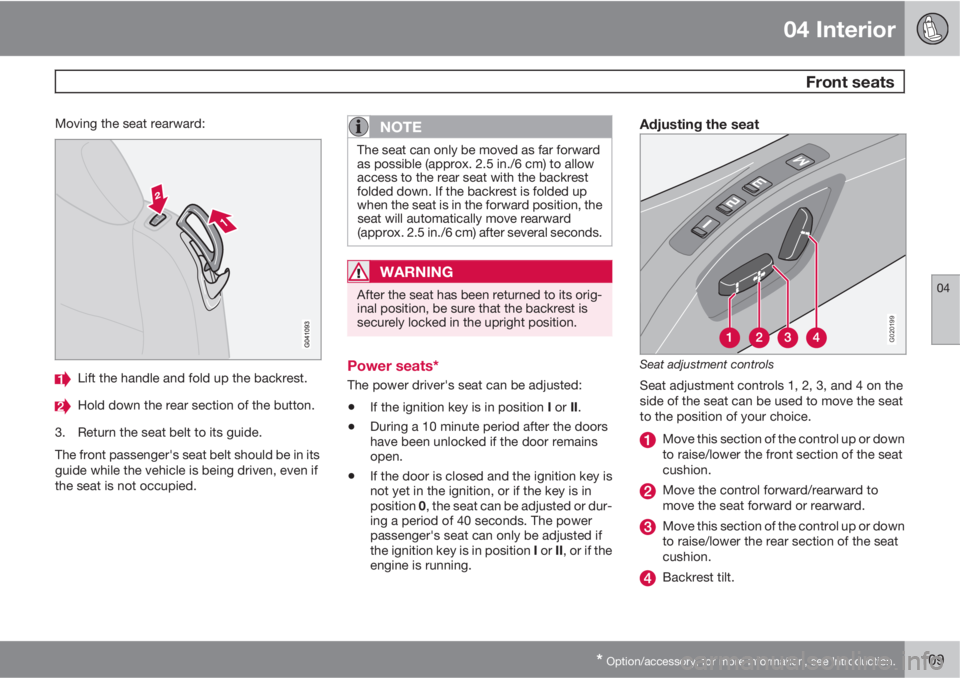
Moving the seat rearward:
Lift the handle and fold up the backrest.
Hold down the rear section of the button.
3. Return the seat belt to its guide.
The front passenger's seat belt should be in its
guide while the vehicle is being driven, even if
the seat is not occupied.
NOTE
The seat can only be moved as far forward
as possible (approx. 2.5 in./6 cm) to allow
access to the rear seat with the backrest
folded down. If the backrest is folded up
when the seat is in the forward position, the
seat will automatically move rearward
(approx. 2.5 in./6 cm) after several seconds.
WARNING
After the seat has been returned to its orig-
inal position, be sure that the backrest is
securely locked in the upright position.
Power seats*
The power driver's seat can be adjusted:
•If the ignition key is in position I or II.
•During a 10 minute period after the doors
have been unlocked if the door remains
open.
•If the door is closed and the ignition key is
not yet in the ignition, or if the key is in
position 0, the seat can be adjusted or dur-
ing a period of 40 seconds. The power
passenger's seat can only be adjusted if
the ignition key is in position I or II, or if the
engine is running.
Adjusting the seat
G020199
Seat adjustment controls
Seat adjustment controls 1, 2, 3, and 4 on the
side of the seat can be used to move the seat
to the position of your choice.
Move this section of the control up or down
to raise/lower the front section of the seat
cushion.
Move the control forward/rearward to
move the seat forward or rearward.
Move this section of the control up or down
to raise/lower the rear section of the seat
cushion.
Backrest tilt.
Page 112 of 300
04 Interior
Front seats
04
110* Option/accessory, for more information, see Introduction.
NOTE
Both front seats are equipped with head
restraints that can be adjusted vertically to
suit the height of the passenger. The upper
edge of the head restraint should be at least
on a level with the upper-most point of the
seat occupant's ear (see the section
"Adjusting the front seat head restraints" on
page 111).
NOTE
The power seats have an overload protector
that activates if a seat is blocked by any
object. If this occurs, switch off the ignition
(key in position 0) and wait for approxi-
mately 20 seconds before operating the
seat again.
Emergency stopIf the seat inadvertently begins to move, press
any of the buttons to stop the seat.
Programming the seat memory, driver's
seat only*
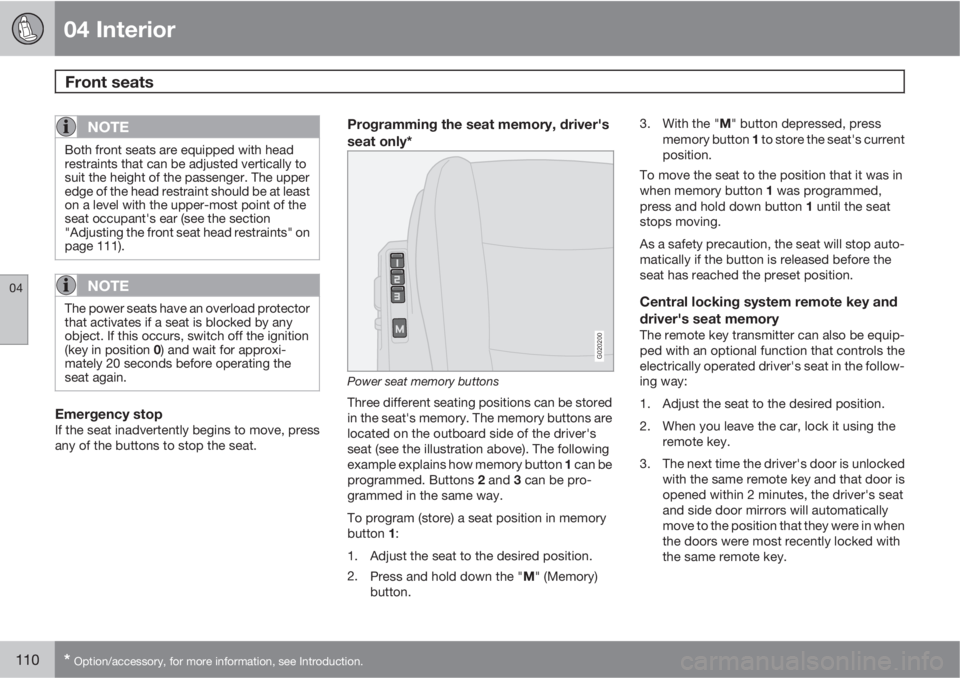
G020200
Power seat memory buttons
Three different seating positions can be stored
in the seat's memory. The memory buttons are
located on the outboard side of the driver's
seat (see the illustration above). The following
example explains how memory button 1 can be
programmed. Buttons 2 and 3 can be pro-
grammed in the same way.
To program (store) a seat position in memory
button 1:
1. Adjust the seat to the desired position.
2.
Press and hold down the "M" (Memory)
button.3.
With the "M" button depressed, press
memory button 1 to store the seat's current
position.
To move the seat to the position that it was in
when memory button 1 was programmed,
press and hold down button 1 until the seat
stops moving.
As a safety precaution, the seat will stop auto-
matically if the button is released before the
seat has reached the preset position.
Central locking system remote key and
driver's seat memory
The remote key transmitter can also be equip-
ped with an optional function that controls the
electrically operated driver's seat in the follow-
ing way:
1. Adjust the seat to the desired position.
2. When you leave the car, lock it using the
remote key.
3. The next time the driver's door is unlocked
with the same remote key and that door is
opened within 2 minutes, the driver's seat
and side door mirrors will automatically
move to the position that they were in when
the doors were most recently locked with
the same remote key.
Page 113 of 300
04 Interior
Front seats
04
111
NOTE
The memory function in the remote key
operates independently the memory func-
tion in the seat.
WARNING
•Because the driver's seat can be
adjusted with the ignition off, children
should never be left unattended in the
car.
•Movement of the seat can be STOPPED
at any time by pressing any button on
the power seat control panel.
•Do not adjust the seat while driving. The
seat should be adjusted so that the
brake pedal can be depressed fully. In
addition, position the seat as far rear-
ward as comfort and control allow.
•The seat rails on the floor must not be
obstructed in any way when the seat is
in motion.
Adjusting the front seat head restraints
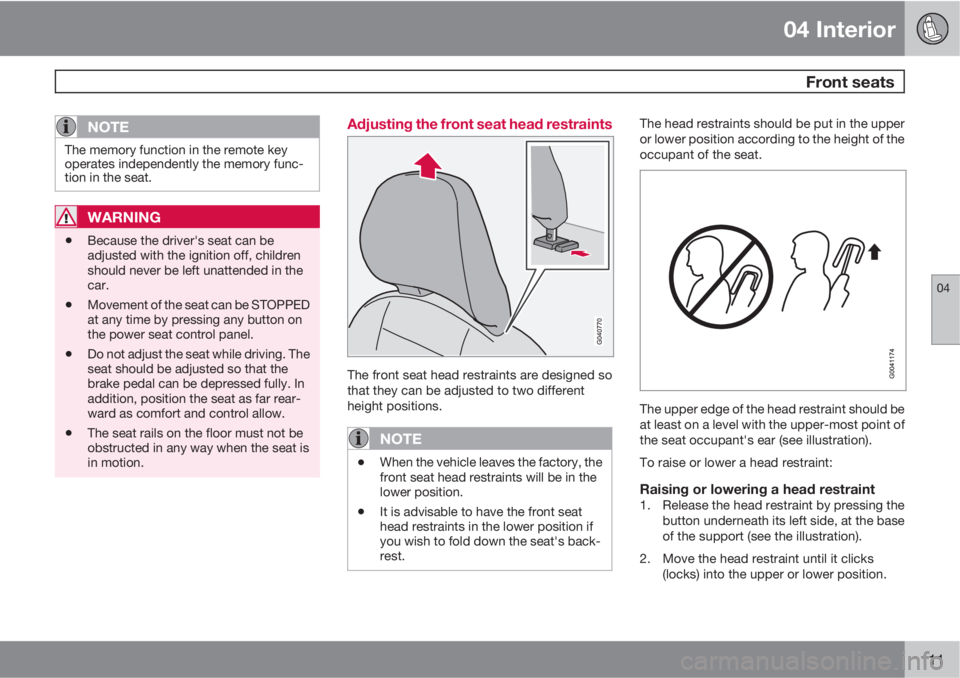
The front seat head restraints are designed so
that they can be adjusted to two different
height positions.
NOTE
•When the vehicle leaves the factory, the
front seat head restraints will be in the
lower position.
•It is advisable to have the front seat
head restraints in the lower position if
you wish to fold down the seat's back-
rest.
The head restraints should be put in the upper
or lower position according to the height of the
occupant of the seat.
The upper edge of the head restraint should be
at least on a level with the upper-most point of
the seat occupant's ear (see illustration).
To raise or lower a head restraint:
Raising or lowering a head restraint1. Release the head restraint by pressing the
button underneath its left side, at the base
of the support (see the illustration).
2. Move the head restraint until it clicks
(locks) into the upper or lower position.
Page 114 of 300
04 Interior
Front seats
04
112
WARNING
After adjusting the head restraint, be sure
that it is securely locked in the new position
by pressing and/or pulling it.
Removing a head restraintThe front seat head restraints can be removed,
for example, when cleaning the upholstery or if
the front passenger's seat backrest is folded
down to accommodate a long load. To do so:
1. Release the head restraint by pressing the
release button underneath its left side, at
the base of the support.
2. While holding in the release button, press
the locking button at the base of the head
restraint's right support with a screw
driver, etc., and lift the head restraint until
it can be removed completely.
WARNING
•If a front seat head restraint has been
removed, it must be put properly back
in place and it must lock (click) into one
of the available adjustment positions
before the seat is occupied.
•The front seat head restraints must be
in position and properly adjusted to the
height of the person sitting in the seat
when the vehicle is driven and when the
front passenger's seat is occupied.
Page 120 of 300
04 Interior
Rear seat
04
118
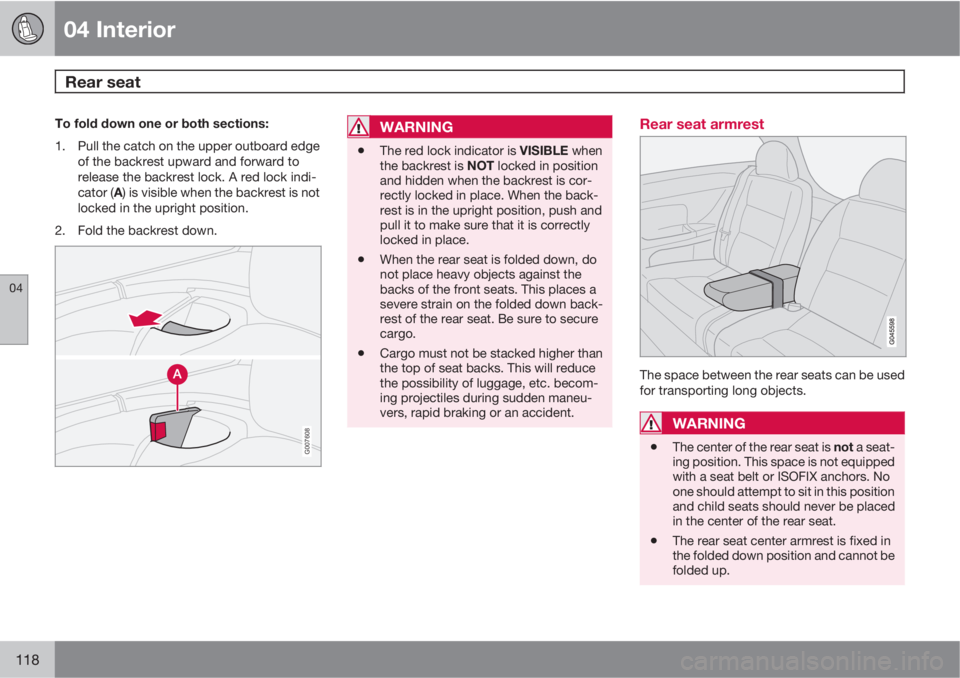
To fold down one or both sections:
1. Pull the catch on the upper outboard edge
of the backrest upward and forward to
release the backrest lock. A red lock indi-
cator (A) is visible when the backrest is not
locked in the upright position.
2. Fold the backrest down.
G007608
WARNING
•The red lock indicator is VISIBLE when
the backrest is NOT locked in position
and hidden when the backrest is cor-
rectly locked in place. When the back-
rest is in the upright position, push and
pull it to make sure that it is correctly
locked in place.
•When the rear seat is folded down, do
not place heavy objects against the
backs of the front seats. This places a
severe strain on the folded down back-
rest of the rear seat. Be sure to secure
cargo.
•Cargo must not be stacked higher than
the top of seat backs. This will reduce
the possibility of luggage, etc. becom-
ing projectiles during sudden maneu-
vers, rapid braking or an accident.
Rear seat armrest
The space between the rear seats can be used
for transporting long objects.
WARNING
•The center of the rear seat is not a seat-
ing position. This space is not equipped
with a seat belt or ISOFIX anchors. No
one should attempt to sit in this position
and child seats should never be placed
in the center of the rear seat.
•The rear seat center armrest is fixed in
the folded down position and cannot be
folded up.
Page 164 of 300
06 Starting and driving
Parking brake
06
162
Parking brake (hand brake)
G026348
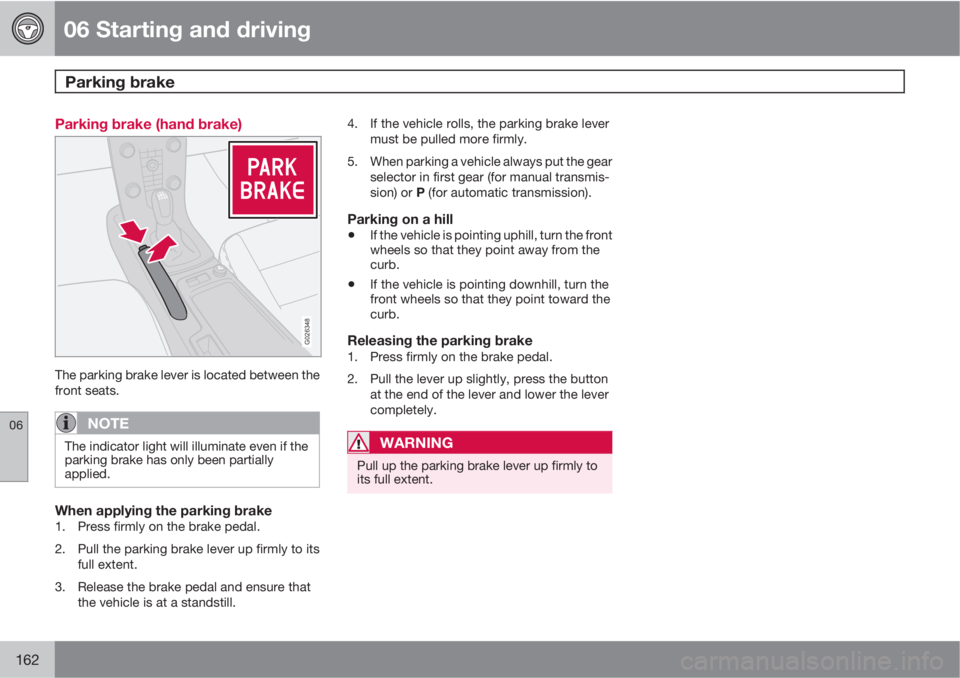
The parking brake lever is located between the
front seats.
NOTE
The indicator light will illuminate even if the
parking brake has only been partially
applied.
When applying the parking brake1. Press firmly on the brake pedal.
2. Pull the parking brake lever up firmly to its
full extent.
3. Release the brake pedal and ensure that
the vehicle is at a standstill.4. If the vehicle rolls, the parking brake lever
must be pulled more firmly.
5. When parking a vehicle always put the gear
selector in first gear (for manual transmis-
sion) or P (for automatic transmission).
Parking on a hill
•If the vehicle is pointing uphill, turn the front
wheels so that they point away from the
curb.
•If the vehicle is pointing downhill, turn the
front wheels so that they point toward the
curb.
Releasing the parking brake1. Press firmly on the brake pedal.
2. Pull the lever up slightly, press the button
at the end of the lever and lower the lever
completely.
WARNING
Pull up the parking brake lever up firmly to
its full extent.
Page 171 of 300
06 Starting and driving
Transporting loads
06
169 Loading the vehicle
Your vehicle's load-carrying capacity is affec-
ted by factors such as:
•the number of passengers
•tire inflation
•the amount of optional or accessory equip-
ment installed
•the amount of cargo.
See the chapter "Wheels and tires" for more
detailed information.
Before loading the car, turn off the engine, and
apply the parking brake when loading or
unloading long objects. The gear selector can
be inadvertently knocked out of position by
long cargo, causing the car to move.
Keep the following in mind when
loading the vehicle:
•Load objects in the cargo area against the
rear seat backrest.
•Load heavy cargo as low as possible.
•Center wide loads.
•Secure all cargo with restraining straps
anchored to the load securing eyelets.
•Cover sharp edges on the load.
•The rear seats can be folded down to
extend the cargo compartment, see
page 117.
WARNING
•Remember that an object weighing
44 lbs (20 kg) produces a force of
2,200 lbs (1,000 kg) in a head-on colli-
sion at 30 mph (50 km/h)!
•When the rear backrest(s) are folded
down, the vehicle should not be loaded
to a level higher than 2 in. (5 cm) below
the upper edge of the rear side win-
dows. Objects placed higher than this
level could impede the function of the
Inflatable Curtain.
Load carriers (accessory)
Load carriers are available as Volvo accesso-
ries. Follow the installation instructions sup-
plied with the load carriers.
Observe the following points when using load
carriers:
•To avoid damaging your car and to achieve
maximum safety when driving, we recom-
mend using the load carriers that Volvo has
developed especially for your car.
•Volvo-approved removable roof racks are
designed to carry the maximum allowable
roof load for this vehicle: 165 lbs (75 kg).
For Non-Volvo roof racks, check the man-
ufacturer's weight limits for the rack.
•Never exceed the rack manufacturer's
weigh limits and never exceed the maxi-
mum rated roof load of 165 lbs (75 kg).
•Avoid single-point loads. Distribute loads
evenly.
•Place heavier cargo at the bottom of the
load.
•Secure the cargo correctly with appropri-
ate tie-down equipment.
•Check periodically that the load carriers
and load are properly secured.
•Remember that the car's center of gravity
and handling change when you carry a
load on the roof.
•The car's wind resistance and fuel con-
sumption will increase with the size of the
load.
•Drive smoothly. Avoid rapid starts, fast
cornering and hard braking.
Page 244 of 300

09 Maintenance and servicing
Fuses 09
242* Option/accessory, for more information, see Introduction.
60.Heated driver's seat*15A
61.Heated passenger's seat*15A
62.Moonroof*20A
63.Not in use
64.SiriusXM
E satellite radio*5A
65.Audio system5A
66.Audio system control mod-
ule (ICM), climate system10A
67.Not in use
68.Cruise control5A
69.Climate system, rain sen-
sor*, BLIS button*5A
70.Not in use
71.Not in use
72.Not in use
73.Moonroof, front ceiling
lighting, auto-dim mirror*,
seat belt reminder5A
74.Fuel pump relay15A
75.Not in use
76.Not in use
77.Not in use
78.Not in use
79.Back-up lights5A
80.Not in use
81.Not in use
82.Power window – front pas-
senger's side door25A
83.Power window and door
lock – front driver's side
door25A
84.Power passenger's seat25A
85.Power driver's seat25A
86.Interior lighting relay, cargo
area light, power seats5A
Page 292 of 300
12 Index
12
290
E
Economical driving.................................. 142
Electrical current – conserving................ 144
Electrically operated moonroof.................. 82
Electrical system...................................... 282
Electronic Brake Force Distribution (EBD) 160
Electronic Climate Control......................... 93
air distribution table............................ 102
Electronic Climate Control (ECC)............... 98
Emergency brake..................................... 162
Emergency locking retractor...................... 39
Emergency starting.................................. 168
Emergency towing................................... 165
Emission inspection readiness................ 217
Engine
specifications...................................... 280
starting................................................ 150
starting with keyless drive.................. 152
Engine compartment overview................220
Engine oil.........................................221, 279
changing............................................. 221
checking............................................. 221
volumes.............................................. 277Environment............................................... 13
Equalizer, audio system........................... 251
Eyelets for anchoring loads..................... 120
F
Federal Clean Air Act............................... 216
Flat tires
changing..................................... 197, 200
repairing with tire sealing system....... 190
Floor mats
cleaning.............................................. 211
placing correctly.........................150, 152
Fluids and oils.......................................... 277
FM1/FM2 menu....................................... 252
Fog lights
front...................................................... 66
rear........................................................ 66
Front airbags.............................................. 24
disconnecting passenger’s side airbag 28
Front fog lights........................................... 66
Front seats............................................... 106
accessing the rear seat...................... 106
adjusting the head restraints.............. 111manually operated.............................. 106
power.................................................. 109
Fuel filler door
unlocking.............................................. 67
Fuel gauge................................................. 54
Fuel requirements.................................... 146
Fuel tank volume.....................................277
Fuses, replacing......................................236
G
Garage door opener
HomeLink® Wireless Control System. . . 87
Gasoline requirements............................. 146
Geartronic................................................ 156
Glossary of tire terminology..................... 186
Glove compartment................................. 115
locking................................................ 136
Gross vehicle weight (GVW)............187, 275
Page 295 of 300
12 Index
12
293
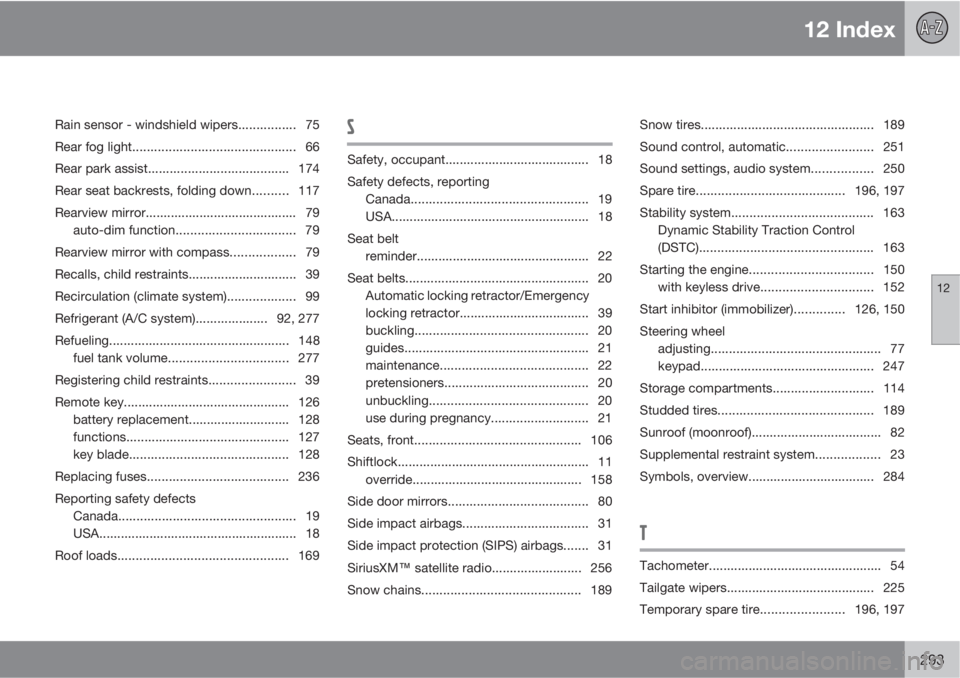
Rain sensor - windshield wipers................ 75
Rear fog light............................................. 66
Rear park assist....................................... 174
Rear seat backrests, folding down.......... 117
Rearview mirror.......................................... 79
auto-dim function................................. 79
Rearview mirror with compass.................. 79
Recalls, child restraints.............................. 39
Recirculation (climate system)................... 99
Refrigerant (A/C system).................... 92, 277
Refueling.................................................. 148
fuel tank volume.................................277
Registering child restraints........................ 39
Remote key.............................................. 126
battery replacement............................ 128
functions............................................. 127
key blade............................................ 128
Replacing fuses....................................... 236
Reporting safety defects
Canada................................................. 19
USA....................................................... 18
Roof loads............................................... 169S
Safety, occupant........................................ 18
Safety defects, reporting
Canada................................................. 19
USA....................................................... 18
Seat belt
reminder................................................ 22
Seat belts................................................... 20
Automatic locking retractor/Emergency
locking retractor.................................... 39
buckling................................................ 20
guides...................................................21
maintenance......................................... 22
pretensioners........................................ 20
unbuckling............................................ 20
use during pregnancy........................... 21
Seats, front.............................................. 106
Shiftlock.....................................................11
override............................................... 158
Side door mirrors....................................... 80
Side impact airbags................................... 31
Side impact protection (SIPS) airbags....... 31
SiriusXM
E satellite radio......................... 256
Snow chains............................................ 189Snow tires................................................ 189
Sound control, automatic........................251
Sound settings, audio system................. 250
Spare tire.........................................196, 197
Stability system....................................... 163
Dynamic Stability Traction Control
(DSTC)................................................ 163
Starting the engine..................................150
with keyless drive............................... 152
Start inhibitor (immobilizer)..............126, 150
Steering wheel
adjusting............................................... 77
keypad................................................ 247
Storage compartments............................ 114
Studded tires........................................... 189
Sunroof (moonroof).................................... 82
Supplemental restraint system.................. 23
Symbols, overview................................... 284
T
Tachometer................................................ 54
Tailgate wipers......................................... 225
Temporary spare tire.......................196, 197