light VOLVO C70 1998 Owners Manual
[x] Cancel search | Manufacturer: VOLVO, Model Year: 1998, Model line: C70, Model: VOLVO C70 1998Pages: 38, PDF Size: 0.71 MB
Page 4 of 38
Chapter 1 - Occupant safety
pg. 1 Occupant safety
Occupant safety
Despite our strongest recommendations, and your best intentions, not wearing a seat belt is like believing "It'll never
happen to me!". Volvo urges you and all adult occupants of your car to wear seat belts and ensure that children are
properly restrained, using an infant, car or booster seat determined by age, weight and height.
Fact: In every state and province, some type of child-restraint legislation has been passed. Additionally, most states
and provinces have already made it mandatory for occupants of a car to use seat belts.
So, urging you to "buckle up" is not just our recommendation - legislation in your state or province may mandate seat
belt usage. The few seconds it takes to buckle up may one day allow you to say, "It's a good thing I was wearing my
seat belt".
Seat belts2
Volvo SRS4
Side Impact Protection System - (SIPS) air bag8
Child safety9
Occupant safety12
Reporting Safety Defects12
pg. 2 Seat belts
Seat belts
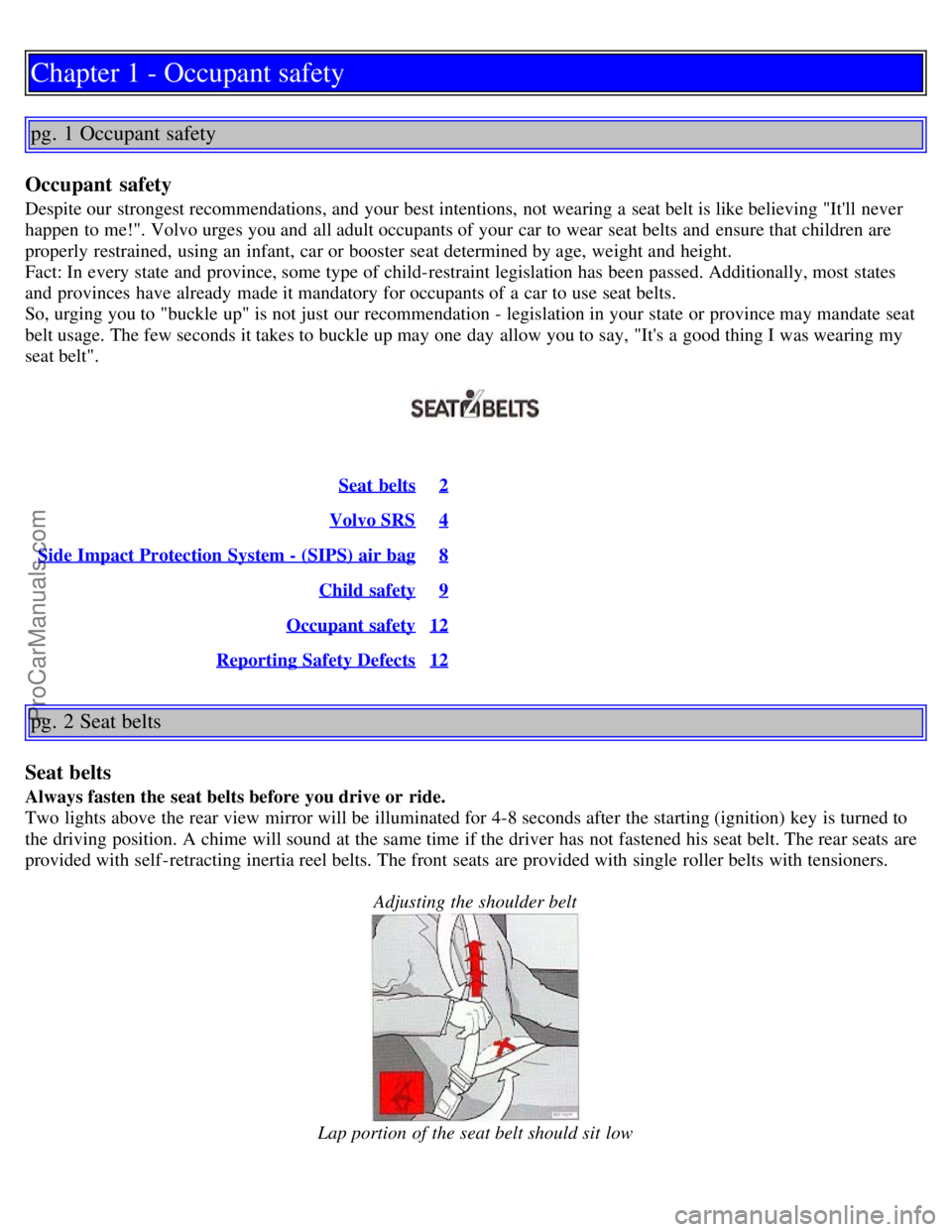
Always fasten the seat belts before you drive or ride.
Two lights above the rear view mirror will be illuminated for 4-8 seconds after the starting (ignition) key is turned to
the driving position. A chime will sound at the same time if the driver has not fastened his seat belt. The rear seats are
provided with self -retracting inertia reel belts. The front seats are provided with single roller belts with tensioners.
Adjusting the shoulder belt
Lap portion of the seat belt should sit low
ProCarManuals.com
Page 7 of 38
Chapter 2 - Instruments, switches and controls
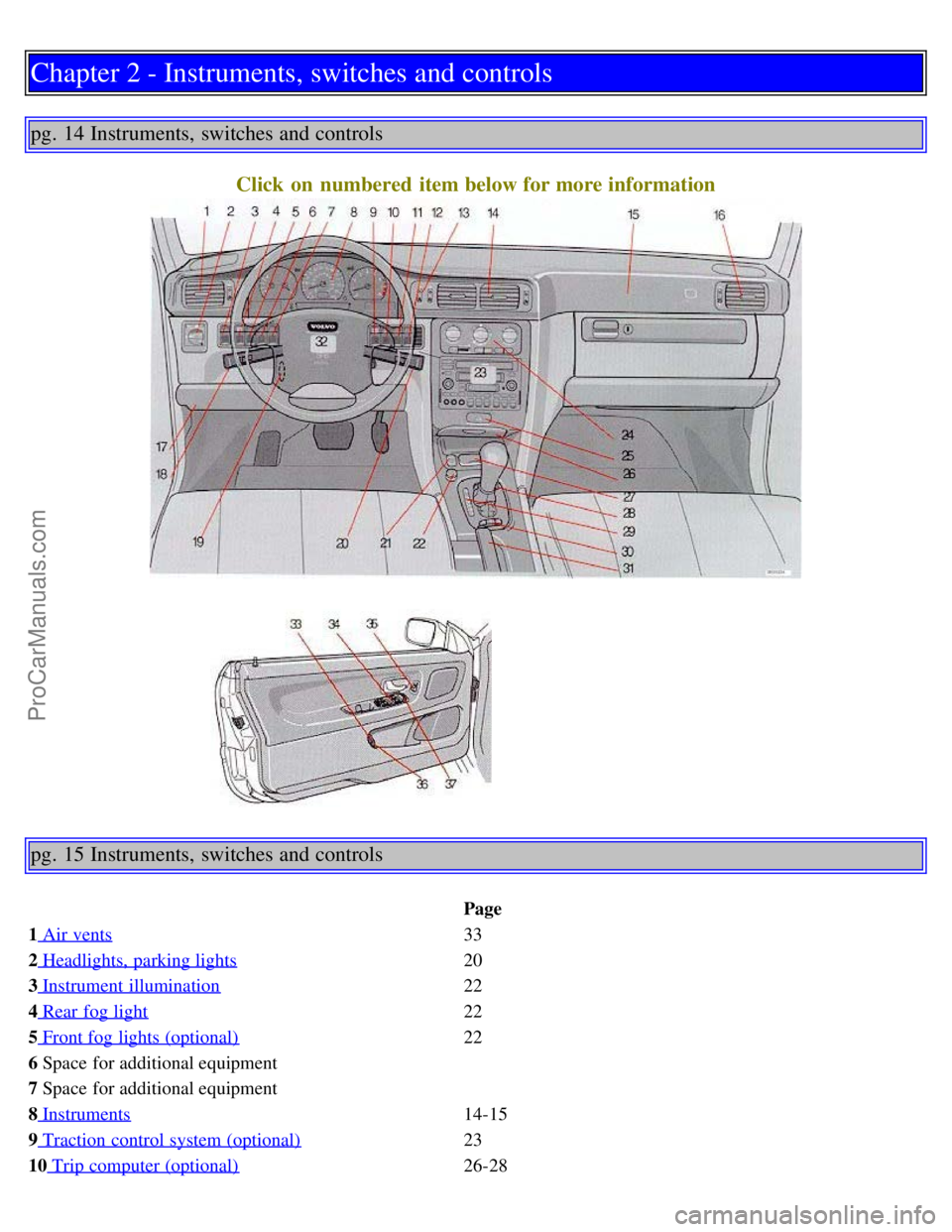
pg. 14 Instruments, switches and controlsClick on numbered item below for more information
pg. 15 Instruments, switches and controls
Page
1 Air vents
33
2 Headlights, parking lights
20
3 Instrument illumination
22
4 Rear fog light
22
5 Front fog lights (optional)
22
6 Space for additional equipment
7 Space for additional equipment
8 Instruments
14-15
9 Traction control system (optional)
23
10 Trip computer (optional)26-28
ProCarManuals.com
Page 9 of 38
The ABS system in your car performs a self -diagnostic test when the vehicle first reaches the speed of approximately
12 mph (20 km/h). The brake pedal will pulsate several times and a sound may be audible from the ABS control
module. This is normal.
Fuel tank cover
The fuel tank cover is locked and must be popped open using the control on the driver's door.
The pages in this section provide detailed descriptions of the vehicle's instruments and controls. Note that vehicles may
be equipped differently, depending on special legal requirements.
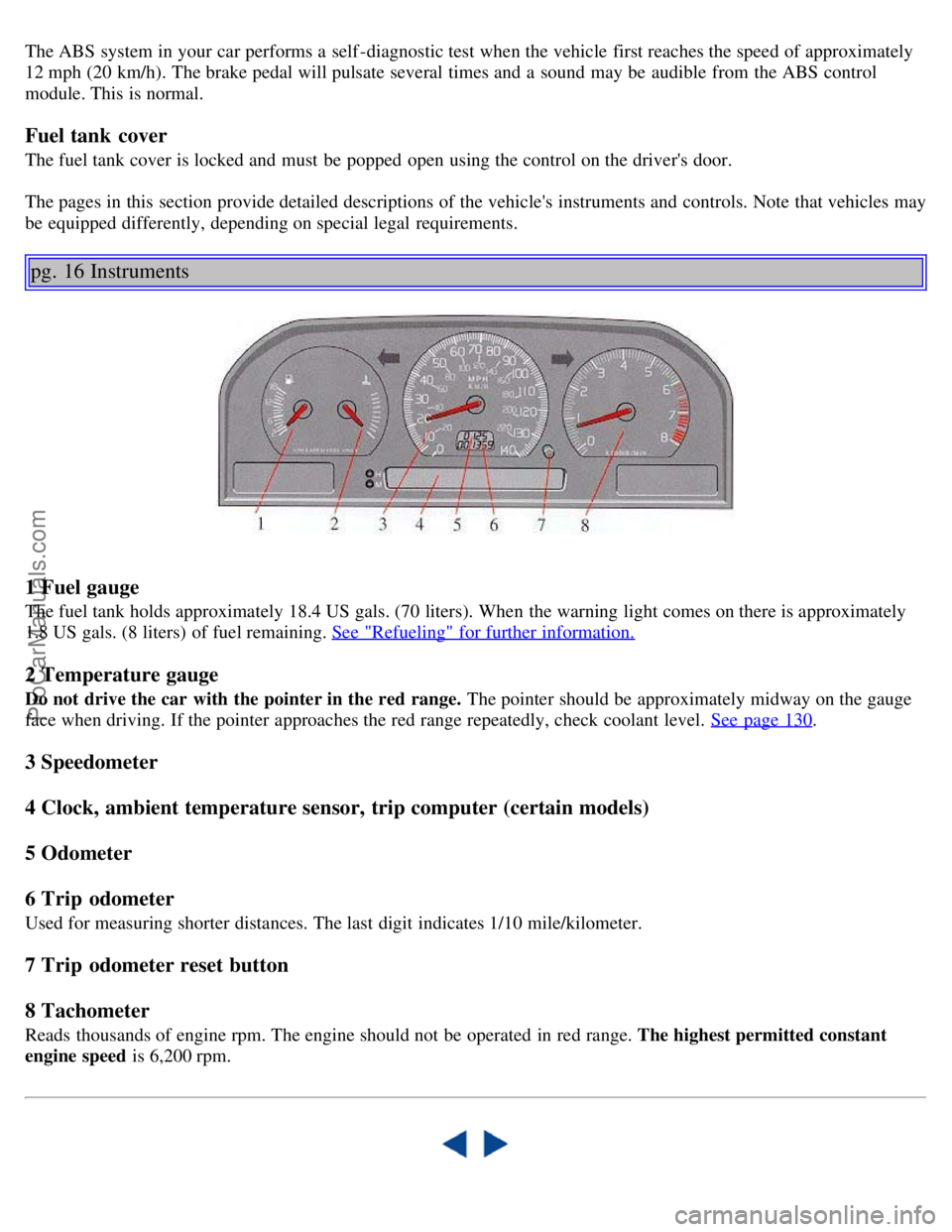
pg. 16 Instruments
1 Fuel gauge
The fuel tank holds approximately 18.4 US gals. (70 liters). When the warning light comes on there is approximately
1.8 US gals. (8 liters) of fuel remaining. See "Refueling" for further information.
2 Temperature gauge
Do not drive the car with the pointer in the red range. The pointer should be approximately midway on the gauge
face when driving. If the pointer approaches the red range repeatedly, check coolant level. See page 130
.
3 Speedometer
4 Clock, ambient temperature sensor, trip computer (certain models)
5 Odometer
6 Trip odometer
Used for measuring shorter distances. The last digit indicates 1/10 mile/kilometer.
7 Trip odometer reset button
8 Tachometer
Reads thousands of engine rpm. The engine should not be operated in red range. The highest permitted constant
engine speed is 6,200 rpm.
ProCarManuals.com
Page 11 of 38

Chapter 3 - Body and interior
pg. 39 Body and interior
Body and interior
The seats, sun roof, mirrors, etc. are described on the following pages.
Storage compartments
40
Sun roof41
Keys, doors and locks42
Remote keyless entry system43
Alarm44
Front seats46
Rear/side view mirrors48
Interior lights, Vanity mirrors49
Long load storage50
Hood51
Opening the trunk52
Trunk light, Spare tire, Jack53
Securing cargo, Avoiding battery drain54
pg. 40 Storage compartments
1 Glove compartment
2 Coin holder
3 Compartment in door
4 Pocket on rear of front seat
5 Compartment between front seats/Cup holder
ProCarManuals.com
Page 13 of 38

Sun visor: The sun roof also features a sliding sun visor. The visor slides back automatically when the sun roof is
opened and also slides back slightly when the sun roof is opened to the ventilation position. The visor must be closed
manually.
CAUTION: Do not close the sun visor when the sun roof is in the ventilation position as this could damage the
mechanism.
NOTE:
The electrically -operated sun roof has an overload protecting circuit breaker (fuse no. 37) which is activated when an
object blocks the sun roof. Should this occur, remove the object and wait 20 seconds for the circuit breaker to reset.
The sun roof should then function normally. Also check fuse no. 35.
WARNING! The sun roof must never be obstructed in any way when in operation.
pg. 42 Keys, doors and locks
Master key
This key operates all locks (ignition switch/steering wheel lock, driver's door, trunk and glove compartment).
Service key
This key operates the driver's door and the ignition switch/steering wheel lock.
NOTE:
As an added anti-theft measure, new keys have been developed which may take slightly longer to copy or replace if
the original keys are misplaced. Duplicate keys may be ordered from your Volvo retailer.
The key number codes are stamped on a separate tag supplied with the keys. This tag should be separated from the
key ring and kept in a safe place.
Doors and locks
Your car is equipped with a central locking system.
The key, used on the driver's door, the remote control, or central locking button, will lock/unlock both doors, and the
trunk.
Turn the key once to unlock the driver's door only.
Turn the key again (within 10 seconds) to unlock both doors and the trunk.
One turn with the key towards lock in the drivers door locks both doors and the trunk.
Use the switch on the front door armrests to lock/unlock the car from the inside.
ProCarManuals.com
Page 14 of 38
Check the action of the buttons on the other door to verify its function (lock/unlock).
WARNING! The doors should not be locked while driving. In case of an accident, this may hinder rapid access to
the occupants of the vehicle.
NOTE: If a door is not closed completely, the courtesy lights will stay on and a chime will sound until the door is
closed.
Contents | Top of Page
ProCarManuals.com
Page 16 of 38

Manual transmission
The following speeds should not be exceeded during the break-in period: Up to 600 miles
(1000 km)600 - 1,200 miles
(1000 - 2000 km)
1st gear 20 mph (30 km/h)25 mph (40 km/h)
2nd gear 30 mph (50 km/h)40 mph (70 km/h)
3rd gear 45 mph (80 km/h)65 mph (100 km/h)
4th gear 70 mph (110 km/h)80 mph (130 km/h)
5th gear/overdrive 80 mph (130 km/h)95 mph (150 km/h)
Posted speed limits should not be exceeded.
Deposit control gasoline (detergent additives)
Volvo recommends the use of gasoline containing deposit control additives. These additives have shown to be efficient
in keeping injectors and intake valves clean. Consistent use of deposit control gasolines will help ensure good
driveability and fuel economy. If you are not sure whether the gasoline contains deposit control additives, check with
the service station operator.
Unleaded Fuel
Each Volvo has a three-way catalytic converter and must use only unleaded gasoline. U.S. and Canadian regulations
require that pumps delivering unleaded gasoline be labeled "UNLEADED". Only these pumps have nozzles which fit
your car's filler inlet. It is unlawful to dispense leaded fuel into a vehicle labeled "unleaded gasoline only". Leaded
gasoline damages the three-way catalytic converter and the heated oxygen sensor system. Repeated use of leaded
gasoline will lessen the effectiveness of the emission control system and could result in loss of emission warranty
coverage. State and local vehicle inspection programs will make detection of misfueling easier, possibly resulting in
emission test failure for misfueled vehicles.
NOTE: Some U.S. and Canadian gasolines contain an octane enhancing additive called methyl-cyclopentadienyl
manganese tricarbonyl (MMT). If such fuels are used, your Emission Control System performance may be affected,
and the Malfunction Indicator Lamp located on your instrument panel may light. If this occurs, please return your
vehicle to an authorized Volvo retailer for service.
pg. 57 Fuel requirements, Refueling
Octane Rating
Volvo engines are designed for optimum performance on unleaded premium gasoline with an octane rating. AKI of 91,
or above. AKI (ANTI KNOCK INDEX) is an average of the Research Octane Number, RON, and the Motor Octane
Number, MON, (RON + MON/ 2).
The minimum octane requirement is AKI 87 (RON 91).
Gasoline containing alcohol and ethers
"Oxygenated fuels"
Some fuel suppliers sell gasoline containing "oxygenates" which are usually alcohols or ethers. In some areas, state or
local laws require that the service pump be marked indicating use of alcohol or ethers. However, there are areas in
which the pumps are unmarked. If you are not sure whether there is alcohol or ethers in the gasoline you buy, check
with the service station operator.
To meet seasonal air quality restrictions, some states require the use of "oxygenated" fuel in certain areas.
Volvo allows the use of the following "oxygenated fuels; however, the octane ratings listed on this page must still be
met.
Alcohol — Ethanol
ProCarManuals.com
Page 17 of 38

Fuels containing up to 10% ethanol by volume may be used.
Ethanol may also be referred to as Ethyl alcohol, or "Gasohol".
Ethers — MTBE
Fuels containing up to 15% MTBE may be used.
Refueling
The fuel filler cap is located inside the fuel tank cover on the right rear fender.
NOTE: The fuel tank cover is locked and must be popped open using the control on the driver's door (see page 37).
Open fuel filler cap slowly during hot weather conditions.
When filling, hang the cap on the special bracket on the inside of the fuel tank cover.
NOTE: Turn the ignition off or to position I when refueling. If the ignition is on, an incorrect reading could occur in
the fuel gauge (low fuel level will be indicated).
After filling the tank, install the cap and turn until a "click" is heard.
The fuel tank is designed to hold approximately 18.4 US gal. (70 liters) with sufficient volume left over to
accommodate possible expansion of the fuel in hot weather. Be aware that the "usable" tank will be somewhat less than
the specified maximum. When the fuel level is low, such factors as ambient temperature, the fuel's "vapor pressure"
characteristics, and terrain can affect the fuel pumps' ability to supply the engine with an adequate supply of fuel.
Therefore, it is advisable to refuel as soon as possible when the needle nears the red zone, or when the fuel warning
light comes on.
CAUTION:
Do not refuel with the engine running. After refueling, close the fuel filler cap by turning it clockwise until it
clicks into place.
Allow for fuel expansion by not overfilling the tank. Overfilling could also cause damage to the emission control
systems.
NOTE: If the fuel filler cap is not closed tightly or if the engine is running when the car is refueled, the Malfunction
Indicator Lamp may indicate a fault. Use only Volvo original or approved fuel filler caps.
CAUTION: Avoid spilling gasoline during refueling. Gasolines containing alcohol can cause damage to painted
surfaces, which may not be covered under the New Vehicle Limited Warranty.
Do not use gasoline containing methanol (methyl alcohol, wood alcohol). This practice can result in vehicle
performance deterioration and can damage critical parts in the fuel system. Such damage may not be covered under
the New Vehicle Limited Warranty.
Contents | Top of Page
ProCarManuals.com
Page 19 of 38
Maintain correct tire pressure.
Drive smoothly: avoid fast starts, hard braking and tire screeching.
Tire wear increases with speed.
Correct front wheel alignment is very important.
Unbalanced wheels impair tire economy and driving comfort.
If the wheels are rotated, they should be kept on the same side of the car so that they revolve in the same direction
as prior to rotation.
Hitting curbs or potholes can damage the tires and/or wheels permanently.
Flat spots
All tires become warm during use. After cooling, when the vehicle is parked, the tires have a tendency to distort
slightly, forming flat spots. These flat spots can cause vibrations similar to the vibrations caused by unbalanced wheels.
They do, however, disappear when the tire warms up. The degree to which the flat spots form depends on the type of
cord used in the tire. Remember that, in cold weather, it takes longer for the tire to warm up and consequently longer
for the flat spot to disappear.
CAUTION: The car must not be driven with wheels of different dimensions. The use of different size wheels can
seriously damage your car's transmission.
pg. 77 Wheels and tires (cont.)
Snow chains
Snow tire chains can be used on your Volvo with the following restrictions:
Snow chains should be installed on front wheels only. Use only Volvo approved snow chains.
Snow chains may be mounted on tire dimension 195/65R15. Tire dimension 205/55R16 requires a special type of
snow chain. Consult your Volvo retailer. Snow chains may not be used on 205/55R16 tires.
If accessory, aftermarket or "custom" tires and wheels are installed and are of a size different than the original tires
and wheels, chains in some cases CANNOT be used. Snow chains cannot be used on those turbo-charged models fitted
with all-season tires 225/50R16 or 225/45R17 or 225/40R18. Sufficient clearances between chains and brakes,
suspension and body components must be maintained.
Some strap -on type chains will interfere with brake components and therefore CANNOT be used.
Consult your Volvo retailer for additional snow chain information.
CAUTION:
Check local regulations regarding the use of snow chains before installing.
Always follow the chains manufacturer's installation instructions carefully. Install chains as tightly as possible and
re-tighten periodically.
Never exceed the chain manufacture's specified maximum speed limit. (Under no circumstances should that limit
be higher than 30 mph (45 km/h).
Avoid bumps, holes or sharp turns when driving with snow chains.
The handling of the vehicle can be adversely affected when driving with chains. Avoid fast or sharp turns as well
as locked wheel braking.
Snow tires, studded tires *
Tires for winter use:
Owners who live in or regularly commute through areas with sustained periods of snow or icy driving
conditions are strongly advised to fit suitable winter tires to help retain the highest degree of traction.
It is important to install winter tires on all four wheels to help retain traction during cornering, braking and
accelerating. Failure to do so could reduce traction to an unsafe level or adversely affect handling. Do not mix tires of
ProCarManuals.com
Page 23 of 38
that a removed wheel can be reinstalled in its original position (as when changing over to winter tires/wheels).
CAUTION:
The car must not be driven with wheels of different dimensions or with a spare tire other than the one that came
with the car. The use of different size wheels can seriously damage your car's transmission.
pg. 83 Wheel changing (cont.)
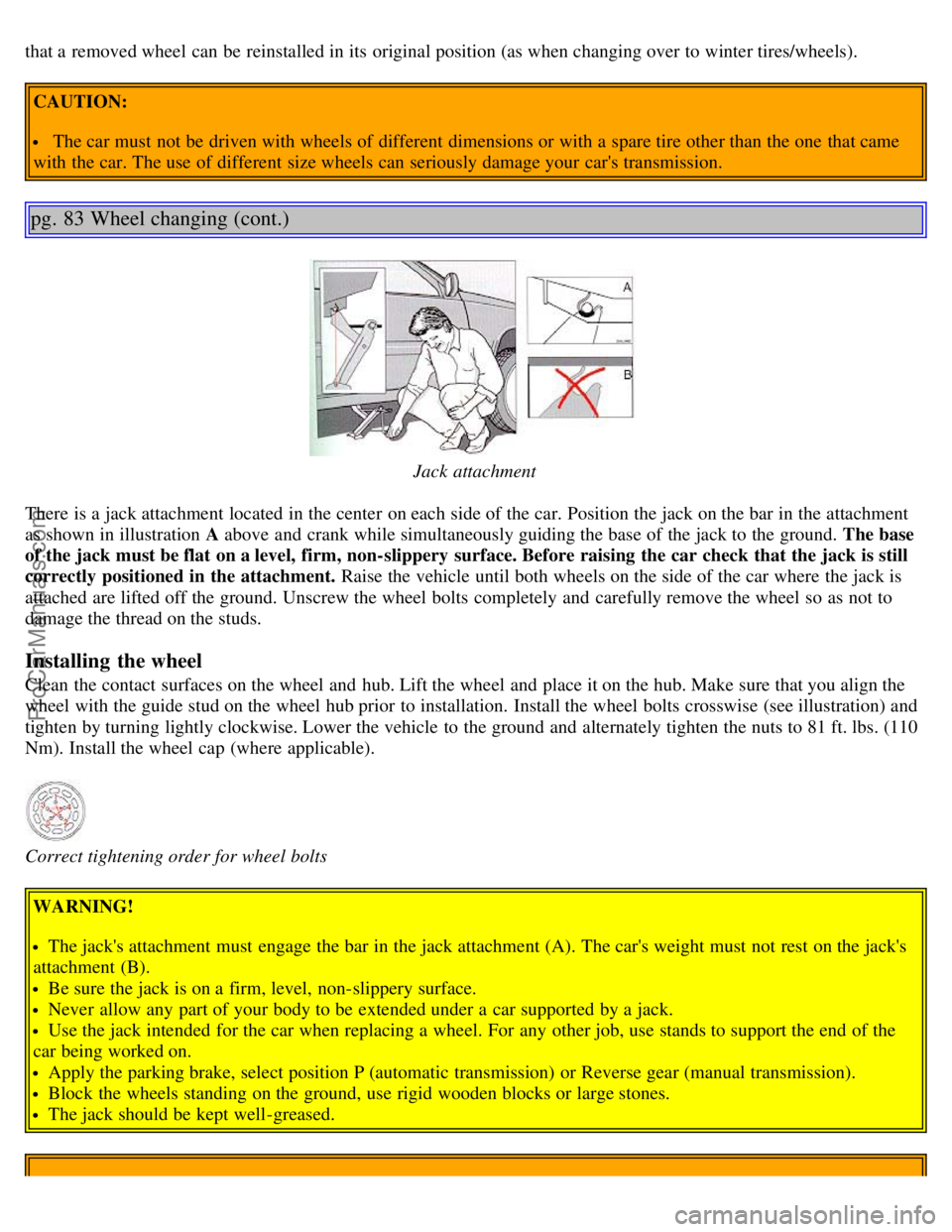
Jack attachment
There is a jack attachment located in the center on each side of the car. Position the jack on the bar in the attachment
as shown in illustration A above and crank while simultaneously guiding the base of the jack to the ground. The base
of the jack must be flat on a level, firm, non-slippery surface. Before raising the car check that the jack is still
correctly positioned in the attachment. Raise the vehicle until both wheels on the side of the car where the jack is
attached are lifted off the ground. Unscrew the wheel bolts completely and carefully remove the wheel so as not to
damage the thread on the studs.
Installing the wheel
Clean the contact surfaces on the wheel and hub. Lift the wheel and place it on the hub. Make sure that you align the
wheel with the guide stud on the wheel hub prior to installation. Install the wheel bolts crosswise (see illustration) and
tighten by turning lightly clockwise. Lower the vehicle to the ground and alternately tighten the nuts to 81 ft. lbs. (110
Nm). Install the wheel cap (where applicable).
Correct tightening order for wheel bolts
WARNING!
The jack's attachment must engage the bar in the jack attachment (A). The car's weight must not rest on the jack's
attachment (B).
Be sure the jack is on a firm, level, non-slippery surface.
Never allow any part of your body to be extended under a car supported by a jack.
Use the jack intended for the car when replacing a wheel. For any other job, use stands to support the end of the
car being worked on.
Apply the parking brake, select position P (automatic transmission) or Reverse gear (manual transmission).
Block the wheels standing on the ground, use rigid wooden blocks or large stones.
The jack should be kept well-greased.
ProCarManuals.com