wheel VOLVO C70 1998 Owners Manual
[x] Cancel search | Manufacturer: VOLVO, Model Year: 1998, Model line: C70, Model: VOLVO C70 1998Pages: 38, PDF Size: 0.71 MB
Page 1 of 38
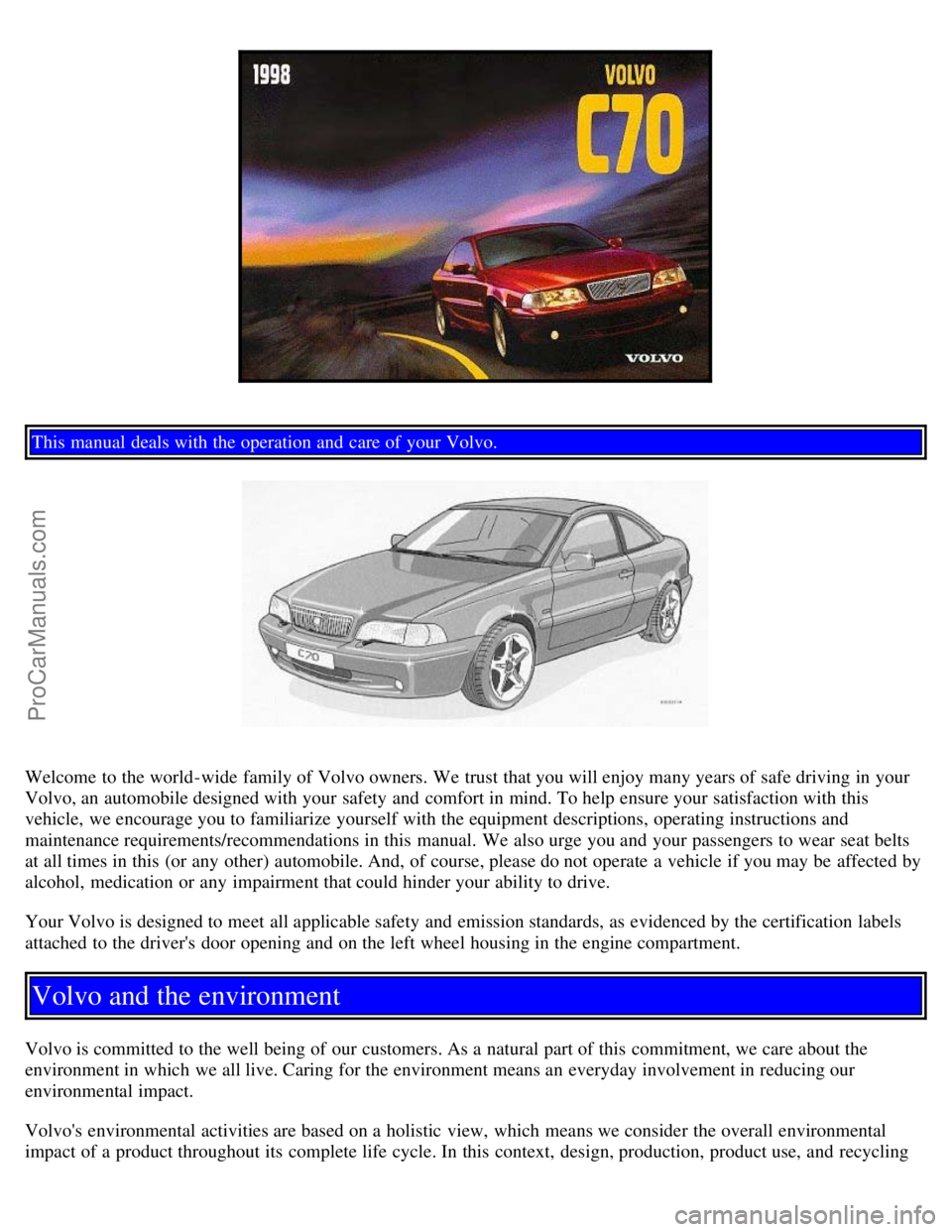
This manual deals with the operation and care of your Volvo.
Welcome to the world-wide family of Volvo owners. We trust that you will enjoy many years of safe driving in your
Volvo, an automobile designed with your safety and comfort in mind. To help ensure your satisfaction with this
vehicle, we encourage you to familiarize yourself with the equipment descriptions, operating instructions and
maintenance requirements/recommendations in this manual. We also urge you and your passengers to wear seat belts
at all times in this (or any other) automobile. And, of course, please do not operate a vehicle if you may be affected by
alcohol, medication or any impairment that could hinder your ability to drive.
Your Volvo is designed to meet all applicable safety and emission standards, as evidenced by the certification labels
attached to the driver's door opening and on the left wheel housing in the engine compartment.
Volvo and the environment
Volvo is committed to the well being of our customers. As a natural part of this commitment, we care about the
environment in which we all live. Caring for the environment means an everyday involvement in reducing our
environmental impact.
Volvo's environmental activities are based on a holistic view, which means we consider the overall environmental
impact of a product throughout its complete life cycle. In this context, design, production, product use, and recycling
ProCarManuals.com
Page 3 of 38
CAUTION: Certain models have reduced ground clearance due to the design of the front spoiler. Please observe
caution when e.g., driving onto garage hoists, through drifted snow or when other road debris is encountered, or
when parking near curbs
©1997 Volvo Cars of North America Inc.
Contents
Chapter 1 - Occupant safety1
Chapter 2 - Instruments, switches and controls15
Chapter 3 - Body and interior39
Chapter 4 - Starting and driving55
Chapter 5 - Wheels and tires75
Chapter 6 - In case of an emergency81
Chapter 7 - Car care99
Chapter 8 - Volvo Service105
Chapter 9 - Specifications123
Chapter 10 - Audio systems131
Index188
Top of Page
ProCarManuals.com
Page 8 of 38
11 Electrically operated sun roof (optional)41
12 Rear window demister/heated door mirrors
23
13 Air mix
33
14 Air vents
33
15 Passenger side air bag (SRS) hatch
4-6
16 Air vents
33
17 Hood release
51
18 Turn signals, high/low beams
20
Cruise control
29
19 Adjustable steering wheel
32
20 Windshield wiper/washer
21
21 Heated front seats (optional)
30
22 Auxiliary socket
31
23 Audio systems
131
24 Heating and ventilation controls
33-35
25 Hazard warning flashers
23
26 Ashtray
31
27 Coin holder
28 Shiftlock release button (automatic transmission only)
97
29 Gear selector shift positions
60-62
30 Transmission mode selectors
62
31 Parking brake
30
32 Horn/SRS
4-6
33 Trunk open control
52
34 Power window controls
36
35 Power mirror controls
48
36 Fuel tank open control
37
37 Central locking button
36
Some of the items above are available on certain models only.
Shiftlock (automatic transmission only)
When your car is parked, the gear selector is locked in the (P)ark position. To release the selector from this position,
turn the ignition key to position II (or start the engine), depress the brake pedal, press the button on the front side of the
gear selector and move the selector from (P)ark.
If it is necessary to manually override the shiftlock system:
Turn the starting (ignition) key to position I
Press firmly on the "SHIFTLOCK OVERRIDE" button located near the base of the gear selector.
While holding the override button down, press the button on the front of the gear selector.
Move the gear selector from the ( P)ark position.
Keylock (automatic transmission only)
This means that when you switch off the ignition, the gear selector must be in the (P)ark position before the starting
(ignition) key can be removed from the ignition switch.
Anti -lock Brake System (ABS)
ProCarManuals.com
Page 13 of 38

Sun visor: The sun roof also features a sliding sun visor. The visor slides back automatically when the sun roof is
opened and also slides back slightly when the sun roof is opened to the ventilation position. The visor must be closed
manually.
CAUTION: Do not close the sun visor when the sun roof is in the ventilation position as this could damage the
mechanism.
NOTE:
The electrically -operated sun roof has an overload protecting circuit breaker (fuse no. 37) which is activated when an
object blocks the sun roof. Should this occur, remove the object and wait 20 seconds for the circuit breaker to reset.
The sun roof should then function normally. Also check fuse no. 35.
WARNING! The sun roof must never be obstructed in any way when in operation.
pg. 42 Keys, doors and locks
Master key
This key operates all locks (ignition switch/steering wheel lock, driver's door, trunk and glove compartment).
Service key
This key operates the driver's door and the ignition switch/steering wheel lock.
NOTE:
As an added anti-theft measure, new keys have been developed which may take slightly longer to copy or replace if
the original keys are misplaced. Duplicate keys may be ordered from your Volvo retailer.
The key number codes are stamped on a separate tag supplied with the keys. This tag should be separated from the
key ring and kept in a safe place.
Doors and locks
Your car is equipped with a central locking system.
The key, used on the driver's door, the remote control, or central locking button, will lock/unlock both doors, and the
trunk.
Turn the key once to unlock the driver's door only.
Turn the key again (within 10 seconds) to unlock both doors and the trunk.
One turn with the key towards lock in the drivers door locks both doors and the trunk.
Use the switch on the front door armrests to lock/unlock the car from the inside.
ProCarManuals.com
Page 18 of 38
Chapter 5 - Wheels and tires
pg. 75 Wheels and tires
Wheels and tires
The handling and riding comfort of the vehicle is dependent on the inflation pressure and the type of tires fitted. Read
the following pages carefully.
General information, Wear indicator, Tire economy, Flat spots
76
Snow chains, Winter tires77
Inflation pressure78
Uniform tire quality grading79
pg. 76 Wheels and tires
General information
Your vehicle is equipped with tires according to the tire information label located on the rear facing side of the
right front door.
The following is an example of a tire designation code 225/50R16:
225 = tire width in mm.
50 = tire profile. This is the relationship (in percent) between the section height and the width of the tire.
R = radial tires.
16 = diameter in inches.
The tires have good road holding characteristics and offer good handling on dry and wet surfaces. It should be noted
however that the tires have been developed to give these features on snow/ice-free surfaces. Certain models are
equipped with "all-season" tires, which provide a somewhat higher degree of winter roadholding on slippery
surfaces than tires without the "all-season" rating. However, for optimum road holding on icy or snow covered
roads - we recommend suitable winter tires on all four wheels. When replacing tires, be sure that the new tires are
the same size designation, type (radial) and preferably from the same manufacturer, on all four wheels. Otherwise there
is a risk of altering the car's road-holding and handling characteristics.
NOTE: When storing wheel/tire assemblies (e.g. winter tires and wheels), either stand the assemblies upright or
suspend them off the ground. Laying wheel/tire assemblies on their sides for prolonged periods can cause wheel and/or
tire damage.
Wear indicator
The tires have a so-called "wear indicator" in the form of a number of narrow strips running across or parallel to the
tread. When approx. 1/16" (1.6 mm) is left on the tread, these strips show up and indicate that the tire should be
replaced.
Tires with less than 1/16" (1.6 mm) tread have a very poor grip in rain or snow.
When replacing worn tires, it is recommended that the tire be identical in type (radial) and size as the one being
replaced. Using a tire of the same make (manufacturer) will prevent alteration of the driving characteristics of the
vehicle.
To improve tire economy:
ProCarManuals.com
Page 19 of 38
Maintain correct tire pressure.
Drive smoothly: avoid fast starts, hard braking and tire screeching.
Tire wear increases with speed.
Correct front wheel alignment is very important.
Unbalanced wheels impair tire economy and driving comfort.
If the wheels are rotated, they should be kept on the same side of the car so that they revolve in the same direction
as prior to rotation.
Hitting curbs or potholes can damage the tires and/or wheels permanently.
Flat spots
All tires become warm during use. After cooling, when the vehicle is parked, the tires have a tendency to distort
slightly, forming flat spots. These flat spots can cause vibrations similar to the vibrations caused by unbalanced wheels.
They do, however, disappear when the tire warms up. The degree to which the flat spots form depends on the type of
cord used in the tire. Remember that, in cold weather, it takes longer for the tire to warm up and consequently longer
for the flat spot to disappear.
CAUTION: The car must not be driven with wheels of different dimensions. The use of different size wheels can
seriously damage your car's transmission.
pg. 77 Wheels and tires (cont.)
Snow chains
Snow tire chains can be used on your Volvo with the following restrictions:
Snow chains should be installed on front wheels only. Use only Volvo approved snow chains.
Snow chains may be mounted on tire dimension 195/65R15. Tire dimension 205/55R16 requires a special type of
snow chain. Consult your Volvo retailer. Snow chains may not be used on 205/55R16 tires.
If accessory, aftermarket or "custom" tires and wheels are installed and are of a size different than the original tires
and wheels, chains in some cases CANNOT be used. Snow chains cannot be used on those turbo-charged models fitted
with all-season tires 225/50R16 or 225/45R17 or 225/40R18. Sufficient clearances between chains and brakes,
suspension and body components must be maintained.
Some strap -on type chains will interfere with brake components and therefore CANNOT be used.
Consult your Volvo retailer for additional snow chain information.
CAUTION:
Check local regulations regarding the use of snow chains before installing.
Always follow the chains manufacturer's installation instructions carefully. Install chains as tightly as possible and
re-tighten periodically.
Never exceed the chain manufacture's specified maximum speed limit. (Under no circumstances should that limit
be higher than 30 mph (45 km/h).
Avoid bumps, holes or sharp turns when driving with snow chains.
The handling of the vehicle can be adversely affected when driving with chains. Avoid fast or sharp turns as well
as locked wheel braking.
Snow tires, studded tires *
Tires for winter use:
Owners who live in or regularly commute through areas with sustained periods of snow or icy driving
conditions are strongly advised to fit suitable winter tires to help retain the highest degree of traction.
It is important to install winter tires on all four wheels to help retain traction during cornering, braking and
accelerating. Failure to do so could reduce traction to an unsafe level or adversely affect handling. Do not mix tires of
ProCarManuals.com
Page 20 of 38
different design as this could also negatively affect overall tire road grip. Volvo recommends 195/65 R15 winter tires
on 15" steel wheels on all C70 models including those equipped with 16", 17" or 18" wheels.
Winter tires wear more quickly on dry roads in warm weather. They should be removed when the winter driving
season has ended.
Studded tires should be run-in 300-600 miles (500-1000 km) during which the car should be driven as smoothly as
possible to give the studs the opportunity to seat properly in the tires. The car tires should have the same rotational
direction throughout their entire lifetime. In other words, if you wish to rotate the wheels, make sure that the same
wheels are always on the same side of the car.
NOTE: Please consult state or local regulations restricting the use of studded winter tires before installing such tires.
* Where permitted
pg. 78 Wheels and tires (cont.)
Checking and correcting tire pressure
Check the tire pressure when refueling.
The tire pressure should be corrected only when the tires are cold.
With warm tires, correct only when the pressure is too low. The tire temperature rises after driving just a few miles.
Vehicle Loading
The tires on your Volvo will perform to specifications at all normal loads when inflated as recommended on the tire
information label* located on the rear facing edge of the passenger's door. This label lists both the tire and vehicle
design limits.
Do not load your car beyond the load limits indicated.
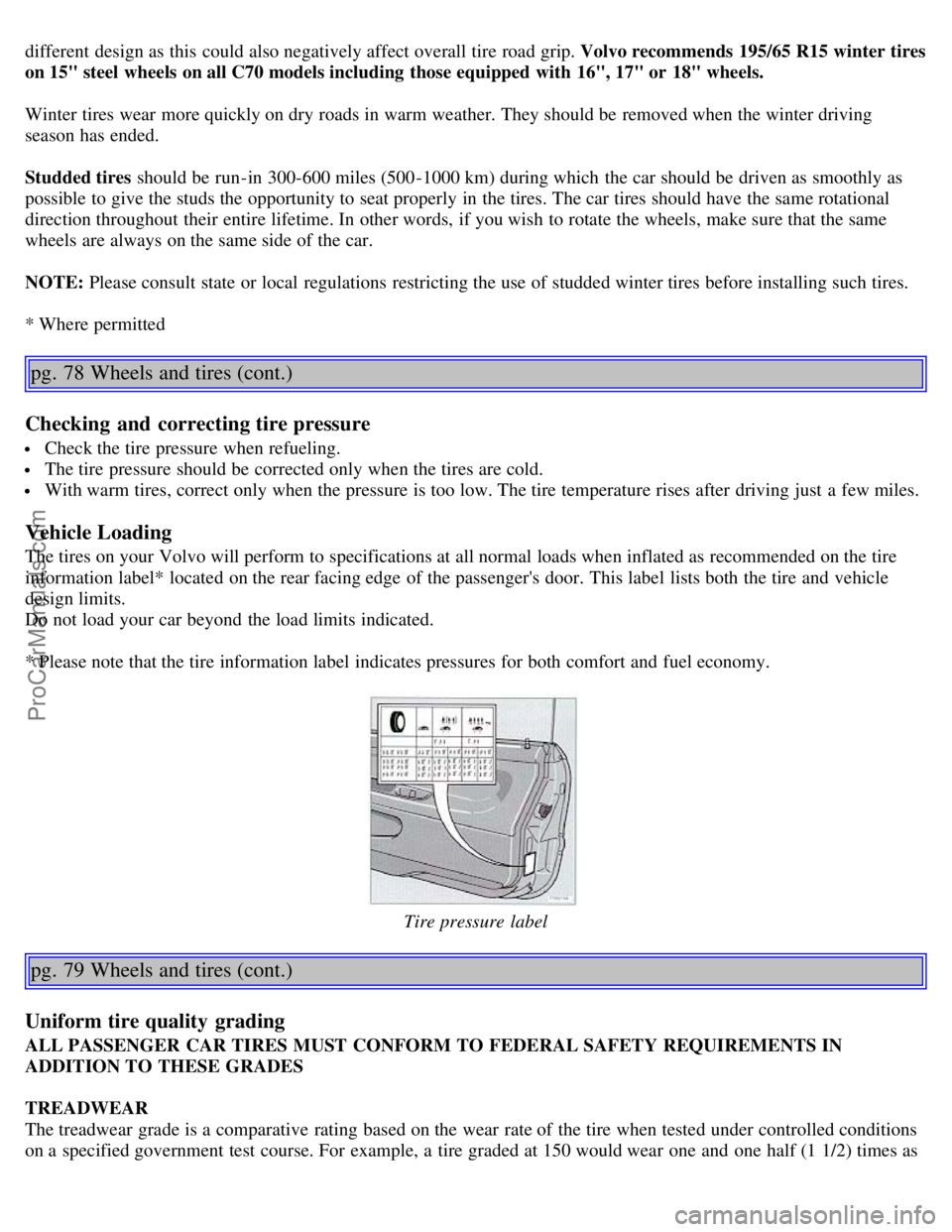
* Please note that the tire information label indicates pressures for both comfort and fuel economy.
Tire pressure label
pg. 79 Wheels and tires (cont.)
Uniform tire quality grading
ALL PASSENGER CAR TIRES MUST CONFORM TO FEDERAL SAFETY REQUIREMENTS IN
ADDITION TO THESE GRADES
TREADWEAR
The treadwear grade is a comparative rating based on the wear rate of the tire when tested under controlled conditions
on a specified government test course. For example, a tire graded at 150 would wear one and one half (1 1/2) times as
ProCarManuals.com
Page 21 of 38

well on the government course as a tire graded 100. The relative performance of tires depends upon the actual
conditions of their use, however, and many depart significantly from the norm due to variation in driving habits,
service practices and differences in road characteristics and climate.
TRACTION
The traction grades, from highest to lowest, are AA, A, B, and C, as measured under controlled conditions on specified
government test surfaces of asphalt and concrete. A tire marked C may have poor traction performance.
WARNING! The traction grade assigned to this tire is based on braking (straight-ahead) traction tests and does not
include cornering (turning) traction.
TEMPERATURE
The temperature grades are AA (the highest), A, B, and C, representing the tire's resistance to the generation of heat
and its ability to dissipate heat when tested under controlled conditions on a specified indoor laboratory test wheel.
Sustained high temperature can cause the material of the tire to degenerate and reduce tire life, and excessive
temperature can lead to sudden tire failure. The grade C corresponds to a level of performance which all passenger car
tires must meet under the Federal Motor Safety Standard No. 109. Grades B and A represent higher levels of
performance on the laboratory test wheel than the minimum required by law.
WARNING! The temperature grade for this tire is established for a tire that is properly inflated and not overloaded.
Excessive speed, underinflation, or excessive loading, either separately or in combination, can cause heat buildup
and possible tire failure.
Contents | Top of Page
ProCarManuals.com
Page 22 of 38

Chapter 6 - In case of emergency
pg. 81 In case of an emergency
In case of an emergency
Even if you maintain your car in good running condition, there is always the possibility that something might go wrong
and prevent you from driving, such as a punctured tire, blown fuse or bulb, etc. For additional information, see section
"ON CALL Road Assistance".
Wheel changing
82-83
Spare tire84
Replacing bulbs85-90
Replacing fuses91-93
Installation of accessories94
Replacing wiper blades95-96
In case of emergency97
pg. 82 Wheel changing
Loosen wheel bolts
Changing a wheel
The spare wheel is located under the carpet on the trunk floor. The jack and crank are secured in the wheel recess.
Engage the parking brake.
Put the gear selector in (P)ark (automatic) or in Reverse (manual).
With the car still on the ground, use the lug wrench to loosen the wheel bolts 1/2 - 1 turn. Turn the bolts
counterclockwise to loosen.
Fold out the crank handle on the jack by pressing the nob on the handle downward. To attach the jack, refer to the
illustration on the following page.
NOTE: To avoid excessive wear and the necessity of rebalancing, mark and reinstall wheels in same location and
position as before removal. To lessen the chance of imbalance, each wheel hub is equipped with a guide stud to ensure
ProCarManuals.com
Page 23 of 38
that a removed wheel can be reinstalled in its original position (as when changing over to winter tires/wheels).
CAUTION:
The car must not be driven with wheels of different dimensions or with a spare tire other than the one that came
with the car. The use of different size wheels can seriously damage your car's transmission.
pg. 83 Wheel changing (cont.)
Jack attachment
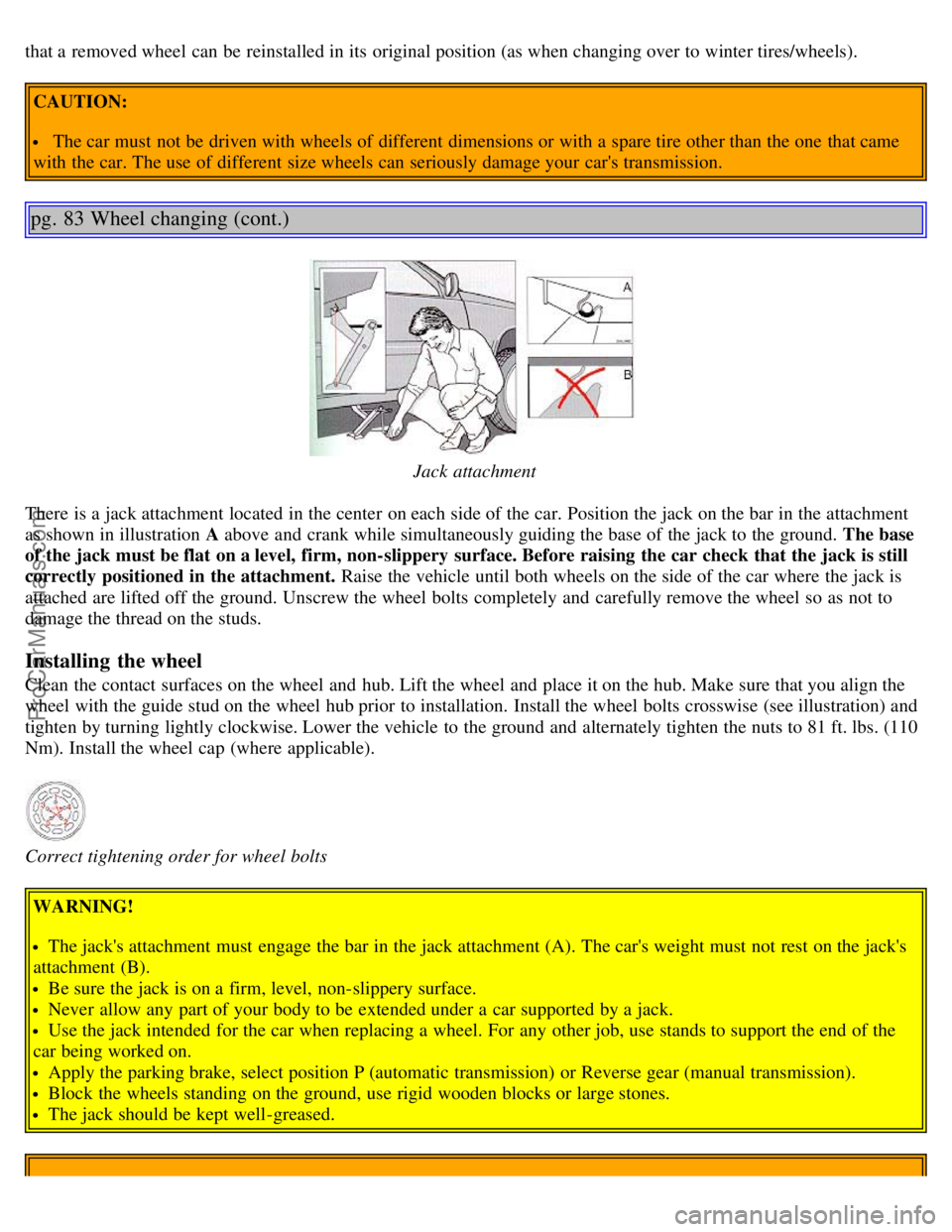
There is a jack attachment located in the center on each side of the car. Position the jack on the bar in the attachment
as shown in illustration A above and crank while simultaneously guiding the base of the jack to the ground. The base
of the jack must be flat on a level, firm, non-slippery surface. Before raising the car check that the jack is still
correctly positioned in the attachment. Raise the vehicle until both wheels on the side of the car where the jack is
attached are lifted off the ground. Unscrew the wheel bolts completely and carefully remove the wheel so as not to
damage the thread on the studs.
Installing the wheel
Clean the contact surfaces on the wheel and hub. Lift the wheel and place it on the hub. Make sure that you align the
wheel with the guide stud on the wheel hub prior to installation. Install the wheel bolts crosswise (see illustration) and
tighten by turning lightly clockwise. Lower the vehicle to the ground and alternately tighten the nuts to 81 ft. lbs. (110
Nm). Install the wheel cap (where applicable).
Correct tightening order for wheel bolts
WARNING!
The jack's attachment must engage the bar in the jack attachment (A). The car's weight must not rest on the jack's
attachment (B).
Be sure the jack is on a firm, level, non-slippery surface.
Never allow any part of your body to be extended under a car supported by a jack.
Use the jack intended for the car when replacing a wheel. For any other job, use stands to support the end of the
car being worked on.
Apply the parking brake, select position P (automatic transmission) or Reverse gear (manual transmission).
Block the wheels standing on the ground, use rigid wooden blocks or large stones.
The jack should be kept well-greased.
ProCarManuals.com