oil VOLVO C70 2000 User Guide
[x] Cancel search | Manufacturer: VOLVO, Model Year: 2000, Model line: C70, Model: VOLVO C70 2000Pages: 89, PDF Size: 2.13 MB
Page 52 of 89

The fabric can be cleaned with soapy water or a detergent. For more difficult spots caused by oil, ice cream, shoe
polish, grease, etc., use a clothing/fabric stain remover.
The plastic in the upholstery can be cleaned with a soft cloth and mild soap solution.
Leather upholstery can be cleaned with a soft cloth and mild soap solution. For more difficult spots, Volvo offers a
leather care kit.
On no account must gasoline, naphtha or similar cleaning agents be used on the plastic or the leather since these
can cause damage.
Cleaning the seat belts
Clean only with lukewarm water and mild soap solution.
Cleaning floor mats
The floor mats should be vacuumed or brushed clean regularly, especially during winter when they should be taken out
for drying. Spots on textile mats can be removed with a mild detergent.
Bear in mind
· Take extra care when removing stains such as ink or lipstick since the coloring can spread.
· Use solvents sparingly. Too much solvent can damage the seat padding.
· Start from the outside of the stain and work toward the center.
Contents | Top of Page
ProCarManuals.com
Page 53 of 89

2 0 0 0
VOLVO C70
Chapter 8 - Volvo Service
pg. 105 Volvo Service
Service an investment
An investment which will pay dividends in the form of improved reliability, durability and resale value. Label information
106
Maintenance service, Warranty107
Maintenance schedule108-109
Servicing110-111
Fuel/emissions systems112
Lubrication113
Engine oil114-115
Power steering fluid, Brake/clutch system fluid reservoir116
Windshield washer nozzle, Washer fluid reservoir117
Coolant118
Engine compartment119
Battery maintenance120
pg. 106 Label information
1 Vehicle Emission Control Information
Your Volvo is designed to meet all applicable emission standards, as evidenced by the certification label on the
underside of the hood. For further information regarding these regulations, please consult your Volvo retailer.
2 Vacuum hose routing
(underside of hood)
ProCarManuals.com
Page 56 of 89
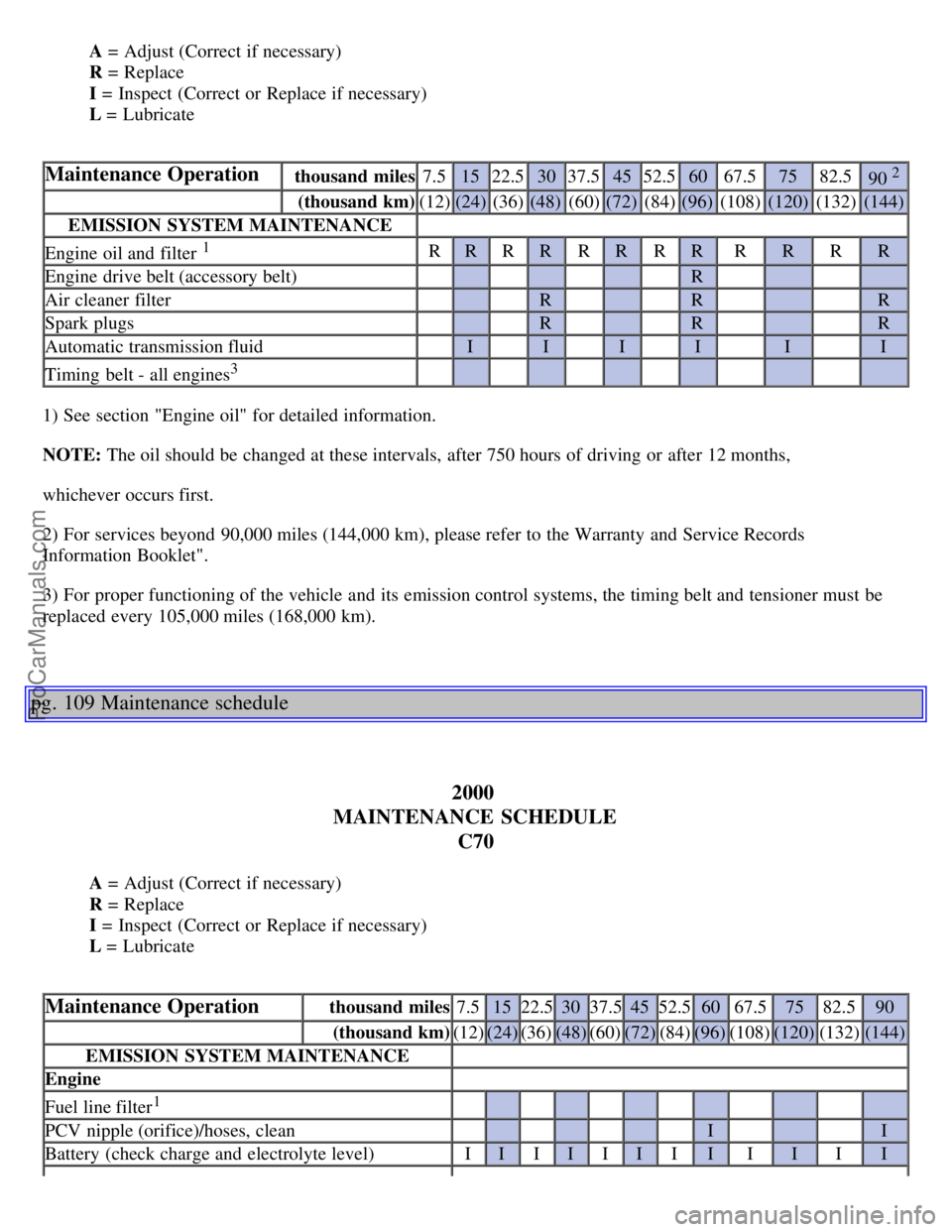
A = Adjust (Correct if necessary)
R = Replace
I = Inspect (Correct or Replace if necessary)
L = Lubricate
Maintenance Operationthousand miles 7.51522.5 3037.5 4552.5 6067.5 7582.5
90 2
(thousand km)(12)(24) (36)(48) (60)(72) (84)(96) (108) (120)(132)(144)
EMISSION SYSTEM MAINTENANCE
Engine oil and filter
1R R RR RR RR R RRR
Engine drive belt (accessory belt) R
Air cleaner filter R R R
Spark plugs R R R
Automatic transmission fluid I I I I I I
Timing belt - all engines
3
1) See section "Engine oil" for detailed information.
NOTE: The oil should be changed at these intervals, after 750 hours of driving or after 12 months,
whichever occurs first.
2) For services beyond 90,000 miles (144,000 km), please refer to the Warranty and Service Records
Information Booklet".
3) For proper functioning of the vehicle and its emission control systems, the timing belt and tensioner must be
replaced every 105,000 miles (168,000 km).
pg. 109 Maintenance schedule
2000
MAINTENANCE SCHEDULE C70
A = Adjust (Correct if necessary)
R = Replace
I = Inspect (Correct or Replace if necessary)
L = Lubricate
Maintenance Operationthousand miles 7.51522.5 3037.5 4552.5 6067.5 7582.5 90
(thousand km)(12)(24)(36) (48)(60) (72)(84)(96)(108) (120) (132)(144)
EMISSION SYSTEM MAINTENANCE
Engine
Fuel line filter
1
PCV nipple (orifice)/hoses, clean I I
Battery (check charge and electrolyte level) II II II I I I II I
ProCarManuals.com
Page 57 of 89

Brakes
Inspect brake pads, replace components as necessary I II II I I I II I
Brake fluid level
2 - check
I I I I I I
Steering/suspension
Tires
3, check pressure, wear and condition I
I II II I I I II I
Check power steering fluid level I I I I I
Body
Power antenna (clean) L L L L L L
Trunk/hood, hinges and latches L L L
Cabin air filter (see page 111)
R R R R R R
1) Replace at 105,000 miles (168,000 km)
2) Brake fluid should be changed at owner request every second year or 30,000 miles (48,000 km). The fluid
should be replaced once a year or every 15,000 miles (24,000 km) when driving under extremely hard
conditions (mountain driving, etc.).
3) Rotate tires at owner request.
The following items should be checked weekly by the driver (it takes only a few minutes):
Engine oil level, brake fluid level, radiator coolant level, operation of all lights, horns, windshield wipers, tire
pressure (all five tires), windshield washer fluid level
The following should also be carried out at regular intervals:
Washing (check all drain holes), polishing, cleaning
pg. 110 Servicing
Hoisting the car
If a garage jack is used to lift the car, the two jack attachments points should be used. They are specially reinforced to
bear the weight of the car. A garage jack can also be placed under the front of the engine support frame and under the
reinforced plate in the spare wheel well. Take care not to damage the splash guard under the engine. Ensure that the
jack is positioned so that the car cannot slide off it. Always use axle stands or similar structures.
If a twopost hoist is used to lift the car, the front lift arm pads should be positioned under the rear engine frame
ProCarManuals.com
Page 58 of 89

mounts. The rear lift arm pads should be positioned under the rear supporting arm bracket.
CAUTION: Certain models have reduced ground clearance due to the design of the front spoiler. Please observe
caution when driving the car onto a garage hoist.
pg. 111 Servicing
Air cleaner
Replace the air cleaner cartridge with a new one every 30,000 miles (48,000 km). The cartridge should be replaced
more often when driving under dirty and dusty conditions. The filter cannot be cleaned and therefore should always be
replaced with a new one.
Timing belt
For proper functioning of the vehicle and its emission control systems, the timing belt and tensioner must be replaced
every 105,000 miles (168,000 km). Engine damage will occur if the belt fails.
Fuel system cap, tank and lines and connections
The effectiveness of the fuel system to contain hydrocarbons is dependent largely on a leakfree system. Check for
proper sealing of the fuel filler cap which contains "O" ring type seals.
NOTE: If the fuel filler cap is not closed tightly or if the engine is running when the car is refueled, the Malfunction
Indicator Lamp ("Check Engine") may indicate a fault. However, your vehicle's performance will not be affected. Use
only Volvo original or approved fuel filler caps.
Fuel (line) filter
For proper functioning of the vehicle and its emission control systems, the fuel line filter should be replaced at 105,000
miles (168,000 km). The filter is replaced as one complete unit. Replace more frequently if contaminated fuel is
introduced into the tank (or if there is reason to suspect that this has occurred).
PCV system
The orifice nipple in the intake manifold and the filter at the end of the PCV hose in the air cleaner should be
inspected at 60,000 miles (96,000 km) and thereafter, at 30,000 mile (48,000 km) intervals.
Cabin air filter
Replace the cabin air filter with a new one at 15,000 mile (24,000 km) intervals. Volvo recommends replacing the
filter more often if the car is driven under dirty and dusty conditions. The filter cannot be cleaned and therefore should
always be replaced with a new one.
pg. 112 Fuel/emissions systems
ProCarManuals.com
Page 60 of 89

· If the fuel filler cap is not closed tightly or if the engine is running when the car is refueled, the Malfunction Indicator
Lamp may indicate a fault.
· During a transitional period, a small number of service stations may still have fuel nozzles that are not compatible
with the fuel filler neck on cars equipped with the evaporative control system (ORVR) mandated by the U.S.
Environmental Protection Agency and the California Air Resources Board. If you experience difficulties in refueling
your vehicle, please ask the gas station attendant for assistance.
CAUTION:
Fuel must not be siphoned from the fuel tank. This will damage the Evaporative control system.
pg. 113 Lubrication
No.Lubrication point lubricant
1 Hood lock and latch Oil
2 Door stop and hinges Oil
3 Sun roof wind deflector (visible when sun roof is open) Oil, low temperature grease
4 Door lock catch plate Oil
5 Power antenna WD 40 or similar
6 Locks Volvo teflon lock spray
7 Trunk lock catch plate Low temperature grease
8 Front seat side rail and latch Oil
To avoid rattles and unnecessary wear, the body should be lubricated at regular service intervals. This should be done
by an authorized Volvo retailer.
Contents | Top of Page
ProCarManuals.com
Page 61 of 89

2 0 0 0
VOLVO C70
Chapter 9 - Specifications
pg. 121 Specifications
Specifications
This chapter contains facts and figures pertaining to the technical specifications of your car. Oil/fluids specifications
122
Engine specifications123
Cooling/fuel/distributor ignition systems124
Front/rear suspensions124
Transmission, Capacities, Vehicle loading125
Electrical system/bulbs126
Dimensions and weights127
Service manuals, Road assistance128
pg. 122 Oil/fluid specifications
Oil quality
Meeting API specification SJ, SJ/CF, or SJ/Energy Conserving
For best fuel economy and engine protection, consult with your authorized Volvo retailer for recommended oils. Oil
with a different quality rating may not provide adequate engine protection.
Synthetic oils complying with oil quality requirements are recommended for: driving in areas of sustained temperature
extremes (hot or cold), when towing a trailer over long distances or for prolonged driving in mountainous areas.
Extra oil additives must not be used unless advised by an authorized Volvo retailer.
Viscosity (stable ambient temperatures):
ProCarManuals.com
Page 62 of 89

Engine oilQuality:
Meeting API specification SJ, SJ/CF,
or SJ/Energy Conserving Capacity (incl. filter)
: 6.1 US
qts. (5.8 liters)*
Automatic transmission fluid Quality: AW4: ATF Dexron III and Mercon. Capacity:
8 US qts. (7.6
liters)
Manual transmission fluid AW5: Only Volvo gearbox oil (1161540-8). Do
not mix with other oils. Capacity:
8 US qts. (7.5
liters)
Power steering fluid Quality: Volvo synthetic gearbox oil 1161423 Capacity:
2.2 US qts. (2.1
liters)
Brake fluid Quality: ATF Capacity:
0.95 US qts. (0.9
liters)
All specifications are subject to
change without notice. Quality: DOT 4+ Capacity:
0.64 US qts. (0.6
liters)
* Add 0.95 qts. (0.9 liters) if the oil cooler has been drained
pg. 123 Engine specifications
Engine
Liquid-cooled gasoline, 5cylinder, inline engine. Aluminum alloy cylinder block with castiron cylinder liners cast
directly into the block. Aluminum alloy cylinder head with double overhead camshafts and separate intake and outlet
channels.
Engine lubrication is provided by an eccentric pump driven from the crankshaft. Fullflow type oil filter. Exhaust
emission control is accomplished by multiport fuel injection, heated oxygen sensor(s) and threeway catalytic converter. Designation: Volvo B 5234 T3 Designation:Volvo B 5244 T
Output 236 hp at 5400 rpm (176 kW/90 rps) Output190 hp at 5100 rpm (142 kW/85 rps)
Max. torque 243 ft. lbs. at 24005100 rpm (330
Nm/4592 rps) Max. torque199 ft. lbs. at 1600-5000 rpm (270
Nm/27-83 rps)
Number of
cylinders 5 Number of
cylinders5
Bore 3.19" (81 mm) Bore3.27" (83 mm)
Stroke 3.54" (90 mm) Stroke3.54" (90 mm)
Displacement 2.3 liters Displacement2.4 liters
Compression
ratio 8.5:1 Compression
ratio9.0:1
Number of
valves 20 Number of
valves20
ProCarManuals.com
Page 63 of 89

All specifications are subject to change without notice.
pg. 124 Specifications
Cooling system
Type: Positive pressure, closed system
Thermostat begins to open at 180° F (87° C)
Coolant: Volvo original coolant/antifreeze
Capacity: 7.4 US qts. (7.0 liters)
Fuel system
The engine is equipped with a multiport fuel injection system.
Distributor ignition system
Firing order:12453
Distributor ignition setting: Not adjustable
Spark plugs: Champion RC8PYP (or equivalent)
Spark plug gap: 0.03" (0.75 mm)
Tightening torque: 18.4 ft. lbs. +/ 3.7 ft. lbs. (25 Nm +/ 5 Nm)
WARNING!
The distributor ignition system operates at very high voltages. Special safety precautions must be followed to
prevent injury. Always turn the ignition off when:
· Replacing distributor ignition components e.g. plugs, coil, etc.
· Do not touch any part of the distributor ignition system while the engine is running. This may result in unintended
movements and body injury.
Replacing spark plugs
The spark plugs should be changed every 30,000 miles (48,000 km). However, city driving or fast highway driving
may necessitate changing after 15,000 miles (24,000 km) of driving. When installing new plugs, be sure to fit the right
type and use correct torque, see "Specifications". When changing the plugs, check that the suppressor connectors are in
good condition. Cracked or damaged connectors should be replaced. When changing the spark plugs, clean the
terminals and the rubber seals.
Front suspension
ProCarManuals.com
Page 65 of 89

5th gear1.02:1
Reverse3.23:1 3.95:1
Capacities
Fuel tank17.9 US gal. (68 liters)
Cooling system 7.4 US qts. (7.0 liters)
Engine oil (incl. filter) 6.1 US qts. ( 5.8 liters) *
Automatic transmission 2 US gals (7.6 liters)
Manual transmission 2.2 US qts. (2.1 liters)
Power steering fluid 0.8 US qts (0.8 liters)
Washer fluid reservoir 4.7 US qts. (4.5 liters)
Brake/clutch system 0.6 US qts (0.6 liters)
* Add 0.95 US qt. (0.9 liters) if the oil cooler has been drained.
Vehicle loading
The tires on your Volvo should perform to specifications at all normal loads when inflated as recommended on the tire
information label. The label is located on the inside of the fuel filler flap. The label lists both tire and vehicle design
limits. Do not load your car beyond the load limits indicated.
WARNING!
Improperly inflated tires will reduce tire life, adversely affect vehicle handling and can possibly lead to failure
resulting in loss of vehicle control without prior warning.
All specifications are subject to change without notice.
pg. 126 Specifications
Electrical system
12 Volt, negative ground.
Voltagecontrolled generator. Singlewire system with chassis and engine used as conductors.
Battery
Voltage 12 Volt
Capacity 520 A/100 min
(certain markets) 420 A/75 min
The battery contains corrosive and poisonous acids. It is of the utmost importance that old batteries are disposed of
correctly. Your Volvo retailer can assist you in this matter.
ProCarManuals.com