transmission VOLVO C70 2000 User Guide
[x] Cancel search | Manufacturer: VOLVO, Model Year: 2000, Model line: C70, Model: VOLVO C70 2000Pages: 89, PDF Size: 2.13 MB
Page 34 of 89
pg. 62 AW4 4-Speed Automatic Transmission (turbo models)
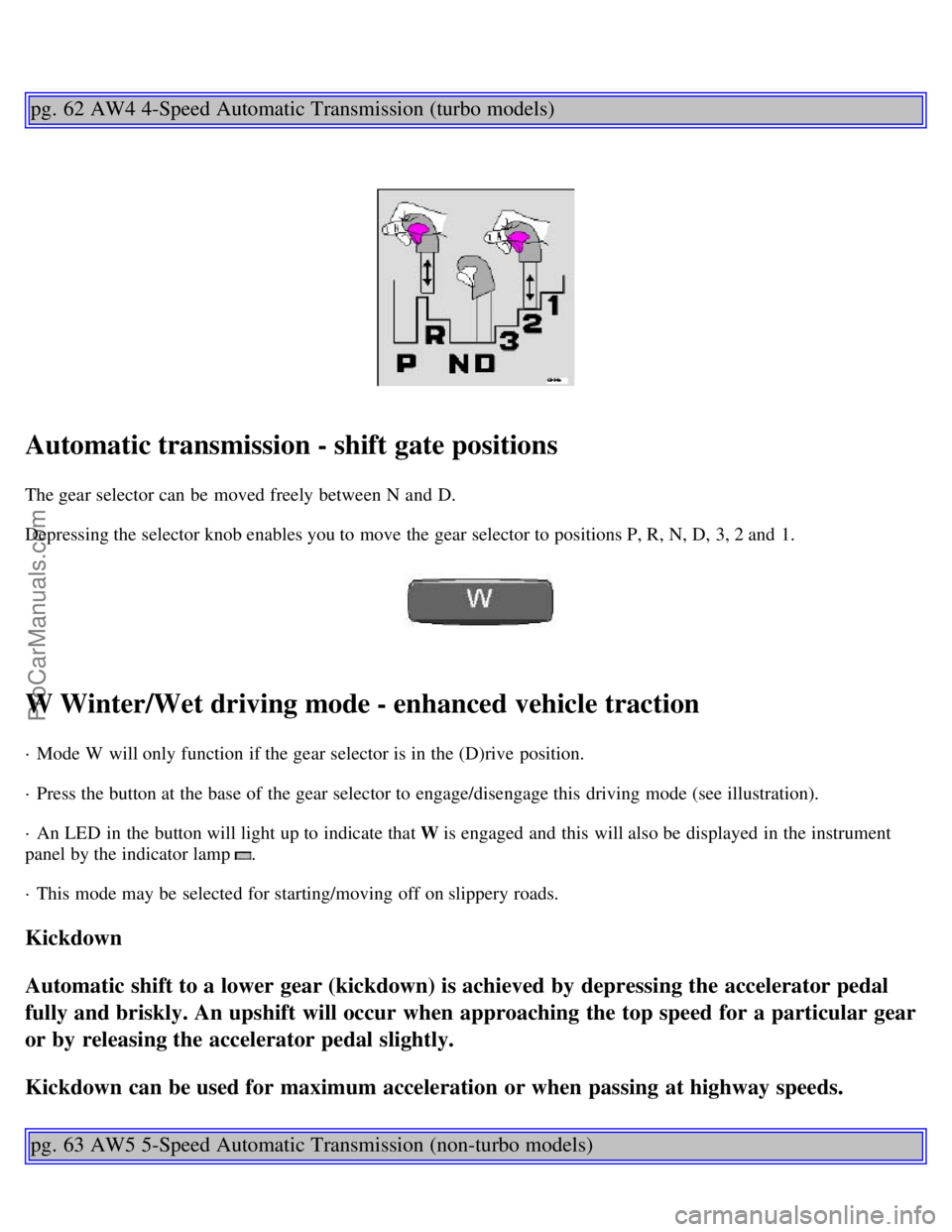
Automatic transmission - shift gate positions
The gear selector can be moved freely between N and D.
Depressing the selector knob enables you to move the gear selector to positions P, R, N, D, 3, 2 and 1.
W Winter/Wet driving mode - enhanced vehicle traction
· Mode W will only function if the gear selector is in the (D)rive position.
· Press the button at the base of the gear selector to engage/disengage this driving mode (see illustration).
· An LED in the button will light up to indicate that W is engaged and this will also be displayed in the instrument
panel by the indicator lamp
.
· This mode may be selected for starting/moving off on slippery roads.
Kickdown
Automatic shift to a lower gear (kickdown) is achieved by depressing the accelerator pedal
fully and briskly. An upshift will occur when approaching the top speed for a particular gear
or by releasing the accelerator pedal slightly.
Kickdown can be used for maximum acceleration or when passing at highway speeds.
pg. 63 AW5 5-Speed Automatic Transmission (non-turbo models)
ProCarManuals.com
Page 35 of 89
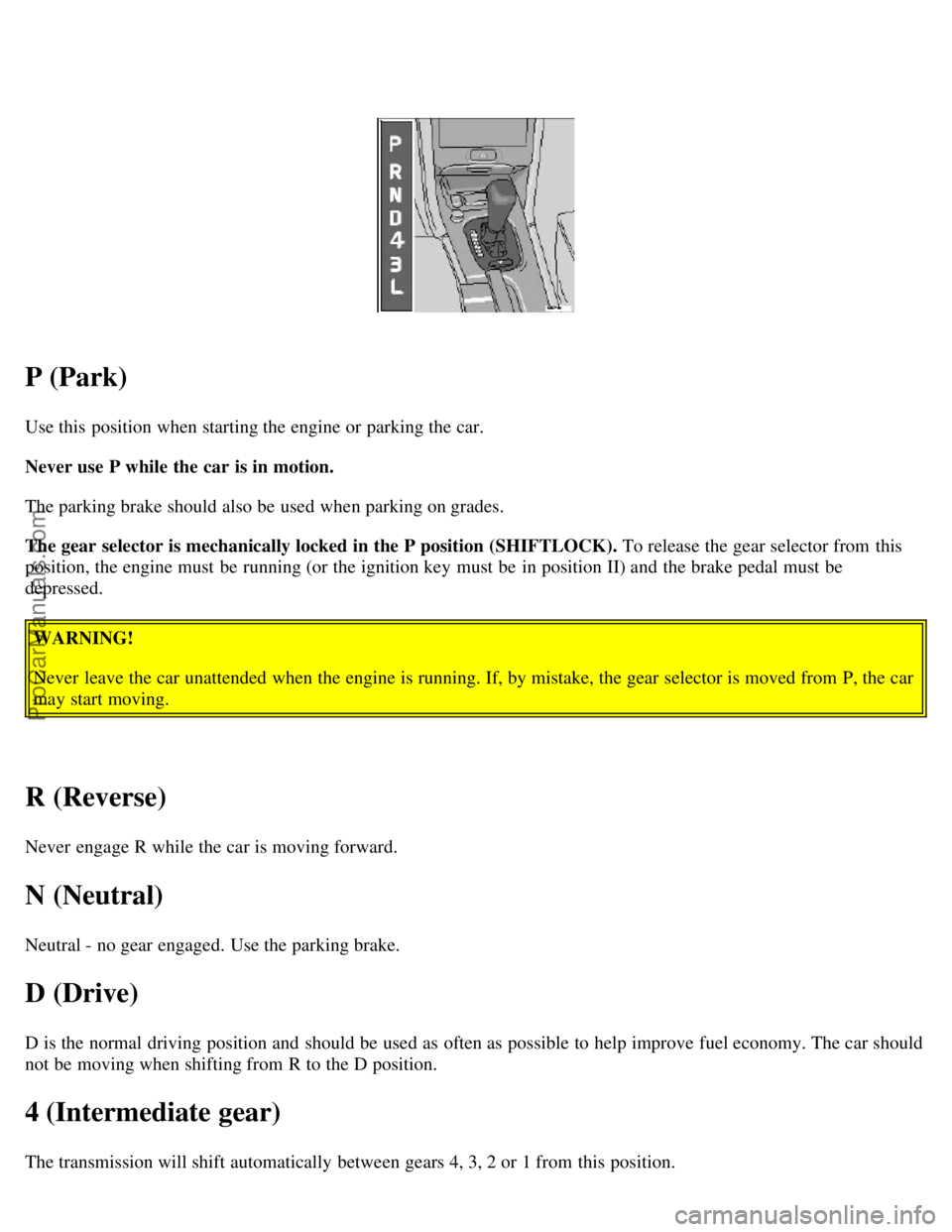
P (Park)
Use this position when starting the engine or parking the car.
Never use P while the car is in motion.
The parking brake should also be used when parking on grades.
The gear selector is mechanically locked in the P position (SHIFTLOCK). To release the gear selector from this
position, the engine must be running (or the ignition key must be in position II) and the brake pedal must be
depressed. WARNING!
Never leave the car unattended when the engine is running. If, by mistake, the gear selector is moved from P, the car
may start moving.
R (Reverse)
Never engage R while the car is moving forward.
N (Neutral)
Neutral - no gear engaged. Use the parking brake.
D (Drive)
D is the normal driving position and should be used as often as possible to help improve fuel economy. The car should
not be moving when shifting from R to the D position.
4 (Intermediate gear)
The transmission will shift automatically between gears 4, 3, 2 or 1 from this position.
ProCarManuals.com
Page 36 of 89
The indicator lamp in the instrument panel lights up when this mode is selected.
The transmission cannot shift up to 4 (D) from position 3.
3 (Intermediate gear)
The transmission will shift automatically between gears 3, 2 and 1 from this position.
The indicator lamp
in the instrument panel lights up when this mode is selected.
The transmission cannot shift up to 3 from position 2.
L (Low gear)
The transmission is locked in gears 1 and 2 when the selector is in this position.
The indicator lamp
in the instrument panel lights up when this mode is selected.
NOTE:
· Gears 4, 3, or L can be used if you are driving in a mountainous area, towing a trailer or to increase engine braking
capacity.
· The transmission has a built-in function which is designed to help prevent excessive engine speeds (high rpm) when
gears 4, 3 or L are selected.
Automatic transmission - adaptive system
The automatic transmission is controlled by an adaptive guidance system that constantly monitors the way in which the
transmission functions. It senses and adapts each gear shift for optimal performance. The system also monitors your
particular driving style and adapts gear shifting accordingly.
Contents | Top of Page
ProCarManuals.com
Page 38 of 89

NOTE: When storing wheel/tire assemblies (e.g. winter tires and wheels), either stand the assemblies upright, or
suspend them off the ground. Laying wheel/tire assemblies on their sides for prolonged periods can cause wheel and/or
tire damage.
Wear indicator
The tires have a socalled "wear indicator" in the form of a number of narrow strips running across or parallel to the
tread. When approx. 1/16" (1.6 mm) is left on the tread, these strips become visible and indicate that the tire should be
replaced.
Tires with less than 1/16" (1.6 mm) tread have a very poor grip in rain or snow.
When replacing worn tires, it is recommended that the tire be identical in type (radial) and size as the one being
replaced. Using a tire of the same make (manufacturer) will prevent alteration of the driving characteristics of the
vehicle.
To improve tire economy:
· Maintain correct tire pressure.
· Drive smoothly: avoid fast starts, hard braking and tire screeching.
· Tire wear increases with speed.
· Correct front wheel alignment is very important.
· Unbalanced wheels impair tire economy and driving comfort.
· If the wheels are rotated, they should be kept on the same side of the car so that they revolve in the same direction as
prior to rotation.
· Hitting curbs or potholes can damage the tires and/or wheels permanently.
Flat spots
All tires become warm during use. After cooling, when the vehicle is parked, the tires have a tendency to distort
slightly, forming flat spots. These flat spots can cause vibrations similar to the vibrations caused by unbalanced wheels.
They do, however, disappear when the tire warms up. The degree to which flat spots form depends on the type of cord
used in the tire. Remember that, in cold weather, it takes longer for the tire to warm up and consequently longer for the
flat spot to disappear.
CAUTION: The car must not be driven with wheels of different dimensions. The use of different size wheels can
seriously damage your car's transmission.
pg. 77 Wheels and tires
Snow chains
Snow chains can be used on your Volvo with the following restrictions:
ProCarManuals.com
Page 43 of 89

The spare wheel is located under the carpet on the trunk floor. The jack and crank are secured in the wheel recess.
· Engage the parking brake.
· Put the gear selector in (P)ark (automatic) or in Reverse (manual).
· With the car still on the ground, use the lug wrench to loosen the wheel bolts 1/2 1 turn. Turn the bolts
counterclocKWise to loosen.
· Fold out the crank handle on the jack by pressing the knob on the handle downward. To attach the jack, refer to the
illustration on the following page.
CAUTION: The car must not be driven with wheels of different dimensions or with a spare tire other than the one that
came with the car. The use of different size wheels can seriously damage your car's transmission.
NOTE: To avoid excessive wear and the necessity of rebalancing, mark and reinstall wheels in the same location and
position as before removal. To lessen the chance of imbalance, each wheel hub is equipped with a guide stud to ensure
that a removed wheel can be reinstalled in its original position (as when changing over to winter tires/wheels).
pg. 83 Wheel changing
There is a jack attachment located in the center on each side of the car. Position the jack on the bar in the attachment
as shown in illustration above and crank while simultaneously guiding the base of the jack to the ground. The base of
the jack must be flat on a level, firm, non-slippery surface. Before raising the car, check that the jack is still
correctly positioned in the attachment. Raise the vehicle until both wheels on the side of the car where the jack is
attached are lifted off the ground. Unscrew the wheel bolts completely and carefully remove the wheel so as not to
damage the thread on the studs.
Installing the wheel
Clean the contact surfaces on the wheel and
hub. Lift the wheel and place it on the hub. Make sure that you align the wheel with the guide stud on the wheel hub
prior to installation. Install the wheel bolts crosswise (see illustration) and tighten by turning lightly clocKWise. Lower
the vehicle to the ground and alternately tighten the bolts to 100 ft. lbs. (136 Nm). Install the wheel cap (where
applicable).
ProCarManuals.com
Page 44 of 89

WARNING!
· The jack's attachment must engage the bar in the jack attachment (A). The car's weight must not rest on the jack
attachment (B).
· Be sure the jack is on a firm, level, non-slippery surface.
· Never allow any part of your body to be extended under a car supported by a jack.
· Use the jack intended for the car when replacing a wheel. For any other job, use stands to support the side of the
car being worked on. -
· Apply the parking brake, select position P (automatic transmission) or Reverse gear (manual transmission).
· Block the wheels standing on the ground, use rigid wooden blocks or large stones.
· The jack should be kept well-greased.
CAUTION : Correct tightening torque on wheel bolts must be observed. The wheel bolts should never be greased or
lubricated. The extended, chromed wheel bolts must not be used with steel rims, as they make it impossible to fit the
hub caps.
Correct tightening order for wheel bolts
pg. 84 Spare tire
Temporary Spare (certain models)
The spare tire in your car is called a "Temporary Spare". It has the following designation: T125/90R15.
Recommended tire pressure (see decal on fuel filler flap) should be maintained irrespective of which position on the
car the Temporary Spare tire is used on.
In the event of damage to this tire, a new one can be purchased from your Volvo retailer.
ProCarManuals.com
Page 45 of 89

CAUTION: The car must not be driven with wheels of different dimensions or with a spare tire other than the one that
came with the car. The use of different size wheels can seriously damage your car's transmission.
WARNING!
Current legislation prohibits the use of the "Temporary Spare" tire other than as a temporary replacement for a
punctured tire. In other words, it must be replaced as soon as possible by a standard tire. Roadholding, etc., may be
affected with the "Temporary Spare" in use. Do not, therefore, exceed 50 mph (80 km/h).
pg. 85 Replacing bulbs
Parking light/direction indicator
1. From the front of the car, use a screwdriver to press down on the silver catch (located in the space between the
inside of the fender and the headlight unit) to release the lamp housing from the front fender.
2. Turn the bulb holder 1/4 turn clocKWise (viewed from the front) and withdraw it from the from the lamp housing.
Leave the connector with its wires in the bulb holder.
4. Remove the bulb from the holder by pulling it straight out.
5. Press a new bulb into the holder and reinstall the unit in the reverse order.
ProCarManuals.com
Page 56 of 89
A = Adjust (Correct if necessary)
R = Replace
I = Inspect (Correct or Replace if necessary)
L = Lubricate
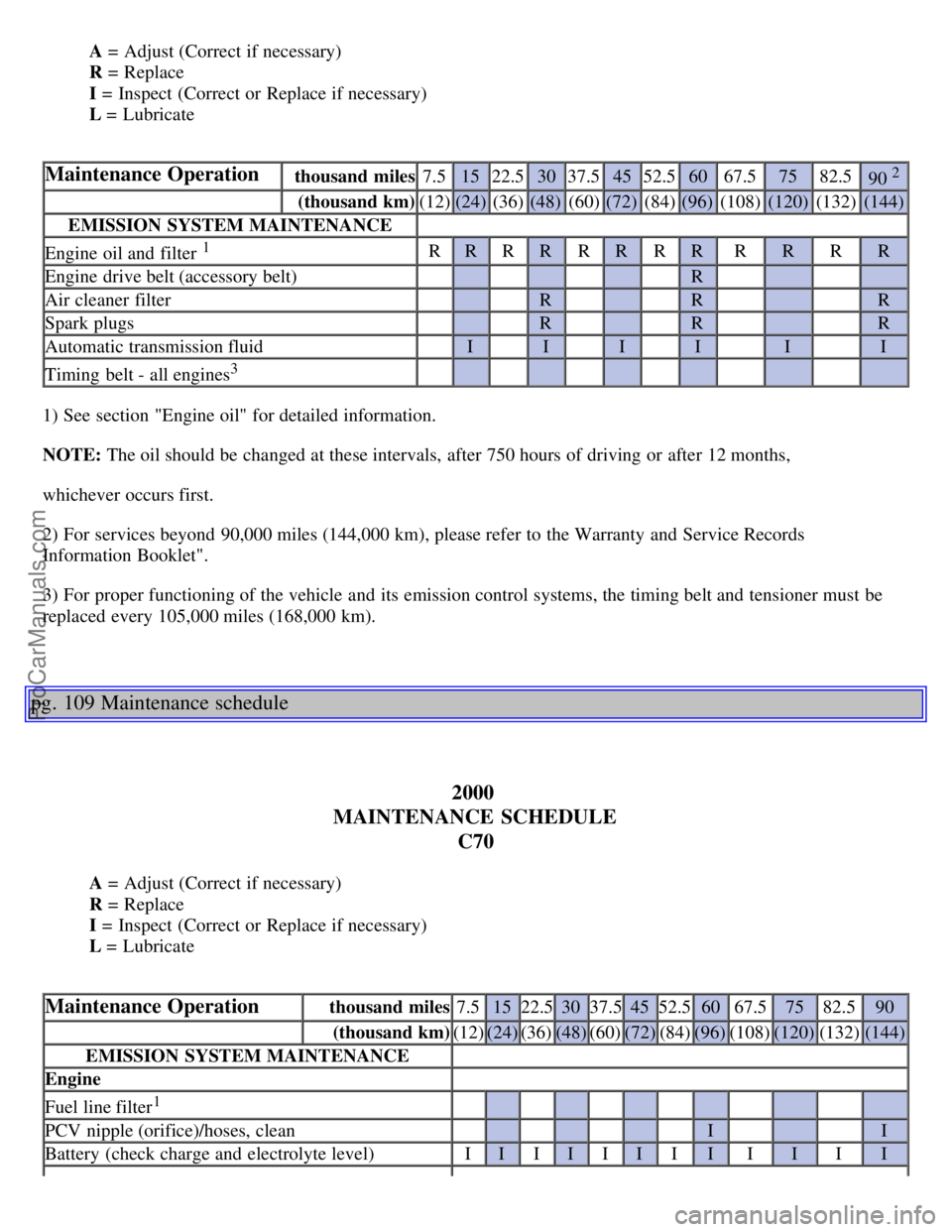
Maintenance Operationthousand miles 7.51522.5 3037.5 4552.5 6067.5 7582.5
90 2
(thousand km)(12)(24) (36)(48) (60)(72) (84)(96) (108) (120)(132)(144)
EMISSION SYSTEM MAINTENANCE
Engine oil and filter
1R R RR RR RR R RRR
Engine drive belt (accessory belt) R
Air cleaner filter R R R
Spark plugs R R R
Automatic transmission fluid I I I I I I
Timing belt - all engines
3
1) See section "Engine oil" for detailed information.
NOTE: The oil should be changed at these intervals, after 750 hours of driving or after 12 months,
whichever occurs first.
2) For services beyond 90,000 miles (144,000 km), please refer to the Warranty and Service Records
Information Booklet".
3) For proper functioning of the vehicle and its emission control systems, the timing belt and tensioner must be
replaced every 105,000 miles (168,000 km).
pg. 109 Maintenance schedule
2000
MAINTENANCE SCHEDULE C70
A = Adjust (Correct if necessary)
R = Replace
I = Inspect (Correct or Replace if necessary)
L = Lubricate
Maintenance Operationthousand miles 7.51522.5 3037.5 4552.5 6067.5 7582.5 90
(thousand km)(12)(24)(36) (48)(60) (72)(84)(96)(108) (120) (132)(144)
EMISSION SYSTEM MAINTENANCE
Engine
Fuel line filter
1
PCV nipple (orifice)/hoses, clean I I
Battery (check charge and electrolyte level) II II II I I I II I
ProCarManuals.com
Page 61 of 89

2 0 0 0
VOLVO C70
Chapter 9 - Specifications
pg. 121 Specifications
Specifications
This chapter contains facts and figures pertaining to the technical specifications of your car. Oil/fluids specifications
122
Engine specifications123
Cooling/fuel/distributor ignition systems124
Front/rear suspensions124
Transmission, Capacities, Vehicle loading125
Electrical system/bulbs126
Dimensions and weights127
Service manuals, Road assistance128
pg. 122 Oil/fluid specifications
Oil quality
Meeting API specification SJ, SJ/CF, or SJ/Energy Conserving
For best fuel economy and engine protection, consult with your authorized Volvo retailer for recommended oils. Oil
with a different quality rating may not provide adequate engine protection.
Synthetic oils complying with oil quality requirements are recommended for: driving in areas of sustained temperature
extremes (hot or cold), when towing a trailer over long distances or for prolonged driving in mountainous areas.
Extra oil additives must not be used unless advised by an authorized Volvo retailer.
Viscosity (stable ambient temperatures):
ProCarManuals.com
Page 62 of 89

Engine oilQuality:
Meeting API specification SJ, SJ/CF,
or SJ/Energy Conserving Capacity (incl. filter)
: 6.1 US
qts. (5.8 liters)*
Automatic transmission fluid Quality: AW4: ATF Dexron III and Mercon. Capacity:
8 US qts. (7.6
liters)
Manual transmission fluid AW5: Only Volvo gearbox oil (1161540-8). Do
not mix with other oils. Capacity:
8 US qts. (7.5
liters)
Power steering fluid Quality: Volvo synthetic gearbox oil 1161423 Capacity:
2.2 US qts. (2.1
liters)
Brake fluid Quality: ATF Capacity:
0.95 US qts. (0.9
liters)
All specifications are subject to
change without notice. Quality: DOT 4+ Capacity:
0.64 US qts. (0.6
liters)
* Add 0.95 qts. (0.9 liters) if the oil cooler has been drained
pg. 123 Engine specifications
Engine
Liquid-cooled gasoline, 5cylinder, inline engine. Aluminum alloy cylinder block with castiron cylinder liners cast
directly into the block. Aluminum alloy cylinder head with double overhead camshafts and separate intake and outlet
channels.
Engine lubrication is provided by an eccentric pump driven from the crankshaft. Fullflow type oil filter. Exhaust
emission control is accomplished by multiport fuel injection, heated oxygen sensor(s) and threeway catalytic converter. Designation: Volvo B 5234 T3 Designation:Volvo B 5244 T
Output 236 hp at 5400 rpm (176 kW/90 rps) Output190 hp at 5100 rpm (142 kW/85 rps)
Max. torque 243 ft. lbs. at 24005100 rpm (330
Nm/4592 rps) Max. torque199 ft. lbs. at 1600-5000 rpm (270
Nm/27-83 rps)
Number of
cylinders 5 Number of
cylinders5
Bore 3.19" (81 mm) Bore3.27" (83 mm)
Stroke 3.54" (90 mm) Stroke3.54" (90 mm)
Displacement 2.3 liters Displacement2.4 liters
Compression
ratio 8.5:1 Compression
ratio9.0:1
Number of
valves 20 Number of
valves20
ProCarManuals.com