lock VOLVO C70 2000 Owner's Manual
[x] Cancel search | Manufacturer: VOLVO, Model Year: 2000, Model line: C70, Model: VOLVO C70 2000Pages: 89, PDF Size: 2.13 MB
Page 46 of 89

Side direction indicator
1. Slide the lens forward and pull out the rear edge.
2. Pull out the entire lens/bulb unit.
3. With the lens toward you, turn the bulb holder 1/4 turn (the wires should not be disconnected from the holder) and
pull out the bulb holder from the lens unit.
4. Pull the old bulb straight out and press a new one into place.
5. Replace the entire unit in the reverse order.
pg. 86 Replacing bulbs
Low beam headlight bulb (A) replacement
1. Turn the plastic cover counterclocKWise and remove it.
2. Press the wire catches on the retaining clamp (1 in inset illustration above) together and push out (2) to release the
bulb and connector from the headlight housing.
3. Pull the bulb out of the connector.
4. Insert a new bulb into the connector.
ProCarManuals.com
Page 50 of 89

Washing the car
· The car should be washed at regular intervals since dirt, dust, insects and tar spots adhere to the paint and may cause
damage.
NOTE: It is particularly important to wash the car frequently in the wintertime to prevent corrosion, when salt has
been used on the roads.
· When washing the car, do not expose it to direct sunlight. Use lukewarm water to soften the dirt before you wash
with a sponge, and plenty of water, to avoid scratching.
· Bird droppings: Remove from paintwork as soon as possible. Otherwise the finish may be permanently damaged.
· A detergent can be used to facilitate the softening of dirt and oil.
· A water-soluble grease solvent may be used in cases of sticky dirt. However, use a wash place equipped with a
drainage separator.
· Dry the car with a clean chamois and remember to clean the drain holes in the doors and rocker panels *.
· The power radio antenna must be dried after washing.
· Tar spots can be removed with kerosene or tar remover after the car has been washed.
· A stiff-bristle brush and lukewarm soapy water can be used to clean the wiper blades. Frequent cleaning improves
visibility considerably.
· Wash off the dirt from the underside (wheel housings, fenders, etc.).
· In areas of high industrial fallout, more frequent washing is recommended.
CAUTION: During high pressure washing, the spray mouthpiece must never be closer to the vehicle than 13" (30
cm). Do not spray into the locks.
· When washing or steam cleaning the engine, avoid spraying water or steam directly on the electrical components or
toward the rear side of the engine.
· After cleaning the engine, the spark plug wells should be inspected for water and blown dry if necessary.
Suitable detergents
Special car washing detergents should be used. A suitable mixture is about 2.5 fl. oz. (8.5 cl) of detergent to 2.6 US
gal. (10 liters) of warm water. After washing with a detergent the car should be well rinsed with clean water.
WARNING!
· When the car is driven immediately after being washed, apply the brakes several times in order to remove any
moisture from the brake linings.
· Engine cleaning agents should not be used when the engine is warm. This constitutes a fire risk.
ProCarManuals.com
Page 60 of 89

· If the fuel filler cap is not closed tightly or if the engine is running when the car is refueled, the Malfunction Indicator
Lamp may indicate a fault.
· During a transitional period, a small number of service stations may still have fuel nozzles that are not compatible
with the fuel filler neck on cars equipped with the evaporative control system (ORVR) mandated by the U.S.
Environmental Protection Agency and the California Air Resources Board. If you experience difficulties in refueling
your vehicle, please ask the gas station attendant for assistance.
CAUTION:
Fuel must not be siphoned from the fuel tank. This will damage the Evaporative control system.
pg. 113 Lubrication
No.Lubrication point lubricant
1 Hood lock and latch Oil
2 Door stop and hinges Oil
3 Sun roof wind deflector (visible when sun roof is open) Oil, low temperature grease
4 Door lock catch plate Oil
5 Power antenna WD 40 or similar
6 Locks Volvo teflon lock spray
7 Trunk lock catch plate Low temperature grease
8 Front seat side rail and latch Oil
To avoid rattles and unnecessary wear, the body should be lubricated at regular service intervals. This should be done
by an authorized Volvo retailer.
Contents | Top of Page
ProCarManuals.com
Page 62 of 89

Engine oilQuality:
Meeting API specification SJ, SJ/CF,
or SJ/Energy Conserving Capacity (incl. filter)
: 6.1 US
qts. (5.8 liters)*
Automatic transmission fluid Quality: AW4: ATF Dexron III and Mercon. Capacity:
8 US qts. (7.6
liters)
Manual transmission fluid AW5: Only Volvo gearbox oil (1161540-8). Do
not mix with other oils. Capacity:
8 US qts. (7.5
liters)
Power steering fluid Quality: Volvo synthetic gearbox oil 1161423 Capacity:
2.2 US qts. (2.1
liters)
Brake fluid Quality: ATF Capacity:
0.95 US qts. (0.9
liters)
All specifications are subject to
change without notice. Quality: DOT 4+ Capacity:
0.64 US qts. (0.6
liters)
* Add 0.95 qts. (0.9 liters) if the oil cooler has been drained
pg. 123 Engine specifications
Engine
Liquid-cooled gasoline, 5cylinder, inline engine. Aluminum alloy cylinder block with castiron cylinder liners cast
directly into the block. Aluminum alloy cylinder head with double overhead camshafts and separate intake and outlet
channels.
Engine lubrication is provided by an eccentric pump driven from the crankshaft. Fullflow type oil filter. Exhaust
emission control is accomplished by multiport fuel injection, heated oxygen sensor(s) and threeway catalytic converter. Designation: Volvo B 5234 T3 Designation:Volvo B 5244 T
Output 236 hp at 5400 rpm (176 kW/90 rps) Output190 hp at 5100 rpm (142 kW/85 rps)
Max. torque 243 ft. lbs. at 24005100 rpm (330
Nm/4592 rps) Max. torque199 ft. lbs. at 1600-5000 rpm (270
Nm/27-83 rps)
Number of
cylinders 5 Number of
cylinders5
Bore 3.19" (81 mm) Bore3.27" (83 mm)
Stroke 3.54" (90 mm) Stroke3.54" (90 mm)
Displacement 2.3 liters Displacement2.4 liters
Compression
ratio 8.5:1 Compression
ratio9.0:1
Number of
valves 20 Number of
valves20
ProCarManuals.com
Page 64 of 89
Spring strut suspension with integrated shock absorbers and control arms linked to the support frame. Powerassisted
rack and pinion steering. Safety type steering column.
The alignment specifications apply to an unladen car but include fuel, coolant and spare wheel.
Toe-in measured on the wheel rims: 2.4 mm +/ 0.7 mm
Toe-in measured on tire sides: 2.9 +/ 0.9 mm
Rear suspension
Deltalink individual rear wheel suspension with longitudinal support arms, double link arms and track rods.
Toe-in measured on the tire sides: 4° +/ 10°
All specifications are subject to change without notice.
pg. 125 Specifications
Power transmission
Manual transmission: M 56 H
Singledisc dry plate clutch. Allsynchromesh on all gears including reverse; integrated final drive. Operation via a floor
mounted gear lever.Final drive ratio 4.00:1
Reduction ratios
1st gear 3.07:1
2nd gear 1.77:1
3rd gear 1.19:1
4th gear 0.87:1
5th gear 0.70:1
Reverse 2.99:1
Automatic transmission: AW 5050 LE and AW 50-42 LE
4 or 5speed automatic electronically controlled gearbox comprising a hydraulic torque converter with a lockup
function; planetary gear, integrated final drive.
Operation via a floor mounted gear selector lever. Drive shafts with symmetrical joint location. Overdrive. Final drive ratio 2.76:1 (Turbocharged models: 2.56:1)
Reduction ratios AW5 AW4
1st gear 4.77:1 3.61:1
2nd gear 2.10:1 2.06:1
3rd gear 1.96:1 1.37:1
4th gear 1.32:1 0.98:1
ProCarManuals.com
Page 72 of 89

Incorrect code
If an incorrect code has been entered "rPt" is displayed. Enter the correct code.
After three unsuccessful coding attempts the set will lock and remain locked for two hours. "OFF" is displayed.
During this waiting period:
· the battery must be connected
· the ignition key must be turned to position I
· the unit must be turned on
Make sure the headlights are turned off to help prevent battery drain (please refer to page 24 for information on turning
the headlights off).
Enter the code again once this time has elapsed.
pg. 132 Radio SC -813
A - On/off switch
Push the button to switch on the radio. Press the button slightly longer to turn the radio off.
B - Volume control
Turn the button clockwise to increase the volume. The volume control is electronic and has no end stop.
C - Waveband selector
The desired waveband is set by pressing one of the waveband selector buttons. The frequency and waveband is shown
on the display.
NOTE: There are two FM wavebands and one AM waveband. This makes it possible to store 2 x 6 FM stations and 6
AM stations in memory.
ProCarManuals.com
Page 75 of 89
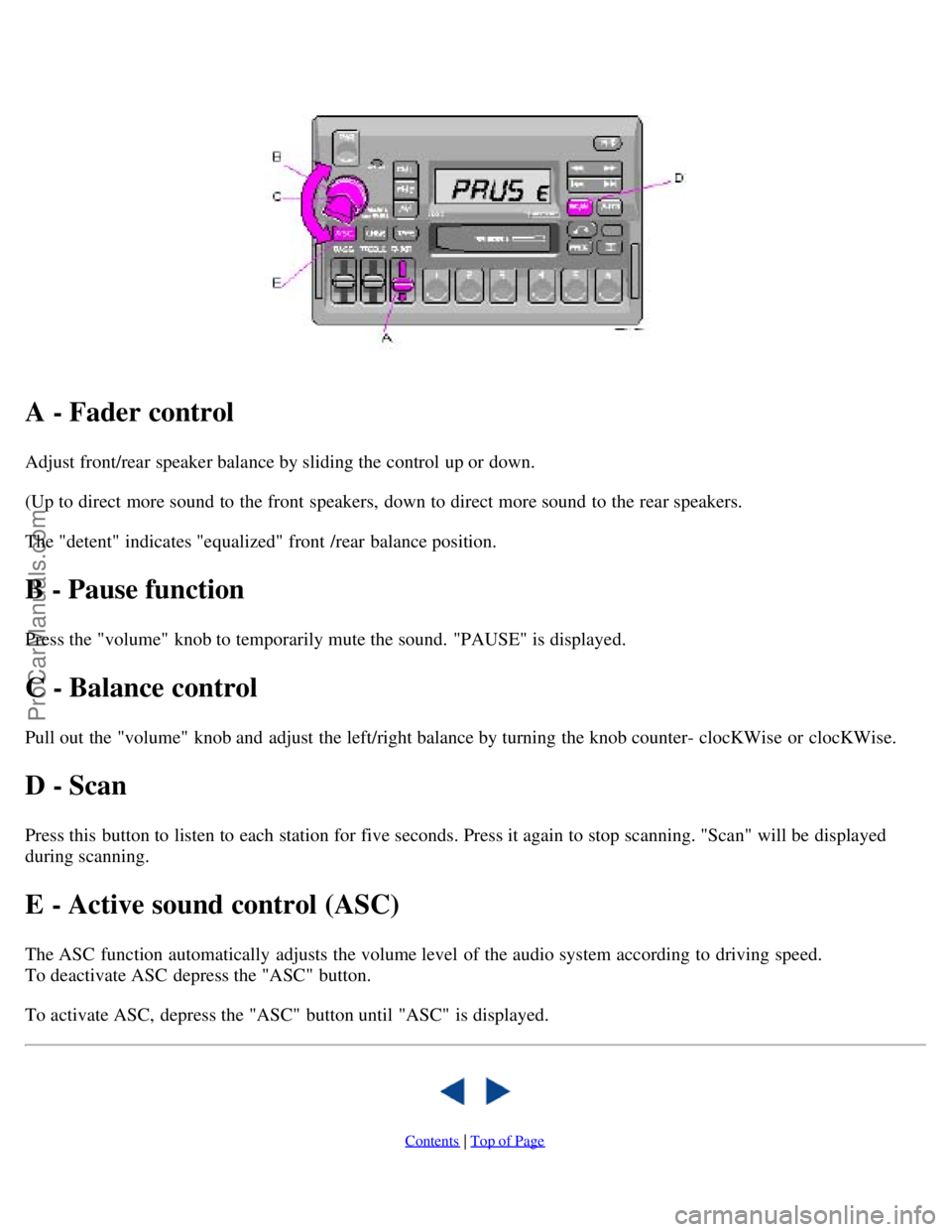
A - Fader control
Adjust front/rear speaker balance by sliding the control up or down.
(Up to direct more sound to the front speakers, down to direct more sound to the rear speakers.
The "detent" indicates "equalized" front /rear balance position.
B - Pause function
Press the "volume" knob to temporarily mute the sound. "PAUSE" is displayed.
C - Balance control
Pull out the "volume" knob and adjust the left/right balance by turning the knob counter- clocKWise or clocKWise.
D - Scan
Press this button to listen to each station for five seconds. Press it again to stop scanning. "Scan" will be displayed
during scanning.
E - Active sound control (ASC)
The ASC function automatically adjusts the volume level of the audio system according to driving speed.
To deactivate ASC depress the "ASC" button.
To activate ASC, depress the "ASC" button until "ASC" is displayed.
Contents | Top of Page
ProCarManuals.com
Page 76 of 89

2 0 0 0
VOLVO C70
HomeLink® Universal Transceiver (option)
pg. 186 HomeLink® Universal Transceiver (option)
HomeLink® Universal Transceiver
This transceiver allows you to replace 3 hand -held transmitters with a single built-in device which can be installed in
your car on a sun visor or overhead console. This feature "learns" the radio frequency codes of most current
transmitters to operate garage doors, driveway gates, security lighting and home security systems. This transceiver is
powered by your car's electrical system.
NOTE: As a security precaution, the HomeLink® Universal Transceiver is designed to not function if the car has
been locked from the outside .
Programming the transceiver
1. Begin by erasing all 3 factory default channels by holding down the two outside buttons (buttons 1 and 3 in the
illustration above) on the HomeLink® Universal Transceiver until the indicator light on the transceiver begins to flash,
after approximately 20 seconds.
Release the buttons.
2. Hold the end of your hand -held transmitter 2 to 5 in. (5 to 12 cm) away from the HomeLink® surface, keeping the
indicator light in view. For placement questions, please contact HomeLink® at
1-800-355-3515 (Internet: www.HomeLink.jci.com).
3. Using both hands, simultaneously push the hand -held transmitter button and the HomeLink® button to be
programmed. Do not release the buttons until this step has been completed.
The HomeLink® indicator light will begin to flash, first slowly, then rapidly. When the indicator light flashes rapidly
ProCarManuals.com
Page 80 of 89

2 0 0 0
VOLVO C70
INDEX
pg. 189 - 191 Index
A
ABS 17
Adjusting headlights86
Air conditioning35
Air mix33
Air vents33
Airbag (SIPS)8
Airbag (SRS)4
Alarm44
Ambient temperature sensor25
Anti-lock Brake System (ABS)17,19,71
Ashtrays31
Audio systems
- General information182
- SC813130
- SC816143
- SC-900/901159
Auto-dim (rear -view mirror)48
Automatic car washing103
Automatic daytime running24
Automatic transmission61,62,63,64, 125
Kickdown62,64
Automatic transmission fluid122
B
Battery74
,126
Battery drain - avoiding54
Battery maintenance120
Booster cushion12
Brake failure warning light17,18
Brake fluid116,122
Brake fluid warning light18
Brake system71,72
ProCarManuals.com
Page 81 of 89

Brake warning light17
Bulb failure warning17,19
Bulbs126
C
Capacities125
Central locking button36
Chains (snow)77
Changing a wheel82
Child booster cushion12
Child Restraint Anchorages10
Child safety12
Clock16
Clock - resetting25
Clutch fluid116
Clutch interlock60
Coolant - checking/changing118
Coolant level sensor19
Coolant level warning light17
Cooling system66,124
Courtesy lights - exterior20
Courtesy lights - front49
Cruise control29
D
Daytime running lights24
Demister - rear window23
Dimensions127
Distributor ignition system124
Diversity antenna185
Doors and locks42
Driving economy58
Driving mode W62,64
E
EBD (Electronic Brake-force Distribution)72
ECC - Electronic Climate Control34,35
Electrical system66,126
Electrically heated front seats30
Electrically operated front seats46,47
Electrically operated sun roof41
Electrically-operated windows36
Electronic Brake Distribution (EBD)72
Electronic Brake-force Distribution (EBD)72
Emergency towing68
Emergency warning flashers23
Engine123
ProCarManuals.com