transmission oil VOLVO C70 2000 Owners Manual
[x] Cancel search | Manufacturer: VOLVO, Model Year: 2000, Model line: C70, Model: VOLVO C70 2000Pages: 89, PDF Size: 2.13 MB
Page 18 of 89

16 Parking brake applied
17 ABS -system
18 Transmission mode: Indicates "W" if winter/wet driving mode is active, or indicates currently selected low gear.
19 Low coolant level
20 Stability and Traction Control (STC) System (option)
21 Malfunction indicator lamp
(See page 18 for more information)
22 Service reminder indicator
pg. 18 Warning lights
The warning lights described on pages 18 and 19 should never stay on when driving
When the ignition key is turned on and before the engine starts, all of the warning lights should go on to test the
function of the bulbs. Should a light not go off after the engine has started, the system indicated should be inspected.
However, the parking brake reminder light will not go off until the parking brake has been fully released.
Generator warning light
If the light comes on while the engine is running, have the charging system checked.
Malfunction indicator lamp
If the lamp comes on (or stays on after the vehicle has started), the engine diagnostic system has detected a possible
fault in the emission control system. Although driveability may not be affected, see an authorized Volvo retailer as
soon as possible for inspection.
NOTE : If the fuel filler cap is not closed tightly or if the engine is running when the car is refueled, the Malfunction
Indicator Lamp may indicate a fault. However, your vehicle's performance will not be affected. Use only Volvo
original or approved fuel filler caps.
Oil pressure warning light
If the light comes on while driving, stop the car and then stop the engine immediately and check the engine oil
level . See page 114. If the light stays on after restart, have the car towed to the nearest authorized Volvo retailer. After
hard driving, the light may come on occasionally when the engine is idling. This is normal, provided it goes off when
the engine speed is increased.
Fault in ETC (Electronic Throttle Control system)
If this lamp comes on, there is a fault in the engine control system and driveability will be affected. Switch the ignition
off and then on again. If the light remains on, the system should be inspected by an authorized Volvo retailer.
Cruise Control
This light will be on when cruise control is engaged. Cruise control will automatically disengage when the ignition is
switched off.
ProCarManuals.com
Page 26 of 89

2 0 0 0
VOLVO C70
Chapter 4 - Starting and driving
pg. 55 Starting and driving
This section on starting and driving contains items such as starting the engine, operating the gear selector, towing,
trailers, etc. Fuel requirements, Refueling
56-57
Driving economy58
Starting the engine59
Manual transmission60
Automatic transmission61
Points to remember65
Emergency towing68
Vehicle towing information69
Jump starting70
Brake system71-72
Trailer towing73
Winter driving74
pg. 56 Fuel requirements
NOTE ENGINE OIL:
Although some oil consumption occurs during normal engine operation, more oil is consumed when the engine is new
as the internal parts generate higher friction while wearingin to each other. From the time the engine is new until the
first service is performed, the oil consumption could be higher than normal. For this reason, it is especially
important to check the oil every time you refuel your car during this period. See page 114.
In general, the rate of oil consumption depends on such factors as: engine temperature, length of trip, driving
conditions, oil viscosity and quality, engine speed and acceleration/deceleration.
ProCarManuals.com
Page 29 of 89

Better driving economy may be obtained by thinking ahead, avoiding rapid starts and stops and adjusting the speed of
your vehicle to immediate traffic conditions. Observe the following rules:
· Bring the engine to normal operating temperature as soon as possible by driving with a light foot on the accelerator
pedal for the first few minutes of operation. A cold engine uses more fuel and is subject to increased wear.
· Whenever possible, avoid using the car for driving short distances. This does not allow the engine to reach normal
operating temperature.
· Drive carefully and avoid rapid acceleration and hard braking.
· Do not exceed speed limit.
· Avoid carrying unnecessary items (extra load) in the car.
· Maintain correct tire pressure. Check tire pressure regularly (check when tires are cold).
· Remove snow tires when threat of snow or ice has ended.
· Note that roof racks, ski racks, etc., increase air resistance and thereby fuel consumption.
· Avoid using automatic transmission kickdown feature unless necessary.
· Avoid using the air conditioning when it is not required. When engaged, the air conditioner's compressor places an
additional load on the engine. However, please note that fuel consumption is lower with the air conditioning on than it
is when driving with the air conditioning switched off and the windows down.
· If your car is equipped with the optional Trip Computer, utilizing the fuel consumption modes can help you "learn"
how to drive more economically.
Other factors which decrease gas mileage are:
· Worn or dirty spark plugs
· Incorrect spark plug gap
· Dirty air cleaner
· Dirty engine oil and clogged oil filter
· Dragging brakes
· Incorrect front end alignment
Some of the above mentioned items and others are checked at the standard Maintenance Service intervals.
NOTE: (D)rive or 5th gear (manual transmissions) should be used as often as possible to help improve fuel economy.
pg. 59 Starting the engine
Starting and stopping
ProCarManuals.com
Page 30 of 89

1. Fasten the seat belt.
WARNING!
Before starting, check that the seat, steering wheel and mirrors are adjusted properly. Make sure the brake pedal can
be depressed completely. Move the seat closer if necessary. Refer to section "front seats".
2. Apply the parking brake, if not already set. The gear selector (automatic transmission) is locked in the (P)ark
position (SHIFT LOCK).
Manual transmission: the clutch must be fully depressed.
3. Without touching the accelerator pedal, turn the ignition key to the starting position*. Allow the starter to operate
for up to 10 seconds. Release the key as soon as the engine starts. If the engine fails to start, repeat step 3.
For cold starts at altitudes above 6000 ft (1800 meters), depress the accelerator pedal halfway and turn the key to the
starting position. Release the pedal slowly when the engine starts.
* If the key is left in the Drive position (position II) for more than 30 seconds, it must be turned to position 0 and then
turned to the Start position (position III) again in order to start the car. See page 21
for ignition key positions.
4. To release the gear selector from the (P)ark position (automatic transmission), the ignition key must be in position II
and the brake pedal must be depressed. See page 97 for instructions on manually releasing the SHIFTLOCK
system.
Do not race a cold engine immediately after starting. Oil flow may not reach some lubrication points fast enough to
prevent engine damage.
NOTE: (Automatic transmission only)
Your car is equipped with a KEYLOCK system. When the engine is switched off, the gear selector must be in the
( P )ark position before the starting key can be removed from the ignition switch.
5. Select the desired gear. The gear engages after a slight delay (automatic transmission) which is especially noticeable
when selecting R.
CAUTION : (Automatic transmission only)
The engine should be idling; never accelerate until after you feel the gear engage! Toorapid acceleration immediately
after selecting a gear will cause harsh engagement and premature transmission wear.
NOTE : Selecting P or N (automatic transmission) when idling at a standstill for prolonged periods of time will help
prevent overheating of transmission oil.
WARNING!
Always place the gear selector (automatic transmission) in Park and apply the parking brake before leaving the
vehicle. Never leave the car unattended with the engine running.
Always open the garage doors fully before starting the engine inside a garage to ensure adequate ventilation. The
exhaust gases contain carbon monoxide, which is invisible and odorless but very poisonous.
ProCarManuals.com
Page 31 of 89
CAUTION:
Never race the engine immediately after starting. Oil flow may not reach some lubricating points fast enough to
prevent engine damage.
Do not race the engine just prior to switching off!
Hydraulic valve lifters
This engine features hydraulic valve lifters which means that valve clearance is adjusted automatically. It is possible
that the valve lifters will produce a ticking sound for the first few seconds after the engine is started, while the oil
pressure is increasing.
If the car has not been used for a long period of time, this ticking sound may last for up to 15 minutes. This is entirely
normal.
Do not exceed 3000 rpm until the ticking sound disappears.
pg. 60 Manual transmission
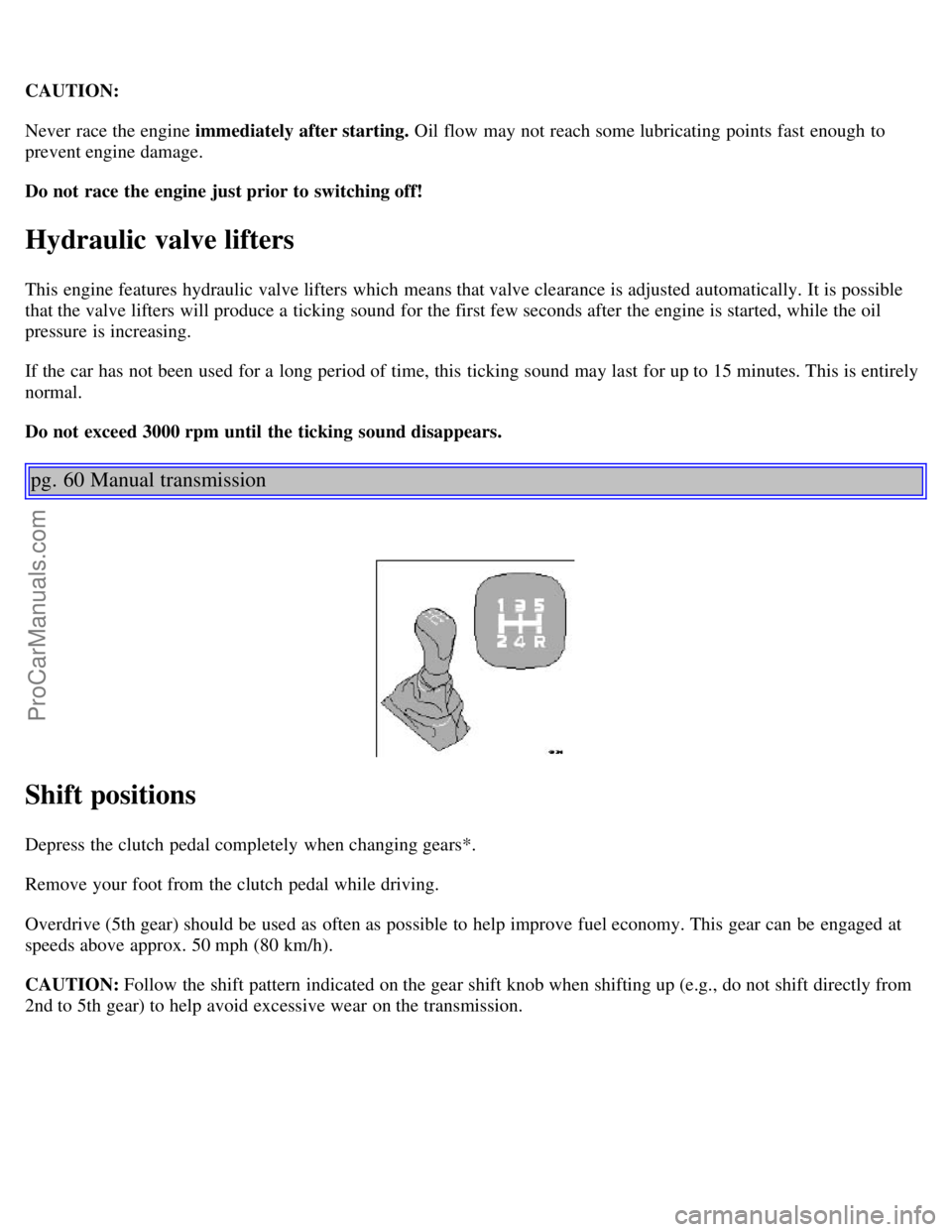
Shift positions
Depress the clutch pedal completely when changing gears*.
Remove your foot from the clutch pedal while driving.
Overdrive (5th gear) should be used as often as possible to help improve fuel economy. This gear can be engaged at
speeds above approx. 50 mph (80 km/h).
CAUTION: Follow the shift pattern indicated on the gear shift knob when shifting up (e.g., do not shift directly from
2nd to 5th gear) to help avoid excessive wear on the transmission.
ProCarManuals.com
Page 56 of 89
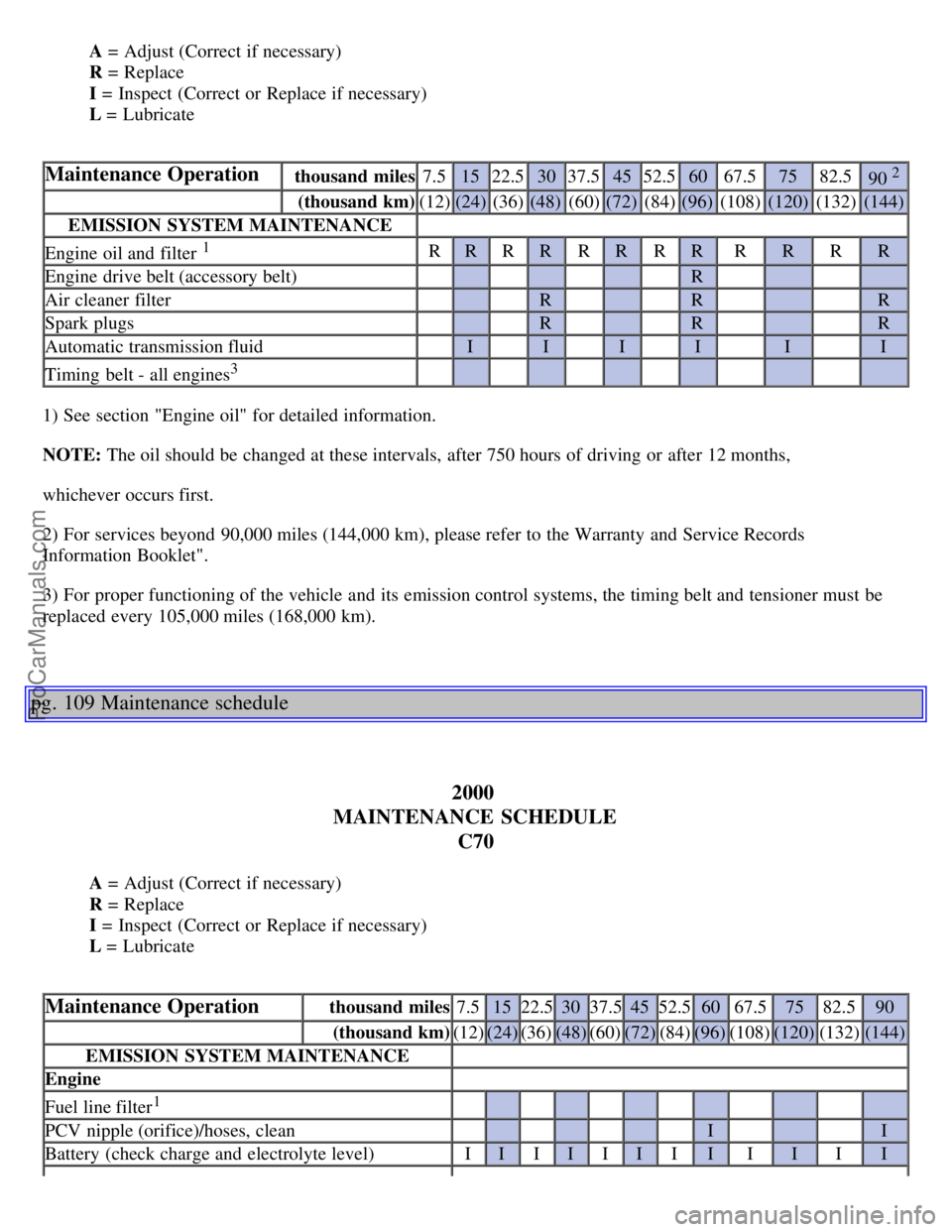
A = Adjust (Correct if necessary)
R = Replace
I = Inspect (Correct or Replace if necessary)
L = Lubricate
Maintenance Operationthousand miles 7.51522.5 3037.5 4552.5 6067.5 7582.5
90 2
(thousand km)(12)(24) (36)(48) (60)(72) (84)(96) (108) (120)(132)(144)
EMISSION SYSTEM MAINTENANCE
Engine oil and filter
1R R RR RR RR R RRR
Engine drive belt (accessory belt) R
Air cleaner filter R R R
Spark plugs R R R
Automatic transmission fluid I I I I I I
Timing belt - all engines
3
1) See section "Engine oil" for detailed information.
NOTE: The oil should be changed at these intervals, after 750 hours of driving or after 12 months,
whichever occurs first.
2) For services beyond 90,000 miles (144,000 km), please refer to the Warranty and Service Records
Information Booklet".
3) For proper functioning of the vehicle and its emission control systems, the timing belt and tensioner must be
replaced every 105,000 miles (168,000 km).
pg. 109 Maintenance schedule
2000
MAINTENANCE SCHEDULE C70
A = Adjust (Correct if necessary)
R = Replace
I = Inspect (Correct or Replace if necessary)
L = Lubricate
Maintenance Operationthousand miles 7.51522.5 3037.5 4552.5 6067.5 7582.5 90
(thousand km)(12)(24)(36) (48)(60) (72)(84)(96)(108) (120) (132)(144)
EMISSION SYSTEM MAINTENANCE
Engine
Fuel line filter
1
PCV nipple (orifice)/hoses, clean I I
Battery (check charge and electrolyte level) II II II I I I II I
ProCarManuals.com
Page 61 of 89

2 0 0 0
VOLVO C70
Chapter 9 - Specifications
pg. 121 Specifications
Specifications
This chapter contains facts and figures pertaining to the technical specifications of your car. Oil/fluids specifications
122
Engine specifications123
Cooling/fuel/distributor ignition systems124
Front/rear suspensions124
Transmission, Capacities, Vehicle loading125
Electrical system/bulbs126
Dimensions and weights127
Service manuals, Road assistance128
pg. 122 Oil/fluid specifications
Oil quality
Meeting API specification SJ, SJ/CF, or SJ/Energy Conserving
For best fuel economy and engine protection, consult with your authorized Volvo retailer for recommended oils. Oil
with a different quality rating may not provide adequate engine protection.
Synthetic oils complying with oil quality requirements are recommended for: driving in areas of sustained temperature
extremes (hot or cold), when towing a trailer over long distances or for prolonged driving in mountainous areas.
Extra oil additives must not be used unless advised by an authorized Volvo retailer.
Viscosity (stable ambient temperatures):
ProCarManuals.com
Page 62 of 89

Engine oilQuality:
Meeting API specification SJ, SJ/CF,
or SJ/Energy Conserving Capacity (incl. filter)
: 6.1 US
qts. (5.8 liters)*
Automatic transmission fluid Quality: AW4: ATF Dexron III and Mercon. Capacity:
8 US qts. (7.6
liters)
Manual transmission fluid AW5: Only Volvo gearbox oil (1161540-8). Do
not mix with other oils. Capacity:
8 US qts. (7.5
liters)
Power steering fluid Quality: Volvo synthetic gearbox oil 1161423 Capacity:
2.2 US qts. (2.1
liters)
Brake fluid Quality: ATF Capacity:
0.95 US qts. (0.9
liters)
All specifications are subject to
change without notice. Quality: DOT 4+ Capacity:
0.64 US qts. (0.6
liters)
* Add 0.95 qts. (0.9 liters) if the oil cooler has been drained
pg. 123 Engine specifications
Engine
Liquid-cooled gasoline, 5cylinder, inline engine. Aluminum alloy cylinder block with castiron cylinder liners cast
directly into the block. Aluminum alloy cylinder head with double overhead camshafts and separate intake and outlet
channels.
Engine lubrication is provided by an eccentric pump driven from the crankshaft. Fullflow type oil filter. Exhaust
emission control is accomplished by multiport fuel injection, heated oxygen sensor(s) and threeway catalytic converter. Designation: Volvo B 5234 T3 Designation:Volvo B 5244 T
Output 236 hp at 5400 rpm (176 kW/90 rps) Output190 hp at 5100 rpm (142 kW/85 rps)
Max. torque 243 ft. lbs. at 24005100 rpm (330
Nm/4592 rps) Max. torque199 ft. lbs. at 1600-5000 rpm (270
Nm/27-83 rps)
Number of
cylinders 5 Number of
cylinders5
Bore 3.19" (81 mm) Bore3.27" (83 mm)
Stroke 3.54" (90 mm) Stroke3.54" (90 mm)
Displacement 2.3 liters Displacement2.4 liters
Compression
ratio 8.5:1 Compression
ratio9.0:1
Number of
valves 20 Number of
valves20
ProCarManuals.com
Page 65 of 89

5th gear1.02:1
Reverse3.23:1 3.95:1
Capacities
Fuel tank17.9 US gal. (68 liters)
Cooling system 7.4 US qts. (7.0 liters)
Engine oil (incl. filter) 6.1 US qts. ( 5.8 liters) *
Automatic transmission 2 US gals (7.6 liters)
Manual transmission 2.2 US qts. (2.1 liters)
Power steering fluid 0.8 US qts (0.8 liters)
Washer fluid reservoir 4.7 US qts. (4.5 liters)
Brake/clutch system 0.6 US qts (0.6 liters)
* Add 0.95 US qt. (0.9 liters) if the oil cooler has been drained.
Vehicle loading
The tires on your Volvo should perform to specifications at all normal loads when inflated as recommended on the tire
information label. The label is located on the inside of the fuel filler flap. The label lists both tire and vehicle design
limits. Do not load your car beyond the load limits indicated.
WARNING!
Improperly inflated tires will reduce tire life, adversely affect vehicle handling and can possibly lead to failure
resulting in loss of vehicle control without prior warning.
All specifications are subject to change without notice.
pg. 126 Specifications
Electrical system
12 Volt, negative ground.
Voltagecontrolled generator. Singlewire system with chassis and engine used as conductors.
Battery
Voltage 12 Volt
Capacity 520 A/100 min
(certain markets) 420 A/75 min
The battery contains corrosive and poisonous acids. It is of the utmost importance that old batteries are disposed of
correctly. Your Volvo retailer can assist you in this matter.
ProCarManuals.com
Page 83 of 89

Immobilizer (start inhibitor)42
Instrument illumination22
Instruments14,15
J
Jack53
,82,83
Jump starting70
K
Keyless entry system43
Keylock59
Keys42
Kick -down61,63
Kickdown62,64
L
Label information106
Lifting the car110
Locks42
Long load storage50
Lubrication113
Lumbar support46
M
Maintenance schedule108
Maintenance service107
Malfunction indicator lamp17,18
Manual transmission60,125
Manual transmission fluid122
Memory function - front seats46
Mirrors - rear/side view48
O
Occupant safety13
Octane rating57
Odometer16
Oil (engine)114,115,122
Oil pressure warning light18
On-call128
P
Paint touchup100
Parking brake17,30
Parking brake reminder light18
Parking lights20
Polishing103
Power seats46,47
Power steering fluid116,122
R
Radio
ProCarManuals.com