roof VOLVO C70 2001 Owners Manual
[x] Cancel search | Manufacturer: VOLVO, Model Year: 2001, Model line: C70, Model: VOLVO C70 2001Pages: 88, PDF Size: 2.07 MB
Page 15 of 88
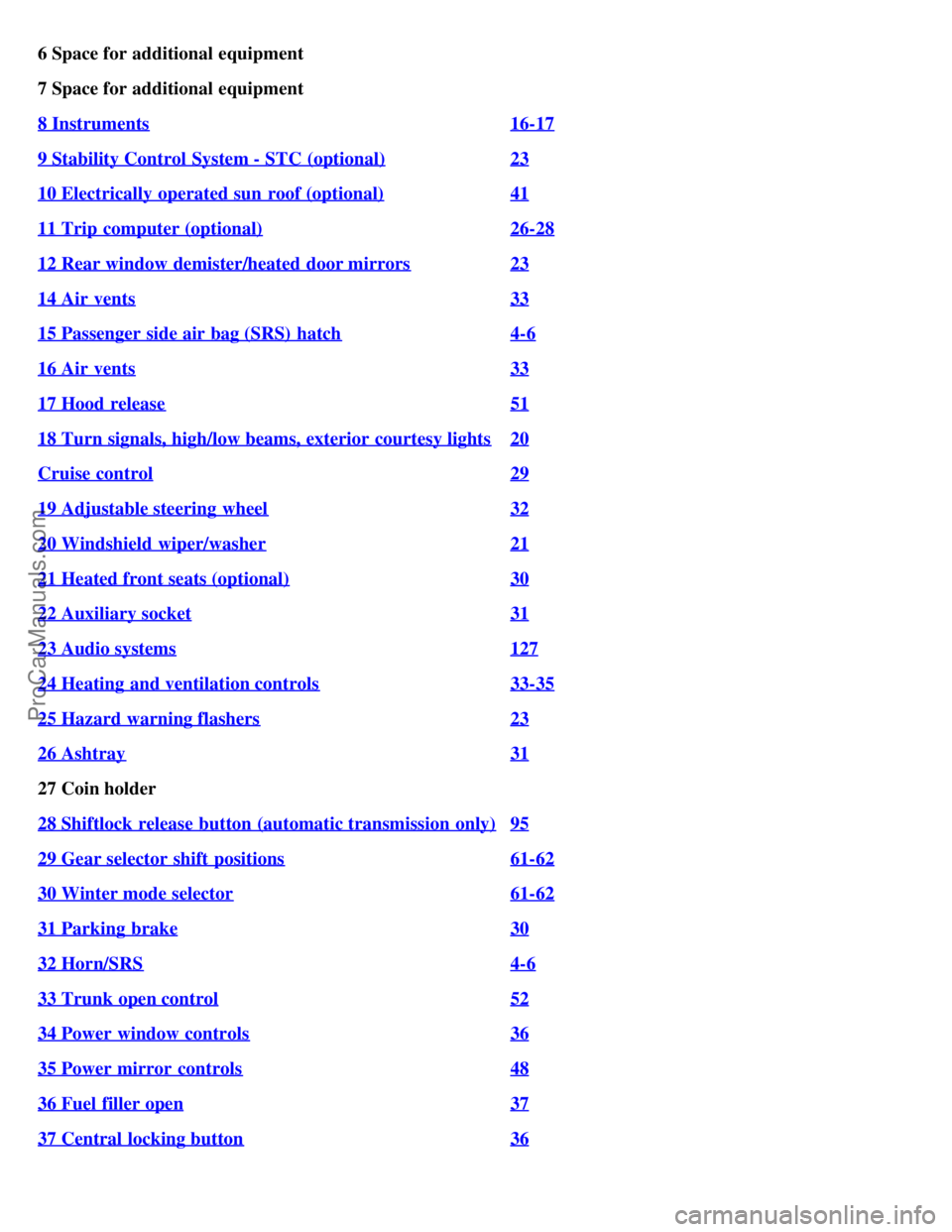
6 Space for additional equipment
7 Space for additional equipment
8 Instruments
16-17
9 Stability Control System - STC (optional)23
10 Electrically operated sun roof (optional)41
11 Trip computer (optional)26-28
12 Rear window demister/heated door mirrors23
14 Air vents33
15 Passenger side air bag (SRS) hatch4-6
16 Air vents33
17 Hood release51
18 Turn signals, high/low beams, exterior courtesy lights20
Cruise control29
19 Adjustable steering wheel32
20 Windshield wiper/washer21
21 Heated front seats (optional)30
22 Auxiliary socket31
23 Audio systems127
24 Heating and ventilation controls33-35
25 Hazard warning flashers23
26 Ashtray31
27 Coin holder
28 Shiftlock release button (automatic transmission only)
95
29 Gear selector shift positions61-62
30 Winter mode selector61-62
31 Parking brake30
32 Horn/SRS4-6
33 Trunk open control52
34 Power window controls36
35 Power mirror controls48
36 Fuel filler open37
37 Central locking button36
ProCarManuals.com
Page 21 of 88

2 0 0 1
VOLVO C70
Chapter 3 - Body and interior
pg. 39 Body and interior
The seats, sun roof, mirrors, etc. are described on the following pages.
Storage compartments
40
Sun roof41
Keys, doors and locks42
Remote keyless entry system43
Alarm44
Front seats46
Rear/side view mirrors48
Interior lights, Vanity mirrors49
Long load storage50
Hood51
Opening the trunk52
Trunk light, Spare tire, Jack53
Securing cargo, Avoiding battery drain54
pg. 40 Storage compartments
WARNING!
Packages on the rear window shelf can obscure vision and may become dangerous projectiles in the event of a
sudden stop or an accident.
ProCarManuals.com
Page 22 of 88

1 Glove compartment
2 Shelf under glove compartment
3 Coin holder
4 Compartment in door
5 Pocket on rear of front seat
6 Compartment between front seats
7 Cup holder
pg. 41 Sun roof (option)
Electrically operated sun roof
The switch for operating the sun roof is located on the instrument panel. The starting
(ignition) key must first be turned to the drive position (position II). The sun roof is also equipped with a one -touch,
ProCarManuals.com
Page 23 of 88

AUTO-open function.
· AUTO-open: Press the lower section of the switch once to automatically open the sun roof.
The AUTO-open function can be stopped at any time by pressing the switch.
· To close the sun roof : Depress the upper section of the switch until the sun roof has closed completely.
· To open the rear edge of the sun roof (ventilation position): With the sun roof closed, depress the upper section of
the switch. To close, depress the lower section of the switch until the sun roof has closed completely.
· To slide open the sun roof : Depress the lower section of the switch until the sun roof has opened to the position
you prefer or until it reaches its final position and stops automatically.
Sun visor : The sun roof also features a sliding sun visor. The visor slides back automatically when the sun roof is
opened and also slides back slightly when the sun roof is opened to the ventilation position. The visor must be closed
manually.
CAUTION : Do not close the sun visor when the sun roof is in the ventilation position as this could damage the
mechanism.
NOTE :
The electrically operated sun roof has an overload protecting circuit breaker (fuse no. 37) which is activated when an
object blocks the sun roof. Should this occur, remove the object and wait 20 seconds for the circuit breaker to reset.
The sun roof should then function normally. Also check fuse no. 35. WARNING!
The sun roof must never be obstructed in any way when in operation.
pg. 42 Keys, doors and locks
ProCarManuals.com
Page 29 of 88
Better driving economy may be obtained by thinking ahead, avoiding rapid starts and stops and adjusting the speed of
your vehicle to immediate traffic conditions. Observe the following rules:
· Bring the engine to normal operating temperature as soon as possible by driving with a light foot on the accelerator
pedal for the first few minutes of operation. A cold engine uses more fuel and is subject to increased wear.
· Whenever possible, avoid using the car for driving short distances. This does not allow the engine to reach normal
operating temperature.
· Drive carefully and avoid rapid acceleration and hard braking.
· Do not exceed speed limit.
· Avoid carrying unnecessary items (extra load) in the car.
· Maintain correct tire pressure. Check tire pressure regularly (check when tires are cold).
· Remove snow tires when threat of snow or ice has ended.
· Note that roof racks, ski racks, etc., increase air resistance and thereby fuel consumption.
· Avoid using automatic transmission kickdown feature unless necessary.
· Avoid using the air conditioning when it is not required. When engaged, the air conditioner's compressor places an
additional load on the engine. However, please note that fuel consumption is lower with the air conditioning on than it
is when driving with the air conditioning switched off and the windows down.
· If your car is equipped with the optional Trip Computer, utilizing the fuel consumption modes can help you "learn"
how to drive more economically.
Other factors which decrease gas mileage are:
· Worn or dirty spark plugs
· Incorrect spark plug gap
· Dirty air cleaner
· Dirty engine oil and clogged oil filter
· Dragging brakes
· Incorrect front end alignment
Some of the above mentioned items and others are checked at the standard Maintenance Service intervals.
NOTE: (D)rive or 5th gear (manual transmissions) should be used as often as possible to help improve fuel economy.
pg. 59 Starting the engine
Starting and stopping
ProCarManuals.com
Page 58 of 88

canister, where it is stored. When the engine is started, the gasoline vapor is drawn from the charcoal canister to the
engine's air intake system and into the combustion process.
NOTE:
· If the fuel filler cap is not closed tightly or if the engine is running when the car is refueled, the Malfunction Indicator
Lamp may indicate a fault.
· During a transitional period, a small number of service stations may still have fuel nozzles that are not compatible
with the fuel filler neck on cars equipped with the evaporative control system (ORVR) mandated by the U.S.
Environmental Protection Agency and the California Air Resources Board. If you experience difficulties in refueling
your vehicle, please ask the gas station attendant for assistance.
CAUTION:
Fuel must not be siphoned from the fuel tank. This will damage the Evaporative control system.
pg. 111 Lubrication
No.Lubrication point lubricant
1 Hood lock and latch Oil
2 Door stop and hinges Oil
3 Sun roof wind deflector (visible when sun roof is open) Oil, low temperature grease
4 Door lock catch plate Oil
5 Power antenna WD 40 or similar
6 Locks Volvo teflon lock spray
7 Trunk lock catch plate Low temperature grease
8 Front seat side rail and latch Oil
To avoid rattles and unnecessary wear, the body should be lubricated at regular service intervals. This should be done
by an authorized Volvo retailer.
ProCarManuals.com
Page 66 of 88

USACanada
Gross vehicle weight (GVW)
(aut.) 4190 lbs (1900 kg)1900 kg
(man.) 4140 lbs (1878 kg)1880 kg
Capacity weight * 785 lbs (356 kg) 355 kg
Curb weight 3305-3405 lbs (1499-1544 kg)1500-1545 kg
Permissible axle weight, front
(aut.) 2360 lbs (1070 kg)1070 kg
(man.) 2310 lbs (1048 kg)1050 kg
Permissible axle weight, rear 1940 lbs (880 kg)880 kg
Max roof load 220 lbs (100 kg)100 kg
Max trailer weight (w/o brakes) 1100 lbs (500 kg)500 kg
Max trailer weight (with brakes)
2" ball 3300 lbs (1500 kg) 1500 kg
1 7/8" ball 2000 lbs (908 kg)900 kg
Max tongue weight **165 lbs (75 kg) 75 kg
* The max permissible axle loads or the gross vehicle weight must not be exceeded.
** See also section "Trailer towing"
All specifications are subject to change without notice.
pg. 126 Road Assistance
Volvo supports Voluntary Mechanic Certification by the A.S.E. Certified mechanics have demonstrated a high degree
of competence in specific areas. Besides passing exams each mechanic must also have worked in the field for two or
more years before a certificate is issued. These professional mechanics are fully able to analyze vehicle problems and
perform the necessary service procedures to keep your Volvo at peak operating condition.
NOTE: The above pertains to the USA only.
ProCarManuals.com
Page 80 of 88
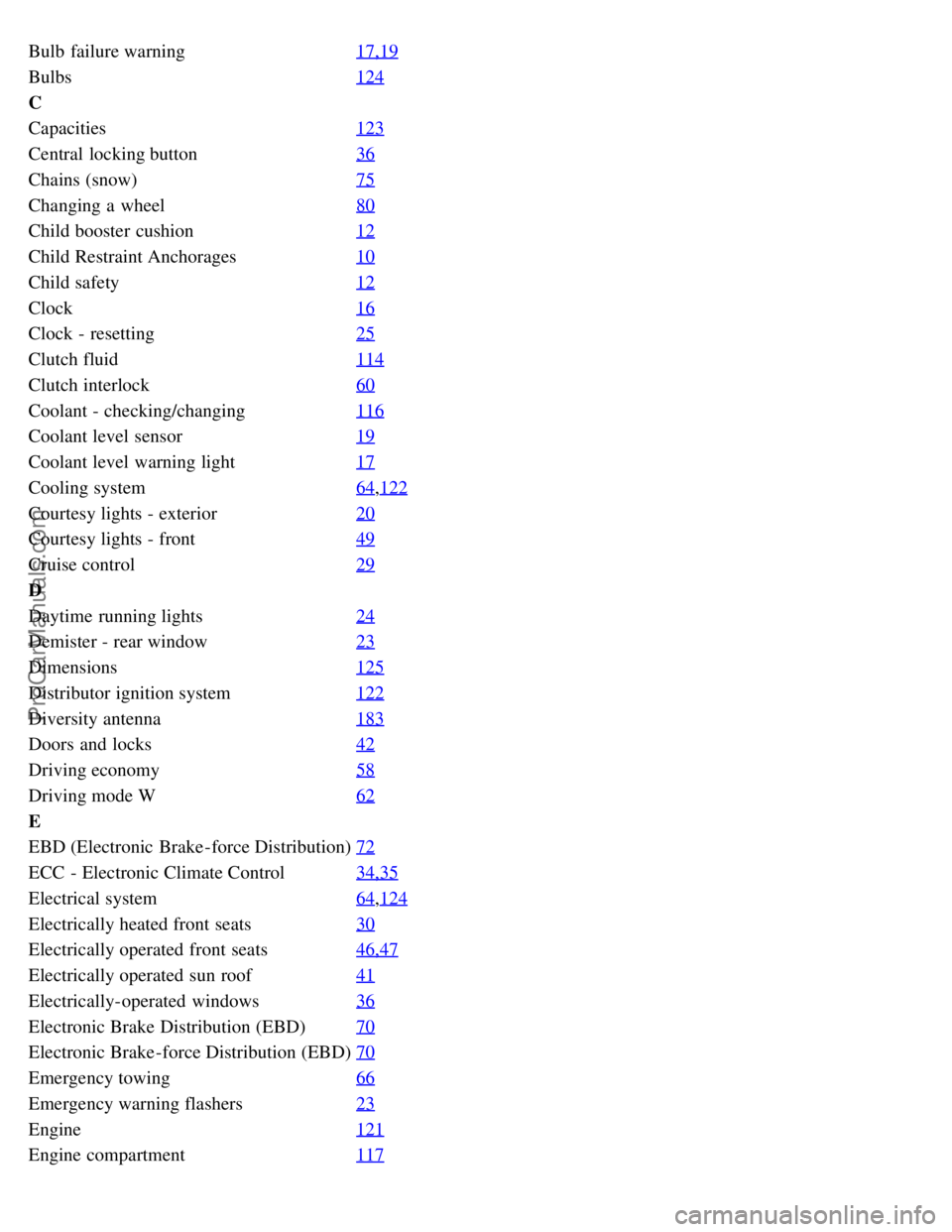
Bulb failure warning17,19
Bulbs124
C
Capacities123
Central locking button36
Chains (snow)75
Changing a wheel80
Child booster cushion12
Child Restraint Anchorages10
Child safety12
Clock16
Clock - resetting25
Clutch fluid114
Clutch interlock60
Coolant - checking/changing116
Coolant level sensor19
Coolant level warning light17
Cooling system64,122
Courtesy lights - exterior20
Courtesy lights - front49
Cruise control29
D
Daytime running lights24
Demister - rear window23
Dimensions125
Distributor ignition system122
Diversity antenna183
Doors and locks42
Driving economy58
Driving mode W62
E
EBD (Electronic Brake-force Distribution)72
ECC - Electronic Climate Control34,35
Electrical system64,124
Electrically heated front seats30
Electrically operated front seats46,47
Electrically operated sun roof41
Electrically-operated windows36
Electronic Brake Distribution (EBD)70
Electronic Brake-force Distribution (EBD)70
Emergency towing66
Emergency warning flashers23
Engine121
Engine compartment117
ProCarManuals.com
Page 83 of 88
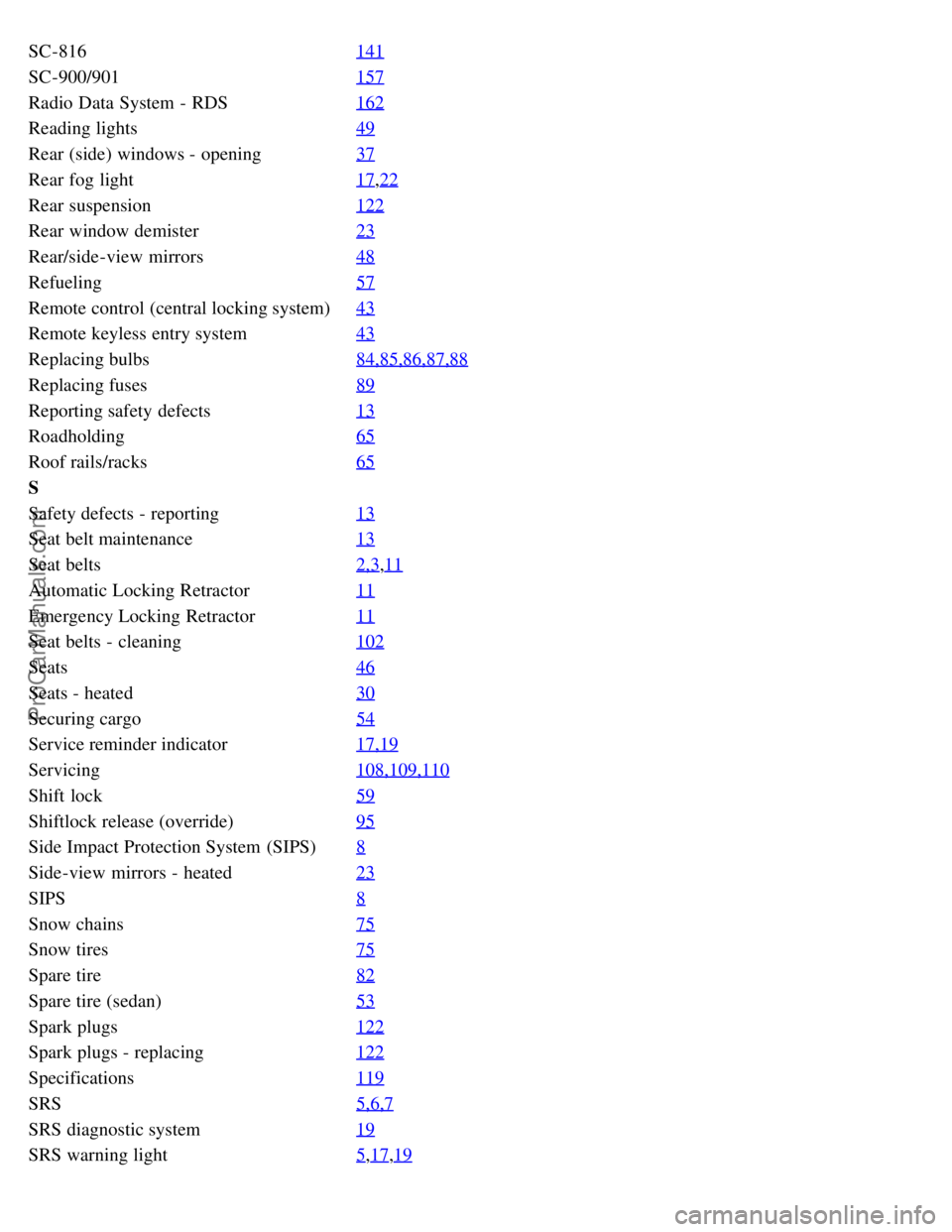
SC-816141
SC-900/901157
Radio Data System - RDS162
Reading lights49
Rear (side) windows - opening37
Rear fog light17,22
Rear suspension122
Rear window demister23
Rear/side-view mirrors48
Refueling57
Remote control (central locking system)43
Remote keyless entry system43
Replacing bulbs84,85,86,87,88
Replacing fuses89
Reporting safety defects13
Roadholding65
Roof rails/racks65
S
Safety defects - reporting13
Seat belt maintenance13
Seat belts2,3,11
Automatic Locking Retractor11
Emergency Locking Retractor11
Seat belts - cleaning102
Seats46
Seats - heated30
Securing cargo54
Service reminder indicator17,19
Servicing108,109,110
Shift lock59
Shiftlock release (override)95
Side Impact Protection System (SIPS)8
Side-view mirrors - heated23
SIPS8
Snow chains75
Snow tires75
Spare tire82
Spare tire (sedan)53
Spark plugs122
Spark plugs - replacing122
Specifications119
SRS5,6,7
SRS diagnostic system19
SRS warning light5,17,19
ProCarManuals.com
Page 84 of 88
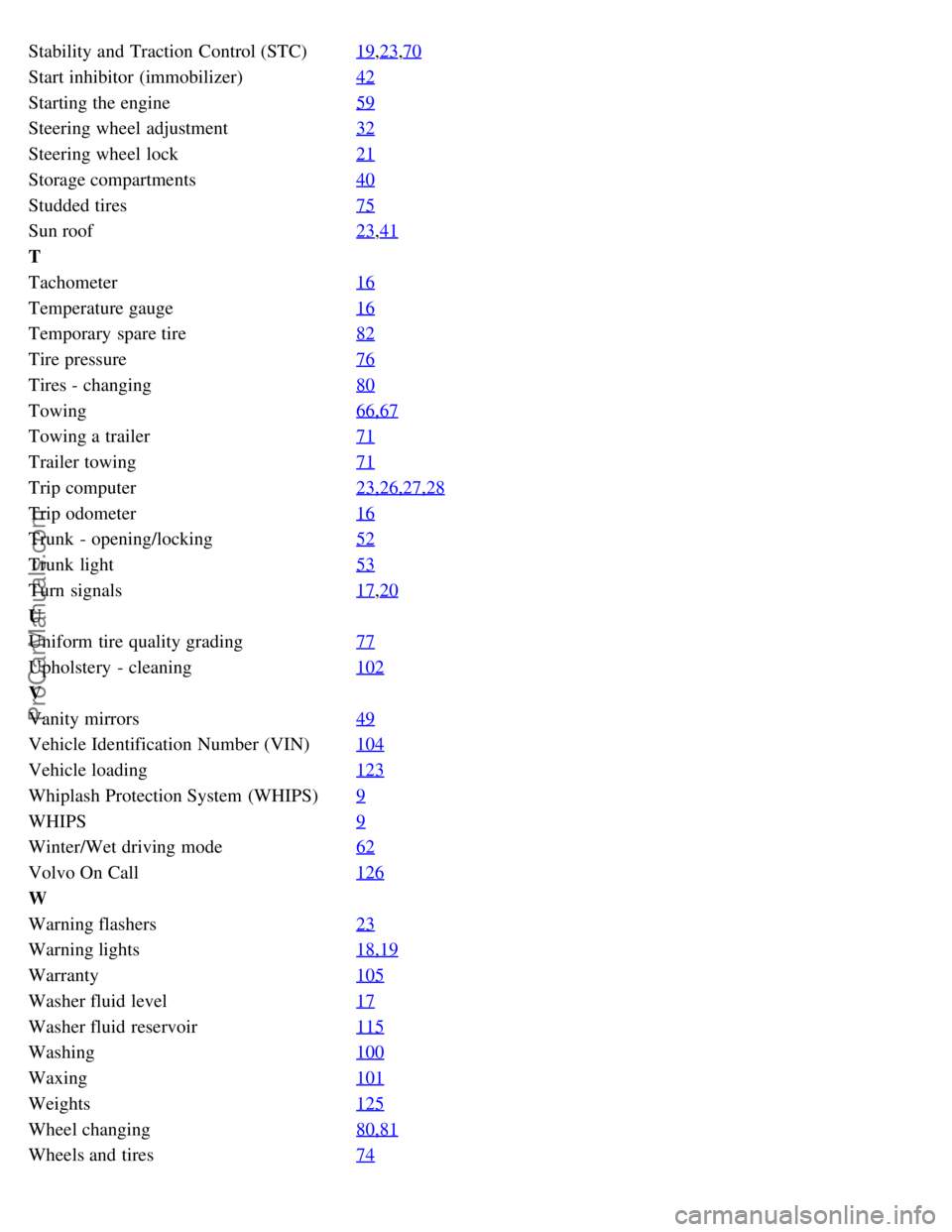
Stability and Traction Control (STC)19,23,70
Start inhibitor (immobilizer)42
Starting the engine59
Steering wheel adjustment32
Steering wheel lock21
Storage compartments40
Studded tires75
Sun roof23,41
T
Tachometer16
Temperature gauge16
Temporary spare tire82
Tire pressure76
Tires - changing80
Towing66,67
Towing a trailer71
Trailer towing71
Trip computer23,26,27,28
Trip odometer16
Trunk - opening/locking52
Trunk light53
Turn signals17,20
U
Uniform tire quality grading77
Upholstery - cleaning102
V
Vanity mirrors49
Vehicle Identification Number (VIN)104
Vehicle loading123
Whiplash Protection System (WHIPS)9
WHIPS9
Winter/Wet driving mode62
Volvo On Call126
W
Warning flashers23
Warning lights18,19
Warranty105
Washer fluid level17
Washer fluid reservoir115
Washing100
Waxing101
Weights125
Wheel changing80,81
Wheels and tires74
ProCarManuals.com