tow VOLVO C70 2001 Owners Manual
[x] Cancel search | Manufacturer: VOLVO, Model Year: 2001, Model line: C70, Model: VOLVO C70 2001Pages: 88, PDF Size: 2.07 MB
Page 12 of 88

airbag. See page 10 for guidelines.
· Occupants in the front passenger's seat must never sit on the edge of the seat, sit leaning toward the instrument
panel or otherwise sit out of position. The occupant's back must be as upright as comfort allows and be against the
seat back with the seat belt properly fastened.
· Feet must be on the floor, e.g. not on the dash, seat or out of the window.
· No objects or accessory equipment, e.g. dash covers, may be placed on, attached to or installed near the SRS hatch
(the area above the glove compartment) or the area affected by airbag deployment (see illustration).
· There should be no loose articles, e.g. coffee cups, on the floor, seat or dash area.
· Never try to open the SRS cover on the steering wheel or the passenger side SRS hatch. This should only be done
by an authorized Volvo service technician.
· Failure to follow these instructions can result in injury to the vehicle occupants in an accident.
pg. 7 Volvo SRS
NOTE: The information on this page does not pertain to the Side Impact Protection System airbags.
When are the airbags deployed?
The SRS system is designed to deploy during certain frontal or frontangular collisions, impacts, or decelerations,
depending on the crash severity, angle, speed and object impacted. The SRS sensor is designed to react to both the
impact of the collision and the inertial forces generated by it and to determine if the intensity of the collision is
sufficient for the airbags to be deployed.
WARNING!
The SRS is designed to help prevent serious injury. Deployment occurs very quickly and with considerable force.
During normal deployment and depending on variables such as seating position, one may experience abrasions,
bruises, swellings, or other injuries as a result of airbag(s) deployment.
If the airbags have been deployed, we recommend the following:
· Have the car towed to an authorized Volvo retailer. Never drive with the airbags deployed.
· Have an authorized Volvo retailer replace the SRS system components.
· Use only new, Genuine Volvo Parts when replacing SRS components (airbags, seat belts, tensioners, etc.).
When are the airbags NOT deployed?
Not all frontal collisions activate the SRS system. If the collision involves a nonrigid object (e.g., a snow drift or
bush), or a rigid, fixed object at a low speed, the SRS system will not necessarily deploy. Airbags do not normally
deploy in a side impact collision, in a collision from the rear or in a rollover situation. The amount of damage to the
bodywork does not reliably indicate if the airbags should have deployed or not.
ProCarManuals.com
Page 13 of 88
Seat belts the heart of the Volvo safety system
The heart of the Volvo safety system is the three-point seat belt (a Volvo invention)! In order for the SRS system to
provide the protection intended, seat belts must be worn at all times by everyone in the car. The SRS system is a
supplement to the seat belts.
WARNING!
If your car has been subjected to flood conditions (e.g. soaked carpeting/standing water on the floor of the vehicle)
or if your car has become flooddamaged in any way, do not attempt to start the vehicle or put the key in the ignition
before disconnecting the battery (see below). This may cause airbag deployment which could result in personal
injury. Have the car towed to an authorized Volvo retailer for repairs.
Automatic transmission only:
Before attempting to tow the car, use the following procedure to override the shiftlock system to move the gear
selector to the neutral position.
· Disconnect the battery
· Wait at least one minute
· Insert the key in the ignition and turn it to position 1
· Press firmly on the shiftlock override button (located near the base of the gear selector).
· While holding the override button down, move the gear selector from the park position.
WARNING!
Never drive with the airbags deployed. The fact that they hang out can impair the steering of your car. Other safety
systems can also be damaged. The smoke and dust formed when the airbags are deployed can cause skin and eye
irritation in the event of prolonged exposure.
Contents | Top of Page
ProCarManuals.com
Page 18 of 88
16 Parking brake applied
17 ABS -system
18 Transmission mode: Indicates "W" if winter/wet driving mode is active, or indicates currently selected low gear.
19 Low coolant level
20 Stability and Traction Control (STC) System (option)
21 Malfunction indicator lamp
(See page 18 for more information)
22 Service reminder indicator
pg. 18 Warning lights
The warning lights described on pages 18 and 19 should never stay on when driving
When the ignition key is turned on and before the engine starts, all of the warning lights should go on to test the
function of the bulbs. Should a light not go off after the engine has started, the system indicated should be inspected.
However, the parking brake reminder light will not go off until the parking brake has been fully released.
Generator warning light
If the light comes on while the engine is running, have the charging system checked.
Malfunction indicator lamp
If the lamp comes on (or stays on after the vehicle has started), the engine diagnostic system has detected a possible
fault in the emission control system. Although driveability may not be affected, see an authorized Volvo retailer as
soon as possible for inspection.
NOTE : If the fuel filler cap is not closed tightly or if the engine is running when the car is refueled, the Malfunction
Indicator Lamp may indicate a fault. However, your vehicle's performance will not be affected. Use only Volvo
original or approved fuel filler caps.
Oil pressure warning light
If the light comes on while driving, stop the car and then stop the engine immediately and check the engine oil
level . See page 112
. If the light stays on after restart, have the car towed to the nearest authorized Volvo retailer. After
hard driving, the light may come on occasionally when the engine is idling. This is normal, provided it goes off when
the engine speed is increased.
Fault in ETC (Electronic Throttle Control system)
If this lamp comes on, there is a fault in the engine control system and driveability will be affected. Switch the ignition
off and then on again. If the light remains on, the system should be inspected by an authorized Volvo retailer.
Cruise Control
This light will be on when cruise control is engaged. Cruise control will automatically disengage when the ignition is
switched off.
ProCarManuals.com
Page 19 of 88
Brake failure warning light
If the light comes on while driving or braking, stop immediately, open the hood and check the brake fluid level
in the reservoir. See page 117
for reservoir position.
Canadian models are equipped with this warning light:
WARNING!
If the fluid level is below the MIN mark in either section of the reservoir: DO NOT DRIVE. Tow the car to a Volvo
retailer and have the brake system checked and any leakage repaired.
Parking brake reminder light
This light will be on when the parking brake (hand brake) is applied. The parking brake lever is situated between the
front seats.
Canadian models are equipped with this warning light:
pg. 19 Warning lights
STC disengaged (option)
The indicator light in the instrument panel will be ON when you have switched the Stability and Traction Control
system (STC) OFF using the button on the dashboard (see page 23).
The light will also come on if there is a fault in the
STC system or to indicate that the brakes have overheated. The light will go out when the brake temperature returns to
normal.
The symbol will flash when STC is actively regulating power to the drive wheels. Normal power may be reduced at
this time. This is normal as power is momentarily reduced to help keep the drive wheels from losing traction and
spinning.
Anti-lock Brake system (ABS)
If the warning lamp lights up there is a malfunction of the ABS system (the standard braking system will however
function). The vehicle should be driven to a Volvo retailer for inspection.
See page 69 for additional information.
Canadian models are equipped with this warning light:
Coolant level sensor
If this light comes on while driving, the coolant level is low. The coolant level in the expansion tank should be
checked immediately and topped up if necessary. The cooling system should be inspected by an authorized Volvo
retailer.
Mode "W" engaged
ProCarManuals.com
Page 24 of 88

Doors and locks
Your car is equipped with a central locking system. The key, used on the driver's door, the remote control or central
locking button, will lock/unlock both doors and the trunk.
· Turn the key once to unlock the driver's door only.
· Turn the key again (within 10 seconds) to unlock both doors and the trunk.
One turn with the key towards lock in the drivers door locks both doors and the trunk.
· Use the switch on the front door armrests to lock/unlock the car from the inside.
Check the action of the button on the other door to verify its function (lock/ unlock).
WARNING!
If the doors are locked while driving, this may hinder rapid access to the occupants of the car in the event of an
accident. (Also see information on "Child safety locks").
NOTE :
· If a door is not closed completely, the courtesy lights will stay on and a chime will sound until the door is closed.
· As an added anti-theft measure, new keys have been developed which may take slightly longer to copy or replace if
the original keys are misplaced. Duplicate keys may be ordered from your Volvo retailer.
Immobilizer (start inhibitor)
Each of the keys supplied with your car contains a coded transmitter and receiver (transponder). The code in the key is
transmitted to an antenna in the ignition switch where it is compared to the code stored in the start inhibitor module.
The car can only be started if a properly coded key is used.
If you misplace a key, take the other keys to an authorized Volvo retailer. The existing code in the start inhibitor
module and all the keys will be erased as an antitheft measure and a new code will be programmed in.
NOTE:
Not more than one of the keys for your car should be kept on the same key ring. This could cause conflicting signals to
be transmitted to the ignition switch, making it impossible to start the car.
ProCarManuals.com
Page 26 of 88
2 0 0 1
VOLVO C70
Chapter 4 - Starting and driving
pg. 55 Starting and driving
This section on starting and driving contains items such as starting the engine, operating the gear selector, towing,
trailers, etc. Fuel requirements, Refueling
56-57
Driving economy58
Starting the engine59
Manual transmission60
Automatic transmission61
Points to remember63
Emergency towing66
Vehicle towing information67
Jump starting68
Brake system69-70
Trailer towing71
Winter driving72
pg. 56 Fuel requirements
NOTE ENGINE OIL:
Although some oil consumption occurs during normal engine operation, more oil is consumed when the engine is new
as the internal parts generate higher friction while wearingin to each other. From the time the engine is new until the
first service is performed, the oil consumption could be higher than normal. For this reason, it is especially
important to check the oil every time you refuel your car during this period. See page 112.
In general, the rate of oil consumption depends on such factors as: engine temperature, length of trip, driving
conditions, oil viscosity and quality, engine speed and acceleration/deceleration.
ProCarManuals.com
Page 33 of 88
D (Drive)
D is the normal driving position and should be used as often as possible to help improve fuel economy. The car should
not be moving when shifting from R to the D position.
Neutral control
When the engine is idling, the gear selector is in the Drive position and the brake pedal is depressed, the
transmission will automatically switch to neutral.
The transmission will automatically return to Drive when the brake pedal is released.
This function has been added to help reduce emissions.
4 (Intermediate gear)
The transmission will shift automatically between gears 4, 3, 2 or 1 from this position.
The transmission cannot shift up to (D)rive from fourth gear.
3 (Intermediate gear)
The transmission will shift automatically between gears 3, 2 and 1 from this position.
The transmission cannot shift up to fourth gear or (D)rive from third gear.
L (Low gears)
The transmission is locked in gears 1 and 2 when the selector is in this position.
NOTE:
· Gears 4, 3, or L can be used if you are driving in a mountainous area, towing a trailer or to increase engine braking
effect.
· The transmission has a built-in limiter designed to help prevent excessive engine speeds (high rpm) when gears 4, 3
or L are selected.
Automatic transmission - adaptive system
The automatic transmission is controlled by an adaptive guidance system that constantly monitors the way in which the
transmission functions. It senses and adapts each gear shift for optimal performance. The system also monitors your
particular driving style and adapts gear shifting accordingly.
ProCarManuals.com
Page 44 of 88
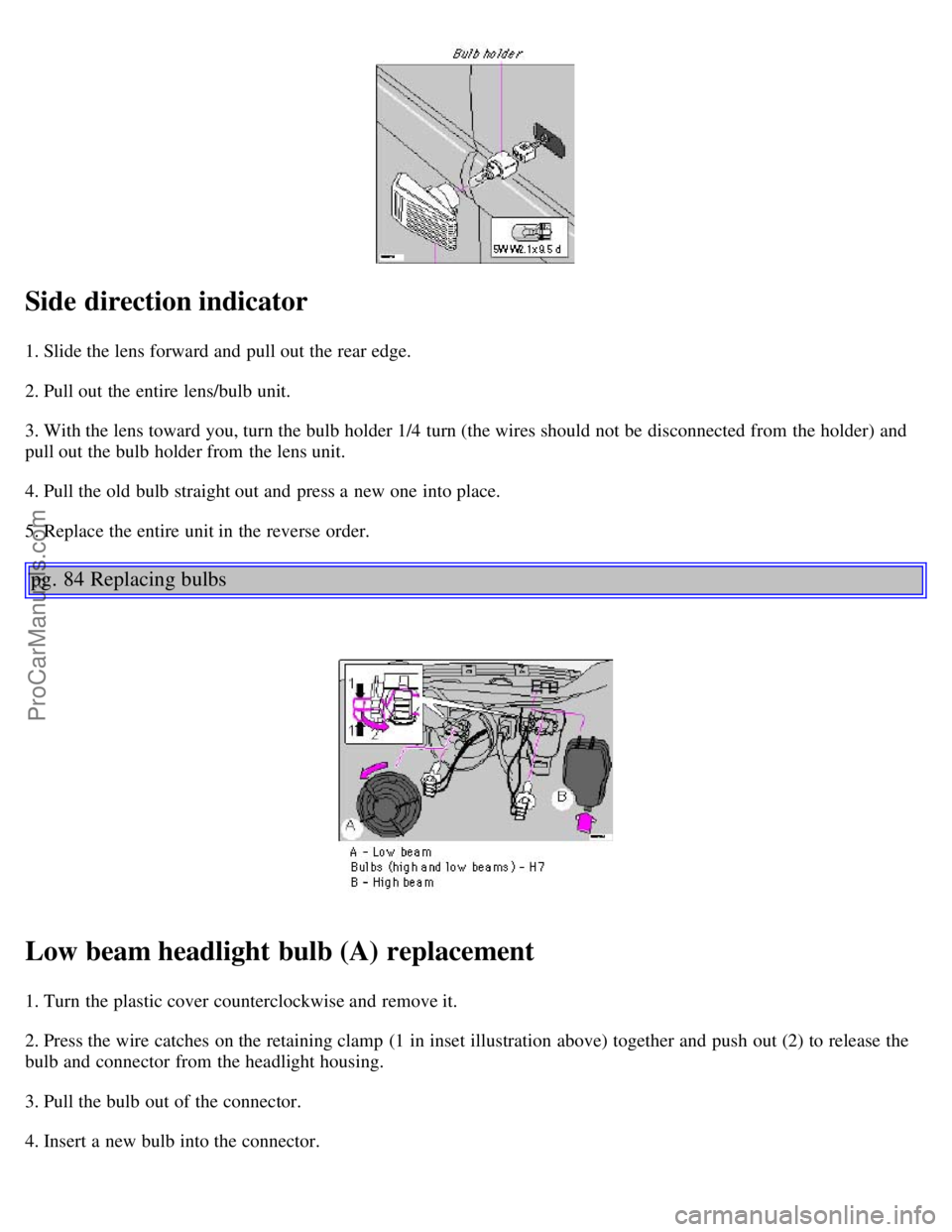
Side direction indicator
1. Slide the lens forward and pull out the rear edge.
2. Pull out the entire lens/bulb unit.
3. With the lens toward you, turn the bulb holder 1/4 turn (the wires should not be disconnected from the holder) and
pull out the bulb holder from the lens unit.
4. Pull the old bulb straight out and press a new one into place.
5. Replace the entire unit in the reverse order.
pg. 84 Replacing bulbs
Low beam headlight bulb (A) replacement
1. Turn the plastic cover counterclockwise and remove it.
2. Press the wire catches on the retaining clamp (1 in inset illustration above) together and push out (2) to release the
bulb and connector from the headlight housing.
3. Pull the bulb out of the connector.
4. Insert a new bulb into the connector.
ProCarManuals.com
Page 48 of 88

Washing the car
· The car should be washed at regular intervals since dirt, dust, insects and tar spots adhere to the paint and may cause
damage.
NOTE: It is particularly important to wash the car frequently in the wintertime to prevent corrosion, when salt has
been used on the roads.
· When washing the car, do not expose it to direct sunlight. Use lukewarm water to soften the dirt before you wash
with a sponge, and plenty of water, to avoid scratching.
· Bird droppings: Remove from paintwork as soon as possible. Otherwise the finish may be permanently damaged.
· A detergent can be used to facilitate the softening of dirt and oil.
· A water-soluble grease solvent may be used in cases of sticky dirt. However, use a wash place equipped with a
drainage separator.
· Dry the car with a clean chamois and remember to clean the drain holes in the doors and rocker panels *.
· The power radio antenna must be dried after washing.
· Tar spots can be removed with kerosene or tar remover after the car has been washed.
· A stiff-bristle brush and lukewarm soapy water can be used to clean the wiper blades. Frequent cleaning improves
visibility considerably.
· Wash off the dirt from the underside (wheel housings, fenders, etc.).
· In areas of high industrial fallout, more frequent washing is recommended.
CAUTION: During high pressure washing, the spray mouthpiece must never be closer to the vehicle than 13" (30
cm). Do not spray into the locks.
· When washing or steam cleaning the engine, avoid spraying water or steam directly on the electrical components or
toward the rear side of the engine.
· After cleaning the engine, the spark plug wells should be inspected for water and blown dry if necessary.
Suitable detergents
Special car washing detergents should be used. A suitable mixture is about 2.5 fl. oz. (8.5 cl) of detergent to 2.6 US
gal. (10 liters) of warm water. After washing with a detergent the car should be well rinsed with clean water.
WARNING!
· When the car is driven immediately after being washed, apply the brakes several times in order to remove any
moisture from the brake linings.
· Engine cleaning agents should not be used when the engine is warm. This constitutes a fire risk.
ProCarManuals.com
Page 50 of 88

The fabric can be cleaned with soapy water or a detergent. For more difficult spots caused by oil, ice cream, shoe
polish, grease, etc., use a clothing/fabric stain remover.
The plastic in the upholstery can be cleaned with a soft cloth and mild soap solution.
Leather upholstery can be cleaned with a soft cloth and mild soap solution. For more difficult spots, Volvo offers a
leather care kit.
On no account must gasoline, naphtha or similar cleaning agents be used on the plastic or the leather since these
can cause damage.
Cleaning the seat belts
Clean only with lukewarm water and mild soap solution.
Cleaning floor mats
The floor mats should be vacuumed or brushed clean regularly, especially during winter when they should be taken out
for drying. Spots on textile mats can be removed with a mild detergent.
Bear in mind
· Take extra care when removing stains such as ink or lipstick since the coloring can spread.
· Use solvents sparingly. Too much solvent can damage the seat padding.
· Start from the outside of the stain and work toward the center.
Contents | Top of Page
ProCarManuals.com