brake VOLVO C70 2002 Owners Manual
[x] Cancel search | Manufacturer: VOLVO, Model Year: 2002, Model line: C70, Model: VOLVO C70 2002Pages: 99, PDF Size: 2.56 MB
Page 3 of 99
CAUTION: Certain models have reduced ground clearance due to the design of the front spoiler. Please observe
caution when e.g., driving onto garage hoists, through drifted snow or when other road debris is encountered, or when
parking near curbs.
© 2001 Volvo Cars of North America Inc.
Shiftlock (automatic transmission only)
When your car is parked, the gear selector is locked in the (P)ark position. To release the selector from this position,
turn the ignition key to position II (or start the engine), depress the brake pedal, press the button on the front side of the
gear selector and move the selector from (P)ark.
If it is necessary to manually override the shiftlock system:
· Turn the starting (ignition) key to position I
· Press firmly on the "SHIFTLOCK OVERRIDE" button located to the right of the base of the gear selector
· While holding the override button down, press the button on the front of the gear selector
· Move the selector from the ( P)ark position.
Keylock (automatic transmission only)
This means that when you switch off the ignition, the gear selector must be in the (P)ark position before the starting
(ignition) key can be removed from the ignition switch.
Clutch interlock (manual transmission only)
The clutch must be fully depressed before you can start you car. If the clutch is not depressed, it will not be possible to
start the engine.
Anti-lock Brake System (ABS)
The ABS system in your car performs a self -diagnostic test when the vehicle first reaches the speed of approximately
12 mph (20 km/h). The brake pedal will pulsate several times and a sound may be audible from the ABS control
module. This is normal.
Fuel tank cover
The fuel tank cover is locked and must be popped open using the control on the driver's door (see illustration on page
16).
Volvo and the environment
Volvo is committed to the well being of our customers. As a natural part of this commitment, we care about the
environment in which we all live. Caring for the environment means an everyday involvement in reducing our
ProCarManuals.com
Page 4 of 99
environmental impact.
Volvo's environmental activities are based on a holistic view, which means we consider the overall environmental
impact of a product throughout its complete life cycle. In this context, design, production, product use, and recycling
are all important considerations.
In production, Volvo has partly or completely phased out several chemicals including freons, lead chromates,
naphtanates, asbestos, mercury and cadmium; and reduced the amount of chemicals used in our plants 50% since 1991.
In use, Volvo was the first in the world to introduce into production a three-way catalytic converter with a Lambda
sond, now called oxygen sensor, in 1976. The current version of this highly efficient system reduces emissions of
harmful substances (CO, HC, NOx) from the exhaust pipe by approximately 95% and the search to eliminate the
remaining emissions continues. Volvo is the only automobile manufacturer to offer CFC-free retrofit kits for the air
conditioning system for all models as far back as the M/Y 1975 240. Advanced electronic engine controls, refined
purification systems and cleaner fuels are bringing us closer to our goal.
After Volvo cars and parts have fulfilled their use, recycling is the next critical step in completing the life cycle. The
metal content is about 75% of the total weight of a car, which makes the car among the most recycled industrial
products. In order to have efficient and well controlled recycling, many Volvo variants have printed dismantling
manuals, indicating the weight and material of individual components. For Volvo, all homogeneous plastic parts
weighing more than 1.7 oz. (50 grams) are marked with international symbols that indicate how the component is to be
sorted for recycling.
In addition to continuous environmental refinement of conventional gasoline-powered internal combustion engines,
Volvo is actively looking at advanced technology alternative-fuel vehicles.
When you drive a Volvo, you become our partner in the work to lessen the car's impact on the environment.
To reduce your vehicle's environmental impact, you can:
· Maintain proper air pressure in your tires. Tests have shown decreased fuel economy with improperly inflated tires
· Follow the recommended maintenance schedule
· Drive at a constant speed
· See an authorized Volvo retailer as soon as possible for inspection if the check engine (malfunction indicator) lamp
illuminates, or stays on after the vehicle has started
· Properly dispose of any vehicle related waste such as used motor oil, used batteries, brake pads, etc.
· When cleaning your car, use Volvo's own car care products, all of which have systematically been adapted to the
environment
For additional information regarding the environmental activities in
which Volvo Cars of North America, Inc. and Volvo Car Corporation are involved, visit our Internet Home Page at:
http://www.volvocars.com
Top of Page
ProCarManuals.com
Page 14 of 99

6Space for additional equipment
7Space for additional equipment
8 Instruments 16-17
9Stability Control System - STC 25
10Trip computer (optional) 28-30
11Electrically operated sun roof (C70 Coupe) 44
11Electrically operated convertible top (C70 Convertible) 44
12Rear window demister/heated door mirrors 25
13Air mix 35
14Air vents 35
15Passenger side air bag (SRS) hatch 4-6
16Air vents 35
17Hood release 58
18Turn signals, high/low beams, exterior courtesy lights 22
18Cruise control 31
19Adjustable steering wheel 34
20Windshield wiper/washer 23
21Heated front seats (optional) 32
22Auxiliary socket 33
23Audio systems 137
24Heating and ventilation controls 35-37
25Hazard warning flashers 25
26Ashtray 33
27Coin holder 42
28Shiftlock release button (automatic transmission only) 105
29Gear selector shift positions 69-71
30Winter mode selector 71
31Parking brake 32
32Horn/SRS 4-6
33Trunk open control 59
34Power window controls 38
35Power mirror controls 54
36Fuel tank open control 40
37Central locking button 38
Some of the items above are available on certain models only.
pg. 18 Instruments
ProCarManuals.com
Page 16 of 99
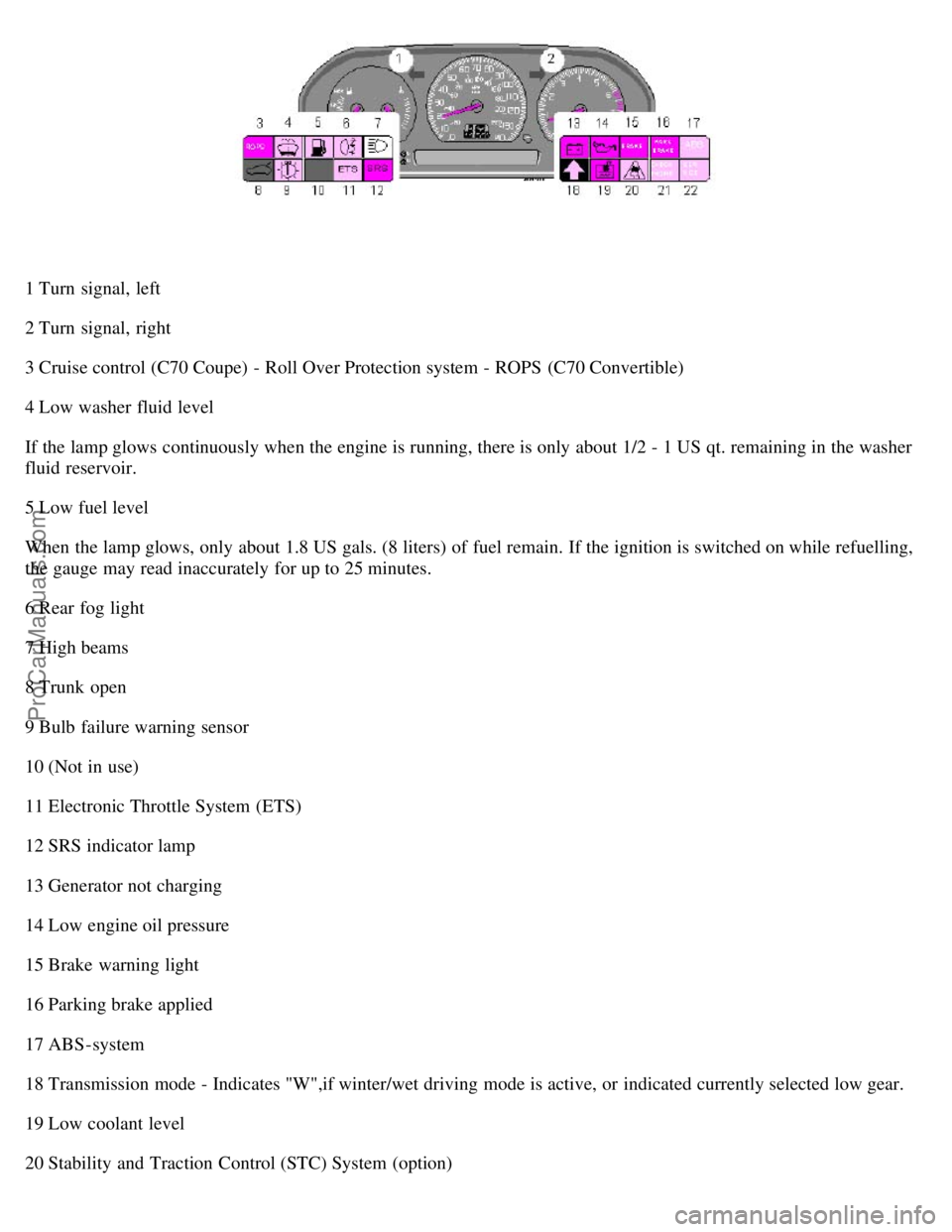
1 Turn signal, left
2 Turn signal, right
3 Cruise control (C70 Coupe) - Roll Over Protection system - ROPS (C70 Convertible)
4 Low washer fluid level
If the lamp glows continuously when the engine is running, there is only about 1/2 - 1 US qt. remaining in the washer
fluid reservoir.
5 Low fuel level
When the lamp glows, only about 1.8 US gals. (8 liters) of fuel remain. If the ignition is switched on while refuelling,
the gauge may read inaccurately for up to 25 minutes.
6 Rear fog light
7 High beams
8 Trunk open
9 Bulb failure warning sensor
10 (Not in use)
11 Electronic Throttle System (ETS)
12 SRS indicator lamp
13 Generator not charging
14 Low engine oil pressure
15 Brake warning light
16 Parking brake applied
17 ABS -system
18 Transmission mode - Indicates "W",if winter/wet driving mode is active, or indicated currently selected low gear.
19 Low coolant level
20 Stability and Traction Control (STC) System (option)
ProCarManuals.com
Page 17 of 99
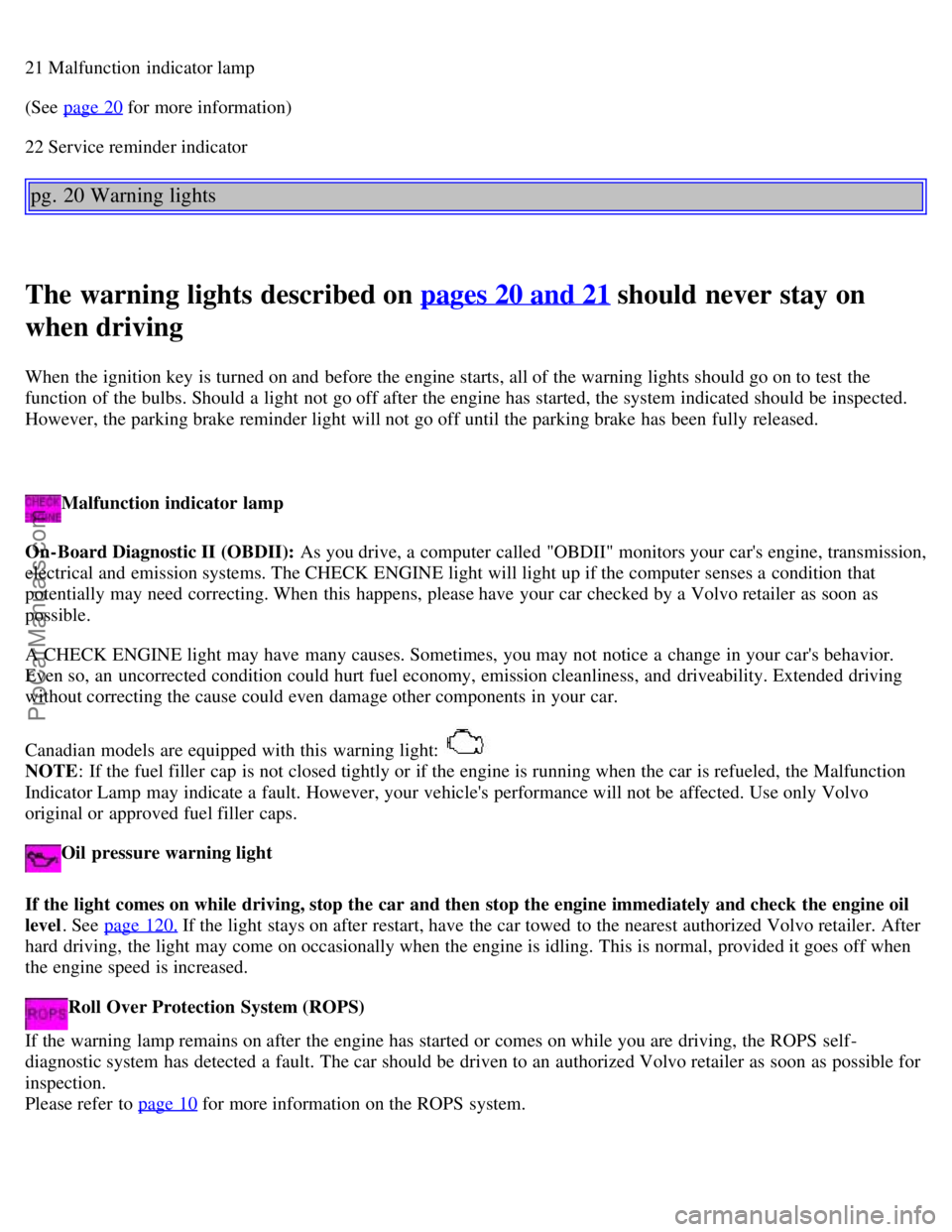
21 Malfunction indicator lamp
(See page 20
for more information)
22 Service reminder indicator
pg. 20 Warning lights
The warning lights described on pages 20 and 21 should never stay on
when driving
When the ignition key is turned on and before the engine starts, all of the warning lights should go on to test the
function of the bulbs. Should a light not go off after the engine has started, the system indicated should be inspected.
However, the parking brake reminder light will not go off until the parking brake has been fully released.
Malfunction indicator lamp
On-Board Diagnostic II (OBDII): As you drive, a computer called "OBDII" monitors your car's engine, transmission,
electrical and emission systems. The CHECK ENGINE light will light up if the computer senses a condition that
potentially may need correcting. When this happens, please have your car checked by a Volvo retailer as soon as
possible.
A CHECK ENGINE light may have many causes. Sometimes, you may not notice a change in your car's behavior.
Even so, an uncorrected condition could hurt fuel economy, emission cleanliness, and driveability. Extended driving
without correcting the cause could even damage other components in your car.
Canadian models are equipped with this warning light:
NOTE : If the fuel filler cap is not closed tightly or if the engine is running when the car is refueled, the Malfunction
Indicator Lamp may indicate a fault. However, your vehicle's performance will not be affected. Use only Volvo
original or approved fuel filler caps.
Oil pressure warning light
If the light comes on while driving, stop the car and then stop the engine immediately and check the engine oil
level . See page 120.
If the light stays on after restart, have the car towed to the nearest authorized Volvo retailer. After
hard driving, the light may come on occasionally when the engine is idling. This is normal, provided it goes off when
the engine speed is increased.
Roll Over Protection System (ROPS)
If the warning lamp remains on after the engine has started or comes on while you are driving, the ROPS self -
diagnostic system has detected a fault. The car should be driven to an authorized Volvo retailer as soon as possible for
inspection.
Please refer to page 10
for more information on the ROPS system.
ProCarManuals.com
Page 18 of 99
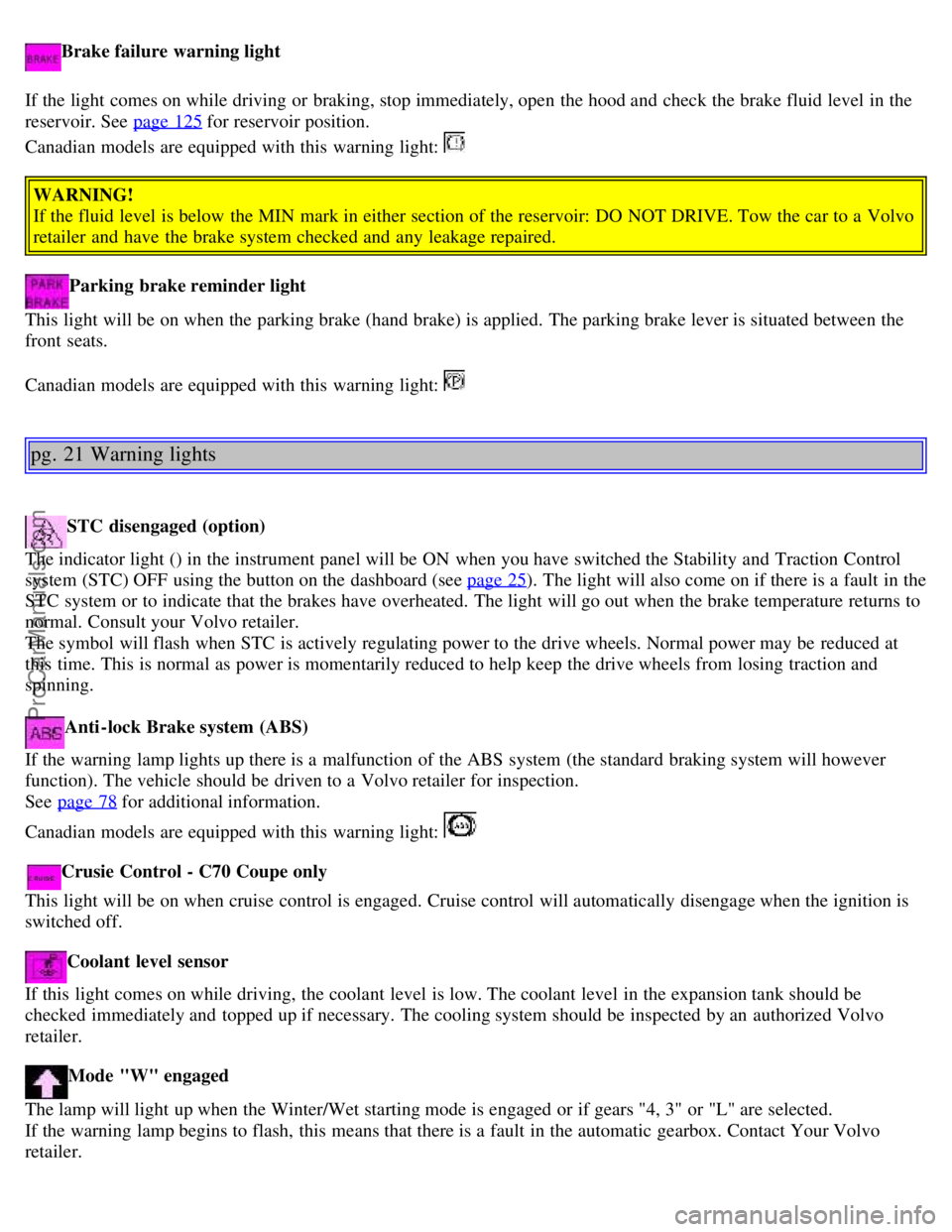
Brake failure warning light
If the light comes on while driving or braking, stop immediately, open the hood and check the brake fluid level in the
reservoir. See page 125
for reservoir position.
Canadian models are equipped with this warning light:
WARNING!
If the fluid level is below the MIN mark in either section of the reservoir: DO NOT DRIVE. Tow the car to a Volvo
retailer and have the brake system checked and any leakage repaired.
Parking brake reminder light
This light will be on when the parking brake (hand brake) is applied. The parking brake lever is situated between the
front seats.
Canadian models are equipped with this warning light:
pg. 21 Warning lights
STC disengaged (option)
The indicator light () in the instrument panel will be ON when you have switched the Stability and Traction Control
system (STC) OFF using the button on the dashboard (see page 25
). The light will also come on if there is a fault in the
STC system or to indicate that the brakes have overheated. The light will go out when the brake temperature returns to
normal. Consult your Volvo retailer.
The symbol will flash when STC is actively regulating power to the drive wheels. Normal power may be reduced at
this time. This is normal as power is momentarily reduced to help keep the drive wheels from losing traction and
spinning.
Anti-lock Brake system (ABS)
If the warning lamp lights up there is a malfunction of the ABS system (the standard braking system will however
function). The vehicle should be driven to a Volvo retailer for inspection.
See page 78
for additional information.
Canadian models are equipped with this warning light:
Crusie Control - C70 Coupe only
This light will be on when cruise control is engaged. Cruise control will automatically disengage when the ignition is
switched off.
Coolant level sensor
If this light comes on while driving, the coolant level is low. The coolant level in the expansion tank should be
checked immediately and topped up if necessary. The cooling system should be inspected by an authorized Volvo
retailer.
Mode "W" engaged
The lamp will light up when the Winter/Wet starting mode is engaged or if gears "4, 3" or "L" are selected.
If the warning lamp begins to flash, this means that there is a fault in the automatic gearbox. Contact Your Volvo
retailer.
ProCarManuals.com
Page 19 of 99
Supplemental Restraint System (SRS)
If the light comes on (or stays on after the vehicle has started), the SRS diagnostic system has detected a fault. Drive to
an authorized Volvo retailer for an inspection of the system. See the SRS section for more information.
Generator warning light
If the light comes on while the engine is running, have the charging system checked.
Service reminder indicator
This light will come on at 7,500 mile (12,000 km) intervals, after 750 hours of driving or after 12 months, whichever
occurs first. It is a reminder to the driver that the service interval has been exceeded. The light will stay on for 2
minutes after start until reset by the servicing retailer.
Bulb failure warning light
The light will come on if any of the following bulbs are defective:
one of the low beam headlights
one of the tail lights
one of the brake lights when the brake pedal is depressed.
Check the fuse and bulb. See sections "Replacing bulbs" and "fuses.
Should the warning light come on after a defective outside bulb has been replaced, the corresponding bulb on the other
side of the car should also be replaced.
Fault in ETC (Electronic Throttle Control system)
If this lamp comes on, there is a fault in the engine control system and driveability will be affected. Switch the ignition
off and then on again. If the light remains on, the system should be inspected by an authorized Volvo retailer.
pg. 22 Headlights, Parking lights, Turn signals
ProCarManuals.com
Page 25 of 99
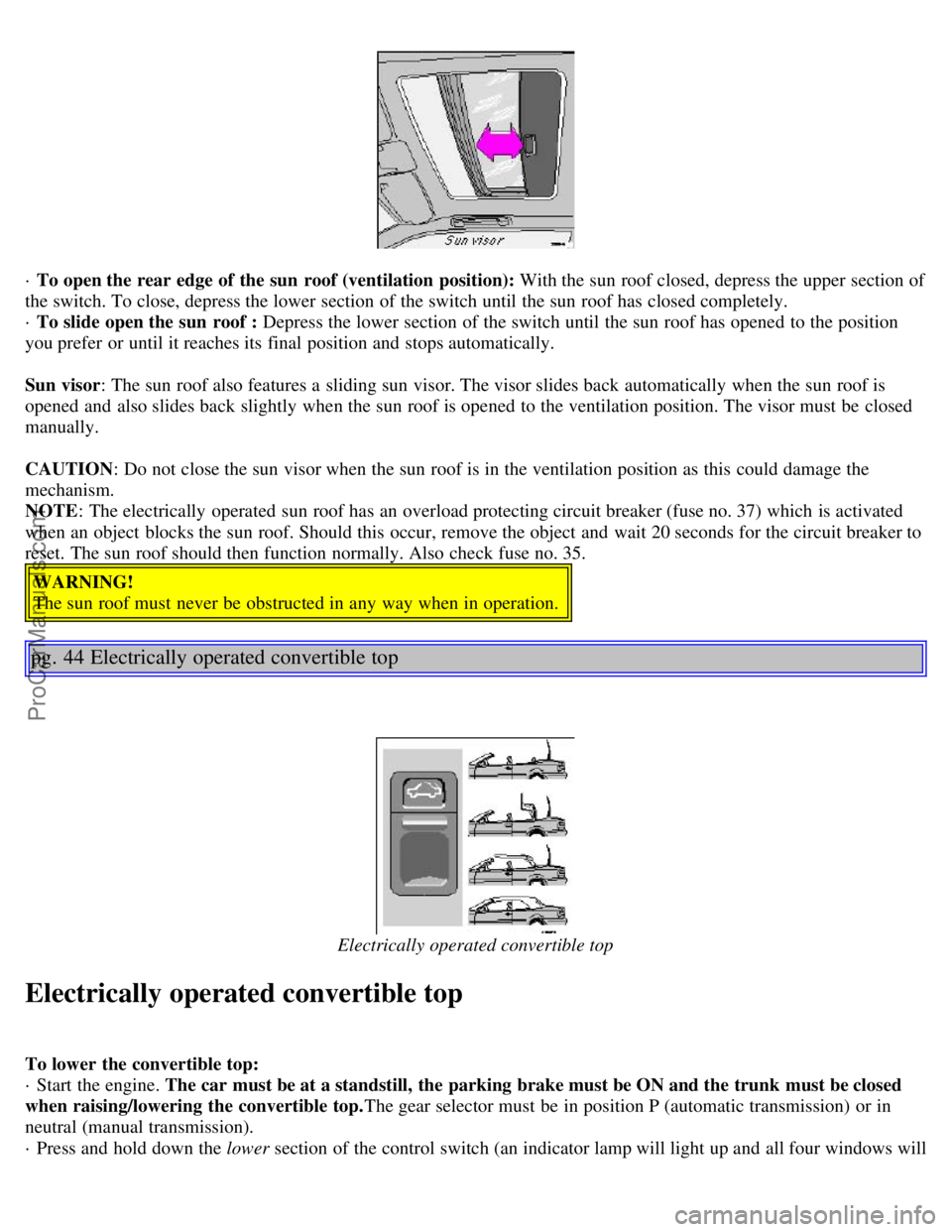
· To open the rear edge of the sun roof (ventilation position): With the sun roof closed, depress the upper section of
the switch. To close, depress the lower section of the switch until the sun roof has closed completely.
· To slide open the sun roof : Depress the lower section of the switch until the sun roof has opened to the position
you prefer or until it reaches its final position and stops automatically.
Sun visor : The sun roof also features a sliding sun visor. The visor slides back automatically when the sun roof is
opened and also slides back slightly when the sun roof is opened to the ventilation position. The visor must be closed
manually.
CAUTION : Do not close the sun visor when the sun roof is in the ventilation position as this could damage the
mechanism.
NOTE : The electrically operated sun roof has an overload protecting circuit breaker (fuse no. 37) which is activated
when an object blocks the sun roof. Should this occur, remove the object and wait 20 seconds for the circuit breaker to
reset. The sun roof should then function normally. Also check fuse no. 35.
WARNING!
The sun roof must never be obstructed in any way when in operation.
pg. 44 Electrically operated convertible top
Electrically operated convertible top
Electrically operated convertible top
To lower the convertible top:
· Start the engine. The car must be at a standstill, the parking brake must be ON and the trunk must be closed
when raising/lowering the convertible top. The gear selector must be in position P (automatic transmission) or in
neutral (manual transmission).
· Press and hold down the lower section of the control switch (an indicator lamp will light up and all four windows will
ProCarManuals.com
Page 33 of 99

1 Lumbar support
2 Strap for controlling front seat for rear seat passengers
3 Backrest release control lever
4 Power seat control panelPower seat control panel
A-seat front (raise/lower), B-forward/rearward, C-seat rear (raise/lower), D-backrest tilt
WARNING!
The power seats are operable with the ignition OFF. Therefore, children should never be left unattended in the car.
Do not adjust the seat while driving. The seat should be adjusted so that the brake pedal can be depressed fully. In
addition, position the seat as far rearward as comfort and control allow. The seat rails on the floor must not be
obstructed in any way when the seat is moved.
Make sure the seats are securely locked in position after they have been adjusted.
Programming the memory
Three seat positions can be programmed. To program a seat position:
1 Adjust the seat to the desired position.
2 Depress the MEM button.
3 Press button 1 to program the current position of the seat.
Buttons 2 and 3 can be programmed in the same way. To move the seat to a programmed position, depress button 1,
2 or 3 until the seat stops.
If the button is released before the seat has reached the programmed position, the seat will stop as a safety
precaution.
NOTE : The seat has an overload protector which engages if an object blocks the movement of the seat. If this
happens, remove the object and wait 20 seconds before operating the seat again.
WARNING!
Do not adjust the seat while driving. The seat should be adjusted so that the brake pedal can be depressed fully. In
addition, position the seat as far rearward as comfort and control allow. The seat rails on the floor must not be
obstructed in any way when the seat is moved.
ProCarManuals.com
Page 36 of 99
2 0 0 2
VOLVO
C70 Coupe & Convertible
Chapter 4 - Starting and driving
pg. 63 Starting and driving
Page
Fuel requirements, Refueling 64
Driving economy67
Starting the engine68
Manual transmission69
Automatic transmission70
Points to remember72
Roof/trunk-mounted luggage racks74
Emergency towing75
Vehicle towing information76
Jump starting77
Brake/Stability systems78-79
Trailer towing80
Winter driving81
pg. 64 Fuel requirements
NOTE ENGINE OIL:
Although some oil consumption occurs during normal engine operation, more oil is consumed when the engine is new
as the internal parts generate higher friction while wearingin to each other. From the time the engine is new until the
first service is performed, the oil consumption could be higher than normal. For this reason, it is especially
important to check the oil every time you refuel your car during this period. See page 120.
In general, the rate of oil consumption depends on such factors as: engine temperature, length of trip, driving
conditions, oil viscosity and quality, engine speed and acceleration/deceleration.
Checking your engine oil level each time the car is refueled is one of the most important items you can perform to
help keep your car in good running order.
Manual transmission
ProCarManuals.com