light VOLVO C70 2003 User Guide
[x] Cancel search | Manufacturer: VOLVO, Model Year: 2003, Model line: C70, Model: VOLVO C70 2003Pages: 98, PDF Size: 1.64 MB
Page 21 of 98
Windshield wipers/washers
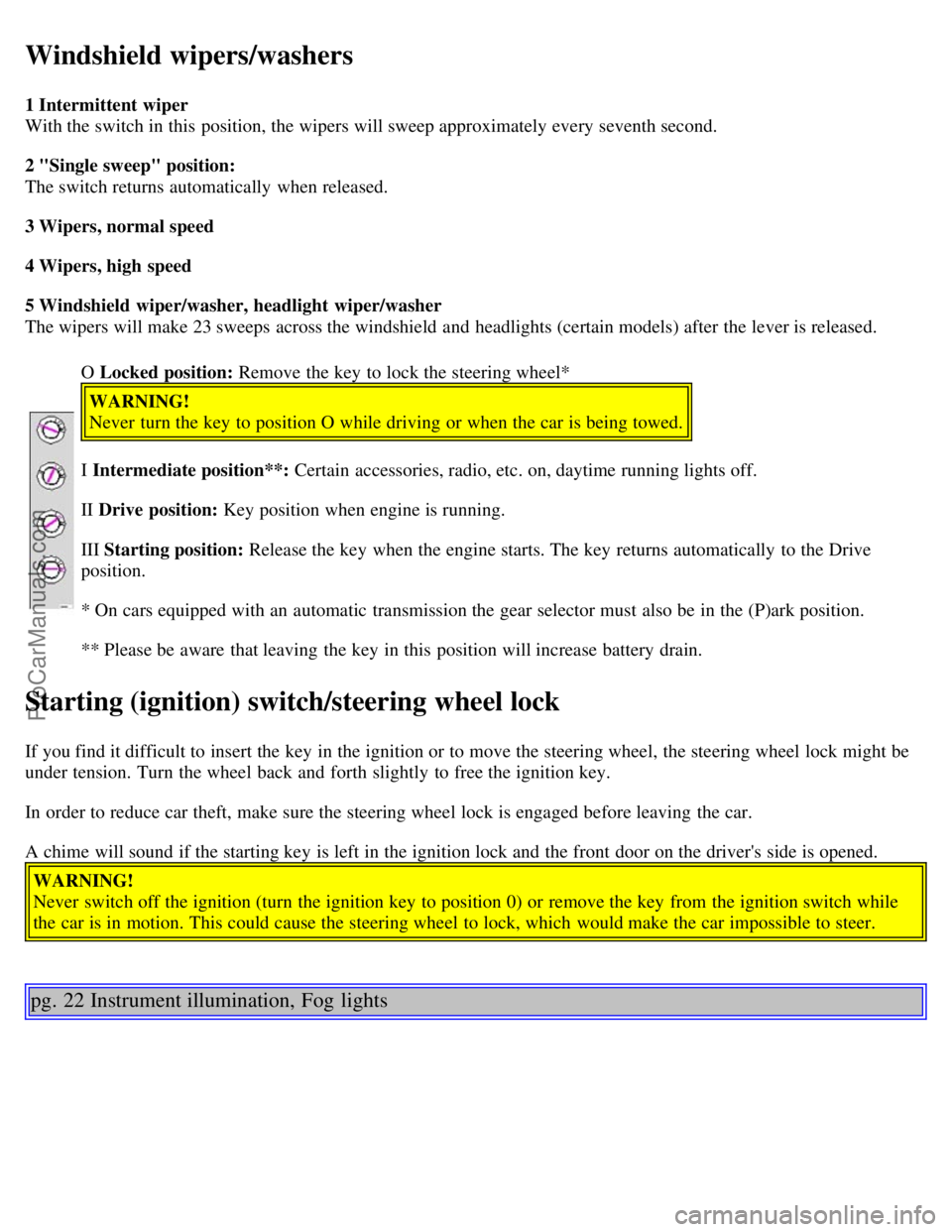
1 Intermittent wiper
With the switch in this position, the wipers will sweep approximately every seventh second.
2 "Single sweep" position:
The switch returns automatically when released.
3 Wipers, normal speed
4 Wipers, high speed
5 Windshield wiper/washer, headlight wiper/washer
The wipers will make 23 sweeps across the windshield and headlights (certain models) after the lever is released.
O Locked position: Remove the key to lock the steering wheel*
WARNING!
Never turn the key to position O while driving or when the car is being towed.
I Intermediate position**: Certain accessories, radio, etc. on, daytime running lights off.
II Drive position: Key position when engine is running.
III Starting position: Release the key when the engine starts. The key returns automatically to the Drive
position.
* On cars equipped with an automatic transmission the gear selector must also be in the (P)ark position.
** Please be aware that leaving the key in this position will increase battery drain.
Starting (ignition) switch/steering wheel lock
If you find it difficult to insert the key in the ignition or to move the steering wheel, the steering wheel lock might be
under tension. Turn the wheel back and forth slightly to free the ignition key.
In order to reduce car theft, make sure the steering wheel lock is engaged before leaving the car.
A chime will sound if the starting key is left in the ignition lock and the front door on the driver's side is opened.
WARNING!
Never switch off the ignition (turn the ignition key to position 0) or remove the key from the ignition switch while
the car is in motion. This could cause the steering wheel to lock, which would make the car impossible to steer.
pg. 22 Instrument illumination, Fog lights
ProCarManuals.com
Page 22 of 98

1 - Instrument illumination
To increase the brightness: move the thumbwheel up.
To decrease the brightness: move the thumbwheel down.
2 - Rear fog light *
The rear fog light (located in the driver's side tail light cluster) is considerably brighter than the normal tail lights and
should be used only when the atmospheric conditions, such as fog, rain, snow, smoke or dust reduce the daytime or
night-time visibility of other vehicles to less than 500 ft (150 meters).
For the rear fog light to function, the low beam headlights must be switched on.
* By design, there is one rear fog light only, located in the driver's side tail light cluster.
3 - Front fog lights
The front fog lights, located in the front spoiler, will only function in combination with the low beam headlights.
4 - Space for optional equipment
5 - Space for optional equipment
Contents | Top of Page
ProCarManuals.com
Page 23 of 98

2 0 0 3
VOLVO C70
Chapter 3 - Body and interior
pg. 39 Body and interior
Page
Convertible top/wind deflector 40
Storage compartments42
Keys, doors and locks43
Remote keyless entry system44
Alarm45
Front seats47
Rear/side view mirrors50
Interior lights, Vanity mirrors52
Long load storage53
Hood54
Opening the trunk55
Trunk light, Spare tire, Jack56
Securing cargo, Avoiding battery drain57
pg. 40 Electrically operated convertible top
Electrically operated convertible top
Electrically operated convertible top
ProCarManuals.com
Page 24 of 98

To lower the convertible top:
Start the engine. The car must be at a standstill, the parking brake must be ON and the trunk must be closed
when raising/lowering the convertible top. The gear selector must be in position P (automatic transmission) or in
neutral (manual transmission).
Press and hold down the lower section of the control switch (an indicator lamp will light up and all four windows
will automatically be lowered slightly) until the convertible top is completely lowered. A chime will indicate when the
top is completely down and properly in place in the storage compartment. The windows can then be raised/lowered
with the "All windows" button on the driver's door.
"All windows" control button
To raise the convertible top:
Press and hold down the upper section of the control switch until the convertible top is completely raised. A chime
will indicate when the top is properly in position.
Check that the cover over the convertible top storage compartment closes completely.
Movement of the convertible top can be stopped at any time by releasing the control switch.
WARNING!
The convertible top must not be obstructed in any way when it is being raised or lowered.
The rear seat should not be occupied while the convertible top is being raised or lowered.
Anyone near the car should be well clear of the convertible top's moving parts before it is raised or lowered.
Children should never be allowed to play with the convertible top control switch.
CAUTION: If the cover over the convertible top storage space is not completely closed , the trunk lid should NOT be
opened to help avoid scratching the paint.
NOTE:
The electrically operated convertible top has an overload protecting circuit breaker that is activated when an object
blocks the top when it is in motion. If this occurs, remove the object and wait 20 seconds for the circuit breaker to reset
before trying to raise/lower the top again.
See page 102
for fault tracing information and instructions on manually raising the convertible top.
The trunk cannot be opened and the power windows/power antenna cannot be operated while the convertible top is
being raised/lowered.
pg. 41 Electrically operated convertible top, Wind deflector
CAUTION:
Be sure there is sufficient clearance above the car before raising/lowering the convertible top.
ProCarManuals.com
Page 27 of 98

One turn with the key towards lock in the drivers door locks both doors and the trunk.
Use the switch on the front door armrests to lock/unlock the car from the inside.
Check the action of the button on the other door to verify its function (lock/ unlock).
WARNING!
If the doors are locked while driving, this may hinder rapid access to the occupants of the car in the event of an
accident. (Also see information on "Child safety locks").
NOTE :
If a door is not closed completely, the courtesy lights will stay on and a chime will sound until the door is closed.
As an added anti-theft measure, new keys have been developed which may take slightly longer to copy or replace if
the original keys are misplaced. Duplicate keys may be ordered from your Volvo retailer.
Immobilizer (start inhibitor)
Each of the keys supplied with your car contains a coded transmitter and receiver (transponder). The code in the key is
transmitted to an antenna in the ignition switch where it is compared to the code stored in the start inhibitor module.
The car can only be started if a properly coded key is used.
If you misplace a key, take the other keys to an authorized Volvo retailer. The existing code in the start inhibitor
module and all the keys will be erased as an antitheft measure and a new code will be programmed in.
NOTE: Not more than one of the keys for your car should be kept on the same key ring. This could cause conflicting
signals to be transmitted to the ignition switch, making it impossible to start the car.
This device complies with part 15 of the FCC rules. Operation is subject to the following condition: (1) This device
may not cause harmful interference, and (2) this device must accept any interference received, including interference
that may cause undesired operation.
The key number codes are stamped on a separate tag supplied with the keys. This tag should be separated from the key
ring and kept in a safe place.
pg. 44 Remote keyless entry system
Remote keyless entry system
Your car is equipped with a remote control transmitter. This transmitter uses a radio frequency which will allow
"keyless" entry into the passenger compartment or the trunk. You will be supplied with two coded key ring
ProCarManuals.com
Page 29 of 98

LED alarm status indicator
Alarm
The radio signal emitted from the transmitter, which is used to set/unset the alarm, is a "rolling code" signal. This
means that the signal is changed randomly for each transmission and is intended to help prevent unauthorized
recording of the code.
When armed (set), the alarm continuously monitors a number of points on the car. The following conditions will set off
the alarm:
The hood is opened
The trunk is opened
A door is opened
The ignition switch is tampered with
The car is lifted or towed (if the car is equipped with the optional inclination sensor)
The battery is disconnected (if the car is equipped with the optional backup battery siren). The alarm will sound for
ten 30 second intervals, with a 5 second pause between intervals. This function cannot be interrupted.
Arming (setting) the alarm
Press the LOCK button on the remote control, lock the car using the key in the driver's door or press the central lock
button on one of the doors with the door open. One long flash of the turn signals will confirm that the alarm is set.
Disarming the alarm
Press the UNLOCK button on the remote control or unlock the doors with the key.
Turning off (stopping) the alarm
If the alarm is sounding, it can be stopped by pressing the UNLOCK button on the remote control or by unlocking the
driver's door with the key.
If the alarm is stopped with the remote control, this will be confirmed by two short flashes from the turn signals.
"Panic" function
In an emergency situation, this feature can be used to attract attention.
Activate the "panic" function by pressing the red panic button on the remote control for at least 3 seconds or by
pressing this button twice within 3 seconds. The turn signals will flash, the interior lights will go on and the alarm will
sound.
The function can be turned off by pressing any of the buttons on the remote control or will stop automatically after 25
ProCarManuals.com
Page 30 of 98

seconds.
NOTE: This button will NOT unlock the car.
Audible alarm signal
An audible alarm signal is given either by a separate alarm horn or by the optional backup siren. One alarm cycle lasts
for 30 seconds.
Visual alarm signal
The visual alarm signal is given by flashing all turn signals and turning on the interior lighting for approximately 5
minutes.
pg. 46 Alarm
Automatic reset function
If only the driver's door is unlocked with the remote control, the lock will automatically re-engage (re-lock) and the
alarm will reset after 2 minutes unless the door has been opened.
Temporarily disconnecting the alarm sensor(s)
In certain situations it may be desirable to disconnect the optional alarm sensors, particularly the inclination sensor, if,
for example, you drive your car onto a ferry where the rocking of the boat could trigger the alarm.
To temporarily disconnect the sensor(s) from the alarm system:
With both doors closed, switch off the ignition and remove the key from the ignition switch
Press the locking (left) side of the central locking button on the driver's door for at least 3 seconds
The doors will first lock and then unlock after 3 seconds to confirm that the sensors have been disconnected
The car can then be locked in the usual way to set the alarm.
NOTE: The sensors will automatically be reconnected to the alarm system the next time the ignition is switched on.
LED alarm status signals
The status of the alarm system is indicated by the red LED at the top center of the dash:
LED off - the alarm is not armed (set)
LED flashes once per second - the alarm is armed (set)
LED flashes rapidly before the ignition is switched on - the alarm has been triggered
LED flashes rapidly for 15 seconds after the ignition has been switched on - a fault has been detected in the alarm
system. Contact a Volvo retailer.
ProCarManuals.com
Page 33 of 98

1. Lift the control lever on the side of the front seat (A)
2. Tilt the backrest forward to reach objects in the rear seat.
Moving the seat forward
1. Lift and hold up the control lever on the side of the front seat (A).
2. Tilt the backrest forward (B) and release the lever.
Electrically operated seats: The seat will slide forward until it reaches the forward-most position.
Manually operated passenger's seat*: When the backrest has been tilted forward , the seat can be moved
forward/rearward without holding the control on the side of the seat .
To tilt up the backrest to its normal position:
1. Press the backrest slightly forward and pull the control lever up to release the backrest locking mechanism.
2. Tilt the backrest toward the rear of the car.
3. Electrically operated seats: Push up the control lever, move the backrest to the upright position and release the
lever. The seat will move to its previously programmed position.
Manually operated passenger's seat*: move the seat to the desired position.
To exit the rear seat:
Pull the strap on the lower inside corner of the seat (C) and push the backrest forward. Release the strap.
The seat will slide forward until it reaches its forward-most position (electrically operated seats). If the car is
equipped with a manually operated passenger's seat, push the seat forward.
*Please see the following page for information on adjusting the manually operated passenger's seat.
WARNING!
To stop a moving electrically operated seat; push the backrest slightly forward or backward.
pg. 49 Front seats
Manually operated passenger's seat (certain models)
1 Height adjustment
The front section of the seat can be adjusted to 7 different height settings (lever A) and the rear section can be adjusted
to 9 different height settings (lever B).
2 Forward-rearward seat adjustment
ProCarManuals.com
Page 36 of 98

The following speeds should not be exceeded during the breakin period:Up to 600 miles
(1000 km) 600 1,200 miles
(1000 2000 km)
1st gear 20 mph (30 km/h) 25 mph (40 km/h)
2nd gear 30 mph (50 km/h) 40 mph (70 km/h)
3rd gear 45 mph (80 km/h) 65 mph (100 km/h)
4th gear 70 mph (110 km/h) 80 mph (130 km/h)
5th gear 80 mph (130 km/h) 95 mph (150 km/h)
Posted speed limits should not be exceeded.
Deposit control (detergent) gasoline
Volvo recommends the use of detergent gasoline to control engine deposits. Detergent gasoline is effective in keeping
injectors and intake valves clean. Consistent use of deposit control gasolines will help ensure good driveability and
fuel economy. If you are not sure whether the gasoline contains deposit control additives, check with the service
station operator.
Unleaded fuel
Each Volvo has a three-way catalytic converter and must use only unleaded gasoline. U.S. and Canadian regulations
require that pumps delivering unleaded gasoline be labelled "UNLEADED". Only these pumps have nozzles which fit
your car's filler inlet. It is unlawful to dispense leaded fuel into a vehicle labelled "unleaded gasoline only". Leaded
gasoline damages the three-way catalytic converter and the heated oxygen sensor system. Repeated use of leaded
gasoline will lessen the effectiveness of the emission control system and could result in loss of emission warranty
coverage. State and local vehicle inspection programs will make detection of misfueling easier, possibly resulting in
emission test failure for misfueled vehicles.
NOTE : Some U.S. and Canadian gasolines contain an octane enhancing additive called methly-cyclopentadienyl
manganese tricarbonyl (MMT). If such fuels are used, your Emission Control System performance may be affected,
and the Malfunction Indicator Lamp located on your instrument panel may light. If this occurs, please return your
vehicle to an authorized Volvo retailer for service.
Octane rating
Volvo engines are designed for optimum performance on unleaded premium gasoline with an octane rating. AKI of 91,
or above. AKI (ANTI KNOCK INDEX) is an average of the Research Octane Number, RON, and the Motor Octane
Number, MON. (RON + MON/2).
The minimum octane requirement is AKI 87 (RON 91).
pg. 61 Fuel requirements
Fuel Formulations
ProCarManuals.com
Page 38 of 98
Fuel filler door control on driver's door
Refueling
The fuel tank holds approximately 17.9 US gal. (68 liters) with sufficient volume left over to accommodate possible
expansion of the fuel in hot weather. Be aware that the "usable" tank capacity will be somewhat less than the specified
maximum. When the fuel level is low, such factors as ambient temperature, the fuel's "Reid vapor pressure"
characteristics, and terrain can affect the fuel pumps' ability to supply the engine with an adequate supply of fuel.
Therefore, it is advisable to refuel as soon as possible when the needle nears the red zone, or when the fuel warning
light comes on.
Fuel filler door
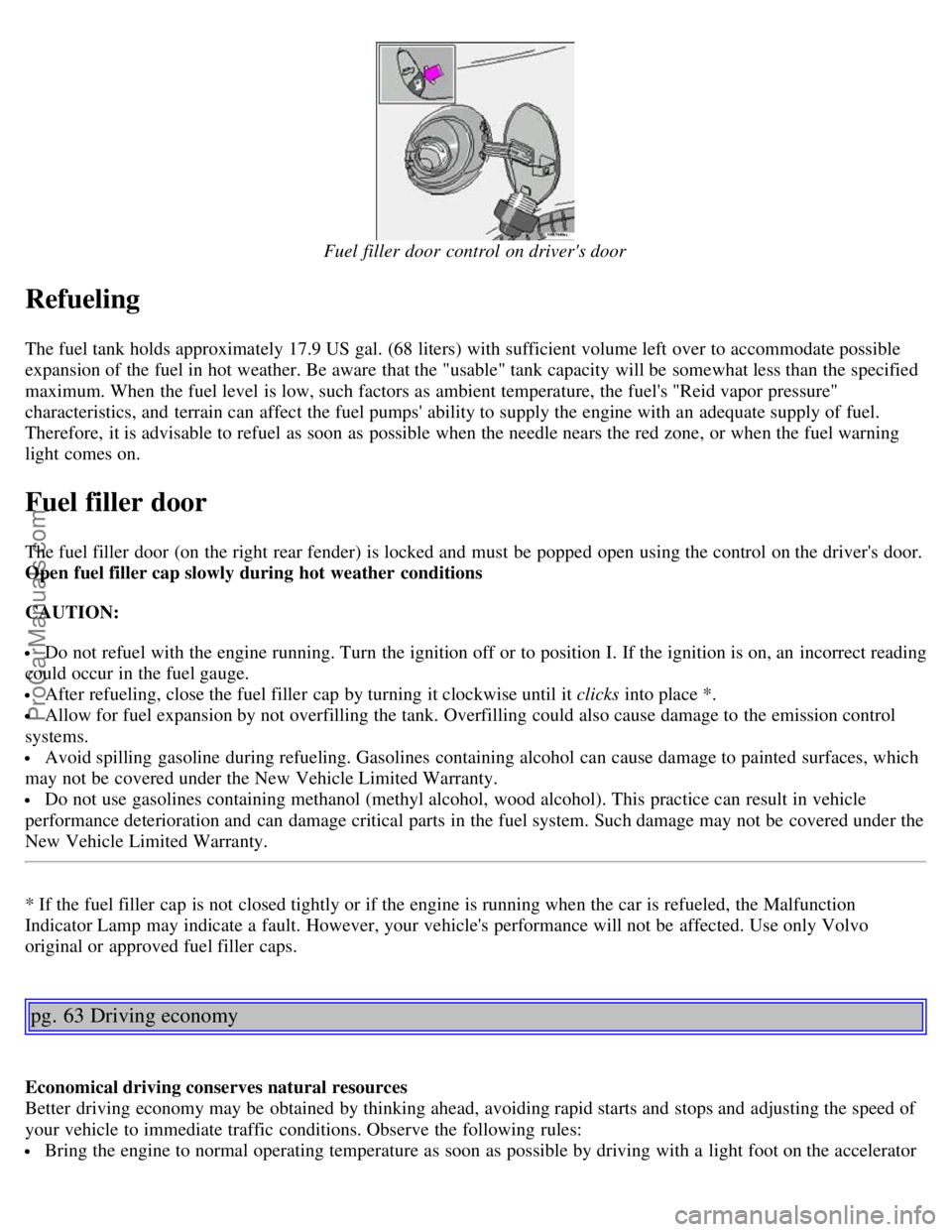
The fuel filler door (on the right rear fender) is locked and must be popped open using the control on the driver's door.
Open fuel filler cap slowly during hot weather conditions
CAUTION:
Do not refuel with the engine running. Turn the ignition off or to position I. If the ignition is on, an incorrect reading
could occur in the fuel gauge.
After refueling, close the fuel filler cap by turning it clockwise until it clicks into place *.
Allow for fuel expansion by not overfilling the tank. Overfilling could also cause damage to the emission control
systems.
Avoid spilling gasoline during refueling. Gasolines containing alcohol can cause damage to painted surfaces, which
may not be covered under the New Vehicle Limited Warranty.
Do not use gasolines containing methanol (methyl alcohol, wood alcohol). This practice can result in vehicle
performance deterioration and can damage critical parts in the fuel system. Such damage may not be covered under the
New Vehicle Limited Warranty.
* If the fuel filler cap is not closed tightly or if the engine is running when the car is refueled, the Malfunction
Indicator Lamp may indicate a fault. However, your vehicle's performance will not be affected. Use only Volvo
original or approved fuel filler caps.
pg. 63 Driving economy
Economical driving conserves natural resources
Better driving economy may be obtained by thinking ahead, avoiding rapid starts and stops and adjusting the speed of
your vehicle to immediate traffic conditions. Observe the following rules:
Bring the engine to normal operating temperature as soon as possible by driving with a light foot on the accelerator
ProCarManuals.com