fuel VOLVO C70 2003 Owner's Manual
[x] Cancel search | Manufacturer: VOLVO, Model Year: 2003, Model line: C70, Model: VOLVO C70 2003Pages: 98, PDF Size: 1.64 MB
Page 69 of 98

2 0 0 3
VOLVO C70
Chapter 9 - Specifications
pg. 125 Specifications
Page
Oil/fluids specifications 126
Engine specifications127
Cooling/fuel/distributor ignition systems128
Front/rear suspensions128
Transmission, Capacities, Vehicle loading129
Electrical system/bulbs130
Dimensions and weights131
On Call Road assistance132
pg. 126 Oil/fluid specifications
Engine Oil
Meeting or exceeding ILSAC specification GF-2, including ACEA A1, API SJ, SJ/CF, and SJ/Energy Conserving.
Oil additives must not be used.
Engine oil Quality:
Meeting API SJ, SJ/CF, and SJ/Energy
Conserving. Capacity (incl. filter)
: 6.2 US
qts. (5.8 liters)
Automatic
transmission fluid Quality:
AW5. Only Volvo gearbox oil (1161540-8). Do
not mix with other oils.. Capacity:
8 US qts. (7.5 liters)
Manual transmission
fluid Quality:
Volvo synthetic gearbox oil 1161423 Capacity: 2.2 US qts. (2.1 liters)
Power steering fluid Quality: ATF Capacity:
0.95 US qts. (0.9
liters)
Brake fluid Quality: DOT 4+ boiling point > 536°F (280°C), P/N
9437433 Capacity:
0.64 US qts. (0.6
liters)
All specifications are subject to change without notice.
ProCarManuals.com
Page 70 of 98
pg. 127 Engine specifications
Engine
Liquid-cooled gasoline, 5-cylinder, in-line engine. Aluminum alloy cylinder block with cast-iron cylinder liners cast
directly into the block. Aluminum alloy cylinder head with double overhead camshafts and separate intake and outlet
channels.
Engine lubrication is provided by an eccentric pump driven from the crankshaft. Full-flow type oil filter. Exhaust
emission control is accomplished by multiport fuel injection, heated oxygen sensor(s) and three-way catalytic
converter.
Charge air cooler (Intercooler)
Turbocharged engines employ a turbo-compressor to force air into the engine inlet manifold and a charge air cooler to
cool the compressed inlet air. The resulting increase in air flow raises pressure in the intake manifold by approx. 8.7
psi (over atmospheric pressure) and engine power output by approx. 50 horsepower over that developed by the
normally-aspirated engine. The charge air cooler (which resembles a radiator) is located between the turbo-compressor
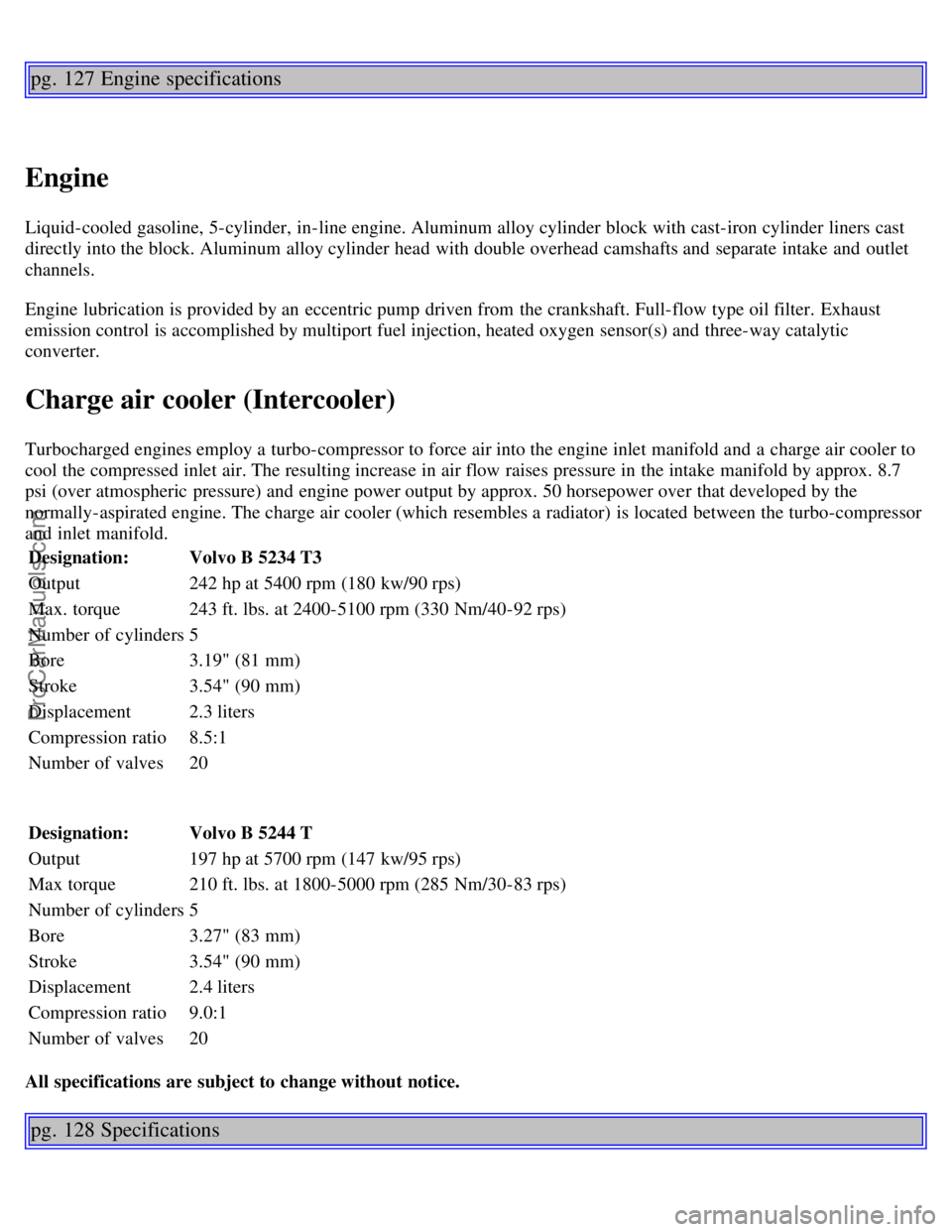
and inlet manifold.Designation: Volvo B 5234 T3
Output 242 hp at 5400 rpm (180 kw/90 rps)
Max. torque 243 ft. lbs. at 2400-5100 rpm (330 Nm/40-92 rps)
Number of cylinders 5
Bore 3.19" (81 mm)
Stroke 3.54" (90 mm)
Displacement 2.3 liters
Compression ratio 8.5:1
Number of valves 20
Designation: Volvo B 5244 T
Output 197 hp at 5700 rpm (147 kw/95 rps)
Max torque 210 ft. lbs. at 1800-5000 rpm (285 Nm/30-83 rps)
Number of cylinders 5
Bore 3.27" (83 mm)
Stroke 3.54" (90 mm)
Displacement 2.4 liters
Compression ratio 9.0:1
Number of valves 20
All specifications are subject to change without notice.
pg. 128 Specifications
ProCarManuals.com
Page 71 of 98

Cooling system
Type: Positive pressure, closed system
Thermostat begins to open at 180° F (87° C)
Coolant: Volvo original coolant/antifreeze
Capacity: 7.4 US qts. (7.0 liters)
Fuel system
The engine is equipped with a multiport fuel injection system.
Distributor ignition system
Firing order: 1-2-4-5-3
Distributor ignition setting: Not adjustable
Spark plugs: Champion RC87PYP (or equivalent)
Spark plug gap: 0.03" (0.75 mm)
Tightening torque: 18.4 ft. lbs. +/- 3.7 ft. lbs. (25 Nm +/- 5 Nm)WARNING!
The distributor ignition system operates at very high voltages. Special safety precautions must be followed to
prevent injury. Always turn the ignition off when:
Replacing distributor ignition components e.g. plugs, coil, etc.
Do not touch any part of the distributor ignition system while the engine is running. This may result in unintended
movements and body injury.
All specifications are subject to change without notice.
Front suspension
Spring strut suspension with integrated shock absorbers and control arms linked to the support frame. Power-assisted
rack and pinion steering. Safety type steering column.
The alignment specifications apply to an unladen car but include fuel, coolant and spare wheel.
Toe-in measured on the wheel rims: 2.4 mm +/- 0.7 mm
Toe-in measured on tire sides: 2.9 +/- 0.9 mm
Rear suspension
Delta-link individual rear wheel suspension with longitudinal support arms, double link arms and track rods.
Toe-in measured on the tire sides: 4° +/- 10°
ProCarManuals.com
Page 72 of 98

pg. 129 Specifications
Power transmission
Manual transmission: M 56 H
Single-disc dry plate clutch. All-synchromesh on all gears including reverse; integrated final drive. Operation via a
floor mounted gear lever.Final drive ratio 4.00:1
Reduction ratios
1st gear 3.07:1
2nd gear 1.77:1
3rd gear 1.19:1
4th gear 0.87:1
5th gear 0.70:1
Reverse 2.99:1
Automatic transmission: AW 55-50 LE
4 or 5-speed automatic electronically controlled gearbox comprising a hydraulic torque converter with a lockup
function; planetary gear, integrated final drive.
Operation via a floor mounted gear selector lever. Drive shafts with symmetrical joint location. Overdrive. Final drive ratio 2.44:1
Reduction ratios
1st gear 4.77:1
2nd gear 3.00:1
3rd gear 1.96:1
4th gear 1.32:1
5th gear 1.02:1
Reverse 3.23:1
Capacities
Fuel tank 17.9 US gals (68 liters)
Cooling system 7.4 US qts. (7.0 liters)
Engine oil (incl. filter) 6.1 US qts. ( 5.8 liters)
Automatic transmission 2 US gals (7.6 liters)
Manual transmission 2.2 US qts. (2.1 liters)
Power steering fluid 0.95 US qts (0.9 liters)
Washer fluid reservoir 4.7 US qts. (4.5 liters)
Brake/clutch system 0.6 US qts (0.6 liters)
ProCarManuals.com
Page 73 of 98
Vehicle loading
The tires on your Volvo should perform to specifications at all normal loads when inflated as recommended on the tire
information label. The label is located on the inside of the fuel filler flap. The label lists vehicle load limits. Do not
load your car beyond the indicated limits.WARNING!
Improperly inflated tires will reduce tire life, adversely affect vehicle handling and can possibly lead to failure
resulting in loss of vehicle control without prior warning.
All specifications are subject to change without notice.
pg. 130 Specifications
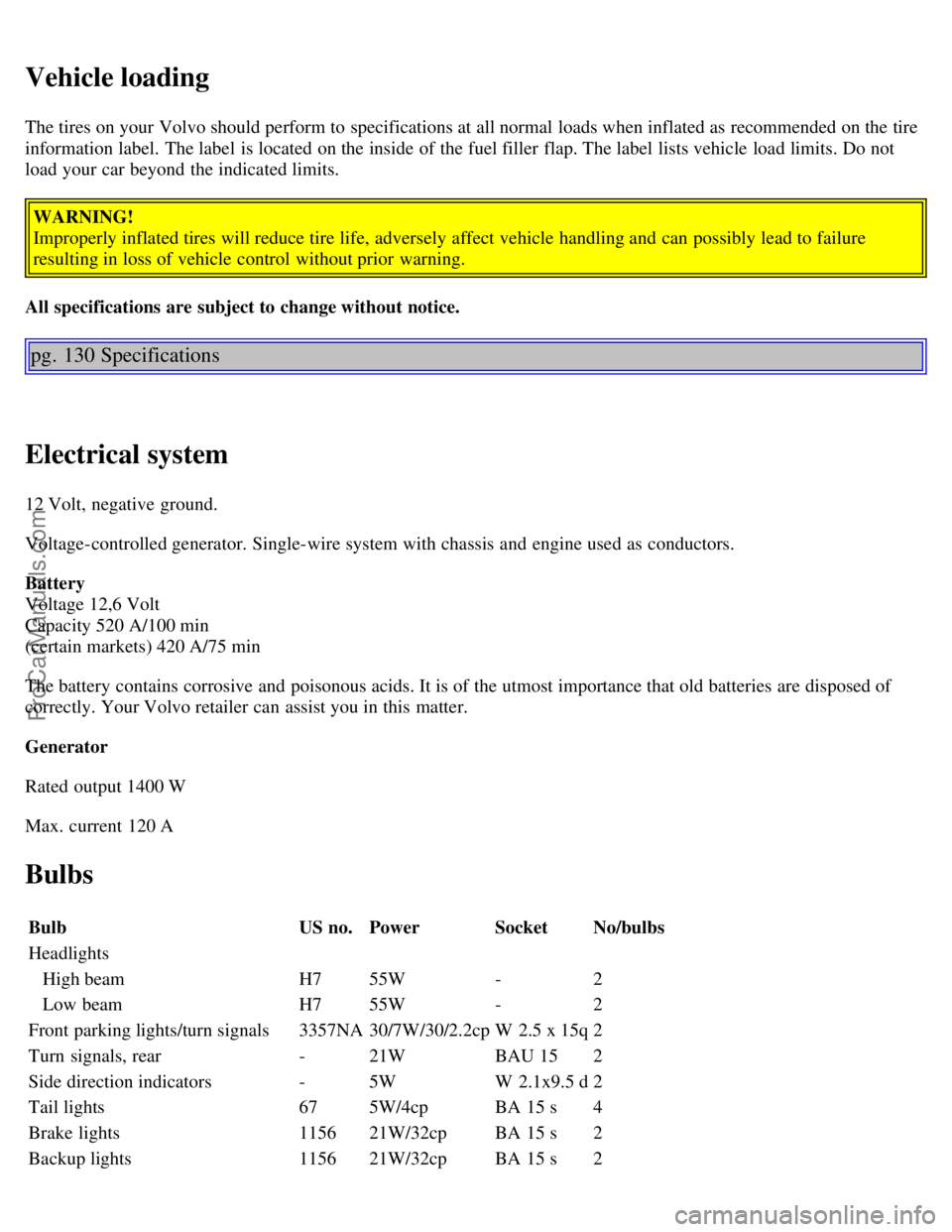
Electrical system
12 Volt, negative ground.
Voltage-controlled generator. Single-wire system with chassis and engine used as conductors.
Battery
Voltage 12,6 Volt
Capacity 520 A/100 min
(certain markets) 420 A/75 min
The battery contains corrosive and poisonous acids. It is of the utmost importance that old batteries are disposed of
correctly. Your Volvo retailer can assist you in this matter.
Generator
Rated output 1400 W
Max. current 120 A
Bulbs
Bulb US no.Power SocketNo/bulbs
Headlights
ProCarManuals.com
Page 91 of 98
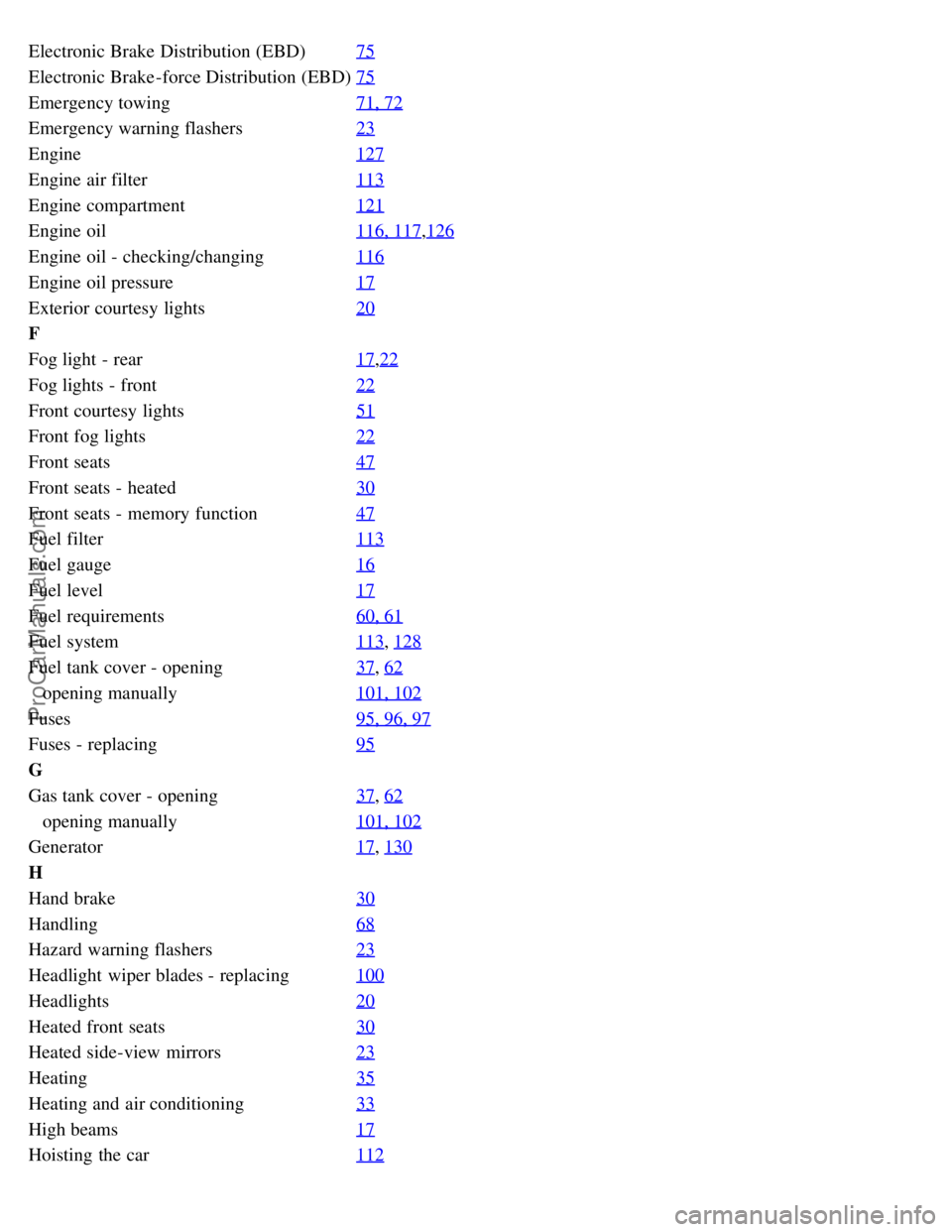
Electronic Brake Distribution (EBD)75
Electronic Brake-force Distribution (EBD)75
Emergency towing71, 72
Emergency warning flashers23
Engine127
Engine air filter113
Engine compartment121
Engine oil116, 117,126
Engine oil - checking/changing116
Engine oil pressure17
Exterior courtesy lights20
F
Fog light - rear17
,22
Fog lights - front22
Front courtesy lights51
Front fog lights22
Front seats47
Front seats - heated30
Front seats - memory function47
Fuel filter113
Fuel gauge16
Fuel level17
Fuel requirements60, 61
Fuel system113, 128
Fuel tank cover - opening37, 62
opening manually101, 102
Fuses95, 96, 97
Fuses - replacing95
G
Gas tank cover - opening37
, 62
opening manually101, 102
Generator17, 130
H
Hand brake30
Handling68
Hazard warning flashers23
Headlight wiper blades - replacing100
Headlights20
Heated front seats30
Heated side-view mirrors23
Heating35
Heating and air conditioning33
High beams17
Hoisting the car112
ProCarManuals.com
Page 93 of 98

Polishing107
Power seats47
Power steering fluid118, 126
R
Radio
-General information186
-SC-813134
-SC-816147
-SC-900/01163
Radio Data System - RDS168
Rear fog light17, 22
Rear suspension128
Rear window demister23
Rear/side-view mirrors50
Refueling62
Remote control (central locking system)44
Remote keyless entry system44
Replacing bulbs89-94
Replacing fuses95
Reporting safety defects13
Road assistance132
Roadholding68
Roll Over Protection System (ROPS)10
Rotating tires82
S
Safety defects - reporting13
Seat belt maintenance13
Seat belts2,3,11
- Automatic Locking Retractor11
- Emergency Locking Retractor11
Seat belts - cleaning108
Seats47
Seats - heated30
Securing cargo57
Service reminder indicator17
Servicing112, 114
Shift lock64
Shiftlock66
Shiftlock release (override)101
Side Impact Protection System (SIPS)8
Side-view mirrors - heated23
SIPS8
Snow chains81
Snow tires81
ProCarManuals.com
Page 97 of 98

A driver has a responsibility to do everything possible to ensure his or her own safety and the safety of passengers in
the vehicle and others sharing the roadway. Avoiding distractions is part of that responsibility.
The following should be checked regularly: *
1 Washer fluid reservoir should be filled with water and solvent (wintertime: windshield washer anti-freeze). See
page 119.
2 Coolant level should be between the expansion tank marks. Mixture: 50% anti-freeze and 50% water. See page 120.
3 Power steering - When cold, the level must not be above the COLD mark and when hot it must not be above the
HOT mark. Top up if the level drops to the ADD mark with ATF fluid. See page 118.
4 Engine oil level should be between the dipstick marks. The distance between the marks represents approx. 1.6 US
qts
(1.5 liters). See page 116.
5 Brake fluid - check, without removing the cap, that the level is above the MIN mark. Use brake fluid DOT 4+. See
page 118.
* Engine oil should be checked each time the car is refuelled.
Octane rating, see page 60.
Tire pressure, see label located on the rear edge of the right front door.
Bulbs Power Socket US no.
1 55 W - H7
2 30/7 W BA 15s 3357NA
3 55 W PK 22s H1
4 5 W BA 15s 67
ProCarManuals.com