ECU VOLVO C70 2003 Owners Manual
[x] Cancel search | Manufacturer: VOLVO, Model Year: 2003, Model line: C70, Model: VOLVO C70 2003Pages: 98, PDF Size: 1.64 MB
Page 6 of 98
Always fasten the seat belts before you drive or ride.
Two lights above the rear view mirror will be illuminated for 4-8 seconds after the starting (ignition) key is turned to
the driving position. A chime will sound at the same time if the driver has not fastened his seat belt. The rear seats are
provided with self -retracting inertia reel belts. The front seats are provided with single roller belts with tensioners.
To buckle:
Pull the belt out far enough to insert the latch plate into the receptacle (buckle for rear seats) until a distinct snapping
sound is heard. The seat belt retractor is normally "unlocked" and you can move freely, provided that the shoulder belt
is not pulled out too far.
The retractor will lock up as follows:
if the belt is pulled out rapidly
during braking and acceleration
if the vehicle is leaning excessively
when driving in turns
For the seat belt to provide maximum protection in the event of an accident, it must be worn correctly. When wearing
the seat belt remember:
The belt should not be twisted or turned.
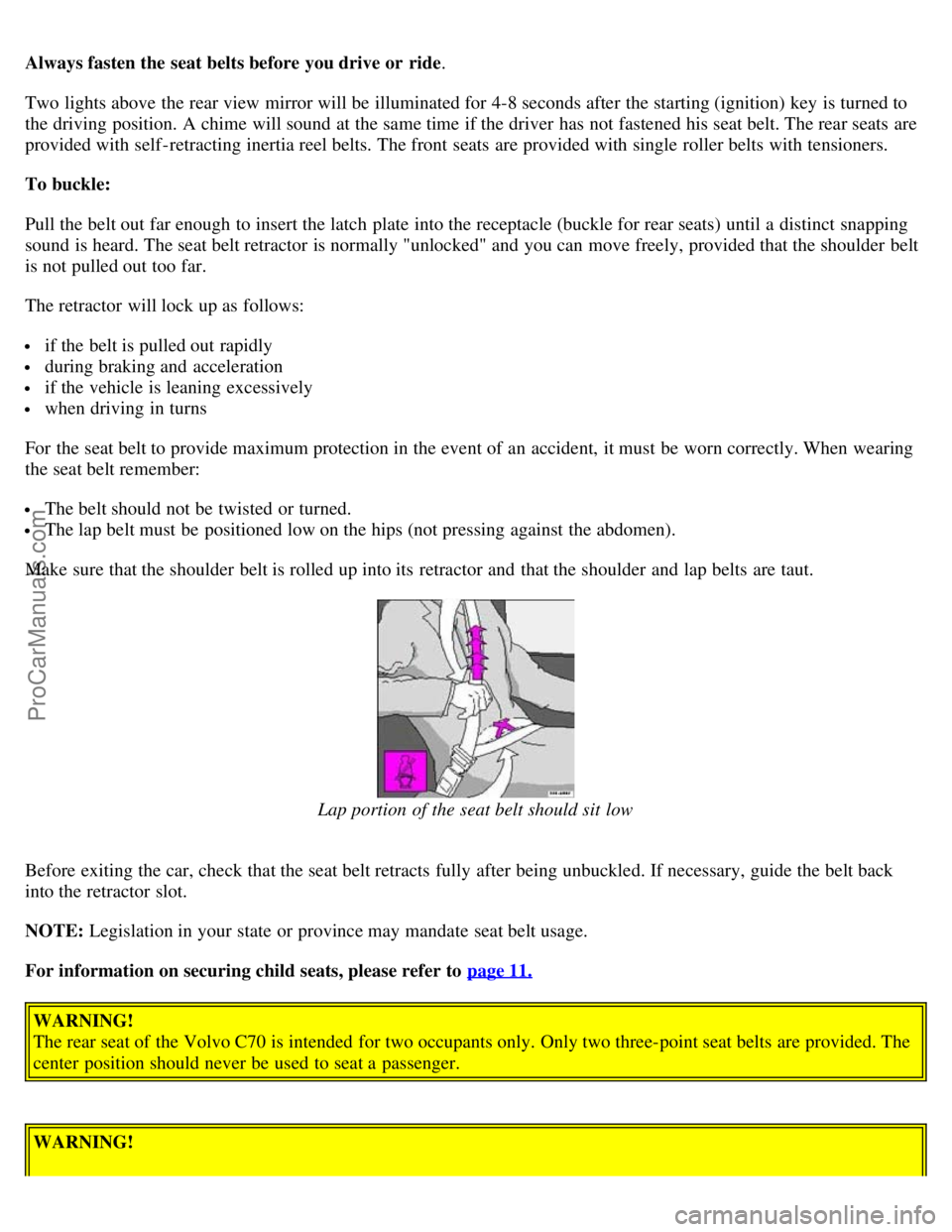
The lap belt must be positioned low on the hips (not pressing against the abdomen).
Make sure that the shoulder belt is rolled up into its retractor and that the shoulder and lap belts are taut.
Lap portion of the seat belt should sit low
Before exiting the car, check that the seat belt retracts fully after being unbuckled. If necessary, guide the belt back
into the retractor slot.
NOTE: Legislation in your state or province may mandate seat belt usage.
For information on securing child seats, please refer to page 11.
WARNING!
The rear seat of the Volvo C70 is intended for two occupants only. Only two three-point seat belts are provided. The
center position should never be used to seat a passenger.
WARNING!
ProCarManuals.com
Page 23 of 98

2 0 0 3
VOLVO C70
Chapter 3 - Body and interior
pg. 39 Body and interior
Page
Convertible top/wind deflector 40
Storage compartments42
Keys, doors and locks43
Remote keyless entry system44
Alarm45
Front seats47
Rear/side view mirrors50
Interior lights, Vanity mirrors52
Long load storage53
Hood54
Opening the trunk55
Trunk light, Spare tire, Jack56
Securing cargo, Avoiding battery drain57
pg. 40 Electrically operated convertible top
Electrically operated convertible top
Electrically operated convertible top
ProCarManuals.com
Page 25 of 98

Volvo recommends that you raise the convertible top and close the windows when you leave the car to help deter
thefts and to protect the interior from rain, windblown dust, etc.
No objects should be placed in the convertible top storage compartment. This could damage the convertible top
mechanism.
Roof racks may not be attached to or placed on the convertible top. See page 74 for information on trunk-mounted
luggage racks.
Ice scrapers should not be used to remove snow from the convertible top.
Do not lower the convertible top if it is frozen. The top should not be raised/lowered if the temperature is below 32°
F (0° C).
The top should be completely dry before it is lowered and stored in the storage compartment to help prevent damage
from mildew.
See page 107
for information on cleaning the convertible top.
Wind deflector (option/accessory)
Installing the wind deflector:
Fold out the panels on the sides of the wind deflector (1).
Slide the two metal slats on the wind deflector under the rear seat head restraints (2). Slide them carefully to avoid
damaging the upholstery.
Press the catches (3) into the holes provided in the side panel until they click into place.
Raise the wind deflector (4) 90°.
NOTE: The panels on the sides of the wind deflector can be folded under so that the deflector can be stored in the
trunk. The catches (3) must be pushed in (toward the center of the car) before the panels can be folded.
WARNING!
The wind deflector must be securely attached to help avoid injury to the occupants of the car or to other motorists.
pg. 42 Storage compartments
WARNING!
Packages on the rear window shelf can obscure vision and may become dangerous projectiles in the event of a
sudden stop or an accident.
ProCarManuals.com
Page 28 of 98

transmitters, which will enable you to lock/unlock both doors and the trunk from a distance of 10-15 feet (3-5 meters).
On vehicles equipped with an alarm, the alarm will also be activated/deactivated by this system.
The car can also be locked/unlocked with the key.
As an extra security precaution in certain situations (valet parking, etc.), Volvo recommends that the transmitter not be
included when the keys are given to anyone. The service key can be used instead. If one of the transmitters is
misplaced, contact the nearest authorized Volvo retailer for assistance.
Using the remote control
Press the LOCK button once to lock both doors and the trunk.
Press the UNLOCK button once to unlock the driver's door only. Press this button again (within 10 seconds) to
unlock both doors and the trunk.
Press the OPEN trunk button twice within 3 seconds to pop open the trunk.
NOTE :
If only the driver's door is unlocked, the lock will automatically re-engage (re-lock) and the alarm will reset after 2
minutes unless the door has been opened.
The lock/unlock and alarm features can also be utilized by using the keys. See page 43.
If the alarm LED glows continuously for 5 seconds, this indicates a fault in the system or that a door is not properly
closed.
To avoid leaving your keys in the car, make a habit of always locking the car with the remote control.
WARNING!
Volvo does not recommend using the transmitter to lock the doors from inside the car. On cars equipped with an
alarm, the alarm would be activated and would sound when one of the doors is opened. The doors must not be
locked using the remote transmitter while the vehicle is occupied. In case of an accident, this may hinder rapid
access to the occupants of the vehicle. The alarm will also sound on models equipped with this feature.
This device complies with part 15 of the FCC rules. Operation is subject to the following conditions: (1) This device
may not cause harmful interference, and (2) this device must accept any interference received, including interference
that may cause undesired operation.
* See also page 45
.
pg. 45 Alarm (certain models)
ProCarManuals.com
Page 31 of 98

Batteries
Each remote transmitter is powered by a three-volt battery, type CR 2016. If the range of the transmitter is noticeably
reduced, this indicates that the battery is weak and should be replaced.
Replacement: Remove the battery cover on the back of the transmitter with a coin. Replace the battery. Reinstall the
cover, making sure it is secured tightly to help protect the transmitter.
CAUTION: Do not attempt to service or repair any components of the alarm system yourself. This should only be
done by an authorized Volvo retailer.
pg. 47 Front seats
Electrically operated seats with memory function
1 Lumbar support
2 Strap for controlling front seat for rear seat passengers
3 Backrest release control lever
4 Power seat control panel
Power seat control panel
A-seat front (raise/lower), B -forward/rearward, C-seat rear (raise/lower), D -backrest tilt
WARNING!
ProCarManuals.com
Page 32 of 98

The power seats are operable with the ignition OFF. Therefore, children should never be left unattended in the car.
Do not adjust the seat while driving. The seat should be adjusted so that the brake pedal can be depressed fully. In
addition, position the seat as far rearward as comfort and control allow. The seat rails on the floor must not be
obstructed in any way when the seat is moved.
Make sure the seats are securely locked in position after they have been adjusted.
Memory programming buttons
Programming the seat's memory
Three seat positions can be programmed using the memory function. To program a seat position:
1 Adjust the seat to the desired position.
2 Depress the MEM button.
3 Press button 1 to program the current position of the seat.
Buttons 2 and 3 can be programmed in the same way.
Moving the seat to a programmed position
Depress button 1, 2 or 3 until the seat stops in the programmed position.
If the button is released before the seat has reached the programmed position, the seat will stop as a safety
precaution.
NOTE : The seat has an overload protector which engages if an object blocks the movement of the seat. If this
happens, remove the object and wait 20 seconds before operating the seat again.
Movement of the seat can be STOPPED at any time by pressing any button on the power seat control panel.
pg. 48 Front seats
Tilting the backrests - moving the seats
Tilting the backrest
The backrests are locked in the upright position and can be tilted forward to allow access to the rear seat.
ProCarManuals.com
Page 34 of 98

Pull the bar upward, then slide the seat forward or rearward to the desired position. Make sure that the seat is properly
secured when you release the bar.
3 Backrest tilt
Rotate the control counterclockwise to tilt the backrest rearward and clockwise to tilt the backrest forward.
4 Lumbar support
5 Strap for controlling front seat (for rear seat passengers)
Contents | Top of Page
ProCarManuals.com
Page 49 of 98

2 0 0 3
VOLVO C70
Chapter 6 - In case of an emergency
pg. 85 In case of an emergency
Page
Wheel changing 86
Spare tire88
Replacing bulbs89
Replacing fuses95
Installation of accessories98
Replacing wiper blades99
In case of emergency101
pg. 86 Wheel changing
Loosen wheel bolts
Changing a wheel
The spare wheel is located under the carpet on the trunk floor. The jack and crank are secured in the wheel recess.
Engage the parking brake.
Put the gear selector in (P)ark (automatic) or in Reverse (manual).
With the car still on the ground, use the lug wrench to loosen the wheel bolts 1/2 1 turn. Turn the bolts
counterclockwise to loosen.
Fold out the crank handle on the jack by pressing the knob on the handle downward. To attach the jack, refer to the
ProCarManuals.com
Page 61 of 98

* Pay special attention to the drain holes near the base of the windshield in the cowl under the rear edge of the hood.
pg. 107 Cleaning the convertible top, Polishing and waxing
Automatic car washing
An automatic was is a simple and quick way to clean your car, but it is worth remembering that it may not be as
thorough as when you yourself go over the car with sponge and water. Keeping the underbody clean is most important,
especially in the winter. Some automatice washers do not have facilities for washing the underbody.
Before driving into an automatic wash, make sure that side view mirrors, auxiliary lamps, etc., are secure, otherwise
there is risk of the machine dislodging them. You should also lower the antenna by turning off the radio.
We do NOT recommend washing your car in an automatice wash during the first six months (because the paint will
not have hardened sufficiently).
Cleaning the convertible top
CAUTION:
Some automatic car washes can damage the convertible top. For this reason, we recommend washing the car by
hand only.
Remember that the windows are lowered slightly when the convertible top is raised. Be sure the windows are closed
and the convertible top is completely raised and properly in place at the upper edge of the windshield before washing
the car. A chime indicates when the top has been fully raised (see page 40
).
Wash the convertible top with a mild detergent, wiping from the front towards the rear. Rinse thoroughly with clean
water.
Do not wash the convertible top with a high pressure spray.
After washing, the convertible top should be completely dry before it is folded down.
Remove bird droppings from the convertible top as soon as possible. Otherwise the top may be permanently stained.
A soft brush can be used to clean the convertible top between washings.
Winter: remove any residue of road salt from the convertible top as soon as possible.
Do not use solvents, tar remover or other all-purpose stain removers to clean the convertible top. Use Volvo
approved cleaning agents only - consult your Volvo retailer.
Polishing and waxing
Normally, polishing is not required during the first year after delivery, however, waxing may be beneficial.
Before applying polish or wax the car must be washed and dried. Tar spots can be removed with kerosene or tar
remover. Difficult spots may require a fine rubbing compound.
After polishing use liquid or paste wax.
Several commercially available products contain both polish and wax.
Waxing alone does not substitute for polishing a dull surface.
A wide range of polymer based car waxes can be purchased today. These waxes are easy to use and produce a long
lasting, highgloss finish that protects the bodywork against oxidation, road dirt and fading.
ProCarManuals.com
Page 85 of 98
2 0 0 3
VOLVO C70
INDEX
pg. 190 HomeLink® Universal Transceiver (option)
HomeLink® Universal Transceiver
HomeLink® is an advanced system that can be programmed to learn the codes of three different remote controlled-
devices (e.g., garage door openers, remote lighting, entry door lock). HomeLink®'s sun visor-mounted transceiver,
powered by your car's electrical system, may then be used in place of your hand -held remote controls.
NOTE: For your security, the HomeLink® Universal Transceiver is designed to not function if you lock your car
from the outside.
Programming the transceiver
1. The ignition switch must be turned to the "accessory" position (II) before programming the HomeLink® Universal
Transceiver.
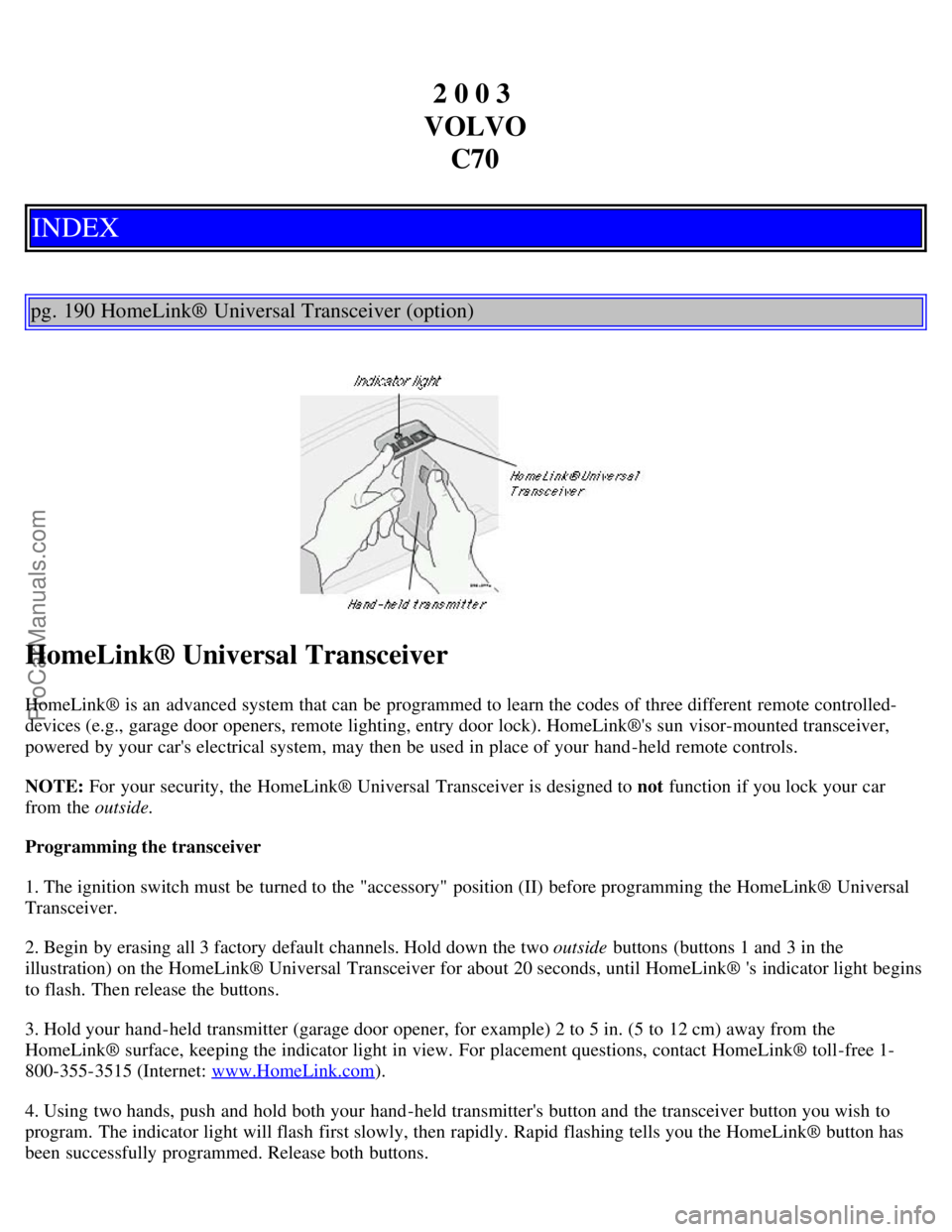
2. Begin by erasing all 3 factory default channels. Hold down the two outside buttons (buttons 1 and 3 in the
illustration) on the HomeLink® Universal Transceiver for about 20 seconds, until HomeLink® 's indicator light begins
to flash. Then release the buttons.
3. Hold your hand -held transmitter (garage door opener, for example) 2 to 5 in. (5 to 12 cm) away from the
HomeLink® surface, keeping the indicator light in view. For placement questions, contact HomeLink® toll-free 1-
800-355-3515 (Internet: www.HomeLink.com
).
4. Using two hands, push and hold both your hand -held transmitter's button and the transceiver button you wish to
program. The indicator light will flash first slowly, then rapidly. Rapid flashing tells you the HomeLink® button has
been successfully programmed. Release both buttons.
ProCarManuals.com