oil pressure VOLVO C70 2003 Owners Manual
[x] Cancel search | Manufacturer: VOLVO, Model Year: 2003, Model line: C70, Model: VOLVO C70 2003Pages: 98, PDF Size: 1.64 MB
Page 4 of 98
In use, Volvo was the first in the world to introduce into production a three-way catalytic converter with a Lambda
sond, now called oxygen sensor, in 1976. The current version of this highly efficient system reduces emissions of
harmful substances (CO, HC, NOx) from the exhaust pipe by approximately 95% and the search to eliminate the
remaining emissions continues. Volvo is the only automobile manufacturer to offer CFC-free retrofit kits for the air
conditioning system for all models as far back as the M/Y 1975 240. Advanced electronic engine controls, refined
purification systems and cleaner fuels are bringing us closer to our goal.
After Volvo cars and parts have fulfilled their use, recycling is the next critical step in completing the life cycle. The
metal content is about 75% of the total weight of a car, which makes the car among the most recycled industrial
products. In order to have efficient and well controlled recycling, many Volvo variants have printed dismantling
manuals, indicating the weight and material of individual components. For Volvo, all homogeneous plastic parts
weighing more than 1.7 oz. (50 grams) are marked with international symbols that indicate how the component is to be
sorted for recycling.
In addition to continuous environmental refinement of conventional gasoline-powered internal combustion engines,
Volvo is actively looking at advanced technology alternative-fuel vehicles.
When you drive a Volvo, you become our partner in the work to lessen the car's impact on the environment.
To reduce your vehicle's environmental impact, you can:
Maintain proper air pressure in your tires. Tests have shown decreased fuel economy with improperly inflated tires
Follow the recommended maintenance schedule in your Warranty and Service Records Information booklet.
Drive at a constant speed
See an authorized Volvo retailer as soon as possible for inspection if the check engine (malfunction indicator) lamp
illuminates, or stays on after the vehicle has started
Properly dispose of any vehicle related waste such as used motor oil, used batteries, brake pads, etc.
When cleaning your car, use Volvo's own car care products, all of which have systematically been adapted to the
environment
For additional information regarding the environmental activities in which Volvo Cars of North America, LLC. and
Volvo Car Corporation are involved, visit our Internet Home Page at:
http://www.volvocars.com
CALIFORNIA Proposition 65 Warning!
WARNING! Engine exhaust, some of its constituents, and certain vehicle components contain or emit chemicals
known to the state of California to cause cancer, and birth defects or other reproductive harm.
In addition, certain
fluids contained in vehicles and certain products of component wear contain or emit chemicals known to the State
of California to cause cancer, and birth defects or other reproductive harm.
Top of Page
ProCarManuals.com
Page 16 of 98

1 Turn signal, left
2 Turn signal, right
3 Roll Over Protection system (ROPS)
4 Low washer fluid level
If the lamp glows continuously when the engine is running, there is only about 1/2 - 1 US qt. remaining in the washer
fluid reservoir.
5 Low fuel level
When the lamp glows, only about 1.8 US gals. (8 liters) of fuel remain. If the ignition is switched on while refuelling,
the gauge may read inaccurately for up to 25 minutes.
6 Rear fog light
7 High beams
8 Trunk open
9 Bulb failure warning sensor
10 (Not in use)
11 Electronic Throttle System (ETS)
12 SRS indicator lamp
13 Generator not charging
14 Low engine oil pressure
15 Brake warning light
16 Parking brake applied
17 ABS -system
18 Transmission mode
Indicates "W",if winter/wet driving mode is active, or indicated currently selected low gear.
19 Low coolant level
ProCarManuals.com
Page 17 of 98

20 Stability and Traction Control (STC) System
21 Malfunction indicator lamp
(See page 20
for more information)
22 Service reminder indicator
pg. 18 Warning lights
The warning lights described on pages 18 and 19 should never stay on when driving
When the ignition key is turned on and before the engine starts, all of the warning lights should go on to test the
function of the bulbs. Should a light not go off after the engine has started, the system indicated should be inspected.
However, the parking brake reminder light will not go off until the parking brake has been fully released.
Malfunction indicator lamp
On-Board Diagnostic II (OBDII): As you drive, a computer called "OBDII" monitors your car's engine, transmission,
electrical and emission systems. The CHECK ENGINE light will light up if the computer senses a condition that
potentially may need correcting. When this happens, please have your car checked by a Volvo retailer as soon as
possible.
A CHECK ENGINE light may have many causes. Sometimes, you may not notice a change in your car's behavior.
Even so, an uncorrected condition could hurt fuel economy, emission cleanliness, and driveability. Extended driving
without correcting the cause could even damage other components in your car.
NOTE : If the fuel filler cap is not closed tightly or if the engine is running when the car is refueled, the Malfunction
Indicator Lamp may indicate a fault. However, your vehicle's performance will not be affected. Use only Volvo
original or approved fuel filler caps.
Canadian models are equipped with this warning light:
Oil pressure warning light
If the light comes on while driving, stop the car and then stop the engine immediately and check the engine oil
level . See page 116.
If the light stays on after restart, have the car towed to the nearest authorized Volvo retailer. After
hard driving, the light may come on occasionally when the engine is idling. This is normal, provided it goes off when
the engine speed is increased.
Roll Over Protection System (ROPS)
If the warning lamp remains on after the engine has started or comes on while you are driving, the ROPS self -
diagnostic system has detected a fault. The car should be driven to an authorized Volvo retailer as soon as possible for
inspection.
Please refer to page 10
for more information on the ROPS system.
Brake failure warning light
If the light comes on while driving or braking, stop immediately, open the hood and check the brake fluid level
ProCarManuals.com
Page 39 of 98
pedal for the first few minutes of operation. A cold engine uses more fuel and is subject to increased wear.
Whenever possible, avoid using the car for driving short distances. This does not allow the engine to reach normal
operating temperature.
Drive carefully and avoid rapid acceleration and hard braking.
Do not exceed speed limit.
Avoid carrying unnecessary items (extra load) in the car.
Maintain correct tire pressure. Check tire pressure regularly (check when tires are cold).
Remove snow tires when threat of snow or ice has ended.
Note that trunk-mounted luggage racks increase air resistance and thereby fuel consumption.
Avoid using automatic transmission kickdown feature unless necessary.
Avoid using the air conditioning when it is not required. When engaged, the air conditioner's compressor places an
additional load on the engine. However, please note that fuel consumption is lower with the air conditioning on than it
is when driving with the air conditioning switched off and the windows down.
If your car is equipped with the optional Trip Computer, utilizing the fuel consumption modes can help you "learn"
how to drive more economically.
Other factors which decrease gas mileage are:
Dirty air cleaner
Dirty engine oil and clogged oil filter
Dragging brakes
Incorrect front end alignment
Some of the above mentioned items and others are checked at the standard Maintenance Service intervals.
NOTE : (D)rive or 5th gear (manual transmissions) should be used as often as possible to help improve fuel economy.
pg. 64 Starting the Engine
Starting and stopping
1. Fasten the seat belt.
WARNING!
Before starting, check that the seat, steering wheel and mirrors are adjusted properly. Make sure the brake pedal can
be depressed completely. Move the seat closer if necessary. Refer to section "front seats".
2. Apply the parking brake, if not already set. The gear selector (automatic transmission) is locked in the (P)ark
position (SHIFT LOCK).
Manual transmission: the clutch must be fully depressed.
3. Without touching the accelerator pedal, turn the ignition key to the starting position*. Allow the starter to operate
for up to 10 seconds. Release the key as soon as the engine starts. If the engine fails to start, repeat step 3.
For cold starts at altitudes above 6000 ft (1800 meters), depress the accelerator pedal halfway and turn the key to the
starting position. Release the pedal slowly when the engine starts.
4. To release the gear selector from the (P)ark position (automatic transmission), the ignition key must be in position II
ProCarManuals.com
Page 60 of 98

NOTE: It is particularly important to wash the car frequently in the wintertime to prevent corrosion, when salt has
been used on the roads.
When washing the car, do not expose it to direct sunlight. Use lukewarm water to soften the dirt before you wash
with a sponge, and plenty of water, to avoid scratching.
Bird droppings: Remove from paintwork and the convertible top as soon as possible. Otherwise the finish may be
permanently damaged.
A detergent can be used to facilitate the softening of dirt and oil.
A water-soluble grease solvent may be used in cases of sticky dirt. However, use a wash place equipped with a
drainage separator.
Dry the car with a clean chamois and remember to clean the drain holes in the doors and rocker panels *.
The power radio antenna must be dried after washing.
Tar spots can be removed with kerosene or tar remover after the car has been washed.
A stiff-bristle brush and lukewarm soapy water can be used to clean the wiper blades. Frequent cleaning improves
visibility considerably.
Wash off the dirt from the underside (wheel housings, fenders, etc.).
In areas of high industrial fallout, more frequent washing is recommended.
CAUTION: During high pressure washing, the spray mouthpiece must never be closer to the painted surfaces of the
vehicle than 13" (30 cm). Do not spray directly into the locks.
When washing or steam cleaning the engine, avoid spraying water or steam directly on the electrical components or
toward the rear side of the engine.
After cleaning the engine, the spark plug wells should be inspected for water and blown dry if necessary.
Suitable detergents
Special car washing detergents should be used. A suitable mixture is about 2.5 fl. oz. (8.5 cl) of detergent to 2.6 US
gal. (10 liters) of warm water. After washing with a detergent the car should be well rinsed with clean water.
WARNING!
When the car is driven immediately after being washed, apply the brakes several times in order to remove any
moisture from the brake linings.
Engine cleaning agents should not be used when the engine is warm. This constitutes a fire risk.
Volvo offers an environmentally friendly Car Care Kit, containing waxing, washing, and degreasing agents.
NOTE: When washing the car, remember to remove dirt from the drain holes in the doors and sills. Bumpers: Wash
the bumpers with the same cleaning agent used on the rest of the car. Never clean the bumpers with gasoline or paint
thinner. Difficult spots can be removed with denatured alcohol. To avoid scratches, do not dry the bumpers with paper.
ProCarManuals.com
Page 63 of 98

2 0 0 3
VOLVO C70
Chapter 8 - Volvo Service
pg. 109 Volvo Service
Page
Label information 110
Maintenance service, Warranty111
Servicing112
Emissions maintenance113
Fuel/emissions systems114
Lubrication115
Engine oil116
Power steering fluid, Brake/clutch system fluid reservoir118
Washer fluid reservoir119
Coolant120
Engine compartment121
Battery maintenance/ Proposition 65 Warning122
Three-way catalytic converter123
pg. 110 Label information
1 Vehicle Emission Control Information
Your Volvo is designed to meet all applicable emission standards, as evidenced by the certification label on the
underside of the hood. For further information regarding these regulations, please consult your Volvo retailer.
2 Vacuum hose routing
(underside of hood)
3 Loads and Tire Pressures
(on rear edge of passenger's door)
4 Model plate
Vehicle Identification Number (VIN). Codes for color and upholstery, etc. This plate is located in the engine
compartment, on the inside of the left front fender.
5 Vehicle Identification Number (VIN) *
ProCarManuals.com
Page 70 of 98
pg. 127 Engine specifications
Engine
Liquid-cooled gasoline, 5-cylinder, in-line engine. Aluminum alloy cylinder block with cast-iron cylinder liners cast
directly into the block. Aluminum alloy cylinder head with double overhead camshafts and separate intake and outlet
channels.
Engine lubrication is provided by an eccentric pump driven from the crankshaft. Full-flow type oil filter. Exhaust
emission control is accomplished by multiport fuel injection, heated oxygen sensor(s) and three-way catalytic
converter.
Charge air cooler (Intercooler)
Turbocharged engines employ a turbo-compressor to force air into the engine inlet manifold and a charge air cooler to
cool the compressed inlet air. The resulting increase in air flow raises pressure in the intake manifold by approx. 8.7
psi (over atmospheric pressure) and engine power output by approx. 50 horsepower over that developed by the
normally-aspirated engine. The charge air cooler (which resembles a radiator) is located between the turbo-compressor
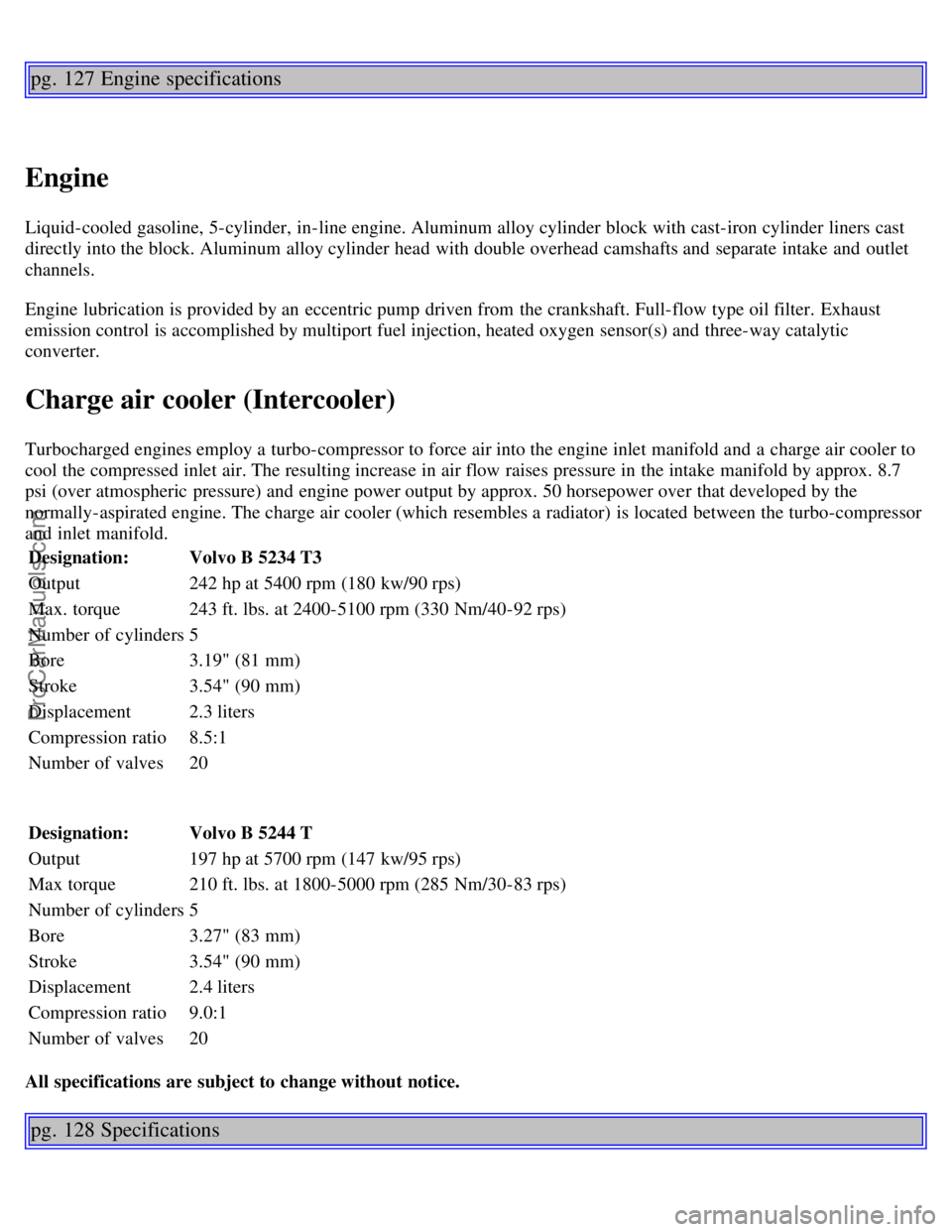
and inlet manifold.Designation: Volvo B 5234 T3
Output 242 hp at 5400 rpm (180 kw/90 rps)
Max. torque 243 ft. lbs. at 2400-5100 rpm (330 Nm/40-92 rps)
Number of cylinders 5
Bore 3.19" (81 mm)
Stroke 3.54" (90 mm)
Displacement 2.3 liters
Compression ratio 8.5:1
Number of valves 20
Designation: Volvo B 5244 T
Output 197 hp at 5700 rpm (147 kw/95 rps)
Max torque 210 ft. lbs. at 1800-5000 rpm (285 Nm/30-83 rps)
Number of cylinders 5
Bore 3.27" (83 mm)
Stroke 3.54" (90 mm)
Displacement 2.4 liters
Compression ratio 9.0:1
Number of valves 20
All specifications are subject to change without notice.
pg. 128 Specifications
ProCarManuals.com
Page 71 of 98

Cooling system
Type: Positive pressure, closed system
Thermostat begins to open at 180° F (87° C)
Coolant: Volvo original coolant/antifreeze
Capacity: 7.4 US qts. (7.0 liters)
Fuel system
The engine is equipped with a multiport fuel injection system.
Distributor ignition system
Firing order: 1-2-4-5-3
Distributor ignition setting: Not adjustable
Spark plugs: Champion RC87PYP (or equivalent)
Spark plug gap: 0.03" (0.75 mm)
Tightening torque: 18.4 ft. lbs. +/- 3.7 ft. lbs. (25 Nm +/- 5 Nm)WARNING!
The distributor ignition system operates at very high voltages. Special safety precautions must be followed to
prevent injury. Always turn the ignition off when:
Replacing distributor ignition components e.g. plugs, coil, etc.
Do not touch any part of the distributor ignition system while the engine is running. This may result in unintended
movements and body injury.
All specifications are subject to change without notice.
Front suspension
Spring strut suspension with integrated shock absorbers and control arms linked to the support frame. Power-assisted
rack and pinion steering. Safety type steering column.
The alignment specifications apply to an unladen car but include fuel, coolant and spare wheel.
Toe-in measured on the wheel rims: 2.4 mm +/- 0.7 mm
Toe-in measured on tire sides: 2.9 +/- 0.9 mm
Rear suspension
Delta-link individual rear wheel suspension with longitudinal support arms, double link arms and track rods.
Toe-in measured on the tire sides: 4° +/- 10°
ProCarManuals.com
Page 91 of 98
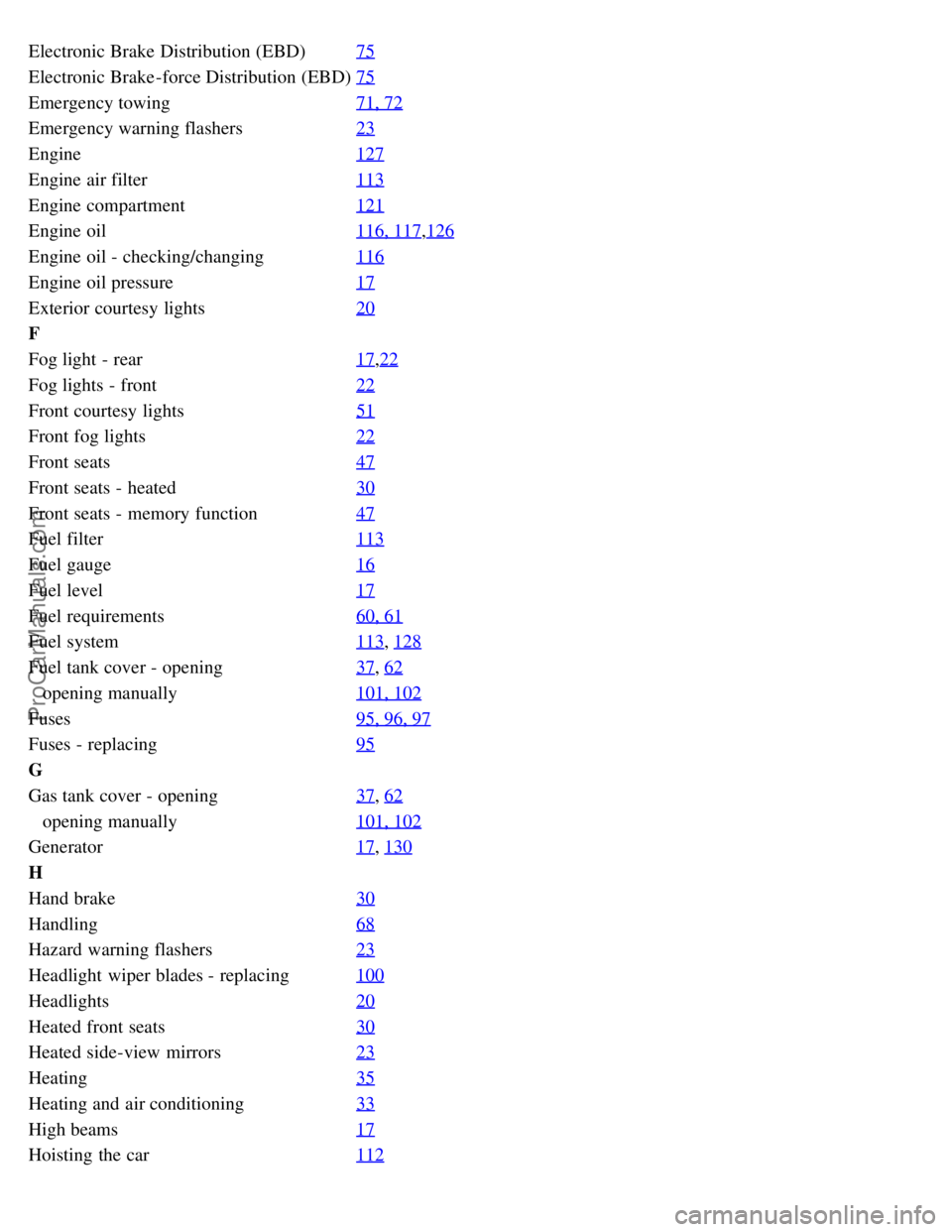
Electronic Brake Distribution (EBD)75
Electronic Brake-force Distribution (EBD)75
Emergency towing71, 72
Emergency warning flashers23
Engine127
Engine air filter113
Engine compartment121
Engine oil116, 117,126
Engine oil - checking/changing116
Engine oil pressure17
Exterior courtesy lights20
F
Fog light - rear17
,22
Fog lights - front22
Front courtesy lights51
Front fog lights22
Front seats47
Front seats - heated30
Front seats - memory function47
Fuel filter113
Fuel gauge16
Fuel level17
Fuel requirements60, 61
Fuel system113, 128
Fuel tank cover - opening37, 62
opening manually101, 102
Fuses95, 96, 97
Fuses - replacing95
G
Gas tank cover - opening37
, 62
opening manually101, 102
Generator17, 130
H
Hand brake30
Handling68
Hazard warning flashers23
Headlight wiper blades - replacing100
Headlights20
Heated front seats30
Heated side-view mirrors23
Heating35
Heating and air conditioning33
High beams17
Hoisting the car112
ProCarManuals.com
Page 92 of 98

Homelink®190-192
Hood54
I
Ignition switch21
Immobilizer (start inhibitor)43
Instrument illumination22
Instruments14, 15
J
Jack56
, 86
Jump starting73
K
Keyless entry system44
Keylock64
Keys43
Kick -down66
Kickdown67
L
Label information110
Lifting the car112
Locks43
Long load storage53
Lubrication115
Luggage racks - trunk-mounted70
Lumbar support49
M
Maintenance service111
Malfunction indicator lamp17
Manual transmission65, 129
Manually raising convertible top102
Memory function - front seats47
Mirrors - rear/side view50
O
Occupant safety13
Octane rating62
Odometer16
Oil (engine)116, 117, 126
Oil pressure warning light18
Opening the trunk from the inside55
P
Paint touchup104
Parking brake17,30
Parking brake reminder light18
Parking lights20
PCV system113
ProCarManuals.com