trunk VOLVO C70 2004 Owners Manual
[x] Cancel search | Manufacturer: VOLVO, Model Year: 2004, Model line: C70, Model: VOLVO C70 2004Pages: 99, PDF Size: 1.79 MB
Page 15 of 99

6Space for additional equipment
7Space for additional equipment
8 Instruments 16-17
9Stability Control System - STC 25
10Trip computer (optional) 28-30
11Electrically operated convertible top 44
12Rear window demister/heated door mirrors 25
13Air mix 35
14Air vents 35
15Passenger side air bag (SRS) hatch 4-6
16Air vents 35
17Hood release 58
18Turn signals, high/low beams, exterior courtesy lights 22
18Cruise control 31
19Adjustable steering wheel 34
20Windshield wiper/washer 23
21Heated front seats (optional) 30
22Auxiliary socket 33
23Audio systems 137
24Heating and ventilation controls 35-37
25Hazard warning flashers 25
26Ashtray 31
27Coin holder 42
28Shiftlock release button (automatic transmission only) 105
29Gear selector shift positions 69-71
30Winter mode selector 71
31Parking brake 32
32Horn/SRS 4-6
33Trunk open control 59
34Power window controls 36
35Power mirror controls 54
36Fuel tank open control 40
37Central locking button 36
Some of the items above are available on certain models only.
pg. 16 Instruments
ProCarManuals.com
Page 17 of 99

1 Turn signal, left
2 Turn signal, right
3 Roll Over Protection system (ROPS)
4 Low washer fluid level
If the lamp glows continuously when the engine is running, there is only about 1/2 - 1 US qt. remaining in the washer
fluid reservoir.
5 Low fuel level
When the lamp glows, only about 1.8 US gals. (8 liters) of fuel remain. If the ignition is switched on while refuelling,
the gauge may read in accurately for up to 25 minutes.
6 Rear fog light
7 High beams
8 Trunk open
9 Bulb failure warning sensor
10 (Not in use)
11 Electronic Throttle System (ETS)
12 SRS indicator lamp
13 Generator not charging
14 Low engine oil pressure
15 Brake warning light
16 Parking brake applied
17 ABS -system
18 Transmission mode
Indicates "W",if winter/wet driving mode is active, or indicated currently selected low gear.
19 Low coolant level
ProCarManuals.com
Page 24 of 99

2 0 0 4
VOLVO C70
Chapter 3 - Body and interior
pg. 39 Body and interior
Page
Convertible top/wind deflector 40
Storage compartments42
Keys, doors and locks43
Remote keyless entry system44
Alarm45
Front seats47
Rear/side view mirrors50
Interior lights, Vanity mirrors52
Long load storage53
Hood54
Opening the trunk55
Trunk light, Spare tire, Jack56
Securing cargo, Avoiding battery drain57
pg. 40 Electrically operated convertible top
Electrically operated convertible top
Electrically operated convertible top
ProCarManuals.com
Page 25 of 99

To lower the convertible top:
Start the engine. The car must be at a standstill, the parking brake must be ON and the trunk must be closed
when raising/lowering the convertible top. The gear selector must be in position P (automatic transmission) or in
neutral (manual transmission).
Press and hold down the lower section of the control switch (an indicator lamp will light up and all four windows
will automatically be lowered slightly) until the convertible top is completely lowered. A chime will indicate when the
top is completely down and properly in place in the storage compartment. The windows can then be raised/lowered
with the "All windows" button on the driver's door.
"All windows" control button
To raise the convertible top:
Press and hold down the upper section of the control switch until the convertible top is completely raised. A chime
will indicate when the top is properly in position.
Check that the cover over the convertible top storage compartment closes completely.
Movement of the convertible top can be stopped at any time by releasing the control switch.
WARNING!
The convertible top must not be obstructed in any way when it is being raised or lowered.
The rear seat should not be occupied while the convertible top is being raised or lowered.
Anyone near the car should be well clear of the convertible top's moving parts before it is raised or lowered.
Children should never be allowed to play with the convertible top control switch.
CAUTION: If the cover over the convertible top storage space is not completely closed , the trunk lid should NOT be
opened to help avoid scratching the paint.
NOTE:
The electrically operated convertible top has an overload protecting circuit breaker that is activated when an object
blocks the top when it is in motion. If this occurs, remove the object and wait 20 seconds for the circuit breaker to reset
before trying to raise/lower the top again.
See page 102
for fault tracing information and instructions on manually raising the convertible top.
The trunk cannot be opened and the power windows/power antenna cannot be operated while the convertible top is
being raised/lowered.
pg. 41 Electrically operated convertible top, Wind deflector
CAUTION:
Be sure there is sufficient clearance above the car before raising/lowering the convertible top.
ProCarManuals.com
Page 26 of 99
Volvo recommends that you raise the convertible top and close the windows when you leave the car to help deter
thefts and to protect the interior from rain, windblown dust, etc.
No objects should be placed in the convertible top storage compartment. This could damage the convertible top
mechanism.
Roof racks may not be attached to or placed on the convertible top. See page 74 for information on trunk-mounted
luggage racks.
Ice scrapers should not be used to remove snow from the convertible top.
Do not lower the convertible top if it is frozen. The top should not be raised/lowered if the temperature is below 32°
F (0° C).
The top should be completely dry before it is lowered and stored in the storage compartment to help prevent damage
from mildew.
See page 107
for information on cleaning the convertible top.
Wind deflector (option/accessory)
Installing the wind deflector:
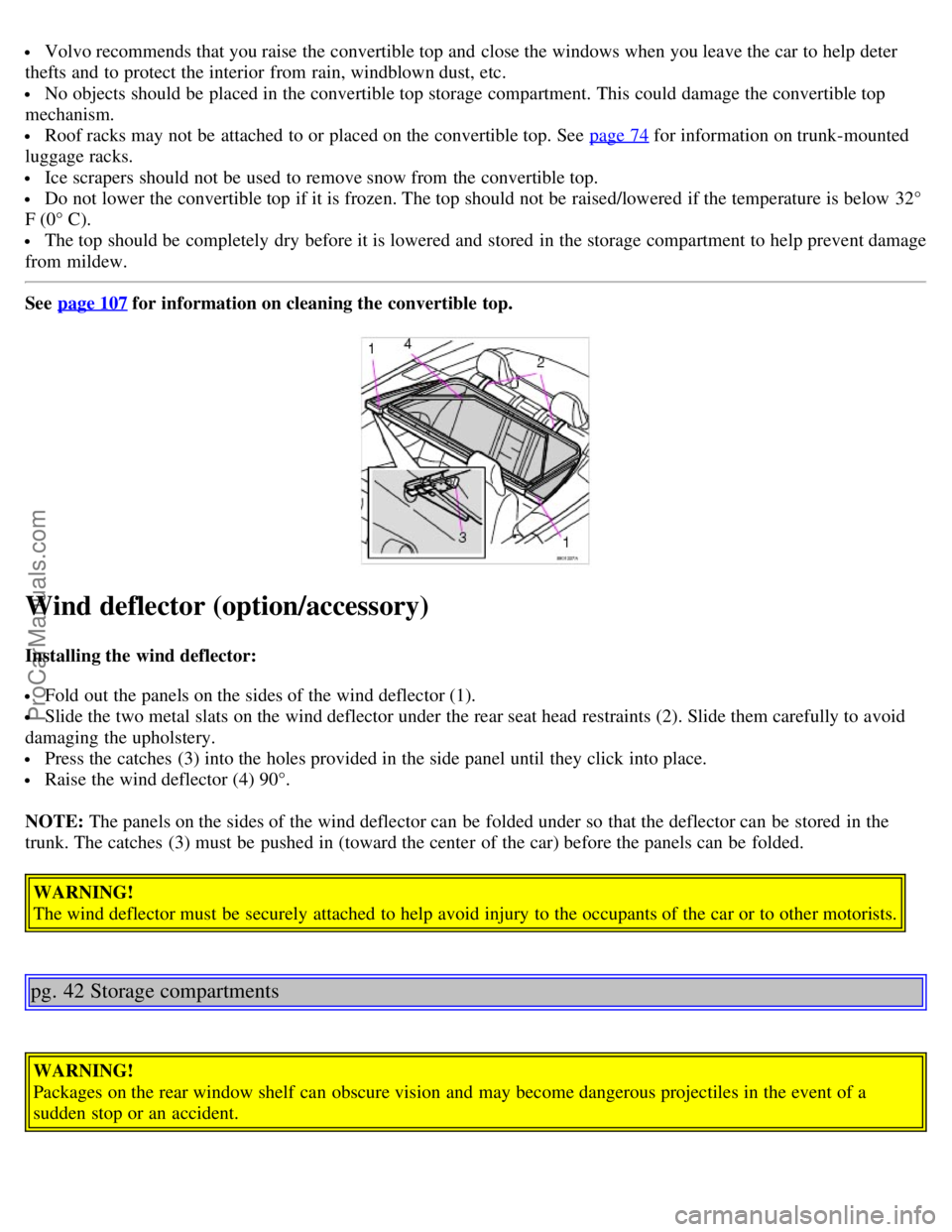
Fold out the panels on the sides of the wind deflector (1).
Slide the two metal slats on the wind deflector under the rear seat head restraints (2). Slide them carefully to avoid
damaging the upholstery.
Press the catches (3) into the holes provided in the side panel until they click into place.
Raise the wind deflector (4) 90°.
NOTE: The panels on the sides of the wind deflector can be folded under so that the deflector can be stored in the
trunk. The catches (3) must be pushed in (toward the center of the car) before the panels can be folded.
WARNING!
The wind deflector must be securely attached to help avoid injury to the occupants of the car or to other motorists.
pg. 42 Storage compartments
WARNING!
Packages on the rear window shelf can obscure vision and may become dangerous projectiles in the event of a
sudden stop or an accident.
ProCarManuals.com
Page 27 of 99
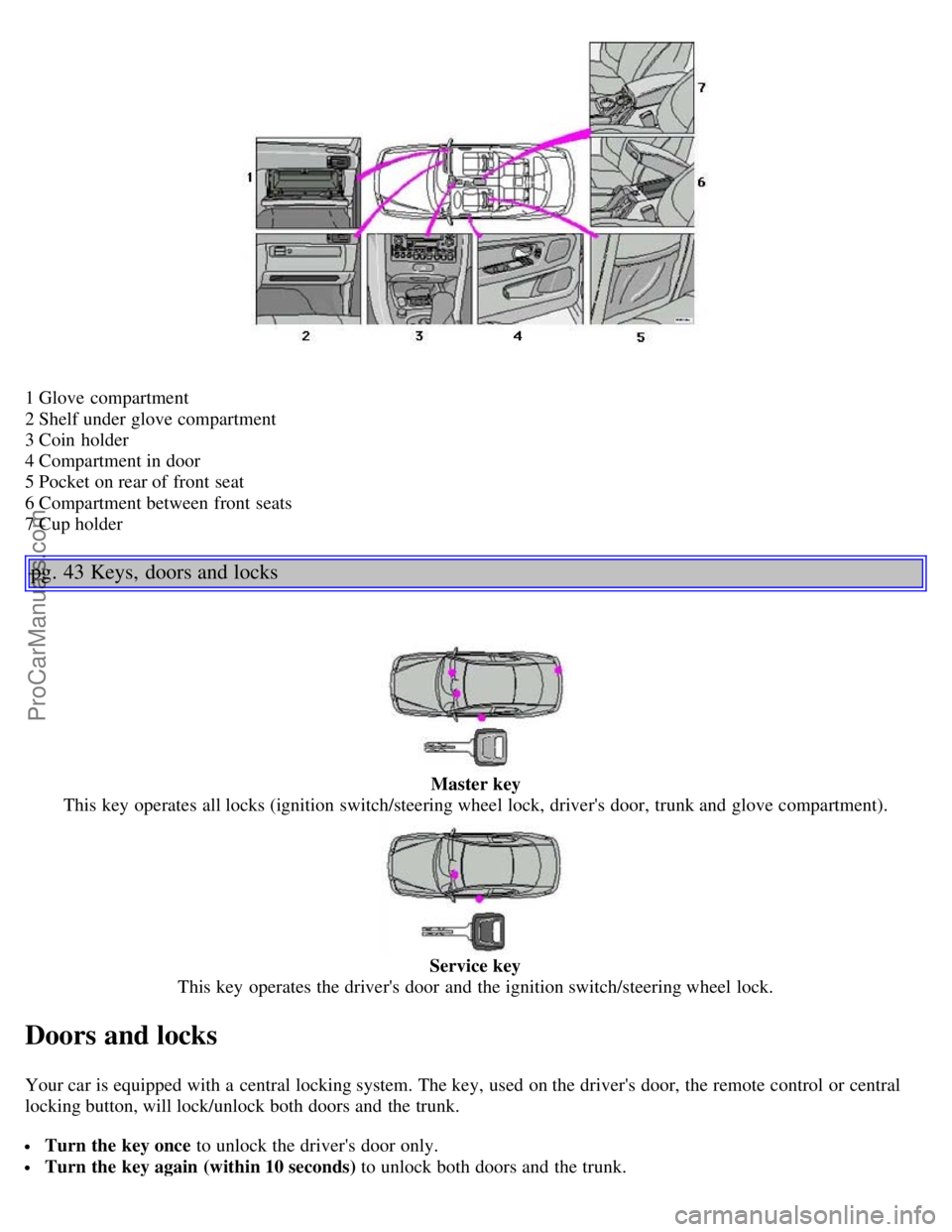
1 Glove compartment
2 Shelf under glove compartment
3 Coin holder
4 Compartment in door
5 Pocket on rear of front seat
6 Compartment between front seats
7 Cup holder
pg. 43 Keys, doors and locks
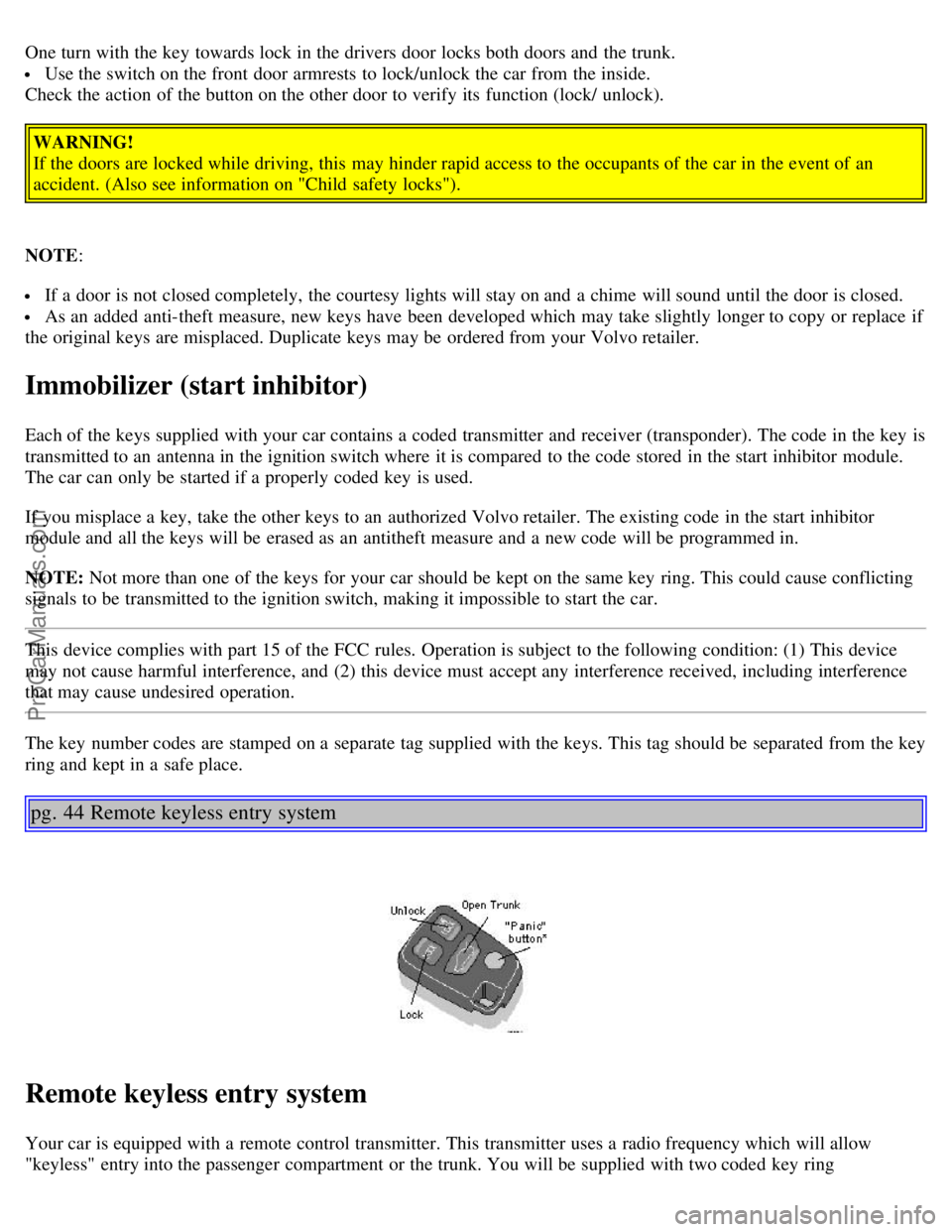
Master key
This key operates all locks (ignition switch/steering wheel lock, driver's door, trunk and glove compartment).
Service key
This key operates the driver's door and the ignition switch/steering wheel lock.
Doors and locks
Your car is equipped with a central locking system. The key, used on the driver's door, the remote control or central
locking button, will lock/unlock both doors and the trunk.
Turn the key once to unlock the driver's door only.
Turn the key again (within 10 seconds) to unlock both doors and the trunk.
ProCarManuals.com
Page 28 of 99
One turn with the key towards lock in the drivers door locks both doors and the trunk.
Use the switch on the front door armrests to lock/unlock the car from the inside.
Check the action of the button on the other door to verify its function (lock/ unlock).
WARNING!
If the doors are locked while driving, this may hinder rapid access to the occupants of the car in the event of an
accident. (Also see information on "Child safety locks").
NOTE :
If a door is not closed completely, the courtesy lights will stay on and a chime will sound until the door is closed.
As an added anti-theft measure, new keys have been developed which may take slightly longer to copy or replace if
the original keys are misplaced. Duplicate keys may be ordered from your Volvo retailer.
Immobilizer (start inhibitor)
Each of the keys supplied with your car contains a coded transmitter and receiver (transponder). The code in the key is
transmitted to an antenna in the ignition switch where it is compared to the code stored in the start inhibitor module.
The car can only be started if a properly coded key is used.
If you misplace a key, take the other keys to an authorized Volvo retailer. The existing code in the start inhibitor
module and all the keys will be erased as an antitheft measure and a new code will be programmed in.
NOTE: Not more than one of the keys for your car should be kept on the same key ring. This could cause conflicting
signals to be transmitted to the ignition switch, making it impossible to start the car.
This device complies with part 15 of the FCC rules. Operation is subject to the following condition: (1) This device
may not cause harmful interference, and (2) this device must accept any interference received, including interference
that may cause undesired operation.
The key number codes are stamped on a separate tag supplied with the keys. This tag should be separated from the key
ring and kept in a safe place.
pg. 44 Remote keyless entry system
Remote keyless entry system
Your car is equipped with a remote control transmitter. This transmitter uses a radio frequency which will allow
"keyless" entry into the passenger compartment or the trunk. You will be supplied with two coded key ring
ProCarManuals.com
Page 29 of 99
transmitters, which will enable you to lock/unlock both doors and the trunk from a distance of 10-15 feet (3-5 meters).
On vehicles equipped with an alarm, the alarm will also be activated/deactivated by this system.
The car can also be locked/unlocked with the key.
As an extra security precaution in certain situations (valet parking, etc.), Volvo recommends that the transmitter not be
included when the keys are given to anyone. The service key can be used instead. If one of the transmitters is
misplaced, contact the nearest authorized Volvo retailer for assistance.
Using the remote control
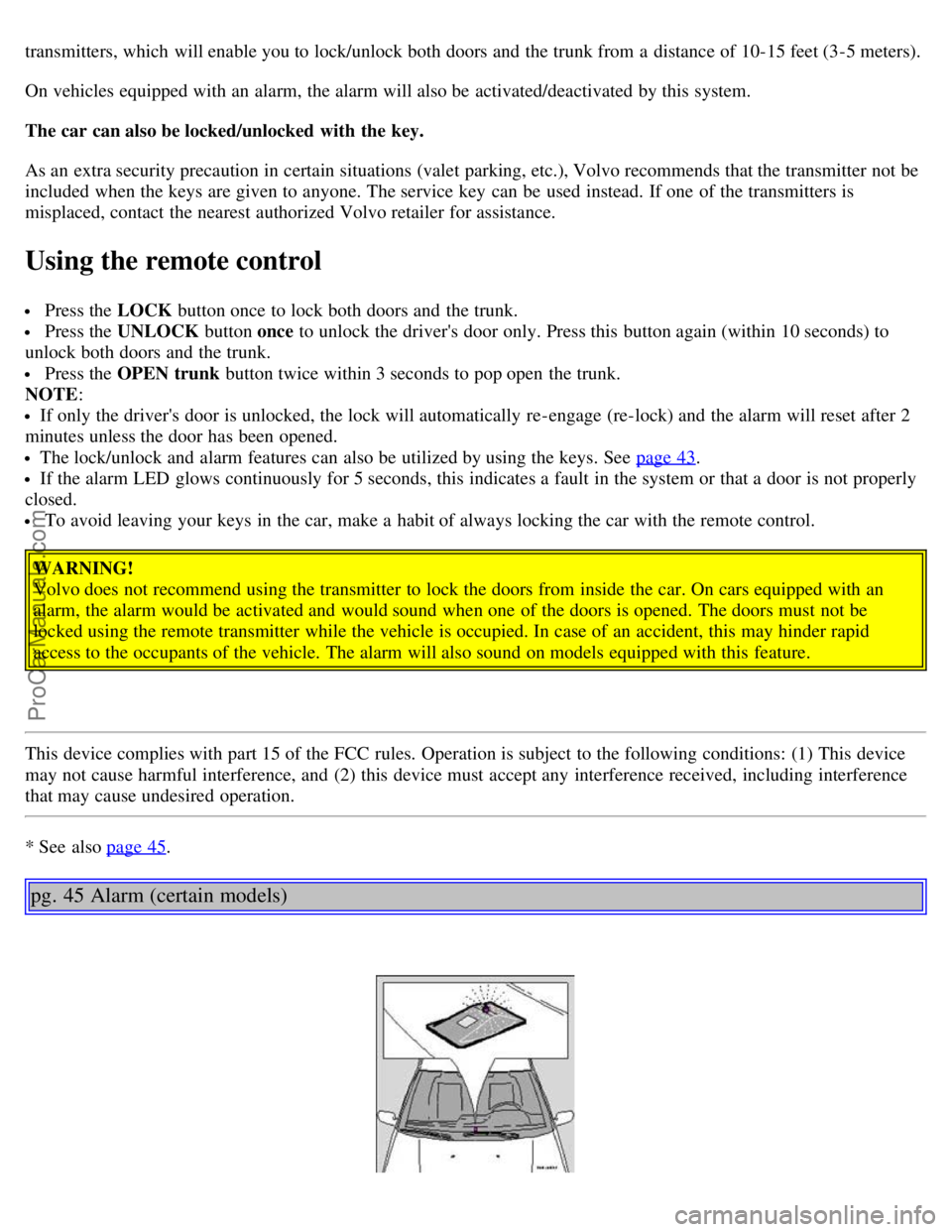
Press the LOCK button once to lock both doors and the trunk.
Press the UNLOCK button once to unlock the driver's door only. Press this button again (within 10 seconds) to
unlock both doors and the trunk.
Press the OPEN trunk button twice within 3 seconds to pop open the trunk.
NOTE :
If only the driver's door is unlocked, the lock will automatically re-engage (re-lock) and the alarm will reset after 2
minutes unless the door has been opened.
The lock/unlock and alarm features can also be utilized by using the keys. See page 43.
If the alarm LED glows continuously for 5 seconds, this indicates a fault in the system or that a door is not properly
closed.
To avoid leaving your keys in the car, make a habit of always locking the car with the remote control.
WARNING!
Volvo does not recommend using the transmitter to lock the doors from inside the car. On cars equipped with an
alarm, the alarm would be activated and would sound when one of the doors is opened. The doors must not be
locked using the remote transmitter while the vehicle is occupied. In case of an accident, this may hinder rapid
access to the occupants of the vehicle. The alarm will also sound on models equipped with this feature.
This device complies with part 15 of the FCC rules. Operation is subject to the following conditions: (1) This device
may not cause harmful interference, and (2) this device must accept any interference received, including interference
that may cause undesired operation.
* See also page 45
.
pg. 45 Alarm (certain models)
ProCarManuals.com
Page 30 of 99
LED alarm status indicator
Alarm
The radio signal emitted from the transmitter, which is used to set/unset the alarm, is a "rolling code" signal. This
means that the signal is changed randomly for each transmission and is intended to help prevent unauthorized
recording of the code.
When armed (set), the alarm continuously monitors a number of points on the car. The following conditions will set off
the alarm:
The hood is opened
The trunk is opened
A door is opened
The ignition switch is tampered with
The car is lifted or towed (if the car is equipped with the optional inclination sensor)
The battery is disconnected (if the car is equipped with the optional backup battery siren). The alarm will sound for
ten 30 second intervals, with a 5 second pause between intervals. This function cannot be interrupted.
Arming (setting) the alarm
Press the LOCK button on the remote control, lock the car using the key in the driver's door or press the central lock
button on one of the doors with the door open. One long flash of the turn signals will confirm that the alarm is set.
Disarming the alarm
Press the UNLOCK button on the remote control or unlock the doors with the key.
Turning off (stopping) the alarm
If the alarm is sounding, it can be stopped by pressing the UNLOCK button on the remote control or by unlocking the
driver's door with the key.
If the alarm is stopped with the remote control, this will be confirmed by two short flashes from the turn signals.
"Panic" function
In an emergency situation, this feature can be used to attract attention.
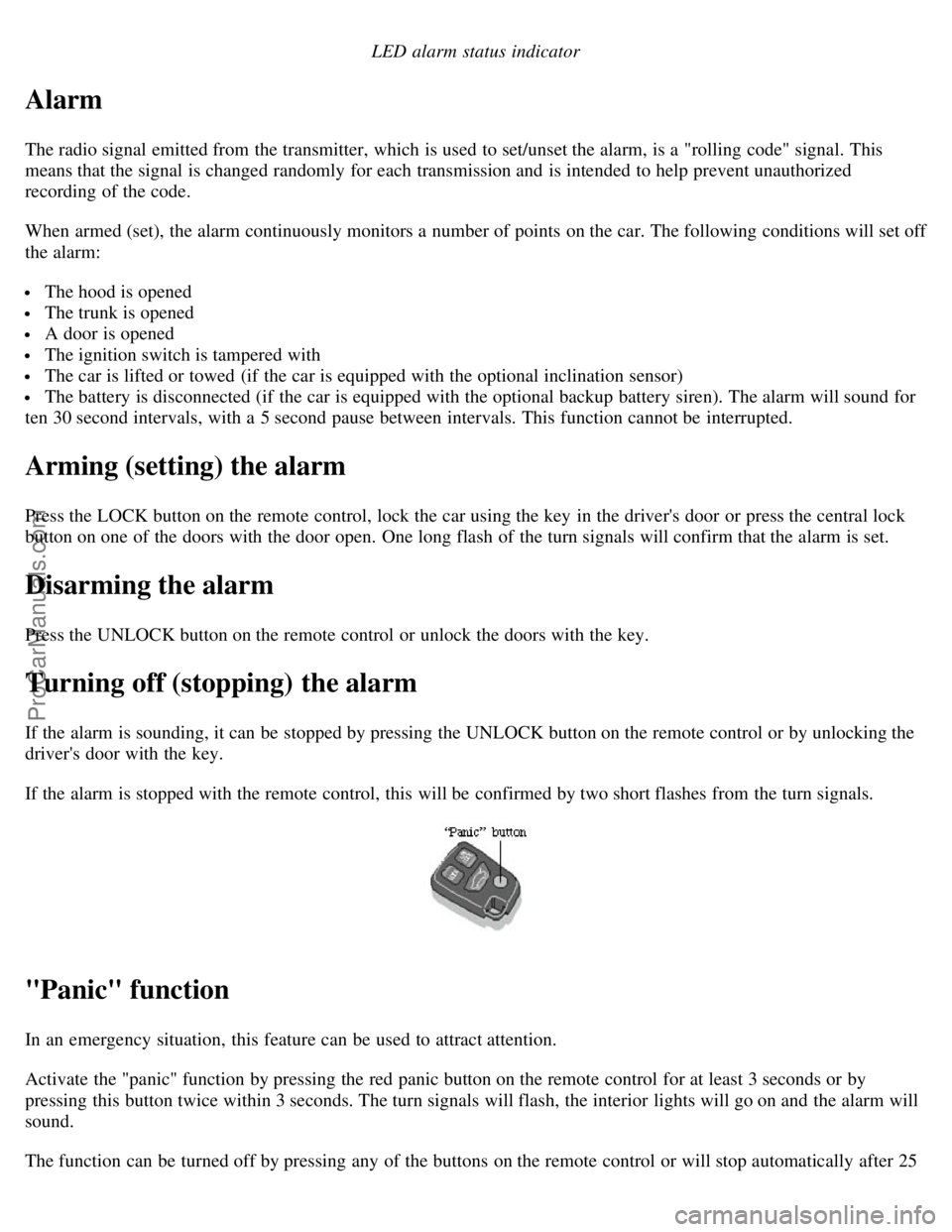
Activate the "panic" function by pressing the red panic button on the remote control for at least 3 seconds or by
pressing this button twice within 3 seconds. The turn signals will flash, the interior lights will go on and the alarm will
sound.
The function can be turned off by pressing any of the buttons on the remote control or will stop automatically after 25
ProCarManuals.com
Page 36 of 99
2 0 0 4
VOLVO C70
Chapter 4 - Starting and driving
pg. 59 Starting and driving
Page
Fuel requirements, Refueling 60
Driving economy63
Starting the engine64
Manual transmission65
Automatic transmission66
Points to remember68
Trunk -mounted luggage racks70
Emergency towing71
Vehicle towing information72
Jump starting73
Brake/Stability systems74
Trailer towing76
Winter driving77
pg. 60 Fuel requirements
NOTE - ENGINE OIL:
Although some oil consumption occurs during normal engine operation, more oil is consumed when the engine is new
as the internal parts generate higher friction while wearing in to each other. From the time the engine is new until
the first service is performed, the oil consumption could be higher than normal. For this reason, it is especially
important to check the oil every time you refuel your car during this period. See page 116-117.
In general, the rate of oil consumption depends on such factors as: engine temperature, length of trip, driving
conditions, oil viscosity and quality, engine speed and acceleration/deceleration.
Checking your engine oil level each time the car is refueled is one of the most important items you can perform to
help keep your car in good running order.
Manual transmission
ProCarManuals.com