mirror VOLVO C70 2006 User Guide
[x] Cancel search | Manufacturer: VOLVO, Model Year: 2006, Model line: C70, Model: VOLVO C70 2006Pages: 182, PDF Size: 3.35 MB
Page 60 of 182

The rear window and door mirrors are defrosted simultaneously if the switch is pressed once. The function is active if
one LED is lit in the switch. The door mirrors are deactivated automatically after approximately 6 minutes. The rear
window is deactivated after approximately 12 minutes.
NOTE: This function is automatically switched off when the power retractable hard top is down.
10. Temperature selector
The temperatures on the driver's and passenger's sides can be set separately using the knob (with the
thermometer in it). The temperature can be set for both sides of the car when the ignition is switched on (both LEDs
will be on), which means that a temperature setting will apply to both sides of the car.
To set the temperature on one side of the car:
pg. 62 Climate
Electronic climate control (ECC)
Press the knob once. The LED for one side of the car will light up. Turn the knob to adjust the temperature.
Press the knob a second time to set the temperature on the opposite side of the car.
Press the knob a third time to set the temperature on both sides of the car the same time.
NOTE: Selecting a temperature that is higher or lower than necessary will not heat or cool the passenger compartment
faster.
pg. 63 Climate
Electronic climate control (ECC)
pg. 64 Climate
ProCarManuals.com
Page 70 of 182

The retractable hard top can be damaged.
pg. 75 Interior
Temporary cover
Covering the vehicle
The cover should only be used if the power retractable hard top is down and cannot be raised. It should be placed over
the car so that the shock-cord attaching points are on the underside.
To install the cover:
Raise all windows.
Take out the cover (stowed in the compartment in the rear side of the ski hatch in the center of the rear seat
backrest), remove it from the bag and unfold it.
Slide the openings in the cover (3) over the respective door mirrors and attach the front shock-cord hooks (2) on the
edges of the front wheel housings.
Slide the cover under the windshield wipers so that there is one fold under each wiper blade (1).
Guide the antenna through hole 5.
Attach the rear side hooks (4) on the edges of the rear wheel housings.
Attach the rear hooks (6) under the rear bumper.
pg. 76 Interior
ProCarManuals.com
Page 73 of 182
the car is locked from the outside using the key or remote control.
If the courtesy lighting is not switched off manually, it will be turned off automatically 5 minutes after the engine has
been switched off.
pg. 78 Interior
Interior lighting
Vanity mirror
Raise the cover to switch on the light.
pg. 79 Interior
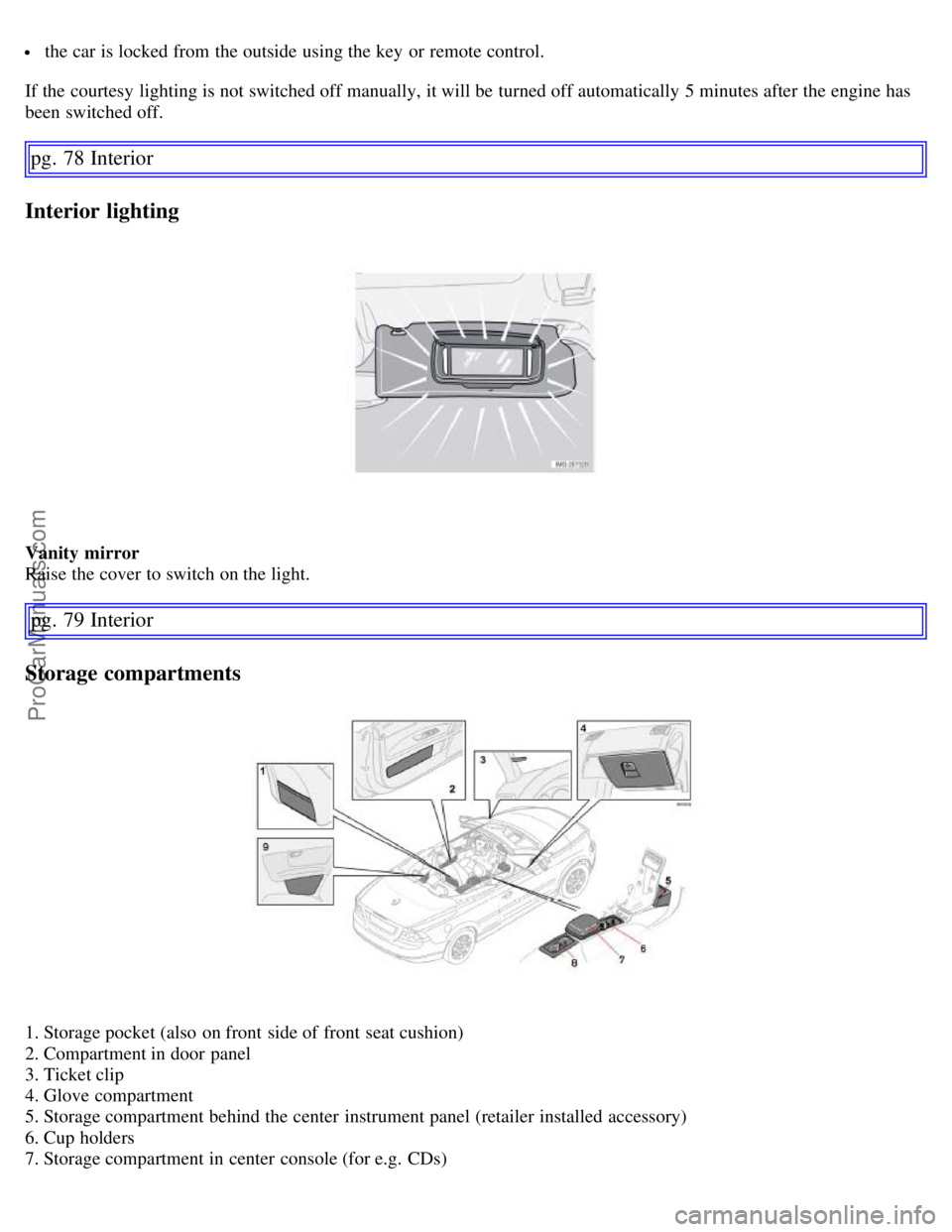
Storage compartments
1. Storage pocket (also on front side of front seat cushion)
2. Compartment in door panel
3. Ticket clip
4. Glove compartment
5. Storage compartment behind the center instrument panel (retailer installed accessory)
6. Cup holders
7. Storage compartment in center console (for e.g. CDs)
ProCarManuals.com
Page 82 of 182

the trunk. See Personal settings on page 61 for more information.
Automatic relocking: If the doors are unlocked, the locks will automatically reengage (re-lock) and the alarm will
rearm after 2 minutes unless a door or the trunk has been opened.
Automatic locking : When the car starts to move, the doors and trunk can be locked automatically. This feature can
be turned on or off, see Personal settings on page 61
for more information.
Airbag deployment will automatically attempt to unlock the doors.
3. Approach lighting - As you approach the car:
Press the yellow button on the remote control to light the interior lighting, position/parking lamps, license plate
lighting and the lights in the door mirrors. These lights will switch off automatically after 30, 60 or 90 seconds. See the
Personal settings on page 51
for information about adjusting the time setting.
4. Unlock trunk - Press the button once to disarm the alarm system and unlock only the trunk. After closing, the trunk
will not automatically relock. Press Lock to relock it and rearm the alarm.
5. Panic alarm : - This button can be used to attract attention during emergency situations. To activate the panic alarm,
press and hold the red button for at least 3 seconds or press it twice within 3 seconds. The turn signals and horn will be
activated. The panic alarm will stop automatically after 30 seconds. To deactivate, wait approximately 5 seconds and
press the red button again.
NOTE: This button will NOT unlock the car.
pg. 88 Locks and alarm
Remote control and key blade
Key blade
The key blade can be removed from the remote control. When removed, the key blade can be used as follows:
To lock/unlock the driver's door
To lock/unlock the glove compartment (see page 90)
To lock/unlock the trunk
For valet locking (see the explanation below)
Removing the key blade
Slide the spring loaded catch (1 in the illustration above) to the side and pull the key blade (2) out of the remote
control.
Reinserting the key blade in the remote control
ProCarManuals.com
Page 97 of 182

Steering wheel lock
When the key is removed from the ignition, the steering wheel locks so that it cannot be turned.
If the front wheels are hard up against a curb, the steering wheel lock may be under too much tension to unlock. If so,
the key will turn in the ignition switch but the car will not start. At the same time, a message "Steering locked" will
appear in the driver information text display.
If this happens:
Remove the key from the ignition.
Turn the steering wheel slightly and hold it to relieve pressure on the lock mechanism. Reinsert it the key. The
steering should immediately unlock. If not, try again.
NOTE: In order to help reduce vehicle theft, make sure the steering wheel lock is engaged before leaving the vehicle.
WARNING!
Never switch off the ignition (turn the ignition key to position 0) or remove the key from the ignition switch while
the vehicle is in motion. This could cause the steering wheel to lock, which would make the vehicle impossible to
steer.
1. The gear selector must be in the Park position.
2. Please be aware that leaving the key in this position will increase battery drain.
pg. 105 Starting and driving
Starting the engine
To start the engine:
Fasten the seat belt.
WARNING!
Before starting, check that the seat, steering wheel and mirrors are adjusted properly. Make sure the brake pedal can
be depressed completely. Adjust the seat if necessary.
Apply the parking brake, if not already set. The gear selector (automatic transmission) is locked in the (P)ark position
(SHIFTLOCK). See also page 108
.
Manual transmission: The clutch must be fully depressed.
Without touching the accelerator pedal, turn the ignition key to the starting position. Allow the starter to operate for
up to 10 seconds. Release the key as soon as the engine starts. If the engine fails to start, repeat this step.
Autostart (T5 turbo with automatic transmission only)
This function makes it possible to start the vehicle without holding the key in position III. Turn the key to position III
and release it. The starter motor will then operate automatically (for up to ten seconds) until the engine starts.
NOTE: After a cold start, idle speed may be noticeably higher than normal for a short period. This is done to help
bring components in the emission control system to their normal operating temperature as quickly as possible, which
enables them to control emissions and help reduce the vehicle's impact on the environment.
For cold starts at altitudes above 6000 ft. (1800 meters), depress the accelerator pedal halfway and turn the key to
the starting position. Release the pedal slowly when the engine starts.
To release the gear selector from the (P)ark position, the engine must be running (or the ignition key must be in
ProCarManuals.com
Page 132 of 182

Automatic washing - simple and quick
We do NOT recommend washing your car in an automatic wash during the first six months (because the paint will
not have hardened sufficiently).
An automatic wash is a simple and quick way to clean your car, but it is worth remembering that it may not be as
thorough as when you yourself go over the car with sponge and water. Keeping the underbody clean is most important,
especially in the winter. Some automatic washers do not have facilities for washing the underbody.
pg. 149 Vehicle care
Washing and cleaning the car
CAUTION!
Before driving into an automatic carwash, turn off the optional rain sensor to avoid damaging the windshield wipers.
Make sure that side view mirrors, auxiliary lamps, etc, are secure, and that any antenna(s) are retracted or removed.
Otherwise there is risk of the machine dislodging them.
WARNING!
When the car is driven immediately after being washed, apply the brakes several times in order to remove any
moisture from the brake linings.
Engine cleaning agents should not be used when the engine is warm. This constitutes a fire risk.
Polishing and Waxing
Normally, polishing is not required during the first year after delivery, however, waxing may be beneficial.
Before applying polish or wax the vehicle must be washed and dried. Tar spots can be removed with kerosene or tar
remover. Difficult spots may require a fine rubbing compound.
After polishing use liquid or paste wax.
Several commercially available products contain both polish and wax.
Waxing alone does not substitute for polishing a dull surface.
A wide range of polymer-based waxes can be purchased today. These waxes are easy to use and produce a long-
lasting, high-gloss finish that protects the bodywork against oxidation, road dirt and fading.
Do not polish or wax your vehicle in direct sunlight (the surface of the vehicle should not be warmer than 113° F
(45° C).
CAUTION!
Volvo does not recommend the use of long-life or durable paint protection coatings, some of which may claim to
prevent pitting, fading, oxidation, etc. These coatings have not been tested by Volvo for compatibility with your
vehicle's clear coat. Some of them may cause the clear coat to soften, crack, or cloud. Damage caused by application
of paint protection coatings may not be covered under your vehicle's paint warranty.
pg. 150 Vehicle care
Washing and cleaning the car
Upholstery care
Fabric
ProCarManuals.com
Page 146 of 182

Battery fluid contains sulfuric acid. Do not allow battery fluid to contact eyes, skin, fabrics or painted surfaces. If
contact occurs, flush the affected area immediately with water. Obtain medical help immediately if eyes are affected.
pg. 164 Maintenance and servicing
Bulbs
Bulbs used in the car1. Low beam headlight 55W H11
2. Bi -Xenon headlight (option) 35W D2S
3. High beam headlight 55W HB3
4. Brake light, Rear fog light P21/W5
5. Turn signal, front/ rear (amber bulb) PY21W
6. Tail lights, Parking light, Side marker light P21/W5
7. Footwell lighting, cargo compartment light W5W
8. Vanity mirror 1,2W
9. License plate lighting,
Parking light in headlight housing
Side turn signal (amber bulb) W5W
10. Front fog light (option) 55W H11
NOTE:
Never touch the glass of bulbs with your fingers. Grease and oils from your fingers vaporize in the heat and will
leave a deposit on the reflector, which will damage it.
The optional Bi -Xenon headlight bulbs contain trace amounts of mercury. These bulbs should always be disposed
of by a trained and qualified Volvo service technician.
Certain bulbs not listed here should only be replaced by a trained and qualified Volvo service technician.
pg. 165 Maintenance and servicing
Replacing front bulbs
ProCarManuals.com
Page 153 of 182

Insert a screwdriver under the edge of the lens. Turn the screwdriver gently to detach the lens.
Remove the defective bulb.
Install a new bulb.
Press the lens back into place.
Vanity mirror lighting
Insert a screwdriver under the center of the lower edge of the mirror, turn it, and carefully pry up the lugs at the
edge.
Move the screwdriver under the edge on the left and right-hand sides (near the black rubber sections) and pry
carefully to release the lower edge of the mirror.
Pry carefully and lift out the entire mirror and the cover.
Remove the defective bulb and replace it with a new one.
To reinstall the mirror, begin by pressing the three lugs at the upper edge of the mirror back into place.
Press the three lower lugs back into place.
Trunk lights
Insert a screwdriver and turn it gently to detach the bulb housing.
Remove the defective bulb.
Install a new bulb.
Press the bulb housing back into place.
pg. 170 Maintenance and servicing
Fuses
Replacing fuses
There are relay/fuse boxes located in the engine compartment and the passenger compartment.
If an electrical component fails to function, this may be due to a blown fuse. The easiest way to see if a fuse is blown
is to remove it.
To do so:
Pull the fuse straight out. If a fuse is difficult to remove, special fuse removal tools are located on the inside of the
fuse box covers.
From the side, examine the curved metal wire in the fuse to see if it is intact.
If the wire is broken, insert a new fuse of the same color and amperage (written on the fuse).
If fuses burn out repeatedly, have the electrical system inspected by a trained and qualified Volvo service technician.
ProCarManuals.com
Page 177 of 182

Central locking system, remote controls86
Changing oil158
Changing wheels138
Charge air cooler192
Child safety28
Clock setting button32
Cold weather precautions99
Collision status26
Compact disc care184
Compartments, storage79
Compass in rearview mirror49
Convertible top -- buttons for operating72
Convertible top -- emergency operation73
Convertible top -- temporary cover73, 75
Coolant159
Cover, temporary75
Cruise control42
D
Dimensions189
Disabling the passenger's side front airbag18
Display, instrument panel32
Door mirrors50
Door open warning36
Double locking91
Driving after a collision26
E
Economical driving98
Electrical current - conserving99
Electrical sockets, 12 volt47
Electrical system193
Electronic Brake Force Distribution (EBD)112
Emission inspection readiness156
Engine compartment157
Engine oil, changing158
Engine specifications192
Environment2
Equalizer, audio system177
Eyelets in trunk83
F
Federal Clean Air Act154
Flash, high beam40
Floor mats105
Floor mats, cleaning150
Fog lights38
ProCarManuals.com
Page 179 of 182

Information symbol32, 33
Inspection readiness156
Instrument overview7
Instrument panel32
Instrument panel lighting38
Interior lighting77
ISOFIX/LATCH anchors29
J
Jack, positioning140
Jack, positioning correctly140
Jump starting119
K
Key blade88
Keylock2, 105
Kickdown109
L
Label information188
LATCH anchors29
License plate lighting, replacing169
Lighting panel38
Lighting, interior77
Load anchoring eyelets83
Loading the vehicle133
Locking (double locking feature)91
Long distance trips100
Low beam bulb, replacing165
Low beam headlights40
M
Maintenance154
Malfunction indicator light34
Manual front seat adjustment66
Manual shifting (Geartronic)108
Manual transmission107
Mirror, rearview49
Mirrors, door-mounted50
O
OBD II156
Occupant safety10
Occupant Weight Sensor (OWS), disabling front passenger's side airbag18
Octane rating101
Oil pressure warning light35
Oil, changing158
On Call Roadside Assistance195
Onboard Diagnostic System (OBD II)156
ProCarManuals.com