seats VOLVO C70 2006 User Guide
[x] Cancel search | Manufacturer: VOLVO, Model Year: 2006, Model line: C70, Model: VOLVO C70 2006Pages: 182, PDF Size: 3.35 MB
Page 28 of 182
Automatic Locking Retractor/ Emergency Locking Retractor
To make child seat installation easier, each seat belt (except for the driver's belt) is equipped with a locking mechanism
to help keep the seat belt taut.
When attaching the seat belt to a child seat:
Attach the seat belt to the child seat according to the child seat manufacturer's instructions.
Pull the seat belt out as far as possible.
Insert the seat belt latch plate into the buckle (lock) in the usual way.
Release the seat belt and pull it taut around the child seat.
A sound from the seat belt retractor will be audible at this time and is normal. The belt will now be locked in place.
This function is automatically disabled when the seat belt is unlocked and the belt is fully retracted.
Volvo's recommendations
Why does Volvo believe that no child should sit in the front seat of a car? It's quite simple really. A front airbag is a
very powerful device designed, by law, to help protect an adult.
Because of the size of the airbag and its speed of inflation, a child should never be placed in the front seat, even if he
or she is properly belted or strapped into a child safety seat. Volvo has been an innovator in safety for over seventy-
five years, and we'll continue to do our part. But we need your help. Please remember to put your children in the back
seat, and buckle them up.
WARNING!
Do not use child safety seats or child booster cushions/backrests in the front passenger's seat. We also recommend
that children who have outgrown these devices sit in the rear seat with the seat belt properly fastened.
Volvo has some very specific recommendations:
Always wear your seat belt.
Airbags are a SUPPLEMENTAL safety device which, when used with a three-point seat belt can help reduce serious
injuries during certain types of accidents. Volvo recommends that you do not disconnect the airbag system in your
vehicle.
Volvo strongly recommends that everyone in the vehicle be properly restrained.
Volvo recommends that ALL occupants (adults and children) shorter than 4 feet 7 inches (140 cm) be seated in the
back seat of any vehicle with a front passenger side airbag.
Drive safely!
Contents | Top of Page
ProCarManuals.com
Page 34 of 182
the front seats. Always pull up this lever as far as possible when applying the parking brake. Canadian models are
equipped with this symbol
.
3. SRS warning light
If this light comes on while the car is being driven, or remains on for longer than approximately 10 seconds
after the car has been started, the SRS system's diagnostic functions have detected a fault in a seat belt lock or
tensioner, a front airbag, side impact airbag, and/or an inflatable curtain. Have the system(s) inspected by a trained and
qualified Volvo service technician as soon as possible.
4. Oil pressure warning light
If the light comes on while driving, stop the car, stop the engine immediately, and check the engine oil level. If
the oil level is normal and the light stays on after restart, have the car towed to the nearest trained and qualified Volvo
service technician. After hard driving, the light may come on occasionally when the engine is idling. This is normal,
provided it goes off when the engine speed is increased.
5. Seat belt reminder
See page 13 for detailed information.
6.Generator warning light
If the light comes on while the engine is running, have the charging system checked by a trained and qualified
Volvo service technician.
7. Brake failure warning light
If this light comes on while driving or braking, stop the car as quickly as possible in a safe place, open the
hood, and check the brake fluid level in the reservoir. See page 157
for the location of the reservoir.
Canadian models are equipped with this symbol
.
WARNING!
If the fluid level is below the MIN mark in the reservoir or if a "Brake failure - Service urgent" message is displayed
in the information display: DO NOT DRIVE. Have the car towed to a trained and qualified Volvo service technician
and have the brake system inspected.
pg. 36 Instruments and controls
Symbols on the center of the instrument panel
If the BRAKE and ABS warning lights come on at the same time, this could indicate a fault in the brake system.
ProCarManuals.com
Page 46 of 182
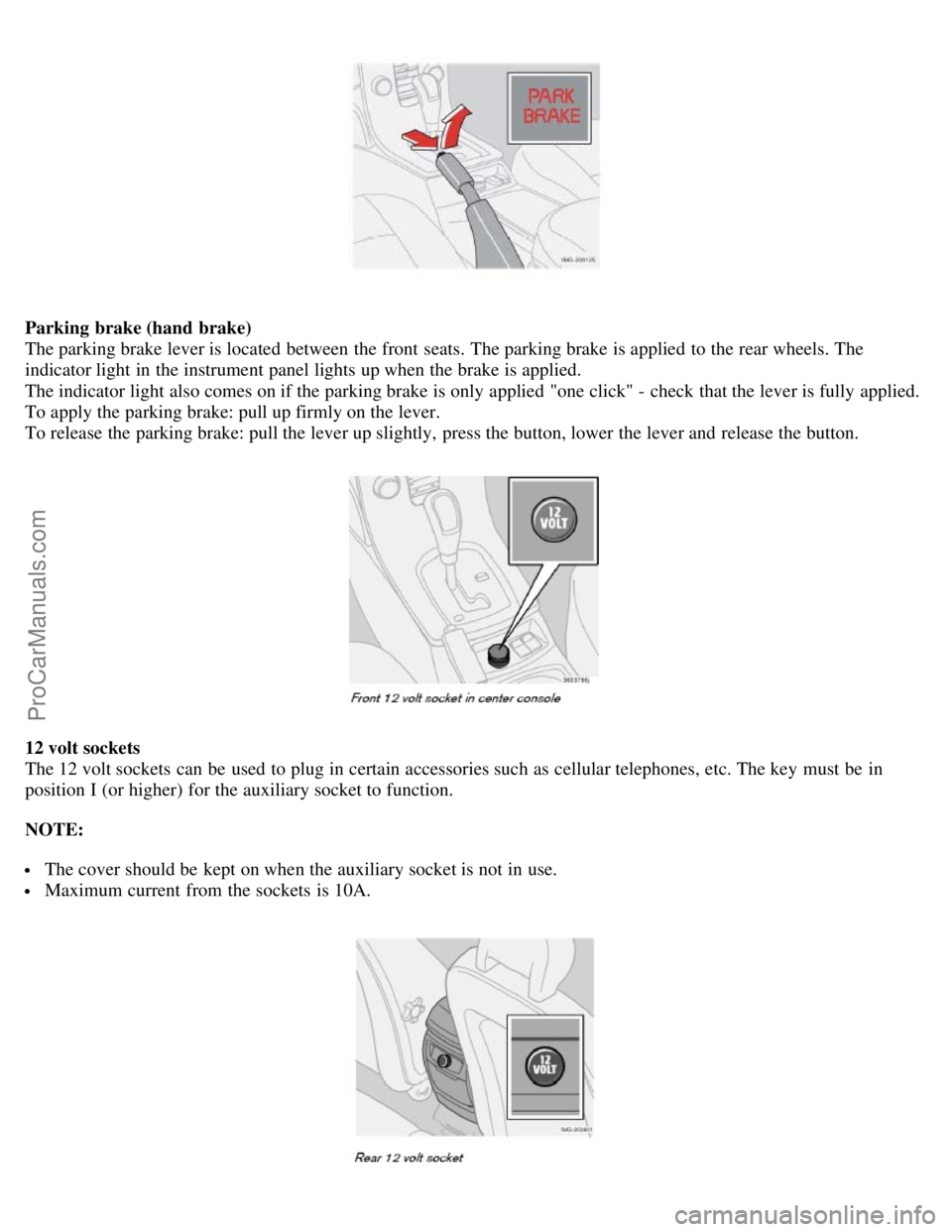
Parking brake (hand brake)
The parking brake lever is located between the front seats. The parking brake is applied to the rear wheels. The
indicator light in the instrument panel lights up when the brake is applied.
The indicator light also comes on if the parking brake is only applied "one click" - check that the lever is fully applied.
To apply the parking brake: pull up firmly on the lever.
To release the parking brake: pull the lever up slightly, press the button, lower the lever and release the button.
12 volt sockets
The 12 volt sockets can be used to plug in certain accessories such as cellular telephones, etc. The key must be in
position I (or higher) for the auxiliary socket to function.
NOTE:
The cover should be kept on when the auxiliary socket is not in use.
Maximum current from the sockets is 10A.
ProCarManuals.com
Page 59 of 182

pg. 61 Climate
Electronic climate control (ECC)
If the air in the car recirculates for too long, there is a risk of condensation forming on the insides of the windows,
especially in winter.
Timer
The timer function minimizes the risk of fogging, or stale air when the recirculation function is selected. See page 52
for information on setting the recirculation timer.
NOTE: Recirculation is always disengaged if the defroster button is engaged to clear ice or condensation from the side
windows.
4. Defroster
Directs airflow to the windshield and side windows and increases blower speed. The LED in the defroster
button lights up when this function is activated. The air conditioning system is controlled to provide maximum air
dehumidification. The air is not recirculated.
5. Airflow controls
Press one of the three buttons in the illustration to activate the selected airflow. A symbol in the display
above the climate control panel and a lit LED in the selected button indicate that the manual function has been
selected. With manually selected airflow both warm and cool air can be selected. See also the table on page 63
.
6. Air conditioning On/Off
The air conditioning system is controlled automatically by the system when the ON LED is lit to maintain
the selected temperature.
When OFF is selected and the OFF LED is lit, the air conditioning system is deactivated. Other functions are still
controlled automatically.
When Defroster (4) is selected, the air conditioning system is activated for maximum dehumidifying.
7 and 8. Heated front seats (option)
Maximum heating: Press the button once - both LEDs light up.
Reduced heating: Press the button a second time - one LED lights up.
Seat heating off: Press the button a third time - no LEDs are lit.
9. Rear window and door mirror defrosters
Press to defrost the rear window and door mirrors.
ProCarManuals.com
Page 62 of 182

2 0 0 6
VOLVO C70
Chapter 5 - Interior
pg. 65 Interior
Front seats 66
Power seats68
Power retractable hard top70
Temporary cover75
Wind blocker76
Interior lighting77
Storage compartments79
Loading the trunk82
Carrying long loads84
pg. 66 Interior
Front seats
Manual passenger's seat adjustment
The passenger's seat can be manually adjusted in a number of ways to provide a comfortable driving and sitting
position.
1. Forward-rearward: Pull the lever up and slide the seat to the position of your choice.
2. Use this control to raise or lower the front edge of the seat cushion.
3. Use this control to raise or lower the rear edge of the seat cushion.
4. Turn this knob (option on some passenger's seats) to adjust the firmness of the lumbar support.
5. Turn this knob to adjust the backrest tilt.
6. Control panel for power seats.
ProCarManuals.com
Page 63 of 182

WARNING!
Do not adjust the seat while driving.
The seat should be adjusted so that the brake pedal can be depressed fully.
Position the seat as far rearward as comfort and control allow.
pg. 67 Interior
Front seats
Accessing the rear seat-Easy Entry
Manual seat
Moving the seat forward:
Pull up control 1 (see the illustration above) to release the backrest.
Tilt the backrest forward and slide the seat forward.
Moving the seat rearward:
With the backrest tilted forward, move the seat rearward to the desired position.
Pull up control 1 and return the backrest to the upright position.
Power seats
Moving the seat forward:
Pull up control 1 (see the illustration above) to release the backrest.
Tilt the backrest forward.
Press and hold down the front section of button 2 (see the illustration above) to move the seat forward.
Moving the seat rearward:
Press and hold down the rear section of button 2 until the seat has returned to its original position.
Pull up control 1 and return the backrest to the upright position.
WARNING!
After the seat has been returned to its original position, be sure that the backrest is securely locked in the upright
ProCarManuals.com
Page 64 of 182

position.
pg. 68 Interior
Power seats
The power driver's seat can be adjusted:
If the ignition key is in position I or II.
During a 10 minute period after the doors have been unlocked if the door remains open.
If the door is closed and the ignition key is not yet in the ignition, or if the key is in position 0, the seat can be
adjusted or during a period of 40 seconds. The power passenger's seat can only be adjusted if the ignition key is in
position I or II, or if the engine is running.
Adjusting the seat
Controls 5, 6, and 7 on the side of the seat can be used to make adjustments.
5. Backrest tilt
6. Move this section of the control up or down to raise/lower the rear section of the seat. Move the control forward to
move the seat forward.
7. Move this section of the control up or down to raise/lower the front section of the seat. Move the control rearward
to move the seat rearward.
NOTE: The power seats have an overload protector that activates if a seat is blocked by any object. If this occurs,
switch off the ignition (key in position 0) and wait for approximately 20 seconds before operating the seat again.
Emergency stop
NOTE: If the seat inadvertently begins to move, press any of the buttons to stop the seat.
Programming the seat memory, driver's seat only (option)
Three different seating positions can be stored (buttons 1, 2, and 3 in the illustration) in the seat's memory.
The following example explains how button 1 can be programmed. Buttons 2 and 3 can be programmed in the same
way.
To program (store) a seat position in button 1:
Use controls 5, 6, and 7 to adjust the seat to the desired position.
Press and hold down the M (memory) button.
With the M button depressed, press button 1 to store the seat's current position.
ProCarManuals.com
Page 65 of 182

To move the seat to the position that it was in when button 1 was programmed, press and hold down button 1 until the
seat stops moving.
As a safety precaution, the seat will stop automatically if the button is released before the seat has reached the preset
position.
Central locking system remote control and driver's seat memory
The remote control transmitter can also be equipped with an optional function that controls the electrically operated
driver's seat in the following way:
Adjust the seat to the desired position.
When you leave the car, lock it using the remote control.
The next time the driver's door is unlocked with the same remote control and the driver's door is opened, the driver's
seat will automatically move to the position
pg. 69 Interior
Power seats
that it was in when the door was most recently locked with that remote control.
WARNING!
Because the driver's seat can be adjusted with the ignition off, children should never be left unattended in the car.
Movement of the seat can be STOPPED at any time by pressing any button on the power seat control panel.
Do not adjust the seat while driving. The seat should be adjusted so that the brake pedal can be depressed fully. In
addition, position the seat as far rearward as comfort and control allow.
The seat rails on the floor must not be obstructed in any way when the seat is in motion.
pg. 70 Interior
Power retractable hard top
Before raising or lowering the power retractable hard top
Please observe the following information before operating the power retractable hard top:
There should be no objects on the power retractable hard top's cover.
Remove all snow, ice or loose objects from the power retractable hard top and trunk lid.
The top should be dry before it is lowered.
CAUTION!
If the power retractable hard top is lowered while it is wet, water may drip into the passenger compartment or trunk.
There should be at least 6.5 feet (2 meters) of free space from the ground (distance A in the illustration below).
There should be at least 8 inches (20 cm) of free space behind the vehicle (distance B in the illustration below).
The ambient temperature should be above 14°F (-10°C).
ProCarManuals.com
Page 157 of 182

72. Not in use
73. Front ceiling lighting, 5A
pg. 174 Maintenance and servicing
Fuses
74. Fuel pump relay, 15A
75. Not in use
76. Not in use
77. 12-volt socket in trunk, accessory control module (AEM), 15A
78. Not in use
79. Back-up lights, 5A
80. Not in use
81. Power window - rear driver's side, 20A
82. Power window and door lock - front passenger's side door, 25A
83. Power window and door lock - front driver's side door, 25A
84. Power passenger's seat (option), 25A
85. Power driver's seat, 25A
86. Interior lighting relay, trunk light, power seats, 5A
Contents | Top of Page
ProCarManuals.com
Page 178 of 182

Front airbags15, 16
Front fog light, replacing167
Front fog lights38
Front seats66
Front seats, manual adjustment66
Front seats, power68
Fuel filler cap2
Fuel filler door2, 102
unlocking38
unlocking manually39
Fuel gauge32
Fuel requirements101
Fuel system192
Fuel tank capacity102
Fuse box in the passenger compartment, accessing172
Fuses170
Fuses in the engine compartment171
Fuses in the passenger compartment173
G
Gasoline101
Geartronic (manual shifting)108
Generator193
Generator warning light35
Glossary of tire terminology132
Glove compartment80
Glove compartment, locking90
H
Hazard warning flashers46
Headlight housing, removing165
Headlight washers44
Headlights38
High beam bulb, replacing166
High beam flash40
High beam headlights40
High beam indicator32
Home safe lighting40, 51
Hood, opening157
I
Immobilizer86
, 105
Indicator and warning symbols32
Inflatable Curtain22
Inflation pressure tables130
Information display32
Information display, messages in37
ProCarManuals.com