fuel VOLVO C70 2006 Owner's Guide
[x] Cancel search | Manufacturer: VOLVO, Model Year: 2006, Model line: C70, Model: VOLVO C70 2006Pages: 182, PDF Size: 3.35 MB
Page 137 of 182

In accordance with applicable U.S. and Canadian regulations, the following list of warranties is provided.
New Vehicle Limited Warranty
Parts and Accessories Limited Warranty
Corrosion Protection Limited Warranty
Seat Belt and Supplemental Restraint Systems Limited Warranty
Emission Design and Defect Warranty
Emission Performance Warranty
These are the federal warranties; other warranties are provided as required by state/ provincial law. Refer to your
separate Warranty and Service Records Information booklet for detailed information concerning each of the warranties.
Periodic maintenance helps minimize emissions
Periodic maintenance will help keep your vehicle running well. Your Warranty and Service Records Information
booklet provides a comprehensive periodic maintenance schedule up to 150,000 miles (240,000 km) of vehicle
maintenance. The schedule includes components that affect vehicle emissions. This page describes some of the
emission-related components.
Vehicle Event Data (Black Box)
Your vehicle's driving and safety systems employ computers that monitor, and share with each other, information
about your vehicle's operation. One or more of these computers may store what they monitor, either during normal
vehicle operation or in a crash or near-crash event. Stored information may be read and used by:
Volvo Car Corporation
service and repair facilities
law enforcement or government agencies
others who may assert a legal right to know, or who obtain your consent to know such information.
pg. 155 Maintenance and servicing
Maintaining your car
Owner maintenance
Periodic maintenance requirements and intervals are described in your vehicle's Warranty and Service Records
Information booklet.
The following points can be carried out between the normally scheduled maintenance services.
Each time the car is refueled:
Check the engine oil level
Clean the windshield, windshield wipers, headlights, and tail lights
Monthly:
Check cold tire pressure in all tires. Inspect the tires for wear.
Check that engine coolant and other fluid levels are between the indicated "min" and "max" markings.
Clean interior glass surfaces with a glass cleaner and soft paper towels.
Wipe driver information displays with a soft cloth.
Visually inspect battery terminals for corrosion. Corrosion may indicate a loose terminal connector, or a battery near
the end of its useful service life. Consult your Volvo retailer for additional information.
As needed:
Wash the car, including the undercarriage, to reduce wear that can be caused by a buildup of dirt, and corrosion that
can be caused by salt residues.
ProCarManuals.com
Page 140 of 182

pg. 158 Maintenance and servicing
Engine oil
Changing engine oil and oil filter
See page 191
for oil specifications. Refer to the Warranty and Service Records Information booklet for information on
the oil change intervals.
Volvo recommends
.
NOTE:
Volvo does not recommend the use of oil additives.
Synthetic oil is not used when the oil is changed at the normal maintenance intervals except at owner request and at
additional charge. Please consult your Volvo retailer.
Checking and adding oil
The oil level should be checked every time the vehicle is refueled. This is especially important during the period up to
the first scheduled maintenance service.
The car should be parked on a level surface when the oil is checked.
If the engine is warm , wait for at least 10-15 minutes after the engine has been switched off before checking the oil.
Checking the oil
1. Pull out the dipstick and wipe it with a lint-free rag.
2. Reinsert the dipstick, pull it out, and check the oil level.
3. Add oil if necessary. If the level is close to the MIN mark, add approximately 1 US quart (1 liter) of oil.
4. Run the engine until it reaches normal operating temperature.
5. Switch off the engine and wait for at least 10-15 minutes and recheck the oil level. If necessary, add oil until the
level is near the MAX mark.
CAUTION!
ProCarManuals.com
Page 155 of 182

12. Feed to heated rear window, 30A
13. Starter motor relay, 30A
14. Trailer connector, 40A
15. Power retractable hard top, 30A
16. Feed to audio system, 30A
17.Windshield wipers, 30A
18. Feed to passenger compartment fuse box, 40A
19. Not in use
20. Horn, 15A
21. Not in use
22. Subwoofer, 25A
23. Engine control module (ECM)/transmission control module (TCM), 10A
24. Not in use
25. Not in use
26. Ignition switch, 15A
27. A/C compressor 10A
28. Not in use
29. Front fog lights (option), 15A
30. Not in use
31. Not in use
32. Fuel injectors, 10A
33. Heated oxygen sensor, vacuum pump, 20A
34. Ignition coils, engine control module, climate unit pressure sensor, 10A
35. Engine sensor valves, A/C relay, 15A
36. Engine control module (ECM), throttle sensor, 10A
pg. 172 Maintenance and servicing
Fuses
Fuse box in the passenger compartment
The fuse box in the passenger compartment is located under the glove compartment.
To access the fuses:
1. Remove the upholstery covering the fuse box by first pressing in the center pins in the mounting clips approximately
0.5 in (1 cm) with a small screwdriver and then pulling the pins out.
2. Turn both retaining screws (2) counterclockwise until they release.
3. Fold down the fuse box (3) half way. Pull it toward the seat until it stops. Fold it down completely. The fuse box can
be unhooked completely.
4. Replace the blown fuse.
5. Close the fuse box in reverse order.
6. Pull the center pins fully out of the mounting clips, secure the upholstery with the mounting clips and press the pins
ProCarManuals.com
Page 157 of 182

72. Not in use
73. Front ceiling lighting, 5A
pg. 174 Maintenance and servicing
Fuses
74. Fuel pump relay, 15A
75. Not in use
76. Not in use
77. 12-volt socket in trunk, accessory control module (AEM), 15A
78. Not in use
79. Back-up lights, 5A
80. Not in use
81. Power window - rear driver's side, 20A
82. Power window and door lock - front passenger's side door, 25A
83. Power window and door lock - front driver's side door, 25A
84. Power passenger's seat (option), 25A
85. Power driver's seat, 25A
86. Interior lighting relay, trunk light, power seats, 5A
Contents | Top of Page
ProCarManuals.com
Page 170 of 182
2 0 0 6
VOLVO C70
Chapter 12 - Specifications
pg. 187 Specifications
Label information 188
Dimensions and weights189
Fuel, oils, and fluids190
Engine oil191
Engine specifications192
Electrical system193
Three-way catalytic converter194
Volvo programs195
pg. 188 Specifications
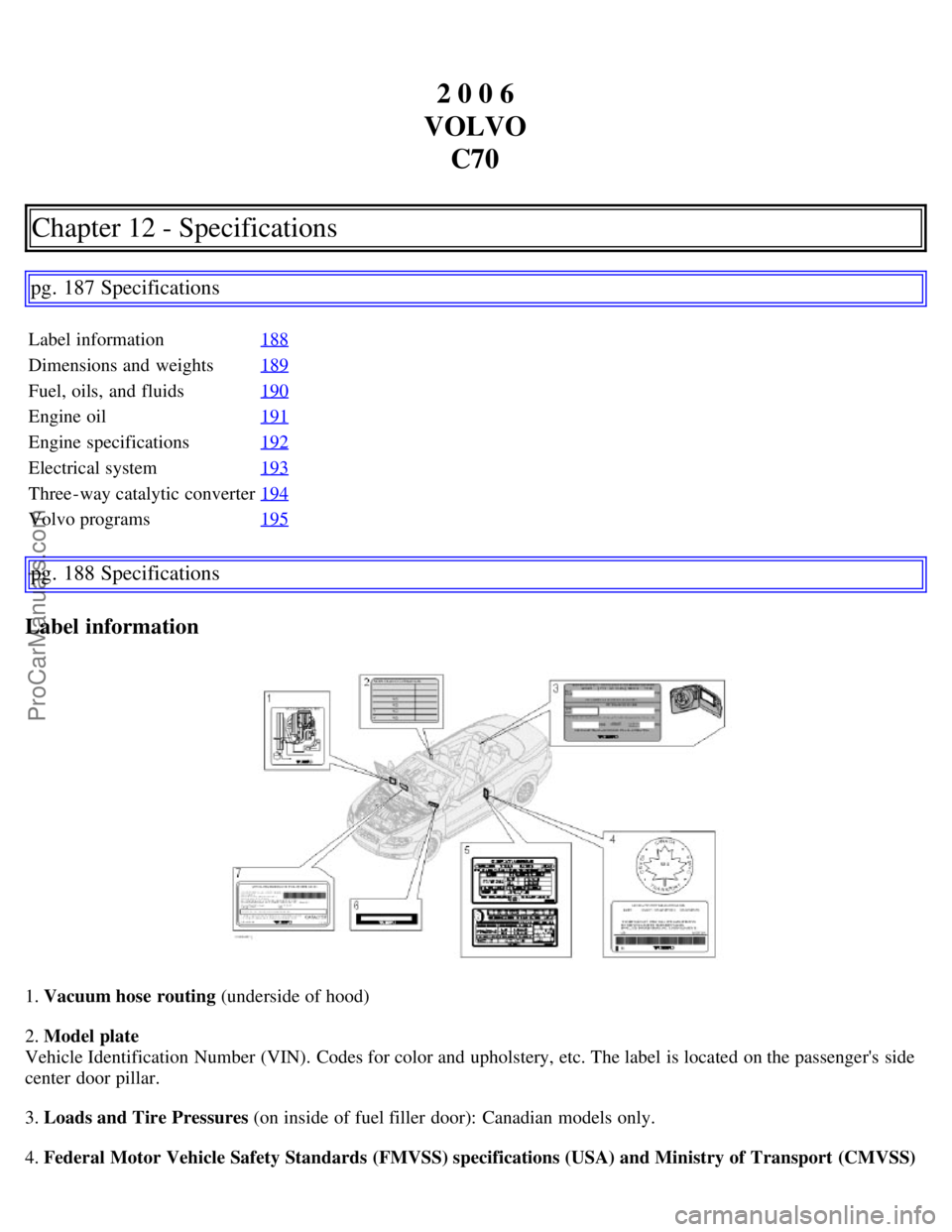
Label information
1. Vacuum hose routing (underside of hood)
2. Model plate
Vehicle Identification Number (VIN). Codes for color and upholstery, etc. The label is located on the passenger's side
center door pillar.
3. Loads and Tire Pressures (on inside of fuel filler door): Canadian models only.
4. Federal Motor Vehicle Safety Standards (FMVSS) specifications (USA) and Ministry of Transport (CMVSS)
ProCarManuals.com
Page 172 of 182

Fuel, oils, and fluids
pg. 191 Specifications
Engine oil
Oil specifications
Engine oil must meet the minimum ILSAC specification GF-3, API SL, or ACEA A1/B1. Lower quality oils may not
offer the same fuel economy, engine performance, or engine protection.
Volume: 6.1 US qts (5.8 liters).
Volume between the MIN and Max marks on the dipstick: approximately 1.7 US qts (1.6 liters).
Volvo recommends
.
Depending on your driving habits, premium or synthetic oils may provide superior fuel economy and engine
protection. Consult your Volvo retailer for recommendations on premium or synthetic oils.
Oil additives must not be used.
NOTE: Synthetic oil is not used when the oil is changed at the normal service intervals. This oil is only used at
customer request, at additional charge. Please consult your Volvo retailer.
Oil viscosity (stable ambient temperatures)
Operation in hot climates
When temperatures exceed 86° F (30° C) in your area, Volvo recommends, for the protection of your engine, that you
use a
heavier weight oil, such as SAE 10W -30. See the viscosity chart.
ProCarManuals.com
Page 173 of 182

Operation in temperate climates
Incorrect viscosity oil can shorten engine life. Under normal use when temperatures do not exceed 86° F (30° C), SAE
5W -30 will provide good fuel economy and engine protection. See the viscosity chart.
Extreme engine operation
Synthetic oils meeting SAE 10W -30 and complying with oil quality requirements are recommended for driving in
areas of sustained temperature extremes (hot or cold), when towing a trailer over long distances, and for prolonged
driving in mountainous areas.
American Petroleum Institute (API) symbol
The API Service Symbol "donut" is divided into three parts:
The upper section describes the oil's performance level.
The center identifies the oil's viscosity.
The lower section indicates whether the oil has demonstrated energy-conserving properties in a standard test in
comparison to a reference oil.
pg. 192 Specifications
Engine specifications
Charge air cooler (Intercooler)
Turbocharged engines employ a turbo-compressor to force air into the engine inlet manifold and a charge air cooler to
cool the compressed inlet air. The resulting increase in air flow raises pressure in the intake manifold and increases
engine power over that developed by the normally-aspirated engine. The charge air cooler (which resembles a radiator)
is located between the turbo-compressor and inlet manifold.
Fuel system
The engine is equipped with a multiport fuel injection system.
pg. 193 Specifications
ProCarManuals.com
Page 174 of 182

Electrical system
General information
12-volt system with voltage controlled generator. Single wire system in which the chassis and engine block are used as
conductors, grounded on the chassis.
Bulbs
Please refer to page 164
for a list of the bulbs used in your car.
Battery Voltage 12 V12 V
Cold start capacity (CCA) 600 A
700 A
1
Reserve capacity (RC) 120 min150 min
1. Cars equipped with the Dynaudio Sound system and/or the Volvo Navigation system
If the battery must be replaced, replace it with one with the same cold start capacity and reserve capacity as the
original (see the decal on the battery). Generator 1 maximum current 120/150 A
Starter motor output 1.4/1.9 kW
1. Dependent on engine type
pg. 194 Specifications
Three-way catalytic converter
Three-way catalytic converter - general information
Keep your engine properly tuned. Certain engine malfunctions, particularly involving the electrical, fuel or
distributor ignition systems, may cause unusually high three-way catalytic converter temperatures. Do not continue to
operate your vehicle if you detect engine misfire, noticeable loss of power or other unusual operating conditions, such
as engine overheating or backfiring. A properly tuned engine will help avoid malfunctions that could damage the three-
way catalytic converter.
Do not park your vehicle over combustible materials, such as grass or leaves, which can come into contact with the
hot exhaust system and cause such materials to ignite under certain wind and weather conditions.
Excessive starter cranking (in excess of one minute), or an intermittently firing or flooded engine can cause three-
way catalytic converter or exhaust system overheating.
Remember that tampering or unauthorized modifications to the engine, the Engine Control Module, or the vehicle
may be illegal and can cause three-way catalytic converter or exhaust system overheating. This includes:
- Altering fuel injection settings or components.
- Altering emission system components or location or removing components.
- Repeated use of leaded fuel.
NOTE: Unleaded fuel is required for vehicles with three-way catalytic converters.
pg. 195 Specifications
Volvo programs
ProCarManuals.com
Page 178 of 182

Front airbags15, 16
Front fog light, replacing167
Front fog lights38
Front seats66
Front seats, manual adjustment66
Front seats, power68
Fuel filler cap2
Fuel filler door2, 102
unlocking38
unlocking manually39
Fuel gauge32
Fuel requirements101
Fuel system192
Fuel tank capacity102
Fuse box in the passenger compartment, accessing172
Fuses170
Fuses in the engine compartment171
Fuses in the passenger compartment173
G
Gasoline101
Geartronic (manual shifting)108
Generator193
Generator warning light35
Glossary of tire terminology132
Glove compartment80
Glove compartment, locking90
H
Hazard warning flashers46
Headlight housing, removing165
Headlight washers44
Headlights38
High beam bulb, replacing166
High beam flash40
High beam headlights40
High beam indicator32
Home safe lighting40, 51
Hood, opening157
I
Immobilizer86
, 105
Indicator and warning symbols32
Inflatable Curtain22
Inflation pressure tables130
Information display32
Information display, messages in37
ProCarManuals.com
Page 180 of 182

Opening the hood157
P
Paint touch up151
Panel lighting, instrument38
Panic alarm, central locking system remote control87
Park assist115
Parking brake47
Parking light bulb, replacing166
Parking lights38
Passenger's side front airbag, disabling18
Personal settings51
PI (Program Information) seek179
Polishing149
Power door mirrors50
Power retractable hard top70
Power steering fluid160
Power windows48
Program Information seek179
Program type, audio system180
PROPOSITION 65 WARNING162
R
Radio Broadcast Data System - RBDS179
Radio station formats180
Radio text179
Rain sensor45
Reading lights77
Rear fog light38
Rear seat, accessing67
Rearview mirror49
Rearview mirror with compass (option)49
Refueling102
Remote control functions87
Remote control, battery replacement92
Remote controls, central locking system86
Replacing fuses170
Reporting safety defects10
Retractable hard top70
Roll-over Protection system (ROPS)25
S
Safety defects, reporting10
Seat belt maintenance13
Seat belt reminder13, 35
Seat belts11
Seats, front66
ProCarManuals.com