warning VOLVO C70 2006 Manual PDF
[x] Cancel search | Manufacturer: VOLVO, Model Year: 2006, Model line: C70, Model: VOLVO C70 2006Pages: 182, PDF Size: 3.35 MB
Page 129 of 182

Unscrew the hose from the tire's inflation valve and reinstall the valve cap.
Disconnect the electrical wire from the 12-volt socket.
Return the hose and electrical wire to the compartment on the side of the unit.
NOTE: When the tire sealing system has been used to seal a flat tire, the tank containing the sealing compound, and
the hose must be replaced. See the instructions on the following page. Contact a Volvo retailer for replacement parts.
pg. 145 Wheels and tires
Tire sealing system
CAUTION!
If your vehicle is equipped with the optional Tire Pressure Monitoring System (see page 117
), the use of the sealing
compound may lead to incorrect tire pressure readings or in rare cases, damage to the tire pressure sensor. Use the
tire sealing system to check and adjust the damaged tire's pressure.
After use, return the tire sealing system to its storage compartment behind the ski hatch in the center of the rear seat
backrest.
WARNING!
If you interrupt your trip for more than one hour, check the inflation pressure in the damaged tire again before
continuing. See the section "Stage 2: Checking inflation pressure" on page 143
.
Replacing the sealing compound container
The sealing compound container must be replaced if:
the tire sealing system has been used to repair a tire the container's expiration date has passed (see the date on decal
1).
After use, the container (6), its retaining bracket (9), and the hose (10) must be replaced. Please consult your Volvo
retailer for replacement parts.
See also the safety regulations on the bottom of the container.
WARNING!
Be sure that the compressor is not connected to a 12-volt socket while replacing the container.
pg. 146 Wheels and tires
ProCarManuals.com
Page 132 of 182

Automatic washing - simple and quick
We do NOT recommend washing your car in an automatic wash during the first six months (because the paint will
not have hardened sufficiently).
An automatic wash is a simple and quick way to clean your car, but it is worth remembering that it may not be as
thorough as when you yourself go over the car with sponge and water. Keeping the underbody clean is most important,
especially in the winter. Some automatic washers do not have facilities for washing the underbody.
pg. 149 Vehicle care
Washing and cleaning the car
CAUTION!
Before driving into an automatic carwash, turn off the optional rain sensor to avoid damaging the windshield wipers.
Make sure that side view mirrors, auxiliary lamps, etc, are secure, and that any antenna(s) are retracted or removed.
Otherwise there is risk of the machine dislodging them.
WARNING!
When the car is driven immediately after being washed, apply the brakes several times in order to remove any
moisture from the brake linings.
Engine cleaning agents should not be used when the engine is warm. This constitutes a fire risk.
Polishing and Waxing
Normally, polishing is not required during the first year after delivery, however, waxing may be beneficial.
Before applying polish or wax the vehicle must be washed and dried. Tar spots can be removed with kerosene or tar
remover. Difficult spots may require a fine rubbing compound.
After polishing use liquid or paste wax.
Several commercially available products contain both polish and wax.
Waxing alone does not substitute for polishing a dull surface.
A wide range of polymer-based waxes can be purchased today. These waxes are easy to use and produce a long-
lasting, high-gloss finish that protects the bodywork against oxidation, road dirt and fading.
Do not polish or wax your vehicle in direct sunlight (the surface of the vehicle should not be warmer than 113° F
(45° C).
CAUTION!
Volvo does not recommend the use of long-life or durable paint protection coatings, some of which may claim to
prevent pitting, fading, oxidation, etc. These coatings have not been tested by Volvo for compatibility with your
vehicle's clear coat. Some of them may cause the clear coat to soften, crack, or cloud. Damage caused by application
of paint protection coatings may not be covered under your vehicle's paint warranty.
pg. 150 Vehicle care
Washing and cleaning the car
Upholstery care
Fabric
ProCarManuals.com
Page 139 of 182

Opening the hood
To open the hood:
Pull the lever located under the left side of the dash to release the hood lock.
Lift the hood slightly.
Press up the release control located under the front edge of the hood (at the center) up to the right, and lift the hood.
WARNING!
Check that the hood locks engage properly when closed.
Engine compartment
1. Cooling system expansion tank
2. Power steering fluid reservoir
3. Dipstick - engine oil
4. Radiator
5. Cooling fan
6. Washer fluid reservoir
7. Engine oil filler cap
8. Brake/clutch fluid reservoir
9. Battery
10. Relay/fuse box
11. Air cleaner
WARNING!
The cooling fan may start or continue to operate (for up to 6 minutes) after the engine has been switched off.
ProCarManuals.com
Page 141 of 182
Not checking the oil level regularly can result in serious engine damage if the oil level becomes too low.
Oil that is lower than the specified quality can damage the engine.
Always add oil of the same type and viscosity as already used.
Never fill oil above the MAX mark. This could cause an increase in oil consumption.
WARNING!
Do not allow oil to spill onto or come into contact with hot exhaust pipe surfaces.
pg. 159 Maintenance and servicing
Fluids
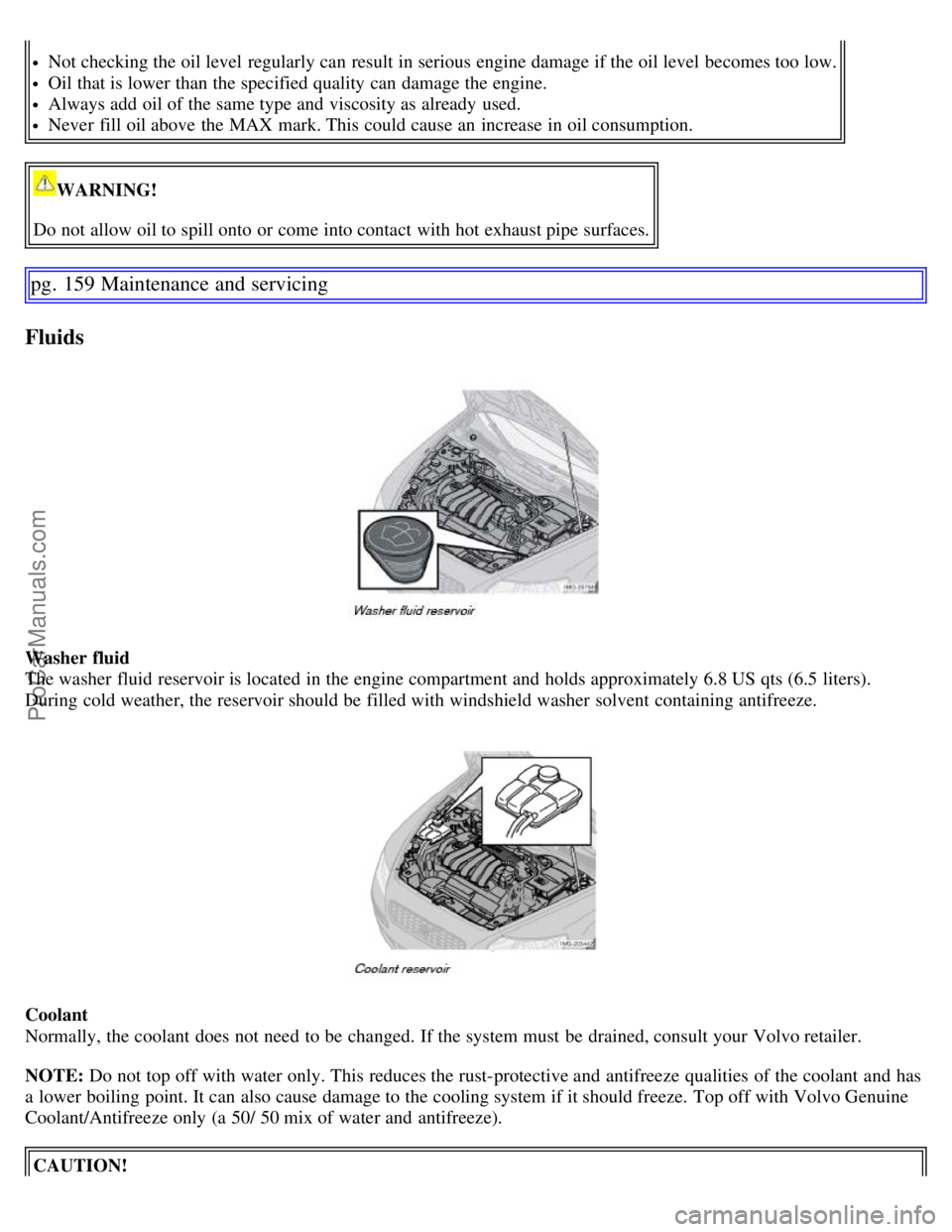
Washer fluid
The washer fluid reservoir is located in the engine compartment and holds approximately 6.8 US qts (6.5 liters).
During cold weather, the reservoir should be filled with windshield washer solvent containing antifreeze.
Coolant
Normally, the coolant does not need to be changed. If the system must be drained, consult your Volvo retailer.
NOTE: Do not top off with water only. This reduces the rust-protective and antifreeze qualities of the coolant and has
a lower boiling point. It can also cause damage to the cooling system if it should freeze. Top off with Volvo Genuine
Coolant/Antifreeze only (a 50/ 50 mix of water and antifreeze).
CAUTION!
ProCarManuals.com
Page 142 of 182
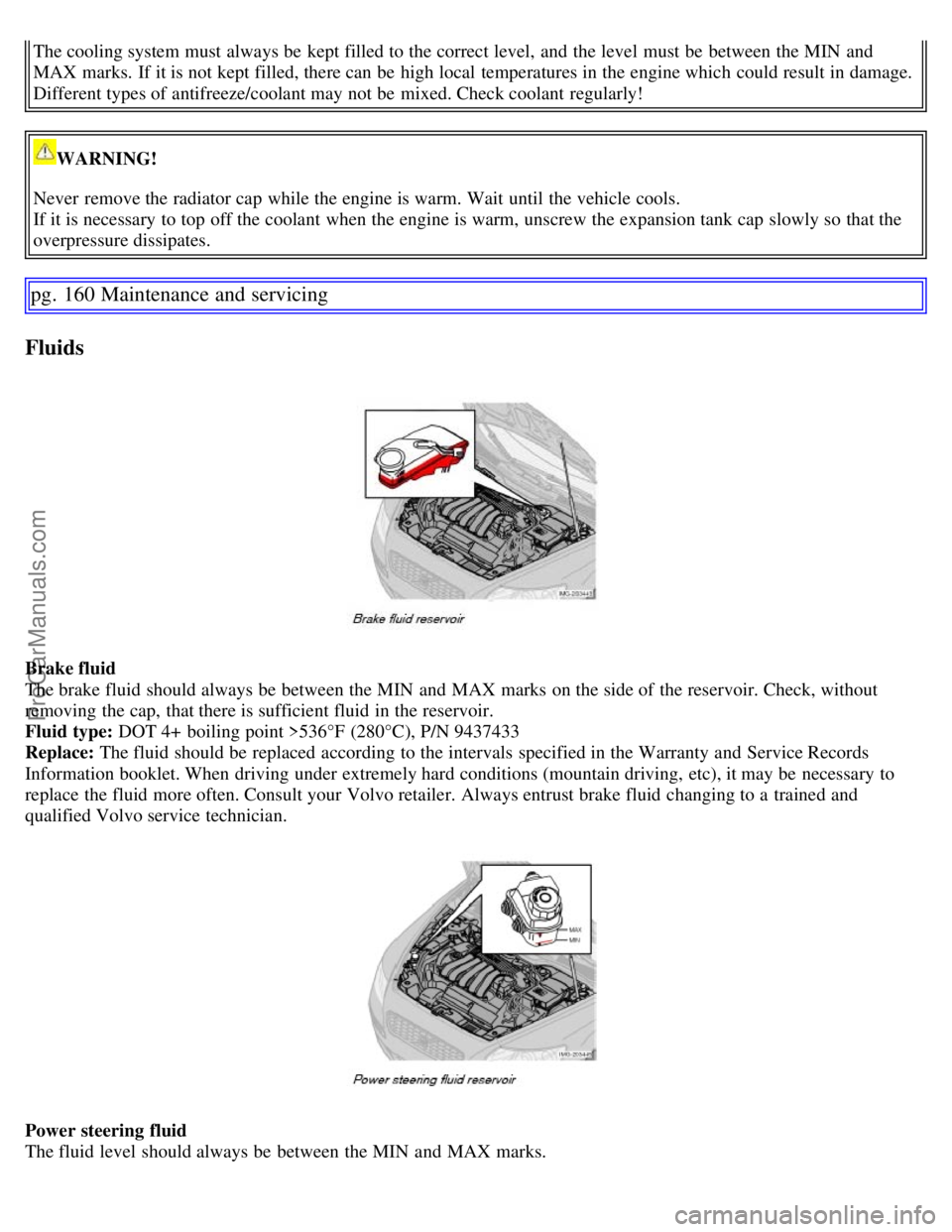
The cooling system must always be kept filled to the correct level, and the level must be between the MIN and
MAX marks. If it is not kept filled, there can be high local temperatures in the engine which could result in damage.
Different types of antifreeze/coolant may not be mixed. Check coolant regularly!
WARNING!
Never remove the radiator cap while the engine is warm. Wait until the vehicle cools.
If it is necessary to top off the coolant when the engine is warm, unscrew the expansion tank cap slowly so that the
overpressure dissipates.
pg. 160 Maintenance and servicing
Fluids
Brake fluid
The brake fluid should always be between the MIN and MAX marks on the side of the reservoir. Check, without
removing the cap, that there is sufficient fluid in the reservoir.
Fluid type: DOT 4+ boiling point >536°F (280°C), P/N 9437433
Replace: The fluid should be replaced according to the intervals specified in the Warranty and Service Records
Information booklet. When driving under extremely hard conditions (mountain driving, etc), it may be necessary to
replace the fluid more often. Consult your Volvo retailer. Always entrust brake fluid changing to a trained and
qualified Volvo service technician.
Power steering fluid
The fluid level should always be between the MIN and MAX marks.
ProCarManuals.com
Page 143 of 182

Fluid type: Volvo power steering fluid or equivalent.
Replace: No fluid change required
WARNING!
If a problem should occur in the power steering system or if the vehicle has no electrical current and must be towed,
it is still possible to steer the vehicle. However, keep in mind that greater effort will be required to turn the steering
wheel.
pg. 161 Maintenance and servicing
Wiper blades
Replacing windshield wiper blades
Fold out the wiper arm and fold out the wiper blade at a 90° angle to the wiper arm.
Pull off the wiper blade from the attachment, straight to the side.
Slide in a new wiper blade at a 90° angle to the wiper arm.
Fold in the wiper blade under the metal plate and fold the wiper arm down.
NOTE: The wiper blades are different lengths. The blade on the driver's side is longer than the one on the passenger's
side.
ProCarManuals.com
Page 145 of 182

The battery should be disconnected from the vehicle when a battery charger is used directly on the battery.
WARNING!
PROPOSITION 65 WARNING!
Battery posts, terminals, and related accessories contain lead and lead compounds, chemicals known to the state of
California to cause cancer and reproductive harm. Wash hands after handling.
1. More frequently in warm climates.
pg. 163 Maintenance and servicing
Battery
Battery replacement
Switch off the ignition and remove the key.
Unscrew the cover over the battery.
Wait at least 5 minutes after switching off the ignition before disconnecting the battery so that all information in the
vehicle's electrical system can be stored in the control modules.
Remove the cover and unscrew the front side of the battery box using a screwdriver.
Disconnect the battery negative (ground)
Release the clamp holding the battery.
Disconnect the positive cable and lift out the battery.
Install the new battery in the reverse order.
WARNING!
Never expose the battery to open flame or electric spark.
Do not smoke near the battery.
ProCarManuals.com
Page 147 of 182

Removing the headlight housing
The entire headlight housing must be lifted out when replacing the high/low beam, parking light, turn signal, and side
marker bulbs. To lift out the housing:
Remove the key from the ignition and turn the headlight switch to position 0.
Open the hood.
Pull up the headlight housing's retaining pin (1)
Pull the headlight housing to one side and then forward (2).
Disconnect the wiring connector.
Lift out the headlight housing and place it on a soft surface to avoid scratching the lens.
After the defective bulb has been replaced, reinsert the housing in the reverse order. Check that the retaining pin is
correctly inserted.
WARNING!
Bi -Xenon headlights (option) - due to the high voltage used by these headlights, these bulbs should only be replaced
by a trained and qualified Volvo service technician.
Low beam bulb
Open the hood.
Remove the headlight housing.
Press the retaining clamps to the sides.
Release the bulb's retaining spring by pressing it to the right, and then moving it outward and downward.
Pull out the bulb.
Disconnect the wiring connector from the bulb. Installing a new bulb.
Insert the new bulb. It can only be installed in one position.
ProCarManuals.com
Page 154 of 182

WARNING!
Never use fuses with higher amperage than those stated in the following tables. Doing so could overload the
vehicle's electrical system.
Fuse box in the engine compartment
The fuse box in the engine compartment has positions for 36 fuses.
Fuses 1-18 are relays/circuit breakers and should only be removed or replaced by a trained and qualified Volvo
service technician.
Fuses 19-36 may be changed at any time when necessary. Several extra fuses and a fuse removal tool to assist in
removing/replacing fuses can be found on the underside of the fuse box cover in the engine compartment.
pg. 171 Maintenance and servicing
Fuses
Fuses in the engine compartment
1. Coolant fan (radiator), 50A
2. Power steering, 80A
3. Feed to passenger compartment fuse box, 60A
4. Feed to passenger compartment fuse box, 60A
5. Not in use
6. Not in use
7. ABS pump, 30A
8. ABS valves, 20A
9. Engine control module (ECM), 30A
10. Climate system blower, 40A
11.Headlight washers, power retractable hard top, locking storage compartments, 20A
ProCarManuals.com
Page 171 of 182

standards (Canada)
Your Volvo is designed to meet all applicable safety standards, as evidenced by the certification label on the facing
side of the driver's door. For further information regarding these regulations, please consult your Volvo retailer.
5. Loads and Tire Pressures U.S. models only
Certain models will only have one decal, depending on the specifications of the vehicle.
6. Vehicle Identification Number (VIN)
1
The VIN plate is located on the top left surface of the dashboard. The VIN is also stamped on the right hand door
pillar, and can be found in the Personal settings menu (see page 52
).
7. Vehicle Emission Control Information
Your Volvo is designed to meet all applicable emission standards, as evidenced by the certification label on the
underside of the hood. For further information regarding these regulations, please consult your Volvo retailer.
1. The Vehicle Identification Number (VIN) should always be quoted in correspondence concerning your vehicle with
the retailer and when ordering parts.
pg. 189 Specifications
Dimensions and weights
CAUTION!
The maximum permissible axle loads and/ or the gross vehicle weight must not be exceeded.
WARNING!
When adding accessories, equipment, luggage and other cargo to your vehicle, the total capacity weight must not be
exceeded.
pg. 190 Specifications
ProCarManuals.com