warning VOLVO C70 2008 Owner's Manual
[x] Cancel search | Manufacturer: VOLVO, Model Year: 2008, Model line: C70, Model: VOLVO C70 2008Pages: 246, PDF Size: 5.14 MB
Page 30 of 246
WARNING
Always refer to the child restraint manufacturer's instructions for detailed information on securing the restraint.
34 01 Safety
Child restraint systems
WARNING
When not in use, keep the child restraint system secured or remove it from the passenger compartment to help
prevent it from injuring passengers in the event of a sudden stop or collision.
A small child's head represents a considerable part of its total weight and its neck is still very weak. Volvo
recommends that children up to age 4 travel, properly restrained, facing rearward. In addition, Volvo recommends
that children should ride rearward facing, properly restrained, as long as possible.
35 01 Safety
Infant seats
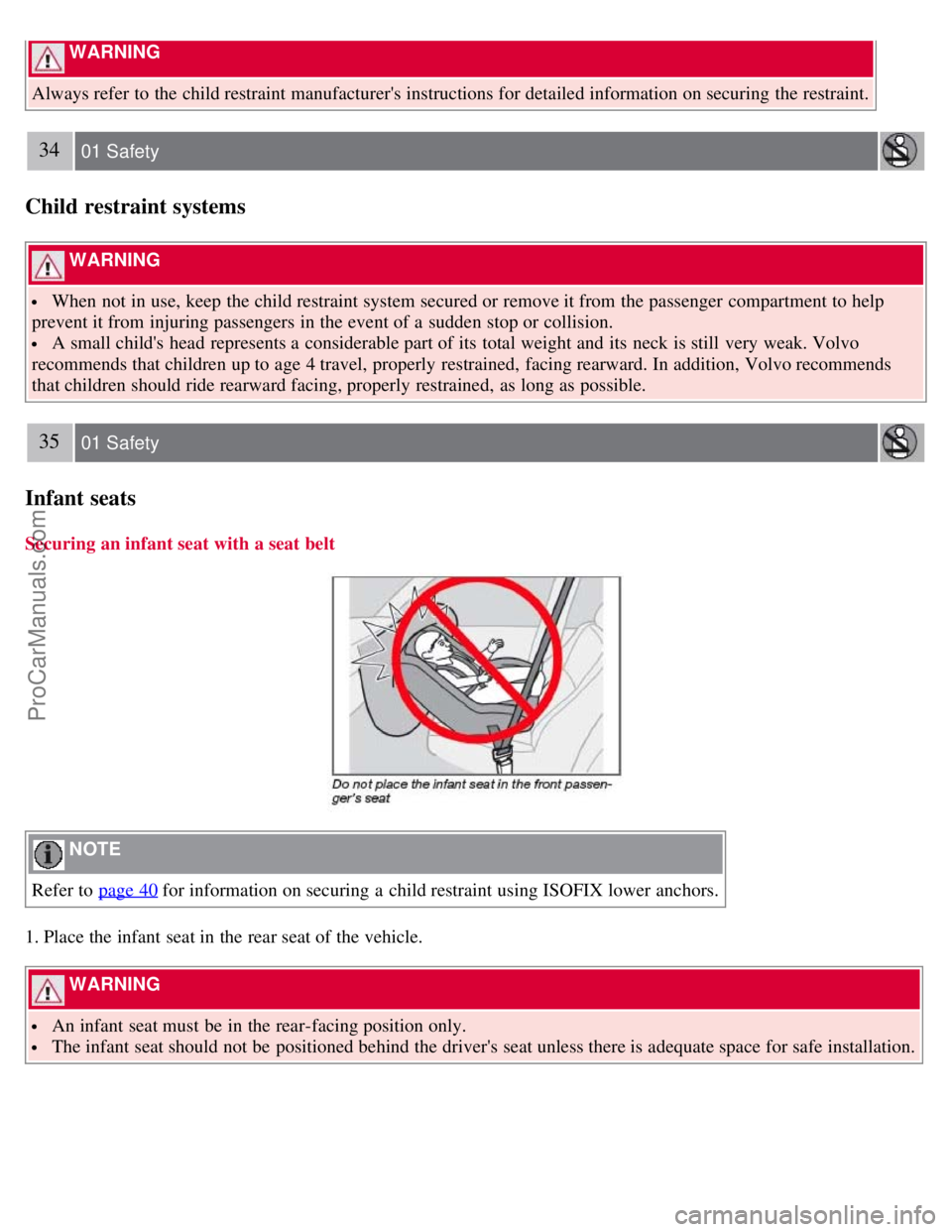
Securing an infant seat with a seat belt
NOTE
Refer to page 40
for information on securing a child restraint using ISOFIX lower anchors.
1. Place the infant seat in the rear seat of the vehicle.
WARNING
An infant seat must be in the rear-facing position only.
The infant seat should not be positioned behind the driver's seat unless there is adequate space for safe installation.
ProCarManuals.com
Page 31 of 246

2. Attach the seat belt to the infant seat according to the manufacturer's instructions.
3. Fasten the seat belt by inserting the latch plate into the buckle (lock) until a distinct click is audible.
WARNING
A child seat should never be used in the front passenger seat of any vehicle with a front passenger airbag - not even
if the "Passenger airbag off" symbol near the rear-view mirror is illuminated (on vehicles equipped with Occupant
Weight Sensor). If the severity of an accident were to cause the airbag to inflate, this could lead to serious injury or
death to a child seated in this position.
36 01 Safety
Infant seats
4. Pull the shoulder section of the seat belt out as far as possible to activate the belt's automatic locking function.
ProCarManuals.com
Page 32 of 246
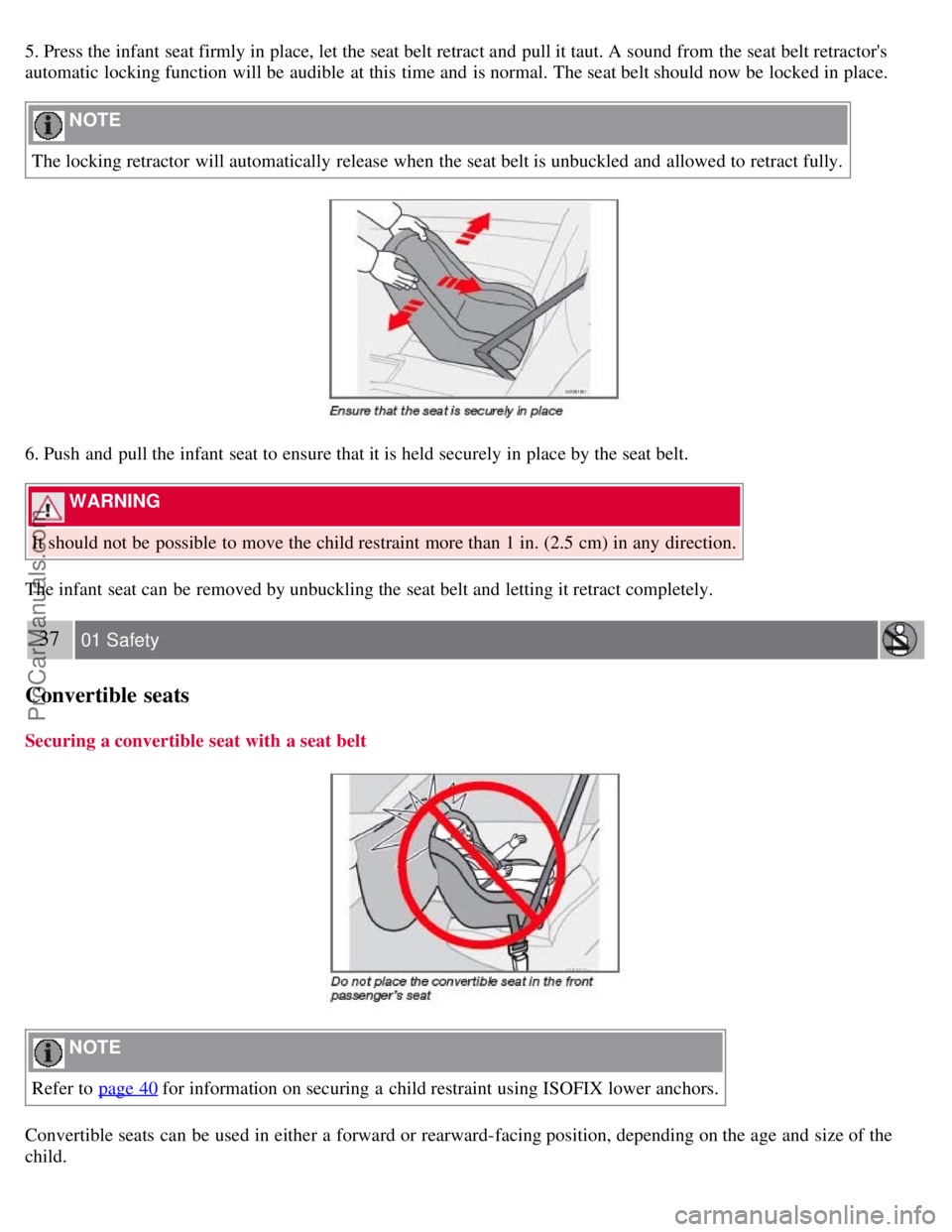
5. Press the infant seat firmly in place, let the seat belt retract and pull it taut. A sound from the seat belt retractor's
automatic locking function will be audible at this time and is normal. The seat belt should now be locked in place.
NOTE
The locking retractor will automatically release when the seat belt is unbuckled and allowed to retract fully.
6. Push and pull the infant seat to ensure that it is held securely in place by the seat belt.
WARNING
It should not be possible to move the child restraint more than 1 in. (2.5 cm) in any direction.
The infant seat can be removed by unbuckling the seat belt and letting it retract completely.
37 01 Safety
Convertible seats
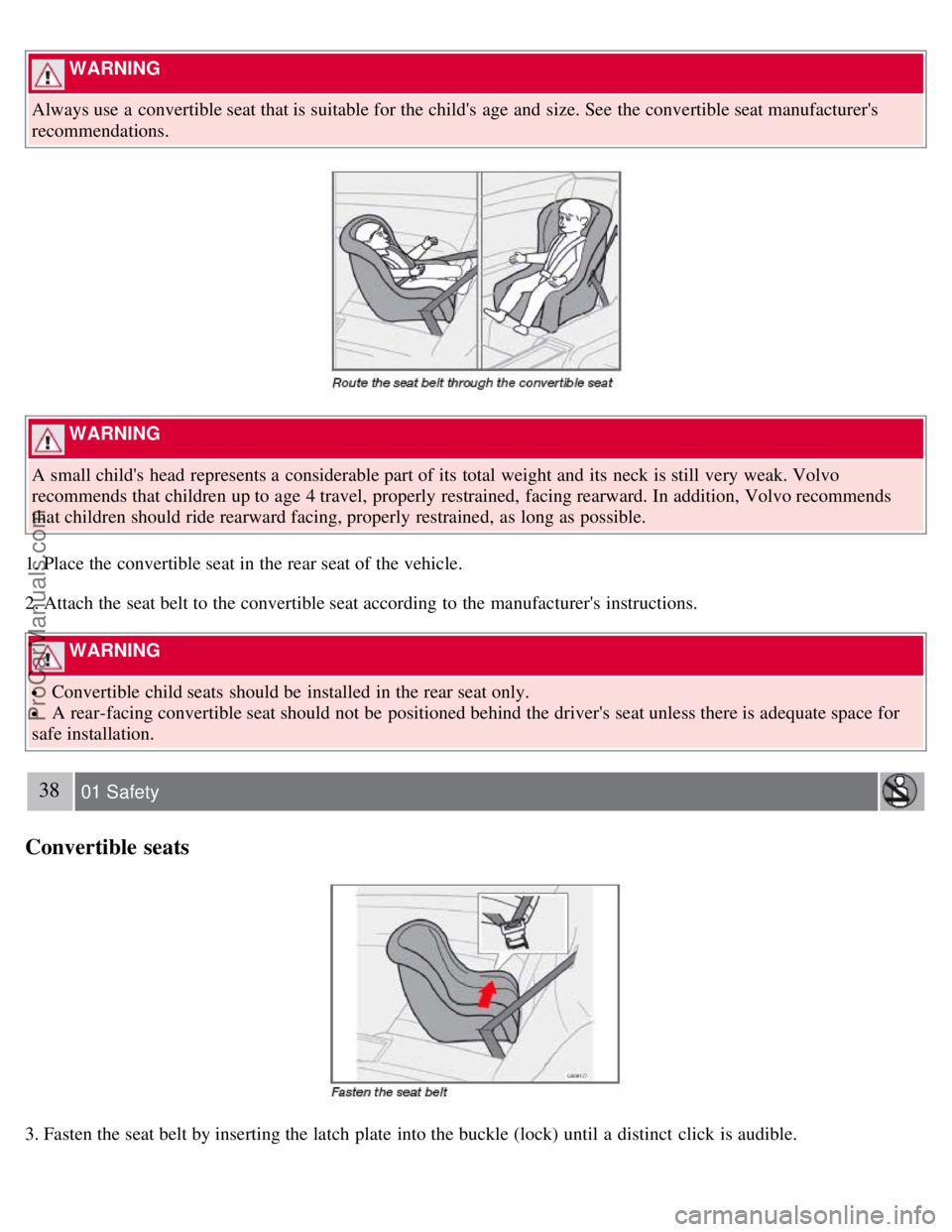
Securing a convertible seat with a seat belt
NOTE
Refer to page 40
for information on securing a child restraint using ISOFIX lower anchors.
Convertible seats can be used in either a forward or rearward-facing position, depending on the age and size of the
child.
ProCarManuals.com
Page 33 of 246
WARNING
Always use a convertible seat that is suitable for the child's age and size. See the convertible seat manufacturer's
recommendations.
WARNING
A small child's head represents a considerable part of its total weight and its neck is still very weak. Volvo
recommends that children up to age 4 travel, properly restrained, facing rearward. In addition, Volvo recommends
that children should ride rearward facing, properly restrained, as long as possible.
1. Place the convertible seat in the rear seat of the vehicle.
2. Attach the seat belt to the convertible seat according to the manufacturer's instructions.
WARNING
Convertible child seats should be installed in the rear seat only.
A rear-facing convertible seat should not be positioned behind the driver's seat unless there is adequate space for
safe installation.
38 01 Safety
Convertible seats
3. Fasten the seat belt by inserting the latch plate into the buckle (lock) until a distinct click is audible.
ProCarManuals.com
Page 34 of 246

4. Pull the shoulder section of the seat belt out as far as possible to activate the belt's automatic locking function.
5. Press the convertible seat firmly in place, let the seat belt retract and pull it taut. A sound from the seat belt
retractor's automatic locking function will be audible at this time and is normal. The seat belt should now be locked in
place.
6. Push and pull the convertible seat to ensure that it is held securely in place by the seat belt.
NOTE
The locking retractor will automatically release when the seat belt is unbuckled and allowed to retract fully.
WARNING
It should not be possible to move the child restraint more than 1 in. (2.5 cm) in any direction.
The convertible seat can be removed by unbuckling the seat belt and letting it retract completely.
WARNING
A child seat should never be used in the front passenger seat of any vehicle with a front passenger airbag - not even
if the "Passenger airbag off" symbol near the rear-view mirror is illuminated (on vehicles equipped with Occupant
Weight Sensor). If the severity of an accident were to cause the airbag to inflate, this could lead to serious injury or
death to a child seated in this position.
39 01 Safety
Booster cushions
ProCarManuals.com
Page 35 of 246
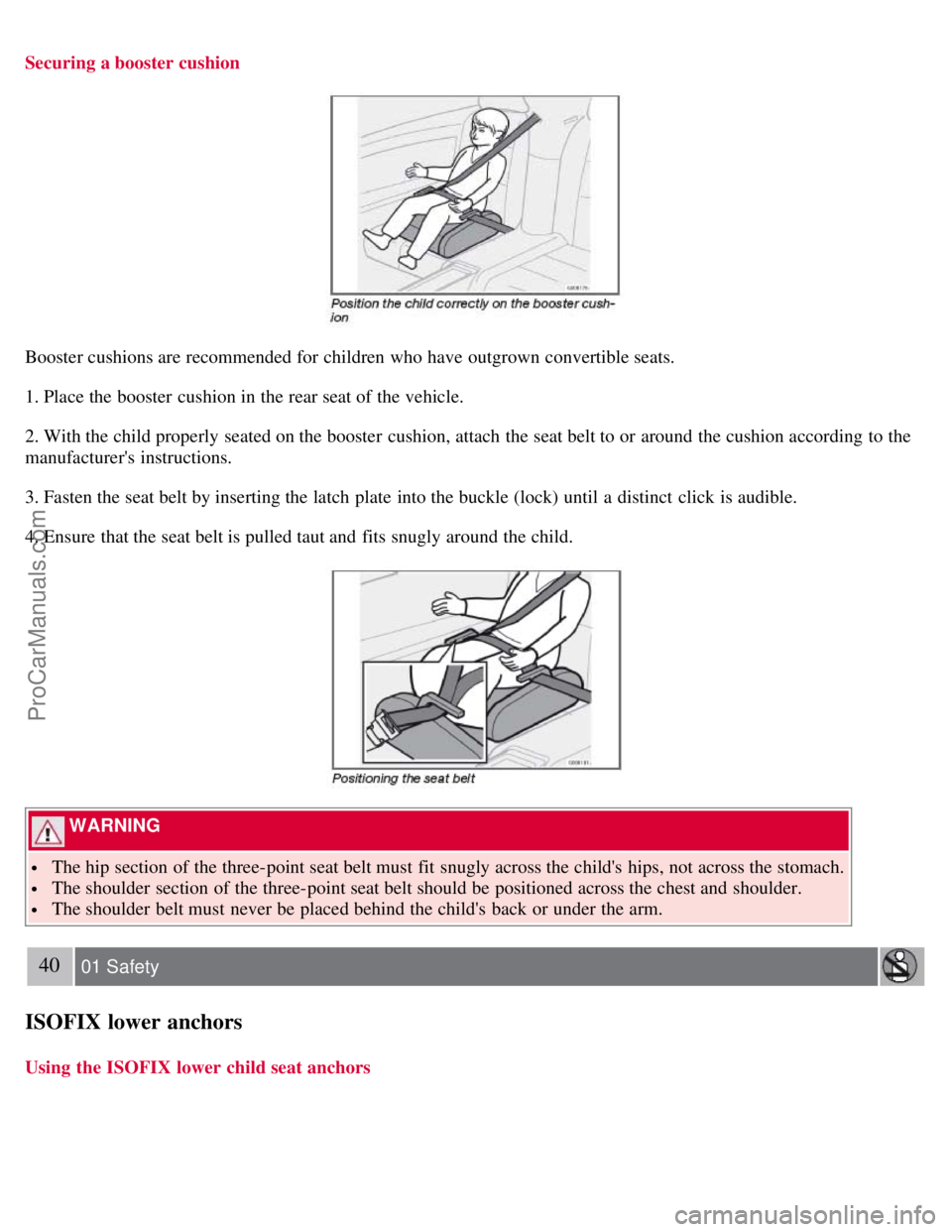
Securing a booster cushion
Booster cushions are recommended for children who have outgrown convertible seats.
1. Place the booster cushion in the rear seat of the vehicle.
2. With the child properly seated on the booster cushion, attach the seat belt to or around the cushion according to the
manufacturer's instructions.
3. Fasten the seat belt by inserting the latch plate into the buckle (lock) until a distinct click is audible.
4. Ensure that the seat belt is pulled taut and fits snugly around the child.
WARNING
The hip section of the three-point seat belt must fit snugly across the child's hips, not across the stomach.
The shoulder section of the three-point seat belt should be positioned across the chest and shoulder.
The shoulder belt must never be placed behind the child's back or under the arm.
40 01 Safety
ISOFIX lower anchors
Using the ISOFIX lower child seat anchors
ProCarManuals.com
Page 36 of 246
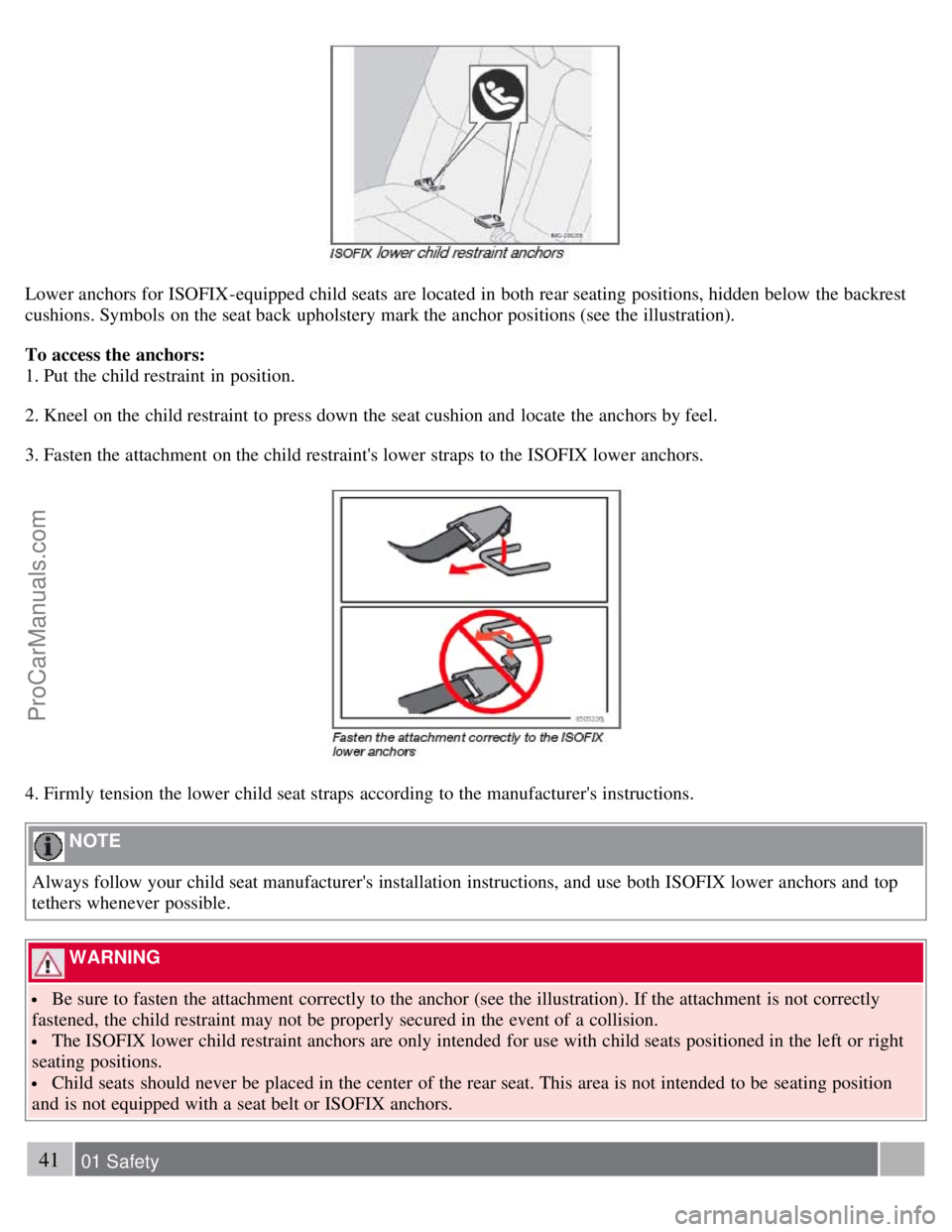
Lower anchors for ISOFIX-equipped child seats are located in both rear seating positions, hidden below the backrest
cushions. Symbols on the seat back upholstery mark the anchor positions (see the illustration).
To access the anchors:
1. Put the child restraint in position.
2. Kneel on the child restraint to press down the seat cushion and locate the anchors by feel.
3. Fasten the attachment on the child restraint's lower straps to the ISOFIX lower anchors.
4. Firmly tension the lower child seat straps according to the manufacturer's instructions.
NOTE
Always follow your child seat manufacturer's installation instructions, and use both ISOFIX lower anchors and top
tethers whenever possible.
WARNING
Be sure to fasten the attachment correctly to the anchor (see the illustration). If the attachment is not correctly
fastened, the child restraint may not be properly secured in the event of a collision.
The ISOFIX lower child restraint anchors are only intended for use with child seats positioned in the left or right
seating positions.
Child seats should never be placed in the center of the rear seat. This area is not intended to be seating position
and is not equipped with a seat belt or ISOFIX anchors.
41 01 Safety
ProCarManuals.com
Page 38 of 246

2 0 0 8
VOLVO C70
42 02 Instruments and controls
Instrument overview 44
Instrument panel47
Symbols - instrument panel50
Information display53
Lighting panel55
Left-side steering wheel lever57
Trip computer58
Right-side steering wheel lever60
Cruise control62
Steering wheel adjustment, Hazard warning flashers64
Parking brake65
12-volt sockets66
Power windows67
Mirrors68
Personal settings71
HomeLink® Universal Transceiver (option)73
43 02 Instruments and controls
44 02 Instruments and controls
Instrument overview
ProCarManuals.com
Page 40 of 246
25. Controls for climate system82
26. Hazard warning flashers.64
27. Door open handle, and locking button123
28. Glove compartment103
29. Gear selector, manual143
Gear selector, automatic144
30. Parking brake65
31. 12-volt socket66
32. Switches for raising/lowering the power retractable hard top96
46 02 Instruments and controls
Instrument overview
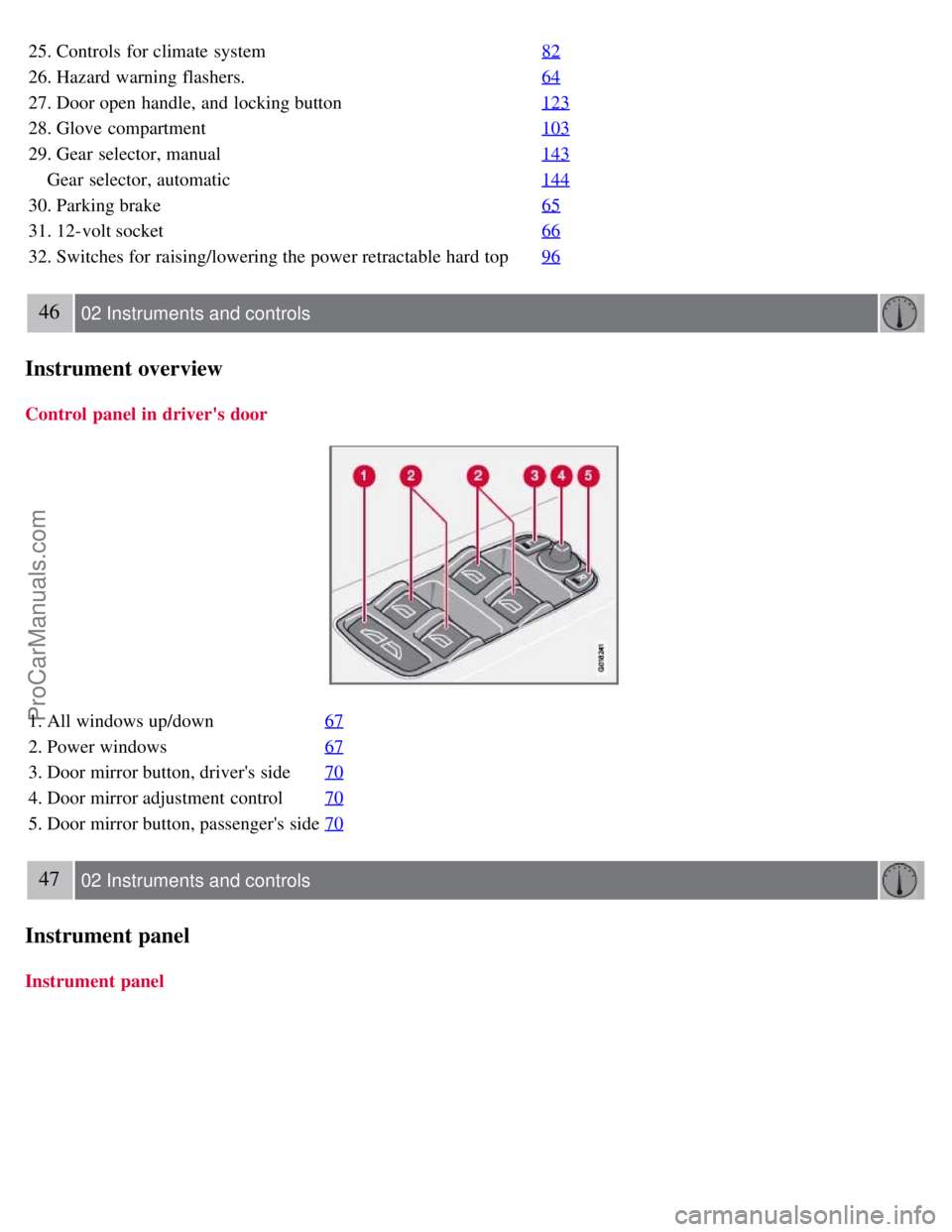
Control panel in driver's door
1. All windows up/down67
2. Power windows67
3. Door mirror button, driver's side70
4. Door mirror adjustment control70
5. Door mirror button, passenger's side70
47 02 Instruments and controls
Instrument panel
Instrument panel
ProCarManuals.com
Page 41 of 246

1. Speedometer
2. Turn signal, left
3. Warning symbol
See the following pages for additional information.
4. Information display
The display presents information and warning messages, the ambient temperature, etc. When the ambient temperature
is between 23° and 36°F (-5° and +2°C), a snowflake symbol is shown in the display. This symbol serves as a
warning for possible slippery road surfaces. Please note that this symbol does not indicate a fault with your car. At low
speeds, or when the car is not moving, the temperature readings may be slightly higher than the actual ambient
temperature.
5. Information symbol
See the following pages for additional information.
6. Turn signal, right
7. Tachometer
The tachometer shows engine speed in thousands of revolutions per minute (rpm). Do not drive continuously with the
needle in the red area of the dial, which indicates maximum allowable engine rpm range. Instead, shift to a higher gear
or slow the vehicle down. The engine management system will automatically prevent excessively high engines speeds.
This will be noticeable as a pronounced unevenness in engine speed.
8. Indicator and warning symbols
9. Fuel gauge (see page 256
for fuel tank volume). When a warning light in the gauge comes on, there are
approximately 2.1 US gallons (8 liters) of fuel remaining in the tank. For more information on fuel level and
consumption, see "Trip computer" on page 58
.
48 02 Instruments and controls
Instrument panel
10. Trip odometer reset button
The trip odometers are used to measure short distances. Press the button briefly to switch between the odometer for the
car's total mileage and the two trip odometers, T1 and T2. A long press (more than 2 seconds) resets the currently
selected trip odometer.
11. Function display
ProCarManuals.com