warning VOLVO C70 2013 Owner´s Manual
[x] Cancel search | Manufacturer: VOLVO, Model Year: 2013, Model line: C70, Model: VOLVO C70 2013Pages: 296, PDF Size: 7.18 MB
Page 202 of 296
07 Wheels and tires
Changing a wheel
07
200
NOTE
The jack provided with your vehicle is
intended to be used only in temporary sit-
uations such as changing wheels in the
event of a flat tire. Only the jack that came
with your particular model should be used
to lift the vehicle. If the vehicle needs to be
lifted more frequently or for a prolonged
period, using a garage jack or hoist is rec-
ommended. Always follow this device’s
instructions for use.
Installing the wheel
1. Clean the contact surfaces between the
wheel and hub.
2. Lift the wheel and place it on the hub.
3. Install the wheel nuts and hand-tighten
them. Using the lug wrench, tighten cross-
wise until all nuts are snug.
4. Lower the vehicle to the ground and alter-
nately tighten the bolts crosswise to
81 ft. lbs. (110 Nm) or 96 ft. lbs. (130 Nm),
depending on the type of wheel/wheel nuts
used on your vehicle. See also 198 for
additional information.
5. Install the wheel cover (where applicable).
See page 196 for information on returning the
jack and tools to their proper storage positions.On vehicles equipped with the tire sealing sys-
tem, the jack should be cranked down as far as
possible and returned to its storage position in
the foam block.
WARNING
The jack and any tools should always be
returned to their proper storage compart-
ments after use to help keep them securely
in place in the event of sudden braking, etc.
Page 203 of 296
07 Wheels and tires
Tire Pressure Monitoring System (TPMS)
07
201 Introduction
The tire pressure monitoring system1 uses sen-
sors mounted in the tire valves to check infla-
tion pressure levels. When the vehicle is mov-
ing at a speed of approximately 20 mph
(30 km/h) or faster, these sensors transmit
inflation pressure data to a receiver located in
the vehicle.
NOTE
USA – FCC ID: KR5S122780002
This device complies with part 15 of the
FCC rules. Operation is subject to the fol-
lowing conditions: (1) This device may not
cause harmful interference, and (2) this
device must accept any interference
received, including interference that may
cause undesired operation.
When low inflation pressure is detected, TPMS
will light up the tire pressure warning light
(also referred to as a telltale) in the instrument
panel and will display one of the following mes-
sages in the text window:
LOW TIRE PRESS.
CHECK TIRES or TIRE PRESSURE LOW.
NOTE
If a fault occurs in TPMS, the tire pressure
warning light will flash for approximately
1 minute and
TIRE PRESS SYST
SERVICE REQUIRED will be displayed.
Each tire, including the spare (if provided),
should be checked monthly when cold and
inflated to the inflation pressure recommended
by the vehicle manufacturer on the vehicle
placard or tire inflation pressure label. (If your
vehicle has tires of a different size than the size
indicated on the vehicle placard or tire inflation
pressure label, you should determine the
proper tire inflation pressure for those tires.)
As an added safety feature, your vehicle has
been equipped with a tire pressure monitoring
system (TPMS) that illuminates a low tire pres-
sure telltale when one or more of your tires is
significantly under-inflated. Accordingly, when
the low tire pressure telltale illuminates, you
should stop and check your tires as soon as
possible, and inflate them to the proper pres-
sure. Driving on a significantly under-inflated
tire causes the tire to overheat and can lead to
tire failure. Under-inflation also reduces fuel
efficiency and tire tread life, and may affect the
vehicle's handling and stopping ability.Please note that the TPMS is not a substitute
for proper tire maintenance, and it is the driv-
er's responsibility to maintain correct tire pres-
sure, even if under-inflation has not reached
the level to trigger illumination of the TPMS low
tire pressure telltale.
Your vehicle has also been equipped with a
TPMS malfunction indicator to indicate when
the system is not operating properly. The
TPMS malfunction indicator is combined with
the low tire pressure telltale . When the system
detects a malfunction, the telltale will flash for
approximately one minute and then remain
continuously illuminated. This sequence will
continue upon subsequent vehicle start-ups as
long as the malfunction exists. When the mal-
function indicator is illuminated, the system
may not be able to detect or signal low tire
pressure as intended. TPMS malfunctions may
occur for a variety of reasons, including the
installation of replacement or alternate tires or
wheels on the vehicle that prevent the TPMS
from functioning properly. Always check the
TPMS malfunction telltale after replacing one
or more tires or wheels on your vehicle to
ensure that the replacement or alternate tires
and wheels allow the TPMS to continue to
function properly.
1U.S. models only
Page 204 of 296
07 Wheels and tires
Tire Pressure Monitoring System (TPMS)
07
202
NOTE
•TPMS indicates low tire pressure but
does not replace normal tire mainte-
nance. For information on correct tire
pressure, please refer to the table on on
page 181, or consult your Volvo retailer.
•The tire pressure warning light will not
identify which tire is underinflated. Be
sure to check all four tires.
•A certain amount of air seepage from
the tires occurs naturally and tire pres-
sure fluctuates with seasonal changes
in temperature. Always check tire pres-
sure regularly.
Erasing warning messagesWhen a low tire pressure warning message has
been displayed, and the tire pressure warning
light has come on:
1. Use a tire pressure gauge to check the
inflation pressure of all four tires.
2. Re-inflate the tire(s) to the correct pressure
(consult the tire pressure placard or the
table, see page 181 ).
3. In certain cases, it may be necessary to
drive the vehicle for several minutes at a
speed of 20 mph (30 km/h) or faster. Thiswill erase the warning text and the warning
light will go out.
WARNING
Incorrect inflation pressure could lead to tire
failure, resulting in a loss of control of the
vehicle.
Changing wheels with TPMSPlease note the following when changing or
replacing the factory installed TPMS wheels/
tires on the vehicle:
•Only the factory-mounted wheels are
equipped with TPMS sensors in the valves.
•If the vehicle is equipped with a temporary
spare tire, this tire does not have a TPMS
sensor.
•If wheels without TPMS sensors are moun-
ted on the vehicle, TIRE PRESS SYST
SERVICE REQUIRED will be displayed
each time the vehicle is driven above
25 mph (40 km/h) for 10 minutes or more.
•Once TPMS sensors are properly installed,
the warning message should not reappear.
If the message is still displayed, drive the
vehicle for several minutes at a speed of
20 mph (30 km/h) or faster to erase the
message.
•Volvo recommends that TPMS sensors be
fitted on all wheels used on the vehicle.Volvo does not recommend moving sen-
sors back and forth between sets of
wheels.
NOTE
•If you change to tires with a different
recommended inflation pressure, the
TPMS system must be recalibrated to
these tires. This must be done by an
authorized Volvo retailer or workshop.
•If a tire is changed, or if the TPMS sen-
sor is moved to another wheel, the sen-
sor's seal, nut, and valve core should be
replaced.
•When installing TPMS sensors, the
vehicle must be parked for at least
15 minutes with the ignition off. If the
vehicle is driven within 15 minutes, a
TPMS error message will be displayed.
CAUTION
When inflating tires with TPMS valves, press
the pump's mouthpiece straight onto the
valve to help avoid bending or otherwise
damaging the valve.
Page 205 of 296
07 Wheels and tires
Tire Pressure Monitoring System (TPMS)
07
* Option/accessory, for more information, see Introduction.203 Self-supporting run flat tires (SST)*
Self-supporting run flat tires are available as
optional equipment. The vehicle must be
equipped with the Tire Pressure Monitoring
System (TPMS) if tires of this type are installed.
Tires of this type have specially reinforced
sidewalls that make it possible to continue
driving to a limited extent even though the tire
has lost some or all of its inflation pressure.
These tires are mounted on special rims (nor-
mal tires can also be mounted on these rims).
If an SST tire loses inflation pressure, the yel-
low TPMS symbol illuminates in the instrument
panel and a text message is also displayed. If
this happens, reduce speed to not more than
50 mph (80 km/h). The tire should be replaced
as soon as possible.
Drive carefully; it may be difficult to determine
which tire is damaged. To find the damaged
tire, check the inflation pressure in all four tires.WARNING
•SST tires should only be mounted by
service technicians who are familiar
with tires of this type.
•SST tires may only be mounted on vehi-
cles equipped with TPMS.
•Do not drive faster than 50 mph
(80 km/h) if TPMS indicates that a tire
has lost inflation pressure.
•Do not drive farther than 50 miles
(80 km) before replacing a damaged
SST tire.
•Drive carefully and avoid e.g., hard
braking or fast turns.
•SST tires must be replaced if they are
damaged. A tire of this type cannot be
repaired.
Page 209 of 296
08 Car care
Washing and cleaning the car
08
207
tant, especially in the winter. Some automatic
washers do not have facilities for washing the
underbody.
CAUTION
•Remove the antenna on the right rear
fender. This antenna should never be
bent in any way. Doing so could result
in damage or malfunction. When the
antenna is put back in position, turn it
carefully to help avoid damaging the
threads on the antenna's mount.
•Before driving into an automatic car
wash, turn off the optional rain sensor to
avoid damaging the windshield wipers.
•Make sure that side view mirrors, auxil-
iary lamps, etc, are secure.
•Chromed wheels: Clean chrome-
plated wheels using the same deter-
gents used for the body of the vehicle.
Aggressive wheel-cleaning agents can
permanently stain chrome-plated
wheels.
WARNING
•When the car is driven immediately after
being washed, apply the brakes several
times in order to remove any moisture
from the brake linings.
•Engine cleaning agents should not be
used when the engine is warm. This
constitutes a fire risk.
Exterior lightingCondensation may form temporarily on the
inside of the lenses of exterior lights such as
headlights, fog lights, or taillights. This is nor-
mal and the lights are designed to withstand
moisture. Normally, condensation will dissi-
pate after the lights have been on for a short
time.
Polishing and Waxing
•Normally, polishing is not required during
the first year after delivery, however, wax-
ing may be beneficial.
•Before applying polish or wax the vehicle
must be washed and dried. Tar spots can
be removed with kerosene or tar remover.
Difficult spots may require a fine rubbing
compound.
•After polishing use liquid or paste wax.
•Several commercially available products
contain both polish and wax.
•Waxing alone does not substitute for pol-
ishing a dull surface.
•A wide range of polymer-based waxes can
be purchased today. These waxes are easy
to use and produce a long-lasting, high-
gloss finish that protects the bodywork
against oxidation, road dirt and fading.
•Do not polish or wax your vehicle in direct
sunlight (the surface of the vehicle should
not be warmer than 113 °F (45 °C).
CAUTION
Volvo does not recommend the use of long-
life or durable paint protection coatings,
some of which may claim to prevent pitting,
fading, oxidation, etc. These coatings have
not been tested by Volvo for compatibility
with your vehicle's clear coat. Some of them
may cause the clear coat to soften, crack,
or cloud. Damage caused by application of
paint protection coatings may not be cov-
ered under your vehicle's paint warranty.
Page 219 of 296
09 Maintenance and servicing
Hood09
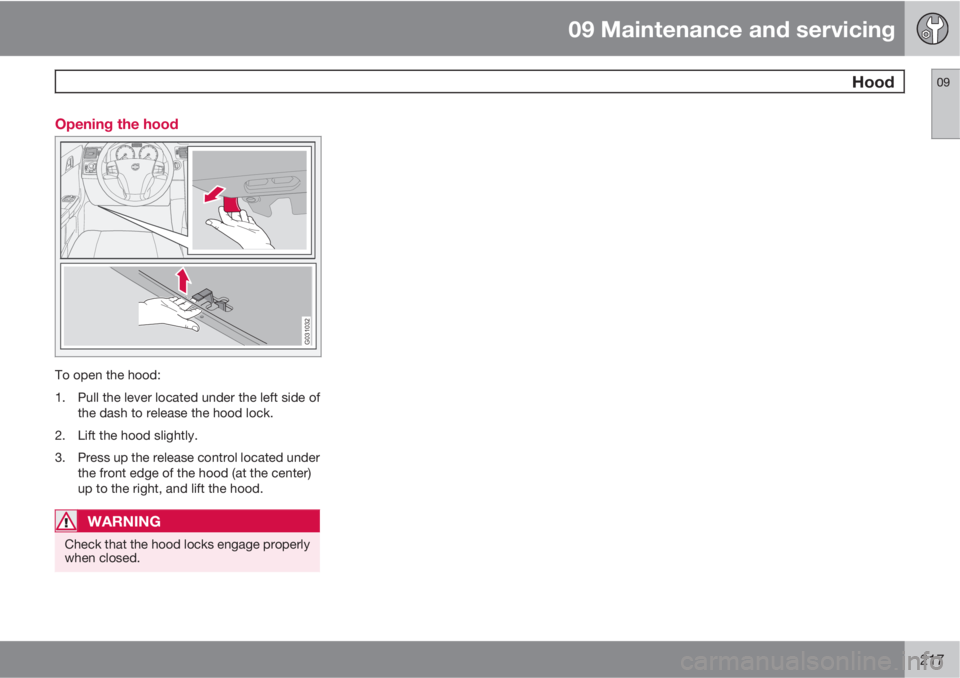
217 Opening the hood
G031032
To open the hood:
1. Pull the lever located under the left side of
the dash to release the hood lock.
2. Lift the hood slightly.
3. Press up the release control located under
the front edge of the hood (at the center)
up to the right, and lift the hood.
WARNING
Check that the hood locks engage properly
when closed.
Page 220 of 296
09 Maintenance and servicing
Engine compartment 09
218
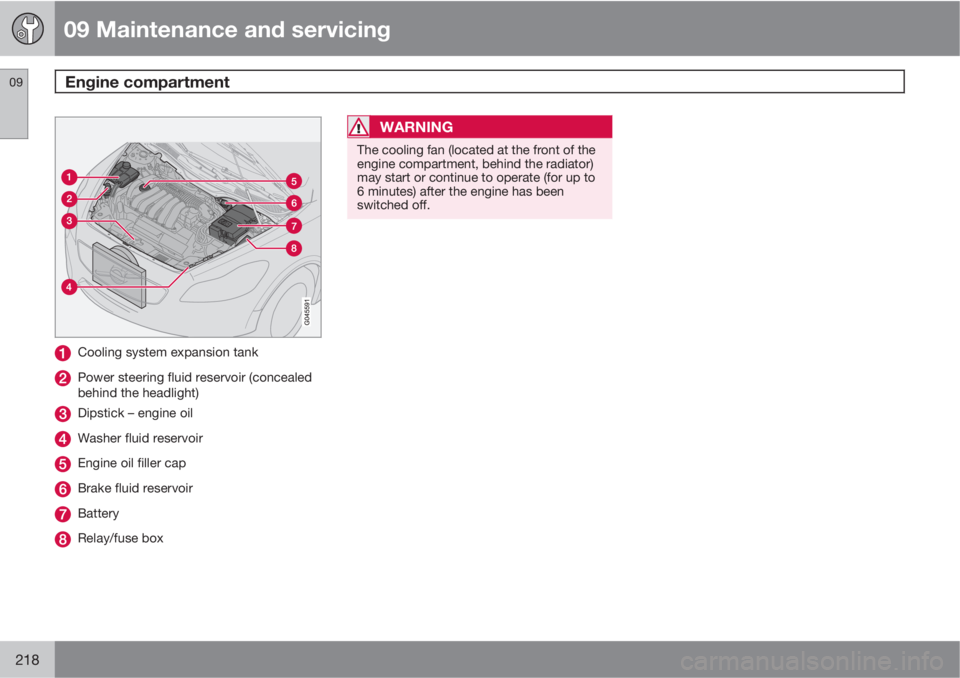
Cooling system expansion tank
Power steering fluid reservoir (concealed
behind the headlight)
Dipstick – engine oil
Washer fluid reservoir
Engine oil filler cap
Brake fluid reservoir
Battery
Relay/fuse box
WARNING
The cooling fan (located at the front of the
engine compartment, behind the radiator)
may start or continue to operate (for up to
6 minutes) after the engine has been
switched off.
Page 222 of 296
09 Maintenance and servicing
Engine oil 09
220
CAUTION
•Not checking the oil level regularly can
result in serious engine damage if the oil
level becomes too low.
•Oil that is lower than the specified qual-
ity can damage the engine.
•Always add oil of the same type and
viscosity as already used.
•Never fill oil above the MAX mark. This
could cause an increase in oil consump-
tion.
•Oil changes should be carried out by a
trained and qualified Volvo service tech-
nician.
WARNING
Do not allow oil to spill onto or come into
contact with hot exhaust pipe surfaces
NOTE
Volvo uses different systems to indicate a
low oil level or pressure. Some models have
an oil pressure sensor, in which case a
warning symbol (see page 58) is used to
indicate low oil pressure. Other models have
an oil level sensor, in which case the driver
is alerted by the warning symbol in the cen-
ter of the instrument panel and a text in the
information display. Some models use both
systems. Contact an authorized Volvo
retailer for more information.
Page 224 of 296
09 Maintenance and servicing
Fluids 09
222
WARNING
•Never remove the expansion tank cap
while the engine is warm. Wait until the
engine cools.
•If it is necessary to top off the coolant
when the engine is warm, unscrew the
expansion tank cap slowly so that the
overpressure dissipates.
Brake fluid
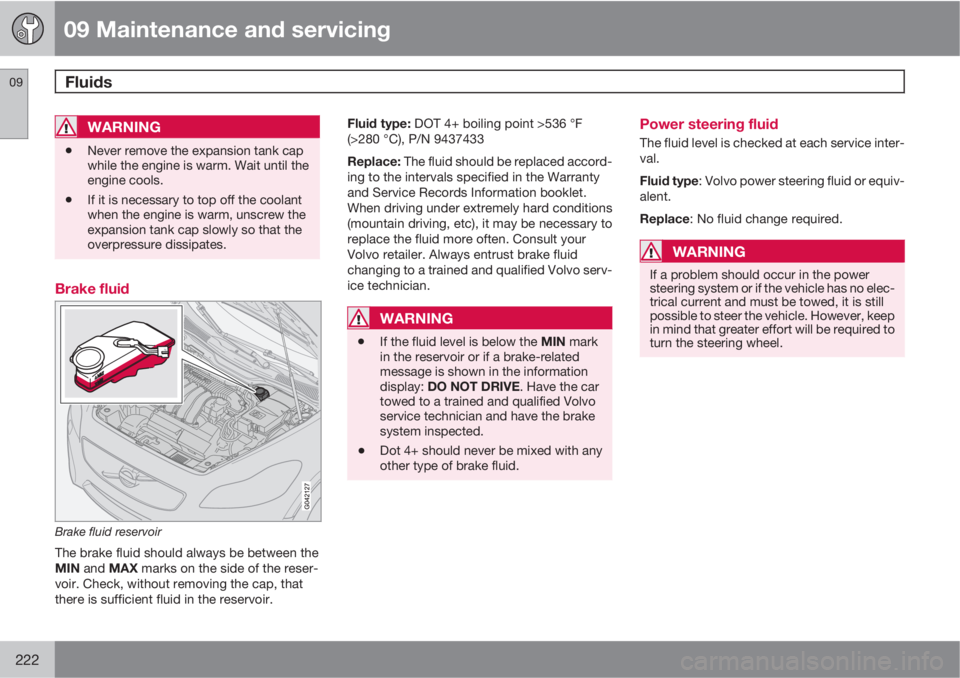
Brake fluid reservoir
The brake fluid should always be between the
MIN and MAX marks on the side of the reser-
voir. Check, without removing the cap, that
there is sufficient fluid in the reservoir.Fluid type: DOT 4+ boiling point >536 °F
(>280 °C), P/N 9437433
Replace: The fluid should be replaced accord-
ing to the intervals specified in the Warranty
and Service Records Information booklet.
When driving under extremely hard conditions
(mountain driving, etc), it may be necessary to
replace the fluid more often. Consult your
Volvo retailer. Always entrust brake fluid
changing to a trained and qualified Volvo serv-
ice technician.
WARNING
•If the fluid level is below the MIN mark
in the reservoir or if a brake-related
message is shown in the information
display: DO NOT DRIVE. Have the car
towed to a trained and qualified Volvo
service technician and have the brake
system inspected.
•Dot 4+ should never be mixed with any
other type of brake fluid.
Power steering fluid
The fluid level is checked at each service inter-
val.
Fluid type: Volvo power steering fluid or equiv-
alent.
Replace: No fluid change required.
WARNING
If a problem should occur in the power
steering system or if the vehicle has no elec-
trical current and must be towed, it is still
possible to steer the vehicle. However, keep
in mind that greater effort will be required to
turn the steering wheel.
Page 226 of 296
09 Maintenance and servicing
Battery 09
224
Battery maintenance
Driving habits and conditions, climate, the
number of starts, etc., all affect the service life
and function of the battery. In order for your
battery to perform satisfactorily, keep the fol-
lowing in mind:
Check the fluid level in each cell in the battery
every 24 months or every 15,000
1 miles
(24,000 km), whichever is sooner.
•Use a screw driver to open the caps or
cover and a flashlight to inspect the level.
•If necessary, add distilled water. The level
should never be above the indicator.
•The fluid level should be checked if the
battery has been recharged.
•After inspection, be sure the cap over each
battery cell or the cover is securely in
place.
•Check that the battery cables are correctly
connected and properly tightened.
•Never disconnect the battery when the
engine is running, or when the key is in the
ignition. This could damage the vehicle's
electrical system.
•The battery should be disconnected from
the vehicle when a battery charger is used
directly on the battery.
•To help keep the battery in good condition,
the vehicle should be driven for at least 15
minutes a week or connected to a charger
with an automatic charging function.
•If the battery is fully discharged a number
of times, this may shorten its service life.
Keeping the battery fully charged helps
prolong its service life.
•The service life of a battery is affected by
factors such as driving conditions and cli-
mate. Extreme cold may also further
decrease the battery’s starting capacity.
•Because the battery’s starting capacity
decreases with time, it may be necessary
to recharge it if the vehicle is not driven for
an extended period of time or if the vehicle
is usually only driven short distances.
•
WARNING
PROPOSITION 65 WARNING!
Battery posts, terminals, and related acces-
sories contain lead and lead compounds,
chemicals known to the state of California
to cause cancer and reproductive harm.
Wash hands after handling.
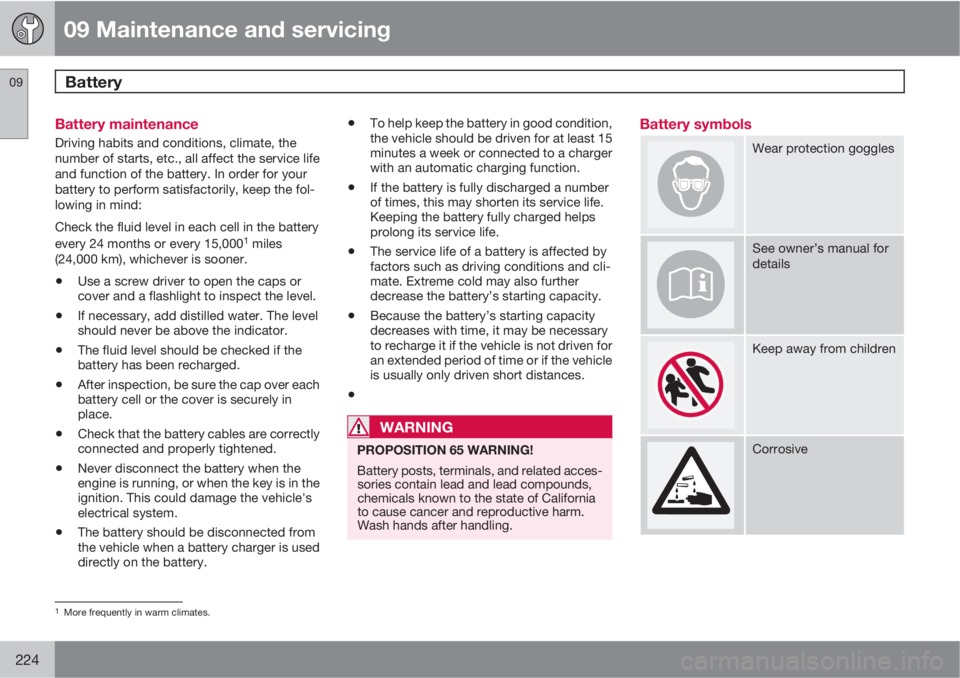
Battery symbols
Wear protection goggles
See owner’s manual for
details
Keep away from children
Corrosive
1More frequently in warm climates.